Matter in Motion
• Motion – object changes position over
  time relative to a reference point
• Speed – distance divided by time (units
  determined by problem (m/s, km/h)
• Average speed = total distance/total time
• Velocity – speed of an object in a
  particular direction
• Acceleration – the rate at which velocity
  changes (either direction or speed)
• Force – a push or pull (unit is newton N)
• Force applied does not mean motion will
  occur
• Net force – combination of all forces
  acting on an object
• Force in the same direction is always
  added, force in opposite directions is
  always subtracted
• Net force that equals 0 is balanced ( and
  no motion will take place) otherwise the
  net force is unbalanced and there will be
  motion
• Friction – force that opposes motion
• Static – not moving
• Gravity – force of attraction between two
  objects due to their mass
• Law of universal gravitation – relationship
  between gravitational force, mass and
  distance (Newton’s 3 laws of motion)
• Gravitational force increase as mass
  increases and gravitational force
  decreases when distance increases
• Weight – measure of the force of gravity
  on an object due to mass, changes with
  location to source of gravity
• Weight units are N (100 g = 1 N) NOT POUNDS
• Mass – amount of matter in an object (units kg)
• Objects have weight only if there is a source of
  gravity present, since all matter has mass, all
  objects will experience the force of gravity
  depending on the mass of the object and the
  distance from the source of gravity
• Formulas:
   – s =d / t (speed = distance divided by time)
   – d=s x t (distance = speed x time)
   – t=d / s (time = distance divided by speed)
• Weight units are N (100 g = 1 N) NOT POUNDS
• Mass – amount of matter in an object (units kg)
• Objects have weight only if there is a source of
  gravity present, since all matter has mass, all
  objects will experience the force of gravity
  depending on the mass of the object and the
  distance from the source of gravity
• Formulas:
   – s =d / t (speed = distance divided by time)
   – d=s x t (distance = speed x time)
   – t=d / s (time = distance divided by speed)

Speed, time, distance

  • 1.
    Matter in Motion •Motion – object changes position over time relative to a reference point • Speed – distance divided by time (units determined by problem (m/s, km/h) • Average speed = total distance/total time • Velocity – speed of an object in a particular direction • Acceleration – the rate at which velocity changes (either direction or speed)
  • 2.
    • Force –a push or pull (unit is newton N) • Force applied does not mean motion will occur • Net force – combination of all forces acting on an object • Force in the same direction is always added, force in opposite directions is always subtracted
  • 3.
    • Net forcethat equals 0 is balanced ( and no motion will take place) otherwise the net force is unbalanced and there will be motion • Friction – force that opposes motion • Static – not moving • Gravity – force of attraction between two objects due to their mass
  • 4.
    • Law ofuniversal gravitation – relationship between gravitational force, mass and distance (Newton’s 3 laws of motion) • Gravitational force increase as mass increases and gravitational force decreases when distance increases • Weight – measure of the force of gravity on an object due to mass, changes with location to source of gravity
  • 5.
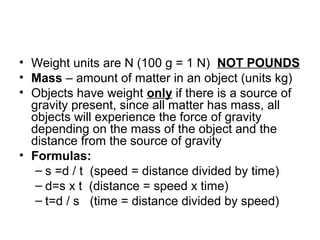
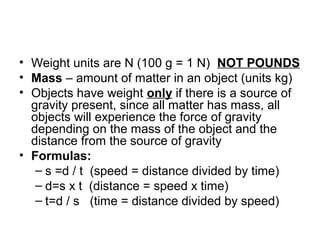
    • Weight unitsare N (100 g = 1 N) NOT POUNDS • Mass – amount of matter in an object (units kg) • Objects have weight only if there is a source of gravity present, since all matter has mass, all objects will experience the force of gravity depending on the mass of the object and the distance from the source of gravity • Formulas: – s =d / t (speed = distance divided by time) – d=s x t (distance = speed x time) – t=d / s (time = distance divided by speed)
  • 6.
    • Weight unitsare N (100 g = 1 N) NOT POUNDS • Mass – amount of matter in an object (units kg) • Objects have weight only if there is a source of gravity present, since all matter has mass, all objects will experience the force of gravity depending on the mass of the object and the distance from the source of gravity • Formulas: – s =d / t (speed = distance divided by time) – d=s x t (distance = speed x time) – t=d / s (time = distance divided by speed)