History of Evolution
• 1831, Darwin, naturalist on H.M.S. Beagle
• Galapagos, Coast of S. America
• Darwin (1831) – naturalist who proposed the
theory of evolution (1859) On the Origin of
Species
• James Hutton(1785)– earth is millions, not
thousands of years old
• Thomas Malthus (1798) – predicted that the
population of earth would exceed it’s resources
Cont.
• Jean-Baptiste Lamarck(1809) – proposed that
inheritance was acquired (1st
mechanism for
organisms changing over time)
• Charles Lyell (1833)- proposed that the process
occurring now have shaped the earth for long
periods of time; published Principles of Geology
• Alfred Wallace (1858)– contemporary of Darwin,
speculated on evolution through natural
selection
Theory of Evolution
• Fitness – individuals ability to survive and
reproduce in it’s environment
• Adaptation – inherited traits/characteristics
that increase the chance of survival
• Artificial selection – humans manipulate
traits
• Natural selection – inherited over time by
the process of nature (cannot be seen
directly)
• Over time organisms produce different
structures, establish different niches, or
occupy different habitats – descent with
modification
• Fossil record supported Darwin’s theory
• Fossil record shows how species have
changed overtime or died
Formation of Earth
• 4.6 billion years old (universe 15 billion)
• Elements arranged themselves by
densities creating the planet (radioactive
decay creates heat, core heaviest metals)
least dense formed early atmosphere (H
and N)
• Atmosphere was toxic to life as we knew it
(it was what we didn’t know could exist in
this environment, cyanobacteria)
Cont.
• 3.8 billion, earth cooled enough to allow
water to remain liquid, creating rain
• Under these conditions, organic
compounds were formed (building blocks
for life)
• DNA is transcribed into RNA then
translated into proteins
Oxygen-evolution
• 2.2 billion increase in oxygen allowed
organisms to evolve (move from water to
land)
• 2 billion eukaryotic cells (nucleus)
appeared, endosymbiotic theory proposes
that eukaryotes evolved from prokaryotic
communities
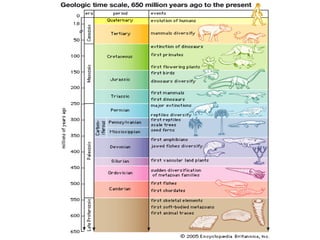
Geologic Time Scale
Cont.
• 90% of earths history occurred during
Precambrian (life only existed in the water)
• Paleozoic Era – abundance of marine life
• Cambrian – hard parts appear, most
animal phyla evolve
• Devonian – vertebrates appear
• Mass extinction occurs
• Mesozoic Era – rise of dinosaurs and
flowering plants
Cont.
• Jurassic – dino’s ruled the earth for 150
million yrs.
• Cretaceous – leafy trees, shrubs, flying
birds, large reptiles still dominant earth
• Mass extinction (meteor) wipes out half of
all plant and animal groups (including all of
the dino’s)
• Cenozoic Era – animals evolve adaptation
for land, water and air
Pattern of Evolution
• 99% of all species that have lived are now
extinct.
• Macroevolution – large scale evolutionary
patterns and processes that occur over long
periods of time
• 6 specific areas of macroevolution – extinction,
adaptive radiation, convergent evolution,
coevolution, punctuated equilibrium, and
changes in developmental genes

Evolution

  • 1.
    History of Evolution •1831, Darwin, naturalist on H.M.S. Beagle • Galapagos, Coast of S. America • Darwin (1831) – naturalist who proposed the theory of evolution (1859) On the Origin of Species • James Hutton(1785)– earth is millions, not thousands of years old • Thomas Malthus (1798) – predicted that the population of earth would exceed it’s resources
  • 2.
    Cont. • Jean-Baptiste Lamarck(1809)– proposed that inheritance was acquired (1st mechanism for organisms changing over time) • Charles Lyell (1833)- proposed that the process occurring now have shaped the earth for long periods of time; published Principles of Geology • Alfred Wallace (1858)– contemporary of Darwin, speculated on evolution through natural selection
  • 3.
    Theory of Evolution •Fitness – individuals ability to survive and reproduce in it’s environment • Adaptation – inherited traits/characteristics that increase the chance of survival • Artificial selection – humans manipulate traits • Natural selection – inherited over time by the process of nature (cannot be seen directly)
  • 4.
    • Over timeorganisms produce different structures, establish different niches, or occupy different habitats – descent with modification • Fossil record supported Darwin’s theory • Fossil record shows how species have changed overtime or died
  • 5.
    Formation of Earth •4.6 billion years old (universe 15 billion) • Elements arranged themselves by densities creating the planet (radioactive decay creates heat, core heaviest metals) least dense formed early atmosphere (H and N) • Atmosphere was toxic to life as we knew it (it was what we didn’t know could exist in this environment, cyanobacteria)
  • 6.
    Cont. • 3.8 billion,earth cooled enough to allow water to remain liquid, creating rain • Under these conditions, organic compounds were formed (building blocks for life) • DNA is transcribed into RNA then translated into proteins
  • 7.
    Oxygen-evolution • 2.2 billionincrease in oxygen allowed organisms to evolve (move from water to land) • 2 billion eukaryotic cells (nucleus) appeared, endosymbiotic theory proposes that eukaryotes evolved from prokaryotic communities
  • 8.
  • 9.
    Cont. • 90% ofearths history occurred during Precambrian (life only existed in the water) • Paleozoic Era – abundance of marine life • Cambrian – hard parts appear, most animal phyla evolve • Devonian – vertebrates appear • Mass extinction occurs • Mesozoic Era – rise of dinosaurs and flowering plants
  • 10.
    Cont. • Jurassic –dino’s ruled the earth for 150 million yrs. • Cretaceous – leafy trees, shrubs, flying birds, large reptiles still dominant earth • Mass extinction (meteor) wipes out half of all plant and animal groups (including all of the dino’s) • Cenozoic Era – animals evolve adaptation for land, water and air
  • 11.
    Pattern of Evolution •99% of all species that have lived are now extinct. • Macroevolution – large scale evolutionary patterns and processes that occur over long periods of time • 6 specific areas of macroevolution – extinction, adaptive radiation, convergent evolution, coevolution, punctuated equilibrium, and changes in developmental genes