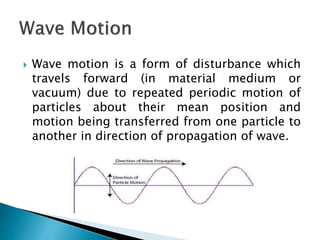
 Wave motion is a form of disturbance which
travels forward (in material medium or
vacuum) due to repeated periodic motion of
particles about their mean position and
motion being transferred from one particle to
another in direction of propagation of wave.
Mechanical or Elastic Waves:
 They compulsorily require material
medium for propagation. For e.g. Sound
Waves, Water Waves (Ripples), Waves in
Strings and Ropes
 The medium in which mechanical waves
propagate must possess inertia and elasticity
(so that particle can come to its original
position & shape also can transfer its energy
to next particle)
Electromagnetic Waves
 The waves which do not require material
medium for their propagation and can travel
in vacuum. For e.g. Radio Waves, Microwaves,
X rays.
Remember
Wave Motion is just the transfer of energy not
te transfer of matter.
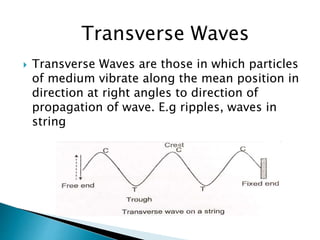
 Transverse Waves are those in which particles
of medium vibrate along the mean position in
direction at right angles to direction of
propagation of wave. E.g ripples, waves in
string
Transverse Waves
 Transverse Waves are those in which particles
of medium vibrate back and forth along the
mean position along the direction of
propagation of wave. E.g Sound Waves, Waves
produced in spring
 Wavelength
 Amplitude
 Frequency
 Wave Velocity
 Crest
 Trough
 Compression
 Rarefaction
For detailed definition of all
terms refer book.
 Features of Longitudinal Waves
 Features of Transverse Waves
 Difference between Longitudinal and
Transverse Waves
 Sound Waves and their properties
 Light Waves and their properties
 Numerical to be practiced on formulae v = nλ
v= wave velocity, n= frequency, λ =
wavelength
 Periodic Motion: A Motion which repeats itself
after certain interval of time. E.g. Pulse beat,
Pendulum of clock, Rotation of earth around its
axis.
 Oscillatory Motion: Any back and forth motion
which equal intervals of time about fixed time.
E.g. Vibrations of strings on musical
instruments, oscillations of mass about spring.
 Remember every oscillatory motion is periodic
but every periodic motion is not oscillatory
 A body is said to execute SHM if its
acceleration is directly proportional to its
displacement from a fixed point (mean
position) and always directed to that point.
E.g. Motion of piston of engine, Vibrations of
prongs of tuning fork.
 Harmonic Oscillator: A body which executes
SHM.
 Displacement, y: The distance travelled by
vibrating particle from its mean position.
 Amplitude, A: Maximum displacement of
particle from mean position.
 Time period, T: Time taken by particle to
move from mean to one extreme position and
back to mean position.
 Frequency, n: Number of Vibrations
completed by particle per second. Units
Hertz, per sec.
 Angular velocity, ω: Rate of change of
angular displacement, ϴ. Units radians/sec
 Phase: State of particle with respect to its
mean position (means how much angle it is
away from mean position)
 Phase Difference: The difference is phases of
two particles oscillating at any instant of
time.
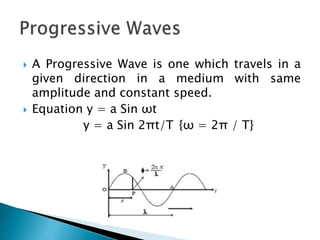
 A Progressive Wave is one which travels in a
given direction in a medium with same
amplitude and constant speed.
 Equation y = a Sin ωt
y = a Sin 2πt/T {ω = 2π / T}
 The redistribution of energy in medium when two
or more waves arrive at a point at same instant of
time.
 Principle of Superposition of Waves: If two or
more waves are moving through medium then
resultant displacement at any point is algebraic
sum of the displacement
 Two waves of same frequency moving in
same direction result in interference.
 Two waves of same frequency moving in
opposite direction produce stationary waves.
 Two waves of slightly different frequencies
moving in same direction give rise to beats.
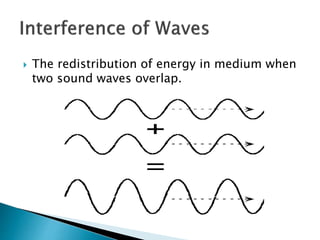
 The redistribution of energy in medium when
two sound waves overlap.
 Constructive Interference: The redistribution
of energy when two waves in same phase
superimpose upon each other.
 Destructive Interference: The redistribution of
energy when two waves in opposite phase
superimpose upon each other.
 When two identical waves travel through a
medium along the same line in opposite
directions, they superimpose on each other
give rise to new types of waves which appear
to be stationary in space.
 Topics to be done Characteristics of
Stationary Waves.
 Comparison between Progressive and
Stationary Waves
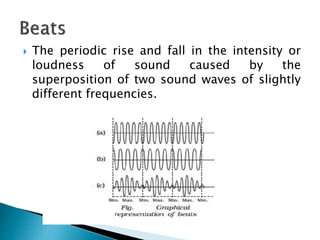
 The periodic rise and fall in the intensity or
loudness of sound caused by the
superposition of two sound waves of slightly
different frequencies.
 Read and memorize the definitions with
examples of above mentioned types of
vibrations.
 Mathematical part of SHM will be discussed.

Wave motion and its applications

  • 2.
     Wave motionis a form of disturbance which travels forward (in material medium or vacuum) due to repeated periodic motion of particles about their mean position and motion being transferred from one particle to another in direction of propagation of wave.
  • 3.
    Mechanical or ElasticWaves:  They compulsorily require material medium for propagation. For e.g. Sound Waves, Water Waves (Ripples), Waves in Strings and Ropes  The medium in which mechanical waves propagate must possess inertia and elasticity (so that particle can come to its original position & shape also can transfer its energy to next particle)
  • 4.
    Electromagnetic Waves  Thewaves which do not require material medium for their propagation and can travel in vacuum. For e.g. Radio Waves, Microwaves, X rays. Remember Wave Motion is just the transfer of energy not te transfer of matter.
  • 5.
     Transverse Wavesare those in which particles of medium vibrate along the mean position in direction at right angles to direction of propagation of wave. E.g ripples, waves in string Transverse Waves
  • 6.
     Transverse Wavesare those in which particles of medium vibrate back and forth along the mean position along the direction of propagation of wave. E.g Sound Waves, Waves produced in spring
  • 7.
     Wavelength  Amplitude Frequency  Wave Velocity  Crest  Trough  Compression  Rarefaction
  • 8.
    For detailed definitionof all terms refer book.
  • 9.
     Features ofLongitudinal Waves  Features of Transverse Waves  Difference between Longitudinal and Transverse Waves  Sound Waves and their properties  Light Waves and their properties  Numerical to be practiced on formulae v = nλ v= wave velocity, n= frequency, λ = wavelength
  • 10.
     Periodic Motion:A Motion which repeats itself after certain interval of time. E.g. Pulse beat, Pendulum of clock, Rotation of earth around its axis.  Oscillatory Motion: Any back and forth motion which equal intervals of time about fixed time. E.g. Vibrations of strings on musical instruments, oscillations of mass about spring.  Remember every oscillatory motion is periodic but every periodic motion is not oscillatory
  • 11.
     A bodyis said to execute SHM if its acceleration is directly proportional to its displacement from a fixed point (mean position) and always directed to that point. E.g. Motion of piston of engine, Vibrations of prongs of tuning fork.
  • 12.
     Harmonic Oscillator:A body which executes SHM.  Displacement, y: The distance travelled by vibrating particle from its mean position.  Amplitude, A: Maximum displacement of particle from mean position.  Time period, T: Time taken by particle to move from mean to one extreme position and back to mean position.
  • 13.
     Frequency, n:Number of Vibrations completed by particle per second. Units Hertz, per sec.  Angular velocity, ω: Rate of change of angular displacement, ϴ. Units radians/sec  Phase: State of particle with respect to its mean position (means how much angle it is away from mean position)  Phase Difference: The difference is phases of two particles oscillating at any instant of time.
  • 15.
     A ProgressiveWave is one which travels in a given direction in a medium with same amplitude and constant speed.  Equation y = a Sin ωt y = a Sin 2πt/T {ω = 2π / T}
  • 16.
     The redistributionof energy in medium when two or more waves arrive at a point at same instant of time.  Principle of Superposition of Waves: If two or more waves are moving through medium then resultant displacement at any point is algebraic sum of the displacement
  • 17.
     Two wavesof same frequency moving in same direction result in interference.  Two waves of same frequency moving in opposite direction produce stationary waves.  Two waves of slightly different frequencies moving in same direction give rise to beats.
  • 18.
     The redistributionof energy in medium when two sound waves overlap.
  • 19.
     Constructive Interference:The redistribution of energy when two waves in same phase superimpose upon each other.  Destructive Interference: The redistribution of energy when two waves in opposite phase superimpose upon each other.
  • 21.
     When twoidentical waves travel through a medium along the same line in opposite directions, they superimpose on each other give rise to new types of waves which appear to be stationary in space.
  • 22.
     Topics tobe done Characteristics of Stationary Waves.  Comparison between Progressive and Stationary Waves
  • 23.
     The periodicrise and fall in the intensity or loudness of sound caused by the superposition of two sound waves of slightly different frequencies.
  • 24.
     Read andmemorize the definitions with examples of above mentioned types of vibrations.  Mathematical part of SHM will be discussed.