SM09:WAVES&OPTICS
MR. MARVIN N. BUSTAMANTE
Course Description
This course provides an in-depth
exploration of waves and optics,
focusing on their fundamental
principles and applications.
Students will develop a deep
understanding of wave
behavior, including reflection,
refraction, interference, and
diffraction.
Course Description
The course will also cover the
properties and behaviors of
light, as well as optical
instruments and their use in
various scientific fields.
Emphasis will be placed on
developing practical skills and
applying theoretical concepts to
real-world scenarios.
COURSE
OBJECTIVES
Understand the fundamental principles of
wave behavior and its applications.
Analyze and interpret optical phenomena
using mathematical models.
Develop practical skills in using optical
instruments and conducting experiments.
Apply wave and optical concepts to solve
real-world problems.
Improve critical thinking and problem-
solving abilities through scientific inquiry.
Enhance communication skills through
presentations and discussions.
COURSE
OUTLINE
• Properties of waves
• Wave terminology and concepts
• Wave equation and mathematical representations
Introduction to Waves
• Reflection and refraction
• Interference and superposition
• Diffraction and polarization
• Doppler effect
Wave Behavior
• Laws of reflection and refraction
• Ray tracing and image formation
• Lens and mirror systems
• Optical instruments: telescopes, microscopes, etc.
Geometric Optics
• Huygens' principle
• Young's double-slit experiment
• Interference patterns and colors
• Diffraction gratings and interference filters
Wave Optics
• Polarization of light
• Polarizers and applications
• Laser principles and applications
Polarization and Lasers
• Scattering and absorption
• Dispersion and prisms
• Optical fibers and communication
Optical Phenomena
COURSE
OUTLINE
• Spectroscopy and spectrometers
• Interferometry and its applications
• Optics in medical imaging
• Optics in astronomy
Optical Instruments and Techniques
• Optics in information technology
• Optics in materials science
• Optics in environmental monitoring
• Optics in biotechnology and medicine
Applications of Waves and Optics
• Students will choose a topic of interest and
conduct a research project related to waves and
optics. They will present their findings to the
class.
Wave and Optics Research Projects
COURSE
OUTLINE
CLASS
RULES
Attend all classes
and arrive on time.
Participate actively
in class discussions
and activities.
Respect the
instructor and
fellow classmates.
Keep electronic
devices silenced
and put away
during class.
Follow laboratory
safety guidelines
during
experiments.
Complete assigned
readings and
homework on time.
Use professional
language and
behavior during
class.
Raise your hand to
ask questions or
contribute to
discussions.
Be responsible for
your own learning
and seek help when
needed.
Submit all
assignments and
exams by the
specified deadlines.
LESSON1:
INTRODUCTIONTO
WAVES
LET’S THINK & SHARE
WHAT ARE SOME
EXAMPLES OF WAVES IN
EVERYDAY LIFE?
HOW DO WAVES TRAVEL
FROM ONE PLACE TO
ANOTHER?
HOW CAN WE DESCRIBE
THE PROPERTIES OF
WAVES?
Waves
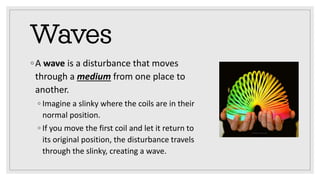
◦A wave is a disturbance that moves
through a medium from one place to
another.
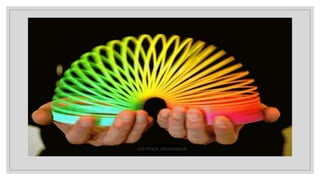
◦ Imagine a slinky where the coils are in their
normal position.
◦ If you move the first coil and let it return to
its original position, the disturbance travels
through the slinky, creating a wave.
Medium
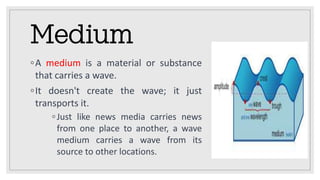
◦A medium is a material or substance
that carries a wave.
◦It doesn't create the wave; it just
transports it.
◦Just like news media carries news
from one place to another, a wave
medium carries a wave from its
source to other locations.
Categories of Waves
◦ Waves can be categorized into different types based
on their behavior and the medium they travel
through.
Behavior-based Categories:
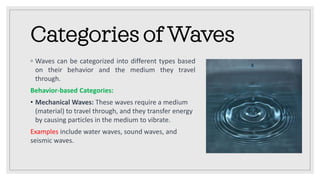
• Mechanical Waves: These waves require a medium
(material) to travel through, and they transfer energy
by causing particles in the medium to vibrate.
Examples include water waves, sound waves, and
seismic waves.
Categories of Waves
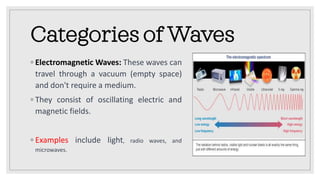
◦ Electromagnetic Waves: These waves can
travel through a vacuum (empty space)
and don't require a medium.
◦ They consist of oscillating electric and
magnetic fields.
◦ Examples include light, radio waves, and
microwaves.
Categories of Waves
Electromagnetic Waves
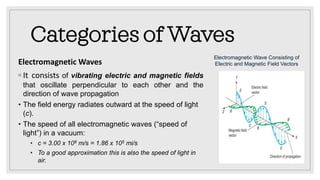
◦ It consists of vibrating electric and magnetic fields
that oscillate perpendicular to each other and the
direction of wave propagation
• The field energy radiates outward at the speed of light
(c).
• The speed of all electromagnetic waves (“speed of
light”) in a vacuum:
• c = 3.00 x 10⁸ m/s = 1.86 x 10⁵ mi/s
• To a good approximation this is also the speed of light in
air.
Electromagnetic Wave Consisting of
Electric and Magnetic Field Vectors
Categories of Waves
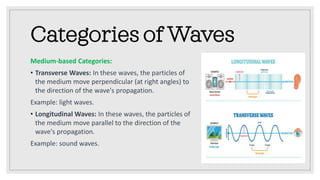
Medium-based Categories:
• Transverse Waves: In these waves, the particles of
the medium move perpendicular (at right angles) to
the direction of the wave's propagation.
Example: light waves.
• Longitudinal Waves: In these waves, the particles of
the medium move parallel to the direction of the
wave's propagation.
Example: sound waves.
Visible Light
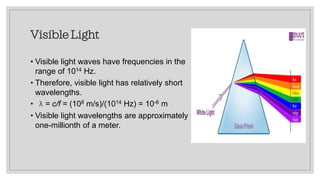
• Visible light waves have frequencies in the
range of 1014 Hz.
• Therefore, visible light has relatively short
wavelengths.
• λ = c/f = (108 m/s)/(1014 Hz) = 10-6 m
• Visible light wavelengths are approximately
one-millionth of a meter.
Visible Light
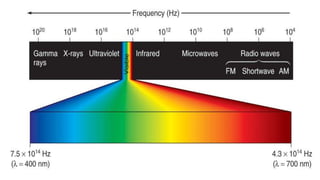
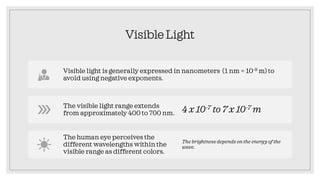
Visible light is generally expressed in nanometers (1 nm = 10-9 m) to
avoid using negative exponents.
The visible light range extends
from approximately 400 to 700 nm. 4 x 10⁻⁷ to 7 x 10⁻⁷ m
The human eye perceives the
different wavelengths within the
visible range as different colors.
The brightness depends on the energy of the
wave.
Sound Waves
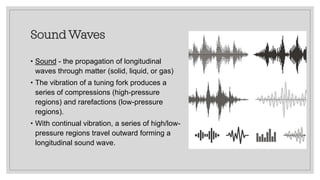
• Sound - the propagation of longitudinal
waves through matter (solid, liquid, or gas)
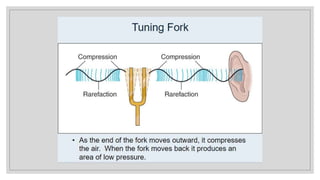
• The vibration of a tuning fork produces a
series of compressions (high-pressure
regions) and rarefactions (low-pressure
regions).
• With continual vibration, a series of high/low-
pressure regions travel outward forming a
longitudinal sound wave.
Sound Spectrum
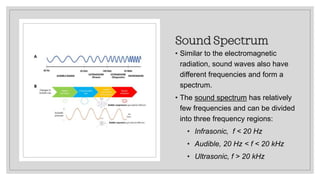
• Similar to the electromagnetic
radiation, sound waves also have
different frequencies and form a
spectrum.
• The sound spectrum has relatively
few frequencies and can be divided
into three frequency regions:
• Infrasonic, f < 20 Hz
• Audible, 20 Hz < f < 20 kHz
• Ultrasonic, f > 20 kHz
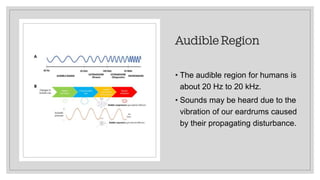
Audible Region
• The audible region for humans is
about 20 Hz to 20 kHz.
• Sounds may be heard due to the
vibration of our eardrums caused
by their propagating disturbance.
Loudness or Intensity
• Loudness is a relative term.
• The term intensity (I) is quantitative and is a measure of the
rate of energy transfer through a given area.
• Intensity is measured in J/s/m2 or W/m2.
• The threshold of hearing is around 10-12 W/m2.
• An intensity of about 1 W/m2 is painful to the ear.
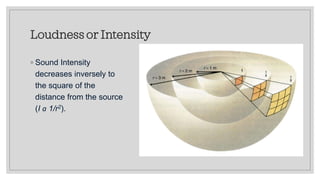
• Intensity decreases with distance from the source (I a 1/r2).
Loudness or Intensity
◦ Sound Intensity
decreases inversely to
the square of the
distance from the source
(I a 1/r2).
Decibel Scale
•Sound Intensity is measured on the decibel scale.
•A decibel is 1/10 of a bel.
• The bel (B) is a unit of intensity named in honor of Alexander
Graham Bell.
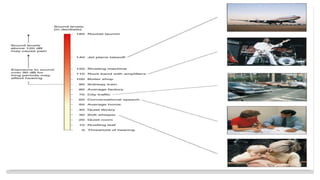
•The decibel scale is not linear with respect to intensity,
therefore when the sound intensity is doubled, the dB
level is only increased by 3 dB.
Decibel
Scale
Ultrasound
• Sound waves with frequencies greater than 20,000 Hz cannot be
detected by the human ear, although may be detected by some
animals (for example dog whistles).
• The reflections of ultrasound frequencies are used to examine
parts of the body, or an unborn child – much less risk than using
x-rays.
• Also useful in cleaning small hard-to-reach recesses – jewelry, lab
equipment, etc.
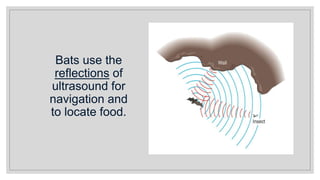
Bats use the
reflections of
ultrasound for
navigation and
to locate food.
Speed of Sound
• The speed of sound depends on the makeup of the particular medium that it is
passing through.
• The speed of sound in air is considered to be, vsound = 344 m/s or 770 mi/h (at
20oC).
• Approximately 1/3 km/s or 1/5 mi/s
• The velocity of sound increases with increasing temperature. (at 0oC = 331
m/s)
• In general, the velocity of sound increases as the density of the medium
increases. (The speed of sound in water is about 4x that in air.)
Sound
• The speed of light is MUCH faster. So, in many cases, we
see something before we hear it (lightning/thunder, echo,
etc.).
• A 5-second lapse between seeing lightning and hearing the
thunder indicates that the lightning occurs at approximately 1
mile.
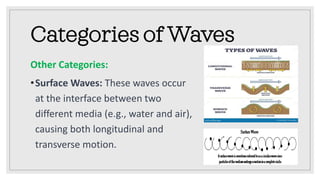
Categories of Waves
Other Categories:
•Surface Waves: These waves occur
at the interface between two
different media (e.g., water and air),
causing both longitudinal and
transverse motion.
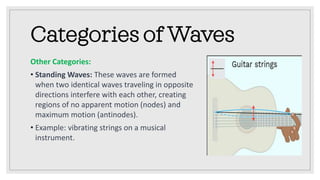
Categories of Waves
Other Categories:
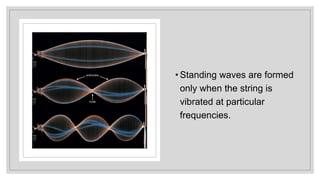
• Standing Waves: These waves are formed
when two identical waves traveling in opposite
directions interfere with each other, creating
regions of no apparent motion (nodes) and
maximum motion (antinodes).
• Example: vibrating strings on a musical
instrument.
• Standing waves are formed
only when the string is
vibrated at particular
frequencies.
Resonance
• Resonance - a wave effect that occurs when an object has a
natural frequency that corresponds to an external frequency.
• Results from a periodic driving force with a frequency equal to one
of the natural frequencies.
• Common example of resonance: Pushing a swing – the
periodic driving force (the push) must be at a certain
frequency to keep the swing going
Resonance
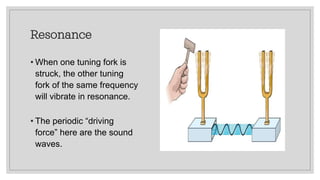
• When one tuning fork is
struck, the other tuning
fork of the same frequency
will vibrate in resonance.
• The periodic “driving
force” here are the sound
waves.
Musical Instruments
• Musical Instruments use standing waves and resonance to produce
different tones.
• Guitars, violins, and pianos all use standing waves to produce tones.
• Stringed instruments are tuned by adjusting the tension of the strings.
• Adjustment of the tension changes the frequency at which the string vibrates.
• The body of the stringed instrument acts as a resonance cavity to
amplify the sound.
Particle-to-Particle Interaction
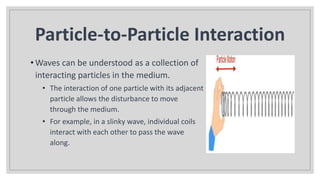
• Waves can be understood as a collection of
interacting particles in the medium.
• The interaction of one particle with its adjacent
particle allows the disturbance to move
through the medium.
• For example, in a slinky wave, individual coils
interact with each other to pass the wave
along.
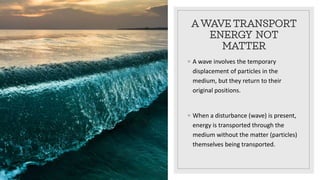
A WAVE TRANSPORT
ENERGY NOT
MATTER
◦ A wave involves the temporary
displacement of particles in the
medium, but they return to their
original positions.
◦ When a disturbance (wave) is present,
energy is transported through the
medium without the matter (particles)
themselves being transported.
Properties of Waves
◦ Waves come in an incredible array of forms, but they all share core
properties that shape their behavior.
1. Amplitude
2. Wavelength
3. Frequency
4. Wave Speed or Velocity
5. Period
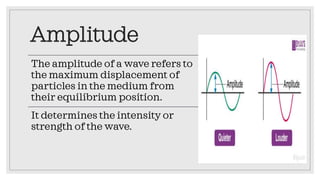
Amplitude
The amplitude of a wave refers to
the maximum displacement of
particles in the medium from
their equilibrium position.
It determines the intensity or
strength of the wave.
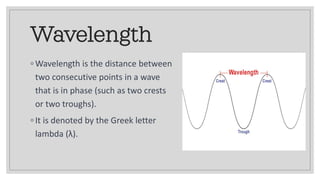
Wavelength
◦ Wavelength is the distance between
two consecutive points in a wave
that is in phase (such as two crests
or two troughs).
◦ It is denoted by the Greek letter
lambda (λ).
Frequency
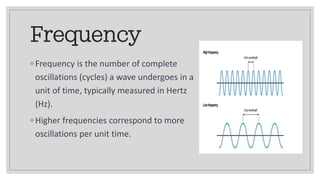
◦ Frequency is the number of complete
oscillations (cycles) a wave undergoes in a
unit of time, typically measured in Hertz
(Hz).
◦ Higher frequencies correspond to more
oscillations per unit time.
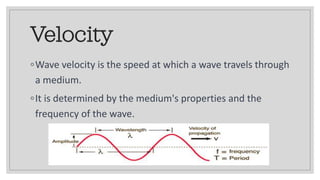
Velocity
◦Wave velocity is the speed at which a wave travels through
a medium.
◦It is determined by the medium's properties and the
frequency of the wave.
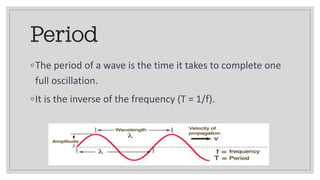
Period
◦The period of a wave is the time it takes to complete one
full oscillation.
◦It is the inverse of the frequency (T = 1/f).
Phase
◦Phase describes the position of a point within a wave cycle
relative to a reference point.
◦In-phase and out-of-phase waves interact differently when
they superpose.
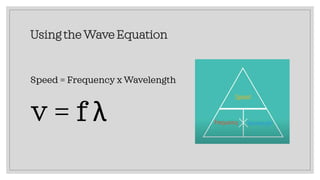
Using the Wave Equation
Speed = Frequency x Wavelength
v = f λ
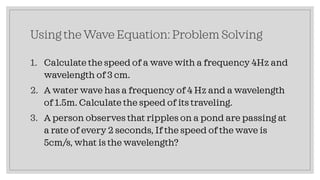
Using the Wave Equation: Problem Solving
1. Calculate the speed of a wave with a frequency 4Hz and
wavelength of 3 cm.
2. A water wave has a frequency of 4 Hz and a wavelength
of 1.5m. Calculate the speed of its traveling.
3. A person observes that ripples on a pond are passing at
a rate of every 2 seconds, If the speed of the wave is
5cm/s, what is the wavelength?
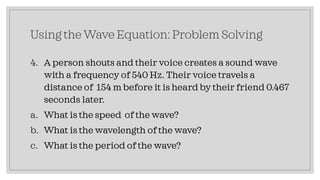
Using the Wave Equation: Problem Solving
4. A person shouts and their voice creates a sound wave
with a frequency of 540 Hz. Their voice travels a
distance of 154 m before it is heard by their friend 0.467
seconds later.
a. What is the speed of the wave?
b. What is the wavelength of the wave?
c. What is the period of the wave?
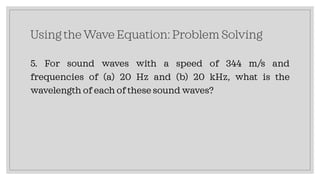
Using the Wave Equation: Problem Solving
5. For sound waves with a speed of 344 m/s and
frequencies of (a) 20 Hz and (b) 20 kHz, what is the
wavelength of each of these sound waves?
Using the Wave Equation: Problem Solving
6. A sound wave has a speed of 344 m/s and a wavelength of
0.500 m. What is the frequency of the wave?

Lesson 1 - Introduction to Waves (Waves & Optics)

  • 1.
  • 2.
    Course Description This courseprovides an in-depth exploration of waves and optics, focusing on their fundamental principles and applications. Students will develop a deep understanding of wave behavior, including reflection, refraction, interference, and diffraction.
  • 3.
    Course Description The coursewill also cover the properties and behaviors of light, as well as optical instruments and their use in various scientific fields. Emphasis will be placed on developing practical skills and applying theoretical concepts to real-world scenarios.
  • 4.
    COURSE OBJECTIVES Understand the fundamentalprinciples of wave behavior and its applications. Analyze and interpret optical phenomena using mathematical models. Develop practical skills in using optical instruments and conducting experiments. Apply wave and optical concepts to solve real-world problems. Improve critical thinking and problem- solving abilities through scientific inquiry. Enhance communication skills through presentations and discussions.
  • 5.
    COURSE OUTLINE • Properties ofwaves • Wave terminology and concepts • Wave equation and mathematical representations Introduction to Waves • Reflection and refraction • Interference and superposition • Diffraction and polarization • Doppler effect Wave Behavior • Laws of reflection and refraction • Ray tracing and image formation • Lens and mirror systems • Optical instruments: telescopes, microscopes, etc. Geometric Optics
  • 6.
    • Huygens' principle •Young's double-slit experiment • Interference patterns and colors • Diffraction gratings and interference filters Wave Optics • Polarization of light • Polarizers and applications • Laser principles and applications Polarization and Lasers • Scattering and absorption • Dispersion and prisms • Optical fibers and communication Optical Phenomena COURSE OUTLINE
  • 7.
    • Spectroscopy andspectrometers • Interferometry and its applications • Optics in medical imaging • Optics in astronomy Optical Instruments and Techniques • Optics in information technology • Optics in materials science • Optics in environmental monitoring • Optics in biotechnology and medicine Applications of Waves and Optics • Students will choose a topic of interest and conduct a research project related to waves and optics. They will present their findings to the class. Wave and Optics Research Projects COURSE OUTLINE
  • 8.
    CLASS RULES Attend all classes andarrive on time. Participate actively in class discussions and activities. Respect the instructor and fellow classmates. Keep electronic devices silenced and put away during class. Follow laboratory safety guidelines during experiments. Complete assigned readings and homework on time. Use professional language and behavior during class. Raise your hand to ask questions or contribute to discussions. Be responsible for your own learning and seek help when needed. Submit all assignments and exams by the specified deadlines.
  • 9.
  • 13.
    LET’S THINK &SHARE WHAT ARE SOME EXAMPLES OF WAVES IN EVERYDAY LIFE? HOW DO WAVES TRAVEL FROM ONE PLACE TO ANOTHER? HOW CAN WE DESCRIBE THE PROPERTIES OF WAVES?
  • 14.
    Waves ◦A wave isa disturbance that moves through a medium from one place to another. ◦ Imagine a slinky where the coils are in their normal position. ◦ If you move the first coil and let it return to its original position, the disturbance travels through the slinky, creating a wave.
  • 15.
    Medium ◦A medium isa material or substance that carries a wave. ◦It doesn't create the wave; it just transports it. ◦Just like news media carries news from one place to another, a wave medium carries a wave from its source to other locations.
  • 16.
    Categories of Waves ◦Waves can be categorized into different types based on their behavior and the medium they travel through. Behavior-based Categories: • Mechanical Waves: These waves require a medium (material) to travel through, and they transfer energy by causing particles in the medium to vibrate. Examples include water waves, sound waves, and seismic waves.
  • 17.
    Categories of Waves ◦Electromagnetic Waves: These waves can travel through a vacuum (empty space) and don't require a medium. ◦ They consist of oscillating electric and magnetic fields. ◦ Examples include light, radio waves, and microwaves.
  • 18.
    Categories of Waves ElectromagneticWaves ◦ It consists of vibrating electric and magnetic fields that oscillate perpendicular to each other and the direction of wave propagation • The field energy radiates outward at the speed of light (c). • The speed of all electromagnetic waves (“speed of light”) in a vacuum: • c = 3.00 x 10⁸ m/s = 1.86 x 10⁵ mi/s • To a good approximation this is also the speed of light in air. Electromagnetic Wave Consisting of Electric and Magnetic Field Vectors
  • 20.
    Categories of Waves Medium-basedCategories: • Transverse Waves: In these waves, the particles of the medium move perpendicular (at right angles) to the direction of the wave's propagation. Example: light waves. • Longitudinal Waves: In these waves, the particles of the medium move parallel to the direction of the wave's propagation. Example: sound waves.
  • 21.
    Visible Light • Visiblelight waves have frequencies in the range of 1014 Hz. • Therefore, visible light has relatively short wavelengths. • λ = c/f = (108 m/s)/(1014 Hz) = 10-6 m • Visible light wavelengths are approximately one-millionth of a meter.
  • 22.
    Visible Light Visible lightis generally expressed in nanometers (1 nm = 10-9 m) to avoid using negative exponents. The visible light range extends from approximately 400 to 700 nm. 4 x 10⁻⁷ to 7 x 10⁻⁷ m The human eye perceives the different wavelengths within the visible range as different colors. The brightness depends on the energy of the wave.
  • 23.
    Sound Waves • Sound- the propagation of longitudinal waves through matter (solid, liquid, or gas) • The vibration of a tuning fork produces a series of compressions (high-pressure regions) and rarefactions (low-pressure regions). • With continual vibration, a series of high/low- pressure regions travel outward forming a longitudinal sound wave.
  • 25.
    Sound Spectrum • Similarto the electromagnetic radiation, sound waves also have different frequencies and form a spectrum. • The sound spectrum has relatively few frequencies and can be divided into three frequency regions: • Infrasonic, f < 20 Hz • Audible, 20 Hz < f < 20 kHz • Ultrasonic, f > 20 kHz
  • 26.
    Audible Region • Theaudible region for humans is about 20 Hz to 20 kHz. • Sounds may be heard due to the vibration of our eardrums caused by their propagating disturbance.
  • 27.
    Loudness or Intensity •Loudness is a relative term. • The term intensity (I) is quantitative and is a measure of the rate of energy transfer through a given area. • Intensity is measured in J/s/m2 or W/m2. • The threshold of hearing is around 10-12 W/m2. • An intensity of about 1 W/m2 is painful to the ear. • Intensity decreases with distance from the source (I a 1/r2).
  • 28.
    Loudness or Intensity ◦Sound Intensity decreases inversely to the square of the distance from the source (I a 1/r2).
  • 29.
    Decibel Scale •Sound Intensityis measured on the decibel scale. •A decibel is 1/10 of a bel. • The bel (B) is a unit of intensity named in honor of Alexander Graham Bell. •The decibel scale is not linear with respect to intensity, therefore when the sound intensity is doubled, the dB level is only increased by 3 dB.
  • 30.
  • 31.
    Ultrasound • Sound waveswith frequencies greater than 20,000 Hz cannot be detected by the human ear, although may be detected by some animals (for example dog whistles). • The reflections of ultrasound frequencies are used to examine parts of the body, or an unborn child – much less risk than using x-rays. • Also useful in cleaning small hard-to-reach recesses – jewelry, lab equipment, etc.
  • 32.
    Bats use the reflectionsof ultrasound for navigation and to locate food.
  • 33.
    Speed of Sound •The speed of sound depends on the makeup of the particular medium that it is passing through. • The speed of sound in air is considered to be, vsound = 344 m/s or 770 mi/h (at 20oC). • Approximately 1/3 km/s or 1/5 mi/s • The velocity of sound increases with increasing temperature. (at 0oC = 331 m/s) • In general, the velocity of sound increases as the density of the medium increases. (The speed of sound in water is about 4x that in air.)
  • 34.
    Sound • The speedof light is MUCH faster. So, in many cases, we see something before we hear it (lightning/thunder, echo, etc.). • A 5-second lapse between seeing lightning and hearing the thunder indicates that the lightning occurs at approximately 1 mile.
  • 35.
    Categories of Waves OtherCategories: •Surface Waves: These waves occur at the interface between two different media (e.g., water and air), causing both longitudinal and transverse motion.
  • 36.
    Categories of Waves OtherCategories: • Standing Waves: These waves are formed when two identical waves traveling in opposite directions interfere with each other, creating regions of no apparent motion (nodes) and maximum motion (antinodes). • Example: vibrating strings on a musical instrument.
  • 37.
    • Standing wavesare formed only when the string is vibrated at particular frequencies.
  • 38.
    Resonance • Resonance -a wave effect that occurs when an object has a natural frequency that corresponds to an external frequency. • Results from a periodic driving force with a frequency equal to one of the natural frequencies. • Common example of resonance: Pushing a swing – the periodic driving force (the push) must be at a certain frequency to keep the swing going
  • 39.
    Resonance • When onetuning fork is struck, the other tuning fork of the same frequency will vibrate in resonance. • The periodic “driving force” here are the sound waves.
  • 40.
    Musical Instruments • MusicalInstruments use standing waves and resonance to produce different tones. • Guitars, violins, and pianos all use standing waves to produce tones. • Stringed instruments are tuned by adjusting the tension of the strings. • Adjustment of the tension changes the frequency at which the string vibrates. • The body of the stringed instrument acts as a resonance cavity to amplify the sound.
  • 41.
    Particle-to-Particle Interaction • Wavescan be understood as a collection of interacting particles in the medium. • The interaction of one particle with its adjacent particle allows the disturbance to move through the medium. • For example, in a slinky wave, individual coils interact with each other to pass the wave along.
  • 42.
    A WAVE TRANSPORT ENERGYNOT MATTER ◦ A wave involves the temporary displacement of particles in the medium, but they return to their original positions. ◦ When a disturbance (wave) is present, energy is transported through the medium without the matter (particles) themselves being transported.
  • 43.
    Properties of Waves ◦Waves come in an incredible array of forms, but they all share core properties that shape their behavior. 1. Amplitude 2. Wavelength 3. Frequency 4. Wave Speed or Velocity 5. Period
  • 44.
    Amplitude The amplitude ofa wave refers to the maximum displacement of particles in the medium from their equilibrium position. It determines the intensity or strength of the wave.
  • 45.
    Wavelength ◦ Wavelength isthe distance between two consecutive points in a wave that is in phase (such as two crests or two troughs). ◦ It is denoted by the Greek letter lambda (λ).
  • 46.
    Frequency ◦ Frequency isthe number of complete oscillations (cycles) a wave undergoes in a unit of time, typically measured in Hertz (Hz). ◦ Higher frequencies correspond to more oscillations per unit time.
  • 47.
    Velocity ◦Wave velocity isthe speed at which a wave travels through a medium. ◦It is determined by the medium's properties and the frequency of the wave.
  • 48.
    Period ◦The period ofa wave is the time it takes to complete one full oscillation. ◦It is the inverse of the frequency (T = 1/f).
  • 49.
    Phase ◦Phase describes theposition of a point within a wave cycle relative to a reference point. ◦In-phase and out-of-phase waves interact differently when they superpose.
  • 50.
    Using the WaveEquation Speed = Frequency x Wavelength v = f λ
  • 51.
    Using the WaveEquation: Problem Solving 1. Calculate the speed of a wave with a frequency 4Hz and wavelength of 3 cm. 2. A water wave has a frequency of 4 Hz and a wavelength of 1.5m. Calculate the speed of its traveling. 3. A person observes that ripples on a pond are passing at a rate of every 2 seconds, If the speed of the wave is 5cm/s, what is the wavelength?
  • 52.
    Using the WaveEquation: Problem Solving 4. A person shouts and their voice creates a sound wave with a frequency of 540 Hz. Their voice travels a distance of 154 m before it is heard by their friend 0.467 seconds later. a. What is the speed of the wave? b. What is the wavelength of the wave? c. What is the period of the wave?
  • 53.
    Using the WaveEquation: Problem Solving 5. For sound waves with a speed of 344 m/s and frequencies of (a) 20 Hz and (b) 20 kHz, what is the wavelength of each of these sound waves?
  • 54.
    Using the WaveEquation: Problem Solving 6. A sound wave has a speed of 344 m/s and a wavelength of 0.500 m. What is the frequency of the wave?