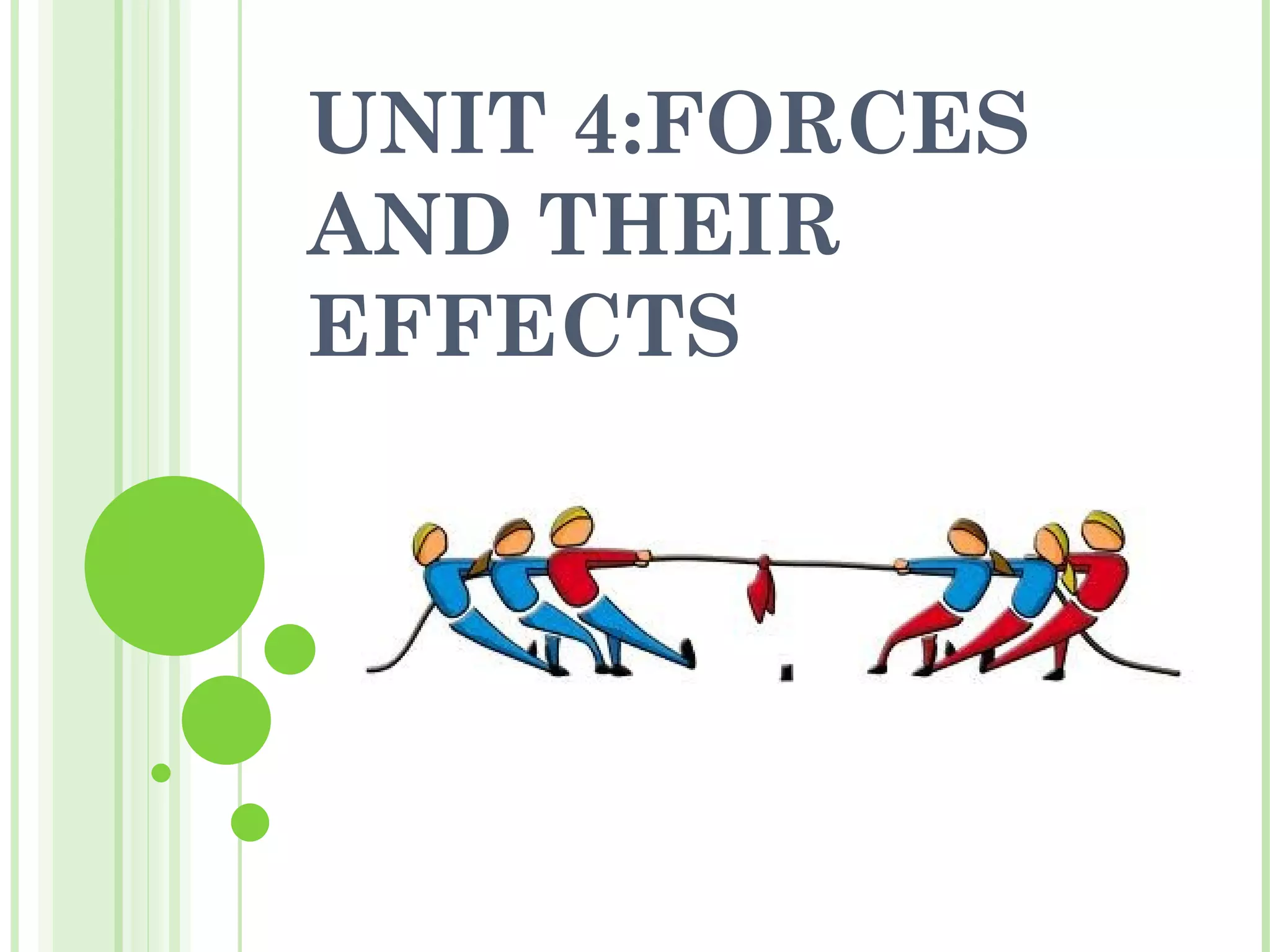
UNIT 4:FORCES
AND THEIR
EFFECTS
WHAT IS A FORCE?
 The direct cause of changes in speed and deformation
  that a body can experience is called force.
 The forces are represented by vectors. They’re
  drawn with arrows.
 TYPES OF FORCES:
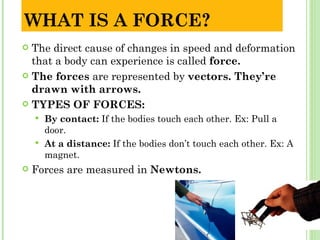
     By contact: If the bodies touch each other. Ex: Pull a
      door.
     At a distance: If the bodies don’t touch each other. Ex: A
      magnet.
   Forces are measured in Newtons.
GRAVITATIONAL PULL
GRAVITACIONAL INTERACTION
 Gravitational interaction is always attractive. Two or more
  masses always attract each other.
 The intensity of this attraction decreases as the distance increases.

THE WEIGHT OF BODIES
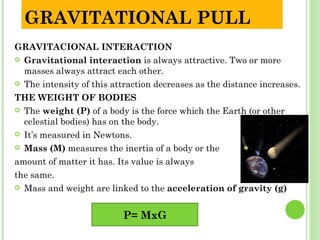
 The weight (P) of a body is the force which the Earth (or other
  celestial bodies) has on the body.
 It’s measured in Newtons.

 Mass (M) measures the inertia of a body or the

amount of matter it has. Its value is always
the same.
 Mass and weight are linked to the acceleration of gravity (g)


                          P= MxG
ARCHIMEDES’ PRINCIPLE
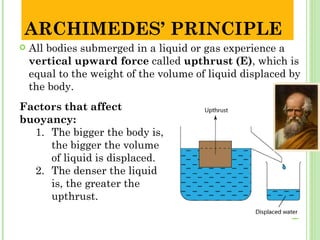
   All bodies submerged in a liquid or gas experience a
    vertical upward force called upthrust (E), which is
    equal to the weight of the volume of liquid displaced by
    the body.
Factors that affect
buoyancy:
  1. The bigger the body is,
     the bigger the volume
     of liquid is displaced.
  2. The denser the liquid
     is, the greater the
     upthrust.
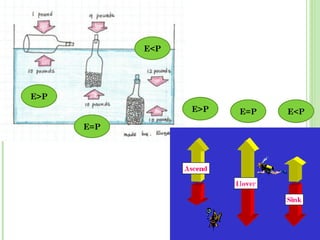
E<P


E>P
                  E>P   E=P   E<P
      E=P
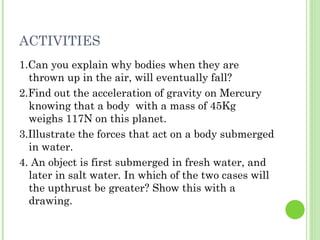
ACTIVITIES
1.Can you explain why bodies when they are
  thrown up in the air, will eventually fall?
2.Find out the acceleration of gravity on Mercury
  knowing that a body with a mass of 45Kg
  weighs 117N on this planet.
3.Illustrate the forces that act on a body submerged
  in water.
4. An object is first submerged in fresh water, and
  later in salt water. In which of the two cases will
  the upthrust be greater? Show this with a
  drawing.
5. Answer the following questions briefly:
a) Why does a body sink in a liquid?
b)Why does a body float in a liquid?
c)Why does it stay in equilibrium?

6. If the acceleration of gravity in Mercury is 2.8 m/
  s2 and in Neptune it’s 11 m/s2 , work out:
a) A body’s weight with 20 Kg of mass on both
  planets.

Unit 4: Forces and their effects

  • 1.
  • 2.
    WHAT IS AFORCE?  The direct cause of changes in speed and deformation that a body can experience is called force.  The forces are represented by vectors. They’re drawn with arrows.  TYPES OF FORCES:  By contact: If the bodies touch each other. Ex: Pull a door.  At a distance: If the bodies don’t touch each other. Ex: A magnet.  Forces are measured in Newtons.
  • 3.
    GRAVITATIONAL PULL GRAVITACIONAL INTERACTION Gravitational interaction is always attractive. Two or more masses always attract each other.  The intensity of this attraction decreases as the distance increases. THE WEIGHT OF BODIES  The weight (P) of a body is the force which the Earth (or other celestial bodies) has on the body.  It’s measured in Newtons.  Mass (M) measures the inertia of a body or the amount of matter it has. Its value is always the same.  Mass and weight are linked to the acceleration of gravity (g) P= MxG
  • 4.
    ARCHIMEDES’ PRINCIPLE  All bodies submerged in a liquid or gas experience a vertical upward force called upthrust (E), which is equal to the weight of the volume of liquid displaced by the body. Factors that affect buoyancy: 1. The bigger the body is, the bigger the volume of liquid is displaced. 2. The denser the liquid is, the greater the upthrust.
  • 5.
    E<P E>P E>P E=P E<P E=P
  • 6.
    ACTIVITIES 1.Can you explainwhy bodies when they are thrown up in the air, will eventually fall? 2.Find out the acceleration of gravity on Mercury knowing that a body with a mass of 45Kg weighs 117N on this planet. 3.Illustrate the forces that act on a body submerged in water. 4. An object is first submerged in fresh water, and later in salt water. In which of the two cases will the upthrust be greater? Show this with a drawing.
  • 7.
    5. Answer thefollowing questions briefly: a) Why does a body sink in a liquid? b)Why does a body float in a liquid? c)Why does it stay in equilibrium? 6. If the acceleration of gravity in Mercury is 2.8 m/ s2 and in Neptune it’s 11 m/s2 , work out: a) A body’s weight with 20 Kg of mass on both planets.