Tentative Schedule
• 3-12 thru 3-16 Digestive/Circulatory
• 3-19 thru 3-23 Circulatory/Respiratory and
Lymphatic
• 3-26 thru 4-10 Reproductive/Endocrine
Systems
• Start Pig Dissection around 4-11 and it will
run thru 4-27 (approx. 2 weeks)
• This could change depending on weather
or other issues that might come up.
Digestive System
• Groups of organs that work together to
digest food so that it can be used by the
body (nutrients)
• Food is digested as it passed through the
system – body needs H2O, carbohydrates,
fats, proteins, vitamins, minerals
• Composed of the mouth, pharynx,
esophagus, stomach, small intestine,
large intestine, rectum, anus
• Substance are secreted by the liver,
gallbladder, pancreas and salivary glands
to assist with digestion
• Two types of digestion:
– Mechanical – physical breaking and crushing
of food (teeth and muscle contractions)
– Chemical – large molecules are broken down
by enzymes (chemical scissors) into smaller
particles that the body can use for growth,
maintenance, and repair
• Major nutrients – protein, carbohydrates
and fats
• Steps in digestion
• (1) Digestion begins in the mouth where
teeth (enamel) are used to break down
and grind food into small manageable
pieces (mechanical)
– Teeth are composed of molars, premolars,
incisors and canines adults have 32 teeth
– Saliva – (amylase - enzyme) liquid produced
by the salivary glands (and pancreas) in the
gums to begin breaking down complex
carbohydrates into simple sugars and moisten
food (chemical)
• (2) pharynx – throat, food is pushed by
the tongue to the back of the mouth and
enters the pharynx which splits into 2
tubes
• (3)Esophagus – passageway to the
stomach
• Squeezes food along the tube with muscle
contractions called peristalsis forcing food
into the stomach
• (4) stomach – muscular baglike organ
connected to the end of the esophagus
• Continues physical and chemical digestion
by churning food with muscle contractions
and releasing digestive enzymes and acid
(HCl) creating chyme
• (5) small intestine – (three parts
duodenum, Jejunum, ileum) chyme is
released by pyloric valve into the small
intestine slowly allowing the small intestine
time to mix chyme with fluids from the liver
and pancreas
• Small intestine is approx. 2.5 cm in
diameter and about 6 m long
• villi – fingerlike projections covered with
nutrient absorbing cells that allows
nutrients to be diffused into the
bloodstream by capillaries
• (6) large intestine – stores, compacts,
and expels materials that are indigestible
• About 7.5 cm in diameter and about 1.5 m
long
• No nutrient absorption takes place in the
large intestine
• Water absorption takes place and creates
a solid mass called feces
• Fiber found in fruits, grains, and vegetables
called cellulose is not digestible by humans and
is used by the body to keep feces soft and
moving in the lg. intestine
• Lg intestine also secretes mucus to allow feces
to move smoothly
• Last part of the lg intestine is the rectum where
feces is stored before passing out of the body
through the anus
• Complete digestion from start (mouth) to
finish (anus) takes approx. 24 hrs.
Assisting Organs
• Pancreas is located between the stomach and
sm intestine that makes enzymes to help in food
digestion and produces an acid neutralizer
called bicarbonate
– Also part of the endocrine system that makes
hormones that regulate blood sugar (insulin)
• Liver – large as a football located on the right
side of abdomen, most massive internal organ
Assisting Organs
• Weighing up to 1.5 kg and has many jobs:
• Makes green liquid called bile which is
used to emulsify fat molecules
• Stores nutrients/produces glycogen
• Breaks down toxic substances in the blood
• Makes cholesterol for cell membranes
– HDL – high density phospholipids (good)
– LDL – low density phospholipids (bad)
Assisting Organs
• Gallbladder – stores bile made by the
liver and is squeezed into the sm intestine
by way of bile duct, breaks up large fat
droplets, allowing for easier digestion, not
necessary
Excretory System/Urinary
• Removes waste products from
blood/balances fluids (H2O)/balances
pH/balances salt (electrolites)/creates
urea
• Excretion – process of removing wastes
and excess products (fluids and some
solid matter (filtrates) from the body
• 3 systems remove waste
– Urinary, respiratory, integumentary
• Blood moves through the kidney’s approx.
350 X’s per day
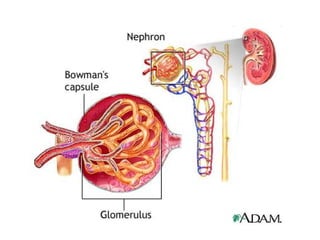
• Each kidney is composed of over 1 million
tiny filters called nephrons
• Each nephron is surrounded by capillaries
called the glomerulus encased in a
hollow cup-shaped structure called
Bowman’s capsule (permeable)
• Materials diffuse across membrane: water,
urea, glucose, salts, amino acids and
some vitamins (filtrate)
• Plasma, cells, and platelets are to large to
pass and remain in blood.
• Removes toxic substances containing
nitrogen called urea, which forms as the
cells use protein for energy
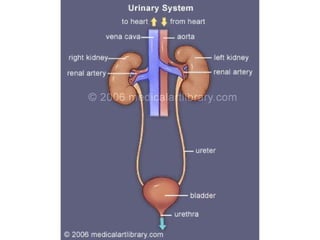
• Ureter – passageway from kidney’s to the
bladder
• Urinary bladder – storage area for urine
• Urethra – tube where urine leaves the
body
• Urine – liquid waste (yellow) that remains
behind when nephrons remove water and
other substances (filtrates) from blood
• Urination – process of expelling urine
• ADH – antidiuretic hormone produced
when your body lacks water
• Signals the kidney’s to take back water
from the nephrons and return the water
back to the bloodstream
• The process makes less urine but a higher
concentration of urine
• Diuretics – thirst is an indication the body
needs water
• Diuretics cause the kidneys to make more
urine decreasing the amount of water in
blood
• Caffeine is a diuretic

Digestion and urinary

  • 1.
    Tentative Schedule • 3-12thru 3-16 Digestive/Circulatory • 3-19 thru 3-23 Circulatory/Respiratory and Lymphatic • 3-26 thru 4-10 Reproductive/Endocrine Systems • Start Pig Dissection around 4-11 and it will run thru 4-27 (approx. 2 weeks) • This could change depending on weather or other issues that might come up.
  • 2.
    Digestive System • Groupsof organs that work together to digest food so that it can be used by the body (nutrients) • Food is digested as it passed through the system – body needs H2O, carbohydrates, fats, proteins, vitamins, minerals • Composed of the mouth, pharynx, esophagus, stomach, small intestine, large intestine, rectum, anus
  • 3.
    • Substance aresecreted by the liver, gallbladder, pancreas and salivary glands to assist with digestion • Two types of digestion: – Mechanical – physical breaking and crushing of food (teeth and muscle contractions) – Chemical – large molecules are broken down by enzymes (chemical scissors) into smaller particles that the body can use for growth, maintenance, and repair
  • 4.
    • Major nutrients– protein, carbohydrates and fats • Steps in digestion • (1) Digestion begins in the mouth where teeth (enamel) are used to break down and grind food into small manageable pieces (mechanical) – Teeth are composed of molars, premolars, incisors and canines adults have 32 teeth
  • 5.
    – Saliva –(amylase - enzyme) liquid produced by the salivary glands (and pancreas) in the gums to begin breaking down complex carbohydrates into simple sugars and moisten food (chemical) • (2) pharynx – throat, food is pushed by the tongue to the back of the mouth and enters the pharynx which splits into 2 tubes
  • 6.
    • (3)Esophagus –passageway to the stomach • Squeezes food along the tube with muscle contractions called peristalsis forcing food into the stomach • (4) stomach – muscular baglike organ connected to the end of the esophagus • Continues physical and chemical digestion by churning food with muscle contractions and releasing digestive enzymes and acid (HCl) creating chyme
  • 7.
    • (5) smallintestine – (three parts duodenum, Jejunum, ileum) chyme is released by pyloric valve into the small intestine slowly allowing the small intestine time to mix chyme with fluids from the liver and pancreas • Small intestine is approx. 2.5 cm in diameter and about 6 m long • villi – fingerlike projections covered with nutrient absorbing cells that allows nutrients to be diffused into the bloodstream by capillaries
  • 8.
    • (6) largeintestine – stores, compacts, and expels materials that are indigestible • About 7.5 cm in diameter and about 1.5 m long • No nutrient absorption takes place in the large intestine • Water absorption takes place and creates a solid mass called feces
  • 9.
    • Fiber foundin fruits, grains, and vegetables called cellulose is not digestible by humans and is used by the body to keep feces soft and moving in the lg. intestine • Lg intestine also secretes mucus to allow feces to move smoothly • Last part of the lg intestine is the rectum where feces is stored before passing out of the body through the anus
  • 10.
    • Complete digestionfrom start (mouth) to finish (anus) takes approx. 24 hrs.
  • 11.
    Assisting Organs • Pancreasis located between the stomach and sm intestine that makes enzymes to help in food digestion and produces an acid neutralizer called bicarbonate – Also part of the endocrine system that makes hormones that regulate blood sugar (insulin) • Liver – large as a football located on the right side of abdomen, most massive internal organ
  • 12.
    Assisting Organs • Weighingup to 1.5 kg and has many jobs: • Makes green liquid called bile which is used to emulsify fat molecules • Stores nutrients/produces glycogen • Breaks down toxic substances in the blood • Makes cholesterol for cell membranes – HDL – high density phospholipids (good) – LDL – low density phospholipids (bad)
  • 13.
    Assisting Organs • Gallbladder– stores bile made by the liver and is squeezed into the sm intestine by way of bile duct, breaks up large fat droplets, allowing for easier digestion, not necessary
  • 14.
    Excretory System/Urinary • Removeswaste products from blood/balances fluids (H2O)/balances pH/balances salt (electrolites)/creates urea • Excretion – process of removing wastes and excess products (fluids and some solid matter (filtrates) from the body • 3 systems remove waste – Urinary, respiratory, integumentary
  • 15.
    • Blood movesthrough the kidney’s approx. 350 X’s per day • Each kidney is composed of over 1 million tiny filters called nephrons • Each nephron is surrounded by capillaries called the glomerulus encased in a hollow cup-shaped structure called Bowman’s capsule (permeable)
  • 16.
    • Materials diffuseacross membrane: water, urea, glucose, salts, amino acids and some vitamins (filtrate) • Plasma, cells, and platelets are to large to pass and remain in blood. • Removes toxic substances containing nitrogen called urea, which forms as the cells use protein for energy
  • 18.
    • Ureter –passageway from kidney’s to the bladder • Urinary bladder – storage area for urine • Urethra – tube where urine leaves the body • Urine – liquid waste (yellow) that remains behind when nephrons remove water and other substances (filtrates) from blood
  • 20.
    • Urination –process of expelling urine • ADH – antidiuretic hormone produced when your body lacks water • Signals the kidney’s to take back water from the nephrons and return the water back to the bloodstream • The process makes less urine but a higher concentration of urine
  • 21.
    • Diuretics –thirst is an indication the body needs water • Diuretics cause the kidneys to make more urine decreasing the amount of water in blood • Caffeine is a diuretic