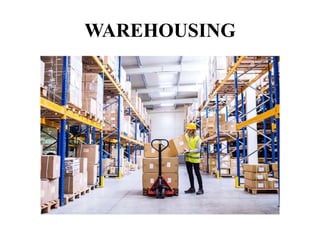
WAREHOUSING
WAREHOUSING
Introduction
The term “Ware” means products or goods.
“Warehousing” generally means storage place or
godowns which is located near a factory to keep
the raw materials and finished products. Storage is
only a holding place of goods. Whereas a
warehouse is located near the market to perform
the other marketing functions such as grading,
standardization, blending, mining packing, etc. The
development of science and technology has
improved the ways and means of storage. It
removes the hindrance of time.
Meaning & Definition
• It is a place where goods are stored for future
use and act as distribution centres.
• According to J. Stephenson, “a warehouse
in an establishment for the storage or
accumulation of goods”.
Need for Warehousing
• Mass production
• Nature of commodities
• Seasonal production but regular consumption
• Regular production but seasonal
consumption
• Proximity to production centers
Types of Warehouses
• On the Basis of Ownership
(a) Private Warehouses
(b) Government Warehouses
(c) Public Warehouses
(d) Co-operative Warehouses
(e) Bonded Warehouses
(f) Institutional Warehouses
(g) Distribution Centre Warehouses
• On the Basis of Commodities Stored
(a) General Warehouses
(b) Special Commodity Warehouses
(c) Cold Storages or Refrigerated
Warehouses
(d) Climate Controlled Warehouses
Functions of Warehouses
(i) Storage
(ii) Price Stabilization
(iii) Equalization of Demand and Supply
(iv) Business Finance
(v) Risk bearing
(vi) Preparation for sale
(vii) Widening the marketing area
(viii) Value added services
Advantages
1. It safeguards the stock of the merchants who do not have storing place.
2. Warehouses reduce distribution cost of the traders by storing the goods
in bulk
and allow the trader to take the goods in small lots to his shop.
3. It helps in selection of channel of distribution. The producer will
prefer
whether to appoint a wholesaler or retailer.
4. It assists in maintaining the continuous sales and avoids the
possibilities of “out of stock” position.
5. It creates employment opportunities for both skilled and unskilled
workers, to improve their standard of living.
Drawbacks of Warehousing
Warehousing is not effective because of the following reasons:
1. There are no adequate transport facilities between the place
of production and warehouses.
2. Lack of sufficient storage facilities for different
commodities such as perishable and non-perishable
commodities.
3. Complicated formalities are to be fulfilled at the
warehouses. The illiterate and innocent farmers are not able
to cope with these procedures.
4. Complicated process of Barcode technology can reduce the
storing of goods by some producers.
Warehousing Documents
a) Warehouse Warrants
b) Warehouse Keeper’s Receipt
c) Dock Warrant
d) Dock Receipt
e) Delivery Order
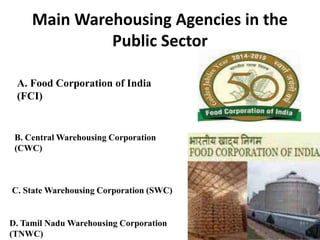
Main Warehousing Agencies in the
Public Sector
A. Food Corporation of India
(FCI)
B. Central Warehousing Corporation
(CWC)
C. State Warehousing Corporation (SWC)
D. Tamil Nadu Warehousing Corporation
(TNWC)
QUESTIONS
1. Explain the different types of
warehouses
2. Explain the advantages of warehousing
functions.

WAREHOUSING

  • 1.
  • 2.
  • 3.
    Introduction The term “Ware”means products or goods. “Warehousing” generally means storage place or godowns which is located near a factory to keep the raw materials and finished products. Storage is only a holding place of goods. Whereas a warehouse is located near the market to perform the other marketing functions such as grading, standardization, blending, mining packing, etc. The development of science and technology has improved the ways and means of storage. It removes the hindrance of time.
  • 4.
    Meaning & Definition •It is a place where goods are stored for future use and act as distribution centres. • According to J. Stephenson, “a warehouse in an establishment for the storage or accumulation of goods”.
  • 5.
    Need for Warehousing •Mass production • Nature of commodities • Seasonal production but regular consumption • Regular production but seasonal consumption • Proximity to production centers
  • 6.
    Types of Warehouses •On the Basis of Ownership (a) Private Warehouses (b) Government Warehouses (c) Public Warehouses (d) Co-operative Warehouses (e) Bonded Warehouses (f) Institutional Warehouses (g) Distribution Centre Warehouses
  • 7.
    • On theBasis of Commodities Stored (a) General Warehouses (b) Special Commodity Warehouses (c) Cold Storages or Refrigerated Warehouses (d) Climate Controlled Warehouses
  • 8.
    Functions of Warehouses (i)Storage (ii) Price Stabilization (iii) Equalization of Demand and Supply (iv) Business Finance (v) Risk bearing (vi) Preparation for sale (vii) Widening the marketing area (viii) Value added services
  • 9.
    Advantages 1. It safeguardsthe stock of the merchants who do not have storing place. 2. Warehouses reduce distribution cost of the traders by storing the goods in bulk and allow the trader to take the goods in small lots to his shop. 3. It helps in selection of channel of distribution. The producer will prefer whether to appoint a wholesaler or retailer. 4. It assists in maintaining the continuous sales and avoids the possibilities of “out of stock” position. 5. It creates employment opportunities for both skilled and unskilled workers, to improve their standard of living.
  • 10.
    Drawbacks of Warehousing Warehousingis not effective because of the following reasons: 1. There are no adequate transport facilities between the place of production and warehouses. 2. Lack of sufficient storage facilities for different commodities such as perishable and non-perishable commodities. 3. Complicated formalities are to be fulfilled at the warehouses. The illiterate and innocent farmers are not able to cope with these procedures. 4. Complicated process of Barcode technology can reduce the storing of goods by some producers.
  • 11.
    Warehousing Documents a) WarehouseWarrants b) Warehouse Keeper’s Receipt c) Dock Warrant d) Dock Receipt e) Delivery Order
  • 12.
    Main Warehousing Agenciesin the Public Sector A. Food Corporation of India (FCI) B. Central Warehousing Corporation (CWC) C. State Warehousing Corporation (SWC) D. Tamil Nadu Warehousing Corporation (TNWC)
  • 13.
    QUESTIONS 1. Explain thedifferent types of warehouses 2. Explain the advantages of warehousing functions.