Agricultural Marketing
A.K.M. Golam Kausar
Concept and
Definition
Objectives of
the study
Scope and
Subject Matter
Concept and definition
 Agriculture and marketing.
 Agriculture means activities aimed at the use of natural
resources for human welfare, i.e., it includes all the
primary activities of production. But, generally, it is used
to mean growing and/or raising crops and livestock.
 Marketing means a series of activities involved in moving
the goods from the point of production to the point of
consumption. It includes all the activities involved in the
creation of time, place, form and possession utility.
Concept and definition
 According to Thomsen, the study of agricultural
marketing comprises all the operations, and the
agencies conducting them, involved in the movement of
farm-produced foods, raw materials and their
derivatives, such as textiles, from the farms to the final
consumers, and the effects of such operations on
farmers, middlemen and consumers.
Concept and definition
 Agricultural marketing is the study of all the activities,
agencies and policies involved in the procurement of farm
inputs by the farmers and the movement of agricultural
products from the farms to the consumers.
Concept and definition
 According to the National Commission on Agriculture
(XII Report), agricultural marketing is a process which
starts with a decision to produce a saleable farm
commodity, and it involves all the aspects of market
structure or system, both functional and institutional,
based on technical and economic considerations, and
includes pre-and post-harvest operations, assembling,
grading, storage, transportation and distribution.
Objectives of Study of Agricultural Marketing
1. understanding of the complexities involved and the
identification of bottlenecks with a view to providing
efficient services in the transfer of farm products and inputs
from producers to consumers.
2. An efficient marketing system minimizes costs, and benefits all
the sections of the society.
The expectations from the system vary from
group to group
• Producers
• Consumers
• Market Middlemen and Traders
• Government
Scope and Subject Matter
 Product marketing as well as input marketing.
 Marketable surplus of the crops following the technological
breakthrough.
 The farmers produce their products for the markets. Farming becomes
market-oriented.
 marketing functions, agencies, channels, efficiency and costs,
price spread and market integration, producer’s surplus,
government policy and research, training and statistics on
agricultural marketing
Agricultural
products vs
Manufactured
products
Importance of
agricultural
marketing
Agricultural and Manufactured Goods
1. Perishability of the Product
2. Seasonality of Production
3. Bulkiness of Products
4. Variation in Quality of Products
5. Irregular Supply of Agricultural Products
6. Small Size of Holdings and Scattered Production
7. Processing
IMPORTANCE OF AGRICULTURAL MARKETING
Optimization of Resource use and Output
Management
Increase in Farm Income
Widening of Markets
Growth of Agro-based Industries
IMPORTANCE…
Price Signals
Adoption and Spread of New Technology
Employment
Addition to National Income
Better Living
Creation of Utility
Market
Market
The word market comes from the
latin word ‟marcatus” which means
merchandise or trade or a place
where business is conducted.
Market
Word “market” has been used to mean
(a) a place or a building where commodities are bought and sold, e.g.,
super market;
(b) potential buyers and sellers of a product, e.g., wheat market and
cotton market;
(c) potential buyers and sellers of a country or region, e.g.,
Bangladeshi market and Asian market;
(d) organization which provides facilities for exchange of
commodities, e.g., Dhaka stock exchange; and
(e) a phase or a course of commercial activity, e.g., a dull market or
bright market.
Market
 an old English saying: ‘two women and a goose may
make a market’.
 In common parlance, a market includes any place where
persons assemble for the sale or purchase of
commodities intended for satisfying human wants.
 Haats, Painths, Shandies and Bazar
Market
word ‘market’ in the economic sense
1. A market is the sphere within which price determining
forces operate.
2. A market is the area within which the forces of demand and
supply converge to establish a single price.
3. The term market means not a particular market place in
which things are bought and sold but the whole of any region
in which buyers and sellers are in such a free intercourse with
one another that the prices of the same goods tend to
equality, easily and quickly.
Market
4. Market means a social institution which performs
activities and provides facilities for exchanging
commodities between buyers and sellers.
5. Economically interpreted, the term market refers,
not to a place but to a commodity or commodities and
buyers and sellers who are in free intercourse with one
another.
Components of a Market
For a market to exist, certain conditions must be
satisfied. These conditions should be both necessary and
sufficient. They may also be termed as the components
of a market.
Components of a Market
1. The existence of a good or commodity for transactions
(physical existence is not necessary);
2. The existence of buyers and sellers;
3. Business relationship or intercourse between buyers
and sellers; and
4. Demarcation of area such as place, region, country or
the whole world. The existence of perfect competition or
a uniform price is not necessary.
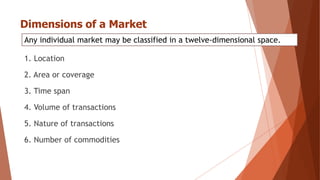
Dimensions of a Market
1. Location
2. Area or coverage
3. Time span
4. Volume of transactions
5. Nature of transactions
6. Number of commodities
Any individual market may be classified in a twelve-dimensional space.
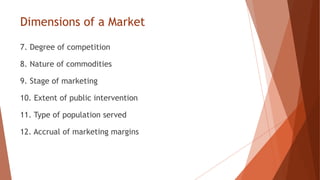
Dimensions of a Market
7. Degree of competition
8. Nature of commodities
9. Stage of marketing
10. Extent of public intervention
11. Type of population served
12. Accrual of marketing margins
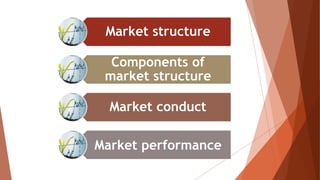
Market structure
Components of
market structure
Market conduct
Market performance
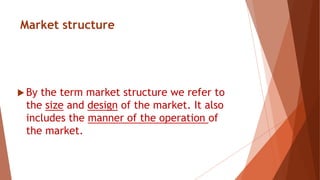
Market structure
 By the term market structure we refer to
the size and design of the market. It also
includes the manner of the operation of
the market.
Some expressions about market
structure
 Market structure refers to those organizational
characteristics of a market which influence the
nature of competition and pricing, and affect the
conduct of business firms.
 Market structure refers to those characteristics of
the market which affect the traders‟ behavior and
their performances.
Components of Market Structure
1. Concentration of Market Power
 represents the control of an individual firm or a group of
firms over the buying and selling of the produce
 measured by the number and size of firms existing in the
market
 Determine the nature of competition and consequently of
market conduct and performance
 A high degree of market concentration restricts the
movement of goods between buyers and sellers at fair and
competitive prices, and creates an oligopoly or oligopsony
situation in the market.
Components…
2. Degree of Product Differentiation
 If products are homogeneous, the price variations in the
market will not be wide.
 When products are heterogeneous, firms have the
tendency to charge different prices for their products.
3. Conditions for Entry of Firms in the Market
 Sometimes, a few big firms do not allow new firms to
enter the market or make their entry difficult by their
dominance in the market.
 Some government restrictions on the entry of firms
Components…
4. Flow of Market Information
 A well-organized market intelligence information
system helps all the buyers and sellers to freely
interact with one another in arriving at prices and
striking deals.
5. Degree of Integration
 Firms plans their strategies in respect of the
methods to be employed in determining prices,
increasing sales, coordinating with competing
firms and adopting predatory practices against
rivals or potential entrants.
Market conduct
 Market conduct refers to the patterns of behavior
of firms, specially in relation to pricing and their
practices in adapting and adjusting to the market
in which they function.
 Market conduct includes:
a) Market sharing and price setting policies;
b) Policies aimed at coercing rivals; and
c) Policies towards setting the quality of products.
Market performance
 The term market performance refers to the
economic results that flow from the industry as
each firm pursues its particular line of conduct.
 Society has to decide the criteria for satisfactory
market performance.
Criteria for measuring market
performance
1. Efficiency in the use of resources, including real cost of
performing various functions;
2. The existence of monopoly or monopoly profits, including
the relationship of margins with the average cost of
performing various functions;
3. Dynamic progressiveness of the system in adjusting the
size and number of firms in relation to the volume of
business, in adopting technological innovations and in finding
and/or inventing new forms of products so as to maximize
general social welfare.
Criteria…
4. Whether or not the system aggravates the problem of
inequalities in interpersonal, inter-regional or inter-group
incomes.
Inequalities may increase under the following situations:
a. A market intermediary may pocket a return greater than
its real contribution to the national product;
b. Small farmers are discriminated against when they are
offered a lower return because of the low quantum of
surplus;
c. Inter-product price parity is substantially disturbed by
new uses for some products and wide variations and
rigidities in the production pattern between regions.
For a satisfactory market performance, the
market structure should keep pace with the
following changes:
1. Production Pattern
 Significant changes occur in the production pattern because
of technological, economic and institutional factors.
2. Demand Pattern
 The demand for various products, specially in terms of form
and quality, keeps on changing because of change in incomes,
the pattern of distribution among consumers, and changes in
their tastes and habits.
Market structure should keep pace with the
following changes:
3. Costs and Patterns of Marketing Functions
 Transportation, storage, financing and dissemination of
market information, have a great bearing on the type of
market structure.
 Government policies with regard to purchases, sales and
subsidies affect the performance of market functions
4. Technological Change in Industry
 Technological changes necessitate changes in the market
structure through adjustments in the scale of business,
the number of firms, and in their financial requirements.

Agricultual marketing

  • 1.
  • 2.
    Concept and Definition Objectives of thestudy Scope and Subject Matter
  • 3.
    Concept and definition Agriculture and marketing.  Agriculture means activities aimed at the use of natural resources for human welfare, i.e., it includes all the primary activities of production. But, generally, it is used to mean growing and/or raising crops and livestock.  Marketing means a series of activities involved in moving the goods from the point of production to the point of consumption. It includes all the activities involved in the creation of time, place, form and possession utility.
  • 4.
    Concept and definition According to Thomsen, the study of agricultural marketing comprises all the operations, and the agencies conducting them, involved in the movement of farm-produced foods, raw materials and their derivatives, such as textiles, from the farms to the final consumers, and the effects of such operations on farmers, middlemen and consumers.
  • 5.
    Concept and definition Agricultural marketing is the study of all the activities, agencies and policies involved in the procurement of farm inputs by the farmers and the movement of agricultural products from the farms to the consumers.
  • 6.
    Concept and definition According to the National Commission on Agriculture (XII Report), agricultural marketing is a process which starts with a decision to produce a saleable farm commodity, and it involves all the aspects of market structure or system, both functional and institutional, based on technical and economic considerations, and includes pre-and post-harvest operations, assembling, grading, storage, transportation and distribution.
  • 7.
    Objectives of Studyof Agricultural Marketing 1. understanding of the complexities involved and the identification of bottlenecks with a view to providing efficient services in the transfer of farm products and inputs from producers to consumers. 2. An efficient marketing system minimizes costs, and benefits all the sections of the society.
  • 8.
    The expectations fromthe system vary from group to group • Producers • Consumers • Market Middlemen and Traders • Government
  • 9.
    Scope and SubjectMatter  Product marketing as well as input marketing.  Marketable surplus of the crops following the technological breakthrough.  The farmers produce their products for the markets. Farming becomes market-oriented.  marketing functions, agencies, channels, efficiency and costs, price spread and market integration, producer’s surplus, government policy and research, training and statistics on agricultural marketing
  • 10.
  • 11.
    Agricultural and ManufacturedGoods 1. Perishability of the Product 2. Seasonality of Production 3. Bulkiness of Products 4. Variation in Quality of Products 5. Irregular Supply of Agricultural Products 6. Small Size of Holdings and Scattered Production 7. Processing
  • 12.
    IMPORTANCE OF AGRICULTURALMARKETING Optimization of Resource use and Output Management Increase in Farm Income Widening of Markets Growth of Agro-based Industries
  • 13.
    IMPORTANCE… Price Signals Adoption andSpread of New Technology Employment Addition to National Income Better Living Creation of Utility
  • 14.
  • 15.
    Market The word marketcomes from the latin word ‟marcatus” which means merchandise or trade or a place where business is conducted.
  • 16.
    Market Word “market” hasbeen used to mean (a) a place or a building where commodities are bought and sold, e.g., super market; (b) potential buyers and sellers of a product, e.g., wheat market and cotton market; (c) potential buyers and sellers of a country or region, e.g., Bangladeshi market and Asian market; (d) organization which provides facilities for exchange of commodities, e.g., Dhaka stock exchange; and (e) a phase or a course of commercial activity, e.g., a dull market or bright market.
  • 17.
    Market  an oldEnglish saying: ‘two women and a goose may make a market’.  In common parlance, a market includes any place where persons assemble for the sale or purchase of commodities intended for satisfying human wants.  Haats, Painths, Shandies and Bazar
  • 18.
    Market word ‘market’ inthe economic sense 1. A market is the sphere within which price determining forces operate. 2. A market is the area within which the forces of demand and supply converge to establish a single price. 3. The term market means not a particular market place in which things are bought and sold but the whole of any region in which buyers and sellers are in such a free intercourse with one another that the prices of the same goods tend to equality, easily and quickly.
  • 19.
    Market 4. Market meansa social institution which performs activities and provides facilities for exchanging commodities between buyers and sellers. 5. Economically interpreted, the term market refers, not to a place but to a commodity or commodities and buyers and sellers who are in free intercourse with one another.
  • 20.
    Components of aMarket For a market to exist, certain conditions must be satisfied. These conditions should be both necessary and sufficient. They may also be termed as the components of a market.
  • 21.
    Components of aMarket 1. The existence of a good or commodity for transactions (physical existence is not necessary); 2. The existence of buyers and sellers; 3. Business relationship or intercourse between buyers and sellers; and 4. Demarcation of area such as place, region, country or the whole world. The existence of perfect competition or a uniform price is not necessary.
  • 22.
    Dimensions of aMarket 1. Location 2. Area or coverage 3. Time span 4. Volume of transactions 5. Nature of transactions 6. Number of commodities Any individual market may be classified in a twelve-dimensional space.
  • 23.
    Dimensions of aMarket 7. Degree of competition 8. Nature of commodities 9. Stage of marketing 10. Extent of public intervention 11. Type of population served 12. Accrual of marketing margins
  • 24.
    Market structure Components of marketstructure Market conduct Market performance
  • 25.
    Market structure  Bythe term market structure we refer to the size and design of the market. It also includes the manner of the operation of the market.
  • 26.
    Some expressions aboutmarket structure  Market structure refers to those organizational characteristics of a market which influence the nature of competition and pricing, and affect the conduct of business firms.  Market structure refers to those characteristics of the market which affect the traders‟ behavior and their performances.
  • 27.
    Components of MarketStructure 1. Concentration of Market Power  represents the control of an individual firm or a group of firms over the buying and selling of the produce  measured by the number and size of firms existing in the market  Determine the nature of competition and consequently of market conduct and performance  A high degree of market concentration restricts the movement of goods between buyers and sellers at fair and competitive prices, and creates an oligopoly or oligopsony situation in the market.
  • 28.
    Components… 2. Degree ofProduct Differentiation  If products are homogeneous, the price variations in the market will not be wide.  When products are heterogeneous, firms have the tendency to charge different prices for their products. 3. Conditions for Entry of Firms in the Market  Sometimes, a few big firms do not allow new firms to enter the market or make their entry difficult by their dominance in the market.  Some government restrictions on the entry of firms
  • 29.
    Components… 4. Flow ofMarket Information  A well-organized market intelligence information system helps all the buyers and sellers to freely interact with one another in arriving at prices and striking deals. 5. Degree of Integration  Firms plans their strategies in respect of the methods to be employed in determining prices, increasing sales, coordinating with competing firms and adopting predatory practices against rivals or potential entrants.
  • 30.
    Market conduct  Marketconduct refers to the patterns of behavior of firms, specially in relation to pricing and their practices in adapting and adjusting to the market in which they function.  Market conduct includes: a) Market sharing and price setting policies; b) Policies aimed at coercing rivals; and c) Policies towards setting the quality of products.
  • 31.
    Market performance  Theterm market performance refers to the economic results that flow from the industry as each firm pursues its particular line of conduct.  Society has to decide the criteria for satisfactory market performance.
  • 32.
    Criteria for measuringmarket performance 1. Efficiency in the use of resources, including real cost of performing various functions; 2. The existence of monopoly or monopoly profits, including the relationship of margins with the average cost of performing various functions; 3. Dynamic progressiveness of the system in adjusting the size and number of firms in relation to the volume of business, in adopting technological innovations and in finding and/or inventing new forms of products so as to maximize general social welfare.
  • 33.
    Criteria… 4. Whether ornot the system aggravates the problem of inequalities in interpersonal, inter-regional or inter-group incomes. Inequalities may increase under the following situations: a. A market intermediary may pocket a return greater than its real contribution to the national product; b. Small farmers are discriminated against when they are offered a lower return because of the low quantum of surplus; c. Inter-product price parity is substantially disturbed by new uses for some products and wide variations and rigidities in the production pattern between regions.
  • 34.
    For a satisfactorymarket performance, the market structure should keep pace with the following changes: 1. Production Pattern  Significant changes occur in the production pattern because of technological, economic and institutional factors. 2. Demand Pattern  The demand for various products, specially in terms of form and quality, keeps on changing because of change in incomes, the pattern of distribution among consumers, and changes in their tastes and habits.
  • 35.
    Market structure shouldkeep pace with the following changes: 3. Costs and Patterns of Marketing Functions  Transportation, storage, financing and dissemination of market information, have a great bearing on the type of market structure.  Government policies with regard to purchases, sales and subsidies affect the performance of market functions 4. Technological Change in Industry  Technological changes necessitate changes in the market structure through adjustments in the scale of business, the number of firms, and in their financial requirements.