Concept Of Agricultural Marketing
A.S. M. Fazlul Hoque
Lecturer
Dept. Of Agribusiness & Marketing
Sher-e Bangla Agricultural University
Agricultural Marketing
The process by which companies create value for customers and build strong customer
relationships in order to capture value from customers in return.
Marketing is managing profitable customer relationships.
Marketing is the activity of identifying and satisfying need and wants of customers
in profitable way
Agricultural Marketing is the study of all the activities, agencies, and polices involved in
the procurement of farm inputs by the farmers and the movement of agricultural
products from the farm to the consumers .
Agricultural Marketing is an effort to estimate demand for farm inputs and to ensure
regular supply of those, to dispose farm product to a proper consumption point.
Need For Understand
 Farmer/producer
 Consumers
 Market middlemen & traders
 Government
Difference Between Agri-Product and
Manufactured Product
 Perishability
 Seasonality of production
 Bulkiness of product
 Variation in quality
 Irregular supply
 Small size of holdings and scattered production
 Processing
New role of Ag. Marketing
 Enhance Food Security
 Increase productivity and competitiveness of agricultural
sector
 Creation of utility
 Changes govt. intervention in Ag.Market
 Urbanization
 specialization in activities of comparative advantage
 enhanced resource-use efficiency and trade advances in
marketing with economic growth
Problems of Agri. Marketing
Price fluctuation
Large number of middlemen
Small and scattered holding
Forced sale
Technological development problems in farm production
Lack of transport facilities
Poor handling, packing, packaging, and processing facilities
Lack of uniform standardization and grading
Inadequate storage capacity and warehousing facilities
Adulteration of produce and malpractices in market
Growth of urban centers
Communication problem
Lack of information about production and marketing
Lack of farmers’ organization
Inadequate research on marketing
Removing Problems
 Establishment of Regulated Markets
 Standardization and grading
 Improvement in handling and packing
 Provision of storage facilities
 Improving transport facilities
 Market information
 Market extension
 Provision of agricultural marketing training to farmers
 Cooperative marketing
 Provision of cold storage facilities and refrigerated transport
 Development of physical market
Prospects Of Ag. Marketing
Agro based economy
Rural population
Low number of SME enterprise
International market
Govt. Support
Easy access to financial institutions
Tax holiday for agri - industries
Market
 Latin word marcatus meaning merchandise or trade or a place where
business is conducted.
 Kotler , market as an area for potential exchanges
 AMA, aggregate demand of the potential buyers for a product/ service.
 Market is nothing but a price at which both the buyers and seller are
interested to exchange commodities.
 Market is a set of potential & actual customers
Components Of Market
 Existence of Commodity/Service
 Buyers& seller
 Business relationship
 Demarcation of area
General ConceptsUsedIn Marketing
Balance of Trade
Brand& Branding
Cartel
Consumer Franchise
Consumerism
Differentiated Marketing
Farmers terms of trade
Food Retailing
Free Market
Law of One Price(LOOP)
Marketing Mix
Marketing Process
Marketing Strategy
Market Segmentation
Terms of trade
Trade Mark
On the basis of Location
 Village Market
 Primary Market
 Secondary Market
 Terminal Market
 Seaboard Market
On the Basis Of Area Coverage
 Local or Village Market
 Regional Market
 National Market
 International Market
On the Basis Of Time Span
 Short period Market
 Periodic Market
 Long Period Market
 Secular Market
On the basis of Volume of Transaction
 Wholesale Market
 Retail Market
On the basis of Nature of Transactions
 Cash Market
 Forward Market
On the basis of Numbers of commodities transacted
 General Market
 Specialized Market
On the basis of Nature of commodities
transacted
 Commodity Market
 Capital Market
On the basis of Degree of Competition
 Perfect Market
 Monopoly Market
 Duopoly Market
 Oligopoly Market
 Monopolistic Competitive Market
On the basis of Stage of Marketing
 Producing Market
 Consuming Market
On the basis of Extent of Public Intervention
 Regulated Market
 Un-Regulated Market
On the basis of Type of Population Served
 Urban Market
 Rural Market
On the basis of Market Functionaries And Accrual of
Marketing Margin
 Farmers Market
 Cooperative Market
 General Market
Market Growth
1.Functional growth
General Market
Specialized Market
Dealings with samples
Dealings with grades
2.Geographical growth
Factors Affecting Rate of Market Development
 Nature of Demand
 Nature of Product
 Transportation & Communication Facilities
 Quantum of Supply & Demand
 Public Policies
 Banking Facilities
 Peace & Security
 Economic Growth
Market Structure
 The term structure refers to something that organization and dimension-shape, size
and design; which is evolved for the purpose of performing a function.
 Market Structure refers to those characteristics of the market which affect the
traders’ behavior and performance.
 Market structure is the formal organization of the functional activity of market
institution.
Components of Market Structure
 Concentration of Market Power
 Degree of Product Differentiation
 Conditions for entry of Firms in the Market
 Flow of Market Information
 Degree of Integration
Dynamics of Market Structure –Conduct and Performance
The market structure determines the market conduct and performance.
The term market conduct refers to the patterns of behavior of firms, specially
in relation to pricing and their practices in adapting and adjusting to the
market in which they function .
a. Market sharing and price setting policies
b. Policies aimed at coercing rivals
c. Policies towards setting the quality of products
Dynamics of Market Structure –
Conduct and Performance
 The term performance refers to the economic results that flow
from the industry as each firms pursues its particular line of
conduct.
1.Efficiency in resource use
2.The existence of monopoly or monopoly profit
3. Dynamics progressiveness of the system & social welfare
4.Problems of inequalities
a. Market intermediaries
b. small farmers discrimination
c. Disturbance of inter product price parity- parity price as the purchasing power of a particular
commodity relative to a farmer's expenses such as wages, interest on debt, equipment, taxes and so forth
Changes in Market
 Production Pattern
 Demand Pattern
 Cost of Marketing Function
 Technological changes in industry
Market Forces
 The forces which affect the process of price
determination, either directly or indirectly may be
termed as market forces. It may be tangible or
intangible.
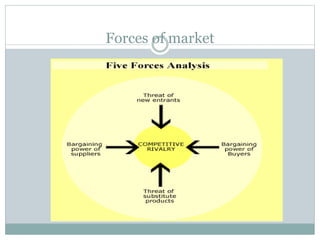
Forces of market
Demand
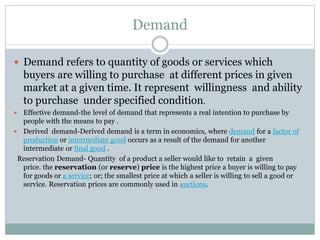
 Demand refers to quantity of goods or services which
buyers are willing to purchase at different prices in given
market at a given time. It represent willingness and ability
to purchase under specified condition.
 Effective demand-the level of demand that represents a real intention to purchase by
people with the means to pay .
 Derived demand-Derived demand is a term in economics, where demand for a factor of
production or intermediate good occurs as a result of the demand for another
intermediate or final good .
Reservation Demand- Quantity of a product a seller would like to retain a given
price. the reservation (or reserve) price is the highest price a buyer is willing to pay
for goods or a service; or; the smallest price at which a seller is willing to sell a good or
service. Reservation prices are commonly used in auctions.
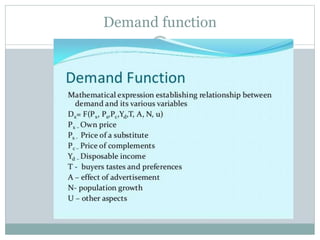
Demand function
Supply
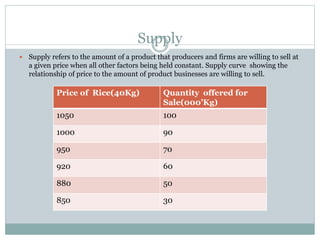
 Supply refers to the amount of a product that producers and firms are willing to sell at
a given price when all other factors being held constant. Supply curve showing the
relationship of price to the amount of product businesses are willing to sell.
Price of Rice(40Kg) Quantity offered for
Sale(000’Kg)
1050 100
1000 90
950 70
920 60
880 50
850 30
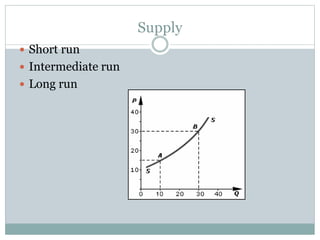
Supply
 Short run
 Intermediate run
 Long run
Factors of Supply
 Two main sources of supply: Domestic farm production& Import
Domestic farm production
 Weather
 Technology
 Irrigation facilities
 Land suitable for cultivation
 Acreage under various crops
 Availability of inputs
 Relative inter- crop and input-output price
Import
 Price difference and shipment cost
 Objectives of the national policy
 Ability of the country to resort to import
 Need of the country to earn foreign exchange
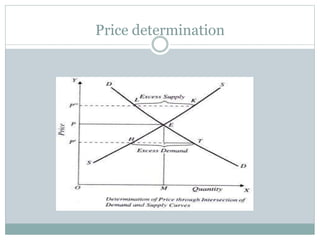
Price determination
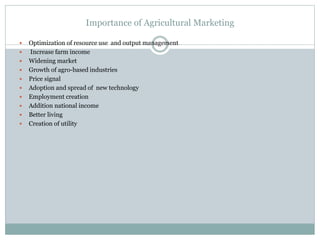
Importance of Agricultural Marketing
 Optimization of resource use and output management
 Increase farm income
 Widening market
 Growth of agro-based industries
 Price signal
 Adoption and spread of new technology
 Employment creation
 Addition national income
 Better living
 Creation of utility
History of Ag. Marketing Development
 Specialization
 Urbanization
 Transportation& communication
 Technological change in agriculture
Producer surplus
Quantity made available to the non-producing population of the country.
1.Farming sound price policies
2.Developing proper procurement and purchase strategies
3.Checking undue price fluctuations
4.Export & Import decision
5.Development of transport and storage systems.
Producer surplus
Marketable surplus : It is the quantity of produce
which can be made available to the non – farm
population of the country.
MS = P-C
Where, MS = Marketable surplus
P= Total Production
C= Total Requirement( family
consumption, farm need, payment to labor,
artisans, landlord and payment for social and
religious work)
Producer Surplus
Marketed Surplus :
Marketed surplus is that quantity of the produce which producer-
farmers actually sell in the market irrespective of their requirements
for family consumption, farm needs and others payment.
Marketed surplus<Marketable surplus
Marketed surplus>Marketable surplus
Marketed surplus=Marketable surplus
Factors affecting Marketable Surplus
 Size of Holding
 Production
 Price of commodity
 Size of family
 Requirement of Seed& feed
 Nature of commodity
 Consumption Habits
Concept Of Agricultural Marketing

Concept Of Agricultural Marketing

  • 1.
    Concept Of AgriculturalMarketing A.S. M. Fazlul Hoque Lecturer Dept. Of Agribusiness & Marketing Sher-e Bangla Agricultural University
  • 2.
    Agricultural Marketing The processby which companies create value for customers and build strong customer relationships in order to capture value from customers in return. Marketing is managing profitable customer relationships. Marketing is the activity of identifying and satisfying need and wants of customers in profitable way Agricultural Marketing is the study of all the activities, agencies, and polices involved in the procurement of farm inputs by the farmers and the movement of agricultural products from the farm to the consumers . Agricultural Marketing is an effort to estimate demand for farm inputs and to ensure regular supply of those, to dispose farm product to a proper consumption point.
  • 3.
    Need For Understand Farmer/producer  Consumers  Market middlemen & traders  Government
  • 4.
    Difference Between Agri-Productand Manufactured Product  Perishability  Seasonality of production  Bulkiness of product  Variation in quality  Irregular supply  Small size of holdings and scattered production  Processing
  • 5.
    New role ofAg. Marketing  Enhance Food Security  Increase productivity and competitiveness of agricultural sector  Creation of utility  Changes govt. intervention in Ag.Market  Urbanization  specialization in activities of comparative advantage  enhanced resource-use efficiency and trade advances in marketing with economic growth
  • 6.
    Problems of Agri.Marketing Price fluctuation Large number of middlemen Small and scattered holding Forced sale Technological development problems in farm production Lack of transport facilities Poor handling, packing, packaging, and processing facilities Lack of uniform standardization and grading Inadequate storage capacity and warehousing facilities Adulteration of produce and malpractices in market Growth of urban centers Communication problem Lack of information about production and marketing Lack of farmers’ organization Inadequate research on marketing
  • 7.
    Removing Problems  Establishmentof Regulated Markets  Standardization and grading  Improvement in handling and packing  Provision of storage facilities  Improving transport facilities  Market information  Market extension  Provision of agricultural marketing training to farmers  Cooperative marketing  Provision of cold storage facilities and refrigerated transport  Development of physical market
  • 8.
    Prospects Of Ag.Marketing Agro based economy Rural population Low number of SME enterprise International market Govt. Support Easy access to financial institutions Tax holiday for agri - industries
  • 9.
    Market  Latin wordmarcatus meaning merchandise or trade or a place where business is conducted.  Kotler , market as an area for potential exchanges  AMA, aggregate demand of the potential buyers for a product/ service.  Market is nothing but a price at which both the buyers and seller are interested to exchange commodities.  Market is a set of potential & actual customers
  • 10.
    Components Of Market Existence of Commodity/Service  Buyers& seller  Business relationship  Demarcation of area
  • 11.
    General ConceptsUsedIn Marketing Balanceof Trade Brand& Branding Cartel Consumer Franchise Consumerism Differentiated Marketing Farmers terms of trade Food Retailing Free Market Law of One Price(LOOP) Marketing Mix Marketing Process Marketing Strategy Market Segmentation Terms of trade Trade Mark
  • 12.
    On the basisof Location  Village Market  Primary Market  Secondary Market  Terminal Market  Seaboard Market
  • 13.
    On the BasisOf Area Coverage  Local or Village Market  Regional Market  National Market  International Market
  • 14.
    On the BasisOf Time Span  Short period Market  Periodic Market  Long Period Market  Secular Market
  • 15.
    On the basisof Volume of Transaction  Wholesale Market  Retail Market
  • 16.
    On the basisof Nature of Transactions  Cash Market  Forward Market
  • 17.
    On the basisof Numbers of commodities transacted  General Market  Specialized Market
  • 18.
    On the basisof Nature of commodities transacted  Commodity Market  Capital Market
  • 19.
    On the basisof Degree of Competition  Perfect Market  Monopoly Market  Duopoly Market  Oligopoly Market  Monopolistic Competitive Market
  • 20.
    On the basisof Stage of Marketing  Producing Market  Consuming Market
  • 21.
    On the basisof Extent of Public Intervention  Regulated Market  Un-Regulated Market
  • 22.
    On the basisof Type of Population Served  Urban Market  Rural Market
  • 23.
    On the basisof Market Functionaries And Accrual of Marketing Margin  Farmers Market  Cooperative Market  General Market
  • 24.
    Market Growth 1.Functional growth GeneralMarket Specialized Market Dealings with samples Dealings with grades 2.Geographical growth
  • 25.
    Factors Affecting Rateof Market Development  Nature of Demand  Nature of Product  Transportation & Communication Facilities  Quantum of Supply & Demand  Public Policies  Banking Facilities  Peace & Security  Economic Growth
  • 26.
    Market Structure  Theterm structure refers to something that organization and dimension-shape, size and design; which is evolved for the purpose of performing a function.  Market Structure refers to those characteristics of the market which affect the traders’ behavior and performance.  Market structure is the formal organization of the functional activity of market institution.
  • 27.
    Components of MarketStructure  Concentration of Market Power  Degree of Product Differentiation  Conditions for entry of Firms in the Market  Flow of Market Information  Degree of Integration
  • 28.
    Dynamics of MarketStructure –Conduct and Performance The market structure determines the market conduct and performance. The term market conduct refers to the patterns of behavior of firms, specially in relation to pricing and their practices in adapting and adjusting to the market in which they function . a. Market sharing and price setting policies b. Policies aimed at coercing rivals c. Policies towards setting the quality of products
  • 29.
    Dynamics of MarketStructure – Conduct and Performance  The term performance refers to the economic results that flow from the industry as each firms pursues its particular line of conduct. 1.Efficiency in resource use 2.The existence of monopoly or monopoly profit 3. Dynamics progressiveness of the system & social welfare 4.Problems of inequalities a. Market intermediaries b. small farmers discrimination c. Disturbance of inter product price parity- parity price as the purchasing power of a particular commodity relative to a farmer's expenses such as wages, interest on debt, equipment, taxes and so forth
  • 30.
    Changes in Market Production Pattern  Demand Pattern  Cost of Marketing Function  Technological changes in industry
  • 31.
    Market Forces  Theforces which affect the process of price determination, either directly or indirectly may be termed as market forces. It may be tangible or intangible.
  • 32.
  • 33.
    Demand  Demand refersto quantity of goods or services which buyers are willing to purchase at different prices in given market at a given time. It represent willingness and ability to purchase under specified condition.  Effective demand-the level of demand that represents a real intention to purchase by people with the means to pay .  Derived demand-Derived demand is a term in economics, where demand for a factor of production or intermediate good occurs as a result of the demand for another intermediate or final good . Reservation Demand- Quantity of a product a seller would like to retain a given price. the reservation (or reserve) price is the highest price a buyer is willing to pay for goods or a service; or; the smallest price at which a seller is willing to sell a good or service. Reservation prices are commonly used in auctions.
  • 34.
  • 35.
    Supply  Supply refersto the amount of a product that producers and firms are willing to sell at a given price when all other factors being held constant. Supply curve showing the relationship of price to the amount of product businesses are willing to sell. Price of Rice(40Kg) Quantity offered for Sale(000’Kg) 1050 100 1000 90 950 70 920 60 880 50 850 30
  • 36.
    Supply  Short run Intermediate run  Long run
  • 37.
    Factors of Supply Two main sources of supply: Domestic farm production& Import Domestic farm production  Weather  Technology  Irrigation facilities  Land suitable for cultivation  Acreage under various crops  Availability of inputs  Relative inter- crop and input-output price
  • 38.
    Import  Price differenceand shipment cost  Objectives of the national policy  Ability of the country to resort to import  Need of the country to earn foreign exchange
  • 39.
  • 40.
    Importance of AgriculturalMarketing  Optimization of resource use and output management  Increase farm income  Widening market  Growth of agro-based industries  Price signal  Adoption and spread of new technology  Employment creation  Addition national income  Better living  Creation of utility
  • 41.
    History of Ag.Marketing Development  Specialization  Urbanization  Transportation& communication  Technological change in agriculture
  • 42.
    Producer surplus Quantity madeavailable to the non-producing population of the country. 1.Farming sound price policies 2.Developing proper procurement and purchase strategies 3.Checking undue price fluctuations 4.Export & Import decision 5.Development of transport and storage systems.
  • 43.
    Producer surplus Marketable surplus: It is the quantity of produce which can be made available to the non – farm population of the country. MS = P-C Where, MS = Marketable surplus P= Total Production C= Total Requirement( family consumption, farm need, payment to labor, artisans, landlord and payment for social and religious work)
  • 44.
    Producer Surplus Marketed Surplus: Marketed surplus is that quantity of the produce which producer- farmers actually sell in the market irrespective of their requirements for family consumption, farm needs and others payment. Marketed surplus<Marketable surplus Marketed surplus>Marketable surplus Marketed surplus=Marketable surplus
  • 45.
    Factors affecting MarketableSurplus  Size of Holding  Production  Price of commodity  Size of family  Requirement of Seed& feed  Nature of commodity  Consumption Habits