AGRICULTURAL MARKETING
By
PRAJWAL V J
Contents
01 Introduction to Agricultural Marketing
02
Nature and scope of Agricultural marketing
Key aspects of agricultural marketing
03
Challenges in Agricultural Marketing
04
Differences between Rural and Agricultural
marketing
Objectives of Agriculture Marketing
05
06
07
Classification of agricultural markets
Introduction to Agricultural Marketing
Definitions
Human activity directed at satisfying the needs and wants through exchange process (Phillip
Kotler).
Performance of business activities that directs the flow of goods and services from producers to
users (American Marketing Association).
The study of agricultural marketing comprises all the operations, and the agencies conducting them,
involved in the movement of farm produced foods; raw materials and their derivatives, such as
textiles, from the farms to the final consumers, and the effect of such operations on the farmers,
middlemen and consumers.
The term agricultural marketing is composed of two words- agriculture and
marketing.
Agriculture: growing and/or raising of crops and livestock
Marketing: It encompasses a series of activities involved in moving the goods
from the point of production to point of consumption.
https://youtu.be/ShoD-FOlMUY
• All activities from supply of farm inputs to the farmers and movement of agricultural products from the farms to the
consumers
• Two major sub systems
o Product marketing - farmers, village/primary traders, wholesalers, processors, importers, exporters, marketing
cooperatives, regulated marketing committees and retailers.
o Input (factor) marketing. - manufacturers, distributors, related associations, importers, exporters and others
• Link between the farm and non-farm sectors.
• Agricultural marketing includes marketing functions, agencies, channels, efficiency and costs, price spread and market
integration, producer’s surplus, government policy and research, training and statistics on agricultural marketing and
imports/exports of agricultural commodities.
Key aspects of agricultural marketing
• Perishability of the product
• Seasonality of production
• Bulkiness of products
• Variation in quality of products
• Irregular supply of agricultural products
• Small size of holding and scattered production
• Product pricing
• Processing
Scope of Agricultural marketing
Marketing of farm products that are produced by the farmers and also includes marketing of
farm inputs required by the farmers in process of production i.e. the subjects includes output
marketing as well as input marketing.
Achieving economic growth and development
Nature of Agricultural marketing
Objectives of Agriculture Marketing
Increasing profit of
farmer
Giving up to date
information
Creating scientific
storage capacity
Stabilizing price level
Providing finance to increase
farmers income at less rates
and zero rates
Integrated value chains to
provide vertical integration of
farmers with primary processors
https://youtu.be/9yoArSI4q3I
Using ICT to make farmers to face
problems and challenges faced in
agricultural marketing
https://youtu.be/vTDvQT_Kenw
Objectives
01
Improper Warehouses
04
Presence of a Large
Number of Middlemen
02
Lack of Grading and
Standardization
05
Malpractices in
Unregulated Markets
03
Inadequate
Transport Facilities
.
06
Inadequate Market
Information
07
Inadequate Credit
Facilities
Challenges in Agricultural Marketing
Differences between Rural and Agricultural marketing
RURAL
MARKETING
AGRICULTURAL
MARKETING
Services involved in moving
agricultural product from
farm to consumer
Meeting needs
and of farmers
Handling agricultural
related products
Developing, pricing,
promoting and distribution
of products and services
Meeting rural customers
needs and demands
Handling all the products
and services to satisfy
both rural customers and
expectations of the
company
Add Text
Simple PowerPoint
Presentation
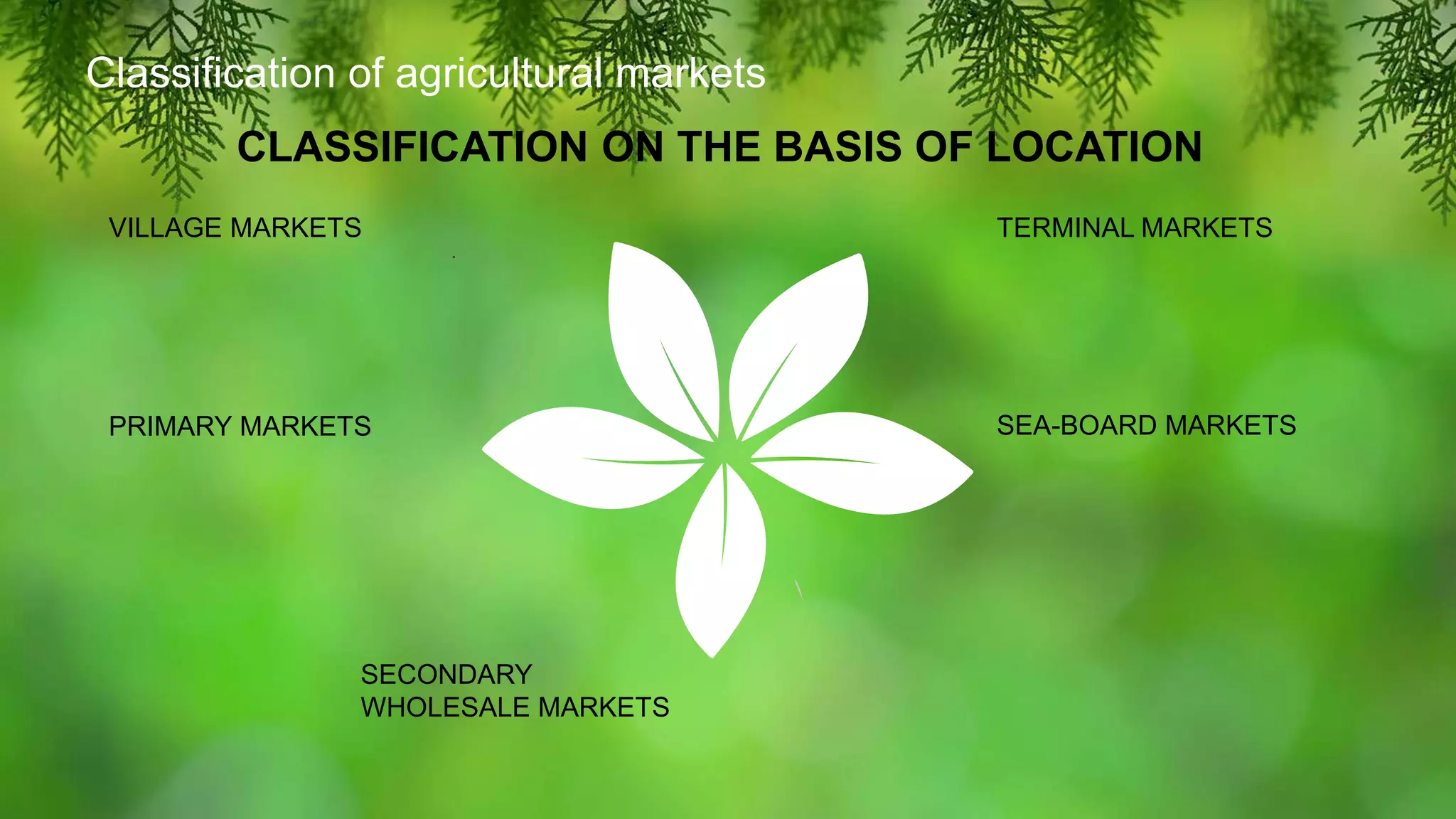
CLASSIFICATION ON THE BASIS OF LOCATION
TERMINAL MARKETS
SEA-BOARD MARKETS
VILLAGE MARKETS
.
PRIMARY MARKETS
SECONDARY
WHOLESALE MARKETS
Classification of agricultural markets
CLASSIFICATION ON THE BASIS OF AREA OR COVERAGE
NATIONAL MARKETS
.
WORLD/INTERNATIONAL
MARKETS
.
LOCAL/VILLAGE
MARKETS
REGIONAL MARKETS
CLASSIFICATION ON THE BASIS OF TIME SPAN
LONG PERIOD MARKETS
SECULAR MARKETS
SHORT PERIOD MARKETS
PERIODIC MARKETS
CLASSIFICATION ON THE BASIS OF VOLUME OF TRANSACTIONS
2. RETAIL MARKETS
2. FORWARD MARKETS
1. WHOLESALE MARKETS
1. SPOT/CASH MARKETS
CLASSIFICATION ON THE BASIS OF NATURE OF TRANSACTIONS
CLASSIFICATION ON THE BASIS OF NUMBER OF COMMODITIES TRANSACTED
1. GENERAL MARKETS
2. SPECIAL MARKETS
CLASSIFICATION ON THE BASIS OF DEGREE OF COMPETITION
OLIGOPOLY MARKETS
MONOPOLISTIC
COMPETITIVE MARKET
PERFECT MARKETS
.
MONOPOLY MARKETS
DUOPOLY MARKETS
CLASSIFICATION ON THE BASIS OF COMMODITIES
CAPITAL MARKETS
CONSUMING MARKETS
UN- REGULATED MARKETS
COMMODITY MARKETS
PRODUCING MARKETS
REGULATED MARKETS
.
CLASSIFICATION ON THE BASIS OF STAGE OF MARKETING
CLASSIFICATION ON THE BASIS OF EXTENT OF PUBLIC INTERVENTION
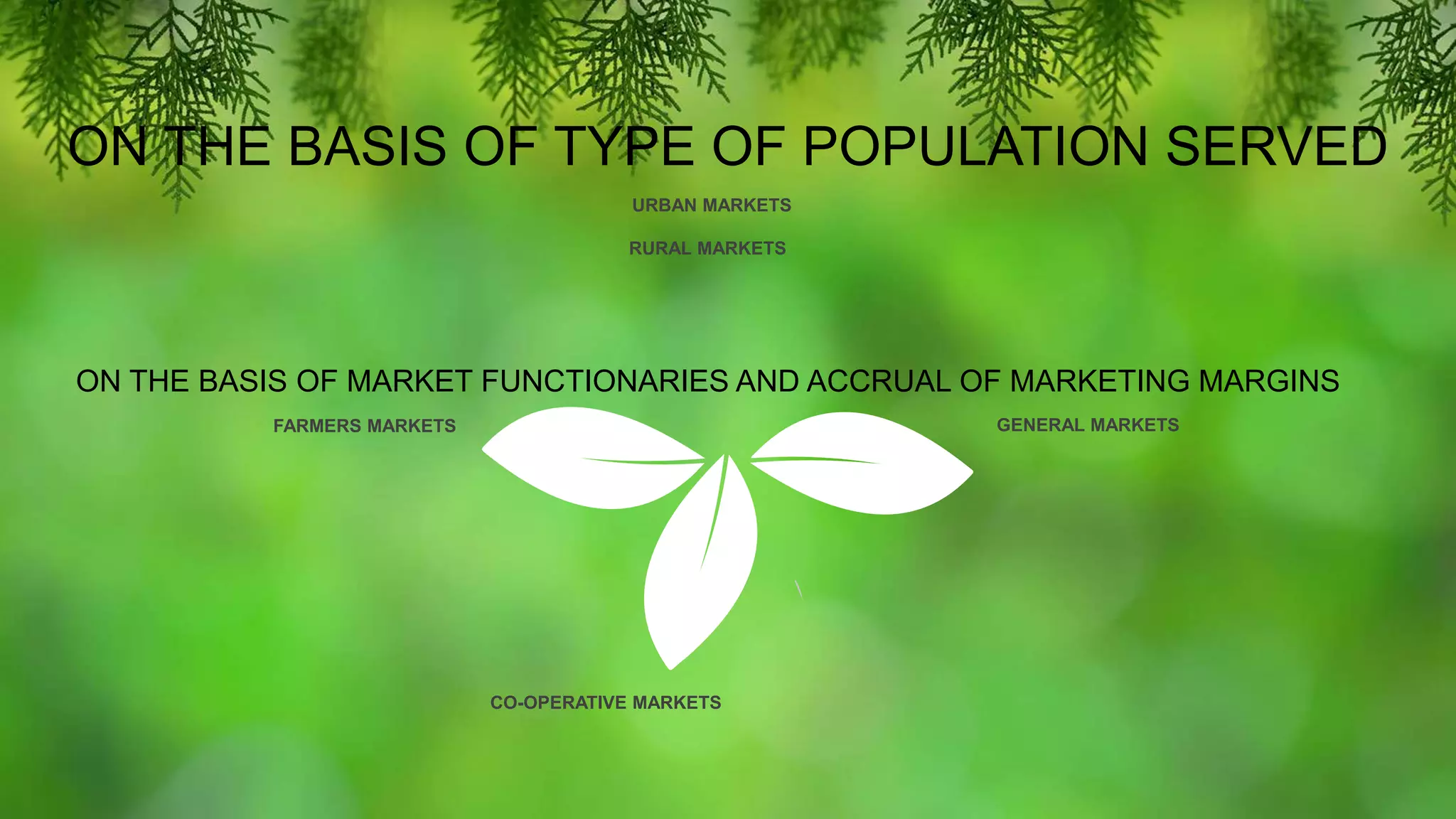
ON THE BASIS OF TYPE OF POPULATION SERVED
RURAL MARKETS
GENERAL MARKETS
URBAN MARKETS
FARMERS MARKETS
CO-OPERATIVE MARKETS
ON THE BASIS OF MARKET FUNCTIONARIES AND ACCRUAL OF MARKETING MARGINS
Thank you
Insert your subtitle here

Agricultural marketing

  • 1.
  • 2.
    Contents 01 Introduction toAgricultural Marketing 02 Nature and scope of Agricultural marketing Key aspects of agricultural marketing 03 Challenges in Agricultural Marketing 04 Differences between Rural and Agricultural marketing Objectives of Agriculture Marketing 05 06 07 Classification of agricultural markets
  • 3.
    Introduction to AgriculturalMarketing Definitions Human activity directed at satisfying the needs and wants through exchange process (Phillip Kotler). Performance of business activities that directs the flow of goods and services from producers to users (American Marketing Association). The study of agricultural marketing comprises all the operations, and the agencies conducting them, involved in the movement of farm produced foods; raw materials and their derivatives, such as textiles, from the farms to the final consumers, and the effect of such operations on the farmers, middlemen and consumers. The term agricultural marketing is composed of two words- agriculture and marketing. Agriculture: growing and/or raising of crops and livestock Marketing: It encompasses a series of activities involved in moving the goods from the point of production to point of consumption. https://youtu.be/ShoD-FOlMUY
  • 4.
    • All activitiesfrom supply of farm inputs to the farmers and movement of agricultural products from the farms to the consumers • Two major sub systems o Product marketing - farmers, village/primary traders, wholesalers, processors, importers, exporters, marketing cooperatives, regulated marketing committees and retailers. o Input (factor) marketing. - manufacturers, distributors, related associations, importers, exporters and others • Link between the farm and non-farm sectors. • Agricultural marketing includes marketing functions, agencies, channels, efficiency and costs, price spread and market integration, producer’s surplus, government policy and research, training and statistics on agricultural marketing and imports/exports of agricultural commodities. Key aspects of agricultural marketing
  • 5.
    • Perishability ofthe product • Seasonality of production • Bulkiness of products • Variation in quality of products • Irregular supply of agricultural products • Small size of holding and scattered production • Product pricing • Processing Scope of Agricultural marketing Marketing of farm products that are produced by the farmers and also includes marketing of farm inputs required by the farmers in process of production i.e. the subjects includes output marketing as well as input marketing. Achieving economic growth and development Nature of Agricultural marketing
  • 6.
    Objectives of AgricultureMarketing Increasing profit of farmer Giving up to date information Creating scientific storage capacity Stabilizing price level Providing finance to increase farmers income at less rates and zero rates Integrated value chains to provide vertical integration of farmers with primary processors https://youtu.be/9yoArSI4q3I Using ICT to make farmers to face problems and challenges faced in agricultural marketing https://youtu.be/vTDvQT_Kenw Objectives
  • 7.
    01 Improper Warehouses 04 Presence ofa Large Number of Middlemen 02 Lack of Grading and Standardization 05 Malpractices in Unregulated Markets 03 Inadequate Transport Facilities . 06 Inadequate Market Information 07 Inadequate Credit Facilities Challenges in Agricultural Marketing
  • 8.
    Differences between Ruraland Agricultural marketing RURAL MARKETING AGRICULTURAL MARKETING Services involved in moving agricultural product from farm to consumer Meeting needs and of farmers Handling agricultural related products Developing, pricing, promoting and distribution of products and services Meeting rural customers needs and demands Handling all the products and services to satisfy both rural customers and expectations of the company Add Text Simple PowerPoint Presentation
  • 9.
    CLASSIFICATION ON THEBASIS OF LOCATION TERMINAL MARKETS SEA-BOARD MARKETS VILLAGE MARKETS . PRIMARY MARKETS SECONDARY WHOLESALE MARKETS Classification of agricultural markets
  • 10.
    CLASSIFICATION ON THEBASIS OF AREA OR COVERAGE NATIONAL MARKETS . WORLD/INTERNATIONAL MARKETS . LOCAL/VILLAGE MARKETS REGIONAL MARKETS
  • 11.
    CLASSIFICATION ON THEBASIS OF TIME SPAN LONG PERIOD MARKETS SECULAR MARKETS SHORT PERIOD MARKETS PERIODIC MARKETS
  • 12.
    CLASSIFICATION ON THEBASIS OF VOLUME OF TRANSACTIONS 2. RETAIL MARKETS 2. FORWARD MARKETS 1. WHOLESALE MARKETS 1. SPOT/CASH MARKETS CLASSIFICATION ON THE BASIS OF NATURE OF TRANSACTIONS CLASSIFICATION ON THE BASIS OF NUMBER OF COMMODITIES TRANSACTED 1. GENERAL MARKETS 2. SPECIAL MARKETS
  • 13.
    CLASSIFICATION ON THEBASIS OF DEGREE OF COMPETITION OLIGOPOLY MARKETS MONOPOLISTIC COMPETITIVE MARKET PERFECT MARKETS . MONOPOLY MARKETS DUOPOLY MARKETS
  • 14.
    CLASSIFICATION ON THEBASIS OF COMMODITIES CAPITAL MARKETS CONSUMING MARKETS UN- REGULATED MARKETS COMMODITY MARKETS PRODUCING MARKETS REGULATED MARKETS . CLASSIFICATION ON THE BASIS OF STAGE OF MARKETING CLASSIFICATION ON THE BASIS OF EXTENT OF PUBLIC INTERVENTION
  • 15.
    ON THE BASISOF TYPE OF POPULATION SERVED RURAL MARKETS GENERAL MARKETS URBAN MARKETS FARMERS MARKETS CO-OPERATIVE MARKETS ON THE BASIS OF MARKET FUNCTIONARIES AND ACCRUAL OF MARKETING MARGINS
  • 16.
    Thank you Insert yoursubtitle here