Prepared BY:
Gurukrushna Patnaik
What is Supply Chain
2
MEANING & DEFINATION
A supply chain is a network of supplier, manufacturing, assembly,
distribution, and logistics facilities that perform a functions of procurement
of materials, transportation of these materials into intermediate and finished
products, and distribution of these products to customers.
Supply chain management (SCM) is the management of the flow of
goods. It includes the movement and storage of raw materials, work-in-
process inventory, and finished goods from point of origin to point of
consumption
3
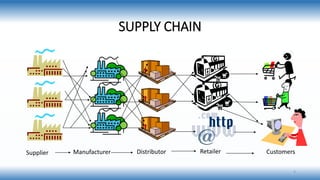
SUPPLY CHAIN
Supplier Manufacturer Distributor Retailer Customers
4
SUPPLY CHAIN MANAGEMENT
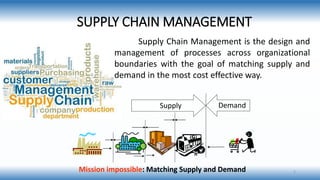
Supply Chain Management is the design and
management of processes across organizational
boundaries with the goal of matching supply and
demand in the most cost effective way.
Supply Demand
Mission impossible: Matching Supply and Demand 5
TYPES OF SUPPLY CHAIN
Raw Supply Chain
Ripe Supply Chain
Internal Supply Chain
Extended Supply Chain
Self-monitored Supply Chain
Outsourced Supply Chain
Production-Oriented Supply Chain
Financial-Oriented Supply Chain
Market-Oriented Supply Chain
6
OBJECTIVE OF SUPPLY CHAIN MANAGEMENT
Service Oriented
System Oriented
Competitiveness and Efficiency
Minimizing the time
Minimizing Work-In-Progress
Improving visibility of Demand
Improving Quality
Reduces Transportation
Reduces Warehousing
7
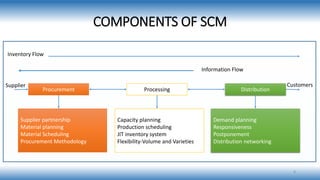
COMPONENTS OF SCM
Supplier partnership
Material planning
Material Scheduling
Procurement Methodology
Capacity planning
Production scheduling
JIT inventory system
Flexibility-Volume and Varieties
Demand planning
Responsiveness
Postponement
Distribution networking
Procurement Processing Distribution
Information Flow
Inventory Flow
Supplier Customers
8
FUNCTIONS
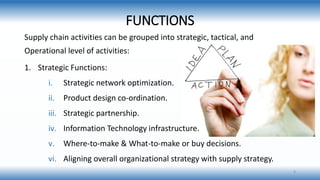
Supply chain activities can be grouped into strategic, tactical, and
Operational level of activities:
1. Strategic Functions:
i. Strategic network optimization.
ii. Product design co-ordination.
iii. Strategic partnership.
iv. Information Technology infrastructure.
v. Where-to-make & What-to-make or buy decisions.
vi. Aligning overall organizational strategy with supply strategy.
9
FUNCTIONS
2. Tactical Functions:
i. Sourcing contracts and other purchasing decision.
ii. Production decision.
iii. Inventory decision.
iv. Transportation strategy.
v. Milestone payments
vi. Focus on customer demand
10
FUNCTIONS
3. Operational Functions:
i. Daily production and distribution planning.
ii. Production scheduling.
iii. Demand planning and forecasting.
iv. Inbound operations
v. Outbound operations.
vi. Order promising.
11
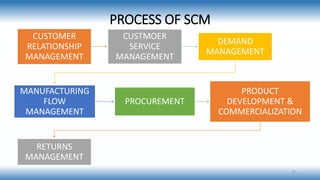
PROCESS OF SCM
CUSTOMER
RELATIONSHIP
MANAGEMENT
CUSTMOER
SERVICE
MANAGEMENT
DEMAND
MANAGEMENT
MANUFACTURING
FLOW
MANAGEMENT
PROCUREMENT
PRODUCT
DEVELOPMENT &
COMMERCIALIZATION
RETURNS
MANAGEMENT
12
FACTOR INFLUENCING SCM
Customer demand
Globalization
Competition
Information and communication
Government regulation
Environment
13
IMPORTATNCE
Reduce inventory cost
Provide better medium for information sharing among the partners.
Improves customer satisfaction as well as service.
Maintains better trust between partner.
Provide efficient manufacturing strategy.
Improve process integration.
Improves quality and gives higher profit margin.
14
15

Supply chain management

  • 1.
  • 2.
  • 3.
    MEANING & DEFINATION Asupply chain is a network of supplier, manufacturing, assembly, distribution, and logistics facilities that perform a functions of procurement of materials, transportation of these materials into intermediate and finished products, and distribution of these products to customers. Supply chain management (SCM) is the management of the flow of goods. It includes the movement and storage of raw materials, work-in- process inventory, and finished goods from point of origin to point of consumption 3
  • 4.
    SUPPLY CHAIN Supplier ManufacturerDistributor Retailer Customers 4
  • 5.
    SUPPLY CHAIN MANAGEMENT SupplyChain Management is the design and management of processes across organizational boundaries with the goal of matching supply and demand in the most cost effective way. Supply Demand Mission impossible: Matching Supply and Demand 5
  • 6.
    TYPES OF SUPPLYCHAIN Raw Supply Chain Ripe Supply Chain Internal Supply Chain Extended Supply Chain Self-monitored Supply Chain Outsourced Supply Chain Production-Oriented Supply Chain Financial-Oriented Supply Chain Market-Oriented Supply Chain 6
  • 7.
    OBJECTIVE OF SUPPLYCHAIN MANAGEMENT Service Oriented System Oriented Competitiveness and Efficiency Minimizing the time Minimizing Work-In-Progress Improving visibility of Demand Improving Quality Reduces Transportation Reduces Warehousing 7
  • 8.
    COMPONENTS OF SCM Supplierpartnership Material planning Material Scheduling Procurement Methodology Capacity planning Production scheduling JIT inventory system Flexibility-Volume and Varieties Demand planning Responsiveness Postponement Distribution networking Procurement Processing Distribution Information Flow Inventory Flow Supplier Customers 8
  • 9.
    FUNCTIONS Supply chain activitiescan be grouped into strategic, tactical, and Operational level of activities: 1. Strategic Functions: i. Strategic network optimization. ii. Product design co-ordination. iii. Strategic partnership. iv. Information Technology infrastructure. v. Where-to-make & What-to-make or buy decisions. vi. Aligning overall organizational strategy with supply strategy. 9
  • 10.
    FUNCTIONS 2. Tactical Functions: i.Sourcing contracts and other purchasing decision. ii. Production decision. iii. Inventory decision. iv. Transportation strategy. v. Milestone payments vi. Focus on customer demand 10
  • 11.
    FUNCTIONS 3. Operational Functions: i.Daily production and distribution planning. ii. Production scheduling. iii. Demand planning and forecasting. iv. Inbound operations v. Outbound operations. vi. Order promising. 11
  • 12.
  • 13.
    FACTOR INFLUENCING SCM Customerdemand Globalization Competition Information and communication Government regulation Environment 13
  • 14.
    IMPORTATNCE Reduce inventory cost Providebetter medium for information sharing among the partners. Improves customer satisfaction as well as service. Maintains better trust between partner. Provide efficient manufacturing strategy. Improve process integration. Improves quality and gives higher profit margin. 14
  • 15.