Warehousing Management
http://study.com/academy/lesson/warehouse-management-systems-types-
benefits.html
WAREHOUSING AND STORAGE
“Warehousing and storage is an act of storing and assorting the
finished goods so as to create maximum time utility at
minimum cost”
 Need for storage arises both for raw material as well as
finished products
 STORAGE involves proper management for preserving goods
from the time of their production or purchase till actual use.
 When this storage is done on a large scale and in a specified
manner it is called WAREHOUSING.
 Is a key part of the supply chain.
Now a days, many private firms are turning to distribution
centers rather than constructing the warehouses.
DEFINITION AND ITS FUNCTIONS
 According to Robert Hughes-
“warehousing is the set of activities that are involved in
receiving and storing of goods and preparing them for
reshipment “
Warehousing is not only concerned with storage facilities
but also involved in various other activities like –
 Receiving,
 identifying,
 Holding
 Assembling and preparing to meet the demand
BASIC FUNCTION PERFORMED
Storage function
Performed by storing products in the warehouse till delivery to
ultimate consumer
Movement function
Receipt of
products from
manufacturing
plant
Transfer into
the warehouse
Placement at
designated
place
Regrouping
products
Transferring
on transport
vehicle
ECONOMIC AND SERVICE BENEFIT OF
WAREHOUSING
 Economic benefits - Consolidation, Break
bulk, Cross Dock, processing postponement,
stock piling[seasonal storage]
 Service benefits - spot stocking,
Assortment, mixing, production support,
market presence
ECONOMIC BENEFITS
Consolidation
warehouse
Plant B
[Product B for
Customer X]
Plant C
[Product C for
Customer X]
Customer X
[Product A+
Product B+
Product C]
Plant A
[Product A for
Customer X]
CONSOLIDATION
Plant A
[Product A
for
Customers
X+Y+Z]
Break bulk
warehouse
Customer
X
Customer
Y
Customer
Z
BREAK BULK WAREHOUSE
CROSS DOCK WAREHOUSE
Plant A
[Product A]
For
W, X, Z
Plant B
[Product B]
For
W,X,Y,Z
Cross Dock
warehouse
Customer W
[A+B+C]
Customer X
[A+B]
Customer Y
[B+C]
Customer Z
A+ C
Plant C
[Product C]
For
W, Y, Z
SERVICE BENEFITS
In transit mixing
Warehouse
[transit mixing point,
mix & make product
C]
Plant A
[Product A]
Plant B
[Product B]
Customer X
Products
A+ B+ C
Customer Y
Products
A+B
TRANSMIT MIXING WAREHOUSE
MANUFACTURING WAREHOUSE
Manufacturing
Warehouse
Vendor A
[part A]
Vendor B
[part B]
Vendor C
[part C] Assembly Line X
Assembly Line Y
Assembly Line Z
OPERATING PRINCIPLES OF
WAREHOUSE DESIGN
1. Design criteria
• Product Flow, Warehouse should be designed
round Material Handling Flow
WAREHOUSE ALTERNATIVES
Private Warehouses
Public Warehouses
WAREHOUSE ALTERNATIVES
1. Private Warehouses
 Owned or leased by the product owner
 Control is fully with the product owner
 Changes can be made to integrate the warehouse with
rest of the logistical system
 Provides market presence to the product owner
 There is no profit to be added to the cost
-continue
2. Public Warehouses
 Available to companies on hire
 Overheads get distributed over a large customer base
 As warehousing is their core business public warehouses
offer expertise in management
 Flexibility of location
 Significant scale economies, several users and resultant
volume, benefits in transportation costs
-continue
Public Vs
Private
Warehouse
FACTORS FOR IDEAL WAREHOUSES
 Convenient Location
 Availability Of Mechanical Appliances To Load and
Unload Goods
 Adequate Space
 Cold Storage Facilities
 Proper Arrangement for Protection
 Sufficient Parking Space
 Round the Clock Security Arrangement
 Latest Fire Fighting Equipment's
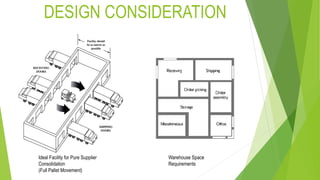
DESIGN CONSIDERATION
Ideal Facility for Pure Supplier
Consolidation
(Full Pallet Movement)
Warehouse Space
Requirements
TYPES OF WAREHOUSE
 General warehouse
 Specific warehouse
 Bonded warehouse (Custom)
 Bulk storage warehouse
 Refrigerated warehouse
WAREHOUSE LOCATION
 Centralized warehouse
 Decentralized warehouse
CENTRALISED WAREHOUSING
Benefits:
1. It improves operating efficiency and inventory control is
felt easier and effective.
2. There is no need to carry large stock and there are no
dangers of stock outs resulting in low level inventories.
3. Transport facilities are optimally used as routing and
scheduling becomes handy.
4. The firm is better placed to meet the demand fluctuations
from different market segments at relatively short notice.
-continue
Drawbacks:
1. It results in loss of customer service due to spatial
considerations and delays are caused.
2. The firm is deprived of its potential market share.
3. It results in heavy transport costs unless each
delivery is sizeable as the carrier has to cover long
distance.
DECENTREALISE WAREHOUSE
Benefits:
1. The firm serves the customers better positioning
the inventory in their proximity. This is the result
of maximum time utility created by it.
2. The firm is likely to effect savings in freight
charges because of bulk handling
3. It facilitates product movement by block rates
• Capital costs
— Costs of space & materials handling
equipment
• Operating costs
— Cost of labor
— Measure of labor productivity is the
number of units that an operator
COSTS OF OPERATING A WAREHOUSE
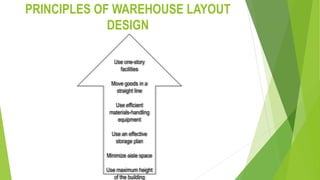
PRINCIPLES OF WAREHOUSE LAYOUT
DESIGN
Use one-story
facilities
Move goods in a
straight line
Use efficient
materials-handling
equipment
Use an effective
storage plan
Minimize aisle space
Use maximum height
of the building
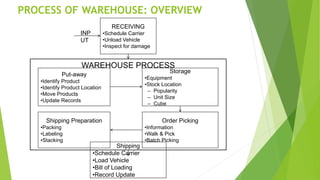
PROCESS OF WAREHOUSE: OVERVIEW
WAREHOUSE PROCESS
Put-away
•Identify Product
•Identify Product Location
•Move Products
•Update Records
Storage
•Equipment
•Stock Location
– Popularity
– Unit Size
– Cube
Shipping Preparation
•Packing
•Labeling
•Stacking
Order Picking
•Information
•Walk & Pick
•Batch Picking
RECEIVING
•Schedule Carrier
•Unload Vehicle
•Inspect for damage
INP
UT
Shipping
•Schedule Carrier
•Load Vehicle
•Bill of Loading
•Record Update
Options for Hiring Warehouse
 Spot Market Prize Option: Irregular or
unstable demand, Declining demand
 Lease Option: Stable Demand
 Flexible Lease Option: Fluctuating Demand

Warehouse

  • 1.
  • 2.
    WAREHOUSING AND STORAGE “Warehousingand storage is an act of storing and assorting the finished goods so as to create maximum time utility at minimum cost”  Need for storage arises both for raw material as well as finished products  STORAGE involves proper management for preserving goods from the time of their production or purchase till actual use.  When this storage is done on a large scale and in a specified manner it is called WAREHOUSING.  Is a key part of the supply chain. Now a days, many private firms are turning to distribution centers rather than constructing the warehouses.
  • 3.
    DEFINITION AND ITSFUNCTIONS  According to Robert Hughes- “warehousing is the set of activities that are involved in receiving and storing of goods and preparing them for reshipment “ Warehousing is not only concerned with storage facilities but also involved in various other activities like –  Receiving,  identifying,  Holding  Assembling and preparing to meet the demand
  • 4.
    BASIC FUNCTION PERFORMED Storagefunction Performed by storing products in the warehouse till delivery to ultimate consumer Movement function Receipt of products from manufacturing plant Transfer into the warehouse Placement at designated place Regrouping products Transferring on transport vehicle
  • 5.
    ECONOMIC AND SERVICEBENEFIT OF WAREHOUSING  Economic benefits - Consolidation, Break bulk, Cross Dock, processing postponement, stock piling[seasonal storage]  Service benefits - spot stocking, Assortment, mixing, production support, market presence
  • 6.
  • 7.
    Consolidation warehouse Plant B [Product Bfor Customer X] Plant C [Product C for Customer X] Customer X [Product A+ Product B+ Product C] Plant A [Product A for Customer X] CONSOLIDATION
  • 8.
    Plant A [Product A for Customers X+Y+Z] Breakbulk warehouse Customer X Customer Y Customer Z BREAK BULK WAREHOUSE
  • 9.
    CROSS DOCK WAREHOUSE PlantA [Product A] For W, X, Z Plant B [Product B] For W,X,Y,Z Cross Dock warehouse Customer W [A+B+C] Customer X [A+B] Customer Y [B+C] Customer Z A+ C Plant C [Product C] For W, Y, Z
  • 10.
  • 11.
    In transit mixing Warehouse [transitmixing point, mix & make product C] Plant A [Product A] Plant B [Product B] Customer X Products A+ B+ C Customer Y Products A+B TRANSMIT MIXING WAREHOUSE
  • 12.
    MANUFACTURING WAREHOUSE Manufacturing Warehouse Vendor A [partA] Vendor B [part B] Vendor C [part C] Assembly Line X Assembly Line Y Assembly Line Z
  • 13.
    OPERATING PRINCIPLES OF WAREHOUSEDESIGN 1. Design criteria • Product Flow, Warehouse should be designed round Material Handling Flow
  • 14.
  • 15.
    WAREHOUSE ALTERNATIVES 1. PrivateWarehouses  Owned or leased by the product owner  Control is fully with the product owner  Changes can be made to integrate the warehouse with rest of the logistical system  Provides market presence to the product owner  There is no profit to be added to the cost -continue
  • 16.
    2. Public Warehouses Available to companies on hire  Overheads get distributed over a large customer base  As warehousing is their core business public warehouses offer expertise in management  Flexibility of location  Significant scale economies, several users and resultant volume, benefits in transportation costs -continue
  • 17.
  • 18.
    FACTORS FOR IDEALWAREHOUSES  Convenient Location  Availability Of Mechanical Appliances To Load and Unload Goods  Adequate Space  Cold Storage Facilities  Proper Arrangement for Protection  Sufficient Parking Space  Round the Clock Security Arrangement  Latest Fire Fighting Equipment's
  • 19.
    DESIGN CONSIDERATION Ideal Facilityfor Pure Supplier Consolidation (Full Pallet Movement) Warehouse Space Requirements
  • 20.
    TYPES OF WAREHOUSE General warehouse  Specific warehouse  Bonded warehouse (Custom)  Bulk storage warehouse  Refrigerated warehouse
  • 21.
    WAREHOUSE LOCATION  Centralizedwarehouse  Decentralized warehouse
  • 23.
    CENTRALISED WAREHOUSING Benefits: 1. Itimproves operating efficiency and inventory control is felt easier and effective. 2. There is no need to carry large stock and there are no dangers of stock outs resulting in low level inventories. 3. Transport facilities are optimally used as routing and scheduling becomes handy. 4. The firm is better placed to meet the demand fluctuations from different market segments at relatively short notice. -continue
  • 24.
    Drawbacks: 1. It resultsin loss of customer service due to spatial considerations and delays are caused. 2. The firm is deprived of its potential market share. 3. It results in heavy transport costs unless each delivery is sizeable as the carrier has to cover long distance.
  • 25.
    DECENTREALISE WAREHOUSE Benefits: 1. Thefirm serves the customers better positioning the inventory in their proximity. This is the result of maximum time utility created by it. 2. The firm is likely to effect savings in freight charges because of bulk handling 3. It facilitates product movement by block rates
  • 26.
    • Capital costs —Costs of space & materials handling equipment • Operating costs — Cost of labor — Measure of labor productivity is the number of units that an operator COSTS OF OPERATING A WAREHOUSE
  • 27.
    PRINCIPLES OF WAREHOUSELAYOUT DESIGN Use one-story facilities Move goods in a straight line Use efficient materials-handling equipment Use an effective storage plan Minimize aisle space Use maximum height of the building
  • 28.
    PROCESS OF WAREHOUSE:OVERVIEW WAREHOUSE PROCESS Put-away •Identify Product •Identify Product Location •Move Products •Update Records Storage •Equipment •Stock Location – Popularity – Unit Size – Cube Shipping Preparation •Packing •Labeling •Stacking Order Picking •Information •Walk & Pick •Batch Picking RECEIVING •Schedule Carrier •Unload Vehicle •Inspect for damage INP UT Shipping •Schedule Carrier •Load Vehicle •Bill of Loading •Record Update
  • 29.
    Options for HiringWarehouse  Spot Market Prize Option: Irregular or unstable demand, Declining demand  Lease Option: Stable Demand  Flexible Lease Option: Fluctuating Demand