WAREHOUSING &
DISTRIBUTION
CONCEPT, TYPES, FUNCTIONS, FACTORS, COSTS
CONCEPT OF WAREHOUSING
 Godowns for keeping and storing goods to preserve goods in a
systematic manner to maintain original quality, quantity and usefulness.
 Raw materials, parts, components, in-processes, finished goods,
maintenance, repairing and operating supplies or any other items used
or sold of a firm.
 Demand of the product cannot be ascertained exactly
 No company can bear stock out situation as there are large number of
alternative products
TYPES OF WAREHOUSE
PUBLIC VS. PRIVATE WAREHOUSES
Public Warehouses
 Operating costs higher due to inclusion of
profit factor, selling and advertising
 No initial investment
 Can have good control due to incentive to
perform short-term contract
 Risk is minimal
 Can derive tax advantages
 Economies of scale is possible due to
serving many customes
 Consolidate to a warehouse and from the
warehouse to the customer.
 Storage and handling costs can be
ascertained for decision making
Private Warehouses
 10 to 25% lower if in sufficient
volumeLarge facility, startup, equipment,
trained personnel.
 Direct reaponsibility
 Risk of obsolescence due to change in
technology and demand.
 Depreciation alloeance
 Dependent on company’s volume
 No consolidation
 Only estimation
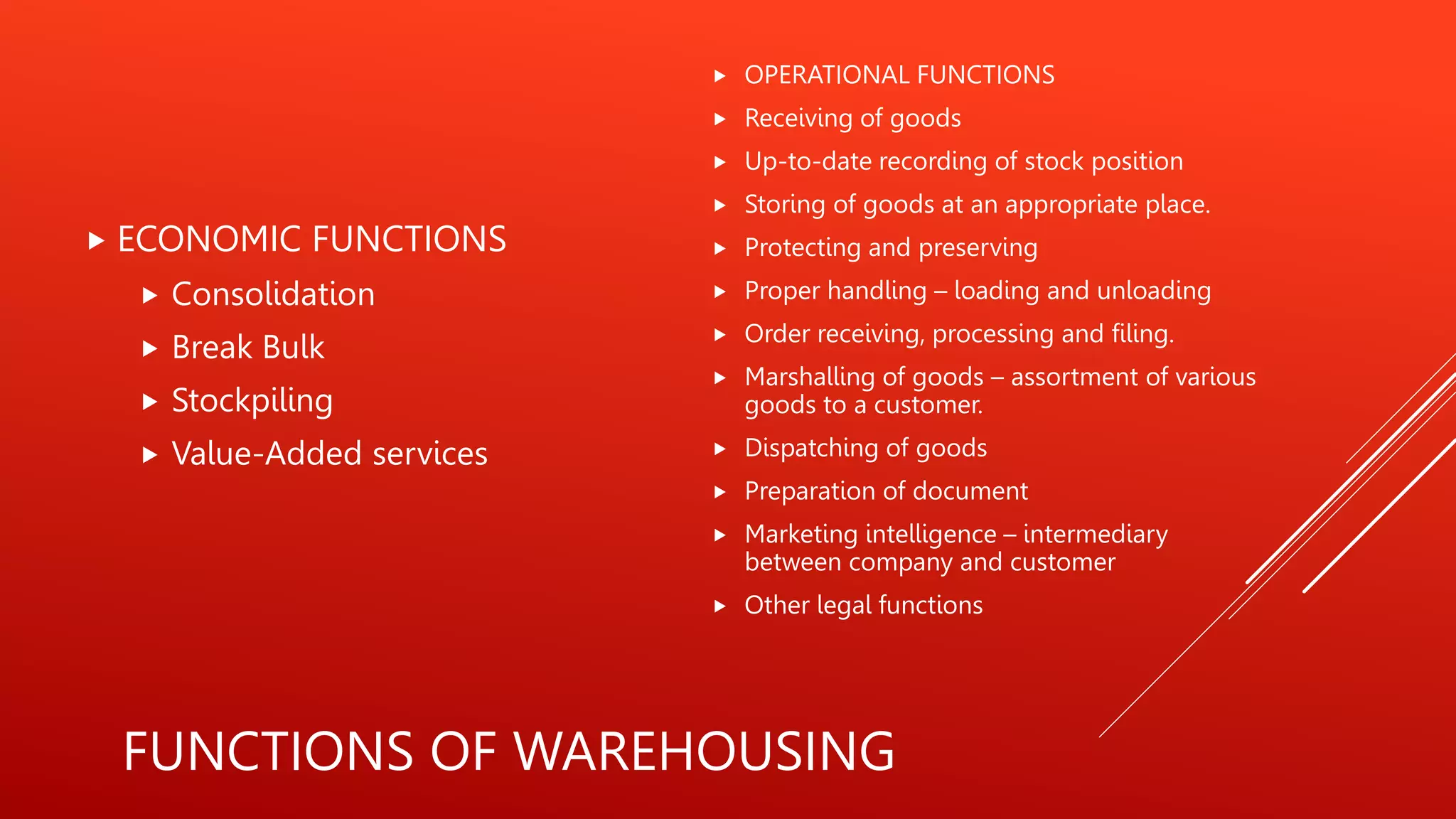
FUNCTIONS OF WAREHOUSING
 ECONOMIC FUNCTIONS
 Consolidation
 Break Bulk
 Stockpiling
 Value-Added services
 OPERATIONAL FUNCTIONS
 Receiving of goods
 Up-to-date recording of stock position
 Storing of goods at an appropriate place.
 Protecting and preserving
 Proper handling – loading and unloading
 Order receiving, processing and filing.
 Marshalling of goods – assortment of various
goods to a customer.
 Dispatching of goods
 Preparation of document
 Marketing intelligence – intermediary
between company and customer
 Other legal functions
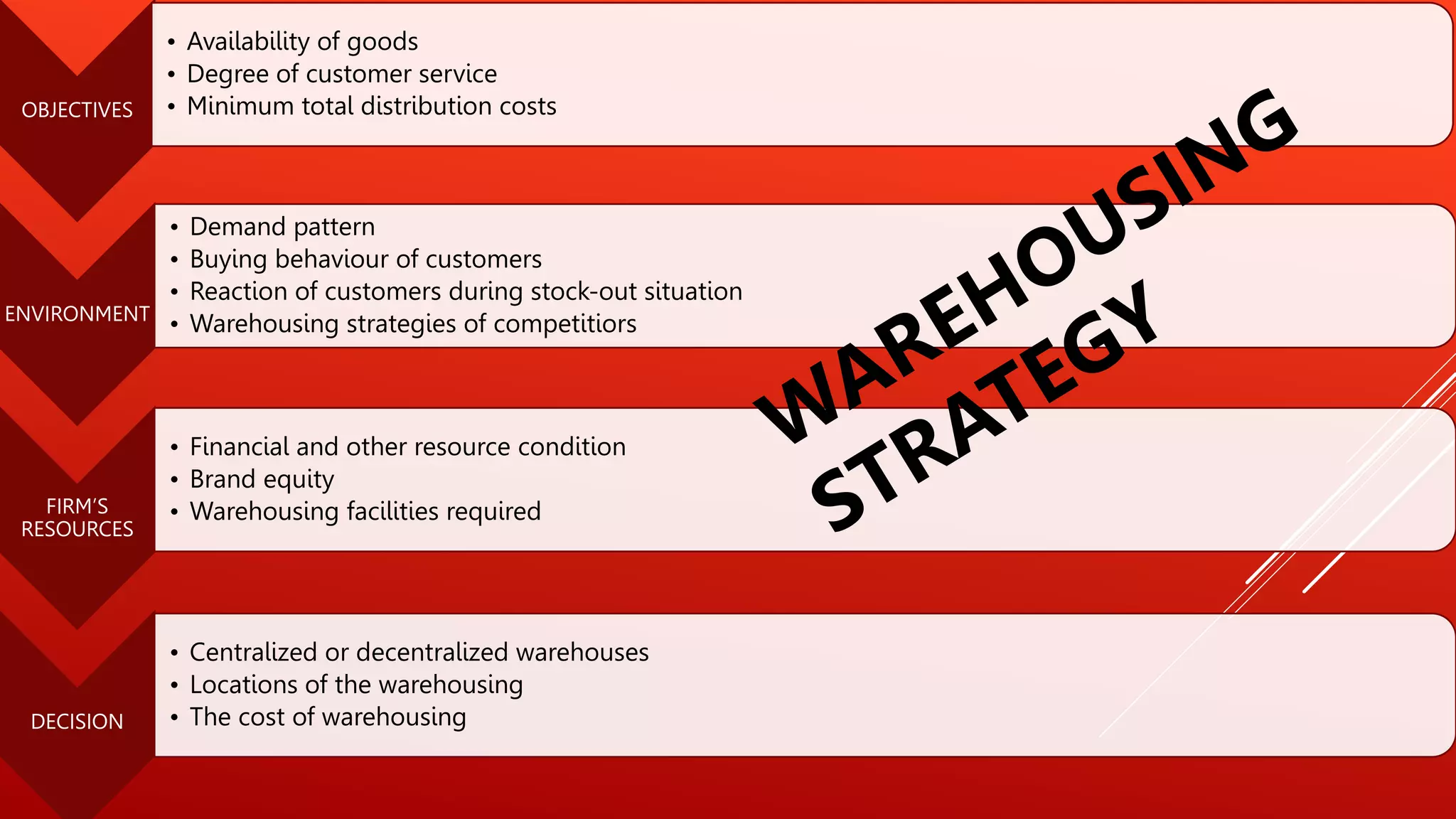
OBJECTIVES
• Availability of goods
• Degree of customer service
• Minimum total distribution costs
ENVIRONMENT
• Demand pattern
• Buying behaviour of customers
• Reaction of customers during stock-out situation
• Warehousing strategies of competitiors
FIRM’S
RESOURCES
• Financial and other resource condition
• Brand equity
• Warehousing facilities required
DECISION
• Centralized or decentralized warehouses
• Locations of the warehousing
• The cost of warehousing
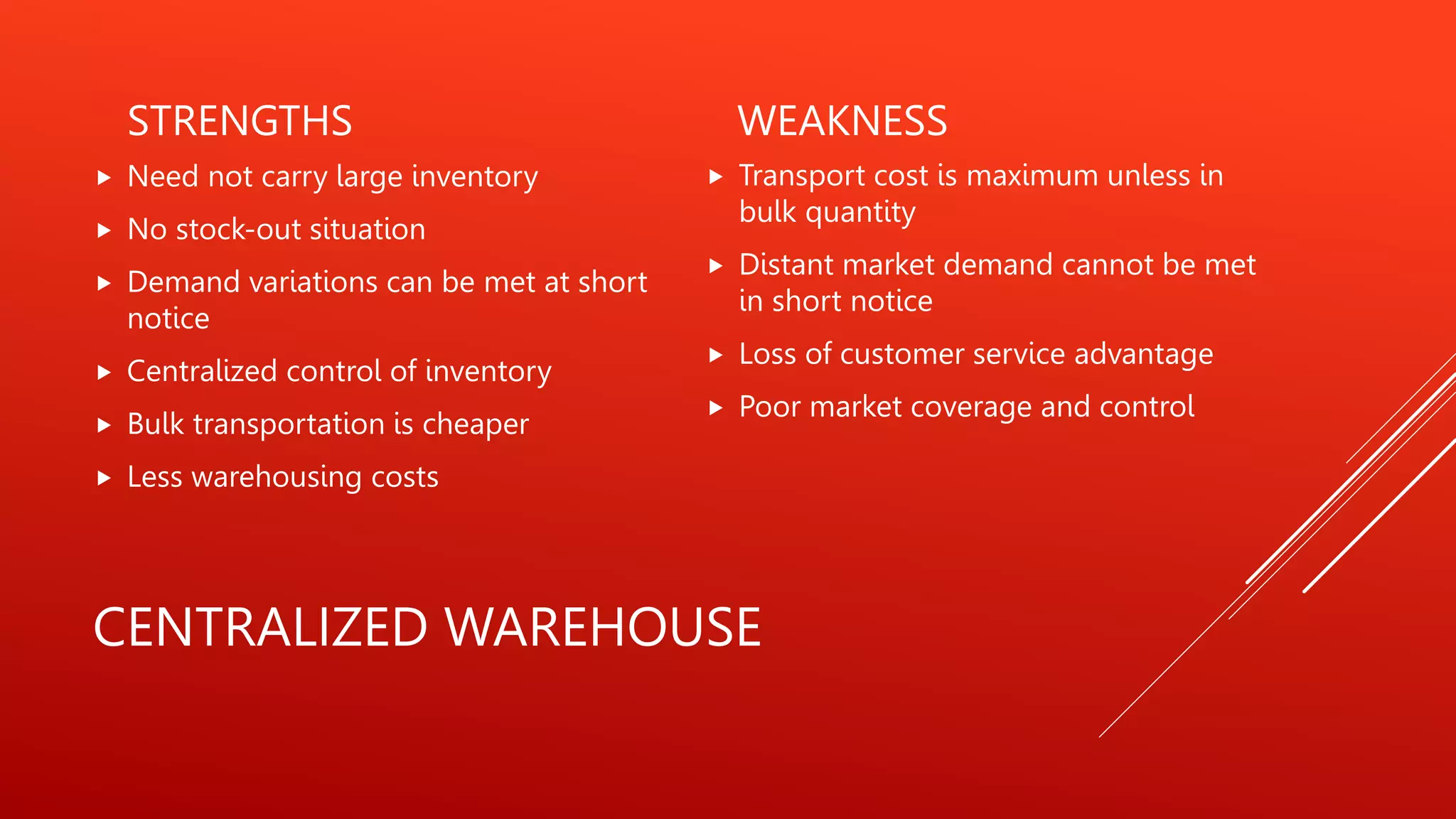
CENTRALIZED WAREHOUSE
STRENGTHS
 Need not carry large inventory
 No stock-out situation
 Demand variations can be met at short
notice
 Centralized control of inventory
 Bulk transportation is cheaper
 Less warehousing costs
WEAKNESS
 Transport cost is maximum unless in
bulk quantity
 Distant market demand cannot be met
in short notice
 Loss of customer service advantage
 Poor market coverage and control
DECENTRALIZED WAREHOUSES
STRENGTHS
 Market coverage will be maximum
 Increased sales
 Maximization of customer services
 Creates loyalty and goodwill
 Transportation cost will be moderate
 Better control over market
intermediaries.
WEAKNESS
 Huge inventory investment
 Huge warehousing development costs
 Stock-out situation
 Shortage of goods at one warehouse
replenished from another warehouse
requires additional transport costs
FACTORS FOR SELECTION OF NUMBER
AND LOCATION OF WAREHOUSES
 NUMBER OF GEOGRAPHICAL LOCATION
 NUMBER OF LOCATIONS OF PRODUCTION CENTRES
 TRANSPORTATION INFRASTRUCTURE FACITLITIES
 NATURE AND QUALITY OF GOODS TO BE STORES
 BRAND LOAYLTY AMONG CUSTOMERS
 FINANCIAL CONSTRIANTS
 POSSIBILITY OF CHANGE IN THE USE OF WAREHOUSE ( SCOPE FOR LEASE OR SALE)
 MANAGEMENT POLICY OF COMPETETIVE ADVANTAGE
ELEMENTS OF WAREHOUSING COSTS
• Handling and transfer costs
• Procurement of storage space
• Administrative cost
• Direct and indirect physical facilities
INFRASTRUCTURAL
COSTS
• Cost of working capital
• Goods stored in warehouse as inventory
WORKING CAPITAL
COSTS
MISCELLANEOUS
COSTS
• Tax to be paid
• Insurance for covering risks
• Risk of product obsolescence
WAREHOUSE DESIGN
 PURPOSE OF FACILITY :
 Size of the building
 Number of storage levels
 Ceiling height, length and width ratio
 Flexibility of dimensions for material handling
 Floor Load capabilities
WAREHOUSE DESIGN
 LAYOUT OF THE FACILITY :
 Required material handling systems & Physical facilities
 Windows
 Material receiving and shipping doors
 Fire doors
 Supporting pillars
 Lighting facilties
 Elevators, cranes, fort lifts, trucks
 Required floor plan
 Receiving, storage, order, selection, packaging, shipping areas within the
warehouse.
WAREHOUSE DESIGN
 SPACE REQUIREMENT AND AISLE LAYOUT
 Pallet Placement
 Aisle width
 space needed for other warehousing facilities
OPERATIONAL MECHANISM OF
WAREHOUSE
Receiving &
Stocking System
Hiring & Training
Personnel
Developing a
working
procedure system
Developing
Security system
Biling and
Inventory
Mangement
System
Local Delivery
system
Safety an
dMainteneance
Sytem
RECEIVING & STOCKING SYSTEM
 Total product-mix to be handled
 Anticipation of the demand pattern and safety stock policy
 Scheduling of arrival of in-bound products
 Time required for unloading products
 Placement in the storage area.
 Slot assignment for different products
 Fixed slot : rigid and permanent assignement of storage area for the
positioning of each single product.
 Variable slot : slot for product positioning in the storage area is always
variable and changes at the arrival of each shipment.
HIRING AND TRAINING PERSONNEL
 Identification and definition of the job requirement
 Describing the role of total system and their hiring
 Acquanting hired personnel with the job profile
 Locating the training need
 Regrouping of personnel for various operations
 Providing hand-on-training to different groups
DEVELOPING WORKING PROCEDURE
SYSTEM
 Maintaining proper inventory recroding system
 Order processing system
 Invoicing and documentation
 Foww-up of the loading procedures such as assortment, item checking,
adequate packaging
 Full pallet load stability
 System for sharing information regarding the status of the order and
shipment schedules.
DEVELOPING SECURITY SYSTEM
 Protecting goods from theft
 Security provisions for proper maintenance of the warehouse
 Speccial provisions for unwanted situation
 Development of a standard procedure for checking at the time of entry
and exit of the employees
 Procedure for the entry of guests, customers, etc.
 Facilities for preserving the physical attributes of the goods
 Prevention of careless handling of goods
 Proper utilization of material handling equipments
BILING AND INVENTORY MANAGEMENT
SYSTEM
 Preparation of invoices and dispatch challans
 Preparation of shipping documents
 Procedure for proper and up-to-date inventory management system
 Prevention of stock-out situation
 Prevention of under/over stocking
LOCAL DELIVERY SYSTEM
 Schedule for the movement of trucks for the delivery of goods to the
customer as per their order specification.
 Routing of trucks in case of multi-customer delivery schedule to fill the
load capacity of the trucks
 Trade-off between total distribution cost and distance covered by
vehicles.
SAFETY AND MAINTENANCE SYSTEM
 Development and deployment of a well-balanced safety programme in
order to prevent accidents.
 Proper and continuous examination and maintenance of all material
handling equipments
 Floor cleaning system on a regular basis
 Installation of fire-fighting systems and proper lighting

WAREHOUSING & DISTRIBUTION ppt.pptx

  • 1.
  • 2.
    CONCEPT OF WAREHOUSING Godowns for keeping and storing goods to preserve goods in a systematic manner to maintain original quality, quantity and usefulness.  Raw materials, parts, components, in-processes, finished goods, maintenance, repairing and operating supplies or any other items used or sold of a firm.  Demand of the product cannot be ascertained exactly  No company can bear stock out situation as there are large number of alternative products
  • 3.
  • 4.
    PUBLIC VS. PRIVATEWAREHOUSES Public Warehouses  Operating costs higher due to inclusion of profit factor, selling and advertising  No initial investment  Can have good control due to incentive to perform short-term contract  Risk is minimal  Can derive tax advantages  Economies of scale is possible due to serving many customes  Consolidate to a warehouse and from the warehouse to the customer.  Storage and handling costs can be ascertained for decision making Private Warehouses  10 to 25% lower if in sufficient volumeLarge facility, startup, equipment, trained personnel.  Direct reaponsibility  Risk of obsolescence due to change in technology and demand.  Depreciation alloeance  Dependent on company’s volume  No consolidation  Only estimation
  • 5.
    FUNCTIONS OF WAREHOUSING ECONOMIC FUNCTIONS  Consolidation  Break Bulk  Stockpiling  Value-Added services  OPERATIONAL FUNCTIONS  Receiving of goods  Up-to-date recording of stock position  Storing of goods at an appropriate place.  Protecting and preserving  Proper handling – loading and unloading  Order receiving, processing and filing.  Marshalling of goods – assortment of various goods to a customer.  Dispatching of goods  Preparation of document  Marketing intelligence – intermediary between company and customer  Other legal functions
  • 6.
    OBJECTIVES • Availability ofgoods • Degree of customer service • Minimum total distribution costs ENVIRONMENT • Demand pattern • Buying behaviour of customers • Reaction of customers during stock-out situation • Warehousing strategies of competitiors FIRM’S RESOURCES • Financial and other resource condition • Brand equity • Warehousing facilities required DECISION • Centralized or decentralized warehouses • Locations of the warehousing • The cost of warehousing
  • 7.
    CENTRALIZED WAREHOUSE STRENGTHS  Neednot carry large inventory  No stock-out situation  Demand variations can be met at short notice  Centralized control of inventory  Bulk transportation is cheaper  Less warehousing costs WEAKNESS  Transport cost is maximum unless in bulk quantity  Distant market demand cannot be met in short notice  Loss of customer service advantage  Poor market coverage and control
  • 8.
    DECENTRALIZED WAREHOUSES STRENGTHS  Marketcoverage will be maximum  Increased sales  Maximization of customer services  Creates loyalty and goodwill  Transportation cost will be moderate  Better control over market intermediaries. WEAKNESS  Huge inventory investment  Huge warehousing development costs  Stock-out situation  Shortage of goods at one warehouse replenished from another warehouse requires additional transport costs
  • 9.
    FACTORS FOR SELECTIONOF NUMBER AND LOCATION OF WAREHOUSES  NUMBER OF GEOGRAPHICAL LOCATION  NUMBER OF LOCATIONS OF PRODUCTION CENTRES  TRANSPORTATION INFRASTRUCTURE FACITLITIES  NATURE AND QUALITY OF GOODS TO BE STORES  BRAND LOAYLTY AMONG CUSTOMERS  FINANCIAL CONSTRIANTS  POSSIBILITY OF CHANGE IN THE USE OF WAREHOUSE ( SCOPE FOR LEASE OR SALE)  MANAGEMENT POLICY OF COMPETETIVE ADVANTAGE
  • 10.
    ELEMENTS OF WAREHOUSINGCOSTS • Handling and transfer costs • Procurement of storage space • Administrative cost • Direct and indirect physical facilities INFRASTRUCTURAL COSTS • Cost of working capital • Goods stored in warehouse as inventory WORKING CAPITAL COSTS MISCELLANEOUS COSTS • Tax to be paid • Insurance for covering risks • Risk of product obsolescence
  • 11.
    WAREHOUSE DESIGN  PURPOSEOF FACILITY :  Size of the building  Number of storage levels  Ceiling height, length and width ratio  Flexibility of dimensions for material handling  Floor Load capabilities
  • 12.
    WAREHOUSE DESIGN  LAYOUTOF THE FACILITY :  Required material handling systems & Physical facilities  Windows  Material receiving and shipping doors  Fire doors  Supporting pillars  Lighting facilties  Elevators, cranes, fort lifts, trucks  Required floor plan  Receiving, storage, order, selection, packaging, shipping areas within the warehouse.
  • 16.
    WAREHOUSE DESIGN  SPACEREQUIREMENT AND AISLE LAYOUT  Pallet Placement  Aisle width  space needed for other warehousing facilities
  • 17.
    OPERATIONAL MECHANISM OF WAREHOUSE Receiving& Stocking System Hiring & Training Personnel Developing a working procedure system Developing Security system Biling and Inventory Mangement System Local Delivery system Safety an dMainteneance Sytem
  • 18.
    RECEIVING & STOCKINGSYSTEM  Total product-mix to be handled  Anticipation of the demand pattern and safety stock policy  Scheduling of arrival of in-bound products  Time required for unloading products  Placement in the storage area.  Slot assignment for different products  Fixed slot : rigid and permanent assignement of storage area for the positioning of each single product.  Variable slot : slot for product positioning in the storage area is always variable and changes at the arrival of each shipment.
  • 19.
    HIRING AND TRAININGPERSONNEL  Identification and definition of the job requirement  Describing the role of total system and their hiring  Acquanting hired personnel with the job profile  Locating the training need  Regrouping of personnel for various operations  Providing hand-on-training to different groups
  • 20.
    DEVELOPING WORKING PROCEDURE SYSTEM Maintaining proper inventory recroding system  Order processing system  Invoicing and documentation  Foww-up of the loading procedures such as assortment, item checking, adequate packaging  Full pallet load stability  System for sharing information regarding the status of the order and shipment schedules.
  • 21.
    DEVELOPING SECURITY SYSTEM Protecting goods from theft  Security provisions for proper maintenance of the warehouse  Speccial provisions for unwanted situation  Development of a standard procedure for checking at the time of entry and exit of the employees  Procedure for the entry of guests, customers, etc.  Facilities for preserving the physical attributes of the goods  Prevention of careless handling of goods  Proper utilization of material handling equipments
  • 22.
    BILING AND INVENTORYMANAGEMENT SYSTEM  Preparation of invoices and dispatch challans  Preparation of shipping documents  Procedure for proper and up-to-date inventory management system  Prevention of stock-out situation  Prevention of under/over stocking
  • 23.
    LOCAL DELIVERY SYSTEM Schedule for the movement of trucks for the delivery of goods to the customer as per their order specification.  Routing of trucks in case of multi-customer delivery schedule to fill the load capacity of the trucks  Trade-off between total distribution cost and distance covered by vehicles.
  • 24.
    SAFETY AND MAINTENANCESYSTEM  Development and deployment of a well-balanced safety programme in order to prevent accidents.  Proper and continuous examination and maintenance of all material handling equipments  Floor cleaning system on a regular basis  Installation of fire-fighting systems and proper lighting