Master in Information Technology


Warehouse Management
   System on RFID

           Presented by:
    Cheri Amour P. Calicdan


        Asia Pacific College
Overview
•   Warehouse process
•   RFID technology
•   Project goal and objectives
•   Benefits analysis
•   Return of Investment
•   Major Milestones
•   Risk
•   Schedule and Budget overview
02/13/13          Asia Pacific College   2
What is Warehouse Management
              System?
• Is a key part of the supply chain and primarily
  aims to control the movement and storage of
  materials within a warehouse and process the
  associated transactions, including shipping,
  receiving, putaway and picking.

• The systems also direct and optimize stock
  putaway based on real-time information about
  the status of bin utilization.

02/13/13            Asia Pacific College            3
What is RFID?
• An ADC (Automated Data Collection)
  technology that:
     – uses radio-frequency waves to transfer data
       between a reader and a movable item to
       identify, categorize, track..
     – Is fast and does not require physical sight or
       contact between reader/scanner and the
       tagged item.

02/13/13               Asia Pacific College             4
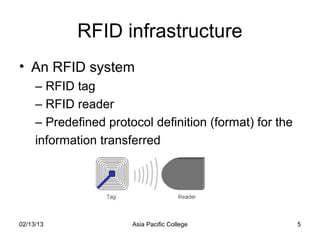
RFID infrastructure
• An RFID system
     – RFID tag
     – RFID reader
     – Predefined protocol definition (format) for the
     information transferred


02/13/13               Asia Pacific College              5
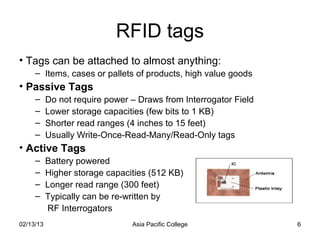
RFID tags
• Tags can be attached to almost anything:
     – Items, cases or pallets of products, high value goods
• Passive Tags
     –     Do not require power – Draws from Interrogator Field
     –     Lower storage capacities (few bits to 1 KB)
     –     Shorter read ranges (4 inches to 15 feet)
     –     Usually Write-Once-Read-Many/Read-Only tags
• Active Tags
     –     Battery powered
     –     Higher storage capacities (512 KB)
     –     Longer read range (300 feet)
     –     Typically can be re-written by
           RF Interrogators
02/13/13                        Asia Pacific College              6
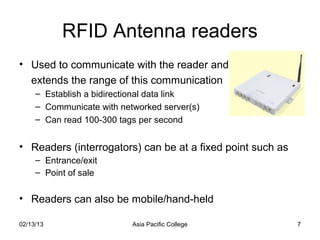
RFID Antenna readers
• Used to communicate with the reader and
  extends the range of this communication
     – Establish a bidirectional data link
     – Communicate with networked server(s)
     – Can read 100-300 tags per second


• Readers (interrogators) can be at a fixed point such as
     – Entrance/exit
     – Point of sale


• Readers can also be mobile/hand-held

02/13/13                   Asia Pacific College             7
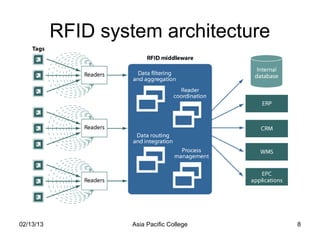
RFID system architecture


02/13/13            Asia Pacific College   8
RFID advantages over bar-codes
• No line of sight required for reading
• Multiple items can be read with a single scan

• Each tag can carry a lot of data (read/write)
• Individual items identified and not just the category

• Passive tags have a virtually unlimited lifetime
• Active tags can be read from great distances


02/13/13                Asia Pacific College              9
Basic function of a Warehouse
The basic functions of a warehouse can be
 described simply as follows:

     – Receive goods from a source
     – Store and protect goods
     – Retrieve goods according to customer requirements
     – Prepare goods for transportation to the customers


02/13/13                Asia Pacific College               10
Activities in a Warehouse
•   Receiving
•   Cross docking
•   Putaway
•   Inventory control and stock location management
•   Picking
•   Sortation and conveying
•   Shipping
•   Asset management
•   Physical control and security


02/13/13                Asia Pacific College          11
Project Goal
Is to develop a Warehouse Management System
   that will be to a RFID technology that will:

     – facilitate the automation of all manual processes
     – reduces the amount of labor
     – eliminates much human error improving data
       accuracy
     – reduces the cost of rework
     – can speed up the handling process


02/13/13                 Asia Pacific College              12
Project Opportunity
• Minimize the cost of movement of goods within
  the warehouse
• Maximize the effective use of space, equipment
  and labor
• Keep track of all items within the warehouse
  correctly
• Respond to customer requests or enquiries in a
  timely manner


02/13/13           Asia Pacific College            13
Project Urgency
The client is already in the process of
 acquiring a third-party provider for the
 needed RFID devices. Consequently, the
 proposed system has to be put into place
 as soon as possible to avoid impeding the
 utilization of these devices.


02/13/13         Asia Pacific College    14
Out of the scope activities that are
            critical to the project success
Activities that are critical to the success of this Warehouse
  Management System but are beyond the scope of this
  project includes the successful acquisition, installation,
  implementation and maintenance of all RFID devices.

The system will be dependent on the inputs generated by
  the RFID devices since the system will gather all its data
  from the database populated by the said RFID devices.


02/13/13                 Asia Pacific College                   15
Project Ranking Criteria
The utilization of this system will result to
 higher efficiency, reduction of cost and
 increase in revenue through the following:
     – Labor Pacing
     – Material Tracking
     – Information Availability
     – Security


02/13/13               Asia Pacific College   16
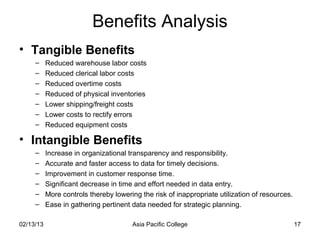
Benefits Analysis
• Tangible Benefits
     –     Reduced warehouse labor costs
     –     Reduced clerical labor costs
     –     Reduced overtime costs
     –     Reduced of physical inventories
     –     Lower shipping/freight costs
     –     Lower costs to rectify errors
     –     Reduced equipment costs

• Intangible Benefits
     –     Increase in organizational transparency and responsibility.
     –     Accurate and faster access to data for timely decisions.
     –     Improvement in customer response time.
     –     Significant decrease in time and effort needed in data entry.
     –     More controls thereby lowering the risk of inappropriate utilization of resources.
     –     Ease in gathering pertinent data needed for strategic planning.

02/13/13                               Asia Pacific College                                     17
Return of Investment


02/13/13         Asia Pacific College   18
Major Milestones
The following are the challenges that are highly likely to be experienced
  related to creating and implementing this system:

     – The transition from a manual to an automated system.
     – Alignment of the RFID WMS with the primary business software
       must be rolled-out.
     – Procurement of equipment such as RF/barcodes scanners,
       portable as well as heavy duty printers, and the appropriate type
       of labels must be done after careful selection from various
       options, taking into consideration the adaptability of existing
       systems and software.


02/13/13                     Asia Pacific College                      19
Risk
Although the implementation of an RFID based WMS will greatly
   benefit key areas, there are still risks associated with the system.
   Primarily, if the RFID tags fail, the system will not be able to track
   the movements of goods inside the warehouse. Moreover, the
   following issues are considered risks:

     –     Dead areas and orientation problems
     –     Proximity issues
     –     Security concerns
     –     Ghost tags
     –     High cost
     –     Unread Tags
     –     Vulnerable to damage

02/13/13                       Asia Pacific College                         20
02/13/13   Asia Pacific College   21

RFID on Warehouse Management System

  • 1.
    Master in InformationTechnology Warehouse Management System on RFID Presented by: Cheri Amour P. Calicdan Asia Pacific College
  • 2.
    Overview • Warehouse process • RFID technology • Project goal and objectives • Benefits analysis • Return of Investment • Major Milestones • Risk • Schedule and Budget overview 02/13/13 Asia Pacific College 2
  • 3.
    What is WarehouseManagement System? • Is a key part of the supply chain and primarily aims to control the movement and storage of materials within a warehouse and process the associated transactions, including shipping, receiving, putaway and picking. • The systems also direct and optimize stock putaway based on real-time information about the status of bin utilization. 02/13/13 Asia Pacific College 3
  • 4.
    What is RFID? •An ADC (Automated Data Collection) technology that: – uses radio-frequency waves to transfer data between a reader and a movable item to identify, categorize, track.. – Is fast and does not require physical sight or contact between reader/scanner and the tagged item. 02/13/13 Asia Pacific College 4
  • 5.
    RFID infrastructure • AnRFID system – RFID tag – RFID reader – Predefined protocol definition (format) for the information transferred 02/13/13 Asia Pacific College 5
  • 6.
    RFID tags • Tagscan be attached to almost anything: – Items, cases or pallets of products, high value goods • Passive Tags – Do not require power – Draws from Interrogator Field – Lower storage capacities (few bits to 1 KB) – Shorter read ranges (4 inches to 15 feet) – Usually Write-Once-Read-Many/Read-Only tags • Active Tags – Battery powered – Higher storage capacities (512 KB) – Longer read range (300 feet) – Typically can be re-written by RF Interrogators 02/13/13 Asia Pacific College 6
  • 7.
    RFID Antenna readers •Used to communicate with the reader and extends the range of this communication – Establish a bidirectional data link – Communicate with networked server(s) – Can read 100-300 tags per second • Readers (interrogators) can be at a fixed point such as – Entrance/exit – Point of sale • Readers can also be mobile/hand-held 02/13/13 Asia Pacific College 7
  • 8.
    RFID system architecture 02/13/13 Asia Pacific College 8
  • 9.
    RFID advantages overbar-codes • No line of sight required for reading • Multiple items can be read with a single scan • Each tag can carry a lot of data (read/write) • Individual items identified and not just the category • Passive tags have a virtually unlimited lifetime • Active tags can be read from great distances 02/13/13 Asia Pacific College 9
  • 10.
    Basic function ofa Warehouse The basic functions of a warehouse can be described simply as follows: – Receive goods from a source – Store and protect goods – Retrieve goods according to customer requirements – Prepare goods for transportation to the customers 02/13/13 Asia Pacific College 10
  • 11.
    Activities in aWarehouse • Receiving • Cross docking • Putaway • Inventory control and stock location management • Picking • Sortation and conveying • Shipping • Asset management • Physical control and security 02/13/13 Asia Pacific College 11
  • 12.
    Project Goal Is todevelop a Warehouse Management System that will be to a RFID technology that will: – facilitate the automation of all manual processes – reduces the amount of labor – eliminates much human error improving data accuracy – reduces the cost of rework – can speed up the handling process 02/13/13 Asia Pacific College 12
  • 13.
    Project Opportunity • Minimizethe cost of movement of goods within the warehouse • Maximize the effective use of space, equipment and labor • Keep track of all items within the warehouse correctly • Respond to customer requests or enquiries in a timely manner 02/13/13 Asia Pacific College 13
  • 14.
    Project Urgency The clientis already in the process of acquiring a third-party provider for the needed RFID devices. Consequently, the proposed system has to be put into place as soon as possible to avoid impeding the utilization of these devices. 02/13/13 Asia Pacific College 14
  • 15.
    Out of thescope activities that are critical to the project success Activities that are critical to the success of this Warehouse Management System but are beyond the scope of this project includes the successful acquisition, installation, implementation and maintenance of all RFID devices. The system will be dependent on the inputs generated by the RFID devices since the system will gather all its data from the database populated by the said RFID devices. 02/13/13 Asia Pacific College 15
  • 16.
    Project Ranking Criteria Theutilization of this system will result to higher efficiency, reduction of cost and increase in revenue through the following: – Labor Pacing – Material Tracking – Information Availability – Security 02/13/13 Asia Pacific College 16
  • 17.
    Benefits Analysis • TangibleBenefits – Reduced warehouse labor costs – Reduced clerical labor costs – Reduced overtime costs – Reduced of physical inventories – Lower shipping/freight costs – Lower costs to rectify errors – Reduced equipment costs • Intangible Benefits – Increase in organizational transparency and responsibility. – Accurate and faster access to data for timely decisions. – Improvement in customer response time. – Significant decrease in time and effort needed in data entry. – More controls thereby lowering the risk of inappropriate utilization of resources. – Ease in gathering pertinent data needed for strategic planning. 02/13/13 Asia Pacific College 17
  • 18.
    Return of Investment 02/13/13 Asia Pacific College 18
  • 19.
    Major Milestones The followingare the challenges that are highly likely to be experienced related to creating and implementing this system: – The transition from a manual to an automated system. – Alignment of the RFID WMS with the primary business software must be rolled-out. – Procurement of equipment such as RF/barcodes scanners, portable as well as heavy duty printers, and the appropriate type of labels must be done after careful selection from various options, taking into consideration the adaptability of existing systems and software. 02/13/13 Asia Pacific College 19
  • 20.
    Risk Although the implementationof an RFID based WMS will greatly benefit key areas, there are still risks associated with the system. Primarily, if the RFID tags fail, the system will not be able to track the movements of goods inside the warehouse. Moreover, the following issues are considered risks: – Dead areas and orientation problems – Proximity issues – Security concerns – Ghost tags – High cost – Unread Tags – Vulnerable to damage 02/13/13 Asia Pacific College 20
  • 21.
    02/13/13 Asia Pacific College 21