




WAREHOUSE MANAGEMENT
DR. CHANDAN VICHORAY
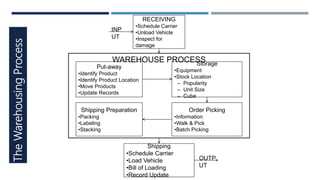
WAREHOUSE PROCESS
Put-away
•Identify Product
•Identify Product Location
•Move Products
•Update Records
Storage
•Equipment
•Stock Location
– Popularity
– Unit Size
– Cube
Shipping Preparation
•Packing
•Labeling
•Stacking
Order Picking
•Information
•Walk & Pick
•Batch Picking
Shipping
•Schedule Carrier
•Load Vehicle
•Bill of Loading
•Record Update
RECEIVING
•Schedule Carrier
•Unload Vehicle
•Inspect for
damage
INP
UT
OUTP
UT
TheWarehousingProcess
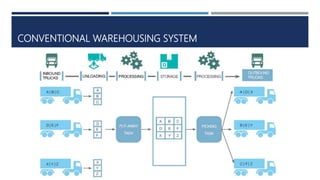
CONVENTIONAL WAREHOUSING SYSTEM
OPERATIONS IN WAREHOUSING
PRIMARY OPERATIONS
• Locator Decisions
• Equipment Planning
• Space Planning
• Docking
• Receiving
• Storage
• Picking
• Packing
• Shipping
• Customer Returns
OPERATIONS IN WAREHOUSING
OTHER OPERATIONS
• Back Orders
• Order Printing
• Time Goals or Standards
• Storage and Picking Capacity
• EDI and Reconciliation capabilities
• Advanced Shipping Notice (ASN)
• Technology in General
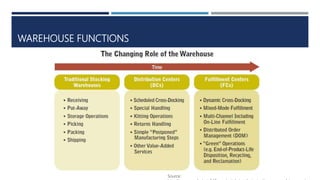
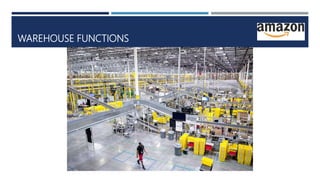
WAREHOUSE FUNCTIONS
Source:
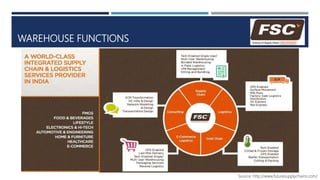
WAREHOUSE FUNCTIONS
Source: http://www.futuresupplychains.com/
WAREHOUSE FUNCTIONS
Source: http://www.mahindralogistics.com/technology/warehouse-management-
MLL WMS helps transform conventional warehouses by improving efficiency and productivity of
operations within the warehouse. MLL WMS automates receiving, put away, picking, and shipping in
warehouses and supports inventory cycle count planning and execution.
This system also adds levels of control that permit users to better plan and manage resource and storage
space in warehouse operations. It also provides management with real-time visibility to inventory and
order status across different warehouses of the organization.
WAREHOUSE FUNCTIONS
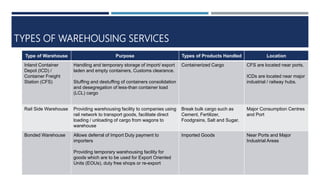
TYPES OF WAREHOUSING SERVICES
Type of Warehouse Purpose Types of Products Handled Location
Inland Container
Depot (ICD) /
Container Freight
Station (CFS)
Handling and temporary storage of import/ export
laden and empty containers, Customs clearance.
Stuffing and destuffing of containers consolidation
and desegregation of less-than container load
(LCL) cargo
Containerized Cargo CFS are located near ports.
ICDs are located near major
industrial / railway hubs.
Rail Side Warehouse Providing warehousing facility to companies using
rail network to transport goods, facilitate direct
loading / unloading of cargo from wagons to
warehouse
Break bulk cargo such as
Cement, Fertilizer,
Foodgrains, Salt and Sugar.
Major Consumption Centres
and Port
Bonded Warehouse Allows deferral of Import Duty payment to
importers
Providing temporary warehousing facility for
goods which are to be used for Export Oriented
Units (EOUs), duty free shops or re-export
Imported Goods Near Ports and Major
Industrial Areas
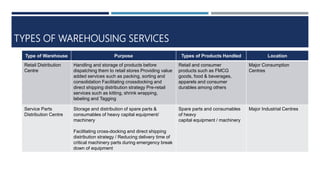
TYPES OF WAREHOUSING SERVICES
Type of Warehouse Purpose Types of Products Handled Location
Retail Distribution
Centre
Handling and storage of products before
dispatching them to retail stores Providing value
added services such as packing, sorting and
consolidation Facilitating crossdocking and
direct shipping distribution strategy Pre-retail
services such as kitting, shrink wrapping,
labeling and Tagging
Retail and consumer
products such as FMCG
goods, food & beverages,
apparels and consumer
durables among others
Major Consumption
Centres
Service Parts
Distribution Centre
Storage and distribution of spare parts &
consumables of heavy capital equipment/
machinery
Facilitating cross-docking and direct shipping
distribution strategy / Reducing delivery time of
critical machinery parts during emergency break
down of equipment
Spare parts and consumables
of heavy
capital equipment / machinery
Major Industrial Centres
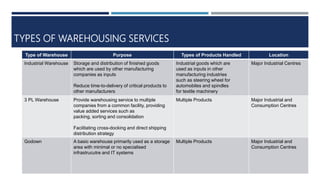
TYPES OF WAREHOUSING SERVICES
Type of Warehouse Purpose Types of Products Handled Location
Industrial Warehouse Storage and distribution of finished goods
which are used by other manufacturing
companies as inputs
Reduce time-to-delivery of critical products to
other manufacturers
Industrial goods which are
used as inputs in other
manufacturing industries
such as steering wheel for
automobiles and spindles
for textile machinery
Major Industrial Centres
3 PL Warehouse Provide warehousing service to multiple
companies from a common facility, providing
value added services such as
packing, sorting and consolidation
Facilitating cross-docking and direct shipping
distribution strategy
Multiple Products Major Industrial and
Consumption Centres
Godown A basic warehouse primarily used as a storage
area with minimal or no specialised
infrastrucutre and IT systems
Multiple Products Major Industrial and
Consumption Centres
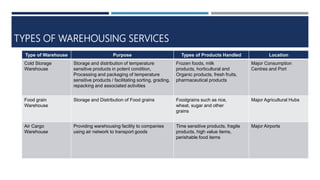
TYPES OF WAREHOUSING SERVICES
Type of Warehouse Purpose Types of Products Handled Location
Cold Storage
Warehouse
Storage and distribution of temperature
sensitive products in potent condition,
Processing and packaging of temperature
sensitive products / facilitating sorting, grading,
repacking and associated activities
Frozen foods, milk
products, horticultural and
Organic products, fresh fruits,
pharmaceutical products
Major Consumption
Centres and Port
Food grain
Warehouse
Storage and Distribution of Food grains Foodgrains such as rice,
wheat, sugar and other
grains
Major Agricultural Hubs
Air Cargo
Warehouse
Providing warehousing facility to companies
using air network to transport goods
Time sensitive products, fragile
products, high value items,
perishable food items
Major Airports
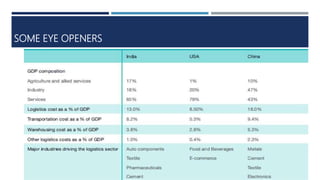
SOME EYE OPENERS
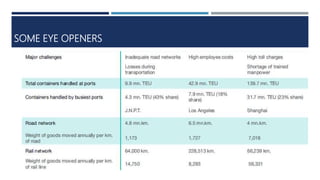
SOME EYE OPENERS
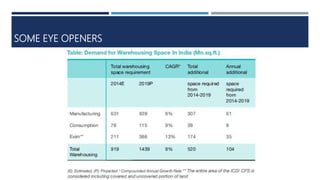
SOME EYE OPENERS
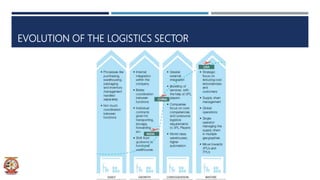
EVOLUTION OF THE LOGISTICS SECTOR
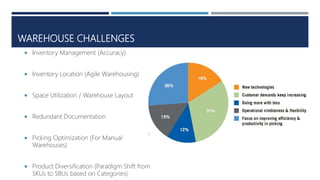
WAREHOUSE CHALLENGES
 Inventory Management (Accuracy)
 Inventory Location (Agile Warehousing)
 Space Utilization / Warehouse Layout
 Redundant Documentation
 Picking Optimization (For Manual
Warehouses)
 Product Diversification (Paradigm Shift from
SKUs to SBUs based on Categories)
SOME PHILOSOPHIES PREVALENT IN
WAREHOUSES
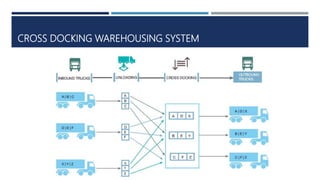
CROSS DOCKING WAREHOUSING SYSTEM
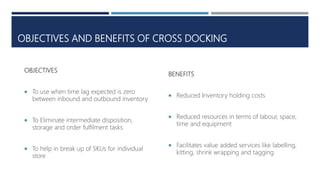
OBJECTIVES AND BENEFITS OF CROSS DOCKING
OBJECTIVES
 To use when time lag expected is zero
between inbound and outbound inventory
 To Eliminate intermediate disposition,
storage and order fulfilment tasks
 To help in break up of SKUs for individual
store
BENEFITS
 Reduced Inventory holding costs
 Reduced resources in terms of labour, space,
time and equipment
 Facilitates value added services like labelling,
kitting, shrink wrapping and tagging
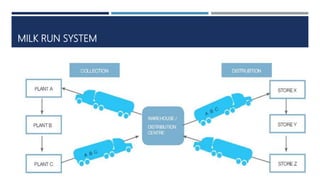
MILK RUNS
 Solution for situation where it is not possible to generate a Full Truck Load (FTL)
 Offsets costs associated with stuck situations like Less Than Truck Load (LTL)
 The same truck can visit multiple vendors picking up consignments on its route instead of separate
trucks delivering shipments from each vendor
 Very much suited for demand driven manufacturing and distribution
MILK RUN SYSTEM
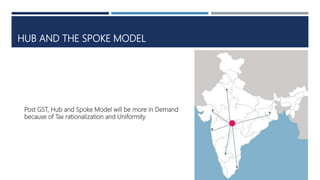
HUB AND THE SPOKE MODEL
Post GST, Hub and Spoke Model will be more in Demand
because of Tax rationalization and Uniformity
AUDITS AND STANDARDS APPLIED TO WAREHOUSES
 Warehouse Development and Regulation Act 2007
 BS 8555 for Environmental Management Systems
 ISO 9000
 OHSAS 18001
 OSHA Publication 2236 (Revised 2002)
 OSHA 3220-10N 2004
OVERVIEW OF LEAN MANUFACTURING
& SUPPLY CHAIN AND
FACTORING WAREHOUSING ACTIVITY
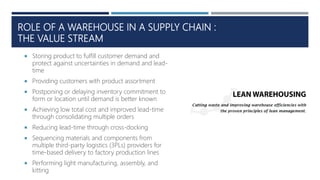
ROLE OF A WAREHOUSE IN A SUPPLY CHAIN :
THE VALUE STREAM
 Storing product to fulfill customer demand and
protect against uncertainties in demand and lead-
time
 Providing customers with product assortment
 Postponing or delaying inventory commitment to
form or location until demand is better known
 Achieving low total cost and improved lead-time
through consolidating multiple orders
 Reducing lead-time through cross-docking
 Sequencing materials and components from
multiple third-party logistics (3PLs) providers for
time-based delivery to factory production lines
 Performing light manufacturing, assembly, and
kitting
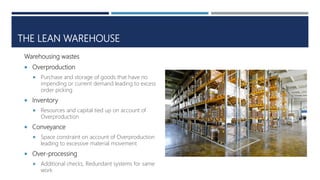
THE LEAN WAREHOUSE
Warehousing wastes
 Overproduction
 Purchase and storage of goods that have no
impending or current demand leading to excess
order picking
 Inventory
 Resources and capital tied up on account of
Overproduction
 Conveyance
 Space constraint on account of Overproduction
leading to excessive material movement
 Over-processing
 Additional checks, Redundant systems for same
work
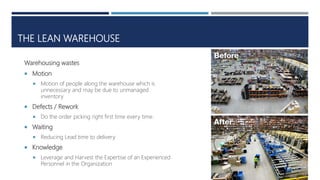
THE LEAN WAREHOUSE
Warehousing wastes
 Motion
 Motion of people along the warehouse which is
unnecessary and may be due to unmanaged
inventory
 Defects / Rework
 Do the order picking right first time every time.
 Waiting
 Reducing Lead time to delivery
 Knowledge
 Leverage and Harvest the Expertise of an Experienced
Personnel in the Organization
TECHNOLOGY
TECHNOLOGY INTERVENTIONS AT A WAREHOUSE
 RFID enabled Warehouses
 Warehouse Management Systems
(WMS)
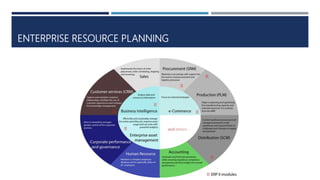
 Enterprise Resource Planning (ERP)
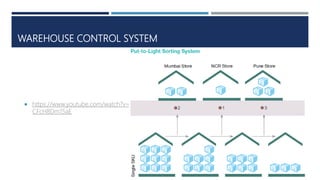
 Warehouse Control System (WCS)
 Smart Warehouses
RFID ENABLED WAREHOUSE
 Used for AS / RS
 https://www.youtube.com/watch?v=j5YbyI7MZ3I
 Movement and Storages are Automated using RFIDs
 https://www.youtube.com/watch?v=eob532iEpqk
WAREHOUSE MANAGEMENT SYSTEM (WMS)
 Software Solution for ready Data mining and Day-
to-Day Activities of a Warehouse
 Provides with a Dashboard giving relevant
information through knowledge management
 Overcomes the weakness of ERP in isolating
individual SKUs
ENTERPRISE RESOURCE PLANNING
WAREHOUSE CONTROL SYSTEM
 https://www.youtube.com/watch?v=
CFcH8Dm15aE
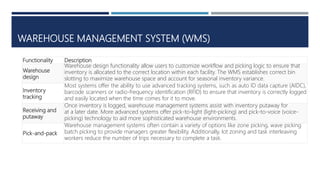
WAREHOUSE MANAGEMENT SYSTEM (WMS)
Functionality Description
Warehouse
design
Warehouse design functionality allow users to customize workflow and picking logic to ensure that
inventory is allocated to the correct location within each facility. The WMS establishes correct bin
slotting to maximize warehouse space and account for seasonal inventory variance.
Inventory
tracking
Most systems offer the ability to use advanced tracking systems, such as auto ID data capture (AIDC),
barcode scanners or radio-frequency identification (RFID) to ensure that inventory is correctly logged
and easily located when the time comes for it to move.
Receiving and
putaway
Once inventory is logged, warehouse management systems assist with inventory putaway for
at a later date. More advanced systems offer pick-to-light (light-picking) and pick-to-voice (voice-
picking) technology to aid more sophisticated warehouse environments.
Pick-and-pack
Warehouse management systems often contain a variety of options like zone picking, wave picking
batch picking to provide managers greater flexibility. Additionally, lot zoning and task interleaving
workers reduce the number of trips necessary to complete a task.
WAREHOUSE MANAGEMENT SYSTEM (WMS)
Shipping
Once inventory is packed, the WMS can send itemized bills of lading (B/L) ahead of the shipment,
generate packing lists and invoices for buyers to reconcile items shipped with items ordered, and
include assembly instructions if needed. Once items have been packed, the warehousing software
send advanced shipment notifications (ASN) to notify other facilities of pending deliveries.
Labor
management
Labor performance modules also help managers monitor worker efficiency and performance. Key
performance indicators (KPIs) help managers keep tabs on the workers who are performing above
below standard.
Yard and dock
management
A common feature in WMS software, yard management assists trucks as they come-and-go and find
the correct loading docks. Some applications also help manage cross-docking, or the ability for
incoming trucks to be unloaded and loaded concurrently.
Reporting
Advanced reporting features within the software can help managers analyze the performance of the
operation as a whole and find areas for improvement. For example, the system can automatically
analyze cycle counts, which count a different subset of inventory each day.
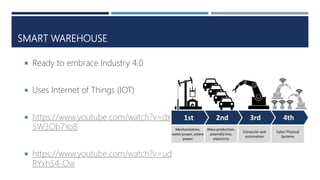
SMART WAREHOUSE
 Ready to embrace Industry 4.0
 Uses Internet of Things (IOT)
 https://www.youtube.com/watch?v=dx
5W3Ob7Yo8
 https://www.youtube.com/watch?v=ud
RYxhS4-Ow
WHAT HAPPENS WHEN YOU PLACE AN ORDER TO AMAZON
 https://www.youtube.com/watch?v=Y-
lBvI6u_hw
THE CURIOUS CASE OF FUTURE SUPPLY CHAIN:
NAGPUR DC
FUTURE GROUP BACKGROUND
 Largest Retail Company in India
 More than 16 mn sq.ft of Retail Space
 Future Supply Chain part of group’s
Supply Chain
 Was Started in 2007
 1000 plus stores across India
FSC OBJECTIVES
 What to Store / Move
 When to Store / Move
 How to Store / Move
INITIAL FSC CHALLENGES
 32 stock points mostly unstructured Godowns
 Inventory and Godown Management based purely on People’s memory
 Supply chain Costs were in the range of 20% of Manufacturing while Benchmark of Europe is 6% - 8%
 Stocks and Inventory Holding were of 90 days
 Frequent Stock-outs at Stores
 Low Visibility on Transit Time
 Under utilization of Trucks and Heavy Pilferages
WHY NAGPUR AS MOTHER DC
 Centrally located
 All major manufacturing hubs and markets within 1000 kms radius
 Used for FTL distribution to Areas with a Consumption of more than 60% of
the revenue
 Costs less
WHY NAGPUR AS MOTHER DC
 Centrally located
 All major manufacturing hubs and markets within 1000 kms radius
 Used for FTL distribution to Areas with a Consumption of more than 60% of the revenue
(About 55-60 stores)
 Costs less
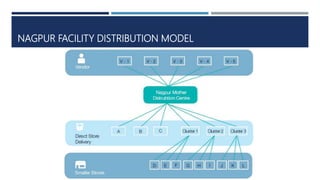
 Could implement the Hub and Spoke Model
 From the sub distribution centres they use Milk Runs (Service about 250 stores)
NAGPUR FACILITY DISTRIBUTION MODEL
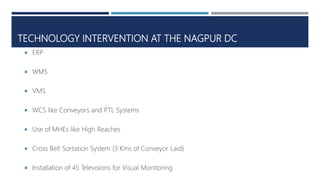
TECHNOLOGY INTERVENTION AT THE NAGPUR DC
 ERP
 WMS
 VMS
 WCS like Conveyors and PTL Systems
 Use of MHEs like High Reaches
 Cross Belt Sortation System (3 Kms of Conveyor Laid)
 Installation of 45 Televisions for Visual Monitoring
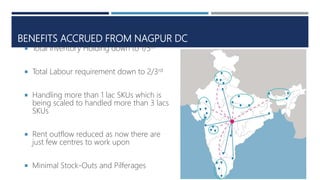
BENEFITS ACCRUED FROM NAGPUR DC
 Total Inventory Holding down to 1/5th
 Total Labour requirement down to 2/3rd
 Handling more than 1 lac SKUs which is
being scaled to handled more than 3 lacs
SKUs
 Rent outflow reduced as now there are
just few centres to work upon
 Minimal Stock-Outs and Pilferages
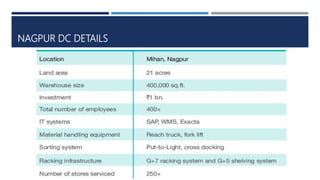
NAGPUR DC DETAILS
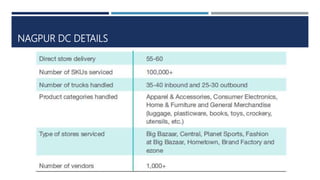
NAGPUR DC DETAILS
WHAT HAPPENS WHEN YOU PLACE AN ORDER TO AMAZON
WHAT LIES IN STORE FOR YOU IN LOGISTICS:
THE FUTURE
 https://www.youtube.com/watch?v=98
BIu9dpwHU
THAT’S IT FROM ME…
Thank you

Warehouse management

  • 1.
  • 2.
    WAREHOUSE PROCESS Put-away •Identify Product •IdentifyProduct Location •Move Products •Update Records Storage •Equipment •Stock Location – Popularity – Unit Size – Cube Shipping Preparation •Packing •Labeling •Stacking Order Picking •Information •Walk & Pick •Batch Picking Shipping •Schedule Carrier •Load Vehicle •Bill of Loading •Record Update RECEIVING •Schedule Carrier •Unload Vehicle •Inspect for damage INP UT OUTP UT TheWarehousingProcess
  • 3.
  • 4.
    OPERATIONS IN WAREHOUSING PRIMARYOPERATIONS • Locator Decisions • Equipment Planning • Space Planning • Docking • Receiving • Storage • Picking • Packing • Shipping • Customer Returns
  • 5.
    OPERATIONS IN WAREHOUSING OTHEROPERATIONS • Back Orders • Order Printing • Time Goals or Standards • Storage and Picking Capacity • EDI and Reconciliation capabilities • Advanced Shipping Notice (ASN) • Technology in General
  • 6.
  • 7.
  • 8.
    WAREHOUSE FUNCTIONS Source: http://www.mahindralogistics.com/technology/warehouse-management- MLLWMS helps transform conventional warehouses by improving efficiency and productivity of operations within the warehouse. MLL WMS automates receiving, put away, picking, and shipping in warehouses and supports inventory cycle count planning and execution. This system also adds levels of control that permit users to better plan and manage resource and storage space in warehouse operations. It also provides management with real-time visibility to inventory and order status across different warehouses of the organization.
  • 9.
  • 10.
    TYPES OF WAREHOUSINGSERVICES Type of Warehouse Purpose Types of Products Handled Location Inland Container Depot (ICD) / Container Freight Station (CFS) Handling and temporary storage of import/ export laden and empty containers, Customs clearance. Stuffing and destuffing of containers consolidation and desegregation of less-than container load (LCL) cargo Containerized Cargo CFS are located near ports. ICDs are located near major industrial / railway hubs. Rail Side Warehouse Providing warehousing facility to companies using rail network to transport goods, facilitate direct loading / unloading of cargo from wagons to warehouse Break bulk cargo such as Cement, Fertilizer, Foodgrains, Salt and Sugar. Major Consumption Centres and Port Bonded Warehouse Allows deferral of Import Duty payment to importers Providing temporary warehousing facility for goods which are to be used for Export Oriented Units (EOUs), duty free shops or re-export Imported Goods Near Ports and Major Industrial Areas
  • 11.
    TYPES OF WAREHOUSINGSERVICES Type of Warehouse Purpose Types of Products Handled Location Retail Distribution Centre Handling and storage of products before dispatching them to retail stores Providing value added services such as packing, sorting and consolidation Facilitating crossdocking and direct shipping distribution strategy Pre-retail services such as kitting, shrink wrapping, labeling and Tagging Retail and consumer products such as FMCG goods, food & beverages, apparels and consumer durables among others Major Consumption Centres Service Parts Distribution Centre Storage and distribution of spare parts & consumables of heavy capital equipment/ machinery Facilitating cross-docking and direct shipping distribution strategy / Reducing delivery time of critical machinery parts during emergency break down of equipment Spare parts and consumables of heavy capital equipment / machinery Major Industrial Centres
  • 12.
    TYPES OF WAREHOUSINGSERVICES Type of Warehouse Purpose Types of Products Handled Location Industrial Warehouse Storage and distribution of finished goods which are used by other manufacturing companies as inputs Reduce time-to-delivery of critical products to other manufacturers Industrial goods which are used as inputs in other manufacturing industries such as steering wheel for automobiles and spindles for textile machinery Major Industrial Centres 3 PL Warehouse Provide warehousing service to multiple companies from a common facility, providing value added services such as packing, sorting and consolidation Facilitating cross-docking and direct shipping distribution strategy Multiple Products Major Industrial and Consumption Centres Godown A basic warehouse primarily used as a storage area with minimal or no specialised infrastrucutre and IT systems Multiple Products Major Industrial and Consumption Centres
  • 13.
    TYPES OF WAREHOUSINGSERVICES Type of Warehouse Purpose Types of Products Handled Location Cold Storage Warehouse Storage and distribution of temperature sensitive products in potent condition, Processing and packaging of temperature sensitive products / facilitating sorting, grading, repacking and associated activities Frozen foods, milk products, horticultural and Organic products, fresh fruits, pharmaceutical products Major Consumption Centres and Port Food grain Warehouse Storage and Distribution of Food grains Foodgrains such as rice, wheat, sugar and other grains Major Agricultural Hubs Air Cargo Warehouse Providing warehousing facility to companies using air network to transport goods Time sensitive products, fragile products, high value items, perishable food items Major Airports
  • 14.
  • 15.
  • 16.
  • 17.
    EVOLUTION OF THELOGISTICS SECTOR
  • 18.
    WAREHOUSE CHALLENGES  InventoryManagement (Accuracy)  Inventory Location (Agile Warehousing)  Space Utilization / Warehouse Layout  Redundant Documentation  Picking Optimization (For Manual Warehouses)  Product Diversification (Paradigm Shift from SKUs to SBUs based on Categories)
  • 19.
  • 20.
  • 21.
    OBJECTIVES AND BENEFITSOF CROSS DOCKING OBJECTIVES  To use when time lag expected is zero between inbound and outbound inventory  To Eliminate intermediate disposition, storage and order fulfilment tasks  To help in break up of SKUs for individual store BENEFITS  Reduced Inventory holding costs  Reduced resources in terms of labour, space, time and equipment  Facilitates value added services like labelling, kitting, shrink wrapping and tagging
  • 22.
    MILK RUNS  Solutionfor situation where it is not possible to generate a Full Truck Load (FTL)  Offsets costs associated with stuck situations like Less Than Truck Load (LTL)  The same truck can visit multiple vendors picking up consignments on its route instead of separate trucks delivering shipments from each vendor  Very much suited for demand driven manufacturing and distribution
  • 23.
  • 24.
    HUB AND THESPOKE MODEL Post GST, Hub and Spoke Model will be more in Demand because of Tax rationalization and Uniformity
  • 25.
    AUDITS AND STANDARDSAPPLIED TO WAREHOUSES  Warehouse Development and Regulation Act 2007  BS 8555 for Environmental Management Systems  ISO 9000  OHSAS 18001  OSHA Publication 2236 (Revised 2002)  OSHA 3220-10N 2004
  • 26.
    OVERVIEW OF LEANMANUFACTURING & SUPPLY CHAIN AND FACTORING WAREHOUSING ACTIVITY
  • 27.
    ROLE OF AWAREHOUSE IN A SUPPLY CHAIN : THE VALUE STREAM  Storing product to fulfill customer demand and protect against uncertainties in demand and lead- time  Providing customers with product assortment  Postponing or delaying inventory commitment to form or location until demand is better known  Achieving low total cost and improved lead-time through consolidating multiple orders  Reducing lead-time through cross-docking  Sequencing materials and components from multiple third-party logistics (3PLs) providers for time-based delivery to factory production lines  Performing light manufacturing, assembly, and kitting
  • 28.
    THE LEAN WAREHOUSE Warehousingwastes  Overproduction  Purchase and storage of goods that have no impending or current demand leading to excess order picking  Inventory  Resources and capital tied up on account of Overproduction  Conveyance  Space constraint on account of Overproduction leading to excessive material movement  Over-processing  Additional checks, Redundant systems for same work
  • 29.
    THE LEAN WAREHOUSE Warehousingwastes  Motion  Motion of people along the warehouse which is unnecessary and may be due to unmanaged inventory  Defects / Rework  Do the order picking right first time every time.  Waiting  Reducing Lead time to delivery  Knowledge  Leverage and Harvest the Expertise of an Experienced Personnel in the Organization
  • 30.
  • 31.
    TECHNOLOGY INTERVENTIONS ATA WAREHOUSE  RFID enabled Warehouses  Warehouse Management Systems (WMS)  Enterprise Resource Planning (ERP)  Warehouse Control System (WCS)  Smart Warehouses
  • 32.
    RFID ENABLED WAREHOUSE Used for AS / RS  https://www.youtube.com/watch?v=j5YbyI7MZ3I  Movement and Storages are Automated using RFIDs  https://www.youtube.com/watch?v=eob532iEpqk
  • 33.
    WAREHOUSE MANAGEMENT SYSTEM(WMS)  Software Solution for ready Data mining and Day- to-Day Activities of a Warehouse  Provides with a Dashboard giving relevant information through knowledge management  Overcomes the weakness of ERP in isolating individual SKUs
  • 34.
  • 35.
  • 36.
    WAREHOUSE CONTROL SYSTEM https://www.youtube.com/watch?v= CFcH8Dm15aE
  • 37.
    WAREHOUSE MANAGEMENT SYSTEM(WMS) Functionality Description Warehouse design Warehouse design functionality allow users to customize workflow and picking logic to ensure that inventory is allocated to the correct location within each facility. The WMS establishes correct bin slotting to maximize warehouse space and account for seasonal inventory variance. Inventory tracking Most systems offer the ability to use advanced tracking systems, such as auto ID data capture (AIDC), barcode scanners or radio-frequency identification (RFID) to ensure that inventory is correctly logged and easily located when the time comes for it to move. Receiving and putaway Once inventory is logged, warehouse management systems assist with inventory putaway for at a later date. More advanced systems offer pick-to-light (light-picking) and pick-to-voice (voice- picking) technology to aid more sophisticated warehouse environments. Pick-and-pack Warehouse management systems often contain a variety of options like zone picking, wave picking batch picking to provide managers greater flexibility. Additionally, lot zoning and task interleaving workers reduce the number of trips necessary to complete a task.
  • 38.
    WAREHOUSE MANAGEMENT SYSTEM(WMS) Shipping Once inventory is packed, the WMS can send itemized bills of lading (B/L) ahead of the shipment, generate packing lists and invoices for buyers to reconcile items shipped with items ordered, and include assembly instructions if needed. Once items have been packed, the warehousing software send advanced shipment notifications (ASN) to notify other facilities of pending deliveries. Labor management Labor performance modules also help managers monitor worker efficiency and performance. Key performance indicators (KPIs) help managers keep tabs on the workers who are performing above below standard. Yard and dock management A common feature in WMS software, yard management assists trucks as they come-and-go and find the correct loading docks. Some applications also help manage cross-docking, or the ability for incoming trucks to be unloaded and loaded concurrently. Reporting Advanced reporting features within the software can help managers analyze the performance of the operation as a whole and find areas for improvement. For example, the system can automatically analyze cycle counts, which count a different subset of inventory each day.
  • 39.
    SMART WAREHOUSE  Readyto embrace Industry 4.0  Uses Internet of Things (IOT)  https://www.youtube.com/watch?v=dx 5W3Ob7Yo8  https://www.youtube.com/watch?v=ud RYxhS4-Ow
  • 40.
    WHAT HAPPENS WHENYOU PLACE AN ORDER TO AMAZON  https://www.youtube.com/watch?v=Y- lBvI6u_hw
  • 41.
    THE CURIOUS CASEOF FUTURE SUPPLY CHAIN: NAGPUR DC
  • 42.
    FUTURE GROUP BACKGROUND Largest Retail Company in India  More than 16 mn sq.ft of Retail Space  Future Supply Chain part of group’s Supply Chain  Was Started in 2007  1000 plus stores across India
  • 43.
    FSC OBJECTIVES  Whatto Store / Move  When to Store / Move  How to Store / Move
  • 44.
    INITIAL FSC CHALLENGES 32 stock points mostly unstructured Godowns  Inventory and Godown Management based purely on People’s memory  Supply chain Costs were in the range of 20% of Manufacturing while Benchmark of Europe is 6% - 8%  Stocks and Inventory Holding were of 90 days  Frequent Stock-outs at Stores  Low Visibility on Transit Time  Under utilization of Trucks and Heavy Pilferages
  • 45.
    WHY NAGPUR ASMOTHER DC  Centrally located  All major manufacturing hubs and markets within 1000 kms radius  Used for FTL distribution to Areas with a Consumption of more than 60% of the revenue  Costs less
  • 46.
    WHY NAGPUR ASMOTHER DC  Centrally located  All major manufacturing hubs and markets within 1000 kms radius  Used for FTL distribution to Areas with a Consumption of more than 60% of the revenue (About 55-60 stores)  Costs less  Could implement the Hub and Spoke Model  From the sub distribution centres they use Milk Runs (Service about 250 stores)
  • 47.
  • 48.
    TECHNOLOGY INTERVENTION ATTHE NAGPUR DC  ERP  WMS  VMS  WCS like Conveyors and PTL Systems  Use of MHEs like High Reaches  Cross Belt Sortation System (3 Kms of Conveyor Laid)  Installation of 45 Televisions for Visual Monitoring
  • 49.
    BENEFITS ACCRUED FROMNAGPUR DC  Total Inventory Holding down to 1/5th  Total Labour requirement down to 2/3rd  Handling more than 1 lac SKUs which is being scaled to handled more than 3 lacs SKUs  Rent outflow reduced as now there are just few centres to work upon  Minimal Stock-Outs and Pilferages
  • 50.
  • 51.
  • 52.
    WHAT HAPPENS WHENYOU PLACE AN ORDER TO AMAZON
  • 53.
    WHAT LIES INSTORE FOR YOU IN LOGISTICS: THE FUTURE  https://www.youtube.com/watch?v=98 BIu9dpwHU
  • 54.
    THAT’S IT FROMME… Thank you