By Omar Youssef
Business Consultant
E-mail: Omar.youssef5@hotmail.com
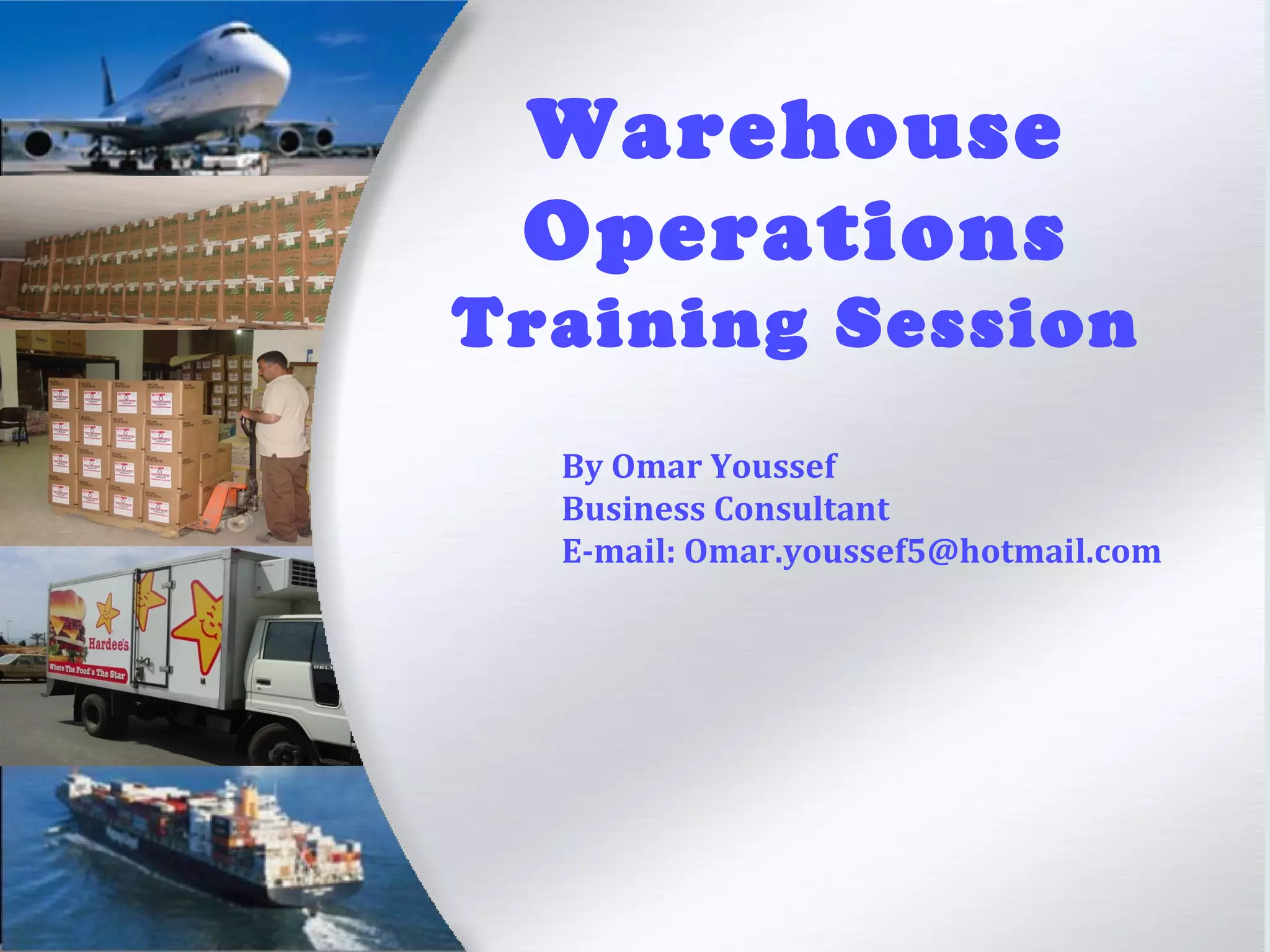
Warehouse
Operations
Training Session
Mission Statement
“The warehouse is our strongest asset.
Dedication, accountability and reliability
are at the heart of our business
philosophy. Focussed on our business
units needs, we provide integrated
logistics of outstanding product quality,
Product quantity, and delivered on time.
we are the extension of your business.”
Warehouse Goals
1. Maximize effective use of space.
2. Maximize effective use of equipment.
3. Maximize effective use of labor.
4. Maximize accessibility of all items.
5. Maximize protection of all items.
6. Maximize effective use of information.
7. Maximize the protection of company’s assets.
8. Minimize goods Handling.
9. Minimize the company operating Cost.
Warehouse Functions
1. Unloading
2. Receiving & Checking inbound goods
3. Internal product movement
4. Storing
5. Order-picking
6. Stock Sortation
7. Stock Rotation
8. Packing
9. Loading & Shipping
10. Cycle Counting
11. Replenishement
12. Handling Returns
13. Maintenance & Loss Prevention
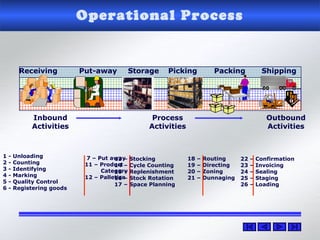
Operational Process
Picking
Inbound
Activities
Outbound
Activities
Process
Activities
Put-away PackingStorageReceiving Shipping
1 - Unloading
2 - Counting
3 - Identifying
4 - Marking
5 - Quality Control
6 - Registering goods
7 – Put away
11 – Product
Category
12 – Palletize
13 – Stocking
14 – Cycle Counting
15 – Replenishment
16 – Stock Rotation
17 – Space Planning
18 – Routing
19 – Directing
20 – Zoning
21 – Dunnaging
22 – Confirmation
23 – Invoicing
24 – Sealing
25 – Staging
26 – Loading
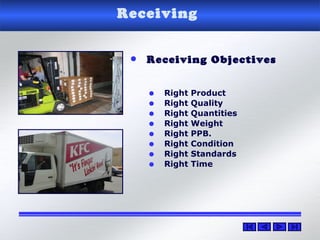
Receiving
• Receiving Objectives
• Right Product
• Right Quality
• Right Quantities
• Right Weight
• Right PPB.
• Right Condition
• Right Standards
• Right Time
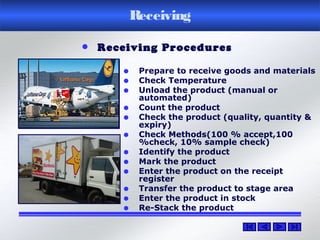
Receiving
• Prepare to receive goods and materials
• Check Temperature
• Unload the product (manual or
automated)
• Count the product
• Check the product (quality, quantity &
expiry)
• Check Methods(100 % accept,100
%check, 10% sample check)
• Identify the product
• Mark the product
• Enter the product on the receipt
register
• Transfer the product to stage area
• Enter the product in stock
• Re-Stack the product
• Receiving Procedures
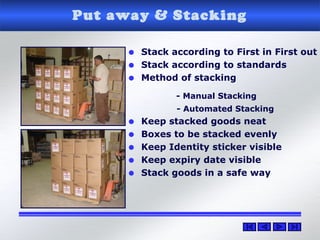
Put away & Stacking
• Stack according to First in First out
• Stack according to standards
• Method of stacking
- Manual Stacking
- Automated Stacking
• Keep stacked goods neat
• Boxes to be stacked evenly
• Keep Identity sticker visible
• Keep expiry date visible
• Stack goods in a safe way
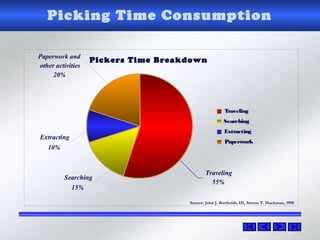
Picking Time Consumption
Source: John J. Bartholdi, III, Steven T. Hackman, 1998
Pickers Time Breakdown
Traveling
55%
Paperwork and
other activities
20%
Extracting
10%
Searching
15%
Traveling
Searching
Extracting
Paperwork
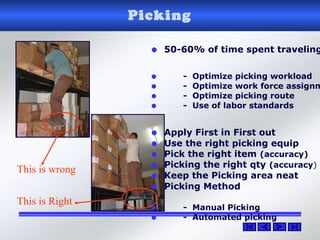
Picking
• 50-60% of time spent traveling
• - Optimize picking workload
• - Optimize work force assignm
• - Optimize picking route
• - Use of labor standards
• Apply First in First out
• Use the right picking equip
• Pick the right item (accuracy)
• Picking the right qty (accuracy)
• Keep the Picking area neat
• Picking Method
• - Manual Picking
• - Automated picking
This is wrong
This is Right
Shipping
• Invoicing
• Staging
• Categorizing
• Checking
• - the right product
• - in the correct quantity
• - in good condition
• - and on scheduled time
• Confirming
• Loading
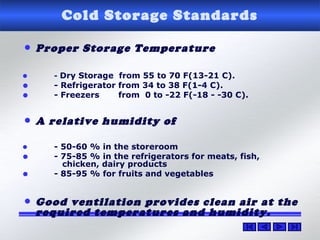
Cold Storage Standards
• Proper Storage Temperature
• - Dry Storage from 55 to 70 F(13-21 C).
• - Refrigerator from 34 to 38 F(1-4 C).
• - Freezers from 0 to -22 F(-18 - -30 C).
• A relative humidity of
• - 50-60 % in the storeroom
• - 75-85 % in the refrigerators for meats, fish,
chicken, dairy products
• - 85-95 % for fruits and vegetables
• Good ventilation provides clean air at the
required temperatures and humidity.
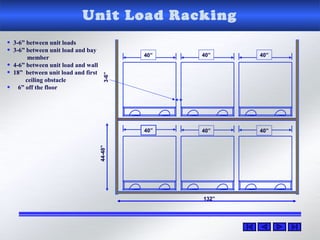
Unit Load Racking
44-48”
40” 40” 40”
132”
40”40”40”
3-6”
• 3-6” between unit loads
• 3-6” between unit load and bay
member
• 4-6” between unit load and wall
• 18” between unit load and first
ceiling obstacle
• 6” off the floor
001
002
003
004
005
006 008 010
009 011
012 014
013
016
015
018
017007
002
001003005007009011013015017
004006008010012014016018
Aisle 12
Aisle 11
11-A-L1-002
11-A-L1-001
11-A-L1-004
11-A-L1-003
11-A-L1-006
11-A-L1-005
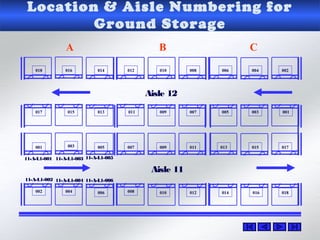
Location & Aisle Numbering for
Ground Storage
A B C
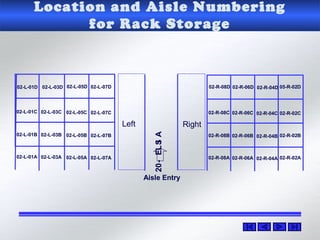
Location and Aisle Numbering
for Rack Storage
AISLE-02
Aisle Entry
Left Right
02-L-01A
02-L-01B
02-L-01C
02-L-01D
02-L-03A
02-L-03B
02-L-03C
02-L-03D
02-L-05A
02-L-05B
02-L-05C
02-L-05D
02-L-07A
02-L-07B
02-L-07C
02-L-07D
02-R-08A
02-R-08B
02-R-08C
02-R-08D
02-R-06A
02-R-06B
02-R-06C
02-R-06D
02-R-04A
02-R-04B
02-R-04C
02-R-04D
02-R-02A
02-R-02B
02-R-02C
05-R-02D
Drivers Duties
• Loyalty to company is very important
• To implement all job description
• Cars, daily check up for maintenance
• Cars, Cleaning on weekly basis
• Cars, Damage resulting of omission
• No eating or drinking while driving
• Complying w/warehouse rules & regulations
• To execute information delivered to you
• Smoking is not allowed in warehouse
• Cooperation w/colleagues and direct managers
• Deal w/rests. representative Like the only customer
• Handling returns as per policy
Key Inventory Terms
• Lead time. Time interval between ordering and
receiving the order
• Holding (carrying) costs. Cost to carry an
item in inventory for a length of time, usually a
year
• Ordering costs. Costs of ordering and receiving
inventory
• Shortage costs. Costs when demand exceeds
supply
Inventory Costs
• Ordering costs.
• Includes monitoring costs, order preparation.
order transmittal, order receipt (unpacking,
shelving, loss and damage).
• Holding (Carrying) costs.
• Includes interest, insurance, depreciation,
obsolescence, deterioration, spoilage, pilferage,
breakage and warehousing costs.
• Warehousing costs.
• Energy, Space, Labor, Equipment security
• Stock out costs.
• Includes opportunity cost of not making a sale
(lost profit), lost customer goodwill, backorder
costs, lateness charges.
COMPONENTS OF CARRYING COSTS
• Capital Costs. Cost of Money.
• Storage Costs. Is the cost of space,
personnel, and equipment.
• Risk Costs. It is the costs of obsolescence,
Damage, pilferage, insurance, etc.
• Records & Handling costs.
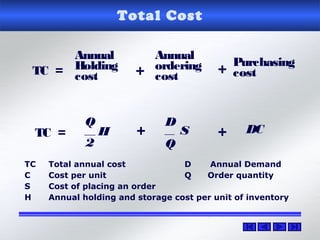
Total Cost
Annual
Holding
cost
Purchasing
costTC = +
Q
2
H
D
Q
STC = +
+
Annual
ordering
cost
DC+
TC Total annual cost D Annual Demand
C Cost per unit Q Order quantity
S Cost of placing an order
H Annual holding and storage cost per unit of inventory
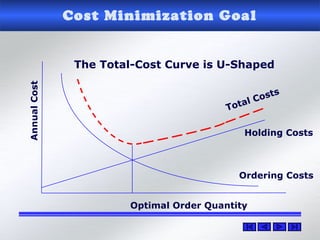
The Total-Cost Curve is U-Shaped
Ordering Costs
AnnualCost
Holding Costs
Total Costs
Cost Minimization Goal
Optimal Order Quantity
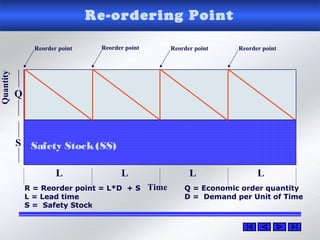
Re-ordering Point
L L
Q
S
TimeR = Reorder point = L*D + S Q = Economic order quantity
L = Lead time D = Demand per Unit of Time
S = Safety Stock
L
Quantity
Reorder point Reorder point Reorder point Reorder point
L
Safety Stock(SS)
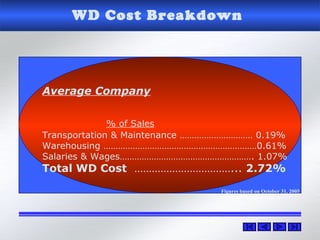
WD Cost Breakdown
Figures based on October 31, 2005
Average Company
% of Sales
Transportation & Maintenance ………………………… 0.19%
Warehousing ………………………………………………………0.61%
Salaries & Wages………………………………………………. 1.07%
Total WD Cost ……………………………... 2.72%
WD Opportunity
• To be Improved
• Inventory Accuracy
• Picking Accuracy
• Picking & Replenishment Efficiency
• Control of Products
• Space Utilization
• Stock Rotation
• Backorder Handling
• Resource Planning & Scheduling
• Labor & Equipment Productivity
• Performance Management
• Reduced
• Inventory
• Workforce
• Damage / Shrinkage Product
• Lost Stock & Safety Stock
• Search Times
• Paperwork / Human Error
• Physical Inventory Taking
• Labor, Equipment & Utility Costs
• Driver / Delivery Costs
• Worker Accidents
• Warehousing Costs
• Outside Warehousing
WD Opportunity
Warehouse Controls
•Personnel Safety and Health
• Reduce all risks
• Follow procedure for security risk
• Report all accidents
• Handle any accident
• Report any security risk
• Promote good housekeeping
• Maintain a clean, neat personnel hygiene
• Maintain a clean workplace
• work according to standards
• Dispose of waste in timely way
• Effectively mark aisles & maintain their
• integrity
• Have adequate lighting
• Apply all rules adopted in your organization
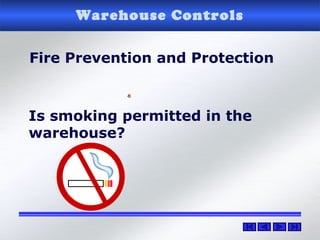
Fire Prevention and Protection
Warehouse Controls
Is smoking permitted in the
warehouse?
Warehouse Controls
•Theft and Pilferage
•Product Damage & Contamination
•Storing Hazardous Materials
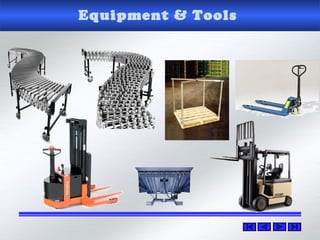
Equipment & Tools
Any Questions?
Managing warehouse operations. How to manage and run warehouse operations by Omar Youssef

Managing warehouse operations. How to manage and run warehouse operations by Omar Youssef

  • 1.
    By Omar Youssef BusinessConsultant E-mail: Omar.youssef5@hotmail.com Warehouse Operations Training Session
  • 2.
    Mission Statement “The warehouseis our strongest asset. Dedication, accountability and reliability are at the heart of our business philosophy. Focussed on our business units needs, we provide integrated logistics of outstanding product quality, Product quantity, and delivered on time. we are the extension of your business.”
  • 3.
    Warehouse Goals 1. Maximizeeffective use of space. 2. Maximize effective use of equipment. 3. Maximize effective use of labor. 4. Maximize accessibility of all items. 5. Maximize protection of all items. 6. Maximize effective use of information. 7. Maximize the protection of company’s assets. 8. Minimize goods Handling. 9. Minimize the company operating Cost.
  • 4.
    Warehouse Functions 1. Unloading 2.Receiving & Checking inbound goods 3. Internal product movement 4. Storing 5. Order-picking 6. Stock Sortation 7. Stock Rotation 8. Packing 9. Loading & Shipping 10. Cycle Counting 11. Replenishement 12. Handling Returns 13. Maintenance & Loss Prevention
  • 5.
    Operational Process Picking Inbound Activities Outbound Activities Process Activities Put-away PackingStorageReceivingShipping 1 - Unloading 2 - Counting 3 - Identifying 4 - Marking 5 - Quality Control 6 - Registering goods 7 – Put away 11 – Product Category 12 – Palletize 13 – Stocking 14 – Cycle Counting 15 – Replenishment 16 – Stock Rotation 17 – Space Planning 18 – Routing 19 – Directing 20 – Zoning 21 – Dunnaging 22 – Confirmation 23 – Invoicing 24 – Sealing 25 – Staging 26 – Loading
  • 6.
    Receiving • Receiving Objectives •Right Product • Right Quality • Right Quantities • Right Weight • Right PPB. • Right Condition • Right Standards • Right Time
  • 7.
    Receiving • Prepare toreceive goods and materials • Check Temperature • Unload the product (manual or automated) • Count the product • Check the product (quality, quantity & expiry) • Check Methods(100 % accept,100 %check, 10% sample check) • Identify the product • Mark the product • Enter the product on the receipt register • Transfer the product to stage area • Enter the product in stock • Re-Stack the product • Receiving Procedures
  • 8.
    Put away &Stacking • Stack according to First in First out • Stack according to standards • Method of stacking - Manual Stacking - Automated Stacking • Keep stacked goods neat • Boxes to be stacked evenly • Keep Identity sticker visible • Keep expiry date visible • Stack goods in a safe way
  • 9.
    Picking Time Consumption Source:John J. Bartholdi, III, Steven T. Hackman, 1998 Pickers Time Breakdown Traveling 55% Paperwork and other activities 20% Extracting 10% Searching 15% Traveling Searching Extracting Paperwork
  • 10.
    Picking • 50-60% oftime spent traveling • - Optimize picking workload • - Optimize work force assignm • - Optimize picking route • - Use of labor standards • Apply First in First out • Use the right picking equip • Pick the right item (accuracy) • Picking the right qty (accuracy) • Keep the Picking area neat • Picking Method • - Manual Picking • - Automated picking This is wrong This is Right
  • 11.
    Shipping • Invoicing • Staging •Categorizing • Checking • - the right product • - in the correct quantity • - in good condition • - and on scheduled time • Confirming • Loading
  • 12.
    Cold Storage Standards •Proper Storage Temperature • - Dry Storage from 55 to 70 F(13-21 C). • - Refrigerator from 34 to 38 F(1-4 C). • - Freezers from 0 to -22 F(-18 - -30 C). • A relative humidity of • - 50-60 % in the storeroom • - 75-85 % in the refrigerators for meats, fish, chicken, dairy products • - 85-95 % for fruits and vegetables • Good ventilation provides clean air at the required temperatures and humidity.
  • 13.
    Unit Load Racking 44-48” 40”40” 40” 132” 40”40”40” 3-6” • 3-6” between unit loads • 3-6” between unit load and bay member • 4-6” between unit load and wall • 18” between unit load and first ceiling obstacle • 6” off the floor
  • 14.
    001 002 003 004 005 006 008 010 009011 012 014 013 016 015 018 017007 002 001003005007009011013015017 004006008010012014016018 Aisle 12 Aisle 11 11-A-L1-002 11-A-L1-001 11-A-L1-004 11-A-L1-003 11-A-L1-006 11-A-L1-005 Location & Aisle Numbering for Ground Storage A B C
  • 15.
    Location and AisleNumbering for Rack Storage AISLE-02 Aisle Entry Left Right 02-L-01A 02-L-01B 02-L-01C 02-L-01D 02-L-03A 02-L-03B 02-L-03C 02-L-03D 02-L-05A 02-L-05B 02-L-05C 02-L-05D 02-L-07A 02-L-07B 02-L-07C 02-L-07D 02-R-08A 02-R-08B 02-R-08C 02-R-08D 02-R-06A 02-R-06B 02-R-06C 02-R-06D 02-R-04A 02-R-04B 02-R-04C 02-R-04D 02-R-02A 02-R-02B 02-R-02C 05-R-02D
  • 16.
    Drivers Duties • Loyaltyto company is very important • To implement all job description • Cars, daily check up for maintenance • Cars, Cleaning on weekly basis • Cars, Damage resulting of omission • No eating or drinking while driving • Complying w/warehouse rules & regulations • To execute information delivered to you • Smoking is not allowed in warehouse • Cooperation w/colleagues and direct managers • Deal w/rests. representative Like the only customer • Handling returns as per policy
  • 17.
    Key Inventory Terms •Lead time. Time interval between ordering and receiving the order • Holding (carrying) costs. Cost to carry an item in inventory for a length of time, usually a year • Ordering costs. Costs of ordering and receiving inventory • Shortage costs. Costs when demand exceeds supply
  • 18.
    Inventory Costs • Orderingcosts. • Includes monitoring costs, order preparation. order transmittal, order receipt (unpacking, shelving, loss and damage). • Holding (Carrying) costs. • Includes interest, insurance, depreciation, obsolescence, deterioration, spoilage, pilferage, breakage and warehousing costs. • Warehousing costs. • Energy, Space, Labor, Equipment security • Stock out costs. • Includes opportunity cost of not making a sale (lost profit), lost customer goodwill, backorder costs, lateness charges.
  • 19.
    COMPONENTS OF CARRYINGCOSTS • Capital Costs. Cost of Money. • Storage Costs. Is the cost of space, personnel, and equipment. • Risk Costs. It is the costs of obsolescence, Damage, pilferage, insurance, etc. • Records & Handling costs.
  • 20.
    Total Cost Annual Holding cost Purchasing costTC =+ Q 2 H D Q STC = + + Annual ordering cost DC+ TC Total annual cost D Annual Demand C Cost per unit Q Order quantity S Cost of placing an order H Annual holding and storage cost per unit of inventory
  • 21.
    The Total-Cost Curveis U-Shaped Ordering Costs AnnualCost Holding Costs Total Costs Cost Minimization Goal Optimal Order Quantity
  • 22.
    Re-ordering Point L L Q S TimeR= Reorder point = L*D + S Q = Economic order quantity L = Lead time D = Demand per Unit of Time S = Safety Stock L Quantity Reorder point Reorder point Reorder point Reorder point L Safety Stock(SS)
  • 23.
    WD Cost Breakdown Figuresbased on October 31, 2005 Average Company % of Sales Transportation & Maintenance ………………………… 0.19% Warehousing ………………………………………………………0.61% Salaries & Wages………………………………………………. 1.07% Total WD Cost ……………………………... 2.72%
  • 24.
    WD Opportunity • Tobe Improved • Inventory Accuracy • Picking Accuracy • Picking & Replenishment Efficiency • Control of Products • Space Utilization • Stock Rotation • Backorder Handling • Resource Planning & Scheduling • Labor & Equipment Productivity • Performance Management
  • 25.
    • Reduced • Inventory •Workforce • Damage / Shrinkage Product • Lost Stock & Safety Stock • Search Times • Paperwork / Human Error • Physical Inventory Taking • Labor, Equipment & Utility Costs • Driver / Delivery Costs • Worker Accidents • Warehousing Costs • Outside Warehousing WD Opportunity
  • 26.
    Warehouse Controls •Personnel Safetyand Health • Reduce all risks • Follow procedure for security risk • Report all accidents • Handle any accident • Report any security risk • Promote good housekeeping • Maintain a clean, neat personnel hygiene • Maintain a clean workplace • work according to standards • Dispose of waste in timely way • Effectively mark aisles & maintain their • integrity • Have adequate lighting • Apply all rules adopted in your organization
  • 27.
    Fire Prevention andProtection Warehouse Controls Is smoking permitted in the warehouse?
  • 28.
    Warehouse Controls •Theft andPilferage •Product Damage & Contamination •Storing Hazardous Materials
  • 29.
  • 30.