Vitamins
Keep
Calm
and take
Vitamins
Medical Chemistry 2 April 21, 2022
Objectives
2 Vitamins VS Biomolecules
1 Definition
Medical Chemistry 2
3 Classification
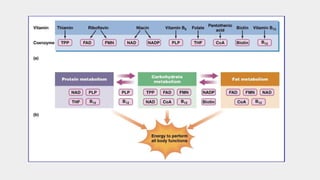
4 Vitamins in metabolism
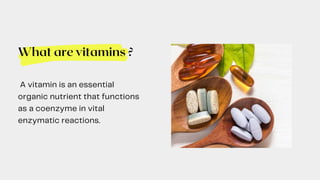
What are vitamins ?
A vitamin is an essential
organic nutrient that functions
as a coenzyme in vital
enzymatic reactions.
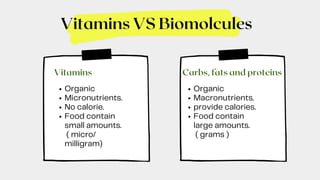
Organic
Macronutrients.
provide calories.
Food contain
large amounts.
( grams )
Organic
Micronutrients.
No calorie.
Food contain
small amounts.
( micro/
milligram)
Vitamins VS Biomolcules
Carbs, fats and proteins
Vitamins
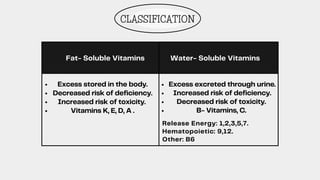
CLASSIFICATION
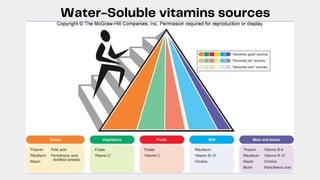
Water- Soluble Vitamins
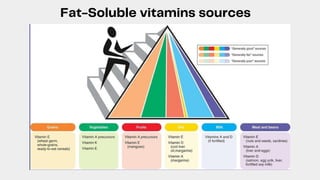
Fat- Soluble Vitamins
Excess stored in the body.
Decreased risk of deficiency.
Increased risk of toxicity.
Vitamins K, E, D, A .
Excess excreted through urine.
Increased risk of deficiency.
Decreased risk of toxicity.
B- Vitamins, C.
Release Energy: 1,2,3,5,7.
Hematopoietic: 9,12.
Other: B6
KEEP
GOING
Fat-soluble
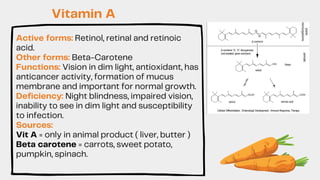
Active forms: Retinol, retinal and retinoic
acid.
Other forms: Beta-Carotene
Functions: Vision in dim light, antioxidant, has
anticancer activity, formation of mucus
membrane and important for normal growth.
Deficiency: Night blindness, impaired vision,
inability to see in dim light and susceptibility
to infection.
Sources:
Vit A = only in animal product ( liver, butter )
Beta carotene = carrots, sweet potato,
pumpkin, spinach.
Vitamin A
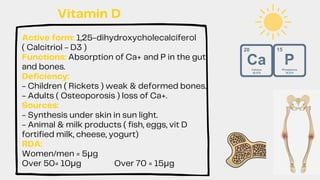
Active form: 1,25-dihydroxycholecalciferol
( Calcitriol - D3 )
Functions: Absorption of Ca+ and P in the gut
and bones.
Deficiency:
- Children ( Rickets ) weak & deformed bones.
- Adults ( Osteoporosis ) loss of Ca+.
Sources:
- Synthesis under skin in sun light.
- Animal & milk products ( fish, eggs, vit D
fortified milk, cheese, yogurt)
RDA:
Women/men = 5μg
Over 50= 10μg Over 70 = 15μg
Vitamin D
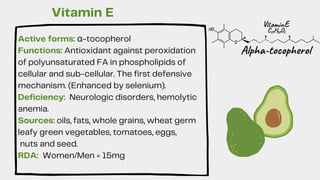
Active forms: α-tocopherol
Functions: Antioxidant against peroxidation
of polyunsaturated FA in phospholipids of
cellular and sub-cellular. The first defensive
mechanism. (Enhanced by selenium).
Deficiency: Neurologic disorders, hemolytic
anemia.
Sources: oils, fats, whole grains, wheat germ
leafy green vegetables, tomatoes, eggs,
nuts and seed.
RDA: Women/Men = 15mg
Vitamin E
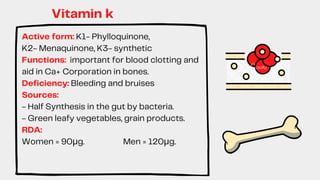
Active form: K1- Phylloquinone,
K2- Menaquinone, K3- synthetic
Functions: important for blood clotting and
aid in Ca+ Corporation in bones.
Deficiency: Bleeding and bruises
Sources:
- Half Synthesis in the gut by bacteria.
- Green leafy vegetables, grain products.
RDA:
Women = 90μg. Men = 120μg.
Vitamin k
KEEP
GOING
Water-soluble
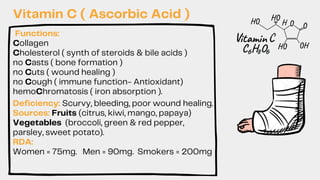
Vitamin C ( Ascorbic Acid )
Functions:
Collagen
Cholesterol ( synth of steroids & bile acids )
no Casts ( bone formation )
no Cuts ( wound healing )
no Cough ( immune function- Antioxidant)
hemoChromatosis ( iron absorption ).
Deficiency: Scurvy, bleeding, poor wound healing.
Sources: Fruits (citrus, kiwi, mango, papaya)
Vegetables (broccoli, green & red pepper,
parsley, sweet potato).
RDA:
Women = 75mg. Men = 90mg. Smokers = 200mg
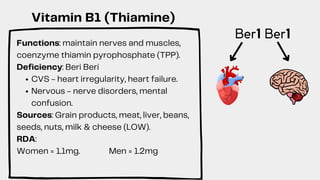
CVS - heart irregularity, heart failure.
Nervous - nerve disorders, mental
confusion.
Functions: maintain nerves and muscles,
coenzyme thiamin pyrophosphate (TPP).
Deficiency: Beri Beri
Sources: Grain products, meat, liver, beans,
seeds, nuts, milk & cheese (LOW).
RDA:
Women = 1.1mg. Men = 1.2mg
Vitamin B1 (Thiamine)
Ber1 Ber1
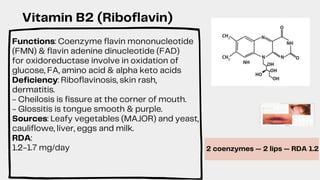
Functions: Coenzyme flavin mononucleotide
(FMN) & flavin adenine dinucleotide (FAD)
for oxidoreductase involve in oxidation of
glucose, FA, amino acid & alpha keto acids
Deficiency: Riboflavinosis, skin rash,
dermatitis.
- Cheilosis is fissure at the corner of mouth.
- Glossitis is tongue smooth & purple.
Sources: Leafy vegetables (MAJOR) and yeast,
cauliflowe, liver, eggs and milk.
RDA:
1.2-1.7 mg/day
Vitamin B2 (Riboflavin)
2 coenzymes — 2 lips — RDA 1.2
Coenzyme = nicotinamide adenine
dinucleotide (NAD), + phosphate (NADP).
maintain normal nervous system.
vasodilator.
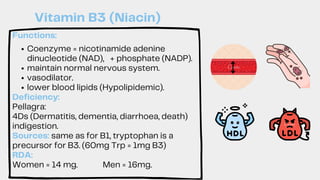
lower blood lipids (Hypolipidemic).
Functions:
Deficiency:
Pellagra:
4Ds (Dermatitis, dementia, diarrhoea, death)
indigestion.
Sources: same as for B1, tryptophan is a
precursor for B3. (60mg Trp = 1mg B3)
RDA:
Women = 14 mg. Men = 16mg.
Vitamin B3 (Niacin)
Functions: Coenzyme (Co A or Co A-SH) acts
as acyl carrier involved in energy metabolism.
Deficiency: Uncommon.
Sources: yeast, legumes, whole grain cereal,
beans, liver, meat, egg, milk.
RDA:
5-10mg/day
Vitamin B5 (Pantothenic)
Infant & children = 0.5-1.5 mg/day.
Adults = 2 mg/day.
pregnant & lactating women 2.5 mg/day.
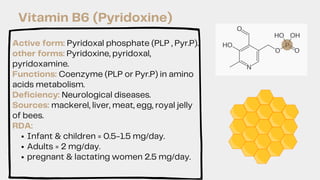
Active form: Pyridoxal phosphate (PLP , Pyr.P).
other forms: Pyridoxine, pyridoxal,
pyridoxamine.
Functions: Coenzyme (PLP or Pyr.P) in amino
acids metabolism.
Deficiency: Neurological diseases.
Sources: mackerel, liver, meat, egg, royal jelly
of bees.
RDA:
Vitamin B6 (Pyridoxine)
CoA carboxylase in FA synthesis.
Pyruvate carboxylase in gluconeogenesis.
Propionyl-CoA carboxylase.
Functions: Energy metabolism,
carboxylation reaction (CO2 carrier)
Coenzymes:
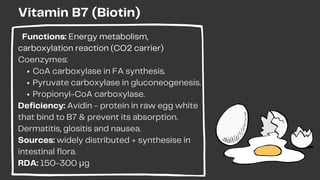
Deficiency: Avidin - protein in raw egg white
that bind to B7 & prevent its absorption.
Dermatitis, glositis and nausea.
Sources: widely distributed + synthesise in
intestinal flora.
RDA: 150-300 μg
Vitamin B7 (Biotin)
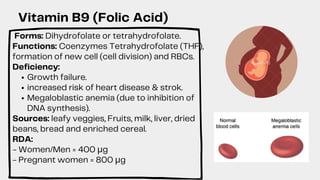
Growth failure.
increased risk of heart disease & strok.
Megaloblastic anemia (due to inhibition of
DNA synthesis).
Forms: Dihydrofolate or tetrahydrofolate.
Functions: Coenzymes Tetrahydrofolate (THF),
formation of new cell (cell division) and RBCs.
Deficiency:
Sources: leafy veggies, Fruits, milk, liver, dried
beans, bread and enriched cereal.
RDA:
- Women/Men = 400 μg
- Pregnant women = 800 μg
Vitamin B9 (Folic Acid)
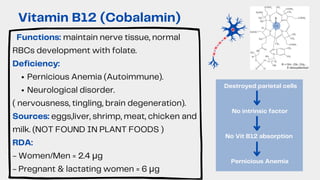
Pernicious Anemia (Autoimmune).
Neurological disorder.
Functions: maintain nerve tissue, normal
RBCs development with folate.
Deficiency:
( nervousness, tingling, brain degeneration).
Sources: eggs,liver, shrimp, meat, chicken and
milk. (NOT FOUND IN PLANT FOODS )
RDA:
- Women/Men = 2.4 μg
- Pregnant & lactating women = 6 μg
Vitamin B12 (Cobalamin)
Destroyed parietal cells
No intrinsic factor
No Vit B12 absorption
Pernicious Anemia
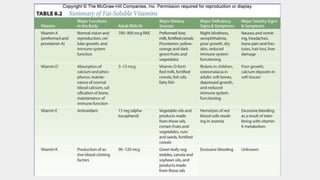
Fat-Soluble vitamins sources
Water-Soluble vitamins sources
References
Devlin, T. M. (2014). Textbook of biochemistry with clinical correlations. Wiley.
Makkieh, P. (2016). The Water Soluble Vitamins (Chapter 10). Retrieved April 6, 2022, from
https://youtu.be/KB_IXQr7Q1w.
Lecture 12: Vitamins, Medical Chemistry course, Taif University.
http://player.slideplayer.com/download/19/5901045/QJJGhV8AL2NMhYfk0tURdg/164997
9211/5901045.ppt
https://youtu.be/yadAyuOvlkc (How vitamins are involved in metabolism)
Thank you!
Happy
weekend!

Vitamins ✨.pdf

  • 1.
  • 2.
    Objectives 2 Vitamins VSBiomolecules 1 Definition Medical Chemistry 2 3 Classification 4 Vitamins in metabolism
  • 3.
    What are vitamins? A vitamin is an essential organic nutrient that functions as a coenzyme in vital enzymatic reactions.
  • 4.
    Organic Macronutrients. provide calories. Food contain largeamounts. ( grams ) Organic Micronutrients. No calorie. Food contain small amounts. ( micro/ milligram) Vitamins VS Biomolcules Carbs, fats and proteins Vitamins
  • 5.
    CLASSIFICATION Water- Soluble Vitamins Fat-Soluble Vitamins Excess stored in the body. Decreased risk of deficiency. Increased risk of toxicity. Vitamins K, E, D, A . Excess excreted through urine. Increased risk of deficiency. Decreased risk of toxicity. B- Vitamins, C. Release Energy: 1,2,3,5,7. Hematopoietic: 9,12. Other: B6
  • 6.
  • 7.
    Active forms: Retinol,retinal and retinoic acid. Other forms: Beta-Carotene Functions: Vision in dim light, antioxidant, has anticancer activity, formation of mucus membrane and important for normal growth. Deficiency: Night blindness, impaired vision, inability to see in dim light and susceptibility to infection. Sources: Vit A = only in animal product ( liver, butter ) Beta carotene = carrots, sweet potato, pumpkin, spinach. Vitamin A
  • 8.
    Active form: 1,25-dihydroxycholecalciferol (Calcitriol - D3 ) Functions: Absorption of Ca+ and P in the gut and bones. Deficiency: - Children ( Rickets ) weak & deformed bones. - Adults ( Osteoporosis ) loss of Ca+. Sources: - Synthesis under skin in sun light. - Animal & milk products ( fish, eggs, vit D fortified milk, cheese, yogurt) RDA: Women/men = 5μg Over 50= 10μg Over 70 = 15μg Vitamin D
  • 9.
    Active forms: α-tocopherol Functions:Antioxidant against peroxidation of polyunsaturated FA in phospholipids of cellular and sub-cellular. The first defensive mechanism. (Enhanced by selenium). Deficiency: Neurologic disorders, hemolytic anemia. Sources: oils, fats, whole grains, wheat germ leafy green vegetables, tomatoes, eggs, nuts and seed. RDA: Women/Men = 15mg Vitamin E
  • 10.
    Active form: K1-Phylloquinone, K2- Menaquinone, K3- synthetic Functions: important for blood clotting and aid in Ca+ Corporation in bones. Deficiency: Bleeding and bruises Sources: - Half Synthesis in the gut by bacteria. - Green leafy vegetables, grain products. RDA: Women = 90μg. Men = 120μg. Vitamin k
  • 11.
  • 12.
    Vitamin C (Ascorbic Acid ) Functions: Collagen Cholesterol ( synth of steroids & bile acids ) no Casts ( bone formation ) no Cuts ( wound healing ) no Cough ( immune function- Antioxidant) hemoChromatosis ( iron absorption ). Deficiency: Scurvy, bleeding, poor wound healing. Sources: Fruits (citrus, kiwi, mango, papaya) Vegetables (broccoli, green & red pepper, parsley, sweet potato). RDA: Women = 75mg. Men = 90mg. Smokers = 200mg
  • 13.
    CVS - heartirregularity, heart failure. Nervous - nerve disorders, mental confusion. Functions: maintain nerves and muscles, coenzyme thiamin pyrophosphate (TPP). Deficiency: Beri Beri Sources: Grain products, meat, liver, beans, seeds, nuts, milk & cheese (LOW). RDA: Women = 1.1mg. Men = 1.2mg Vitamin B1 (Thiamine) Ber1 Ber1
  • 14.
    Functions: Coenzyme flavinmononucleotide (FMN) & flavin adenine dinucleotide (FAD) for oxidoreductase involve in oxidation of glucose, FA, amino acid & alpha keto acids Deficiency: Riboflavinosis, skin rash, dermatitis. - Cheilosis is fissure at the corner of mouth. - Glossitis is tongue smooth & purple. Sources: Leafy vegetables (MAJOR) and yeast, cauliflowe, liver, eggs and milk. RDA: 1.2-1.7 mg/day Vitamin B2 (Riboflavin) 2 coenzymes — 2 lips — RDA 1.2
  • 15.
    Coenzyme = nicotinamideadenine dinucleotide (NAD), + phosphate (NADP). maintain normal nervous system. vasodilator. lower blood lipids (Hypolipidemic). Functions: Deficiency: Pellagra: 4Ds (Dermatitis, dementia, diarrhoea, death) indigestion. Sources: same as for B1, tryptophan is a precursor for B3. (60mg Trp = 1mg B3) RDA: Women = 14 mg. Men = 16mg. Vitamin B3 (Niacin)
  • 16.
    Functions: Coenzyme (CoA or Co A-SH) acts as acyl carrier involved in energy metabolism. Deficiency: Uncommon. Sources: yeast, legumes, whole grain cereal, beans, liver, meat, egg, milk. RDA: 5-10mg/day Vitamin B5 (Pantothenic)
  • 17.
    Infant & children= 0.5-1.5 mg/day. Adults = 2 mg/day. pregnant & lactating women 2.5 mg/day. Active form: Pyridoxal phosphate (PLP , Pyr.P). other forms: Pyridoxine, pyridoxal, pyridoxamine. Functions: Coenzyme (PLP or Pyr.P) in amino acids metabolism. Deficiency: Neurological diseases. Sources: mackerel, liver, meat, egg, royal jelly of bees. RDA: Vitamin B6 (Pyridoxine)
  • 18.
    CoA carboxylase inFA synthesis. Pyruvate carboxylase in gluconeogenesis. Propionyl-CoA carboxylase. Functions: Energy metabolism, carboxylation reaction (CO2 carrier) Coenzymes: Deficiency: Avidin - protein in raw egg white that bind to B7 & prevent its absorption. Dermatitis, glositis and nausea. Sources: widely distributed + synthesise in intestinal flora. RDA: 150-300 μg Vitamin B7 (Biotin)
  • 19.
    Growth failure. increased riskof heart disease & strok. Megaloblastic anemia (due to inhibition of DNA synthesis). Forms: Dihydrofolate or tetrahydrofolate. Functions: Coenzymes Tetrahydrofolate (THF), formation of new cell (cell division) and RBCs. Deficiency: Sources: leafy veggies, Fruits, milk, liver, dried beans, bread and enriched cereal. RDA: - Women/Men = 400 μg - Pregnant women = 800 μg Vitamin B9 (Folic Acid)
  • 20.
    Pernicious Anemia (Autoimmune). Neurologicaldisorder. Functions: maintain nerve tissue, normal RBCs development with folate. Deficiency: ( nervousness, tingling, brain degeneration). Sources: eggs,liver, shrimp, meat, chicken and milk. (NOT FOUND IN PLANT FOODS ) RDA: - Women/Men = 2.4 μg - Pregnant & lactating women = 6 μg Vitamin B12 (Cobalamin) Destroyed parietal cells No intrinsic factor No Vit B12 absorption Pernicious Anemia
  • 23.
  • 25.
  • 26.
    References Devlin, T. M.(2014). Textbook of biochemistry with clinical correlations. Wiley. Makkieh, P. (2016). The Water Soluble Vitamins (Chapter 10). Retrieved April 6, 2022, from https://youtu.be/KB_IXQr7Q1w. Lecture 12: Vitamins, Medical Chemistry course, Taif University. http://player.slideplayer.com/download/19/5901045/QJJGhV8AL2NMhYfk0tURdg/164997 9211/5901045.ppt https://youtu.be/yadAyuOvlkc (How vitamins are involved in metabolism)
  • 27.