Spurthi BS
Doctor of Pharmacy (PharmD)
Mallige college of pharmacy
INTRODUCTION
The word "vitamin" comes from the Latin word “vita”, means
"life".
Vitamins are organic components in food that are needed
in very small amounts for growth and for maintaining
good health.
Everybody must eat a certain amount of vitamins to stay
healthy.
Vitamins are chemicals found in very small amounts in many
different foods.
CHARACTERISTICS
Vitamins are required in small quantities in the diet because
they cannot be synthesized by the body.
Water soluble vitamins cannot be stored in human tissues.
Their excess is excreted with urine.
Significant amounts of fat soluble vitamins can be stored in
adipose tissue and the liver.
Synthetic vitamins are identical to natural vitamins.
Once growth and development are completed, vitamins remain
essential nutrients for the healthy maintenance of the cells,
tissues, and organs.
CLASSIFICATION
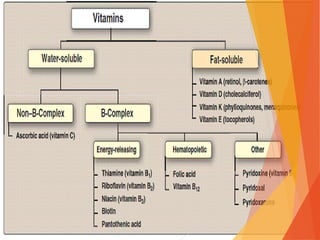
 On the basis of their solubility vitamins are mainly 2 types-
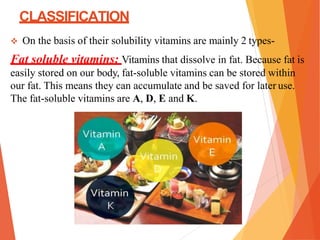
Fat soluble vitamins: Vitamins that dissolve in fat. Because fat is
easily stored on our body, fat-soluble vitamins can be stored within
our fat. This means they can accumulate and be saved for later use.
The fat-soluble vitamins are A, D, E and K.
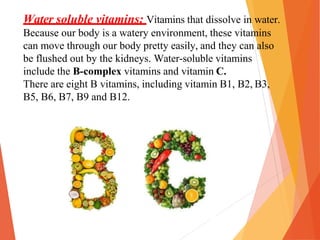
Water soluble vitamins: Vitamins that dissolve in water.
Because our body is a watery environment, these vitamins
can move through our body pretty easily, and they can also
be flushed out by the kidneys. Water-soluble vitamins
include the B-complex vitamins and vitamin C.
There are eight B vitamins, including vitamin B1, B2, B3,
B5, B6, B7, B9 and B12.
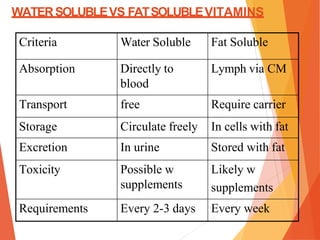
WATERSOLUBLEVS FATSOLUBLEVITAMINS
Criteria Water Soluble Fat Soluble
Absorption Directly to
blood
Lymph via CM
Transport free Require carrier
Storage Circulate freely In cells with fat
Excretion In urine Stored with fat
Toxicity Possible w
supplements
Likely w
supplements
Requirements Every 2-3 days Every week
FATSOLUBLEVITAMINS (A, D, E, K )
VITAMIN A
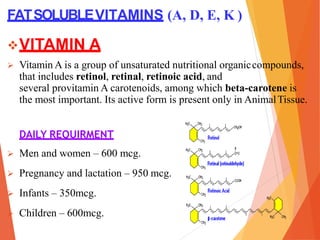
 Vitamin A is a group of unsaturated nutritional organiccompounds,
that includes retinol, retinal, retinoic acid, and
several provitamin A carotenoids, among which beta-carotene is
the most important. Its active form is present only in AnimalTissue.
DAILY REQUIRMENT
 Men and women – 600 mcg.
 Pregnancy and lactation – 950 mcg.
 Infants – 350mcg.
 Children – 600mcg.
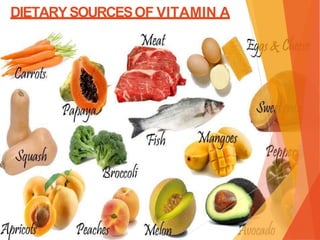
DIETARYSOURCESOF VITAMIN A
FUNCTIONS
 Vitamin A plays a role in a variety of functions
throughout the body, such as:
Vision
Gene transcription
Immune function
Embryonic development and reproduction
Bone metabolism
Hematopoiesis (the production of blood cells and
platelets)
Skin and cellular health
Antioxidant activity
VITAMIN D
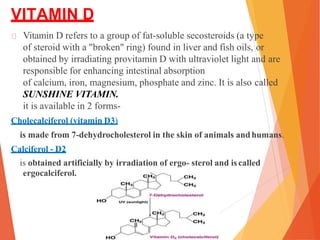
Vitamin D refers to a group of fat-soluble secosteroids (a type
of steroid with a "broken" ring) found in liver and fish oils, or
obtained by irradiating provitamin D with ultraviolet light and are
responsible for enhancing intestinal absorption
of calcium, iron, magnesium, phosphate and zinc. It is also called
SUNSHINE VITAMIN.
it is available in 2 forms-
Cholecalciferol (vitamin D3)
is made from 7-dehydrocholesterol in the skin of animals andhumans.
Calciferol - D2
is obtained artificially by irradiation of ergo- sterol and iscalled
ergocalciferol.
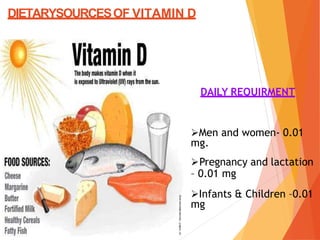
DIETARYSOURCESOF VITAMIN D
DAILY REQUIRMENT
Men and women- 0.01
mg.
Pregnancy and lactation
– 0.01 mg
Infants & Children –0.01
mg
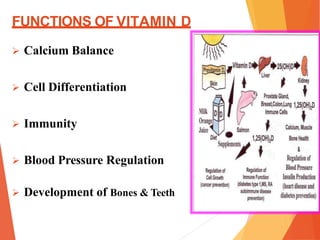
FUNCTIONS OF VITAMIN D
 Calcium Balance
 Cell Differentiation
 Immunity
 Blood Pressure Regulation
 Development of Bones & Teeth
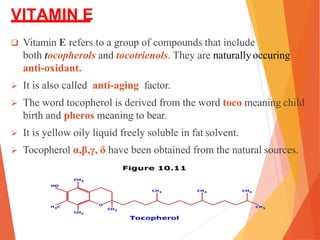
VITAMIN E
 Vitamin E refers to a group of compounds that include
both tocopherols and tocotrienols. They are naturally occuring
anti-oxidant.
 It is also called anti-aging factor.
 The word tocopherol is derived from the word toco meaning child
birth and pheros meaning to bear.
 It is yellow oily liquid freely soluble in fat solvent.
 Tocopherol α,β,γ, δ have been obtained from the natural sources.
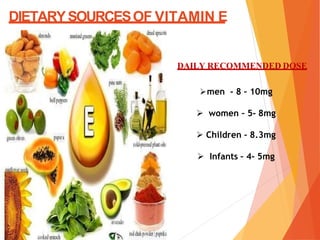
DIETARYSOURCESOF VITAMIN E
DAILY RECOMMENDED DOSE
men - 8 – 10mg
 women – 5- 8mg
 Children – 8.3mg
 Infants – 4- 5mg
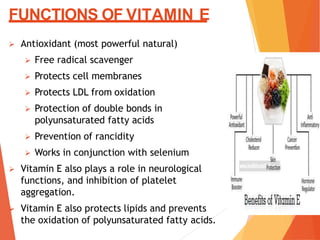
FUNCTIONS OF VITAMIN E
 Antioxidant (most powerful natural)
 Free radical scavenger
 Protects cell membranes
 Protects LDL from oxidation
 Protection of double bonds in
polyunsaturated fatty acids
 Prevention of rancidity
 Works in conjunction with selenium
 Vitamin E also plays a role in neurological
functions, and inhibition of platelet
aggregation.
 Vitamin E also protects lipids and prevents
the oxidation of polyunsaturated fatty acids.
VITAMIN K
Vitamin K refers to a group of structurally similar, fat-
soluble vitamins the human body needs for complete
synthesis of certain proteins that are required for
blood coagulation, and also certain proteins that the
body uses to manipulate binding of calcium in bone and
other tissues.
Vitamin K is naturally produced by the bacteria in the
intestines.
It is essential for production of a type of protein called
prothrombin & other factor involve in blood clotting
mechanism. Hence it is known as anti – hemorrhagic
vitamin.
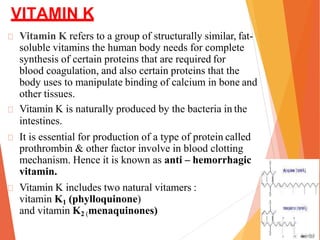
Vitamin K includes two natural vitamers :
vitamin K1 (phylloquinone)
and vitamin K2 (menaquinones)
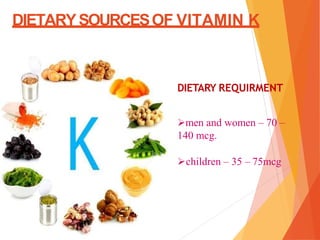
DIETARYSOURCESOF VITAMIN K
DIETARY REQUIRMENT
men and women – 70 –
140 mcg.
children – 35 – 75mcg
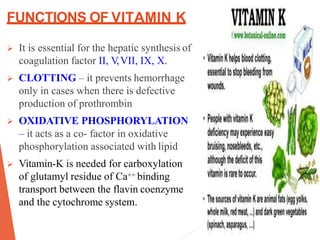
FUNCTIONS OF VITAMIN K
 It is essential for the hepatic synthesis of
coagulation factor II, V,VII, IX, X.
 CLOTTING – it prevents hemorrhage
only in cases when there is defective
production of prothrombin
 OXIDATIVE PHOSPHORYLATION
– it acts as a co- factor in oxidative
phosphorylation associated with lipid
 Vitamin-K is needed for carboxylation
of glutamyl residue of Ca++ binding
transport between the flavin coenzyme
and the cytochrome system.
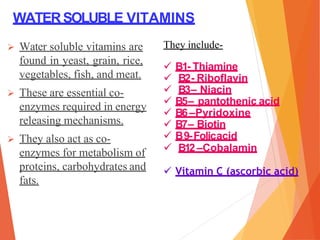
WATERSOLUBLE VITAMINS
 Water soluble vitamins are
found in yeast, grain, rice,
vegetables, fish, and meat.
 These are essential co-
enzymes required in energy
releasing mechanisms.
 They also act as co-
enzymes for metabolism of
proteins, carbohydrates and
fats.
They include-
 B1- Thiamine
 B2- Riboflavin
 B3– Niacin
 B5– pantothenic acid
 B6 –Pyridoxine
 B7– Biotin
 B9-Folicacid
 B12 –Cobalamin
 Vitamin C (ascorbic acid)
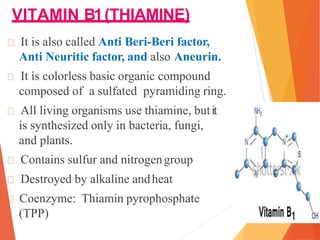
VITAMIN B1(THIAMINE)
It is also called Anti Beri-Beri factor,
Anti Neuritic factor, and also Aneurin.
It is colorless basic organic compound
composed of a sulfated pyramiding ring.
All living organisms use thiamine, butit
is synthesized only in bacteria, fungi,
and plants.
Contains sulfur and nitrogengroup
Destroyed by alkaline andheat
Coenzyme: Thiamin pyrophosphate
(TPP)
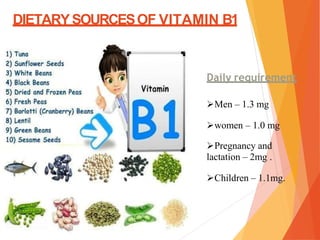
DIETARYSOURCESOF VITAMIN B1
Daily requirement
Men – 1.3 mg
women – 1.0 mg
Pregnancy and
lactation – 2mg .
Children – 1.1mg.
FUNCTIONS OF THIAMINE
Vitamin B1, is very essential for converting carbohydrate
into energy.
The most important use of thiamine is in the treatment of
beriberi, a condition caused by a deficiency of thiamine in
the diet. Symptoms include swelling, tingling or burning
sensation in the hands and feet, confusion, difficulty
breathing.
Vitamin B1, helps in maintaining the healthy nervous
system.
Vitamin B1, is necessary for healthy mucous membranes.
It helps in the digestion of food.
It provides strength to muscles.
It is very useful for the proper functioning of heart.
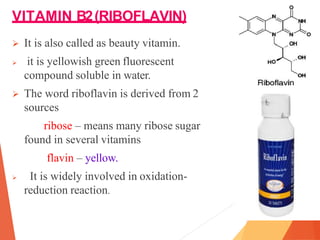
VITAMIN B2(RIBOFLAVIN)
 It is also called as beauty vitamin.
 it is yellowish green fluorescent
compound soluble in water.
 The word riboflavin is derived from 2
sources
ribose – means many ribose sugar
found in several vitamins
flavin – yellow.
 It is widely involved in oxidation-
reduction reaction.
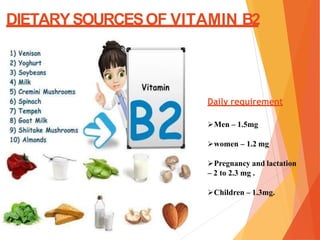
DIETARYSOURCESOF VITAMIN B2
Daily requirement
Men – 1.5mg
women – 1.2 mg
Pregnancy and lactation
– 2 to 2.3 mg .
Children – 1.3mg.
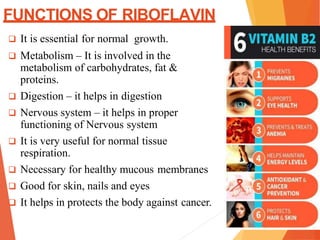
FUNCTIONS OF RIBOFLAVIN
 It is essential for normal growth.
 Metabolism – It is involved in the
metabolism of carbohydrates, fat &
proteins.
 Digestion – it helps in digestion
 Nervous system – it helps in proper
functioning of Nervous system
 It is very useful for normal tissue
respiration.
 Necessary for healthy mucous membranes
 Good for skin, nails and eyes
 It helps in protects the body against cancer.
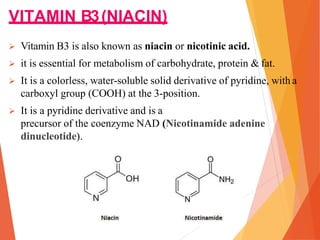
VITAMIN B3(NIACIN)
 Vitamin B3 is also known as niacin or nicotinic acid.
 it is essential for metabolism of carbohydrate, protein & fat.
 It is a colorless, water-soluble solid derivative of pyridine, with a
carboxyl group (COOH) at the 3-position.
 It is a pyridine derivative and is a
precursor of the coenzyme NAD (Nicotinamide adenine
dinucleotide).
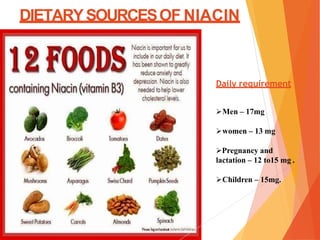
DIETARYSOURCESOF NIACIN
Daily requirement
Men – 17mg
women – 13 mg
Pregnancy and
lactation – 12 to15 mg .
Children – 15mg.
FUNCTIONS OF NIACIN (VIT B3)
Vitamin B3, helps in releasing energy from carbohydrates, fats and
protiens.
vitamin B3, is very essential for the DNA synthesis.
it is essential for production of estrogen progesterone & testosterone
It is also helpful in reducing migraine headaches.
Vitamin B3, as niacinamide, may improve arthritis symptoms, including
increasing joint mobility and reducing the amount of anti-inflammatory
medications needed.
It is necessary for healthy skin, nerves and digestive system.
High doses of niacin medications are used to prevent development of
atherosclerosis and to reduce recurrent complications such as heart attack
and peripheral vascular disease in those with the condition.
It helps to detoxify the body.
Vitamin B3, is very essential for the proper digestion of the food.
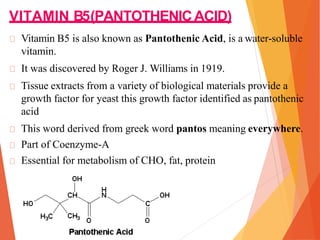
VITAMIN B5(PANTOTHENICACID)
Vitamin B5 is also known as Pantothenic Acid, is a water-soluble
vitamin.
It was discovered by Roger J. Williams in 1919.
Tissue extracts from a variety of biological materials provide a
growth factor for yeast this growth factor identified as pantothenic
acid
This word derived from greek word pantos meaning everywhere.
Part of Coenzyme-A
Essential for metabolism of CHO, fat, protein
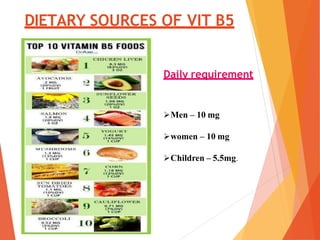
DIETARY SOURCES OF VIT B5
Men – 10 mg
women – 10 mg
Children – 5.5mg.
Daily requirement
FUNCTIONS OF VIT B5 (PANTOTHENIC ACID)
Vitamin B5 plays an important role in helping release energy from
sugars, starches, and fats.
Vitamin B5 is important for releasing energy stored as fat, it is equally
important for the creation of fat. Two basic types of fats - fatty acids
and cholesterol - both require the CoA form of B5 for their synthesis.
Sometimes it is important for the body to make small chemical changes
in the shape of cell proteins, thus vitamin B5 is used in this case.
They are essential for the cell metabolism.
They are very helpful in the cholesterol metabolism.
Accelerates wound healing.
It is also used as anti-stress factor.
Allergies, headaches, arthritis, psoriasis, insomnia, asthma, and
infections have all been treated with some effectiveness using vitamin
B5.
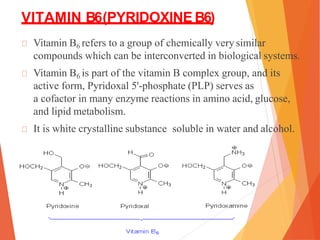
VITAMIN B6(PYRIDOXINE B6)
Vitamin B6 refers to a group of chemically very similar
compounds which can be interconverted in biological systems.
Vitamin B6 is part of the vitamin B complex group, and its
active form, Pyridoxal 5'-phosphate (PLP) serves as
a cofactor in many enzyme reactions in amino acid, glucose,
and lipid metabolism.
It is white crystalline substance soluble in water and alcohol.
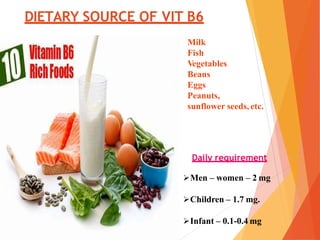
DIETARY SOURCE OF VIT B6
Daily requirement
Men – women – 2 mg
Children – 1.7 mg.
Infant – 0.1-0.4 mg
Milk
Fish
Vegetables
Beans
Eggs
Peanuts,
sunflower seeds, etc.
FUNCTIONS OF VITAMIN B6
Make antibodies. Antibodies are needed to fightmany
diseases.
Maintain normal nerve function
Make hemoglobin. Hemoglobin carries oxygen in the red
blood cells to the tissues. Avitamin B6 deficiency can cause a
form of anemia.
Break down proteins. The more protein you eat, the more
vitamin B6 you need.
Keep blood sugar (glucose) in normal ranges
Assists in the balancing of Sodium and Potassium levels.
Promotes RBC production.
Production of Serotonin, Dopamine, Noradrenaline and
Adrenaline
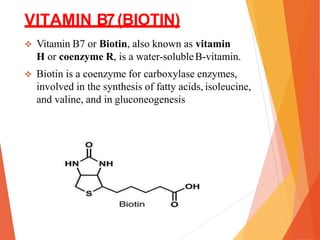
VITAMIN B7(BIOTIN)
 Vitamin B7 or Biotin, also known as vitamin
H or coenzyme R, is a water-solubleB-vitamin.
 Biotin is a coenzyme for carboxylase enzymes,
involved in the synthesis of fatty acids, isoleucine,
and valine, and in gluconeogenesis
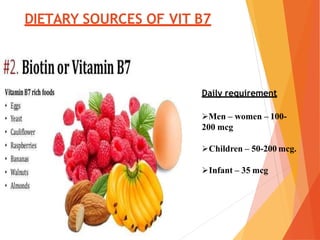
DIETARY SOURCES OF VIT B7
Daily requirement
Men – women – 100-
200 mcg
Children – 50-200 mcg.
Infant – 35 mcg
FUNCTIONS OF VITAMIN B7
sufficient intake of vitamin B7 (biotin) is important as it helps the body to-
•convert food into glucose, which is used to produce energy
•produce fatty acids and amino acids (the building blocks of protein)
•activate protein/amino acid metabolism in the hair roots and fingernail cells.
The European Food Safety Authority (EFSA), which provides scientific
advice to assist policy makers, has confirmed that clear health benefits have
been established for the dietary intake of biotin (vitamin B7) in contributing to:
•normal macronutrient metabolism;
•normal energy yielding metabolism;
•the maintenance of normal skin and mucous membranes;
•the normal function of the nervous system;
•the maintenance of normal hair;
•normal psychological functions.
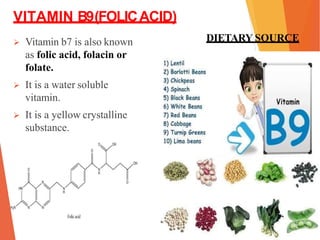
VITAMIN B9(FOLICACID)
 Vitamin b7 is also known
as folic acid, folacin or
folate.
 It is a water soluble
vitamin.
 It is a yellow crystalline
substance.
DIETARY SOURCE
FUNCTIONS OF VIT B9
 Formation of RBC – folic acid in combination with vitamin
B12 is essential for formation, maturation.
 Nerve – it is necessary for growth & division of all body cells,
 Hair & Skin – it is essential for the health of skin & hair
 Pregnancy – it is an important nutrient for the pregnant
women & her developing fetus.& folic acid improves the
lactation.
DNAsynthesis
Transfer of single carbon units
Synthesis of adenine and guanine
Anticancer drug methotrexate
Homocysteine metabolism
Neurotransmitter formation
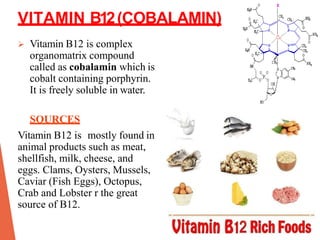
VITAMIN B12(COBALAMIN)
 Vitamin B12 is complex
organomatrix compound
called as cobalamin which is
cobalt containing porphyrin.
It is freely soluble in water.
SOURCES
Vitamin B12 is mostly found in
animal products such as meat,
shellfish, milk, cheese, and
eggs. Clams, Oysters, Mussels,
Caviar (Fish Eggs), Octopus,
Crab and Lobster r the great
source of B12.
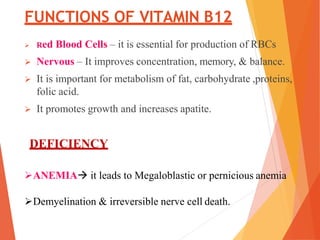
FUNCTIONS OF VITAMIN B12
 Red Blood Cells – it is essential for production of RBCs
 Nervous – It improves concentration, memory, & balance.
 It is important for metabolism of fat, carbohydrate ,proteins,
folic acid.
 It promotes growth and increases apatite.
DEFICIENCY
ANEMIA it leads to Megaloblastic or pernicious anemia
Demyelination & irreversible nerve cell death.
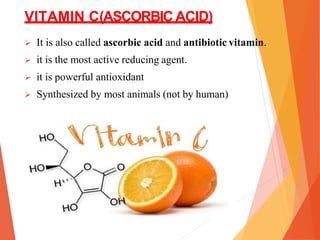
VITAMIN C(ASCORBIC ACID)
 It is also called ascorbic acid and antibiotic vitamin.
 it is the most active reducing agent.
 it is powerful antioxidant
 Synthesized by most animals (not by human)
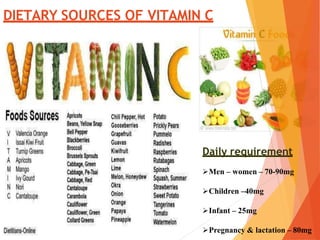
DIETARY SOURCES OF VITAMIN C
Daily requirement
Men – women – 70-90mg
Children –40mg
Infant – 25mg
Pregnancy & lactation – 80mg
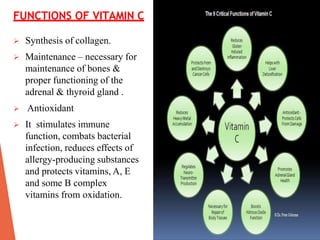
FUNCTIONS OF VITAMIN C
 Synthesis of collagen.
 Maintenance – necessary for
maintenance of bones &
proper functioning of the
adrenal & thyroid gland .
 Antioxidant
 It stimulates immune
function, combats bacterial
infection, reduces effects of
allergy-producing substances
and protects vitamins, A, E
and some B complex
vitamins from oxidation.
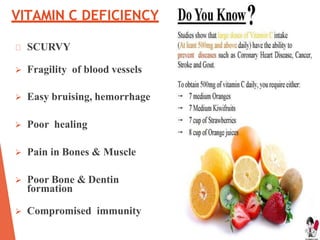
VITAMIN C DEFICIENCY
SCURVY
 Fragility of blood vessels
 Easy bruising, hemorrhage
 Poor healing
 Pain in Bones & Muscle
 Poor Bone & Dentin
formation
 Compromised immunity

Vitamins

  • 1.
    Spurthi BS Doctor ofPharmacy (PharmD) Mallige college of pharmacy
  • 2.
    INTRODUCTION The word "vitamin"comes from the Latin word “vita”, means "life". Vitamins are organic components in food that are needed in very small amounts for growth and for maintaining good health. Everybody must eat a certain amount of vitamins to stay healthy. Vitamins are chemicals found in very small amounts in many different foods.
  • 3.
    CHARACTERISTICS Vitamins are requiredin small quantities in the diet because they cannot be synthesized by the body. Water soluble vitamins cannot be stored in human tissues. Their excess is excreted with urine. Significant amounts of fat soluble vitamins can be stored in adipose tissue and the liver. Synthetic vitamins are identical to natural vitamins. Once growth and development are completed, vitamins remain essential nutrients for the healthy maintenance of the cells, tissues, and organs.
  • 4.
    CLASSIFICATION  On thebasis of their solubility vitamins are mainly 2 types- Fat soluble vitamins: Vitamins that dissolve in fat. Because fat is easily stored on our body, fat-soluble vitamins can be stored within our fat. This means they can accumulate and be saved for later use. The fat-soluble vitamins are A, D, E and K.
  • 5.
    Water soluble vitamins:Vitamins that dissolve in water. Because our body is a watery environment, these vitamins can move through our body pretty easily, and they can also be flushed out by the kidneys. Water-soluble vitamins include the B-complex vitamins and vitamin C. There are eight B vitamins, including vitamin B1, B2, B3, B5, B6, B7, B9 and B12.
  • 7.
    WATERSOLUBLEVS FATSOLUBLEVITAMINS Criteria WaterSoluble Fat Soluble Absorption Directly to blood Lymph via CM Transport free Require carrier Storage Circulate freely In cells with fat Excretion In urine Stored with fat Toxicity Possible w supplements Likely w supplements Requirements Every 2-3 days Every week
  • 9.
    FATSOLUBLEVITAMINS (A, D,E, K ) VITAMIN A  Vitamin A is a group of unsaturated nutritional organiccompounds, that includes retinol, retinal, retinoic acid, and several provitamin A carotenoids, among which beta-carotene is the most important. Its active form is present only in AnimalTissue. DAILY REQUIRMENT  Men and women – 600 mcg.  Pregnancy and lactation – 950 mcg.  Infants – 350mcg.  Children – 600mcg.
  • 10.
  • 11.
    FUNCTIONS  Vitamin Aplays a role in a variety of functions throughout the body, such as: Vision Gene transcription Immune function Embryonic development and reproduction Bone metabolism Hematopoiesis (the production of blood cells and platelets) Skin and cellular health Antioxidant activity
  • 12.
    VITAMIN D Vitamin Drefers to a group of fat-soluble secosteroids (a type of steroid with a "broken" ring) found in liver and fish oils, or obtained by irradiating provitamin D with ultraviolet light and are responsible for enhancing intestinal absorption of calcium, iron, magnesium, phosphate and zinc. It is also called SUNSHINE VITAMIN. it is available in 2 forms- Cholecalciferol (vitamin D3) is made from 7-dehydrocholesterol in the skin of animals andhumans. Calciferol - D2 is obtained artificially by irradiation of ergo- sterol and iscalled ergocalciferol.
  • 13.
    DIETARYSOURCESOF VITAMIN D DAILYREQUIRMENT Men and women- 0.01 mg. Pregnancy and lactation – 0.01 mg Infants & Children –0.01 mg
  • 14.
    FUNCTIONS OF VITAMIND  Calcium Balance  Cell Differentiation  Immunity  Blood Pressure Regulation  Development of Bones & Teeth
  • 15.
    VITAMIN E  VitaminE refers to a group of compounds that include both tocopherols and tocotrienols. They are naturally occuring anti-oxidant.  It is also called anti-aging factor.  The word tocopherol is derived from the word toco meaning child birth and pheros meaning to bear.  It is yellow oily liquid freely soluble in fat solvent.  Tocopherol α,β,γ, δ have been obtained from the natural sources.
  • 16.
    DIETARYSOURCESOF VITAMIN E DAILYRECOMMENDED DOSE men - 8 – 10mg  women – 5- 8mg  Children – 8.3mg  Infants – 4- 5mg
  • 17.
    FUNCTIONS OF VITAMINE  Antioxidant (most powerful natural)  Free radical scavenger  Protects cell membranes  Protects LDL from oxidation  Protection of double bonds in polyunsaturated fatty acids  Prevention of rancidity  Works in conjunction with selenium  Vitamin E also plays a role in neurological functions, and inhibition of platelet aggregation.  Vitamin E also protects lipids and prevents the oxidation of polyunsaturated fatty acids.
  • 18.
    VITAMIN K Vitamin Krefers to a group of structurally similar, fat- soluble vitamins the human body needs for complete synthesis of certain proteins that are required for blood coagulation, and also certain proteins that the body uses to manipulate binding of calcium in bone and other tissues. Vitamin K is naturally produced by the bacteria in the intestines. It is essential for production of a type of protein called prothrombin & other factor involve in blood clotting mechanism. Hence it is known as anti – hemorrhagic vitamin. Vitamin K includes two natural vitamers : vitamin K1 (phylloquinone) and vitamin K2 (menaquinones)
  • 19.
    DIETARYSOURCESOF VITAMIN K DIETARYREQUIRMENT men and women – 70 – 140 mcg. children – 35 – 75mcg
  • 20.
    FUNCTIONS OF VITAMINK  It is essential for the hepatic synthesis of coagulation factor II, V,VII, IX, X.  CLOTTING – it prevents hemorrhage only in cases when there is defective production of prothrombin  OXIDATIVE PHOSPHORYLATION – it acts as a co- factor in oxidative phosphorylation associated with lipid  Vitamin-K is needed for carboxylation of glutamyl residue of Ca++ binding transport between the flavin coenzyme and the cytochrome system.
  • 21.
    WATERSOLUBLE VITAMINS  Watersoluble vitamins are found in yeast, grain, rice, vegetables, fish, and meat.  These are essential co- enzymes required in energy releasing mechanisms.  They also act as co- enzymes for metabolism of proteins, carbohydrates and fats. They include-  B1- Thiamine  B2- Riboflavin  B3– Niacin  B5– pantothenic acid  B6 –Pyridoxine  B7– Biotin  B9-Folicacid  B12 –Cobalamin  Vitamin C (ascorbic acid)
  • 22.
    VITAMIN B1(THIAMINE) It isalso called Anti Beri-Beri factor, Anti Neuritic factor, and also Aneurin. It is colorless basic organic compound composed of a sulfated pyramiding ring. All living organisms use thiamine, butit is synthesized only in bacteria, fungi, and plants. Contains sulfur and nitrogengroup Destroyed by alkaline andheat Coenzyme: Thiamin pyrophosphate (TPP)
  • 23.
    DIETARYSOURCESOF VITAMIN B1 Dailyrequirement Men – 1.3 mg women – 1.0 mg Pregnancy and lactation – 2mg . Children – 1.1mg.
  • 24.
    FUNCTIONS OF THIAMINE VitaminB1, is very essential for converting carbohydrate into energy. The most important use of thiamine is in the treatment of beriberi, a condition caused by a deficiency of thiamine in the diet. Symptoms include swelling, tingling or burning sensation in the hands and feet, confusion, difficulty breathing. Vitamin B1, helps in maintaining the healthy nervous system. Vitamin B1, is necessary for healthy mucous membranes. It helps in the digestion of food. It provides strength to muscles. It is very useful for the proper functioning of heart.
  • 25.
    VITAMIN B2(RIBOFLAVIN)  Itis also called as beauty vitamin.  it is yellowish green fluorescent compound soluble in water.  The word riboflavin is derived from 2 sources ribose – means many ribose sugar found in several vitamins flavin – yellow.  It is widely involved in oxidation- reduction reaction.
  • 26.
    DIETARYSOURCESOF VITAMIN B2 Dailyrequirement Men – 1.5mg women – 1.2 mg Pregnancy and lactation – 2 to 2.3 mg . Children – 1.3mg.
  • 27.
    FUNCTIONS OF RIBOFLAVIN It is essential for normal growth.  Metabolism – It is involved in the metabolism of carbohydrates, fat & proteins.  Digestion – it helps in digestion  Nervous system – it helps in proper functioning of Nervous system  It is very useful for normal tissue respiration.  Necessary for healthy mucous membranes  Good for skin, nails and eyes  It helps in protects the body against cancer.
  • 28.
    VITAMIN B3(NIACIN)  VitaminB3 is also known as niacin or nicotinic acid.  it is essential for metabolism of carbohydrate, protein & fat.  It is a colorless, water-soluble solid derivative of pyridine, with a carboxyl group (COOH) at the 3-position.  It is a pyridine derivative and is a precursor of the coenzyme NAD (Nicotinamide adenine dinucleotide).
  • 29.
    DIETARYSOURCESOF NIACIN Daily requirement Men– 17mg women – 13 mg Pregnancy and lactation – 12 to15 mg . Children – 15mg.
  • 30.
    FUNCTIONS OF NIACIN(VIT B3) Vitamin B3, helps in releasing energy from carbohydrates, fats and protiens. vitamin B3, is very essential for the DNA synthesis. it is essential for production of estrogen progesterone & testosterone It is also helpful in reducing migraine headaches. Vitamin B3, as niacinamide, may improve arthritis symptoms, including increasing joint mobility and reducing the amount of anti-inflammatory medications needed. It is necessary for healthy skin, nerves and digestive system. High doses of niacin medications are used to prevent development of atherosclerosis and to reduce recurrent complications such as heart attack and peripheral vascular disease in those with the condition. It helps to detoxify the body. Vitamin B3, is very essential for the proper digestion of the food.
  • 31.
    VITAMIN B5(PANTOTHENICACID) Vitamin B5is also known as Pantothenic Acid, is a water-soluble vitamin. It was discovered by Roger J. Williams in 1919. Tissue extracts from a variety of biological materials provide a growth factor for yeast this growth factor identified as pantothenic acid This word derived from greek word pantos meaning everywhere. Part of Coenzyme-A Essential for metabolism of CHO, fat, protein
  • 32.
    DIETARY SOURCES OFVIT B5 Men – 10 mg women – 10 mg Children – 5.5mg. Daily requirement
  • 33.
    FUNCTIONS OF VITB5 (PANTOTHENIC ACID) Vitamin B5 plays an important role in helping release energy from sugars, starches, and fats. Vitamin B5 is important for releasing energy stored as fat, it is equally important for the creation of fat. Two basic types of fats - fatty acids and cholesterol - both require the CoA form of B5 for their synthesis. Sometimes it is important for the body to make small chemical changes in the shape of cell proteins, thus vitamin B5 is used in this case. They are essential for the cell metabolism. They are very helpful in the cholesterol metabolism. Accelerates wound healing. It is also used as anti-stress factor. Allergies, headaches, arthritis, psoriasis, insomnia, asthma, and infections have all been treated with some effectiveness using vitamin B5.
  • 34.
    VITAMIN B6(PYRIDOXINE B6) VitaminB6 refers to a group of chemically very similar compounds which can be interconverted in biological systems. Vitamin B6 is part of the vitamin B complex group, and its active form, Pyridoxal 5'-phosphate (PLP) serves as a cofactor in many enzyme reactions in amino acid, glucose, and lipid metabolism. It is white crystalline substance soluble in water and alcohol.
  • 35.
    DIETARY SOURCE OFVIT B6 Daily requirement Men – women – 2 mg Children – 1.7 mg. Infant – 0.1-0.4 mg Milk Fish Vegetables Beans Eggs Peanuts, sunflower seeds, etc.
  • 36.
    FUNCTIONS OF VITAMINB6 Make antibodies. Antibodies are needed to fightmany diseases. Maintain normal nerve function Make hemoglobin. Hemoglobin carries oxygen in the red blood cells to the tissues. Avitamin B6 deficiency can cause a form of anemia. Break down proteins. The more protein you eat, the more vitamin B6 you need. Keep blood sugar (glucose) in normal ranges Assists in the balancing of Sodium and Potassium levels. Promotes RBC production. Production of Serotonin, Dopamine, Noradrenaline and Adrenaline
  • 37.
    VITAMIN B7(BIOTIN)  VitaminB7 or Biotin, also known as vitamin H or coenzyme R, is a water-solubleB-vitamin.  Biotin is a coenzyme for carboxylase enzymes, involved in the synthesis of fatty acids, isoleucine, and valine, and in gluconeogenesis
  • 38.
    DIETARY SOURCES OFVIT B7 Daily requirement Men – women – 100- 200 mcg Children – 50-200 mcg. Infant – 35 mcg
  • 39.
    FUNCTIONS OF VITAMINB7 sufficient intake of vitamin B7 (biotin) is important as it helps the body to- •convert food into glucose, which is used to produce energy •produce fatty acids and amino acids (the building blocks of protein) •activate protein/amino acid metabolism in the hair roots and fingernail cells. The European Food Safety Authority (EFSA), which provides scientific advice to assist policy makers, has confirmed that clear health benefits have been established for the dietary intake of biotin (vitamin B7) in contributing to: •normal macronutrient metabolism; •normal energy yielding metabolism; •the maintenance of normal skin and mucous membranes; •the normal function of the nervous system; •the maintenance of normal hair; •normal psychological functions.
  • 40.
    VITAMIN B9(FOLICACID)  Vitaminb7 is also known as folic acid, folacin or folate.  It is a water soluble vitamin.  It is a yellow crystalline substance. DIETARY SOURCE
  • 41.
    FUNCTIONS OF VITB9  Formation of RBC – folic acid in combination with vitamin B12 is essential for formation, maturation.  Nerve – it is necessary for growth & division of all body cells,  Hair & Skin – it is essential for the health of skin & hair  Pregnancy – it is an important nutrient for the pregnant women & her developing fetus.& folic acid improves the lactation. DNAsynthesis Transfer of single carbon units Synthesis of adenine and guanine Anticancer drug methotrexate Homocysteine metabolism Neurotransmitter formation
  • 42.
    VITAMIN B12(COBALAMIN)  VitaminB12 is complex organomatrix compound called as cobalamin which is cobalt containing porphyrin. It is freely soluble in water. SOURCES Vitamin B12 is mostly found in animal products such as meat, shellfish, milk, cheese, and eggs. Clams, Oysters, Mussels, Caviar (Fish Eggs), Octopus, Crab and Lobster r the great source of B12.
  • 43.
    FUNCTIONS OF VITAMINB12  Red Blood Cells – it is essential for production of RBCs  Nervous – It improves concentration, memory, & balance.  It is important for metabolism of fat, carbohydrate ,proteins, folic acid.  It promotes growth and increases apatite. DEFICIENCY ANEMIA it leads to Megaloblastic or pernicious anemia Demyelination & irreversible nerve cell death.
  • 44.
    VITAMIN C(ASCORBIC ACID) It is also called ascorbic acid and antibiotic vitamin.  it is the most active reducing agent.  it is powerful antioxidant  Synthesized by most animals (not by human)
  • 45.
    DIETARY SOURCES OFVITAMIN C Daily requirement Men – women – 70-90mg Children –40mg Infant – 25mg Pregnancy & lactation – 80mg
  • 46.
    FUNCTIONS OF VITAMINC  Synthesis of collagen.  Maintenance – necessary for maintenance of bones & proper functioning of the adrenal & thyroid gland .  Antioxidant  It stimulates immune function, combats bacterial infection, reduces effects of allergy-producing substances and protects vitamins, A, E and some B complex vitamins from oxidation.
  • 47.
    VITAMIN C DEFICIENCY SCURVY Fragility of blood vessels  Easy bruising, hemorrhage  Poor healing  Pain in Bones & Muscle  Poor Bone & Dentin formation  Compromised immunity