WATER – SOLUBLE
VITAMINS
P R E E T H I . S
AS S I S TAN T P R O F E S S O R
N U T R I T I O N AN D D I E T E T I C S
B I S H O P H E B E R C O L L E G E , T R I C H Y.
WATER SOLUBLEVITAMINS
– B & C
VITAMINS
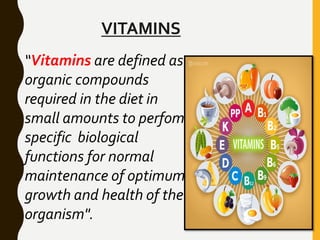
“Vitamins are defined as
organic compounds
required in the diet in
small amounts to perfom
specific biological
functions for normal
maintenance of optimum
growth and health of the
organism".
CLASSIFICATION
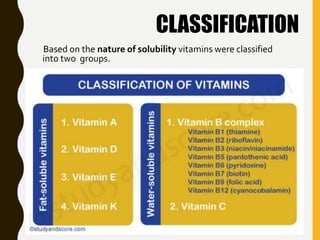
Based on the nature of solubility vitamins were classified
into two groups.
 They are heterogeneous group of compounds -
differ chemically.
 Common character – solubility in water.
 Easily absorbed.
 Not stored in the body except forVitamin B12.
 Readily excreted in urine.
 Form coenzymes – biochemical reactions.
WATER-SOLUBLEVITAMINS
VITAMIN-C (ASCORBIC ACID)
 The isolation of vitamin C - Zilva (1917-1927).
He obtained - highly potent substance &
reducing properties
 In 1928, Szent-Gyorgi isolated an acid with
strong reducing properties from cabbages,
adrenal glands and oranges – “Hexuronic acid"
 In 1933, Waugh and King isolated vitamin C in
crystalline form - lemon juice
 In 1933, Vitamin C as ascorbic acid owing its
anti-scorbutic properties
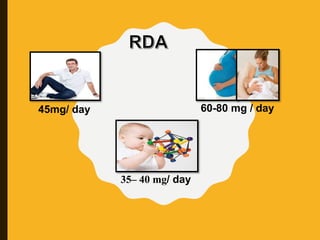
45mg/ day 60-80 mg / day
35– 40 mg/ day
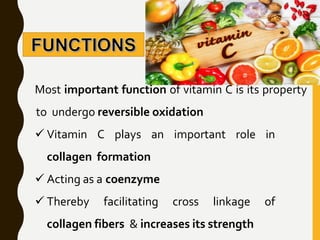
Most important function of vitamin C is its property
to undergo reversible oxidation
 Vitamin C plays an important role in
collagen formation
 Acting as a coenzyme
 Thereby facilitating cross linkage of
collagen fibers & increases its strength
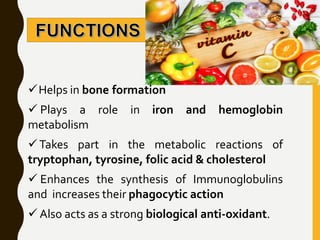
Helps in bone formation
 Plays a role in iron and hemoglobin
metabolism
Takes part in the metabolic reactions of
tryptophan, tyrosine, folic acid & cholesterol
 Enhances the synthesis of Immunoglobulins
and increases their phagocytic action
 Also acts as a strong biological anti-oxidant.
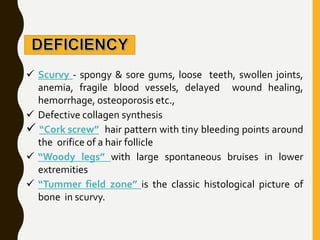
 Scurvy - spongy & sore gums, loose teeth, swollen joints,
anemia, fragile blood vessels, delayed wound healing,
hemorrhage, osteoporosis etc.,
 Defective collagen synthesis
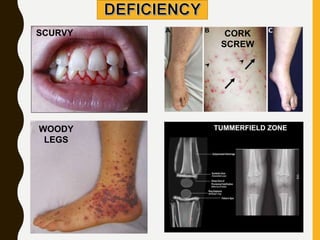
 “Cork screw” hair pattern with tiny bleeding points around
the orifice of a hair follicle
 “Woody legs” with large spontaneous bruises in lower
extremities
 “Tummer field zone” is the classic histological picture of
bone in scurvy.
SCURVY
WOODY
LEGS
CORK
SCREW
TUMMERFIELD ZONE
ORAL
MANIFESTATIONS
 Swollen & spongy gums – inter-dental
papillae producing the appearance of
scurvy buds
 In severe cases - hemorrhages to
periodontal membranes followed by
loss of bone & loosening of teeth occurs
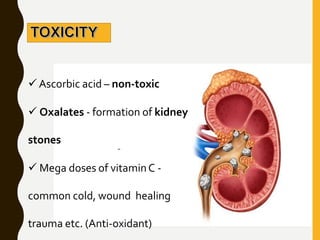
 Ascorbic acid – non-toxic
 Oxalates - formation of kidney
stones
 Mega doses of vitaminC -
common cold, wound healing
trauma etc. (Anti-oxidant)
 B-complex group of vitamins - large
number of water soluble vitamins :
nutritional essentials for all forms of life,
from the lowest form of yeast & bacteria
to the highest form, the man
 Not only nutritionally, also form essential
co enzymes to certain important
intracellular enzyme systems
There are about individual components,
most of them are synthesized by the
microbial flora
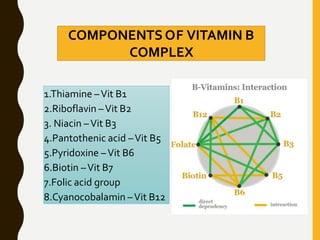
COMPONENTS OF VITAMIN B
COMPLEX
1.Thiamine –Vit B1
2.Riboflavin –Vit B2
3. Niacin –Vit B3
4.Pantothenic acid –Vit B5
5.Pyridoxine –Vit B6
6.Biotin –Vit B7
7.Folic acid group
8.Cyanocobalamin –Vit B12
THIAMINE (VITAMIN B1, ANTI
BERIBERI,ANTI-NEURITICVITAMIN)
 Free thiamin - basic & heat stable
 Specific coenzyme, thiamine pyrophosphate (TPP) -
carbohydrate metabolism
 Readily soluble in water
 Stable in acid medium
 Destroyed – autoclaved at 120°C for 30min
 Destroyed even @ room temperature in alkaline medium
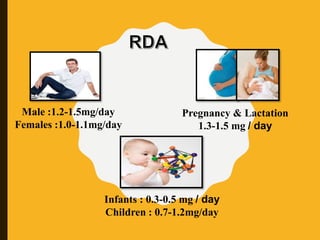
Male :1.2-1.5mg/day
Females :1.0-1.1mg/day
Infants : 0.3-0.5 mg / day
Children : 0.7-1.2mg/day
Pregnancy & Lactation
1.3-1.5 mg / day
BIOCHEMICAL
FUNCTIONS
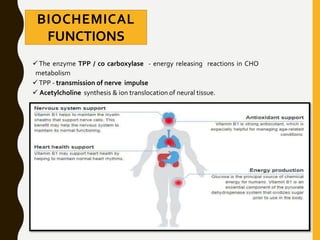
The enzyme TPP / co carboxylase - energy releasing reactions in CHO
metabolism
TPP - transmission of nerve impulse
 Acetylcholine synthesis & ion translocation of neural tissue.
DEFICIENCY
MANIFESTATIONS
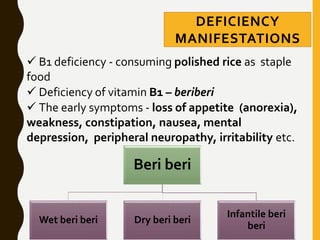
 B1 deficiency - consuming polished rice as staple
food
 Deficiency of vitamin B1 – beriberi
 The early symptoms - loss of appetite (anorexia),
weakness, constipation, nausea, mental
depression, peripheral neuropathy, irritability etc.
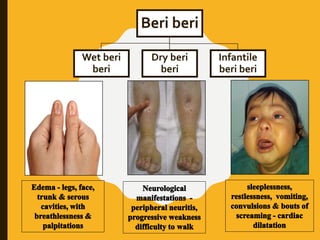
Beri beri
Wet beri beri Dry beri beri
Infantile beri
beri
Beri beri
Wet beri
beri
Dry beri
beri
Infantile
beri beri
RIBOFLAVIN (VITAMIN B2)
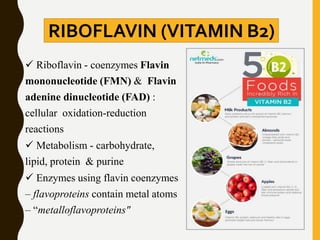
 Riboflavin - coenzymes Flavin
mononucleotide (FMN) & Flavin
adenine dinucleotide (FAD) :
cellular oxidation-reduction
reactions
 Metabolism - carbohydrate,
lipid, protein & purine
 Enzymes using flavin coenzymes
– flavoproteins contain metal atoms
– “metalloflavoproteins"
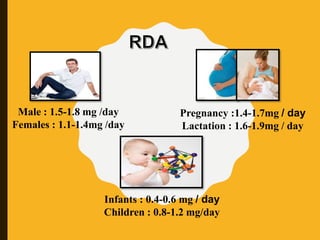
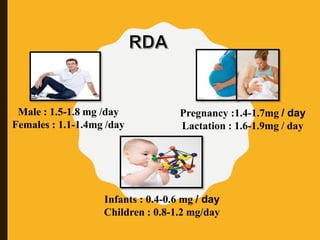
Male : 1.5-1.8 mg /day
Females : 1.1-1.4mg /day
Infants : 0.4-0.6 mg / day
Children : 0.8-1.2 mg/day
Pregnancy :1.4-1.7mg / day
Lactation : 1.6-1.9mg / day
DEFICIENCY
•
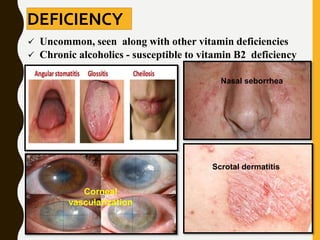
 Uncommon, seen along with other vitamin deficiencies
 Chronic alcoholics - susceptible to vitamin B2 deficiency
Nasal seborrhea
Scrotal dermatitis
Corneal
vascularization
NIACIN (VITAMIN B3, NICOTINIC ACID)
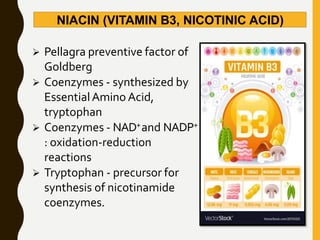
 Pellagra preventive factor of
Goldberg
 Coenzymes - synthesized by
EssentialAmino Acid,
tryptophan
 Coenzymes - NAD+and NADP+
: oxidation-reduction
reactions
 Tryptophan - precursor for
synthesis of nicotinamide
coenzymes.
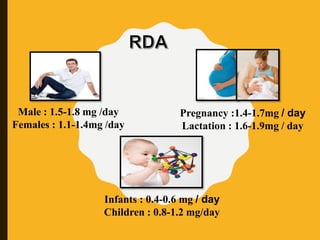
Male : 1.5-1.8 mg /day
Females : 1.1-1.4mg /day
Infants : 0.4-0.6 mg / day
Children : 0.8-1.2 mg/day
Pregnancy :1.4-1.7mg / day
Lactation : 1.6-1.9mg / day
DEFICIENCY
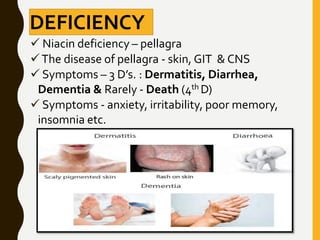
 Niacin deficiency – pellagra
The disease of pellagra - skin, GIT & CNS
 Symptoms – 3 D’s. : Dermatitis, Diarrhea,
Dementia & Rarely - Death (4th D)
 Symptoms - anxiety, irritability, poor memory,
insomnia etc.
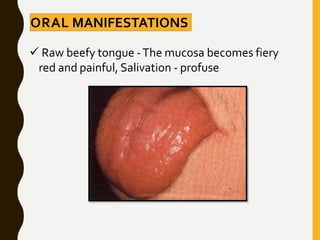
ORAL MANIFESTATIONS
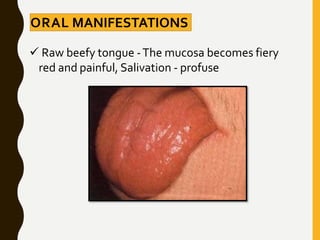
 Raw beefy tongue -The mucosa becomes fiery
red and painful, Salivation - profuse
PANTOTHENIC ACID (VITAMIN B5)
 Pantothenic acid – also
known as chick anti-
dermatitis factor/filtrate
factor
 Functions - exerted
through coenzymeA/CoA
 CoA - central molecule in
metabolisms (carbohydrate,
lipid and protein), as the
carrier of activated acetyl/acyl
groups
Male : 1.5-1.8 mg /day
Females : 1.1-1.4mg /day
Infants : 0.4-0.6 mg / day
Children : 0.8-1.2 mg/day
Pregnancy :1.4-1.7mg / day
Lactation : 1.6-1.9mg / day
DEFICIENCY
MANIFESTATIONS
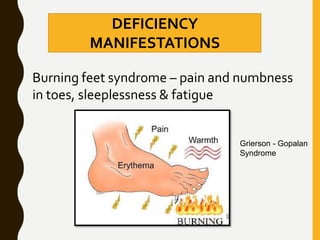
Burning feet syndrome – pain and numbness
in toes, sleeplessness & fatigue
Grierson - Gopalan
Syndrome
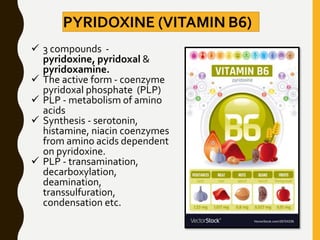
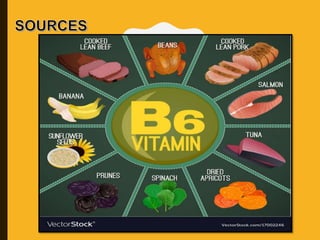
PYRIDOXINE (VITAMIN B6)
 3 compounds -
pyridoxine, pyridoxal &
pyridoxamine.
 The active form - coenzyme
pyridoxal phosphate (PLP)
 PLP - metabolism of amino
acids
 Synthesis - serotonin,
histamine, niacin coenzymes
from amino acids dependent
on pyridoxine.
 PLP - transamination,
decarboxylation,
deamination,
transsulfuration,
condensation etc.
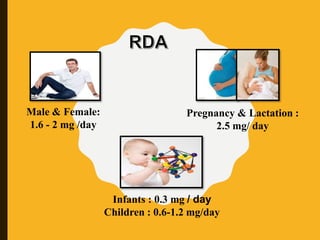
Male & Female:
1.6 - 2 mg /day
Infants : 0.3 mg / day
Children : 0.6-1.2 mg/day
Pregnancy & Lactation :
2.5 mg/ day
DEFICIENCY
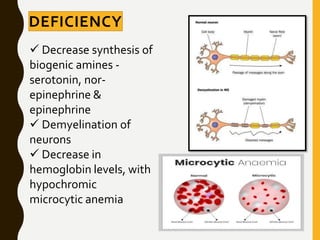
 Decrease synthesis of
biogenic amines -
serotonin, nor-
epinephrine &
epinephrine
 Demyelination of
neurons
 Decrease in
hemoglobin levels, with
hypochromic
microcytic anemia
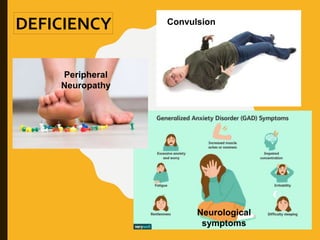
DEFICIENCY
Peripheral
Neuropathy
Convulsion
Neurological
symptoms
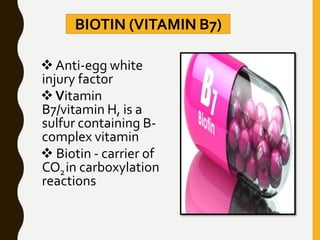
BIOTIN (VITAMIN B7)
 Anti-egg white
injury factor
Vitamin
B7/vitamin H, is a
sulfur containing B-
complex vitamin
 Biotin - carrier of
CO2in carboxylation
reactions
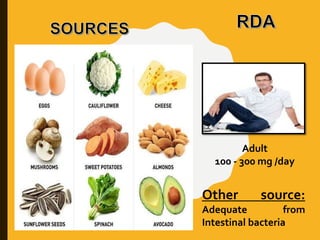
Adult
100 - 300 mg /day
Other source:
Adequate from
Intestinal bacteria
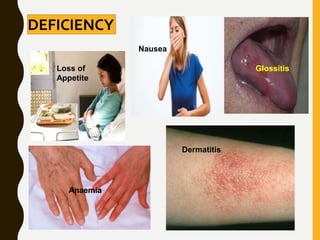
DEFICIENCY
Loss of
Appetite
Anaemia
Dermatitis
Nausea
Glossitis
FOLICACID
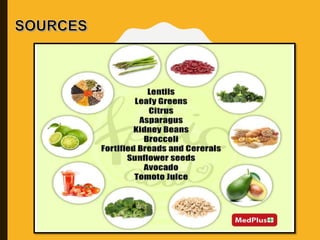
 Folic acid/folacin – GLV
Important - one carbon
metabolism & synthesis
of amino acids, purines &
pyrimidine-thymine
Tetrahydrofolate (THF
or FH4),the coenzyme of
folic acid is active -
carbon metabolism
THF - acceptor/donor of
carbon units in a variety
of reactions involving
amino acid & nucleotide
metabolism
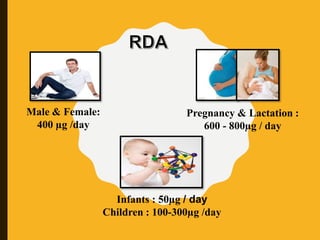
Male & Female:
400 µg /day
Infants : 50µg / day
Children : 100-300µg /day
Pregnancy & Lactation :
600 - 800µg / day
DEFICIENCY
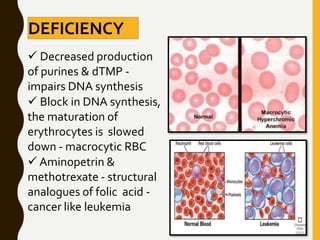
 Decreased production
of purines & dTMP -
impairs DNA synthesis
 Block in DNA synthesis,
the maturation of
erythrocytes is slowed
down - macrocytic RBC
 Aminopetrin &
methotrexate - structural
analogues of folic acid -
cancer like leukemia
CYANOCOBALAMINE (VITAMIN B12)
Vitamin B12 / anti-pernicious anemia vitamin &
extrinsic factor ofCastle
 Derived - cobalamine & cyanocobalamine due to
cobalt & cyanide groups
Vit B12 - formation of labile methyl groups, for the
synthesis of thymine, nucleic - normal hemopoisis
 Synthesis of methionine from homocysteine
 Isomerization of methymalonylCoA to succinyl
CoA
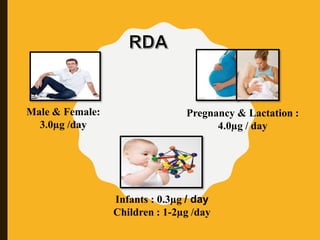
Male & Female:
3.0µg /day
Infants : 0.3µg / day
Children : 1-2µg /day
Pregnancy & Lactation :
4.0µg / day
DEFICIENCY
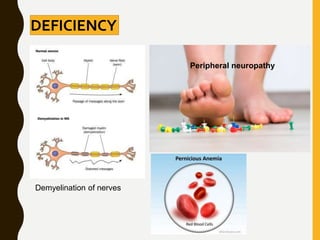
Demyelination of nerves
Peripheral neuropathy
ORAL MANIFESTATIONS
 Raw beefy tongue -The mucosa becomes fiery
red and painful, Salivation - profuse
THANK YOU

Water soluble vitamins

  • 1.
    WATER – SOLUBLE VITAMINS PR E E T H I . S AS S I S TAN T P R O F E S S O R N U T R I T I O N AN D D I E T E T I C S B I S H O P H E B E R C O L L E G E , T R I C H Y.
  • 2.
  • 3.
    VITAMINS “Vitamins are definedas organic compounds required in the diet in small amounts to perfom specific biological functions for normal maintenance of optimum growth and health of the organism".
  • 4.
    CLASSIFICATION Based on thenature of solubility vitamins were classified into two groups.
  • 5.
     They areheterogeneous group of compounds - differ chemically.  Common character – solubility in water.  Easily absorbed.  Not stored in the body except forVitamin B12.  Readily excreted in urine.  Form coenzymes – biochemical reactions. WATER-SOLUBLEVITAMINS
  • 6.
    VITAMIN-C (ASCORBIC ACID) The isolation of vitamin C - Zilva (1917-1927). He obtained - highly potent substance & reducing properties  In 1928, Szent-Gyorgi isolated an acid with strong reducing properties from cabbages, adrenal glands and oranges – “Hexuronic acid"  In 1933, Waugh and King isolated vitamin C in crystalline form - lemon juice  In 1933, Vitamin C as ascorbic acid owing its anti-scorbutic properties
  • 8.
    45mg/ day 60-80mg / day 35– 40 mg/ day
  • 9.
    Most important functionof vitamin C is its property to undergo reversible oxidation  Vitamin C plays an important role in collagen formation  Acting as a coenzyme  Thereby facilitating cross linkage of collagen fibers & increases its strength
  • 10.
    Helps in boneformation  Plays a role in iron and hemoglobin metabolism Takes part in the metabolic reactions of tryptophan, tyrosine, folic acid & cholesterol  Enhances the synthesis of Immunoglobulins and increases their phagocytic action  Also acts as a strong biological anti-oxidant.
  • 11.
     Scurvy -spongy & sore gums, loose teeth, swollen joints, anemia, fragile blood vessels, delayed wound healing, hemorrhage, osteoporosis etc.,  Defective collagen synthesis  “Cork screw” hair pattern with tiny bleeding points around the orifice of a hair follicle  “Woody legs” with large spontaneous bruises in lower extremities  “Tummer field zone” is the classic histological picture of bone in scurvy.
  • 12.
  • 13.
    ORAL MANIFESTATIONS  Swollen &spongy gums – inter-dental papillae producing the appearance of scurvy buds  In severe cases - hemorrhages to periodontal membranes followed by loss of bone & loosening of teeth occurs
  • 14.
     Ascorbic acid– non-toxic  Oxalates - formation of kidney stones  Mega doses of vitaminC - common cold, wound healing trauma etc. (Anti-oxidant)
  • 15.
     B-complex groupof vitamins - large number of water soluble vitamins : nutritional essentials for all forms of life, from the lowest form of yeast & bacteria to the highest form, the man  Not only nutritionally, also form essential co enzymes to certain important intracellular enzyme systems There are about individual components, most of them are synthesized by the microbial flora
  • 16.
    COMPONENTS OF VITAMINB COMPLEX 1.Thiamine –Vit B1 2.Riboflavin –Vit B2 3. Niacin –Vit B3 4.Pantothenic acid –Vit B5 5.Pyridoxine –Vit B6 6.Biotin –Vit B7 7.Folic acid group 8.Cyanocobalamin –Vit B12
  • 17.
    THIAMINE (VITAMIN B1,ANTI BERIBERI,ANTI-NEURITICVITAMIN)  Free thiamin - basic & heat stable  Specific coenzyme, thiamine pyrophosphate (TPP) - carbohydrate metabolism  Readily soluble in water  Stable in acid medium  Destroyed – autoclaved at 120°C for 30min  Destroyed even @ room temperature in alkaline medium
  • 19.
    Male :1.2-1.5mg/day Females :1.0-1.1mg/day Infants: 0.3-0.5 mg / day Children : 0.7-1.2mg/day Pregnancy & Lactation 1.3-1.5 mg / day
  • 20.
    BIOCHEMICAL FUNCTIONS The enzyme TPP/ co carboxylase - energy releasing reactions in CHO metabolism TPP - transmission of nerve impulse  Acetylcholine synthesis & ion translocation of neural tissue.
  • 21.
    DEFICIENCY MANIFESTATIONS  B1 deficiency- consuming polished rice as staple food  Deficiency of vitamin B1 – beriberi  The early symptoms - loss of appetite (anorexia), weakness, constipation, nausea, mental depression, peripheral neuropathy, irritability etc. Beri beri Wet beri beri Dry beri beri Infantile beri beri
  • 22.
    Beri beri Wet beri beri Dryberi beri Infantile beri beri
  • 23.
    RIBOFLAVIN (VITAMIN B2) Riboflavin - coenzymes Flavin mononucleotide (FMN) & Flavin adenine dinucleotide (FAD) : cellular oxidation-reduction reactions  Metabolism - carbohydrate, lipid, protein & purine  Enzymes using flavin coenzymes – flavoproteins contain metal atoms – “metalloflavoproteins"
  • 25.
    Male : 1.5-1.8mg /day Females : 1.1-1.4mg /day Infants : 0.4-0.6 mg / day Children : 0.8-1.2 mg/day Pregnancy :1.4-1.7mg / day Lactation : 1.6-1.9mg / day
  • 26.
    DEFICIENCY •  Uncommon, seenalong with other vitamin deficiencies  Chronic alcoholics - susceptible to vitamin B2 deficiency Nasal seborrhea Scrotal dermatitis Corneal vascularization
  • 27.
    NIACIN (VITAMIN B3,NICOTINIC ACID)  Pellagra preventive factor of Goldberg  Coenzymes - synthesized by EssentialAmino Acid, tryptophan  Coenzymes - NAD+and NADP+ : oxidation-reduction reactions  Tryptophan - precursor for synthesis of nicotinamide coenzymes.
  • 29.
    Male : 1.5-1.8mg /day Females : 1.1-1.4mg /day Infants : 0.4-0.6 mg / day Children : 0.8-1.2 mg/day Pregnancy :1.4-1.7mg / day Lactation : 1.6-1.9mg / day
  • 30.
    DEFICIENCY  Niacin deficiency– pellagra The disease of pellagra - skin, GIT & CNS  Symptoms – 3 D’s. : Dermatitis, Diarrhea, Dementia & Rarely - Death (4th D)  Symptoms - anxiety, irritability, poor memory, insomnia etc.
  • 31.
    ORAL MANIFESTATIONS  Rawbeefy tongue -The mucosa becomes fiery red and painful, Salivation - profuse
  • 32.
    PANTOTHENIC ACID (VITAMINB5)  Pantothenic acid – also known as chick anti- dermatitis factor/filtrate factor  Functions - exerted through coenzymeA/CoA  CoA - central molecule in metabolisms (carbohydrate, lipid and protein), as the carrier of activated acetyl/acyl groups
  • 34.
    Male : 1.5-1.8mg /day Females : 1.1-1.4mg /day Infants : 0.4-0.6 mg / day Children : 0.8-1.2 mg/day Pregnancy :1.4-1.7mg / day Lactation : 1.6-1.9mg / day
  • 35.
    DEFICIENCY MANIFESTATIONS Burning feet syndrome– pain and numbness in toes, sleeplessness & fatigue Grierson - Gopalan Syndrome
  • 36.
    PYRIDOXINE (VITAMIN B6) 3 compounds - pyridoxine, pyridoxal & pyridoxamine.  The active form - coenzyme pyridoxal phosphate (PLP)  PLP - metabolism of amino acids  Synthesis - serotonin, histamine, niacin coenzymes from amino acids dependent on pyridoxine.  PLP - transamination, decarboxylation, deamination, transsulfuration, condensation etc.
  • 38.
    Male & Female: 1.6- 2 mg /day Infants : 0.3 mg / day Children : 0.6-1.2 mg/day Pregnancy & Lactation : 2.5 mg/ day
  • 39.
    DEFICIENCY  Decrease synthesisof biogenic amines - serotonin, nor- epinephrine & epinephrine  Demyelination of neurons  Decrease in hemoglobin levels, with hypochromic microcytic anemia
  • 40.
  • 41.
    BIOTIN (VITAMIN B7) Anti-egg white injury factor Vitamin B7/vitamin H, is a sulfur containing B- complex vitamin  Biotin - carrier of CO2in carboxylation reactions
  • 42.
    Adult 100 - 300mg /day Other source: Adequate from Intestinal bacteria
  • 43.
  • 44.
    FOLICACID  Folic acid/folacin– GLV Important - one carbon metabolism & synthesis of amino acids, purines & pyrimidine-thymine Tetrahydrofolate (THF or FH4),the coenzyme of folic acid is active - carbon metabolism THF - acceptor/donor of carbon units in a variety of reactions involving amino acid & nucleotide metabolism
  • 46.
    Male & Female: 400µg /day Infants : 50µg / day Children : 100-300µg /day Pregnancy & Lactation : 600 - 800µg / day
  • 47.
    DEFICIENCY  Decreased production ofpurines & dTMP - impairs DNA synthesis  Block in DNA synthesis, the maturation of erythrocytes is slowed down - macrocytic RBC  Aminopetrin & methotrexate - structural analogues of folic acid - cancer like leukemia
  • 48.
    CYANOCOBALAMINE (VITAMIN B12) VitaminB12 / anti-pernicious anemia vitamin & extrinsic factor ofCastle  Derived - cobalamine & cyanocobalamine due to cobalt & cyanide groups Vit B12 - formation of labile methyl groups, for the synthesis of thymine, nucleic - normal hemopoisis  Synthesis of methionine from homocysteine  Isomerization of methymalonylCoA to succinyl CoA
  • 50.
    Male & Female: 3.0µg/day Infants : 0.3µg / day Children : 1-2µg /day Pregnancy & Lactation : 4.0µg / day
  • 51.
  • 52.
    ORAL MANIFESTATIONS  Rawbeefy tongue -The mucosa becomes fiery red and painful, Salivation - profuse
  • 53.