VITAMINS
NUTRITIONAL NURSING
MR. RAJENDRA MEENA
ASSOCIATE PROFESSOR
M.Sc NURSING (PEDIATRIC )
INTRODUCTION
 The word ‘vitamin’ come from the latin word ‘vita’, means
“life”.
 Vitamins are organic components in food that are needed in
very small amounts for growth and for maintaining good health.
 Everybody must eat a certain amount of vitamins to stay
healthy.
 Vitamins are chemicals found in very small amounts in many
different foods.
CHARACTERISTICS
 Vitamins are required in small quantities in the diet because
they cannot be synthesized by the body.
 Water soluble vitamins cannot be stored in human tissues. Their
excess is excreted with urine.
 Significant amounts of fat soluble vitamins can be stored in
adipose tissue and the liver.
 Synthetic vitamins are identical to natural vitamins.
 Once growth and development are completed, vitamins remain
essential nutrients for the healthy maintenance of the cells,
tissues, and organs.
FUNCTIONS
 Vitamins are helpful for the health and life of the body in
the following respects:
(a) They build up the resistance of the body against
diseases.
(b) Prevent and cure various diseases caused by deficiency.
(c) Help the digestion and utilization of mineral salts and
Carbohydrates in the body.
(d) Stimulate and give strength to digestive and nervous
system.
(e) Help health protection.
(f) Help maintenance of proper health and normal growth.
CLASSIFICATION
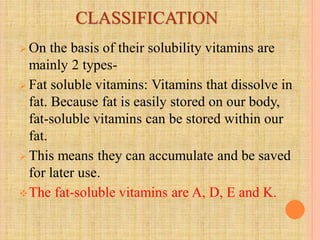
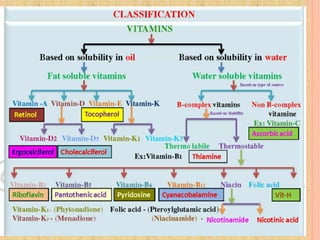
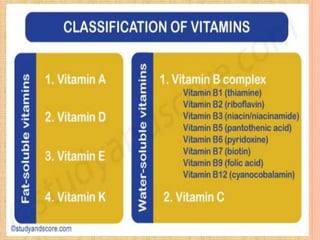
 On the basis of their solubility vitamins are
mainly 2 types-
 Fat soluble vitamins: Vitamins that dissolve in
fat. Because fat is easily stored on our body,
fat-soluble vitamins can be stored within our
fat.
 This means they can accumulate and be saved
for later use.
The fat-soluble vitamins are A, D, E and K.
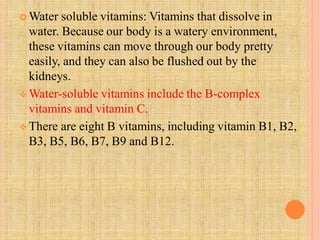
 Water soluble vitamins: Vitamins that dissolve in
water. Because our body is a watery environment,
these vitamins can move through our body pretty
easily, and they can also be flushed out by the
kidneys.
 Water-soluble vitamins include the B-complex
vitamins and vitamin C.
 There are eight B vitamins, including vitamin B1, B2,
B3, B5, B6, B7, B9 and B12.
FAT SOLUBLE VITAMINS (A, D, E, K )
VITAMIN A :- (RETINOL)
 Vitamin A is a group of unsaturated nutritional organic
compounds, that includes retinol, retinal, retinoic acid, and
several provitamin A carotenoids, among which beta-carotene
is the most important.
 Its active form is present only in Animal Tissue.
DAILY REQUIRMENT
 Men and women – 600 mcg.
 Pregnancy and lactation – 950 mcg.
 Infants – 350mcg.
 Children – 600mcg.
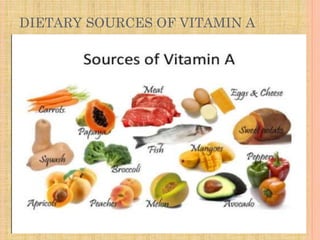
DIETARY SOURCES OF VITAMIN A
FUNCTIONS
Vitamin A plays a role in a variety of functions
throughout the body, such as:
 Vision
 Gene transcription
 Immune function
 Embryonic development and reproduction Bone
metabolism
 Hematopoiesis (the production of blood cells and
platelets)
 Skin and cellular health
 Antioxidant activity
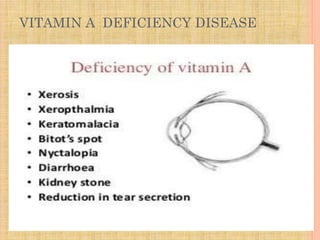
VITAMIN A DEFICIENCY DISEASE
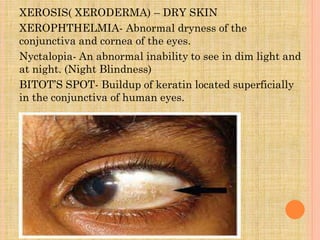
XEROSIS( XERODERMA) – DRY SKIN
XEROPHTHELMIA- Abnormal dryness of the
conjunctiva and cornea of the eyes.
Nyctalopia- An abnormal inability to see in dim light and
at night. (Night Blindness)
BITOT’S SPOT- Buildup of keratin located superficially
in the conjunctiva of human eyes.
VITAMIN D (CHOLECALCIFEROL)
Vitamin D refers to a group of fat-soluble secosteroids (a type of
steroid with a "broken" ring) found in liver and fish oils, or
obtained by irradiating provitamin D with ultraviolet light and
are responsible for enhancing intestinal absorption of calcium,
iron, magnesium, phosphate and zinc. It is also called
SUNSHINE VITAMIN.
It is available in 2 forms:-
(i) Cholecalciferol (vitamin D3) is made from 7-
dehydrocholesterol in the skin of animals and humans.
(ii) Calciferol - D2 is obtained artificially by irradiation of ergo-
sterol and is called ergocalciferol.
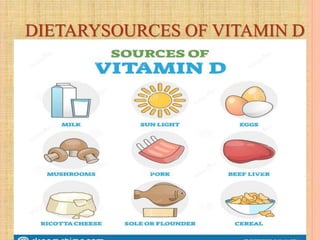
DIETARYSOURCES OF VITAMIN D
DAILY REQUIRMENT
Men and women- 5 gm/day)
Pregnancy and lactation – 0.01 mg (10gm/day)
Infants & Children –0.01 mg (10gm/day)
FUNCTIONS OF VITAMIN D
Calcium Balance
Cell Differentiation
Immunity
Blood Pressure Regulation
Development of Bones & Teeth
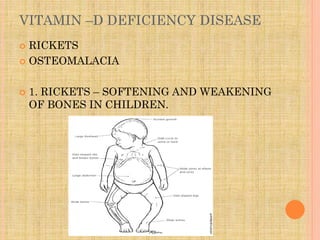
VITAMIN –D DEFICIENCY DISEASE
 RICKETS
 OSTEOMALACIA
 1. RICKETS – SOFTENING AND WEAKENING
OF BONES IN CHILDREN.
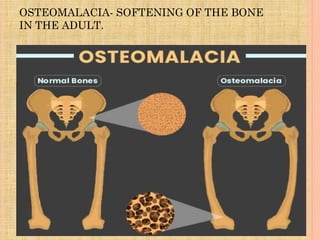
OSTEOMALACIA- SOFTENING OF THE BONE
IN THE ADULT.
VITAMIN E(TOCOFEROL)
 Vitamin E refers to a group of compounds that
include both tocopherols and tocotrienols. They are
naturally occuring anti-oxidant.
 It is also called anti-aging factor.
 The word tocopherol is derived from the word toco
meaning child birth and pheros meaning to bear.
 It is yellow oily liquid freely soluble in fat solvent.
 Tocopherol α,β,γ, δ have been obtained from the
natural sources.
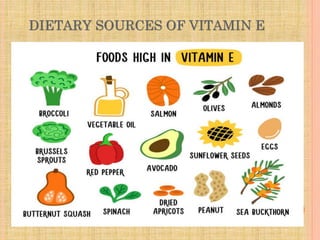
DIETARY SOURCES OF VITAMIN E
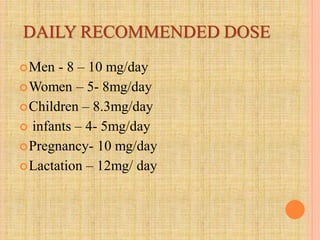
DAILY RECOMMENDED DOSE
Men - 8 – 10 mg/day
Women – 5- 8mg/day
Children – 8.3mg/day
 infants – 4- 5mg/day
Pregnancy- 10 mg/day
Lactation – 12mg/ day
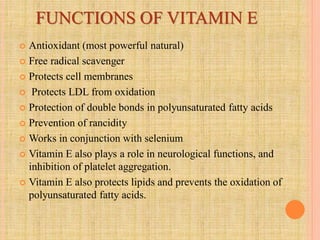
FUNCTIONS OF VITAMIN E
 Antioxidant (most powerful natural)
 Free radical scavenger
 Protects cell membranes
 Protects LDL from oxidation
 Protection of double bonds in polyunsaturated fatty acids
 Prevention of rancidity
 Works in conjunction with selenium
 Vitamin E also plays a role in neurological functions, and
inhibition of platelet aggregation.
 Vitamin E also protects lipids and prevents the oxidation of
polyunsaturated fatty acids.
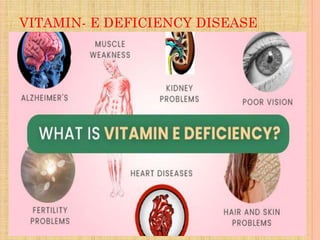
VITAMIN- E DEFICIENCY DISEASE
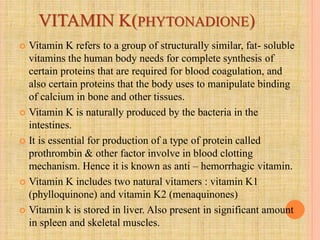
VITAMIN K(PHYTONADIONE)
 Vitamin K refers to a group of structurally similar, fat- soluble
vitamins the human body needs for complete synthesis of
certain proteins that are required for blood coagulation, and
also certain proteins that the body uses to manipulate binding
of calcium in bone and other tissues.
 Vitamin K is naturally produced by the bacteria in the
intestines.
 It is essential for production of a type of protein called
prothrombin & other factor involve in blood clotting
mechanism. Hence it is known as anti – hemorrhagic vitamin.
 Vitamin K includes two natural vitamers : vitamin K1
(phylloquinone) and vitamin K2 (menaquinones)
 Vitamin k is stored in liver. Also present in significant amount
in spleen and skeletal muscles.
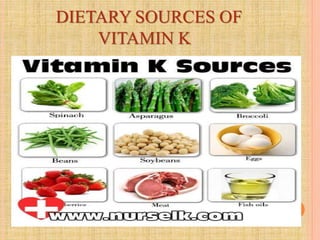
DIETARY SOURCES OF
VITAMIN K
DIETARY REQUIRMENT
Men and women – 70 – 140 mcg.
Children – 35 – 75mcg
Pregnancy/ lactation- 90/90 mcg
Infant- 2-2.5 mcg
FUNCTIONS OF VITAMIN K
 It is essential for the hepatic synthesis of coagulation
factor II, V, VII, IX, X.
 CLOTTING – it prevents hemorrhage only in cases
when there is defective production of prothrombin
 OXIDATIVE PHOSPHORYLATION – it acts as a co-
factor in oxidative phosphorylation associated with
lipid
 Vitamin-K is needed for carboxylation of glutamyl
residue of Ca++ binding transport between the flavin
coenzyme and the cytochrome system.
VITAMIN- D DEFICIENCY DISEASE
1. PROLONGED BLEEDING
2. LIVER FUNCTIONS LOWER
WATER SOLUBLE VITAMINS
Water soluble vitamins are found in yeast, grain, rice, vegetables, fish,
and meat.
These are essential co- enzymes required in energy releasing
mechanisms.
They also act as co- enzymes for metabolism of proteins, carbohydrates
and fats. They include-
 B1- Thiamine
 B2 - Riboflavin
 B3 – Niacin
 B5 – pantothenic acid
 B6 –Pyridoxine
 B7 – Biotin
 B 9- Folic acid
 B12 –Cobalamin
 Vitamin C (ascorbic acid)
VITAMIN B1 (THIAMINE)
 It is also called Anti Beri-Beri factor, Anti Neuritic factor, and
also Aneurin.
 It is colorless basic organic compound composed of a sulfated
pyramiding ring.
 All living organisms use thiamine, but it is synthesized only in
bacteria, fungi, and plants.
 Contains sulfur and nitrogen group
 Destroyed by alkaline and heat
 Coenzyme: Thiamin pyrophosphate (TPP)
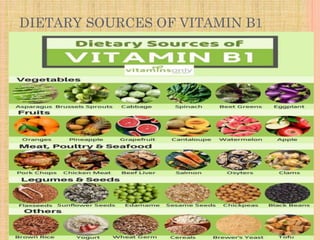
DIETARY SOURCES OF VITAMIN B1
DAILY REQUIREMENT
 Men – 1.3 mg
 women – 1.0 mg
 Pregnancy and lactation – 2mg .
 Children – 1.1mg.
FUNCTIONS OF THIAMINE
 Vitamin B1, is very essential for converting carbohydrate into
energy.
 The most important use of thiamine is in the treatment of
beriberi, a condition caused by a deficiency of thiamine in the
diet. Symptoms include swelling, tingling or burning sensation in
the hands and feet, confusion, difficulty breathing.
 Vitamin B1, helps in maintaining the healthy nervous system.
 Vitamin B1, is necessary for healthy mucous membranes.
 It helps in the digestion of food.
 It provides strength to muscles.
 It is very useful for the proper functioning of heart.
VITAMIN B1 DEFICIENCY DISEASE
1. BERIBERI-
 Wet beriberi- affects the cardiovascular system. Since it involves the
functioning of the heart, it's a life-threatening medical emergency that needs
immediate treatment.
 Dry beriberi- can damage the central nervous system (CNS). It disrupts motor
functioning (the movement of the muscles). It can also cause impaired reflexes
and numbness in the extremities, but it’s generally easier to treat than beriberi
that impacts the heart.
 Other possible symptoms of beriberi include:
 Weakness and muscle loss
 Mental confusion
 Tingling or loss of sensitivity in the fingers or feet
 Fatigue
 Rapid heart beat
 Chest pain
 Nausea or vomiting
 Fever
2. WERNICKE-KORSAKOFF SYNDROME-
 It is a degenerative brain disorder caused by the lack
of thiamine (vitamin B1)
 It may result from alcohol abuse, dietary deficiencies,
prolonged vomiting, eating disorders, or the effects of
chemotherapy.
 B1 deficiency causes damage to the brain's thalamus
and hypothalamus.
VITAMIN B2 (RIBOFLAVIN)
 It is also called as beauty vitamin.
 It is yellowish green fluorescent compound soluble in
water.
 The riboflavin is derived from 2 sources-
RIBOSE- means many ribose sugar found in several
vitamins
Flavin – Yellow
 It is widely involved in oxidation- reduction reaction
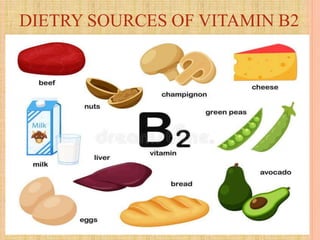
DIETRY SOURCES OF VITAMIN B2
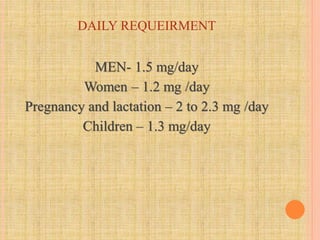
DAILY REQUEIRMENT
MEN- 1.5 mg/day
Women – 1.2 mg /day
Pregnancy and lactation – 2 to 2.3 mg /day
Children – 1.3 mg/day
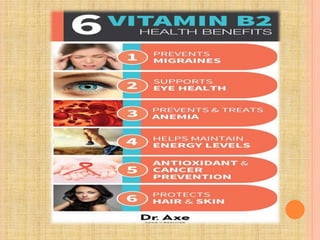
FUNCTIONS OF RIBOFLAVIN
 It is essential for normal growth.
 Metabolism- it involved in the metabolism of
carbohydrate, fat & proteins.
 Digestion- it help to digestion
 Nervous system- it help in proper functioning of
nervous system.
 It is very useful for normal tissue respiration.
 Necessary for healthy mucous membranes.
 Good for skin, nail, eyes.
 It help in protect the body against cancer.
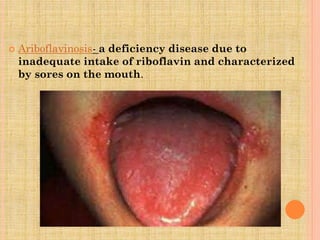
 Ariboflavinosis- a deficiency disease due to
inadequate intake of riboflavin and characterized
by sores on the mouth.
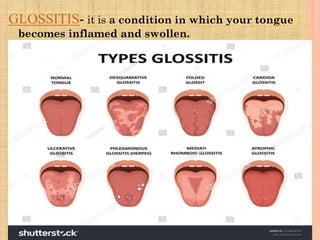
GLOSSITIS- it is a condition in which your tongue
becomes inflamed and swollen.
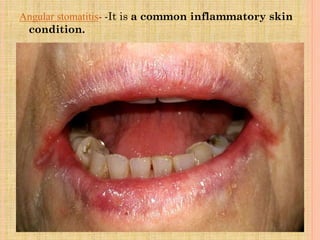
Angular stomatitis- -It is a common inflammatory skin
condition.
VITAMIN B3(NIACIN)
 Vitamin B3 is also k/a niacin or nicotinic acid.
 It is essential for metabolism of carbohydrate, fat &
protein.
 It is colorless.
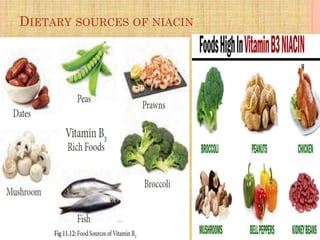
DIETARY SOURCES OF NIACIN
DAILY REQUIREMENT
Men- 17 mg/ day
Women- 13 mg/ day
Pregnancy & lactation- 12 to 15 mg /day
Children- 15 mg/ day
FUNCTION OF NIACIN (B3)
 Vitamin B3 help in releasing energy from carbohydrate, fat and
proteins.
 Vitamin B3 is very essential for the DNA synthesis.
 It is essential for production of estrogen, progesteron and
testosterone.
 It is also helpful in reducing migraine headache.
 Vitamin B3 may improve arthritis symptoms, including
increasing joint mobility and reducing the amount of anti-
inflammatory medications needed.
 It is necessary for healthy skin. Nervous and digestive system.
 It help to detoxify the body.
 Vitamin B3 is very essential for the proper digestion of the food.
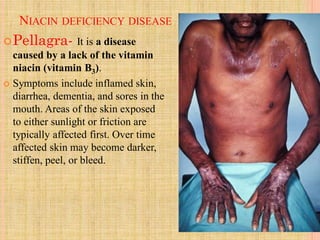
NIACIN DEFICIENCY DISEASE
Pellagra- It is a disease
caused by a lack of the vitamin
niacin (vitamin B3).
 Symptoms include inflamed skin,
diarrhea, dementia, and sores in the
mouth. Areas of the skin exposed
to either sunlight or friction are
typically affected first. Over time
affected skin may become darker,
stiffen, peel, or bleed.
VITAMIN B5 ( PANTOTHENIC ACID)
 Vitamin B5 also K/A Pantothenic acid, is a water soluble vitamin.
 It is discovered by Roger J. Williams in 1919.
 This word deriveted from greek word panto meaning everywhere.
 Part of coenzymes-A.
 Essential for metabolism for CHO, fat, and Proteins.
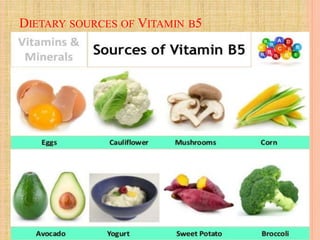
DIETARY SOURCES OF VITAMIN B5
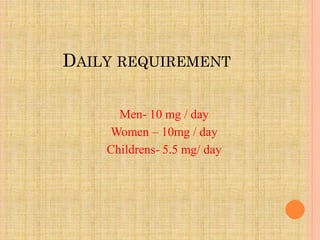
DAILY REQUIREMENT
Men- 10 mg / day
Women – 10mg / day
Childrens- 5.5 mg/ day
FUNCTIONS OF VITAMIN B5 ( PANTOTHENIC ACID
 Vitamin B5 play an important role in helping release
energy from sugar, starch, and fats.
 They are essential for the cell metabolism.
 They are very helpful in the cholesterol metabolism.
 accelerates wound healing.
 It is also used as anti- stress factor.
 Allergies, headache, arthritis, psoriasis, insomnia,
asthma and infection have all treated with some
effective using vitamin B5.
VITAMIN B5 DEFICIENCY DISEASE
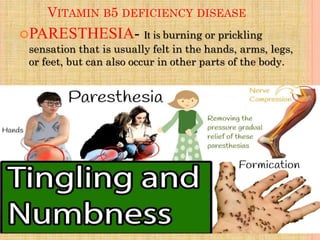
PARESTHESIA- It is burning or prickling
sensation that is usually felt in the hands, arms, legs,
or feet, but can also occur in other parts of the body.
VITAMIN B6 (PYRIDOXINE)
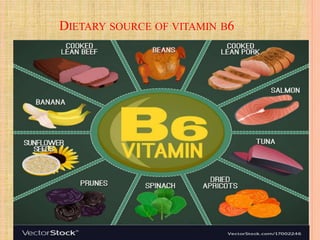
DIETARY SOURCE OF VITAMIN B6
DAILY REQUIREMENT
 Men & Women- 2 mg / day
 Children- 1.7 mg / Day
 Infant – 0.1 to 0.4 mg/ day
FUNCTIONS OF VITAMIN B6
 Make antibodies. Antibodies are needed to fight many disease.
 Maintain normal nerve functions.
 Make hemoglobin. Hemoglobin carry oxygen in the red blood
cell to the tissue. A vitamin B6 deficiency can cause a form of
anemia.
 Break down protein . The protein you eat, the more vitamin B6
you need,.
 Keep blood sugar (glucose) in normal ranges.
 Assists in the balancing of sodium and potassium level.
 Promote RBC production.
 Production of serotonin, Dopamine , Nor-adrenaline and
Adrenaline.
B6 DEFICIENCY DISEASE
Anemia:- Anemia is a condition in
which you lack enough healthy red
blood cells to carry adequate oxygen to
your body's tissues.
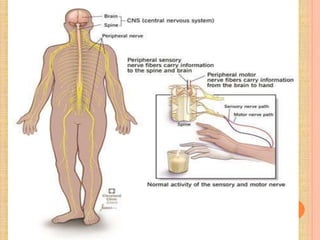
Peripheral neuropathy:- Peripheral neuropathy, a
result of damage to the nerves located outside of the
brain and spinal cord (peripheral nerves), often causes
weakness, numbness and pain, usually in the hands and
feet. It can also affect other areas and body functions
including digestion, urination and circulation.
VITAMIN B7 (BIOTIN)
 Vitamin B7 or biotin, also known as vitamin H or
coenzyme R.
 Biotin is a enzyme for carboxylase enzyme, involved in the
synthesis of fatty acid, isoleucine, and valine and in
gluconeogenesis.
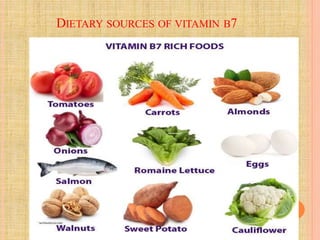
DIETARY SOURCES OF VITAMIN B7
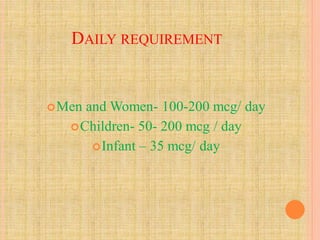
DAILY REQUIREMENT
Men and Women- 100-200 mcg/ day
Children- 50- 200 mcg / day
Infant – 35 mcg/ day
FUNCTIONS OF VITAMIN B7
 Convert food into glucose, which use to produce
energy.
 Produce fatty acid and amino acid ( building
blocks of protein)
 Activate protein and amino acid metabolism in
the hair roots and fingernail cells.
 The maintenance of normal hair.
 The maintenance of normal skin and mucus
membranes.
 The normal function of the nervous system.
 Normal psychological functions.
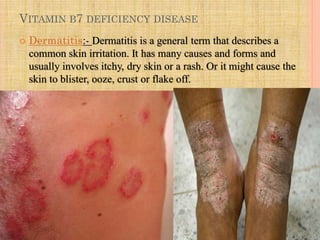
VITAMIN B7 DEFICIENCY DISEASE
 Dermatitis:- Dermatitis is a general term that describes a
common skin irritation. It has many causes and forms and
usually involves itchy, dry skin or a rash. Or it might cause the
skin to blister, ooze, crust or flake off.
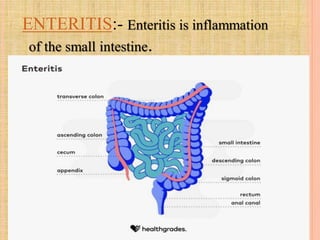
ENTERITIS:- Enteritis is inflammation
of the small intestine.
VITAMIN B9 ( FOLIC ACID)
 Vitamin B9 is also known as folic acid, folacin or
folate.
 It is a water soluble vitamin.
 It is yellow crystaline substance.
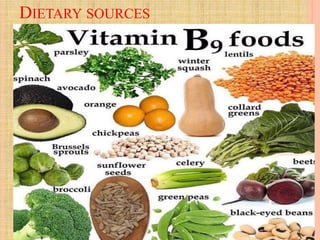
DIETARY SOURCES
FUNCTIONS OF VITAMIN B9
 Formation of RBC- folic acid in combination with vitamin
B12 is essential for formation, maturation.
 Nerve- it is necessary for growth and division of all body
cells.
 Hair and Skin- it is an important nutrient for the pregnant
women & her developing fetus & folic improves the
lactation.
 DNA synthesis
 Hemocysteine metabolism
 Neurotransmitter formation

FOLIC ACID DEFICIENCY DISEASE
 Megaloblastic anemia :- Megaloblastic anemia is a form
of macrocytic anemia, a blood disorder that happens when your bone
marrow produces stem cells that make abnormally large red blood cells
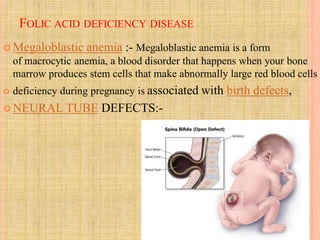
 deficiency during pregnancy is associated with birth defects,
 NEURAL TUBE DEFECTS:-
VITAMIN B12(COBALAMIN)
 Vitamin B12 is complex organomatric
compound called as cobalamin which is cobalt
containing prophyrin.
 It is freely soluble in water.
SOURCES OF VITAMIN B12
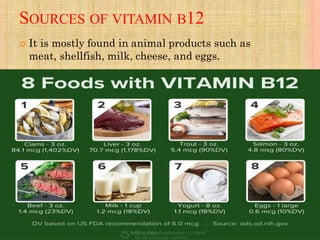
 It is mostly found in animal products such as
meat, shellfish, milk, cheese, and eggs.
FUNCTIONS OF VITAMIN B12
 RBC- it is essential for production of RBCs.
 Nervous- it improve concentration, memory,and
balance .
 It is important for metabolism of fat,
carbohydrate, and protein, folic acid.
 It promote growth and increase apatite.

VITAMINS.pdf

  • 1.
    VITAMINS NUTRITIONAL NURSING MR. RAJENDRAMEENA ASSOCIATE PROFESSOR M.Sc NURSING (PEDIATRIC )
  • 2.
    INTRODUCTION  The word‘vitamin’ come from the latin word ‘vita’, means “life”.  Vitamins are organic components in food that are needed in very small amounts for growth and for maintaining good health.  Everybody must eat a certain amount of vitamins to stay healthy.  Vitamins are chemicals found in very small amounts in many different foods.
  • 3.
    CHARACTERISTICS  Vitamins arerequired in small quantities in the diet because they cannot be synthesized by the body.  Water soluble vitamins cannot be stored in human tissues. Their excess is excreted with urine.  Significant amounts of fat soluble vitamins can be stored in adipose tissue and the liver.  Synthetic vitamins are identical to natural vitamins.  Once growth and development are completed, vitamins remain essential nutrients for the healthy maintenance of the cells, tissues, and organs.
  • 4.
    FUNCTIONS  Vitamins arehelpful for the health and life of the body in the following respects: (a) They build up the resistance of the body against diseases. (b) Prevent and cure various diseases caused by deficiency. (c) Help the digestion and utilization of mineral salts and Carbohydrates in the body. (d) Stimulate and give strength to digestive and nervous system. (e) Help health protection. (f) Help maintenance of proper health and normal growth.
  • 5.
    CLASSIFICATION  On thebasis of their solubility vitamins are mainly 2 types-  Fat soluble vitamins: Vitamins that dissolve in fat. Because fat is easily stored on our body, fat-soluble vitamins can be stored within our fat.  This means they can accumulate and be saved for later use. The fat-soluble vitamins are A, D, E and K.
  • 6.
     Water solublevitamins: Vitamins that dissolve in water. Because our body is a watery environment, these vitamins can move through our body pretty easily, and they can also be flushed out by the kidneys.  Water-soluble vitamins include the B-complex vitamins and vitamin C.  There are eight B vitamins, including vitamin B1, B2, B3, B5, B6, B7, B9 and B12.
  • 9.
    FAT SOLUBLE VITAMINS(A, D, E, K ) VITAMIN A :- (RETINOL)  Vitamin A is a group of unsaturated nutritional organic compounds, that includes retinol, retinal, retinoic acid, and several provitamin A carotenoids, among which beta-carotene is the most important.  Its active form is present only in Animal Tissue. DAILY REQUIRMENT  Men and women – 600 mcg.  Pregnancy and lactation – 950 mcg.  Infants – 350mcg.  Children – 600mcg.
  • 10.
  • 11.
    FUNCTIONS Vitamin A playsa role in a variety of functions throughout the body, such as:  Vision  Gene transcription  Immune function  Embryonic development and reproduction Bone metabolism  Hematopoiesis (the production of blood cells and platelets)  Skin and cellular health  Antioxidant activity
  • 12.
  • 13.
    XEROSIS( XERODERMA) –DRY SKIN XEROPHTHELMIA- Abnormal dryness of the conjunctiva and cornea of the eyes. Nyctalopia- An abnormal inability to see in dim light and at night. (Night Blindness) BITOT’S SPOT- Buildup of keratin located superficially in the conjunctiva of human eyes.
  • 14.
    VITAMIN D (CHOLECALCIFEROL) VitaminD refers to a group of fat-soluble secosteroids (a type of steroid with a "broken" ring) found in liver and fish oils, or obtained by irradiating provitamin D with ultraviolet light and are responsible for enhancing intestinal absorption of calcium, iron, magnesium, phosphate and zinc. It is also called SUNSHINE VITAMIN. It is available in 2 forms:- (i) Cholecalciferol (vitamin D3) is made from 7- dehydrocholesterol in the skin of animals and humans. (ii) Calciferol - D2 is obtained artificially by irradiation of ergo- sterol and is called ergocalciferol.
  • 15.
  • 16.
    DAILY REQUIRMENT Men andwomen- 5 gm/day) Pregnancy and lactation – 0.01 mg (10gm/day) Infants & Children –0.01 mg (10gm/day)
  • 17.
    FUNCTIONS OF VITAMIND Calcium Balance Cell Differentiation Immunity Blood Pressure Regulation Development of Bones & Teeth
  • 18.
    VITAMIN –D DEFICIENCYDISEASE  RICKETS  OSTEOMALACIA  1. RICKETS – SOFTENING AND WEAKENING OF BONES IN CHILDREN.
  • 19.
    OSTEOMALACIA- SOFTENING OFTHE BONE IN THE ADULT.
  • 20.
    VITAMIN E(TOCOFEROL)  VitaminE refers to a group of compounds that include both tocopherols and tocotrienols. They are naturally occuring anti-oxidant.  It is also called anti-aging factor.  The word tocopherol is derived from the word toco meaning child birth and pheros meaning to bear.  It is yellow oily liquid freely soluble in fat solvent.  Tocopherol α,β,γ, δ have been obtained from the natural sources.
  • 21.
  • 22.
    DAILY RECOMMENDED DOSE Men- 8 – 10 mg/day Women – 5- 8mg/day Children – 8.3mg/day  infants – 4- 5mg/day Pregnancy- 10 mg/day Lactation – 12mg/ day
  • 23.
    FUNCTIONS OF VITAMINE  Antioxidant (most powerful natural)  Free radical scavenger  Protects cell membranes  Protects LDL from oxidation  Protection of double bonds in polyunsaturated fatty acids  Prevention of rancidity  Works in conjunction with selenium  Vitamin E also plays a role in neurological functions, and inhibition of platelet aggregation.  Vitamin E also protects lipids and prevents the oxidation of polyunsaturated fatty acids.
  • 24.
  • 25.
    VITAMIN K(PHYTONADIONE)  VitaminK refers to a group of structurally similar, fat- soluble vitamins the human body needs for complete synthesis of certain proteins that are required for blood coagulation, and also certain proteins that the body uses to manipulate binding of calcium in bone and other tissues.  Vitamin K is naturally produced by the bacteria in the intestines.  It is essential for production of a type of protein called prothrombin & other factor involve in blood clotting mechanism. Hence it is known as anti – hemorrhagic vitamin.  Vitamin K includes two natural vitamers : vitamin K1 (phylloquinone) and vitamin K2 (menaquinones)  Vitamin k is stored in liver. Also present in significant amount in spleen and skeletal muscles.
  • 26.
  • 27.
    DIETARY REQUIRMENT Men andwomen – 70 – 140 mcg. Children – 35 – 75mcg Pregnancy/ lactation- 90/90 mcg Infant- 2-2.5 mcg
  • 28.
    FUNCTIONS OF VITAMINK  It is essential for the hepatic synthesis of coagulation factor II, V, VII, IX, X.  CLOTTING – it prevents hemorrhage only in cases when there is defective production of prothrombin  OXIDATIVE PHOSPHORYLATION – it acts as a co- factor in oxidative phosphorylation associated with lipid  Vitamin-K is needed for carboxylation of glutamyl residue of Ca++ binding transport between the flavin coenzyme and the cytochrome system.
  • 29.
    VITAMIN- D DEFICIENCYDISEASE 1. PROLONGED BLEEDING 2. LIVER FUNCTIONS LOWER
  • 30.
    WATER SOLUBLE VITAMINS Watersoluble vitamins are found in yeast, grain, rice, vegetables, fish, and meat. These are essential co- enzymes required in energy releasing mechanisms. They also act as co- enzymes for metabolism of proteins, carbohydrates and fats. They include-  B1- Thiamine  B2 - Riboflavin  B3 – Niacin  B5 – pantothenic acid  B6 –Pyridoxine  B7 – Biotin  B 9- Folic acid  B12 –Cobalamin  Vitamin C (ascorbic acid)
  • 31.
    VITAMIN B1 (THIAMINE) It is also called Anti Beri-Beri factor, Anti Neuritic factor, and also Aneurin.  It is colorless basic organic compound composed of a sulfated pyramiding ring.  All living organisms use thiamine, but it is synthesized only in bacteria, fungi, and plants.  Contains sulfur and nitrogen group  Destroyed by alkaline and heat  Coenzyme: Thiamin pyrophosphate (TPP)
  • 32.
  • 33.
    DAILY REQUIREMENT  Men– 1.3 mg  women – 1.0 mg  Pregnancy and lactation – 2mg .  Children – 1.1mg.
  • 34.
    FUNCTIONS OF THIAMINE Vitamin B1, is very essential for converting carbohydrate into energy.  The most important use of thiamine is in the treatment of beriberi, a condition caused by a deficiency of thiamine in the diet. Symptoms include swelling, tingling or burning sensation in the hands and feet, confusion, difficulty breathing.  Vitamin B1, helps in maintaining the healthy nervous system.  Vitamin B1, is necessary for healthy mucous membranes.  It helps in the digestion of food.  It provides strength to muscles.  It is very useful for the proper functioning of heart.
  • 35.
    VITAMIN B1 DEFICIENCYDISEASE 1. BERIBERI-  Wet beriberi- affects the cardiovascular system. Since it involves the functioning of the heart, it's a life-threatening medical emergency that needs immediate treatment.  Dry beriberi- can damage the central nervous system (CNS). It disrupts motor functioning (the movement of the muscles). It can also cause impaired reflexes and numbness in the extremities, but it’s generally easier to treat than beriberi that impacts the heart.  Other possible symptoms of beriberi include:  Weakness and muscle loss  Mental confusion  Tingling or loss of sensitivity in the fingers or feet  Fatigue  Rapid heart beat  Chest pain  Nausea or vomiting  Fever
  • 36.
    2. WERNICKE-KORSAKOFF SYNDROME- It is a degenerative brain disorder caused by the lack of thiamine (vitamin B1)  It may result from alcohol abuse, dietary deficiencies, prolonged vomiting, eating disorders, or the effects of chemotherapy.  B1 deficiency causes damage to the brain's thalamus and hypothalamus.
  • 37.
    VITAMIN B2 (RIBOFLAVIN) It is also called as beauty vitamin.  It is yellowish green fluorescent compound soluble in water.  The riboflavin is derived from 2 sources- RIBOSE- means many ribose sugar found in several vitamins Flavin – Yellow  It is widely involved in oxidation- reduction reaction
  • 38.
  • 39.
    DAILY REQUEIRMENT MEN- 1.5mg/day Women – 1.2 mg /day Pregnancy and lactation – 2 to 2.3 mg /day Children – 1.3 mg/day
  • 40.
    FUNCTIONS OF RIBOFLAVIN It is essential for normal growth.  Metabolism- it involved in the metabolism of carbohydrate, fat & proteins.  Digestion- it help to digestion  Nervous system- it help in proper functioning of nervous system.  It is very useful for normal tissue respiration.  Necessary for healthy mucous membranes.  Good for skin, nail, eyes.  It help in protect the body against cancer.
  • 42.
     Ariboflavinosis- adeficiency disease due to inadequate intake of riboflavin and characterized by sores on the mouth.
  • 43.
    GLOSSITIS- it isa condition in which your tongue becomes inflamed and swollen.
  • 44.
    Angular stomatitis- -Itis a common inflammatory skin condition.
  • 45.
    VITAMIN B3(NIACIN)  VitaminB3 is also k/a niacin or nicotinic acid.  It is essential for metabolism of carbohydrate, fat & protein.  It is colorless.
  • 46.
  • 47.
    DAILY REQUIREMENT Men- 17mg/ day Women- 13 mg/ day Pregnancy & lactation- 12 to 15 mg /day Children- 15 mg/ day
  • 48.
    FUNCTION OF NIACIN(B3)  Vitamin B3 help in releasing energy from carbohydrate, fat and proteins.  Vitamin B3 is very essential for the DNA synthesis.  It is essential for production of estrogen, progesteron and testosterone.  It is also helpful in reducing migraine headache.  Vitamin B3 may improve arthritis symptoms, including increasing joint mobility and reducing the amount of anti- inflammatory medications needed.  It is necessary for healthy skin. Nervous and digestive system.  It help to detoxify the body.  Vitamin B3 is very essential for the proper digestion of the food.
  • 49.
    NIACIN DEFICIENCY DISEASE Pellagra-It is a disease caused by a lack of the vitamin niacin (vitamin B3).  Symptoms include inflamed skin, diarrhea, dementia, and sores in the mouth. Areas of the skin exposed to either sunlight or friction are typically affected first. Over time affected skin may become darker, stiffen, peel, or bleed.
  • 50.
    VITAMIN B5 (PANTOTHENIC ACID)  Vitamin B5 also K/A Pantothenic acid, is a water soluble vitamin.  It is discovered by Roger J. Williams in 1919.  This word deriveted from greek word panto meaning everywhere.  Part of coenzymes-A.  Essential for metabolism for CHO, fat, and Proteins.
  • 51.
  • 52.
    DAILY REQUIREMENT Men- 10mg / day Women – 10mg / day Childrens- 5.5 mg/ day
  • 53.
    FUNCTIONS OF VITAMINB5 ( PANTOTHENIC ACID  Vitamin B5 play an important role in helping release energy from sugar, starch, and fats.  They are essential for the cell metabolism.  They are very helpful in the cholesterol metabolism.  accelerates wound healing.  It is also used as anti- stress factor.  Allergies, headache, arthritis, psoriasis, insomnia, asthma and infection have all treated with some effective using vitamin B5.
  • 54.
    VITAMIN B5 DEFICIENCYDISEASE PARESTHESIA- It is burning or prickling sensation that is usually felt in the hands, arms, legs, or feet, but can also occur in other parts of the body.
  • 55.
  • 56.
  • 57.
    DAILY REQUIREMENT  Men& Women- 2 mg / day  Children- 1.7 mg / Day  Infant – 0.1 to 0.4 mg/ day
  • 58.
    FUNCTIONS OF VITAMINB6  Make antibodies. Antibodies are needed to fight many disease.  Maintain normal nerve functions.  Make hemoglobin. Hemoglobin carry oxygen in the red blood cell to the tissue. A vitamin B6 deficiency can cause a form of anemia.  Break down protein . The protein you eat, the more vitamin B6 you need,.  Keep blood sugar (glucose) in normal ranges.  Assists in the balancing of sodium and potassium level.  Promote RBC production.  Production of serotonin, Dopamine , Nor-adrenaline and Adrenaline.
  • 59.
    B6 DEFICIENCY DISEASE Anemia:-Anemia is a condition in which you lack enough healthy red blood cells to carry adequate oxygen to your body's tissues. Peripheral neuropathy:- Peripheral neuropathy, a result of damage to the nerves located outside of the brain and spinal cord (peripheral nerves), often causes weakness, numbness and pain, usually in the hands and feet. It can also affect other areas and body functions including digestion, urination and circulation.
  • 61.
    VITAMIN B7 (BIOTIN) Vitamin B7 or biotin, also known as vitamin H or coenzyme R.  Biotin is a enzyme for carboxylase enzyme, involved in the synthesis of fatty acid, isoleucine, and valine and in gluconeogenesis.
  • 62.
  • 63.
    DAILY REQUIREMENT Men andWomen- 100-200 mcg/ day Children- 50- 200 mcg / day Infant – 35 mcg/ day
  • 64.
    FUNCTIONS OF VITAMINB7  Convert food into glucose, which use to produce energy.  Produce fatty acid and amino acid ( building blocks of protein)  Activate protein and amino acid metabolism in the hair roots and fingernail cells.  The maintenance of normal hair.  The maintenance of normal skin and mucus membranes.  The normal function of the nervous system.  Normal psychological functions.
  • 65.
    VITAMIN B7 DEFICIENCYDISEASE  Dermatitis:- Dermatitis is a general term that describes a common skin irritation. It has many causes and forms and usually involves itchy, dry skin or a rash. Or it might cause the skin to blister, ooze, crust or flake off.
  • 66.
    ENTERITIS:- Enteritis isinflammation of the small intestine.
  • 67.
    VITAMIN B9 (FOLIC ACID)  Vitamin B9 is also known as folic acid, folacin or folate.  It is a water soluble vitamin.  It is yellow crystaline substance.
  • 68.
  • 69.
    FUNCTIONS OF VITAMINB9  Formation of RBC- folic acid in combination with vitamin B12 is essential for formation, maturation.  Nerve- it is necessary for growth and division of all body cells.  Hair and Skin- it is an important nutrient for the pregnant women & her developing fetus & folic improves the lactation.  DNA synthesis  Hemocysteine metabolism  Neurotransmitter formation 
  • 70.
    FOLIC ACID DEFICIENCYDISEASE  Megaloblastic anemia :- Megaloblastic anemia is a form of macrocytic anemia, a blood disorder that happens when your bone marrow produces stem cells that make abnormally large red blood cells  deficiency during pregnancy is associated with birth defects,  NEURAL TUBE DEFECTS:-
  • 71.
    VITAMIN B12(COBALAMIN)  VitaminB12 is complex organomatric compound called as cobalamin which is cobalt containing prophyrin.  It is freely soluble in water.
  • 72.
    SOURCES OF VITAMINB12  It is mostly found in animal products such as meat, shellfish, milk, cheese, and eggs.
  • 73.
    FUNCTIONS OF VITAMINB12  RBC- it is essential for production of RBCs.  Nervous- it improve concentration, memory,and balance .  It is important for metabolism of fat, carbohydrate, and protein, folic acid.  It promote growth and increase apatite.