Tints and Filter for Patients
with Low Vision
Moderator
Mr. Niraj Dev Joshi
Presenters
Gauri Chaudhary
Puja Gurung
Maharajgunj Medical Campus
Contents
• Introduction to low vision
• Classification
• Epidemiology
• Problems faced by low vision patients
• Introduction to tints and filters
• Filters for various low vision conditions
• Assessment of Subjective and Objective trials
Introduction
• A person with low vision is a one who has
impairment of visual functioning even after
treatment of standard refractive correction, and
has visual acuity of less than 6/18 to light
perception and/or visual field less than 10 degrees
from the point of fixation and who is potentially
able to use vision for planning and execution of
task
WHO Definition
Contd…
• According to ICD-10, low vision is categorized as
Visual acuity of less than 6/18 but equal to or
better than 3/60
Corresponding visual field loss, to less than 20
degrees in the better eye with best possible
correction
Epidemiology
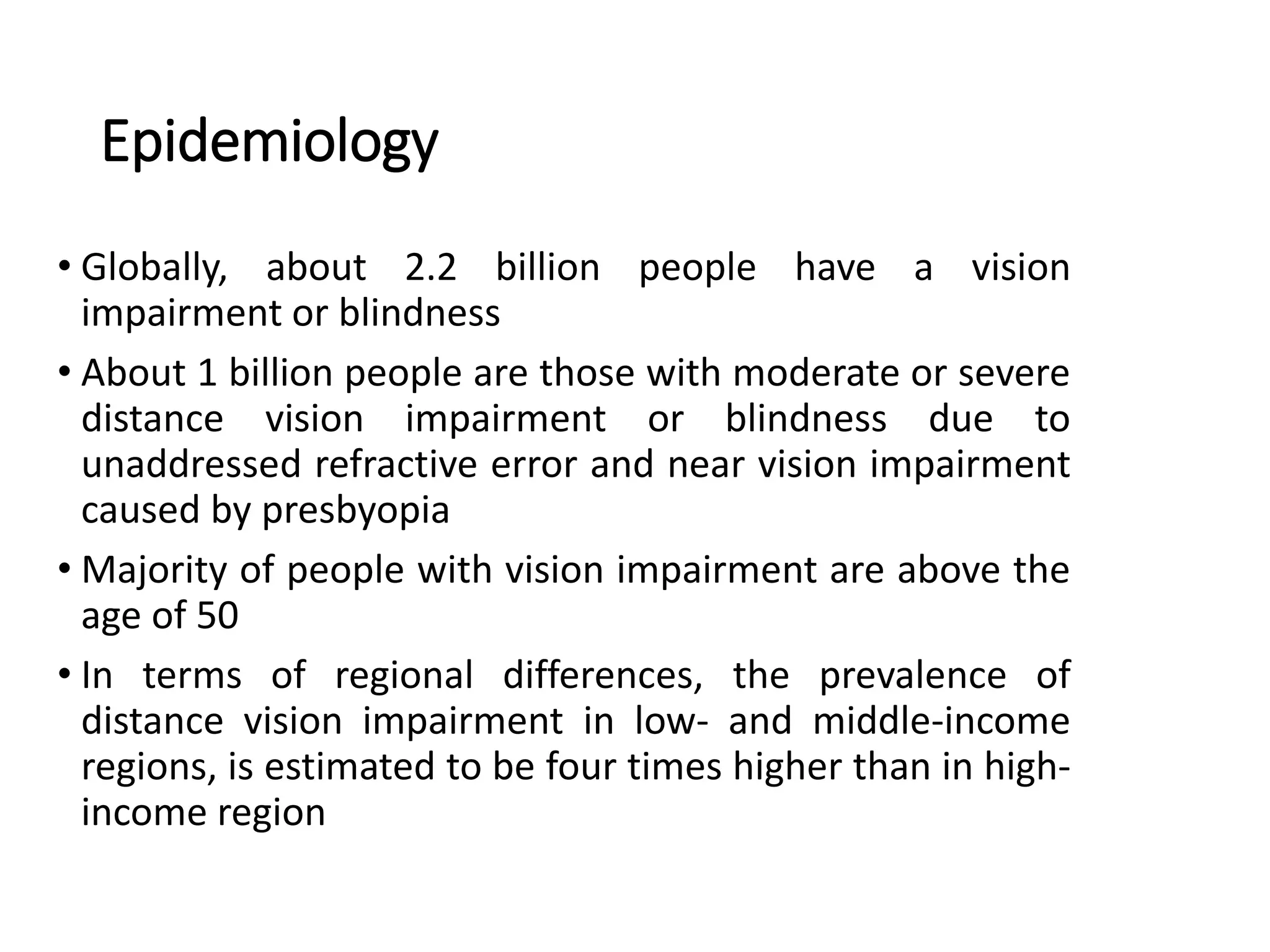
• Globally, about 2.2 billion people have a vision
impairment or blindness
• About 1 billion people are those with moderate or severe
distance vision impairment or blindness due to
unaddressed refractive error and near vision impairment
caused by presbyopia
• Majority of people with vision impairment are above the
age of 50
• In terms of regional differences, the prevalence of
distance vision impairment in low- and middle-income
regions, is estimated to be four times higher than in high-
income region
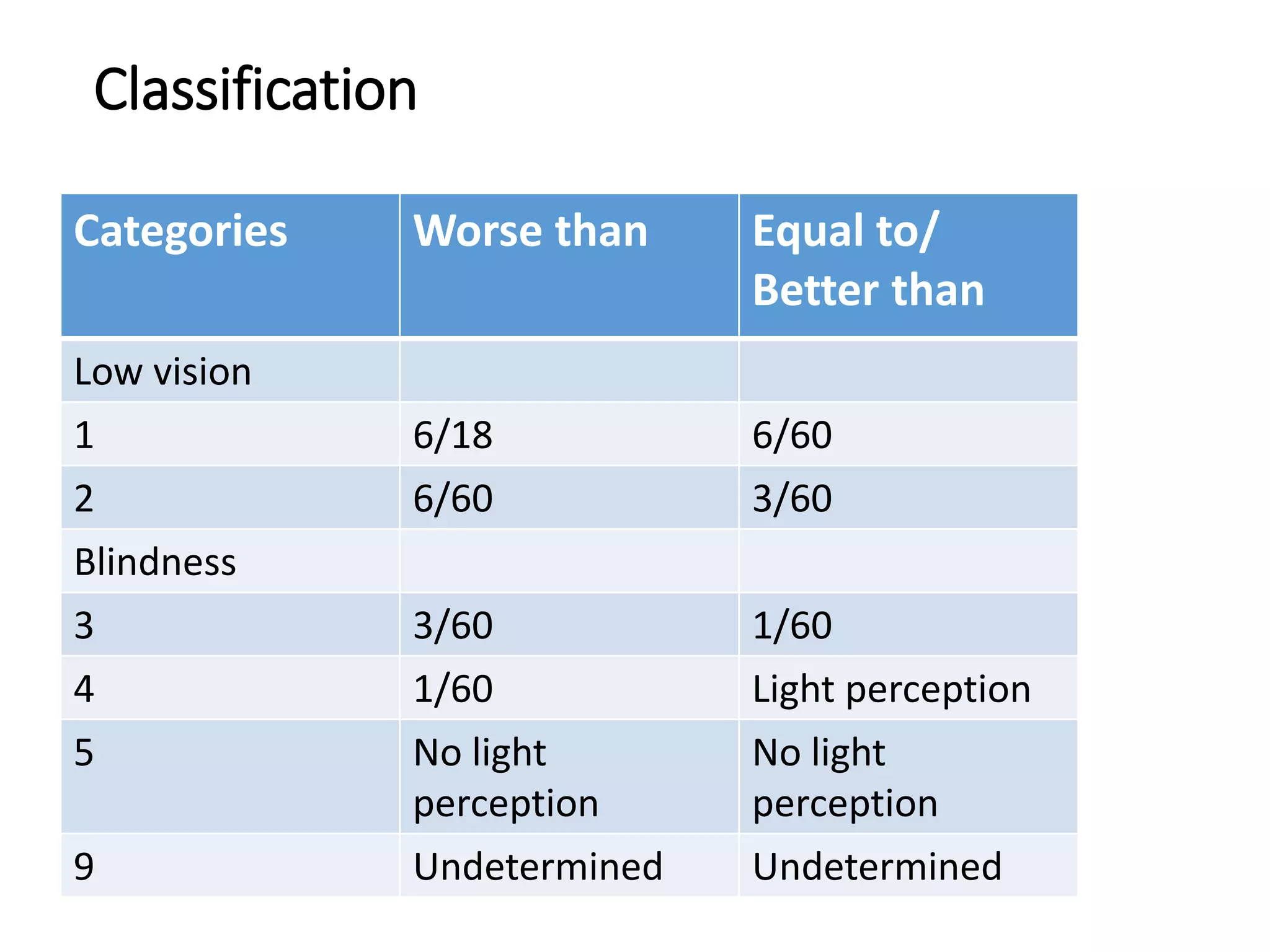
Classification
Categories Worse than Equal to/
Better than
Low vision
1 6/18 6/60
2 6/60 3/60
Blindness
3 3/60 1/60
4 1/60 Light perception
5 No light
perception
No light
perception
9 Undetermined Undetermined
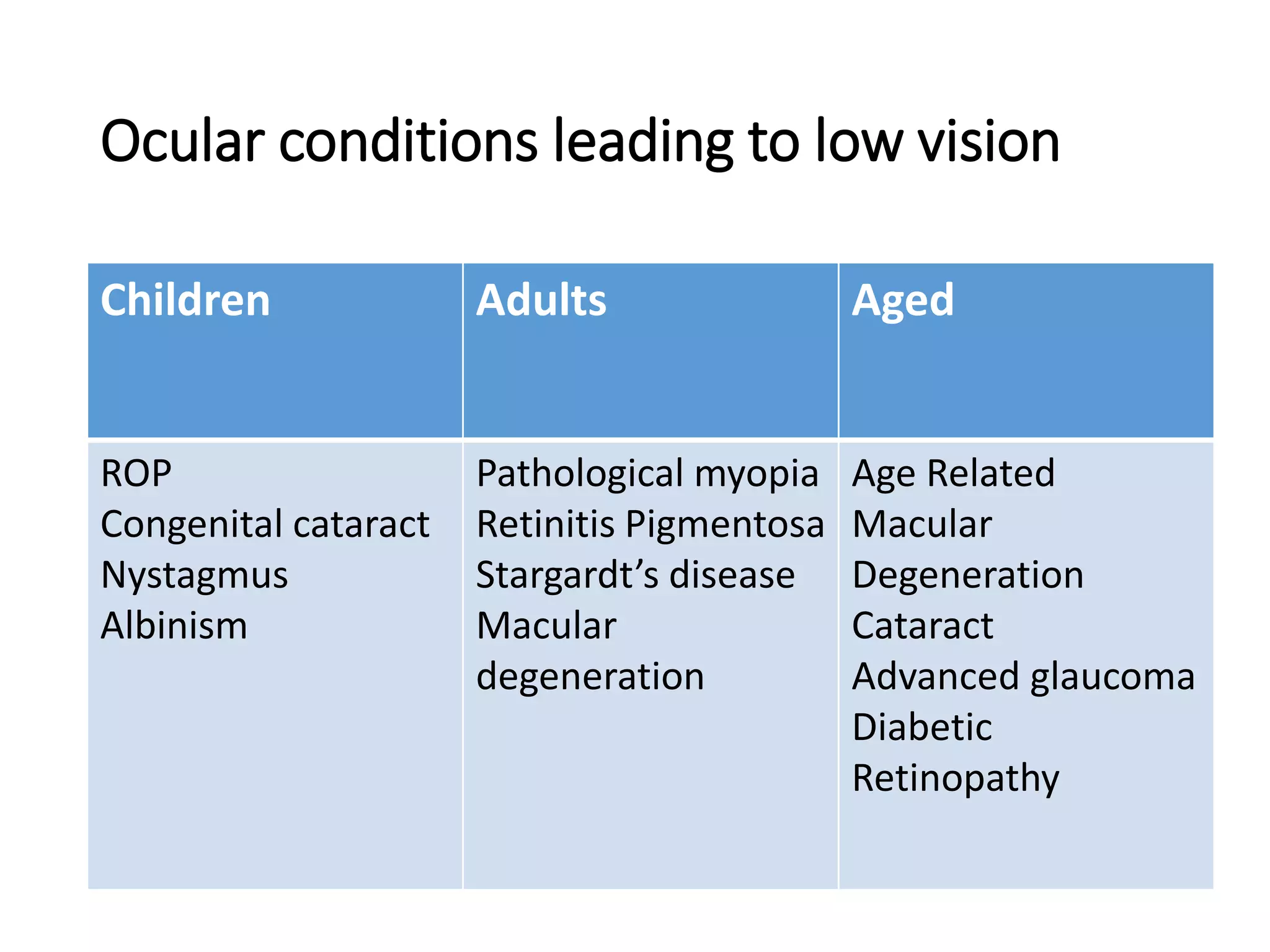
Ocular conditions leading to low vision
Children Adults Aged
ROP
Congenital cataract
Nystagmus
Albinism
Pathological myopia
Retinitis Pigmentosa
Stargardt’s disease
Macular
degeneration
Age Related
Macular
Degeneration
Cataract
Advanced glaucoma
Diabetic
Retinopathy
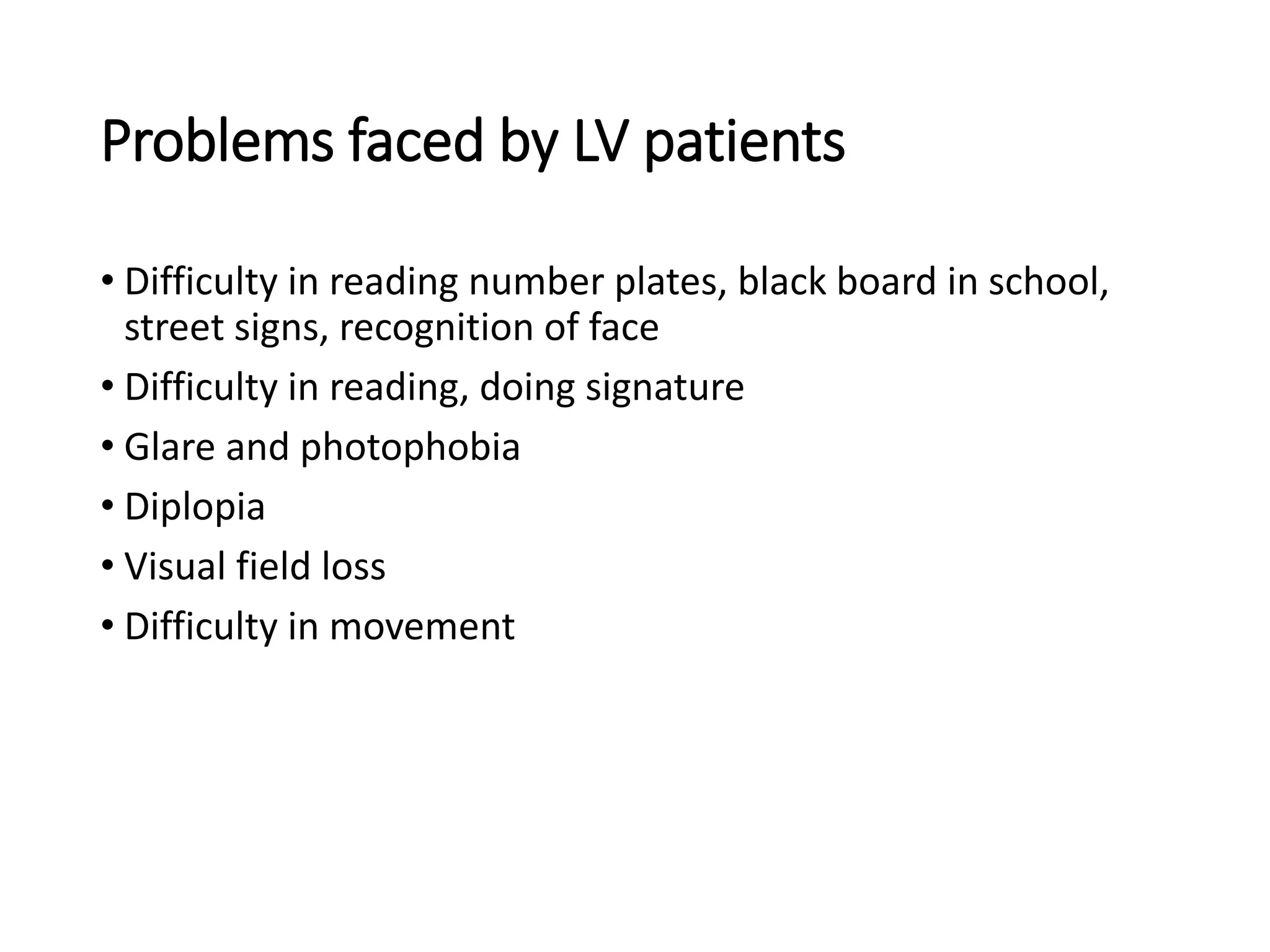
Problems faced by LV patients
• Difficulty in reading number plates, black board in school,
street signs, recognition of face
• Difficulty in reading, doing signature
• Glare and photophobia
• Diplopia
• Visual field loss
• Difficulty in movement
Introduction to Tints and Filters
• A tinted lens reduces the light entering into the eye,
the darker the tint the less light can enter the eye.
• A filter lens will filter out the disturbing light while
at the same time allowing most of the useful light
into the eye
Difference between Tints and Filters
• Tints do not discriminate between light waves that cause
disturbance and the useful light waves that help to see
• Tints reduce glare as well as vision while filters do not
reduce vision
Contd…
• Tints are not used for diagnostic purposes while filters
are used such as cobalt blue, red free, neutral density,
green and red filters
• Tints do not enhance contrast while filters do
• Tinted glasses are used for cosmetic purposes but
filters are not
Visible Light Transmission
• The amount of light that reaches eye through the
lens
• The smaller the percentage, the less amount of light
is being transmitted
• Glasses with dark tint have low level of VLT
• Standard sunglasses have a VLT of 15 to 25%
Choosing Your Tints and Filters
• Discomfort glare is caused by short wave light rays below
511nm, entering the eye and scattering within the ocular
media
• Important filter for this purpose are in the sun safe range of
450-511 nm
• No Infrared(NoIR) range spectra shield 465 and 505 nm
• UV shields like amber, orange, grey and greens
• Choose NoIR range with the highest possible VLT
Glare avoidance
• It is achieved by reducing the amount of short wave
light entering the eye
• Sunsafe filters from 450-511 nm
• NoIR shield spectra 465 and 505 nm
• In the UV shield range yellow, amber, orange tend to
be more successful
• Filter with highest VLT that can be tolerated should
be used
• Use the filter with highest VLT
Contrast enhancement
• A darker filter will be required for those who cannot tolerate
light indoor or outdoor
• In the SunSafe range, a filter between 527nm and 550 nm is
helpful
• In the NoIR range the spectra shield 533 and 553 prove to be
successful
• In the UV shield range grey, grey-green, red and plum is
useful
Control for light sensitivity
Reduced Migraines
• Patient who experiences migraines may be hypersensitive to
the visual stimuli
• Color filters can reduce symptoms caused by these stimuli
Driving Factors
• It is essential to offer protection to the eyes while driving in
order to
1. See better
2. React quickly to dangerous conditions
3. Improve safety
• Lenses should not be too dark as they reduce VA
• Grey tint is good for day time driving
• Yellow or amber tint is good for night time driving
Blue Light Hazards
• Blue light do not cause severe damage to the eyes, they
desensitize the eyes to light
• Blue light spreads in the whole interior of the eye, causing
dazzle
• This severely affects the eyes with pathologies like Cataract,
ARMD, Glaucoma, RP, Aniridia
Available Tints and Filters
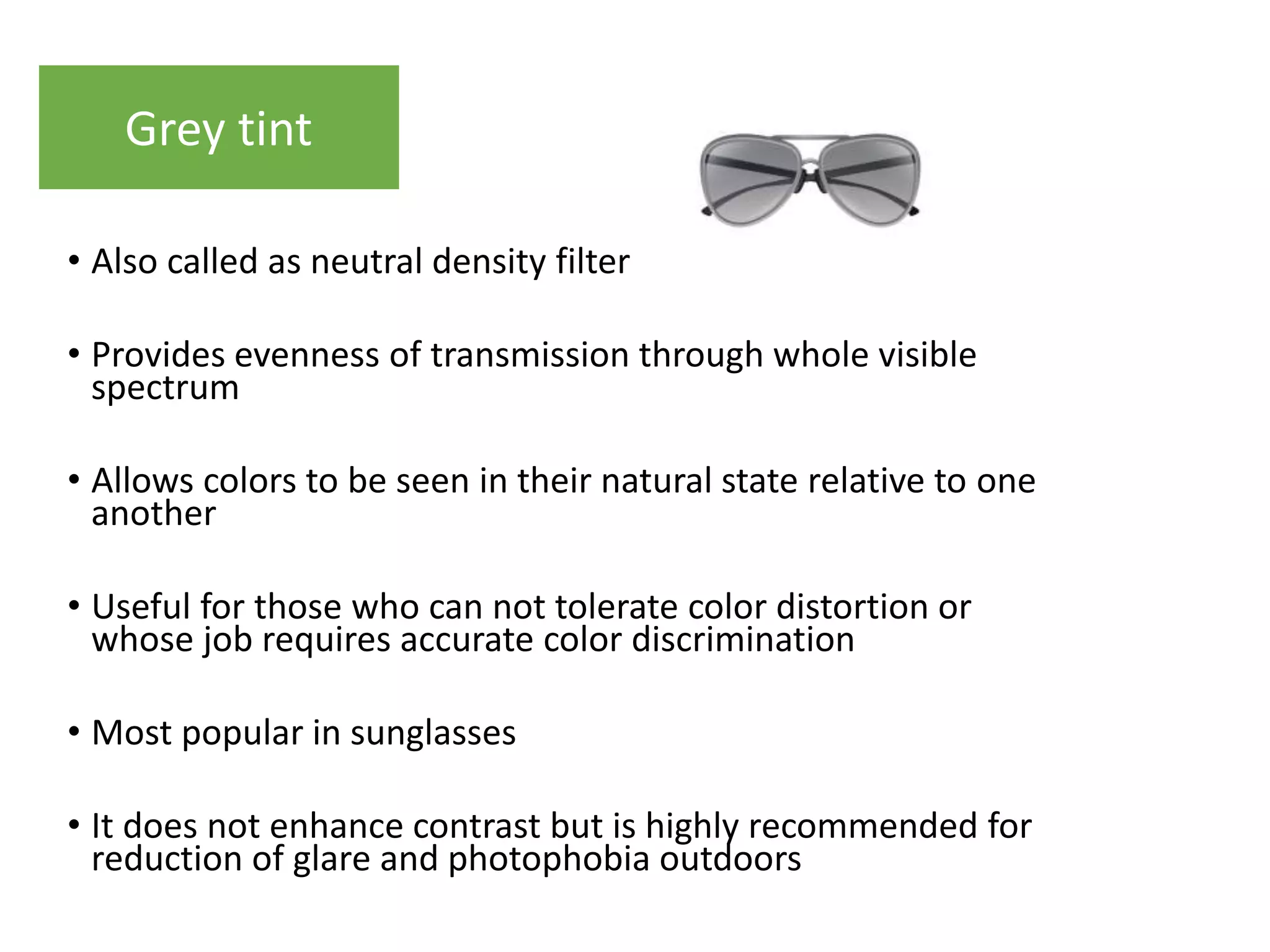
• Also called as neutral density filter
• Provides evenness of transmission through whole visible
spectrum
• Allows colors to be seen in their natural state relative to one
another
• Useful for those who can not tolerate color distortion or
whose job requires accurate color discrimination
• Most popular in sunglasses
• It does not enhance contrast but is highly recommended for
reduction of glare and photophobia outdoors
Grey tint
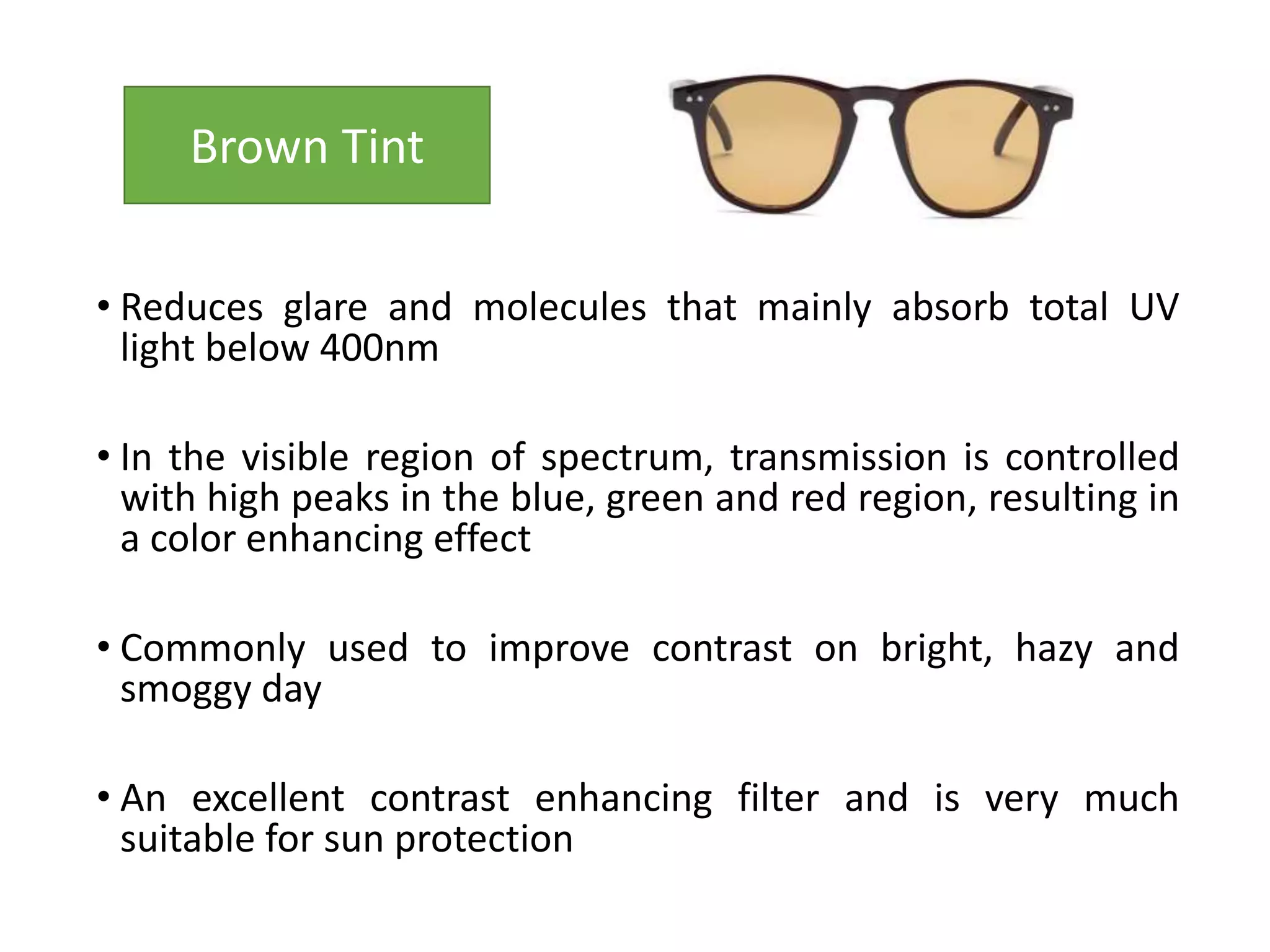
• Reduces glare and molecules that mainly absorb total UV
light below 400nm
• In the visible region of spectrum, transmission is controlled
with high peaks in the blue, green and red region, resulting in
a color enhancing effect
• Commonly used to improve contrast on bright, hazy and
smoggy day
• An excellent contrast enhancing filter and is very much
suitable for sun protection
Brown Tint
• Allows about 34% of light transmission
• Provides 100% UVA/UVB protection
• Blocks 100% of blue light
• Blocks visible upto 520nm
• Improves object definition and clarity
• Maximizes contrast enhancement
Orange Tint
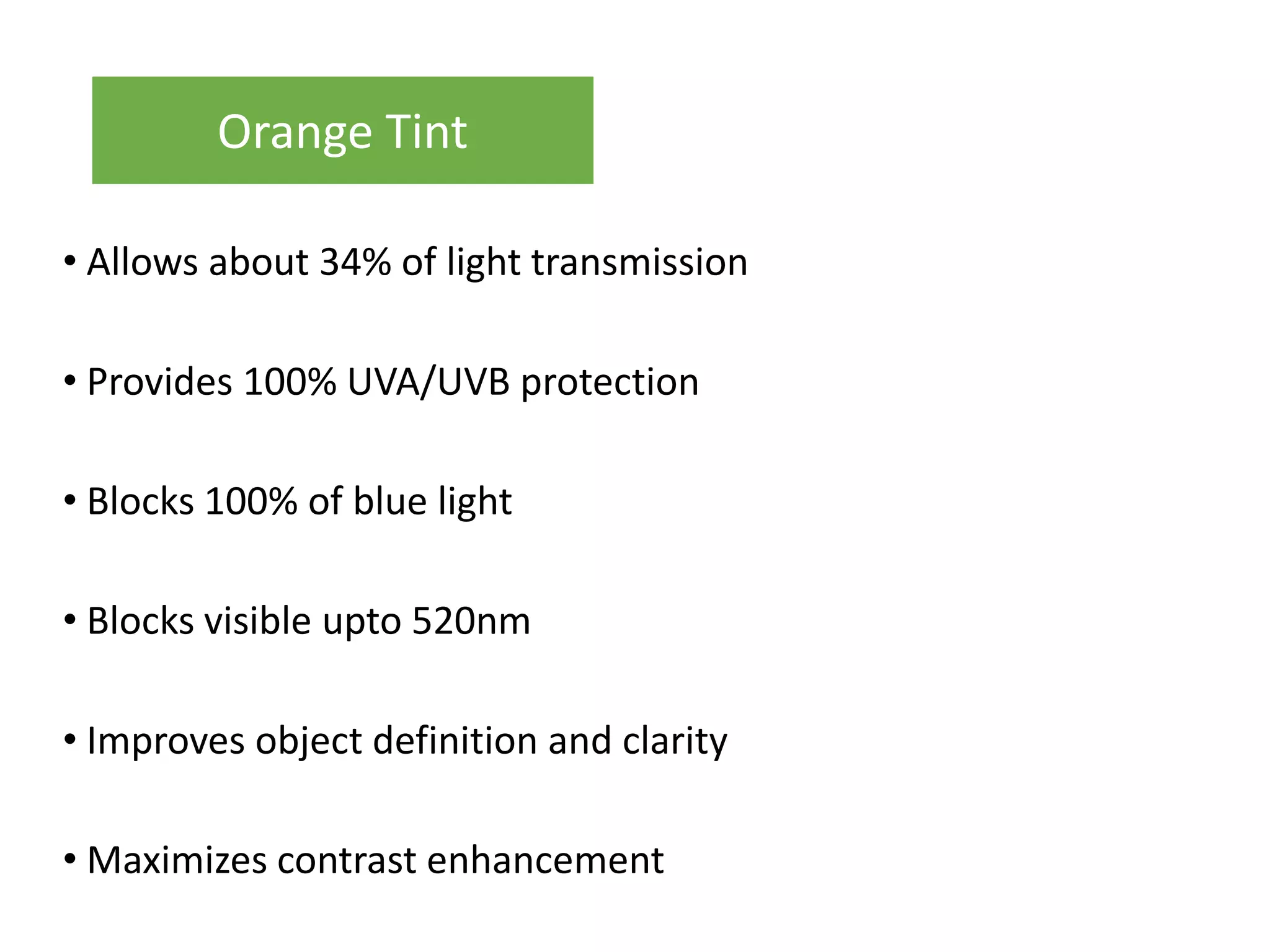
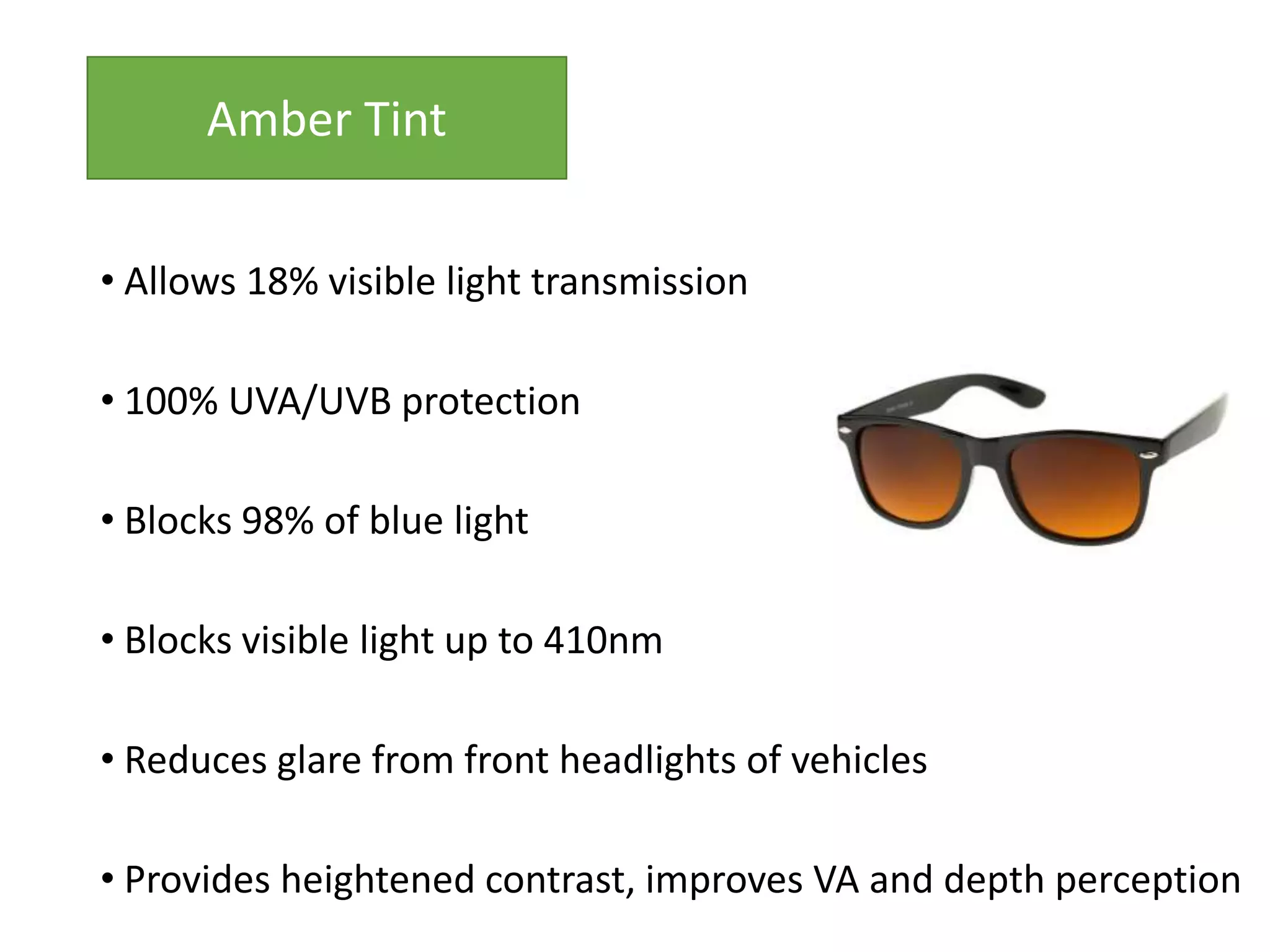
• Allows 18% visible light transmission
• 100% UVA/UVB protection
• Blocks 98% of blue light
• Blocks visible light up to 410nm
• Reduces glare from front headlights of vehicles
• Provides heightened contrast, improves VA and depth perception
Amber Tint
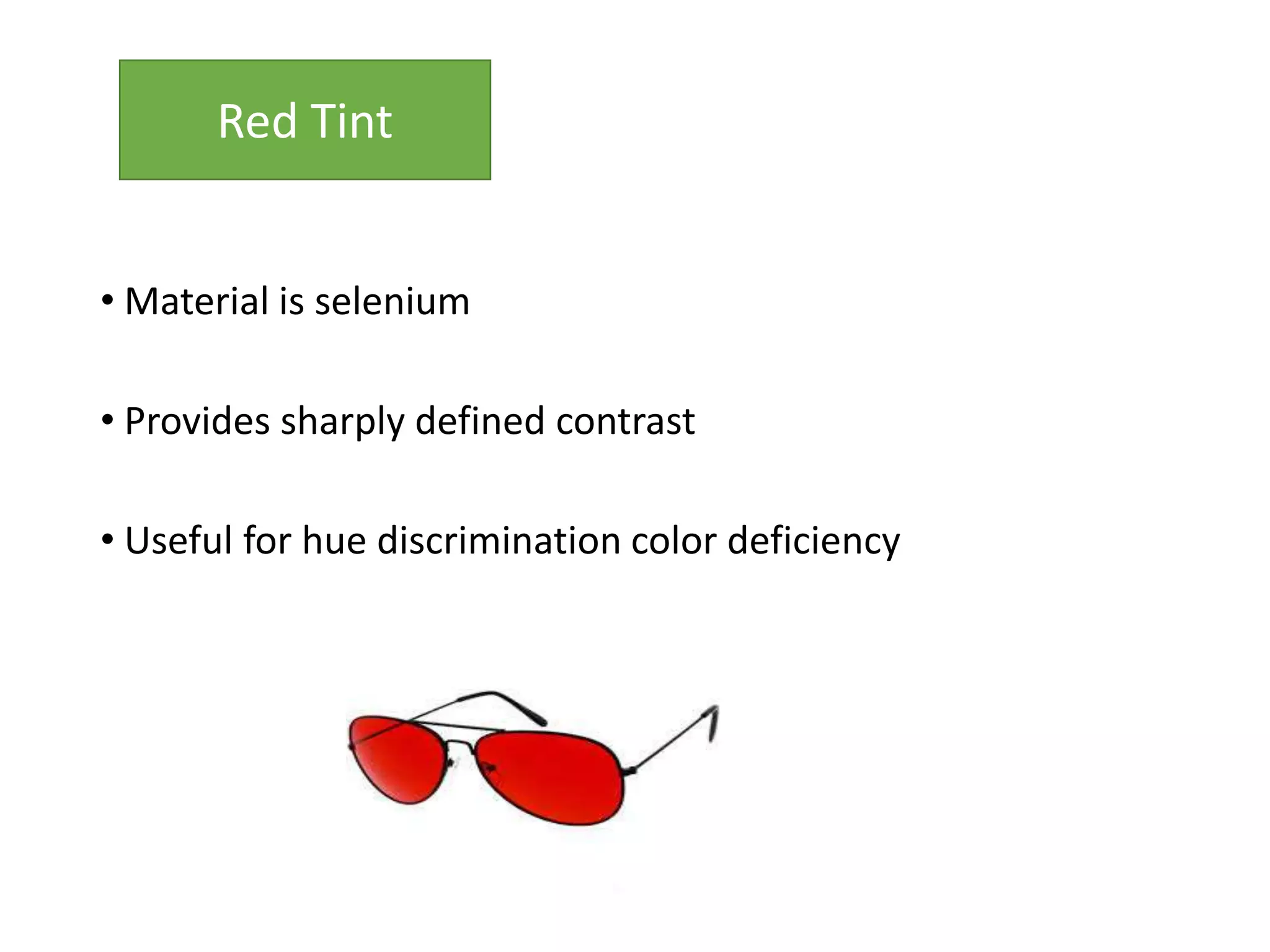
• Material is selenium
• Provides sharply defined contrast
• Useful for hue discrimination color deficiency
Red Tint
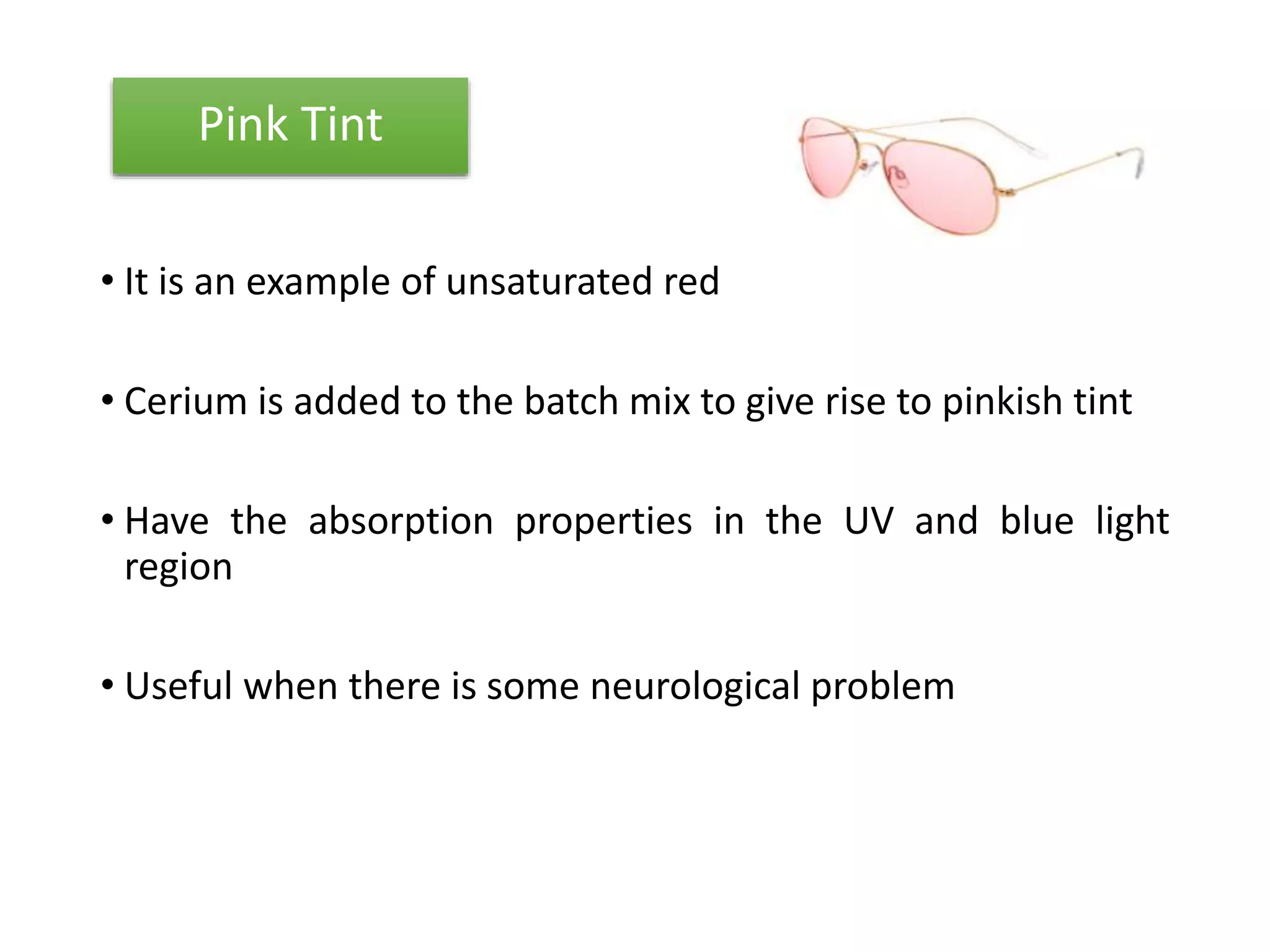
• It is an example of unsaturated red
• Cerium is added to the batch mix to give rise to pinkish tint
• Have the absorption properties in the UV and blue light
region
• Useful when there is some neurological problem
Pink Tint
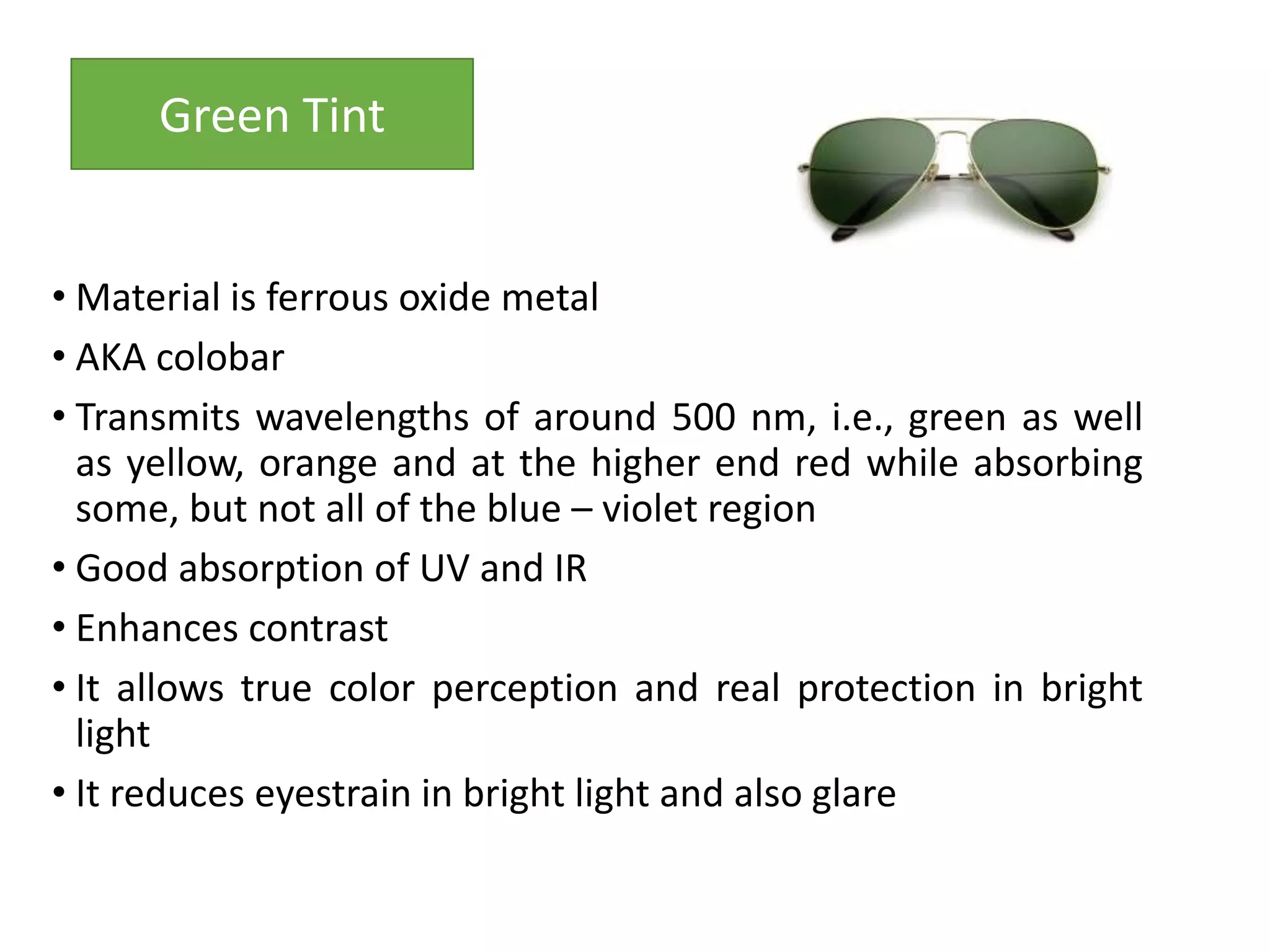
• Material is ferrous oxide metal
• AKA colobar
• Transmits wavelengths of around 500 nm, i.e., green as well
as yellow, orange and at the higher end red while absorbing
some, but not all of the blue – violet region
• Good absorption of UV and IR
• Enhances contrast
• It allows true color perception and real protection in bright
light
• It reduces eyestrain in bright light and also glare
Green Tint
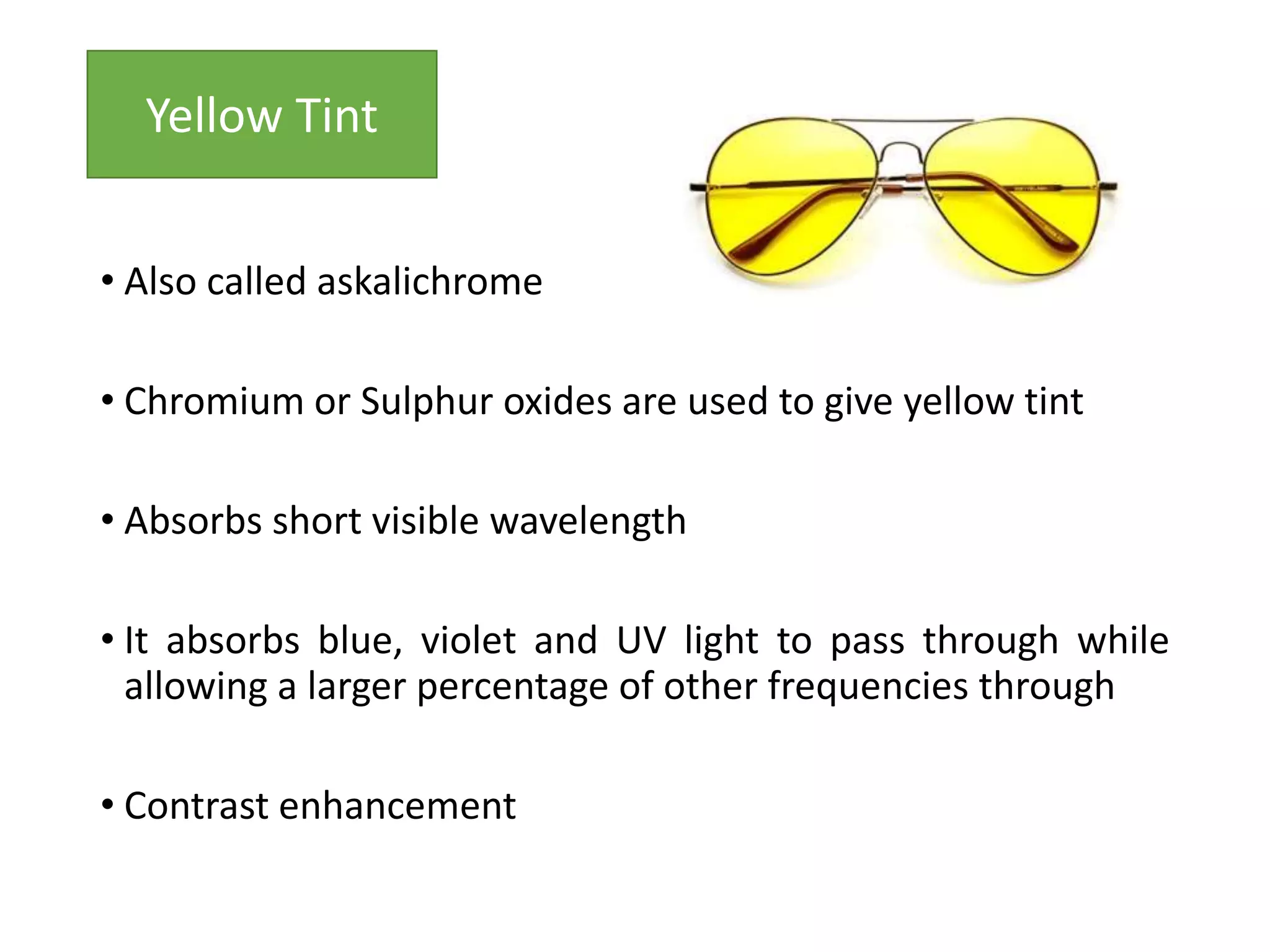
• Also called askalichrome
• Chromium or Sulphur oxides are used to give yellow tint
• Absorbs short visible wavelength
• It absorbs blue, violet and UV light to pass through while
allowing a larger percentage of other frequencies through
• Contrast enhancement
Yellow Tint
• Combination of both grey and green
• Reduces glare and eye strain in bright light
• Good option for sunglasses
G 15 Tint
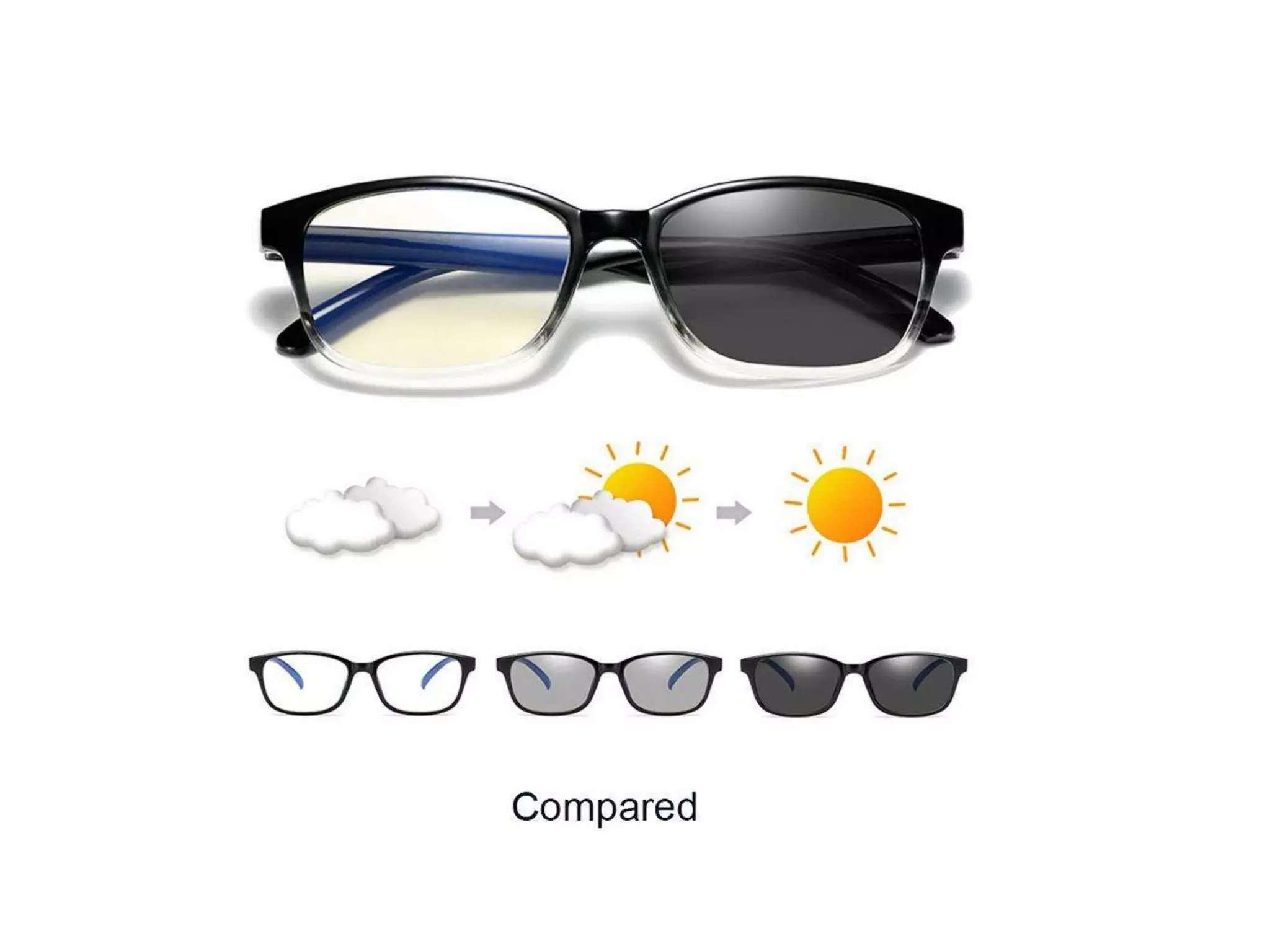
• CPF lenses are photochromatic lenses in four different
spectral cutoff levels, manufactured by Corning
Medical Optics
• The filter eliminates virtually all of the UV and blue
end of the visible spectrum
• They relieve symptoms of glare discomfort and
reduced vision d/t scattering
• Contrast is enhanced and adaptation time to changes
in illumination is also aided
Corning Photochromatic
Filter(CPF)
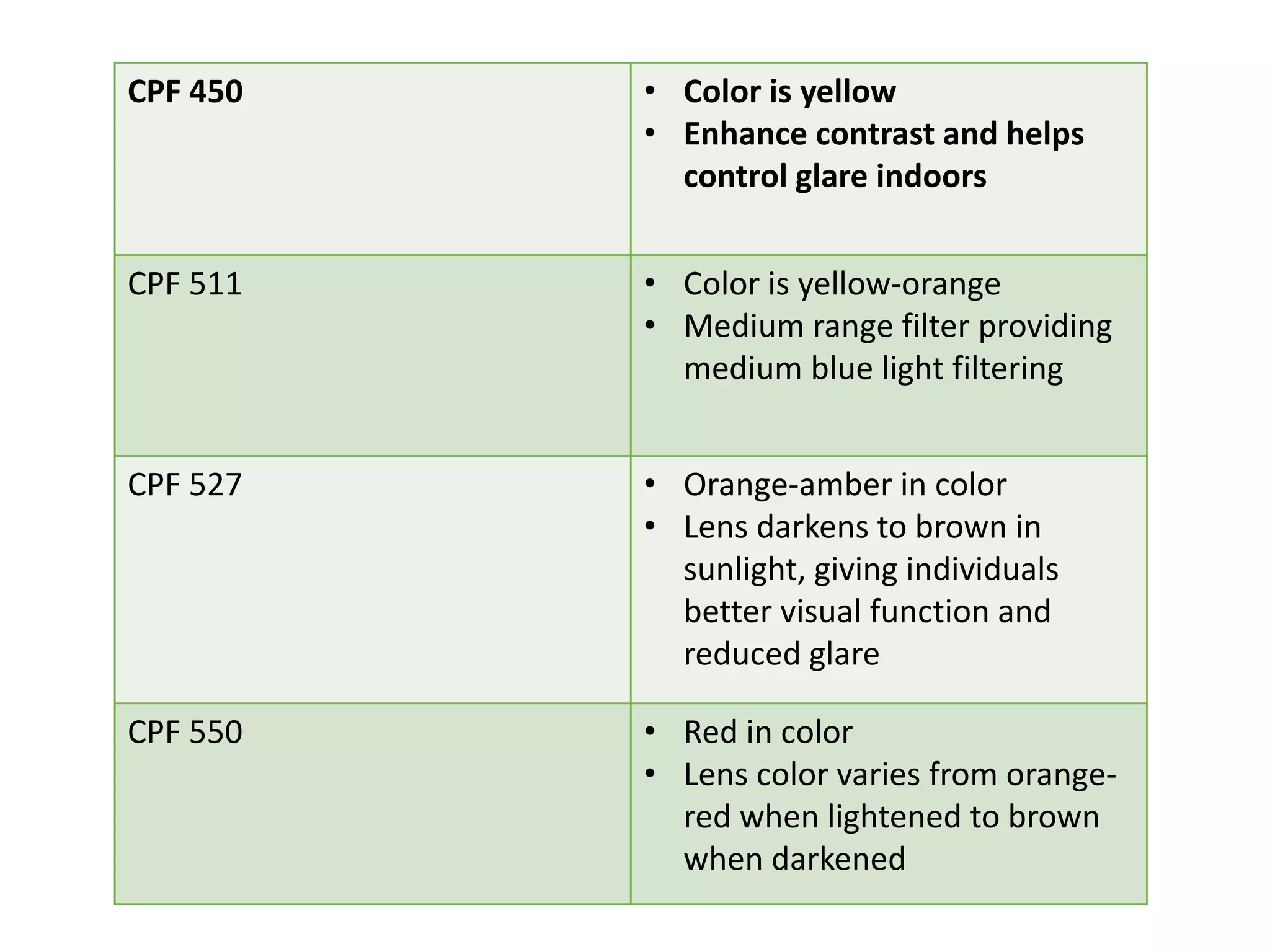
CPF 450 • Color is yellow
• Enhance contrast and helps
control glare indoors
CPF 511 • Color is yellow-orange
• Medium range filter providing
medium blue light filtering
CPF 527 • Orange-amber in color
• Lens darkens to brown in
sunlight, giving individuals
better visual function and
reduced glare
CPF 550 • Red in color
• Lens color varies from orange-
red when lightened to brown
when darkened
• NoIR filters relieve glare by absorbing short wavelengths of
visible spectrum that can scatter within the ocular media
• Prevent greater than 99% of all glare-causing high energy short
wavelengths from reaching the eye
• Enhance contrast by highlighting visual contrast
• Also cut IR wavelengths, cooling the light by reducing the heat
energy of the sun to provide a more soothing, comfortable
viewing experience
No Infrared Filter(NoIR)
• Lights reflected off horizontal surfaces can produce intense
glare problem
• Glare results in eyestrain, loss of clear vision, poor color
saturation, loss of depth perception, causing discomfort
• Polaroid filters can help in these conditions
Polaroid Filters
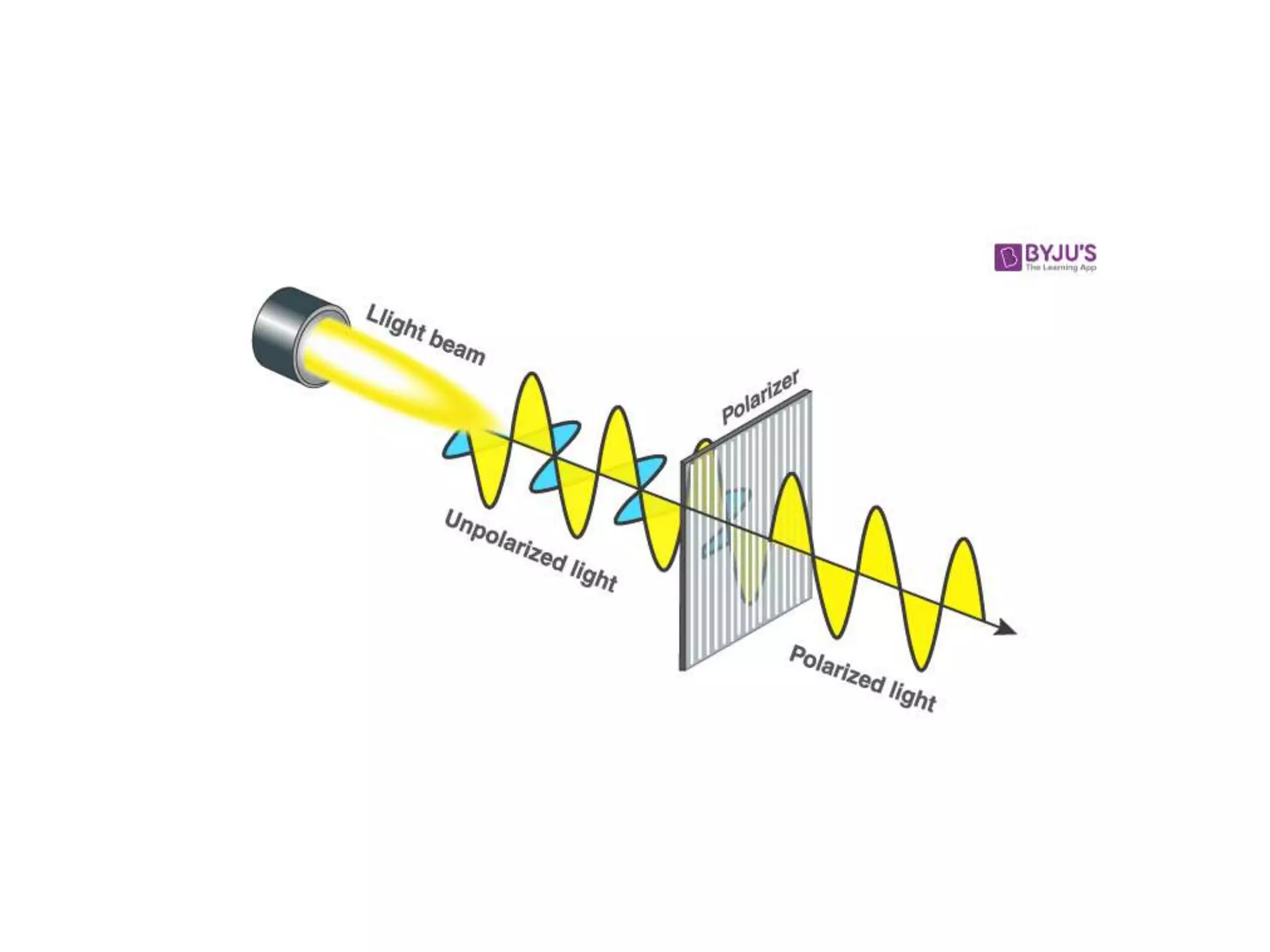
Phenomenon
• Under normal conditions, light vibrates in all directions
• When light reflects off a shiny surface, they become
concentrated and vibrate in a specific horizontal
direction
• Polaroid filters, when properly placed(vertically) in front
of the reflected light rays, filter out this problematic
glare created by specular reflection
• This property is called plane polarization
• However, if the light rays are reflected at different
angles, they will only be partially filtered or absorbed
Tints Vs Polarized Lens
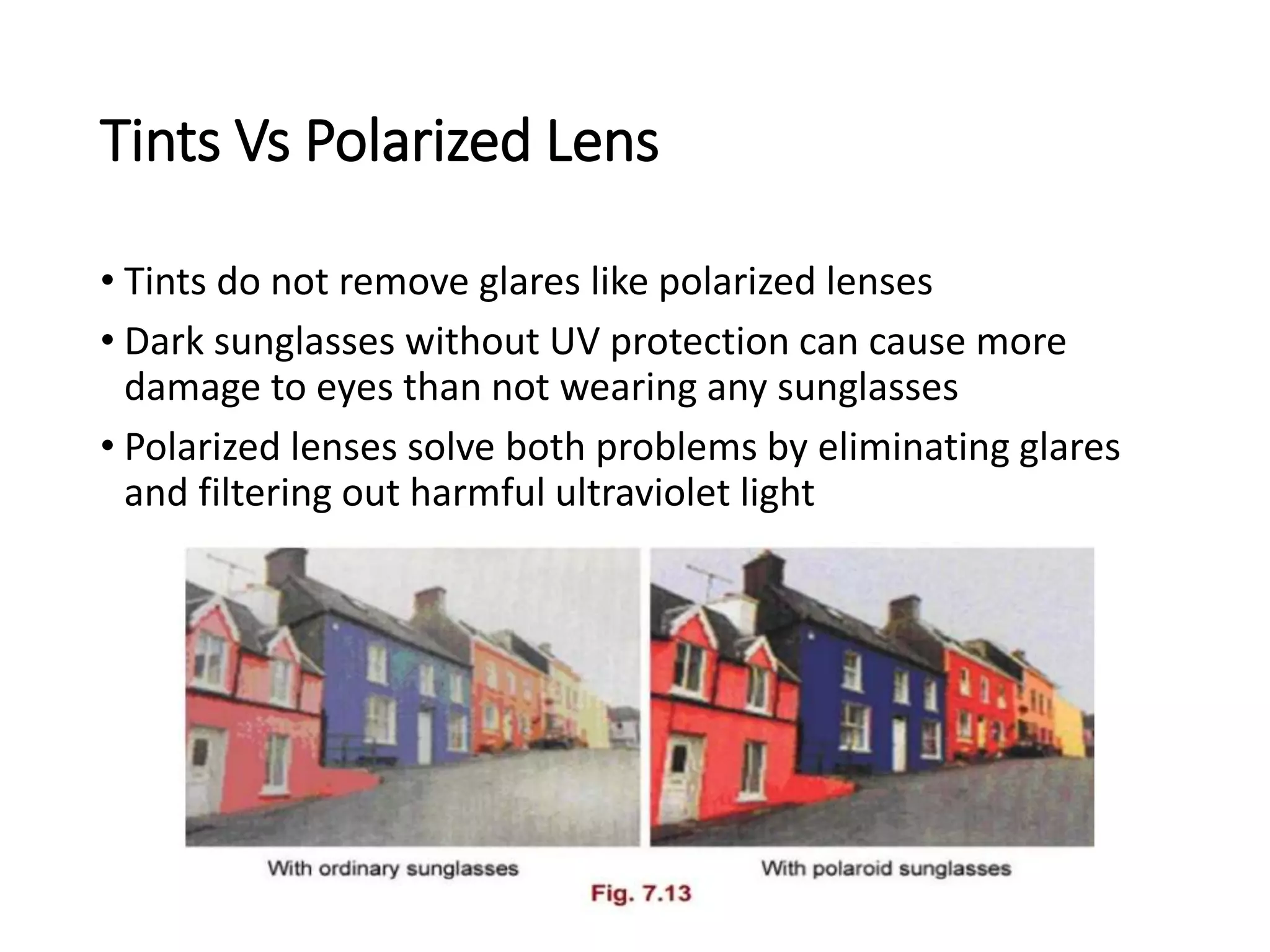
• Tints do not remove glares like polarized lenses
• Dark sunglasses without UV protection can cause more
damage to eyes than not wearing any sunglasses
• Polarized lenses solve both problems by eliminating glares
and filtering out harmful ultraviolet light
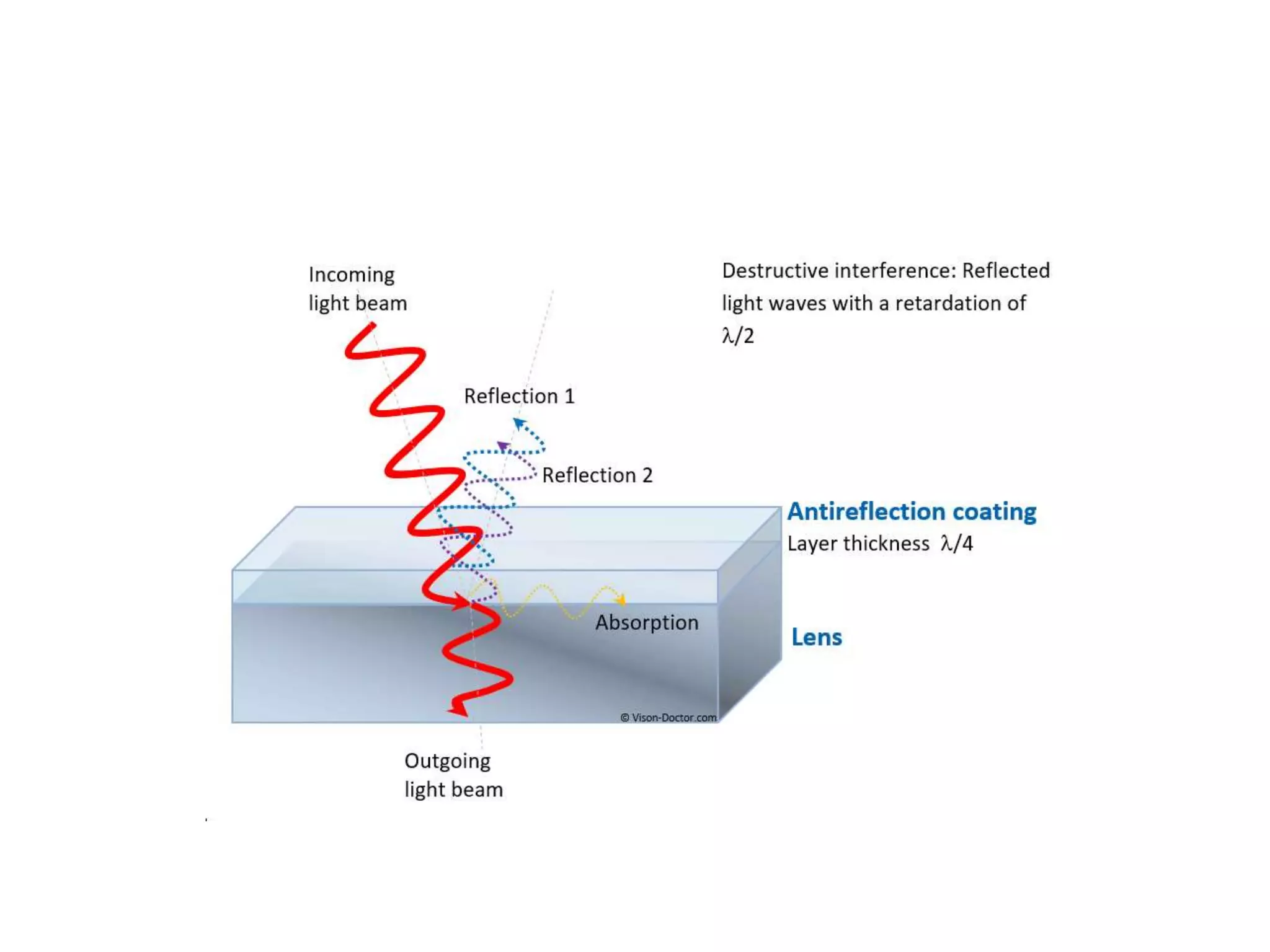
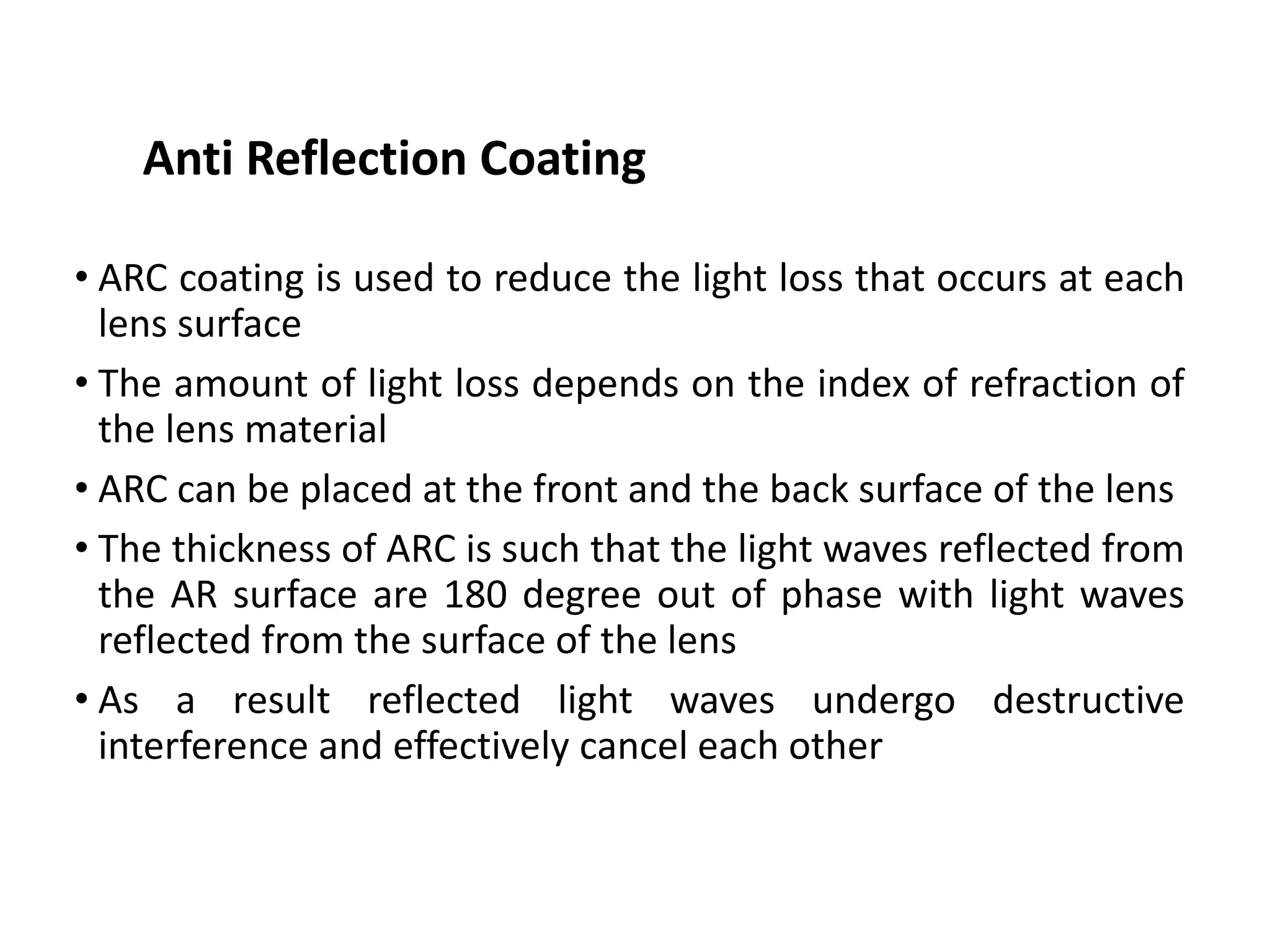
• ARC coating is used to reduce the light loss that occurs at each
lens surface
• The amount of light loss depends on the index of refraction of
the lens material
• ARC can be placed at the front and the back surface of the lens
• The thickness of ARC is such that the light waves reflected from
the AR surface are 180 degree out of phase with light waves
reflected from the surface of the lens
• As a result reflected light waves undergo destructive
interference and effectively cancel each other
Anti Reflection Coating
• In low vision, many prescriptions require very
steep or very flat curvatures or doublet lenses in
various lens designs
• As a result they produce reflections that distract
from the visual performance of the lens
• ARC helps to reduce the amount of lens
reflections
Filters in Various Eye Conditions
Age Related Macular Degeneration
• B/L disease of persons above the age of 50 yrs
• Leading cause of blindness in developed countries
• Can be exudative or non-exudative
• Characterized by:
• Soft drusens
• Hypopigmentation or hyperpigmentation of Retinal
Pigment Epithelium
• RPE and associated neurosensory detachment
• Haemorrhage, geographic atrophy of RPE and fibrous
scarring
• Sunsafe 511 and 527 filters can be used as glare control
and contrast enhancer
• In the No Infrared(NoIR) range, spectral shield plus 505
orange or the 533 amber/orange is recommended
• In the UV shields range, 40% amber, 60% orange work
best
• 21 medium grey, 22 dark grey or 32 grey-grey green is
suitable for patients with light sensitivity
• Always use the tint with highest VLT that is acceptable
Filter Options
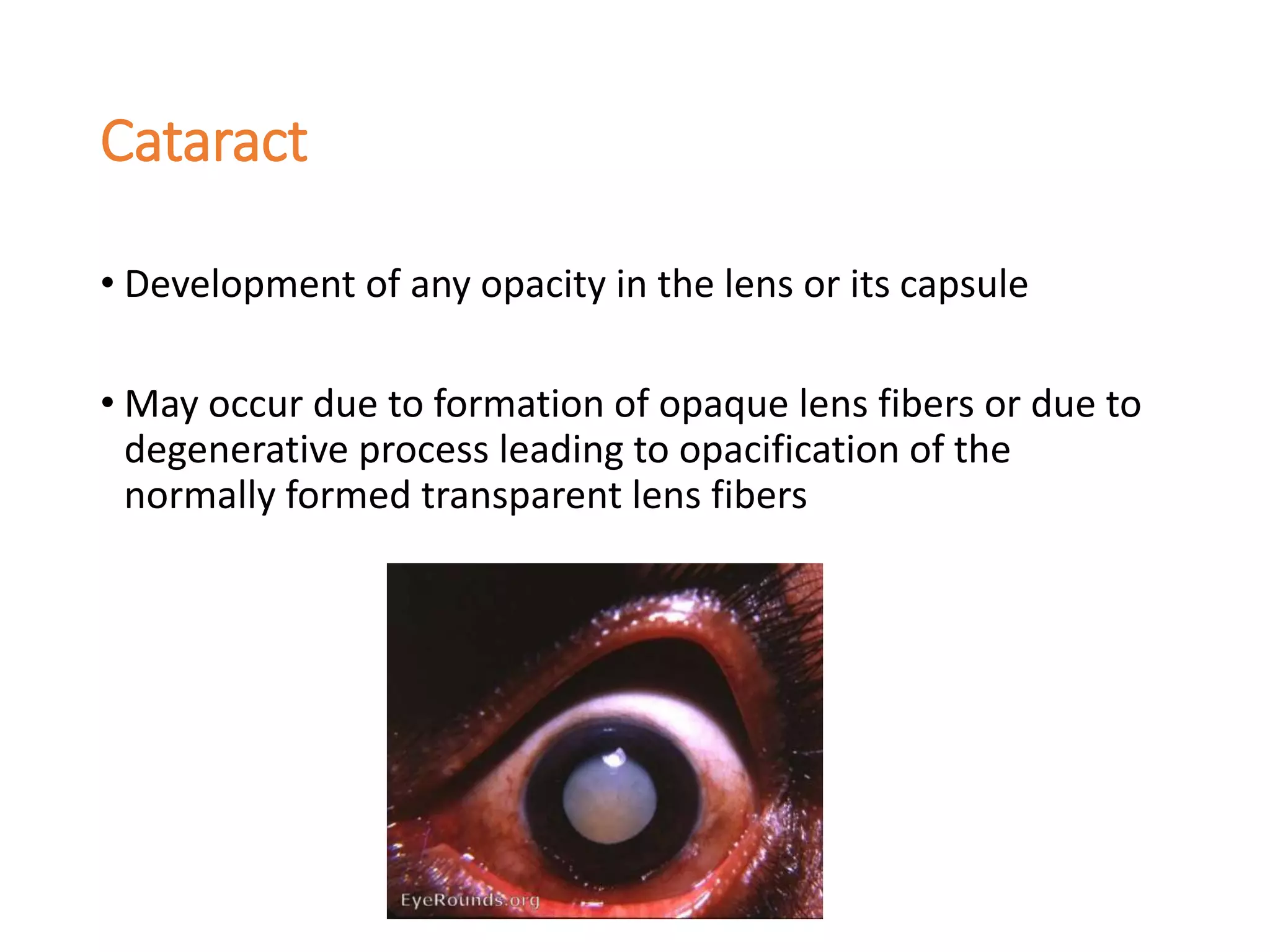
Cataract
• Development of any opacity in the lens or its capsule
• May occur due to formation of opaque lens fibers or due to
degenerative process leading to opacification of the
normally formed transparent lens fibers
• In the sunsafe range, the 450 or 511 are usually most
effective
• In the NoIR range, the spectra shield 465 yellow or
505 orange is useful
• The UV shield 50 yellow, 40 amber or 21 grey are
effective
• In case of extreme glare problems, the multilens 511
yellow orange, the NoIR 22 dark grey is helpful
Filter Options
Glaucoma
• A group of disorders characterized by
1. Progressive optic neuropathy resulting in a
characteristic appearance of optic disc
2. Visual field defects
3. Increased IOP
• Can be congenital, primary or secondary glaucoma
• The sunsafe 450 are the most appropriate for contrast
enhancement
• When using the NoIR Spectra Shield or UV range the 10
Clear [for indoors and when reading] the 50 Yellow or
the 21 Grey tend to be successful
• the 22 Dark Grey or 32 Grey-Green or the 81 Plum may
prove more effective in cases of light sensitivity and
extreme glare problems
• Always use the tint with highest VLT
Filter Options
Diabetic Retinopathy
• Retinal changes seen in patients with diabetis mellitus
• Can be Non Proliferative Diabetic Retinopathy, Proliferative
Diabetic Retinopathy, Diabetic Maculopathy and Advanced
Diabetic Eye Disease
• NPDR is characterized by microaneurysms, retinal
haemorrhage, cotton wool spots, hard exudates, venous
abnormalities
• PDR is characterized by occurrence of neovascularization,
fibrovascular epiretinal membrane, vitreous detachment and
vitreous haemorrhage
• Diabetic macular edema occurs d/t increased permeability of
the retinal capillaries k/a diabetic maculopathy
• ADED is the end result of PDR, marked by persistent vitreous
haemorrhage, tractional RD and neovascular glaucoma
• The SunSafe 511, 527 or 550 tend to be the
beneficial
• In the NoIR range the Spectra Shields 533 and
553 can help
• In the UV Shields the 60 Orange is effective
• 81 plum may be more appropriate if the person
suffers from light sensitivity
Filter Options
Retinitis Pigmentosa
• A hereditary disorder predominantly affecting the
photoreceptor(rods more than cones), occurs by the death
of photoreceptors
• Characterized by progressive peripheral vision loss and night
vision difficulties(Nyctalopia) that can lead to central vision
loss
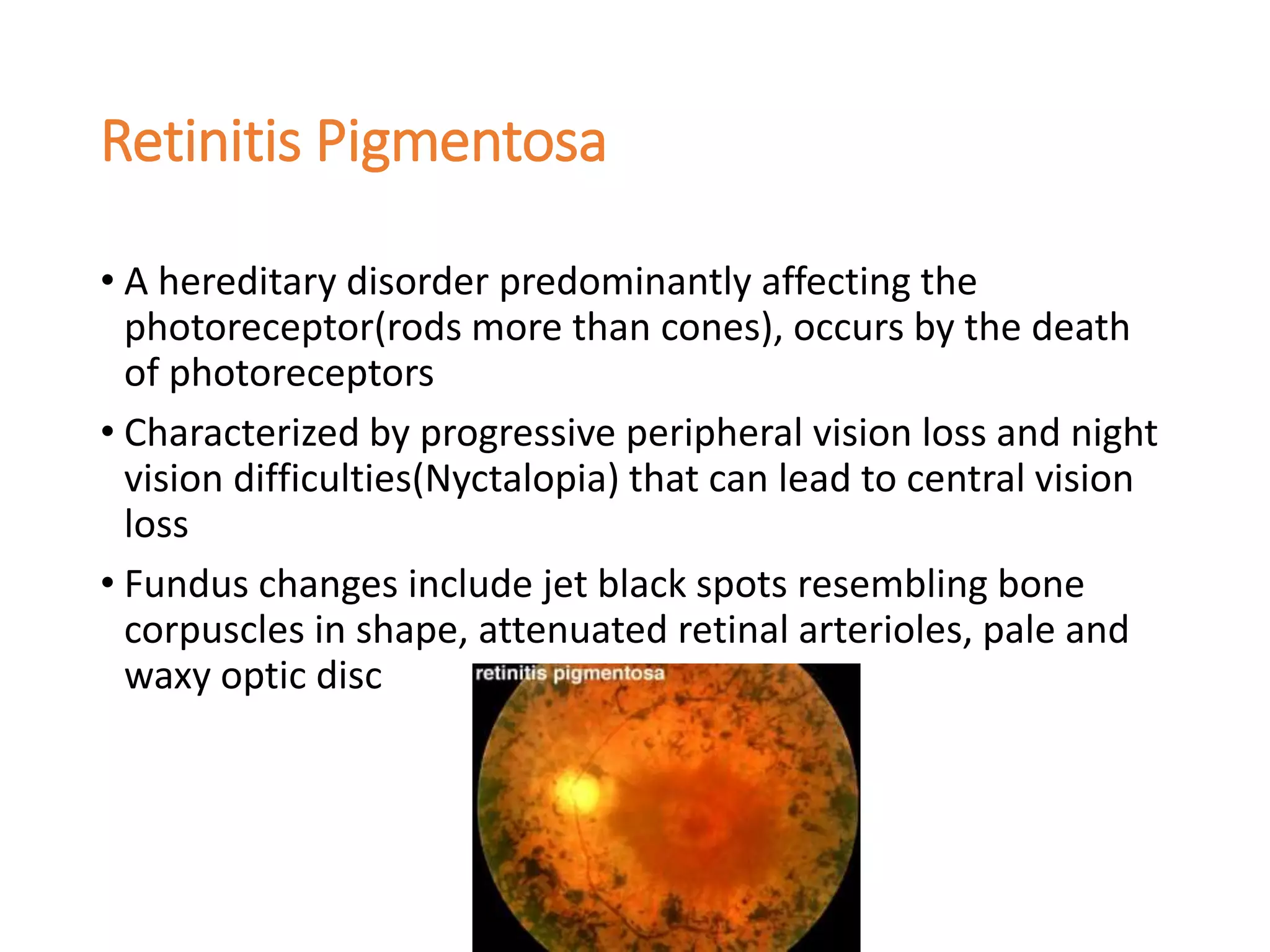
• Fundus changes include jet black spots resembling bone
corpuscles in shape, attenuated retinal arterioles, pale and
waxy optic disc
• Orange or Red filters are mostly effective in case of
RP
• In the SunSafe range the 527 Orange/Red, 550 Red
are mostly useful
• In the NoIR range the Spectra Shield 533
Amber/Orange, 553 Red/Orange are useful
• The UV Shield 60 Orange is also effective
• The lightest possible VLT lens should be used in this
condition
Filter Options
Pathological Myopia
• Extremely high amount of near sightedness(6 to 20D)
• Major alternation of shape or globe of eye leads to profound
vision loss
• 7th leading cause of legal blindness
• Associated with Down’s syndrome, Marfan’s syndrome,
ocular albinism, ROP, infantile glaucoma
• May lead to staphyloma, myopic macular degeneration,
retinal detachment, glaucoma
• Short wavelength filtering lenses(blue-violet filters) help to
improve contrast sensitivity and visual acuity in photopic
conditions, improve retinal image quality and strengthen
accommodative function
• They can be used to delay myopia progression
• Yellow and NoIR filters are mostly useful in this condition which
can absorb UV light less than 380nm as well as 400-500nm high
energy blue light
Filter Options
Corneal Dystrophy
• A group of disorders characterized by the non-inflammatory
inherited bilateral opacity of the cornea with no
vascularization
• Classified by IC3D into:
1. Epithelial and sub-epithelial dystrophies
2. Bowman layer dystrophies
3. Stromal dystrophies
4. Descemet membrane and endothelial
dystrophies
Filter Options
• UV protection lenses in the range of 290 to 315 like CPF such
as Photogray II, Photogray Extra, Photosun II, Photogray
Extra-16, Photobrown Extra-16, Photogray Thin and Dark,
Photobrown Thin and Dark
• Yellow, brown filters tend to enhance vision
• Contrast enhancement can be achieved by yellow and
orange filters
Albinism
• It is the congenital absence of melanin pigment or the
body’s ability to produce melanin pigment
• May occur as oculocutaneous albinism or just ocular
albinism
• Characterized by light blue iris, white eyebrows and
eyelashes, pendular sensory nystagmus
• Colored ophthalmic filters are often prescribed for
people with albinism to reduce ocular discomfort,
enhance visual performance or both
• Yellow, orange, red, grey have the potential to enhance
vision
• Dark amber lenses significantly decrease the light
intensity
• The ability of colored short wavelength light-absorbing
filters to improved contrast sensitivity among subjects
has been attributed to reduction in intraocular light
scatter
• CPF lenses help the patients outdoors
Filter Options
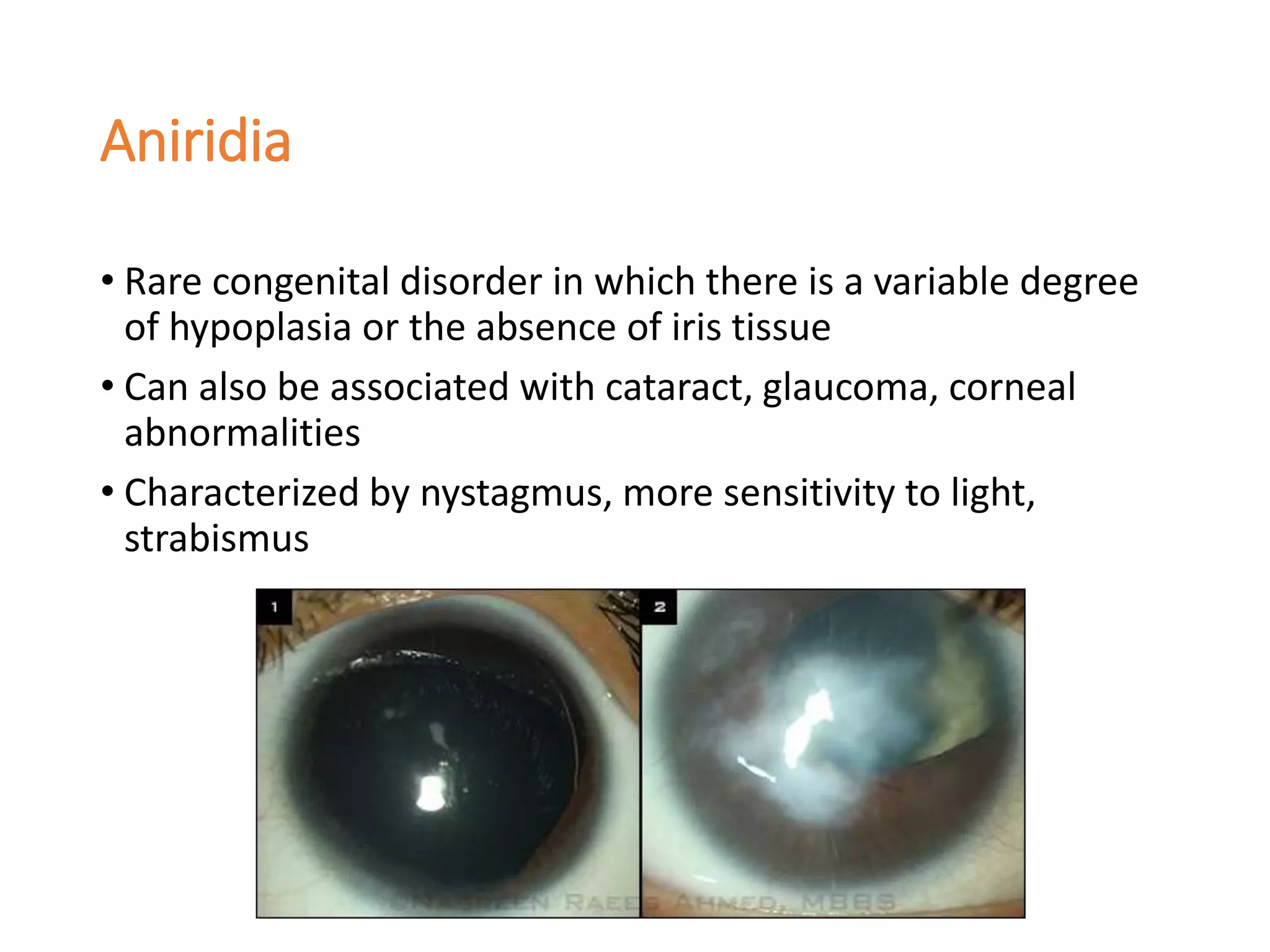
Aniridia
• Rare congenital disorder in which there is a variable degree
of hypoplasia or the absence of iris tissue
• Can also be associated with cataract, glaucoma, corneal
abnormalities
• Characterized by nystagmus, more sensitivity to light,
strabismus
Filter Options
• They are likely to select grey, green and blue filters but reject
orange and yellow filters
• Green, yellow, brown and red tints are useful for contrast
enhancement
• CPF 450, CPF 511, CPF 527, CPF 550 can be used indoors and
outdoors
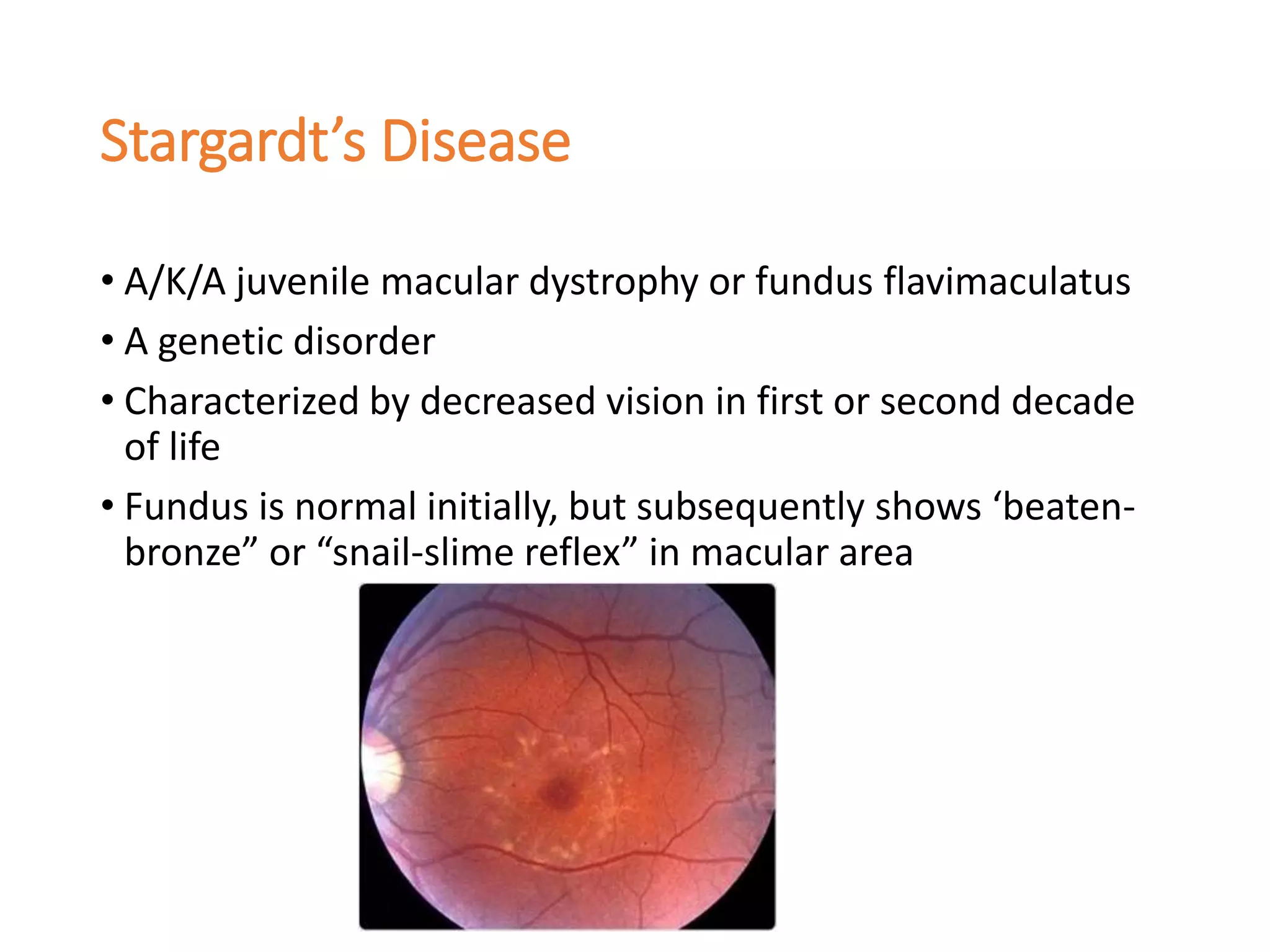
Stargardt’s Disease
• A/K/A juvenile macular dystrophy or fundus flavimaculatus
• A genetic disorder
• Characterized by decreased vision in first or second decade
of life
• Fundus is normal initially, but subsequently shows ‘beaten-
bronze” or “snail-slime reflex” in macular area
• Ultraviolet rays are believed to enhance the macular
degeneration in Stargardt’s disease
• Filtering lenses help to improve contrast sensitivity and
visual acuity
• Grey, brown and green filters can be used
• Photochromic lenses can help in sunlight
Filter Options
Assessing Objective and Subjective Trials
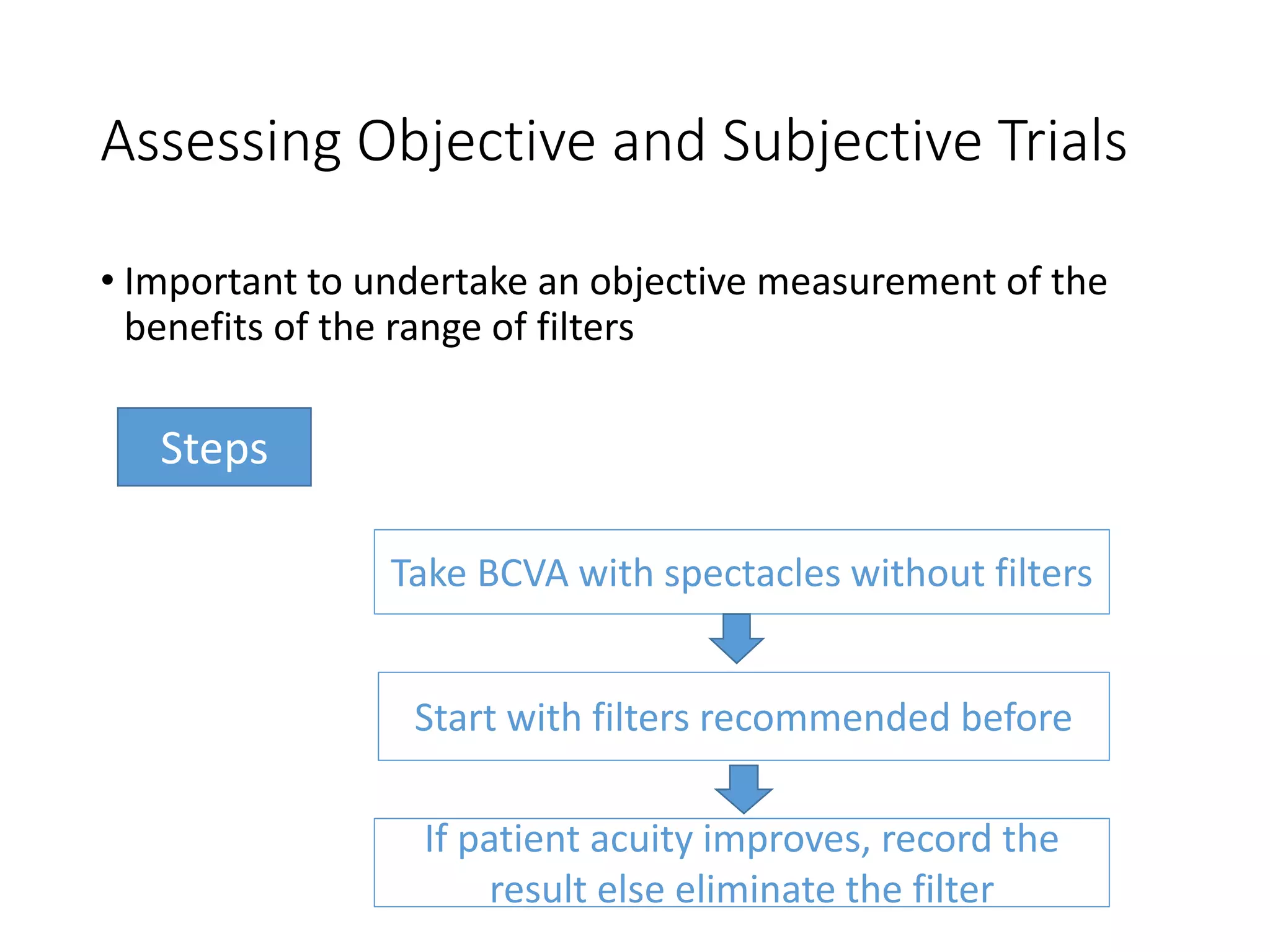
• Important to undertake an objective measurement of the
benefits of the range of filters
Steps
Take BCVA with spectacles without filters
Start with filters recommended before
If patient acuity improves, record the
result else eliminate the filter
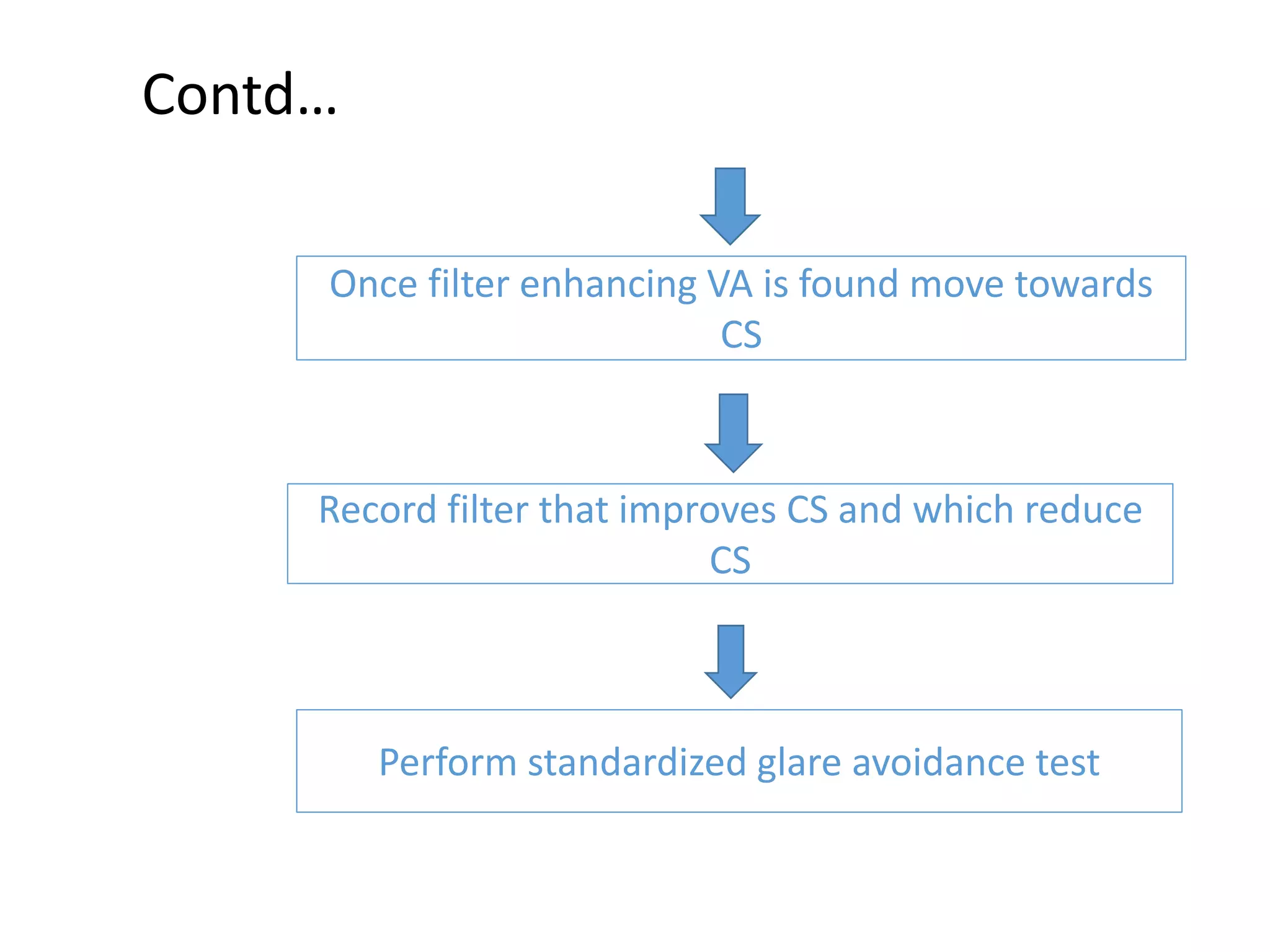
Contd…
Once filter enhancing VA is found move towards
CS
Record filter that improves CS and which reduce
CS
Perform standardized glare avoidance test
References
• Clinical Optics by Troy E. Fannin and Theodore Grosvenor
• Essentials of Low Vision
• Ophthalmic Lenses by Ajay Kumar Bhootra
• http://www.optimalowvision.co.uk/documents/ChoosingYou
rAntiglareFilters.pdf

Tints and filter for patients with low vision

  • 1.
    Tints and Filterfor Patients with Low Vision Moderator Mr. Niraj Dev Joshi Presenters Gauri Chaudhary Puja Gurung Maharajgunj Medical Campus
  • 2.
    Contents • Introduction tolow vision • Classification • Epidemiology • Problems faced by low vision patients • Introduction to tints and filters • Filters for various low vision conditions • Assessment of Subjective and Objective trials
  • 3.
    Introduction • A personwith low vision is a one who has impairment of visual functioning even after treatment of standard refractive correction, and has visual acuity of less than 6/18 to light perception and/or visual field less than 10 degrees from the point of fixation and who is potentially able to use vision for planning and execution of task WHO Definition
  • 4.
    Contd… • According toICD-10, low vision is categorized as Visual acuity of less than 6/18 but equal to or better than 3/60 Corresponding visual field loss, to less than 20 degrees in the better eye with best possible correction
  • 5.
    Epidemiology • Globally, about2.2 billion people have a vision impairment or blindness • About 1 billion people are those with moderate or severe distance vision impairment or blindness due to unaddressed refractive error and near vision impairment caused by presbyopia • Majority of people with vision impairment are above the age of 50 • In terms of regional differences, the prevalence of distance vision impairment in low- and middle-income regions, is estimated to be four times higher than in high- income region
  • 6.
    Classification Categories Worse thanEqual to/ Better than Low vision 1 6/18 6/60 2 6/60 3/60 Blindness 3 3/60 1/60 4 1/60 Light perception 5 No light perception No light perception 9 Undetermined Undetermined
  • 7.
    Ocular conditions leadingto low vision Children Adults Aged ROP Congenital cataract Nystagmus Albinism Pathological myopia Retinitis Pigmentosa Stargardt’s disease Macular degeneration Age Related Macular Degeneration Cataract Advanced glaucoma Diabetic Retinopathy
  • 8.
    Problems faced byLV patients • Difficulty in reading number plates, black board in school, street signs, recognition of face • Difficulty in reading, doing signature • Glare and photophobia • Diplopia • Visual field loss • Difficulty in movement
  • 9.
    Introduction to Tintsand Filters • A tinted lens reduces the light entering into the eye, the darker the tint the less light can enter the eye. • A filter lens will filter out the disturbing light while at the same time allowing most of the useful light into the eye
  • 10.
    Difference between Tintsand Filters • Tints do not discriminate between light waves that cause disturbance and the useful light waves that help to see • Tints reduce glare as well as vision while filters do not reduce vision
  • 11.
    Contd… • Tints arenot used for diagnostic purposes while filters are used such as cobalt blue, red free, neutral density, green and red filters • Tints do not enhance contrast while filters do • Tinted glasses are used for cosmetic purposes but filters are not
  • 12.
    Visible Light Transmission •The amount of light that reaches eye through the lens • The smaller the percentage, the less amount of light is being transmitted • Glasses with dark tint have low level of VLT • Standard sunglasses have a VLT of 15 to 25%
  • 13.
  • 14.
    • Discomfort glareis caused by short wave light rays below 511nm, entering the eye and scattering within the ocular media • Important filter for this purpose are in the sun safe range of 450-511 nm • No Infrared(NoIR) range spectra shield 465 and 505 nm • UV shields like amber, orange, grey and greens • Choose NoIR range with the highest possible VLT Glare avoidance
  • 15.
    • It isachieved by reducing the amount of short wave light entering the eye • Sunsafe filters from 450-511 nm • NoIR shield spectra 465 and 505 nm • In the UV shield range yellow, amber, orange tend to be more successful • Filter with highest VLT that can be tolerated should be used • Use the filter with highest VLT Contrast enhancement
  • 16.
    • A darkerfilter will be required for those who cannot tolerate light indoor or outdoor • In the SunSafe range, a filter between 527nm and 550 nm is helpful • In the NoIR range the spectra shield 533 and 553 prove to be successful • In the UV shield range grey, grey-green, red and plum is useful Control for light sensitivity
  • 17.
    Reduced Migraines • Patientwho experiences migraines may be hypersensitive to the visual stimuli • Color filters can reduce symptoms caused by these stimuli
  • 18.
    Driving Factors • Itis essential to offer protection to the eyes while driving in order to 1. See better 2. React quickly to dangerous conditions 3. Improve safety • Lenses should not be too dark as they reduce VA • Grey tint is good for day time driving • Yellow or amber tint is good for night time driving
  • 19.
    Blue Light Hazards •Blue light do not cause severe damage to the eyes, they desensitize the eyes to light • Blue light spreads in the whole interior of the eye, causing dazzle • This severely affects the eyes with pathologies like Cataract, ARMD, Glaucoma, RP, Aniridia
  • 20.
  • 21.
    • Also calledas neutral density filter • Provides evenness of transmission through whole visible spectrum • Allows colors to be seen in their natural state relative to one another • Useful for those who can not tolerate color distortion or whose job requires accurate color discrimination • Most popular in sunglasses • It does not enhance contrast but is highly recommended for reduction of glare and photophobia outdoors Grey tint
  • 22.
    • Reduces glareand molecules that mainly absorb total UV light below 400nm • In the visible region of spectrum, transmission is controlled with high peaks in the blue, green and red region, resulting in a color enhancing effect • Commonly used to improve contrast on bright, hazy and smoggy day • An excellent contrast enhancing filter and is very much suitable for sun protection Brown Tint
  • 23.
    • Allows about34% of light transmission • Provides 100% UVA/UVB protection • Blocks 100% of blue light • Blocks visible upto 520nm • Improves object definition and clarity • Maximizes contrast enhancement Orange Tint
  • 24.
    • Allows 18%visible light transmission • 100% UVA/UVB protection • Blocks 98% of blue light • Blocks visible light up to 410nm • Reduces glare from front headlights of vehicles • Provides heightened contrast, improves VA and depth perception Amber Tint
  • 25.
    • Material isselenium • Provides sharply defined contrast • Useful for hue discrimination color deficiency Red Tint
  • 26.
    • It isan example of unsaturated red • Cerium is added to the batch mix to give rise to pinkish tint • Have the absorption properties in the UV and blue light region • Useful when there is some neurological problem Pink Tint
  • 27.
    • Material isferrous oxide metal • AKA colobar • Transmits wavelengths of around 500 nm, i.e., green as well as yellow, orange and at the higher end red while absorbing some, but not all of the blue – violet region • Good absorption of UV and IR • Enhances contrast • It allows true color perception and real protection in bright light • It reduces eyestrain in bright light and also glare Green Tint
  • 28.
    • Also calledaskalichrome • Chromium or Sulphur oxides are used to give yellow tint • Absorbs short visible wavelength • It absorbs blue, violet and UV light to pass through while allowing a larger percentage of other frequencies through • Contrast enhancement Yellow Tint
  • 29.
    • Combination ofboth grey and green • Reduces glare and eye strain in bright light • Good option for sunglasses G 15 Tint
  • 30.
    • CPF lensesare photochromatic lenses in four different spectral cutoff levels, manufactured by Corning Medical Optics • The filter eliminates virtually all of the UV and blue end of the visible spectrum • They relieve symptoms of glare discomfort and reduced vision d/t scattering • Contrast is enhanced and adaptation time to changes in illumination is also aided Corning Photochromatic Filter(CPF)
  • 32.
    CPF 450 •Color is yellow • Enhance contrast and helps control glare indoors CPF 511 • Color is yellow-orange • Medium range filter providing medium blue light filtering CPF 527 • Orange-amber in color • Lens darkens to brown in sunlight, giving individuals better visual function and reduced glare CPF 550 • Red in color • Lens color varies from orange- red when lightened to brown when darkened
  • 33.
    • NoIR filtersrelieve glare by absorbing short wavelengths of visible spectrum that can scatter within the ocular media • Prevent greater than 99% of all glare-causing high energy short wavelengths from reaching the eye • Enhance contrast by highlighting visual contrast • Also cut IR wavelengths, cooling the light by reducing the heat energy of the sun to provide a more soothing, comfortable viewing experience No Infrared Filter(NoIR)
  • 35.
    • Lights reflectedoff horizontal surfaces can produce intense glare problem • Glare results in eyestrain, loss of clear vision, poor color saturation, loss of depth perception, causing discomfort • Polaroid filters can help in these conditions Polaroid Filters
  • 36.
    Phenomenon • Under normalconditions, light vibrates in all directions • When light reflects off a shiny surface, they become concentrated and vibrate in a specific horizontal direction • Polaroid filters, when properly placed(vertically) in front of the reflected light rays, filter out this problematic glare created by specular reflection • This property is called plane polarization • However, if the light rays are reflected at different angles, they will only be partially filtered or absorbed
  • 38.
    Tints Vs PolarizedLens • Tints do not remove glares like polarized lenses • Dark sunglasses without UV protection can cause more damage to eyes than not wearing any sunglasses • Polarized lenses solve both problems by eliminating glares and filtering out harmful ultraviolet light
  • 39.
    • ARC coatingis used to reduce the light loss that occurs at each lens surface • The amount of light loss depends on the index of refraction of the lens material • ARC can be placed at the front and the back surface of the lens • The thickness of ARC is such that the light waves reflected from the AR surface are 180 degree out of phase with light waves reflected from the surface of the lens • As a result reflected light waves undergo destructive interference and effectively cancel each other Anti Reflection Coating
  • 40.
    • In lowvision, many prescriptions require very steep or very flat curvatures or doublet lenses in various lens designs • As a result they produce reflections that distract from the visual performance of the lens • ARC helps to reduce the amount of lens reflections
  • 42.
    Filters in VariousEye Conditions
  • 43.
    Age Related MacularDegeneration • B/L disease of persons above the age of 50 yrs • Leading cause of blindness in developed countries • Can be exudative or non-exudative • Characterized by: • Soft drusens • Hypopigmentation or hyperpigmentation of Retinal Pigment Epithelium • RPE and associated neurosensory detachment • Haemorrhage, geographic atrophy of RPE and fibrous scarring
  • 44.
    • Sunsafe 511and 527 filters can be used as glare control and contrast enhancer • In the No Infrared(NoIR) range, spectral shield plus 505 orange or the 533 amber/orange is recommended • In the UV shields range, 40% amber, 60% orange work best • 21 medium grey, 22 dark grey or 32 grey-grey green is suitable for patients with light sensitivity • Always use the tint with highest VLT that is acceptable Filter Options
  • 45.
    Cataract • Development ofany opacity in the lens or its capsule • May occur due to formation of opaque lens fibers or due to degenerative process leading to opacification of the normally formed transparent lens fibers
  • 46.
    • In thesunsafe range, the 450 or 511 are usually most effective • In the NoIR range, the spectra shield 465 yellow or 505 orange is useful • The UV shield 50 yellow, 40 amber or 21 grey are effective • In case of extreme glare problems, the multilens 511 yellow orange, the NoIR 22 dark grey is helpful Filter Options
  • 47.
    Glaucoma • A groupof disorders characterized by 1. Progressive optic neuropathy resulting in a characteristic appearance of optic disc 2. Visual field defects 3. Increased IOP • Can be congenital, primary or secondary glaucoma
  • 48.
    • The sunsafe450 are the most appropriate for contrast enhancement • When using the NoIR Spectra Shield or UV range the 10 Clear [for indoors and when reading] the 50 Yellow or the 21 Grey tend to be successful • the 22 Dark Grey or 32 Grey-Green or the 81 Plum may prove more effective in cases of light sensitivity and extreme glare problems • Always use the tint with highest VLT Filter Options
  • 49.
    Diabetic Retinopathy • Retinalchanges seen in patients with diabetis mellitus • Can be Non Proliferative Diabetic Retinopathy, Proliferative Diabetic Retinopathy, Diabetic Maculopathy and Advanced Diabetic Eye Disease • NPDR is characterized by microaneurysms, retinal haemorrhage, cotton wool spots, hard exudates, venous abnormalities • PDR is characterized by occurrence of neovascularization, fibrovascular epiretinal membrane, vitreous detachment and vitreous haemorrhage • Diabetic macular edema occurs d/t increased permeability of the retinal capillaries k/a diabetic maculopathy • ADED is the end result of PDR, marked by persistent vitreous haemorrhage, tractional RD and neovascular glaucoma
  • 50.
    • The SunSafe511, 527 or 550 tend to be the beneficial • In the NoIR range the Spectra Shields 533 and 553 can help • In the UV Shields the 60 Orange is effective • 81 plum may be more appropriate if the person suffers from light sensitivity Filter Options
  • 51.
    Retinitis Pigmentosa • Ahereditary disorder predominantly affecting the photoreceptor(rods more than cones), occurs by the death of photoreceptors • Characterized by progressive peripheral vision loss and night vision difficulties(Nyctalopia) that can lead to central vision loss • Fundus changes include jet black spots resembling bone corpuscles in shape, attenuated retinal arterioles, pale and waxy optic disc
  • 52.
    • Orange orRed filters are mostly effective in case of RP • In the SunSafe range the 527 Orange/Red, 550 Red are mostly useful • In the NoIR range the Spectra Shield 533 Amber/Orange, 553 Red/Orange are useful • The UV Shield 60 Orange is also effective • The lightest possible VLT lens should be used in this condition Filter Options
  • 53.
    Pathological Myopia • Extremelyhigh amount of near sightedness(6 to 20D) • Major alternation of shape or globe of eye leads to profound vision loss • 7th leading cause of legal blindness • Associated with Down’s syndrome, Marfan’s syndrome, ocular albinism, ROP, infantile glaucoma • May lead to staphyloma, myopic macular degeneration, retinal detachment, glaucoma
  • 54.
    • Short wavelengthfiltering lenses(blue-violet filters) help to improve contrast sensitivity and visual acuity in photopic conditions, improve retinal image quality and strengthen accommodative function • They can be used to delay myopia progression • Yellow and NoIR filters are mostly useful in this condition which can absorb UV light less than 380nm as well as 400-500nm high energy blue light Filter Options
  • 55.
    Corneal Dystrophy • Agroup of disorders characterized by the non-inflammatory inherited bilateral opacity of the cornea with no vascularization • Classified by IC3D into: 1. Epithelial and sub-epithelial dystrophies 2. Bowman layer dystrophies 3. Stromal dystrophies 4. Descemet membrane and endothelial dystrophies
  • 56.
    Filter Options • UVprotection lenses in the range of 290 to 315 like CPF such as Photogray II, Photogray Extra, Photosun II, Photogray Extra-16, Photobrown Extra-16, Photogray Thin and Dark, Photobrown Thin and Dark • Yellow, brown filters tend to enhance vision • Contrast enhancement can be achieved by yellow and orange filters
  • 57.
    Albinism • It isthe congenital absence of melanin pigment or the body’s ability to produce melanin pigment • May occur as oculocutaneous albinism or just ocular albinism • Characterized by light blue iris, white eyebrows and eyelashes, pendular sensory nystagmus
  • 58.
    • Colored ophthalmicfilters are often prescribed for people with albinism to reduce ocular discomfort, enhance visual performance or both • Yellow, orange, red, grey have the potential to enhance vision • Dark amber lenses significantly decrease the light intensity • The ability of colored short wavelength light-absorbing filters to improved contrast sensitivity among subjects has been attributed to reduction in intraocular light scatter • CPF lenses help the patients outdoors Filter Options
  • 59.
    Aniridia • Rare congenitaldisorder in which there is a variable degree of hypoplasia or the absence of iris tissue • Can also be associated with cataract, glaucoma, corneal abnormalities • Characterized by nystagmus, more sensitivity to light, strabismus
  • 60.
    Filter Options • Theyare likely to select grey, green and blue filters but reject orange and yellow filters • Green, yellow, brown and red tints are useful for contrast enhancement • CPF 450, CPF 511, CPF 527, CPF 550 can be used indoors and outdoors
  • 61.
    Stargardt’s Disease • A/K/Ajuvenile macular dystrophy or fundus flavimaculatus • A genetic disorder • Characterized by decreased vision in first or second decade of life • Fundus is normal initially, but subsequently shows ‘beaten- bronze” or “snail-slime reflex” in macular area
  • 62.
    • Ultraviolet raysare believed to enhance the macular degeneration in Stargardt’s disease • Filtering lenses help to improve contrast sensitivity and visual acuity • Grey, brown and green filters can be used • Photochromic lenses can help in sunlight Filter Options
  • 63.
    Assessing Objective andSubjective Trials • Important to undertake an objective measurement of the benefits of the range of filters Steps Take BCVA with spectacles without filters Start with filters recommended before If patient acuity improves, record the result else eliminate the filter
  • 64.
    Contd… Once filter enhancingVA is found move towards CS Record filter that improves CS and which reduce CS Perform standardized glare avoidance test
  • 65.
    References • Clinical Opticsby Troy E. Fannin and Theodore Grosvenor • Essentials of Low Vision • Ophthalmic Lenses by Ajay Kumar Bhootra • http://www.optimalowvision.co.uk/documents/ChoosingYou rAntiglareFilters.pdf

Editor's Notes

  • #5 International statistical classification of diseases and related health problems( ICD-10)
  • #22 Because it absorbs light equally over the whole visible spectrum
  • #23 Absorbs blue more than yellow Ideal tint for day time drivers
  • #25 Color ranges form light straw to dark red
  • #26 Because strongly blocks the transmission of blue and blue-green wavelengths
  • #28 So good option for sunglasses Good intermediate filter to use when grey or yellow does not seem right.
  • #29 Not good for light sensitive person
  • #30 Green and 15% light can transmit through the lens Blocks visible light,not for bright sunny day
  • #31 450nm, 511nm, 527nm and 550nm 450nm filters about 96%of light of wavelength less than 450nm
  • #33 Principle of photochromatic lens..
  • #35 Table showing NOIR from book
  • #36 2. So polaroid lenses are useful in these conditions
  • #40 2. Directly proportional
  • #47 People with cataracts tend to benefit most from lighter filters, which illuminate the blue light waves
  • #50 Advanced Diabetic Eye Disease
  • #55 <380nm, 400-500nm
  • #56 International Committee for Classification of Corneal Dystrophies
  • #59 Photochromic, filters, sunglasses
  • #64 It is simply not sufficient to allow the individual to try the various options in a subjective manner, this will inevitably end up with the individual choosing a filter far too dark which will in turn reduce visual acuity