Soft Toric Contact Lens
Manish Dahal
Vasan Institute Of Ophthalmology & Research
Bangalore, India India
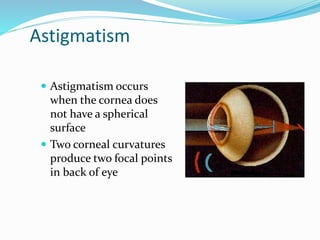
Astigmatism
 Astigmatism occurs
when the cornea does
not have a spherical
surface
 Two corneal curvatures
produce two focal points
in back of eye
Contact Lens Correction - Astigmatism
 Almost 45% to 50% of visually corrected population
have significant amounts (-0.75D or more) of
astigmatism
 There are essentially three ways astigmatism may
be corrected with contact lenses:
 Rigid Gas Permeable Lenses (RGPs)
 Spherical Soft Lenses
 Toric Soft Lenses
What is a Toric Lens ?
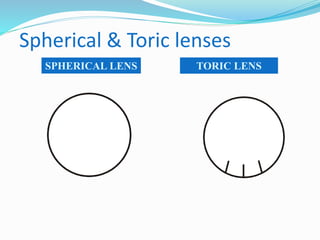
 Toric lens is a lens used to correct Astigmatism or
Cylindrical number as it contains cylindrical
component which standard soft contact lenses do not
have.
Spherical & Toric lenses
SPHERICAL LENS TORIC LENS
Indications
 Visual compromise from residual astigmatism
 Unsatisfactory V/A with best sphere
 High sphere to cylinder ratio
 RGPs not tolerated
Fitting Toric Lenses
Three fitting techniques:
 Diagnostic
 Trial
 Empirical
Toric lens stability and Stabilization
techniques
 A Toric lens should remain stable or should not rotate
in the eye to provide stable vision to the wearer.
 There are different method and design for stabilization
 Prism Ballasting
 Truncation
 Peri-ballasting
 Dynamic Stabilization/ double slab off
 Combination of all
Toric SCL Measurement Of Lens Rotation
 Rotation is measured by laser marks which are at 3,
6 and 9 o’clock positions
 Rotation can be measured by :-
 Narrow Slit – Lamp Beam
 Protractor Scale on the eye piece of K
 Spectacle Trial Frame
Toric lens fitting
 STEP 1- Refraction and cylinder in MINUS cylinder
form
e.g- R/E - -3.00 /-2.50 x 170 degrees
 Step 2- Unlike spherical lenses there is no need to do
spherical equivalent
 Step 3 -Do vertex distance compensation of the sphere
& cylinder separately
Toric lens fitting
e.g- R/E - -3.00 /-2.50 x 170 degrees
-3.00 / -2.25 To be Decided
 Step 4- All Toric lenses have base curve
Toric lens fitting
 Step 5-Base curve is determined by doing Keratometry
e.g- 7.60mm/7.80mm
 Step 6- Add 0.80 mm to the flattest meridian or the highest
reading in mm. In the above example 7.80mm is flatter
/higher than 7.60mm
Toric lens fitting
 7.80mm + 0.80mm = 8.60mm
 The BC of the trial lens will be 8.60mm
Step 7- You have the spherical,Cylindrical power as
well as the Base curve of the trial lens to be tried on
the patient
Step 8- Choose a trial lens as close as possible to
spectacle Cylindrical axis(i.e-170 degrees)
Toric lens fitting
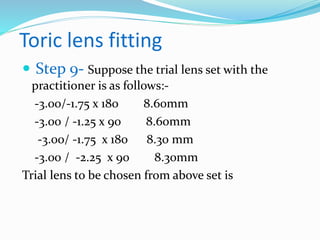
 Step 9- Suppose the trial lens set with the
practitioner is as follows:-
-3.00/-1.75 x 180 8.60mm
-3.00 / -1.25 x 90 8.60mm
-3.00/ -1.75 x 180 8.30 mm
-3.00 / -2.25 x 90 8.30mm
Trial lens to be chosen from above set is
Toric lens fitting
 -3.00/ -1.75 x 180 8.60 mm
Toric lens fitting
Step 10- Give the trial to the patient - wait for 15-20
minutes before assessing fit of the lens
Step 11 -Assess fit of the lens by assessing
 Full corneal Coverage
 Centration
 Movement
 Comfort
 Stable vision
Toric lens fitting
Step 12 - It is not always possible to show vision to
a patient as trial lens axis might not match spectacle
axis
Step 13-If first 4 factors are fine then axis
finalisation is done
Toric lens fitting
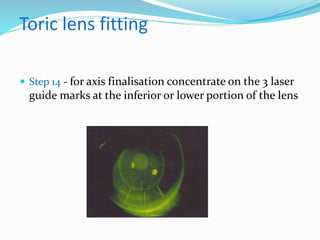
 Step 14 - for axis finalisation concentrate on the 3 laser
guide marks at the inferior or lower portion of the lens
Toric axis finalization
3 things can happen while assessing Toric lens rotation
 No rotation or minimal rotation of 5 degrees
 Rotation to L.H.S ( with reference to
Practitioner)
 Rotation to R.H.S (Practitioner)
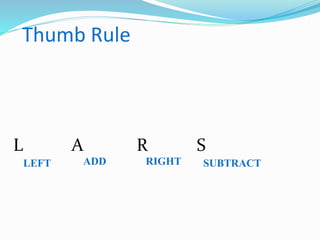
Thumb Rule
L A R S
LEFT ADD RIGHT SUBTRACT
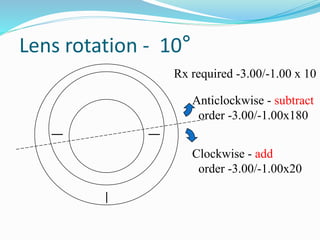
Lens rotation - 10°
Rx required -3.00/-1.00 x 10
Anticlockwise - subtract
order -3.00/-1.00x180
Clockwise - add
order -3.00/-1.00x20
Toric axis finalization
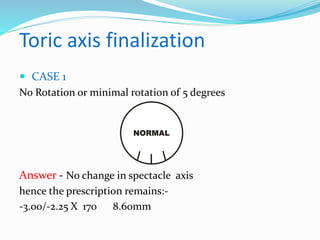
 CASE 1
No Rotation or minimal rotation of 5 degrees
Answer - No change in spectacle axis
hence the prescription remains:-
-3.00/-2.25 X 170 8.60mm
Toric axis finalization
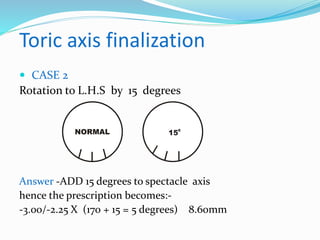
 CASE 2
Rotation to L.H.S by 15 degrees
Answer -ADD 15 degrees to spectacle axis
hence the prescription becomes:-
-3.00/-2.25 X (170 + 15 = 5 degrees) 8.60mm
150
Toric axis finalization
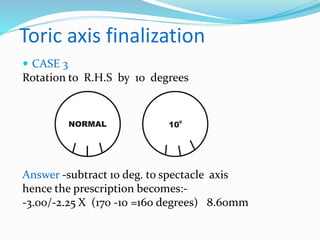
 CASE 3
Rotation to R.H.S by 10 degrees
Answer -subtract 10 deg. to spectacle axis
hence the prescription becomes:-
-3.00/-2.25 X (170 -10 =160 degrees) 8.60mm
100
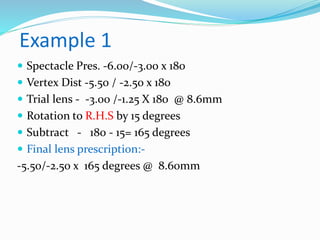
Example 1
 Spectacle Pres. -6.00/-3.00 x 180
 Vertex Dist -5.50 / -2.50 x 180
 Trial lens - -3.00 /-1.25 X 180 @ 8.6mm
 Rotation to R.H.S by 15 degrees
 Subtract - 180 - 15= 165 degrees
 Final lens prescription:-
-5.50/-2.50 x 165 degrees @ 8.60mm
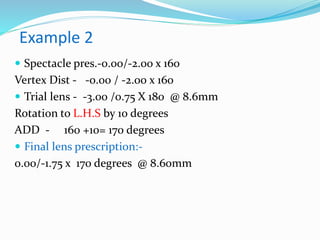
Example 2
 Spectacle pres.-0.00/-2.00 x 160
Vertex Dist - -0.00 / -2.00 x 160
 Trial lens - -3.00 /0.75 X 180 @ 8.6mm
Rotation to L.H.S by 10 degrees
ADD - 160 +10= 170 degrees
 Final lens prescription:-
0.00/-1.75 x 170 degrees @ 8.60mm
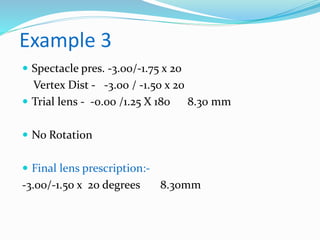
Example 3
 Spectacle pres. -3.00/-1.75 x 20
Vertex Dist - -3.00 / -1.50 x 20
 Trial lens - -0.00 /1.25 X 180 8.30 mm
 No Rotation
 Final lens prescription:-
-3.00/-1.50 x 20 degrees 8.30mm
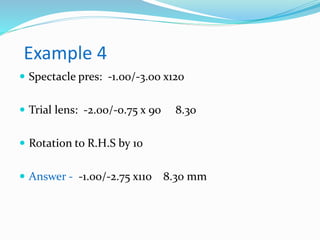
Example 4
 Spectacle pres: -1.00/-3.00 x120
 Trial lens: -2.00/-0.75 x 90 8.30
 Rotation to R.H.S by 10
 Answer - -1.00/-2.75 x110 8.30 mm
Toric lens fitting
 STEP 13 - After axis finalization the final Toric lens order
is given to the manufacturer
TORIC SCL ASSESSMENT OF FIT
 GOOD FIT: FULL CORNEAL COVERAGE,
GOOD CENTRATION AND MOVEMENT,
QUICK RETURN TO AXIS IF MISLOCATED.
 TIGHT FIT: GOOD CENTRATION,
INITIALLY COMFORTABLE,
LITTLE OR NO MOVEMENT.
SLOW RETURN TO AXIS IF MISLOCATED.
 LOOSE FIT: EXCESSIVE MOVEMENT,
POOR CENTRATION,
UNCOMFORTABLE.
LENS ORIENTATION UNSTABLE AND
INCONSISTENT.
Things to remember
 Do not make any changes in trial lens axis
 Trial lens (Diagnostic lens ) fitting is a very reliable
and scientific method of fitting Toric lenses
 Choose trial lens axis as close as possible to
spectacle axis
Things to remember
 If trial lens axis & spectacle axis are different then do
not attempt over refraction as it can lead to confusion
 Final lens Base Curve should be same as Trial lens Base
Curve
 Like the trial lens, final lens would also show similar
rotation
Care & Maintenance
 Similar to standard soft contact lenses
 Multipurpose solutions
 Proper insertion & removal to be taught to the patient
to avoid lens damage
Care & Maintenance
 While removal the patient should either pinch the lens
from the centre or else rotate the lens in either
direction (L or R) to avoid lens damage along lens
markings
Brands of Toric lenses
 Alcon
 Bausch + Lomb
 Cooper Vision
 J&J
 Custom made soft torics are also available from
companies like Flexilens / Purecon etc .
Thank you

Soft toric Contact Lens

  • 1.
    Soft Toric ContactLens Manish Dahal Vasan Institute Of Ophthalmology & Research Bangalore, India India
  • 2.
    Astigmatism  Astigmatism occurs whenthe cornea does not have a spherical surface  Two corneal curvatures produce two focal points in back of eye
  • 3.
    Contact Lens Correction- Astigmatism  Almost 45% to 50% of visually corrected population have significant amounts (-0.75D or more) of astigmatism  There are essentially three ways astigmatism may be corrected with contact lenses:  Rigid Gas Permeable Lenses (RGPs)  Spherical Soft Lenses  Toric Soft Lenses
  • 4.
    What is aToric Lens ?  Toric lens is a lens used to correct Astigmatism or Cylindrical number as it contains cylindrical component which standard soft contact lenses do not have.
  • 5.
    Spherical & Toriclenses SPHERICAL LENS TORIC LENS
  • 6.
    Indications  Visual compromisefrom residual astigmatism  Unsatisfactory V/A with best sphere  High sphere to cylinder ratio  RGPs not tolerated
  • 7.
    Fitting Toric Lenses Threefitting techniques:  Diagnostic  Trial  Empirical
  • 8.
    Toric lens stabilityand Stabilization techniques  A Toric lens should remain stable or should not rotate in the eye to provide stable vision to the wearer.  There are different method and design for stabilization  Prism Ballasting  Truncation  Peri-ballasting  Dynamic Stabilization/ double slab off  Combination of all
  • 9.
    Toric SCL MeasurementOf Lens Rotation  Rotation is measured by laser marks which are at 3, 6 and 9 o’clock positions  Rotation can be measured by :-  Narrow Slit – Lamp Beam  Protractor Scale on the eye piece of K  Spectacle Trial Frame
  • 10.
    Toric lens fitting STEP 1- Refraction and cylinder in MINUS cylinder form e.g- R/E - -3.00 /-2.50 x 170 degrees  Step 2- Unlike spherical lenses there is no need to do spherical equivalent  Step 3 -Do vertex distance compensation of the sphere & cylinder separately
  • 11.
    Toric lens fitting e.g-R/E - -3.00 /-2.50 x 170 degrees -3.00 / -2.25 To be Decided  Step 4- All Toric lenses have base curve
  • 12.
    Toric lens fitting Step 5-Base curve is determined by doing Keratometry e.g- 7.60mm/7.80mm  Step 6- Add 0.80 mm to the flattest meridian or the highest reading in mm. In the above example 7.80mm is flatter /higher than 7.60mm
  • 13.
    Toric lens fitting 7.80mm + 0.80mm = 8.60mm  The BC of the trial lens will be 8.60mm Step 7- You have the spherical,Cylindrical power as well as the Base curve of the trial lens to be tried on the patient Step 8- Choose a trial lens as close as possible to spectacle Cylindrical axis(i.e-170 degrees)
  • 14.
    Toric lens fitting Step 9- Suppose the trial lens set with the practitioner is as follows:- -3.00/-1.75 x 180 8.60mm -3.00 / -1.25 x 90 8.60mm -3.00/ -1.75 x 180 8.30 mm -3.00 / -2.25 x 90 8.30mm Trial lens to be chosen from above set is
  • 15.
    Toric lens fitting -3.00/ -1.75 x 180 8.60 mm
  • 16.
    Toric lens fitting Step10- Give the trial to the patient - wait for 15-20 minutes before assessing fit of the lens Step 11 -Assess fit of the lens by assessing  Full corneal Coverage  Centration  Movement  Comfort  Stable vision
  • 17.
    Toric lens fitting Step12 - It is not always possible to show vision to a patient as trial lens axis might not match spectacle axis Step 13-If first 4 factors are fine then axis finalisation is done
  • 18.
    Toric lens fitting Step 14 - for axis finalisation concentrate on the 3 laser guide marks at the inferior or lower portion of the lens
  • 19.
    Toric axis finalization 3things can happen while assessing Toric lens rotation  No rotation or minimal rotation of 5 degrees  Rotation to L.H.S ( with reference to Practitioner)  Rotation to R.H.S (Practitioner)
  • 20.
    Thumb Rule L AR S LEFT ADD RIGHT SUBTRACT
  • 21.
    Lens rotation -10° Rx required -3.00/-1.00 x 10 Anticlockwise - subtract order -3.00/-1.00x180 Clockwise - add order -3.00/-1.00x20
  • 22.
    Toric axis finalization CASE 1 No Rotation or minimal rotation of 5 degrees Answer - No change in spectacle axis hence the prescription remains:- -3.00/-2.25 X 170 8.60mm
  • 23.
    Toric axis finalization CASE 2 Rotation to L.H.S by 15 degrees Answer -ADD 15 degrees to spectacle axis hence the prescription becomes:- -3.00/-2.25 X (170 + 15 = 5 degrees) 8.60mm 150
  • 24.
    Toric axis finalization CASE 3 Rotation to R.H.S by 10 degrees Answer -subtract 10 deg. to spectacle axis hence the prescription becomes:- -3.00/-2.25 X (170 -10 =160 degrees) 8.60mm 100
  • 25.
    Example 1  SpectaclePres. -6.00/-3.00 x 180  Vertex Dist -5.50 / -2.50 x 180  Trial lens - -3.00 /-1.25 X 180 @ 8.6mm  Rotation to R.H.S by 15 degrees  Subtract - 180 - 15= 165 degrees  Final lens prescription:- -5.50/-2.50 x 165 degrees @ 8.60mm
  • 26.
    Example 2  Spectaclepres.-0.00/-2.00 x 160 Vertex Dist - -0.00 / -2.00 x 160  Trial lens - -3.00 /0.75 X 180 @ 8.6mm Rotation to L.H.S by 10 degrees ADD - 160 +10= 170 degrees  Final lens prescription:- 0.00/-1.75 x 170 degrees @ 8.60mm
  • 27.
    Example 3  Spectaclepres. -3.00/-1.75 x 20 Vertex Dist - -3.00 / -1.50 x 20  Trial lens - -0.00 /1.25 X 180 8.30 mm  No Rotation  Final lens prescription:- -3.00/-1.50 x 20 degrees 8.30mm
  • 28.
    Example 4  Spectaclepres: -1.00/-3.00 x120  Trial lens: -2.00/-0.75 x 90 8.30  Rotation to R.H.S by 10  Answer - -1.00/-2.75 x110 8.30 mm
  • 29.
    Toric lens fitting STEP 13 - After axis finalization the final Toric lens order is given to the manufacturer
  • 30.
    TORIC SCL ASSESSMENTOF FIT  GOOD FIT: FULL CORNEAL COVERAGE, GOOD CENTRATION AND MOVEMENT, QUICK RETURN TO AXIS IF MISLOCATED.  TIGHT FIT: GOOD CENTRATION, INITIALLY COMFORTABLE, LITTLE OR NO MOVEMENT. SLOW RETURN TO AXIS IF MISLOCATED.  LOOSE FIT: EXCESSIVE MOVEMENT, POOR CENTRATION, UNCOMFORTABLE. LENS ORIENTATION UNSTABLE AND INCONSISTENT.
  • 31.
    Things to remember Do not make any changes in trial lens axis  Trial lens (Diagnostic lens ) fitting is a very reliable and scientific method of fitting Toric lenses  Choose trial lens axis as close as possible to spectacle axis
  • 32.
    Things to remember If trial lens axis & spectacle axis are different then do not attempt over refraction as it can lead to confusion  Final lens Base Curve should be same as Trial lens Base Curve  Like the trial lens, final lens would also show similar rotation
  • 33.
    Care & Maintenance Similar to standard soft contact lenses  Multipurpose solutions  Proper insertion & removal to be taught to the patient to avoid lens damage
  • 34.
    Care & Maintenance While removal the patient should either pinch the lens from the centre or else rotate the lens in either direction (L or R) to avoid lens damage along lens markings
  • 35.
    Brands of Toriclenses  Alcon  Bausch + Lomb  Cooper Vision  J&J  Custom made soft torics are also available from companies like Flexilens / Purecon etc .
  • 36.