Visual acuity measurement in
children
Rachana Kafle
VISION
• Vision or visual perception is a complex
integration of light sense,form sense, contrast
sense and color sense.
• VA is considered as a measure of form sense.
Visual Acuity
• It is the measure of the spatial resolution of
visual processing.
• Also known as resolving power of eye.
• Ability to differentiate two separate object as
separate and appreciate the details of visible
object.
Components of VA
• Minimum visibility-a judgement of whether a
target is present or absent (detection acuity)
• Resolution-evidence that the spatial detail
contained within a target has been fully resolved
(resolution acuity)
• Recognition- the identification of a target
• Minimum discriminable
1.Minimum visibility
-Ability to detect whether an object is present or
not.
-depends on specification of stimulus; size,
shape and illumination.
2. Resolution
-The discrimination of two spatially separated
object is resolution.
-The normal angle threshold for discrimination of
resolution is 30-60 second of arc.It is known as
Minimum Angle of Resolution.
- it is assessment function of fovea centralis.
Recognition
-The ability to not only discriminate the spatial
characteristics of test pattern but also identifies
the pattern with which one has had an
experience.
- It is familiar with the test pattern,
- The test targets are called as optotypes.
Eg-identification of faces
Minimun discriminable
- It refers to the spatial detection by an observer
when an threshold stimulus is much lower than
the ordinary acuity.
VERNIER ACUITY
Normal Visual Development and
Functions
• In normal visual development, children start by observing their
mother's face. Experiences of space, distances, and hand-eye
coordination are important steps in stimulating the development of
all visual functions during the critical period from birth to five years.
Deprivation disturbs this development and may lead to
‘nystagmus’(pendular, mainly horizontal, involuntary eye
movements). Amblyopia or ‘lazy eye’ is another condition that can
result from visual deprivation in early childhood.
• Major visual functions which can be tested from a very young age
include:
• pupil reaction
• motility
• fusion
• fixation
• visual acuity
• colour vision
• The most important visual function is visual
acuity. If a child has eye problems, visual acuity
should be measured as soon as possible. This
will indicate if vision is developing normally. It is
not always possible to obtain a quantitative
measurement of a child's visual acuity. However,
a qualitative assessment by an experienced
observer can be very useful. Although a
qualitative assessment will show if a child is
blind or not, it will not detect unilateral poor
vision.
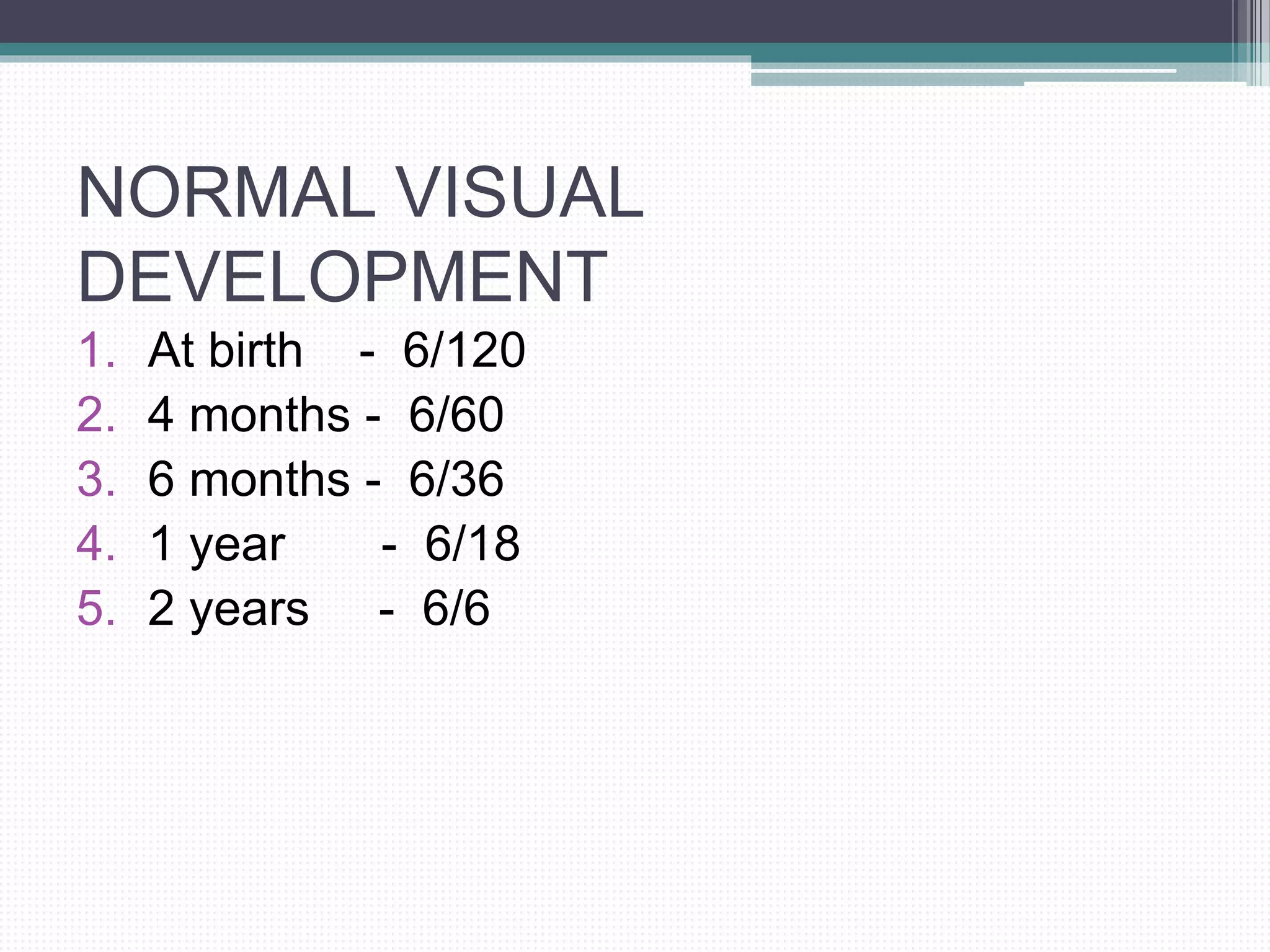
NORMAL VISUAL
DEVELOPMENT
1. At birth - 6/120
2. 4 months - 6/60
3. 6 months - 6/36
4. 1 year - 6/18
5. 2 years - 6/6
MILESTONE OF VISUAL
DEVELOPMENT
• Very soon after birth-
Can fix and follow a light source, face or large,
colorful toy.
• 1month-
Fixation is central, steady and maintained , can
follow as low target, and converge, preference
of looking at face.
• 3months-
binocular vision and eye cordination, eyes follow
a moving light or face, responsive smile.
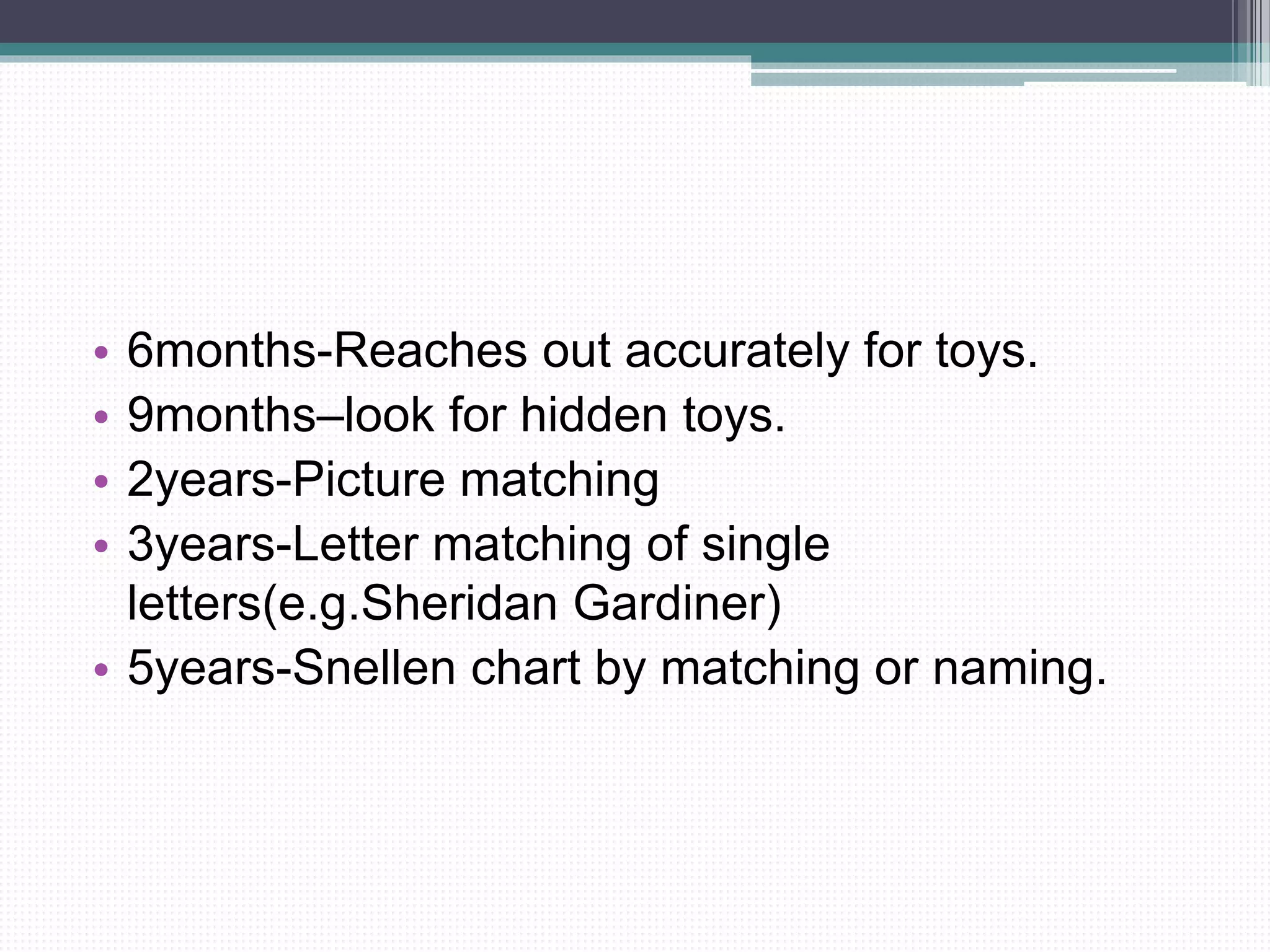
• 6months-Reaches out accurately for toys.
• 9months–look for hidden toys.
• 2years-Picture matching
• 3years-Letter matching of single
letters(e.g.Sheridan Gardiner)
• 5years-Snellen chart by matching or naming.
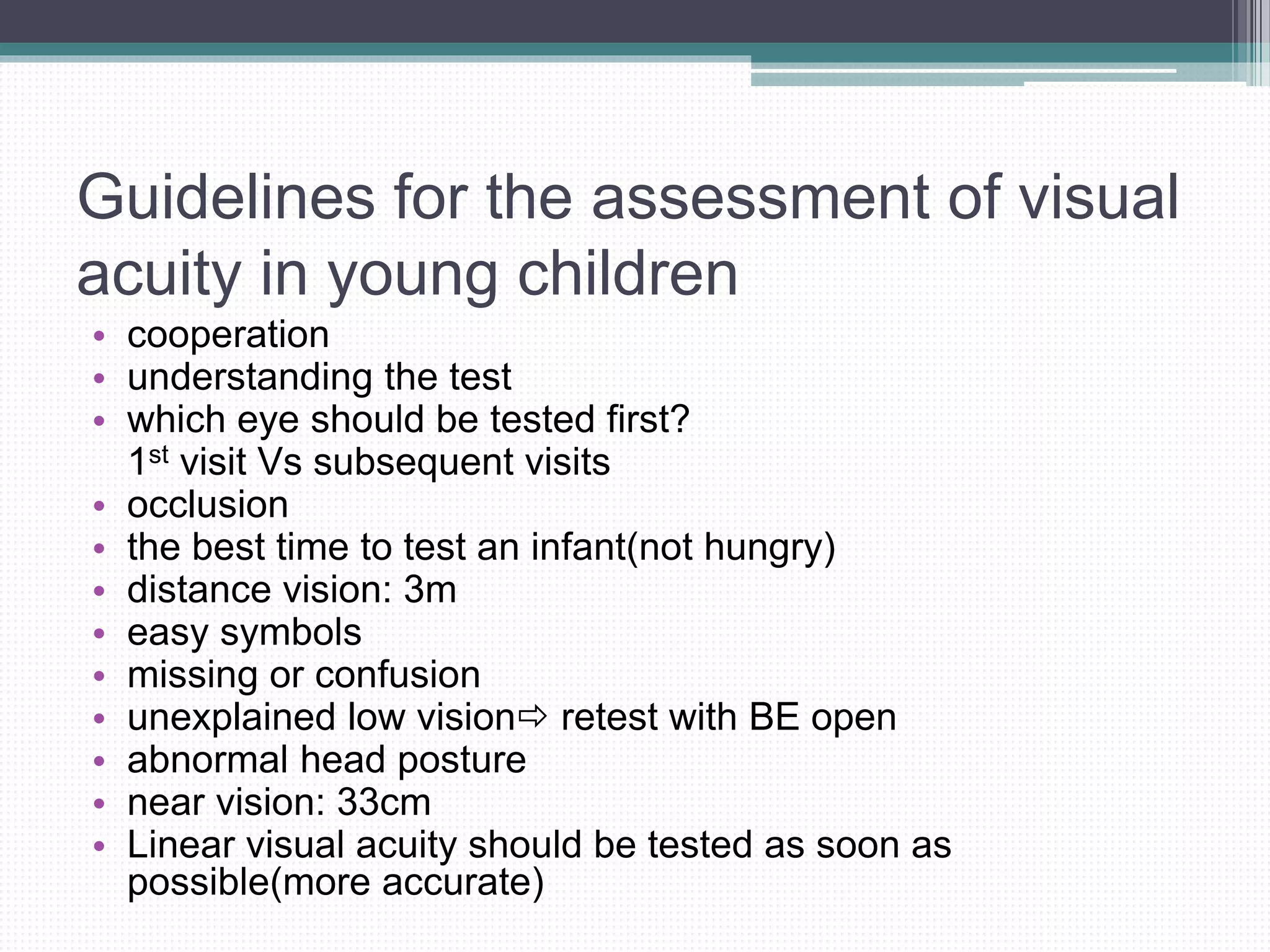
Guidelines for the assessment of visual
acuity in young children
• cooperation
• understanding the test
• which eye should be tested first?
1st visit Vs subsequent visits
• occlusion
• the best time to test an infant(not hungry)
• distance vision: 3m
• easy symbols
• missing or confusion
• unexplained low vision retest with BE open
• abnormal head posture
• near vision: 33cm
• Linear visual acuity should be tested as soon as
possible(more accurate)
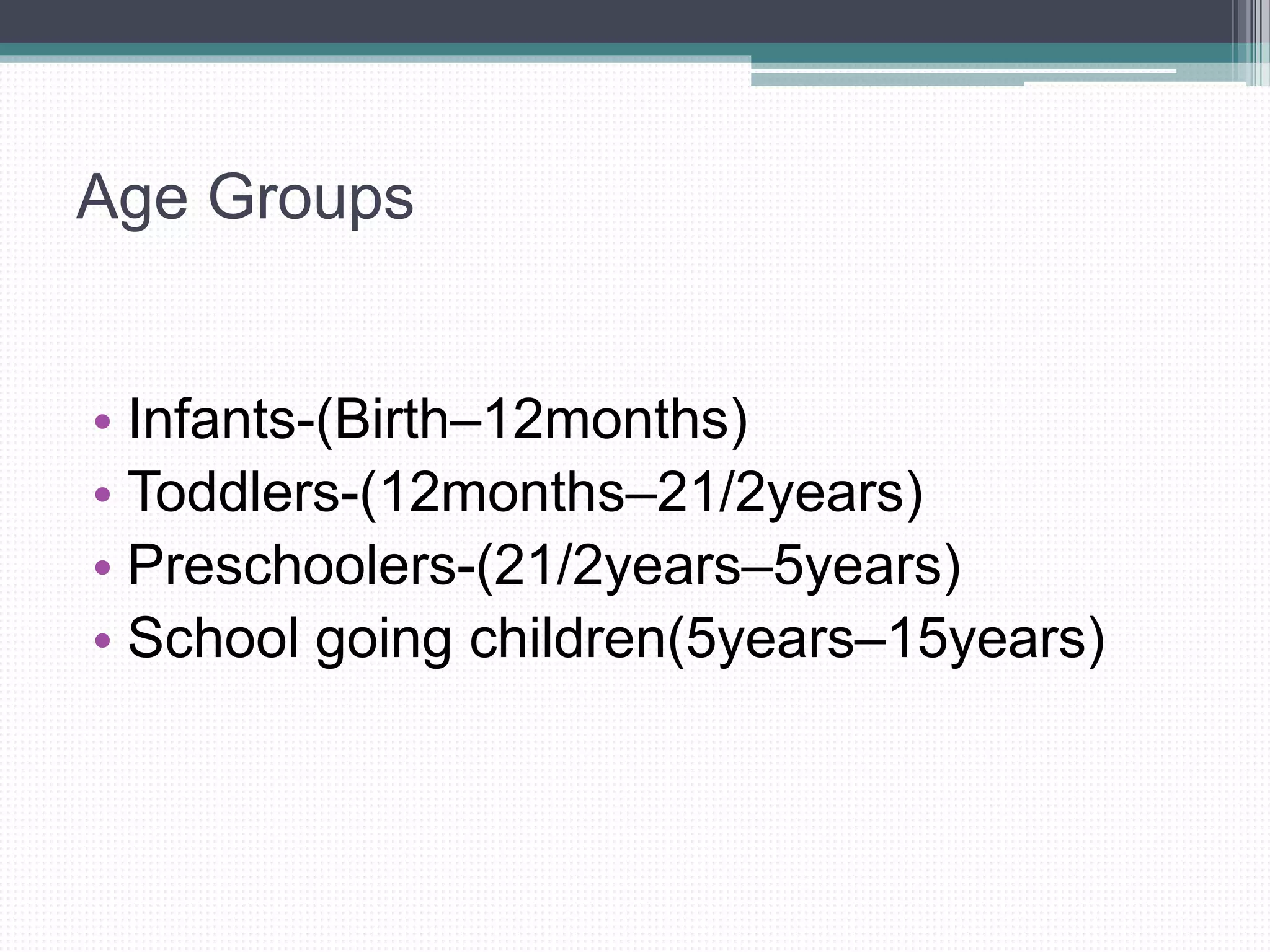
Age Groups
• Infants-(Birth–12months)
• Toddlers-(12months–21/2years)
• Preschoolers-(21/2years–5years)
• School going children(5years–15years)
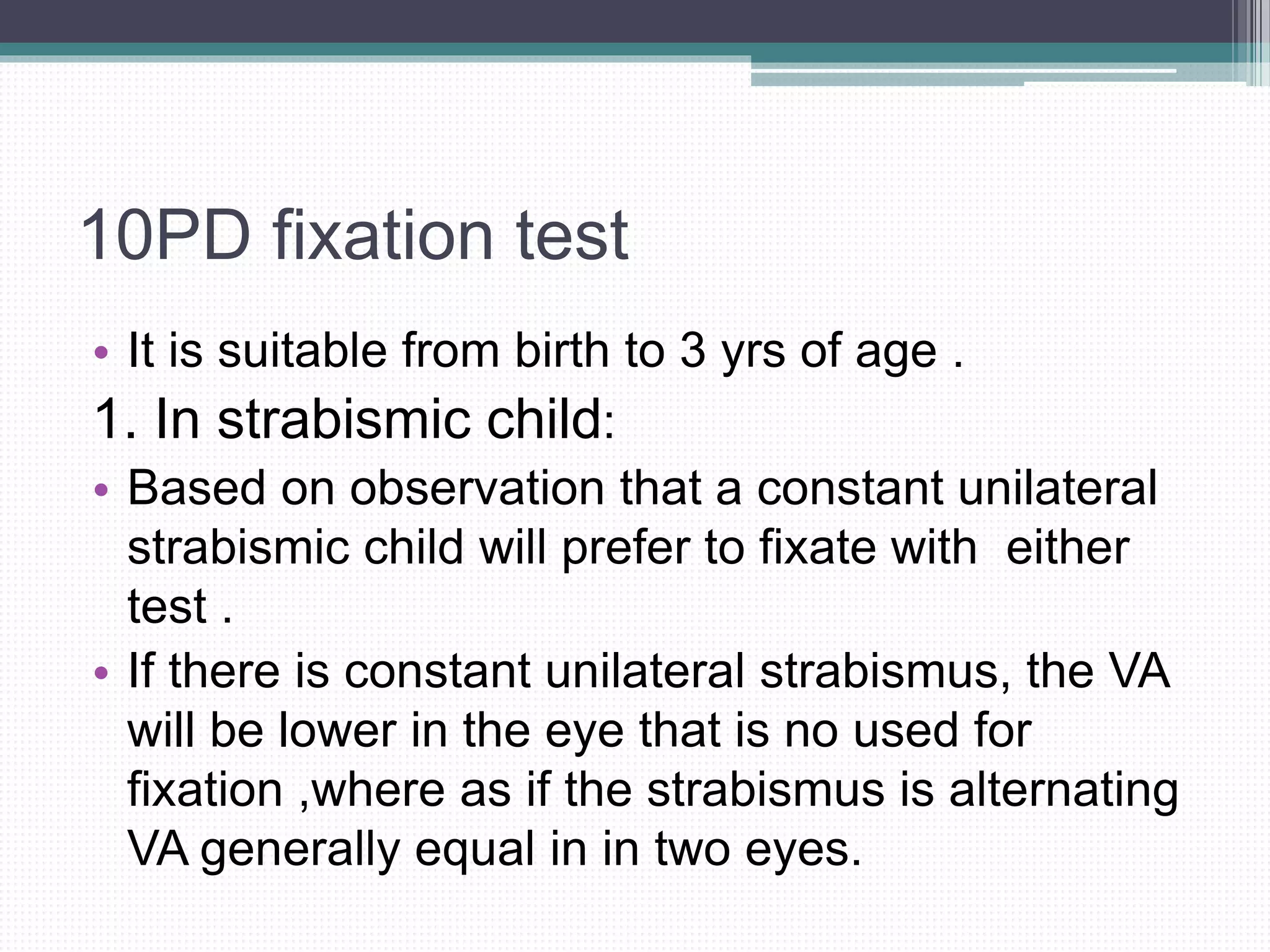
10PD fixation test
• It is suitable from birth to 3 yrs of age .
1. In strabismic child:
• Based on observation that a constant unilateral
strabismic child will prefer to fixate with either
test .
• If there is constant unilateral strabismus, the VA
will be lower in the eye that is no used for
fixation ,where as if the strabismus is alternating
VA generally equal in in two eyes.
• In nonstrabismic eyes vertical prism is used to
dissociate the eye and to assess the fixation
preference
• It produces diplopia .
• If both eyes have equal acuity , examiner
observe back and forth from Rt to Lt eye .
Following criteria are used to grade the
fixation preference
• 1. spontaneously alternates: Pt freely alternates
without any intervention on the part of examiner.
• 2.Holds well: the non preferred eye can hold the
fixation for 5 sec through smooth pursuit
movement or blink.
• 3. holds momentarily
• 4. will not hold
• The 1&2 category are considered as normal i.e.
of equal acuity
• where as 3&4 consider as difference in acuity or
amblyopic.
• Form 3&4 groups:
- have at least 2 lines of difference in acuity is
suspected.
Alternate occlusion method
• This test is suitable for the age from few wks .
• By using this test some assessment of equality
of vision between two eyes can be made.
• Each eye is occluded by resting one hand on
the child forehead and then drooping of thumb
down in line of visual axis .
• If each eye has equal acuity there will be no
difference in response as each eye has covered
.
• However when a dominant eye is occluded the
child will usually show signs of disquiet .
• The test can be further refined by assessing the
child response to a small target .
Vision Tests in Infants
•C:Central
• S:Steady
•M:Maintenance
Test is done by providing target at 40cm distance.
•C refers to the central corneal light reflex as the
patient fixates eye on the examiner’s light and if
fixation target is viewed eccentrically then it is termed
as uncentral.
•S refers to the steadiness as the examiner’s light is
motionless and then it is slowly moved out.
1.CSM
• M refers to the ability of patient to maintain
alignment ,first with one eye then with another.
EVALUATION
• CSM- 66-69
• CSNM-636-660
• Unsteady central fixation-<660
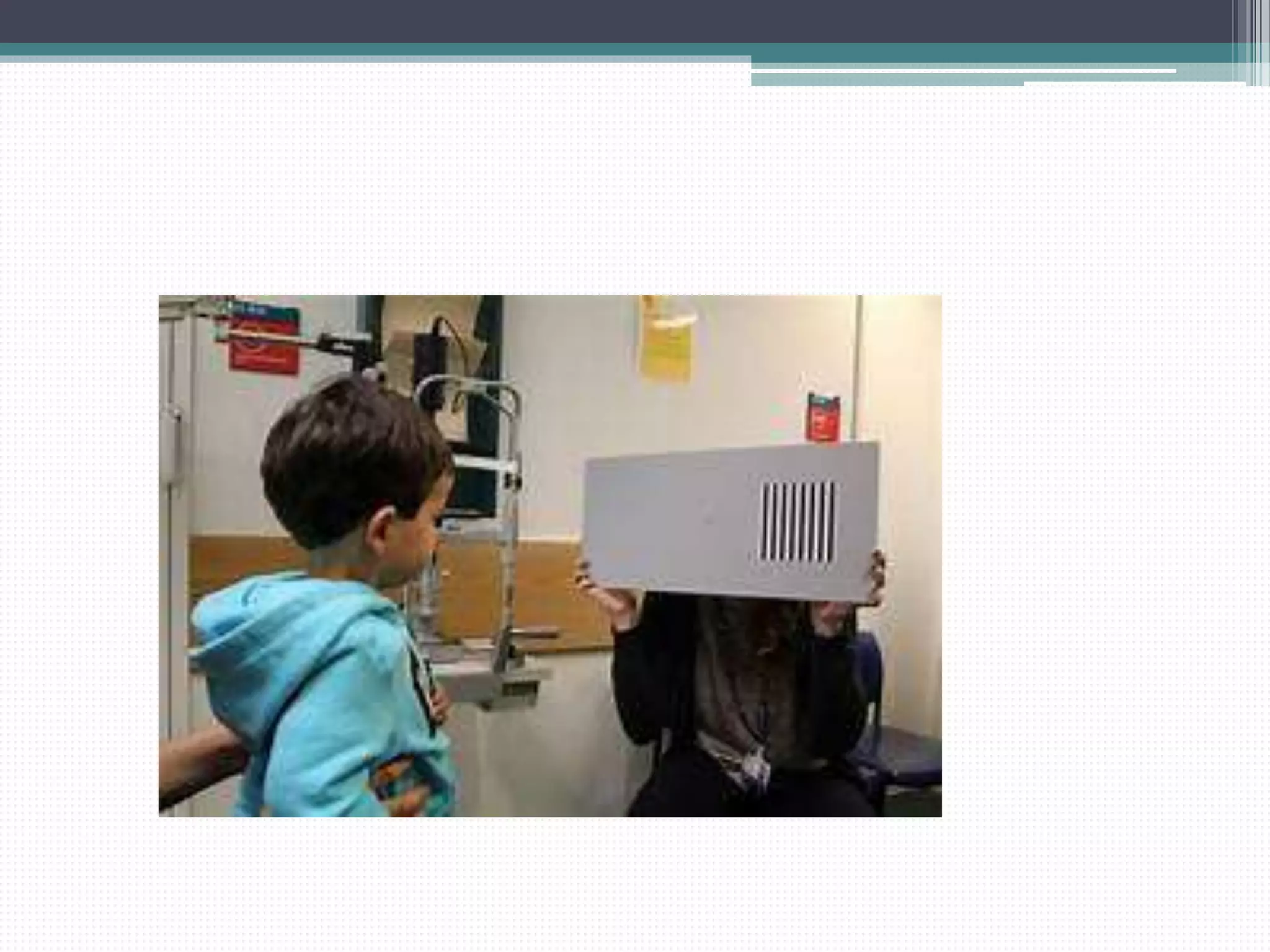
2.Preferential Looking Test
• Most Commonly used Test
• Based upon turning of the head or eyes towards the
pattern rather than a uniform[homogenous]field.
• Alternating Black and White Stripes are present
Stripe width progressively narrows which is then
Randomly shown next to plain test object
• Children with better vision are able to see finer
grating and turn towards it
Drawbacks of Preferential Looking
Tests
Test near vision not distance vision
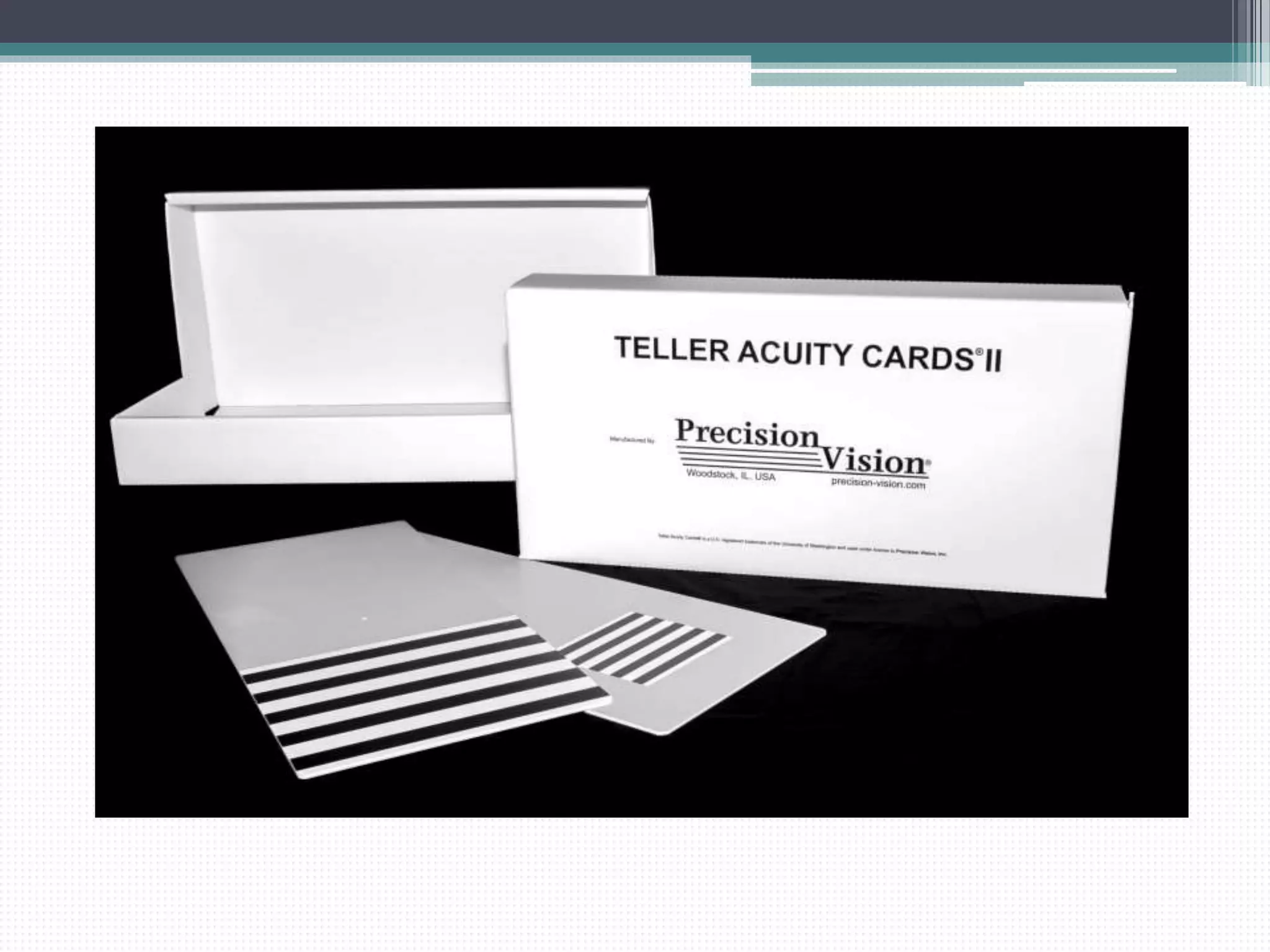
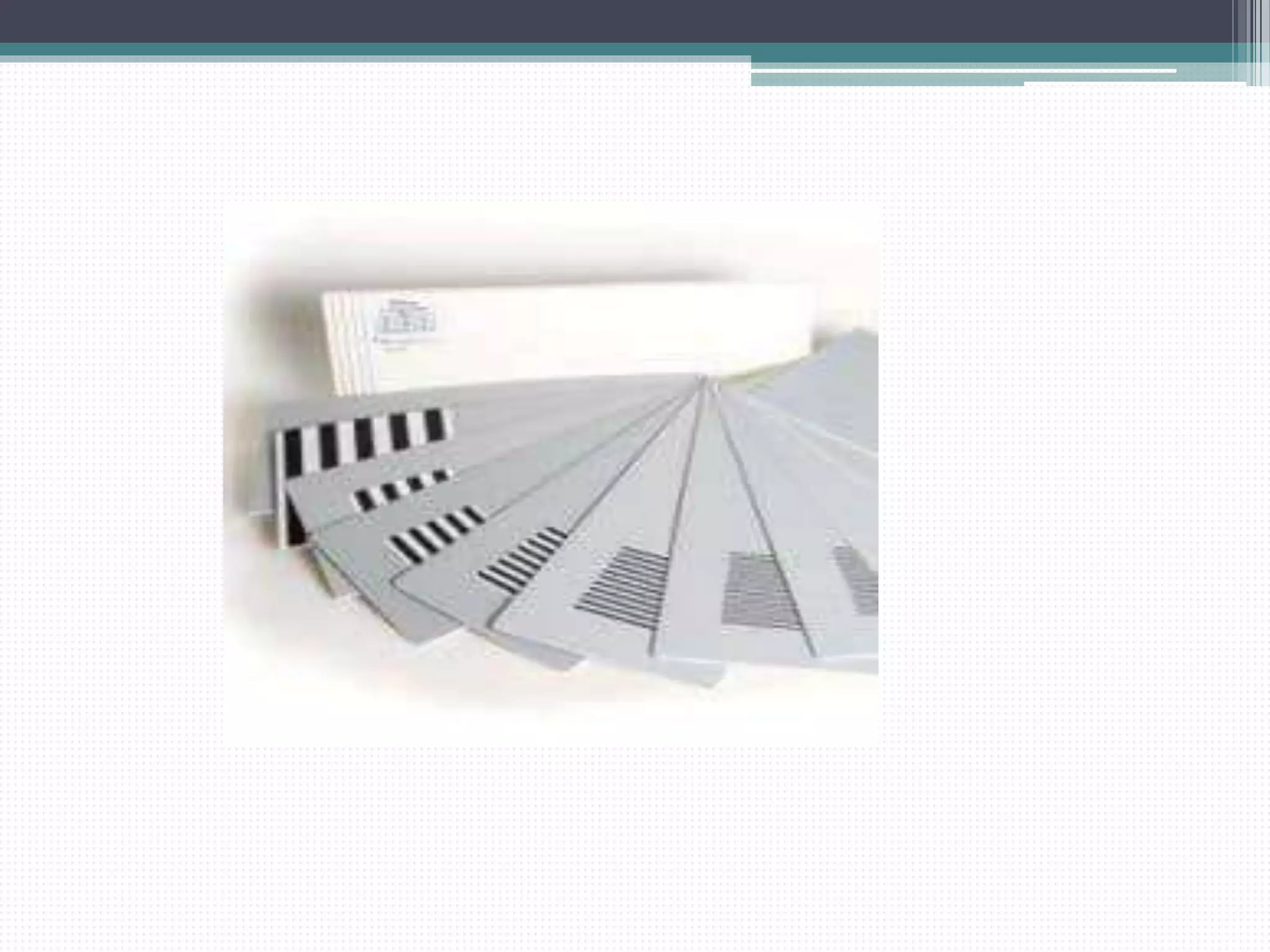
3.Teller Acuity Cards
• Modified form of Preferential
• Looking Test
• Simpler & rapid testing
• contains 17cards
• 12.5x12.5cmpatchesofsquarewavegrating-
• Gratingscontrast:82%-84%
• Properillumination:10candelas/m²
Drawbacks
Measures near visual acuity and not distance
4.Visual Evoked Potential
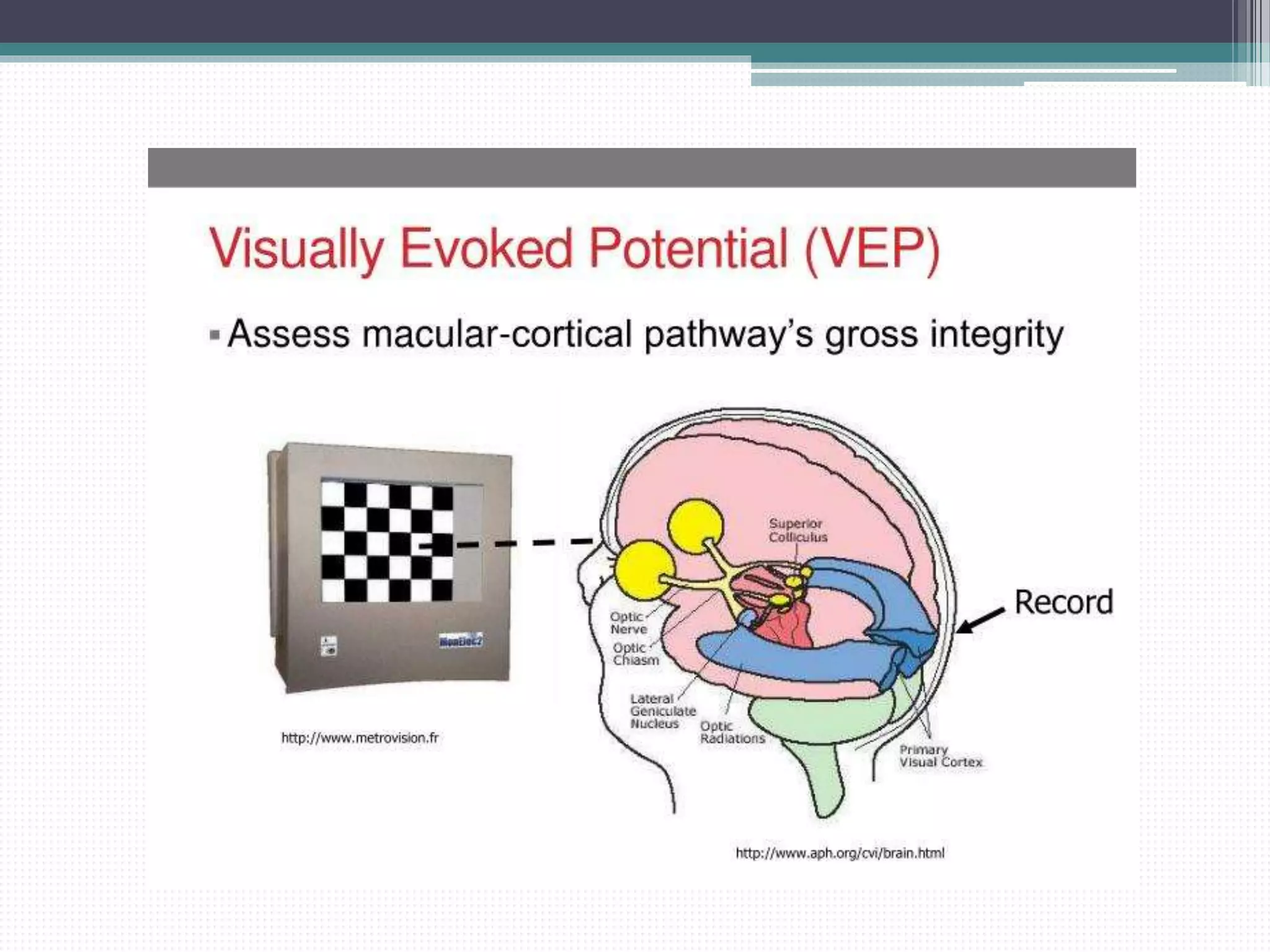
• VEP is the measure of change of electrical
activity of the visual cortex in response to
patterned stimulus
• Checkered board or square wave grating
• Abnormal VEP may indicate a problem with the
visual information reaching the cortex
• VEP is very sensitive to optical blurring can thus
be used as a method of refraction in very young
patient
VEP
• VEP is useful in the determination of problems
such as amblyopia, cortical blindness, and
visual impairment.
A. Flash VEPs
B. Pattern reversal VEPs
C. Sweep VEPs
5.Optokinetic nystagmus
• Commonly used Test in Neonates
• Test object moves in one direction
• Based on observation of Pendular Eye
movements
• Slow following phase& rapid recovery phase.
• Good correlation with subjective acuity.
Drawbacks of Optokinetic Nystagmus
• Overestimates the visual acuity as the target is
moving
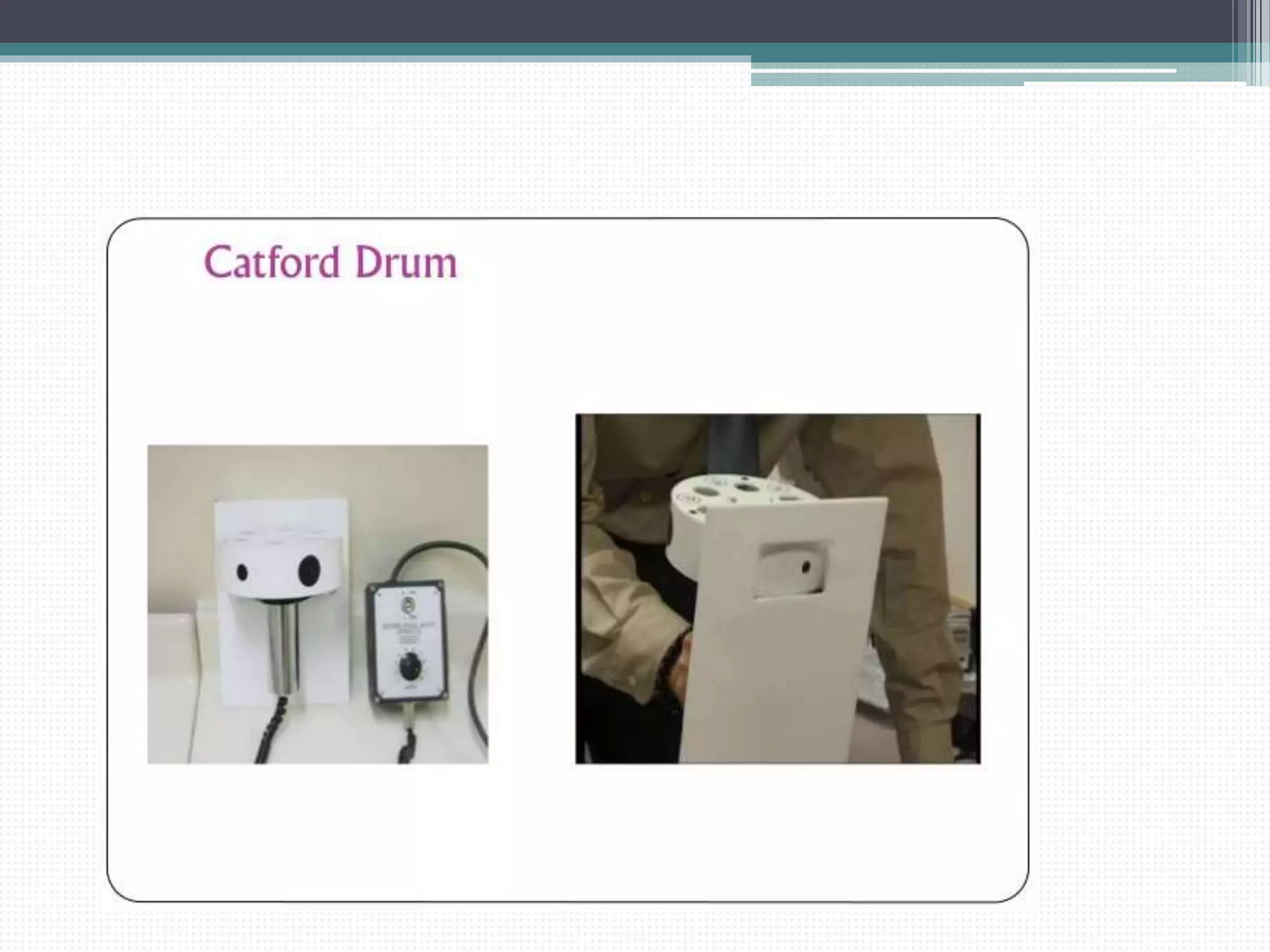
6.Catford Drum Test(CAT)
• Based on observation of Pendular Eye movements
Testing distance is 60cm
• It comprises of white cylinder marked with black
dots of increasing size corresponding to visual
acuities
• The drum is masked by a screen except for a
rectangular aperture which exposes a single spot
• Spot is made to oscillate horizontally and stimulates
eye movement
Drawbacks
• Overestimate vision as
target is moving and test is conducted at Short
working distance
• Unreliable for Amblyopia Screening
Vision test in 1-2years
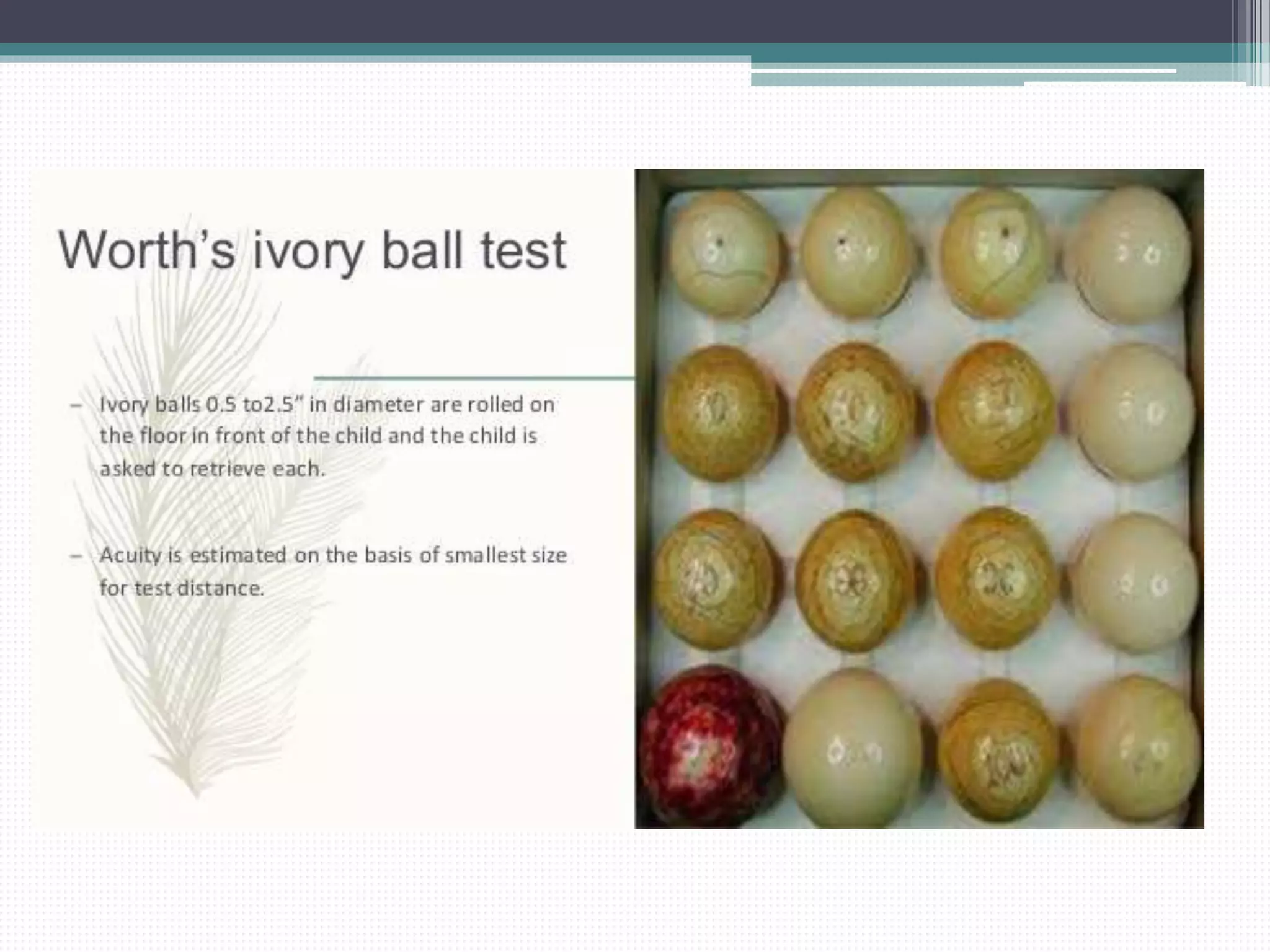
1.Worth's ivory ball test:
• Commonly Used
• Based on Quality of Fixation
• Ivory balls ranging from0.5"to1.5",rolled on floor
at a distance of about 3metres.
• Child is asked to retrieve each ball
• Rough estimate of visual acuity is made from
the size of smallest ball which the child can see
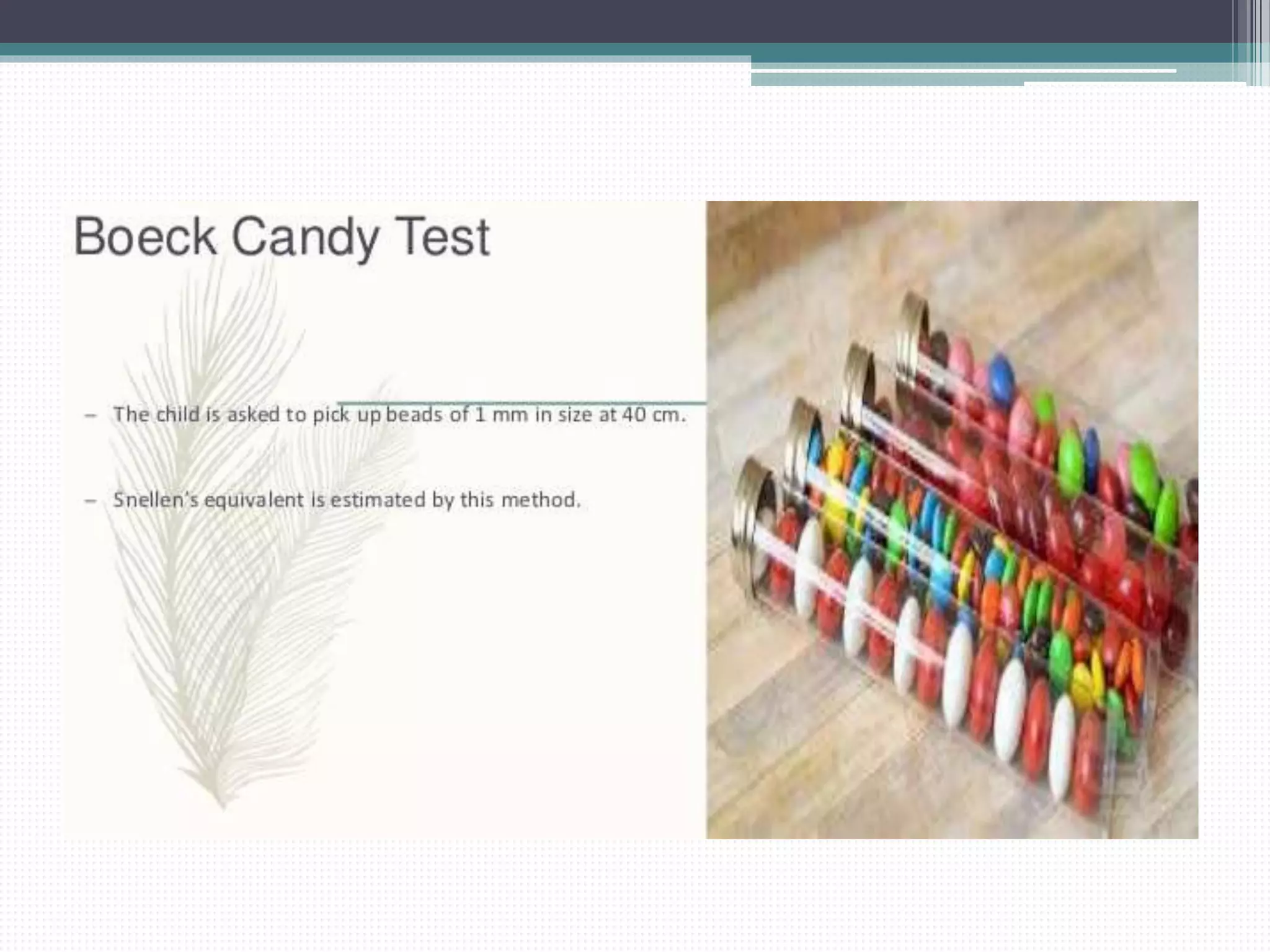
2.Boeck Candy Test
• Child picks up only those candy beads which he
can see easily
• Beads of different sizes are shown to child and
is expected to pick them up
• This gives approximate estimation of visual
acuity
3.Screening Test for Young Children
and Retards [STYCAR]
1.DYNAMIC
• Based on Pursuit Eye movements
• Ten Balls rolled across a well illuminating
contrasting floor 3m away from child
• Pursuit Eye movements indicate that they are seen.
2.STATIC
The sphere is mounted on a wand and introduced into
the periphery of the visual field and the child
examiner determines whether the child fixates or
not.
4. Marble game test
• In children of 1-2 years of age reaching or
placing games can be used to estimate visual
function.
• The game is the marble game.
• This test is not intended to measure visual
acuity of each eye.
Procedure:
• The child is asked to place marbles in the holes
of a card or in a box.
• Compare the functioning of the child’s eye when
one or the other is closed.
• The vision of an eye is then noted as being
useful or less useful.
VisionTestin2-3years
Dot visual acuity
test
• Black dots on white background
• Touch a black dot
• Test dist--25 cm
• VA--20/800 to 20/20
PROCEDURE…….
• Child is shown an illuminated box with black
dots of different sizes printed on it
• The smallest dot identified denotes the visual
acuity of the child
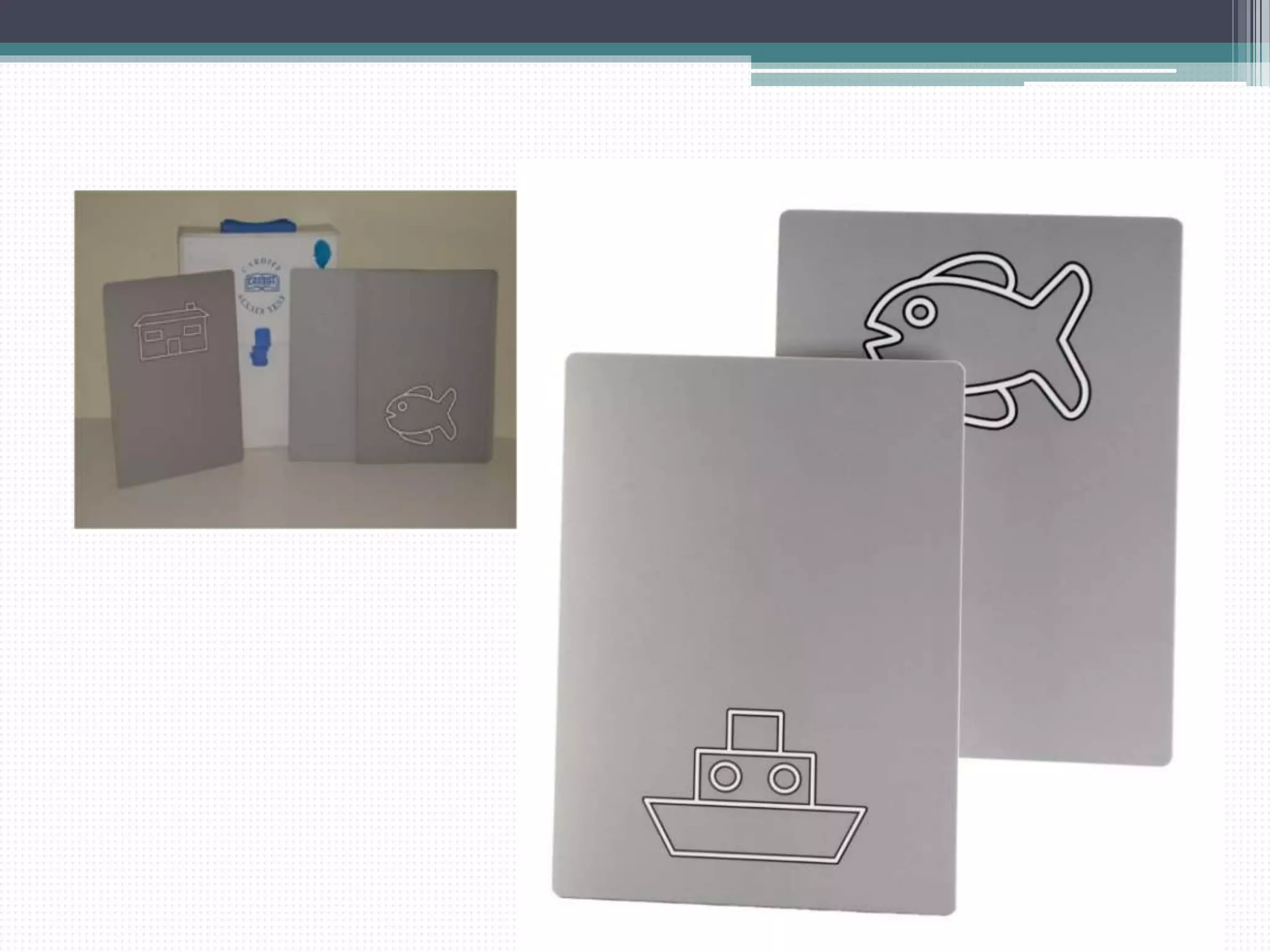
1.Cardiff Acuity Test (CAT)
• Principle: vanishing optotype
• Target- pictures, of the same overall size, drawn
in decreasing widths of white space
• Acuity is determined by the narrowest white
band for which the target is visible to the child
• Child naturally prefers to look at a target figure
rather than the blank end of the stimulus.
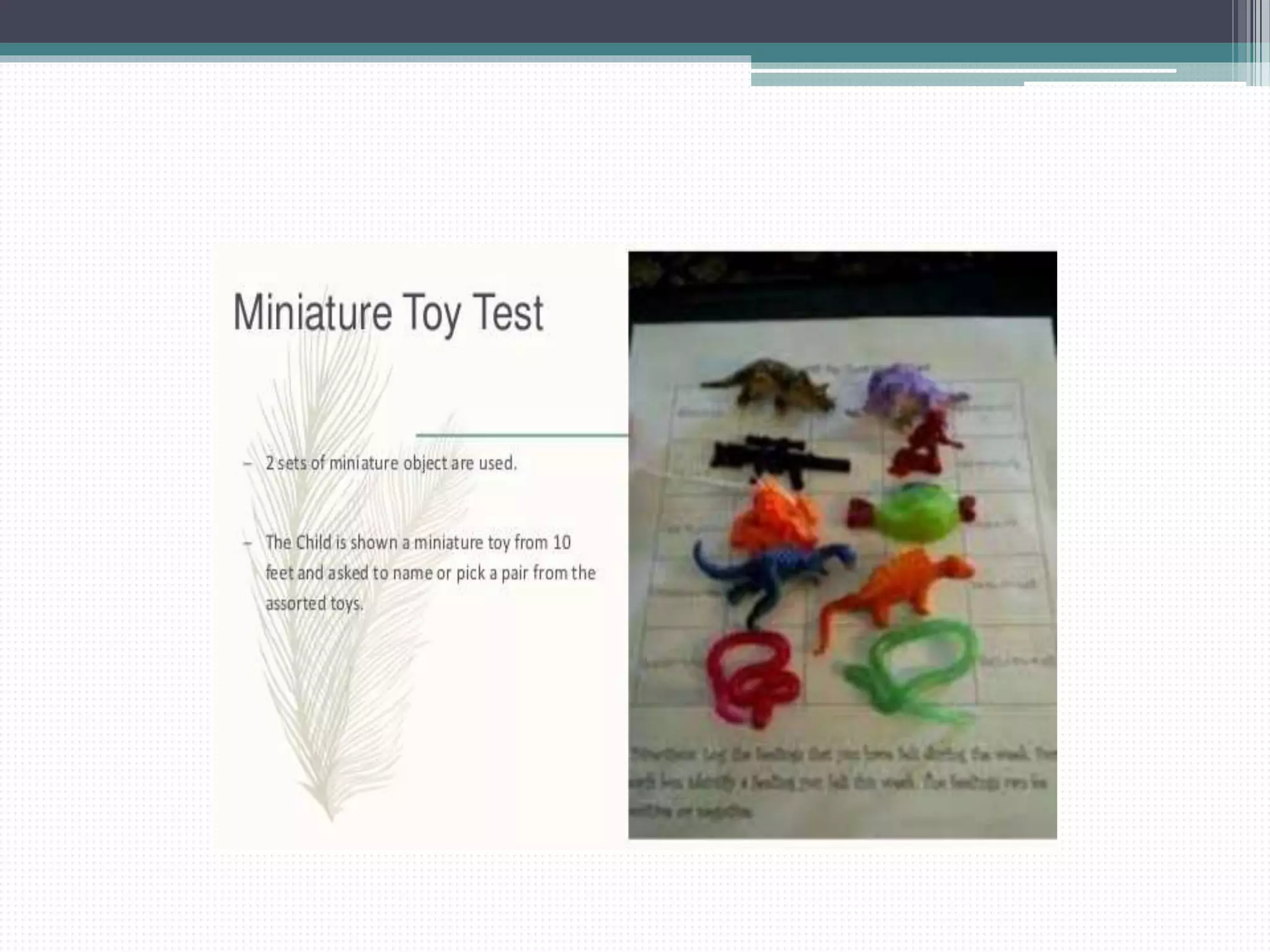
2.Miniature Toy Test
• Was previously used for
handicapped children and low Intelligence patient
Component of STYCAR Test
• 2 sets of Miniature object are used Oneset is with
Examiner standing at 10ft and child is askedto pick
up similar objects from his own set
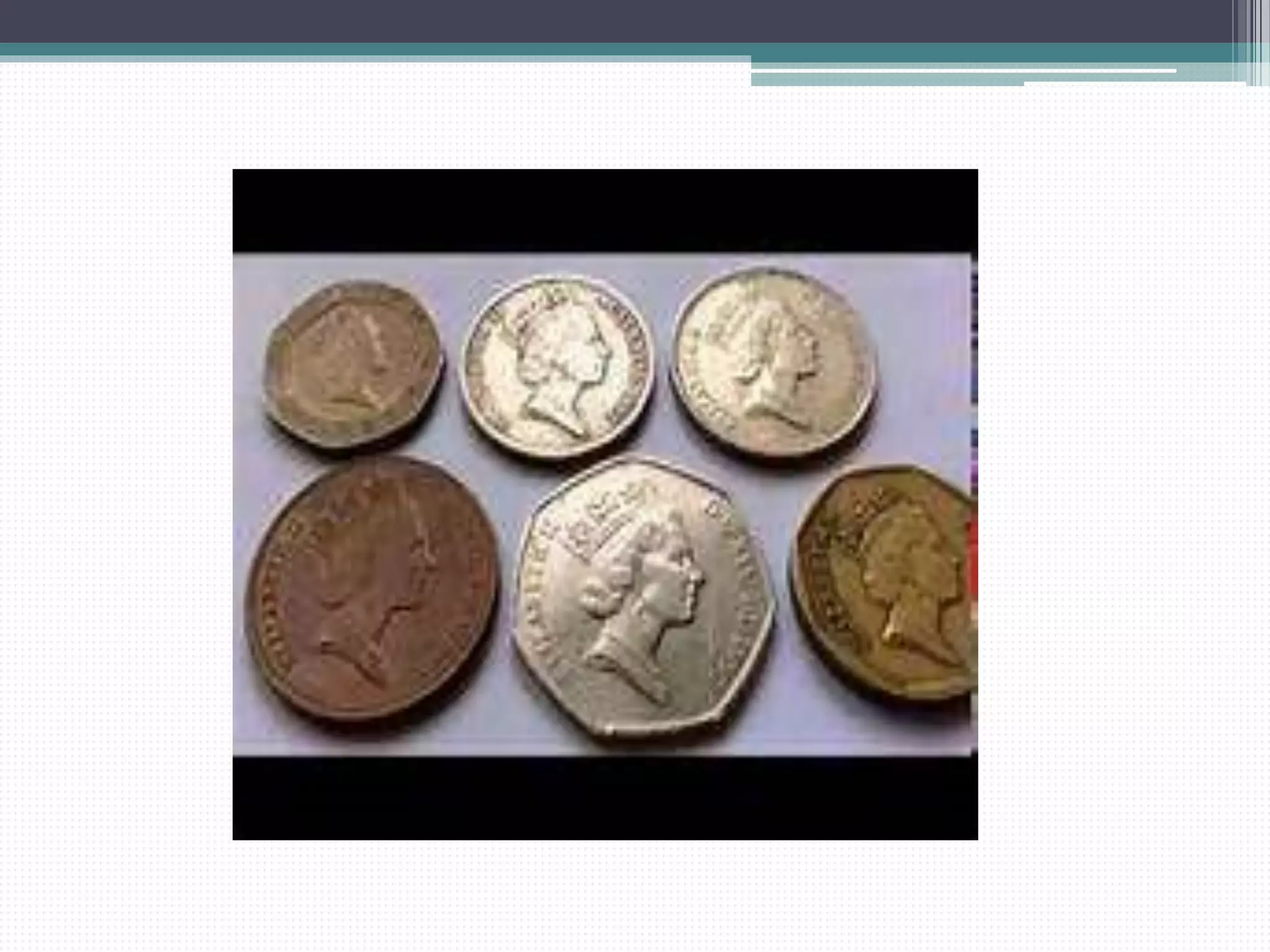
3.Coin Test
• Coins of different sizes are shown to child and is
Child picks up only those coins which he can
see easily
• Expected to pick them up
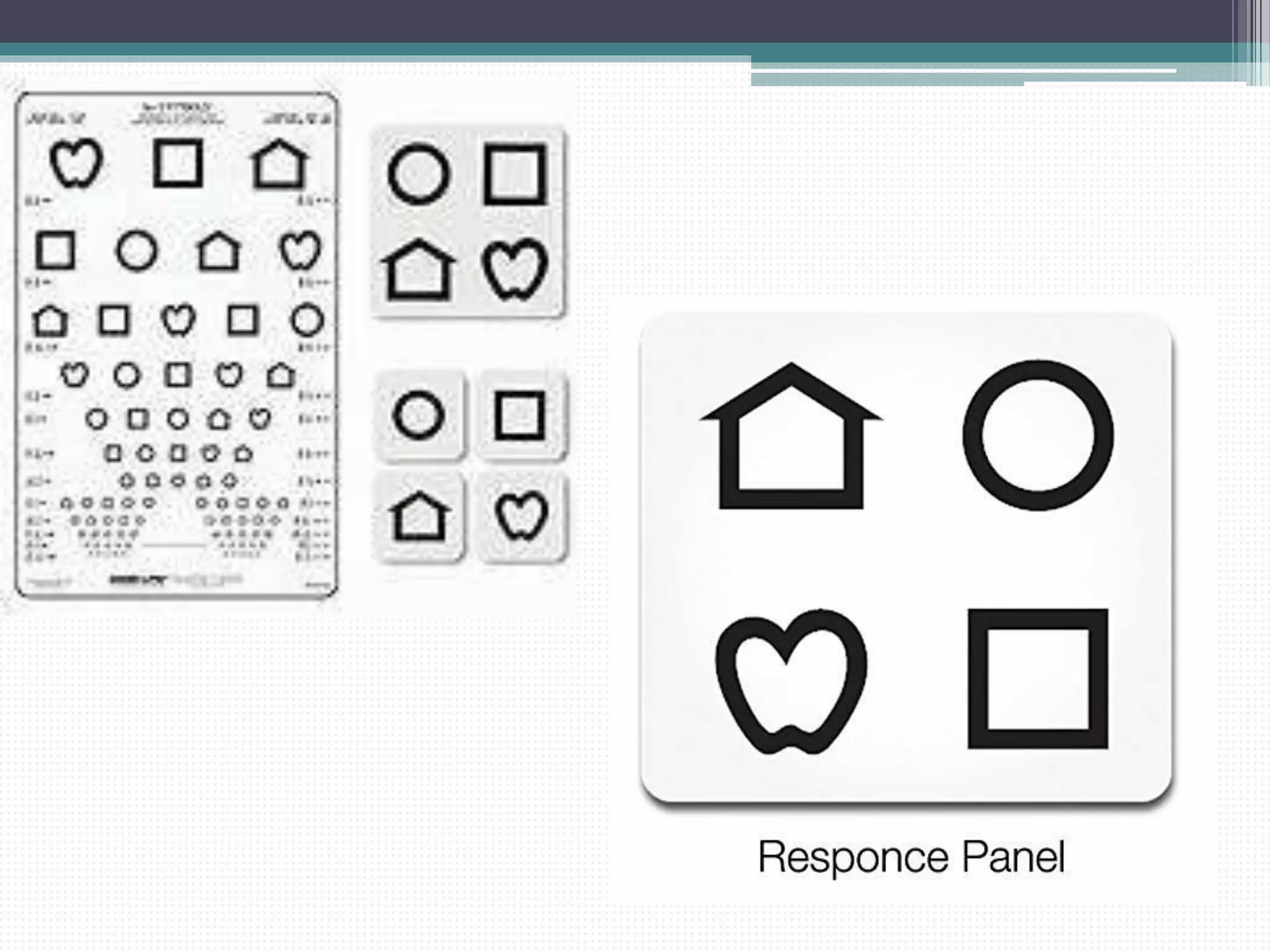
4.LEA Symbol test
• Good for amblyopic patient to avoid crowding
phenomenon
• Bailey-Lovie tumbling E chart is comparable to
the Lea symbols chart in pre-school children.
But preference should be given to Lea symbols
for children aged 3-4 years as the symbols are
more familiar than a directional test for this age
group.
(https://www.ncbi.nlm.nih.gov/pmc/articles/PMC
3841955/)
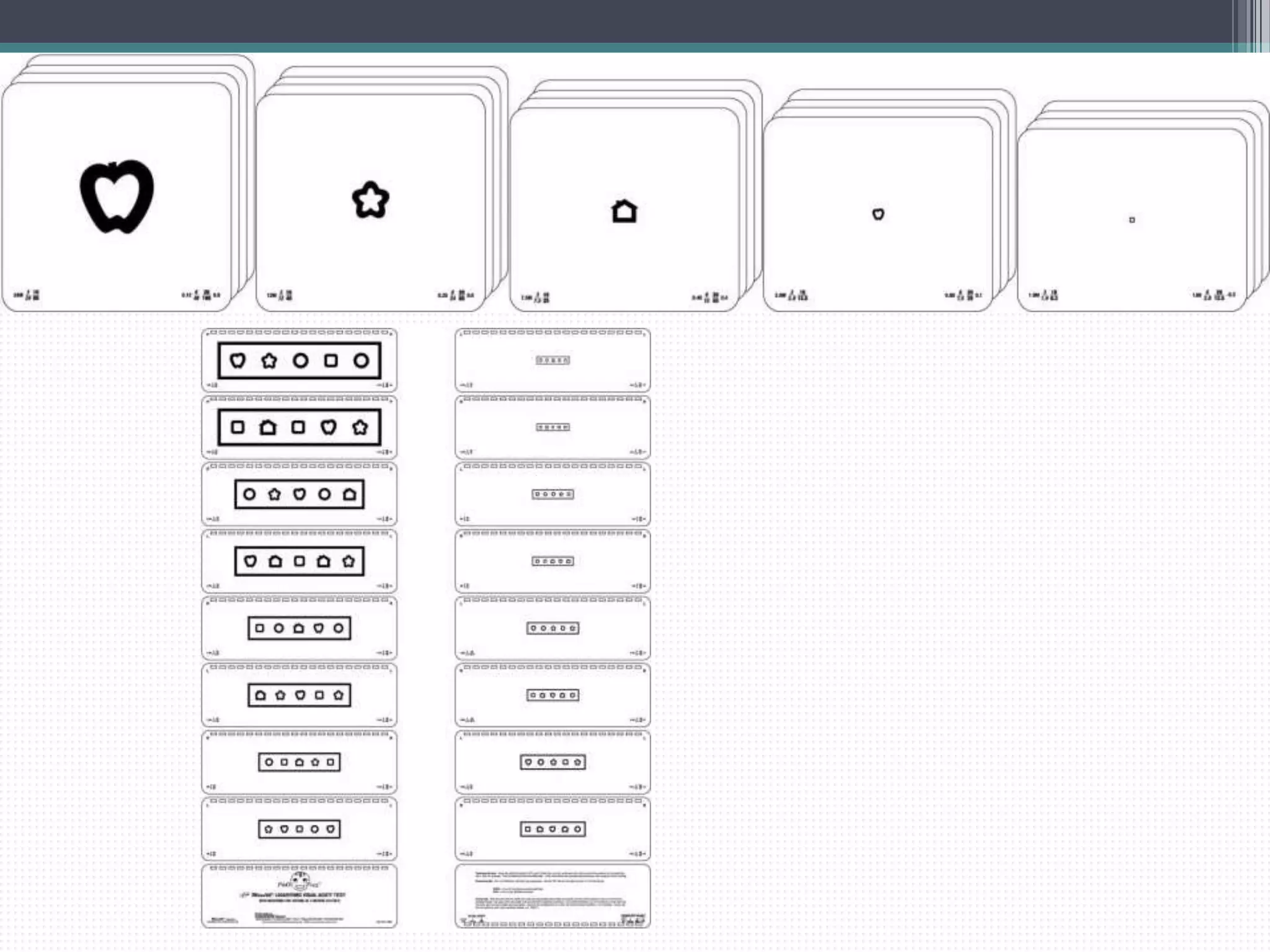
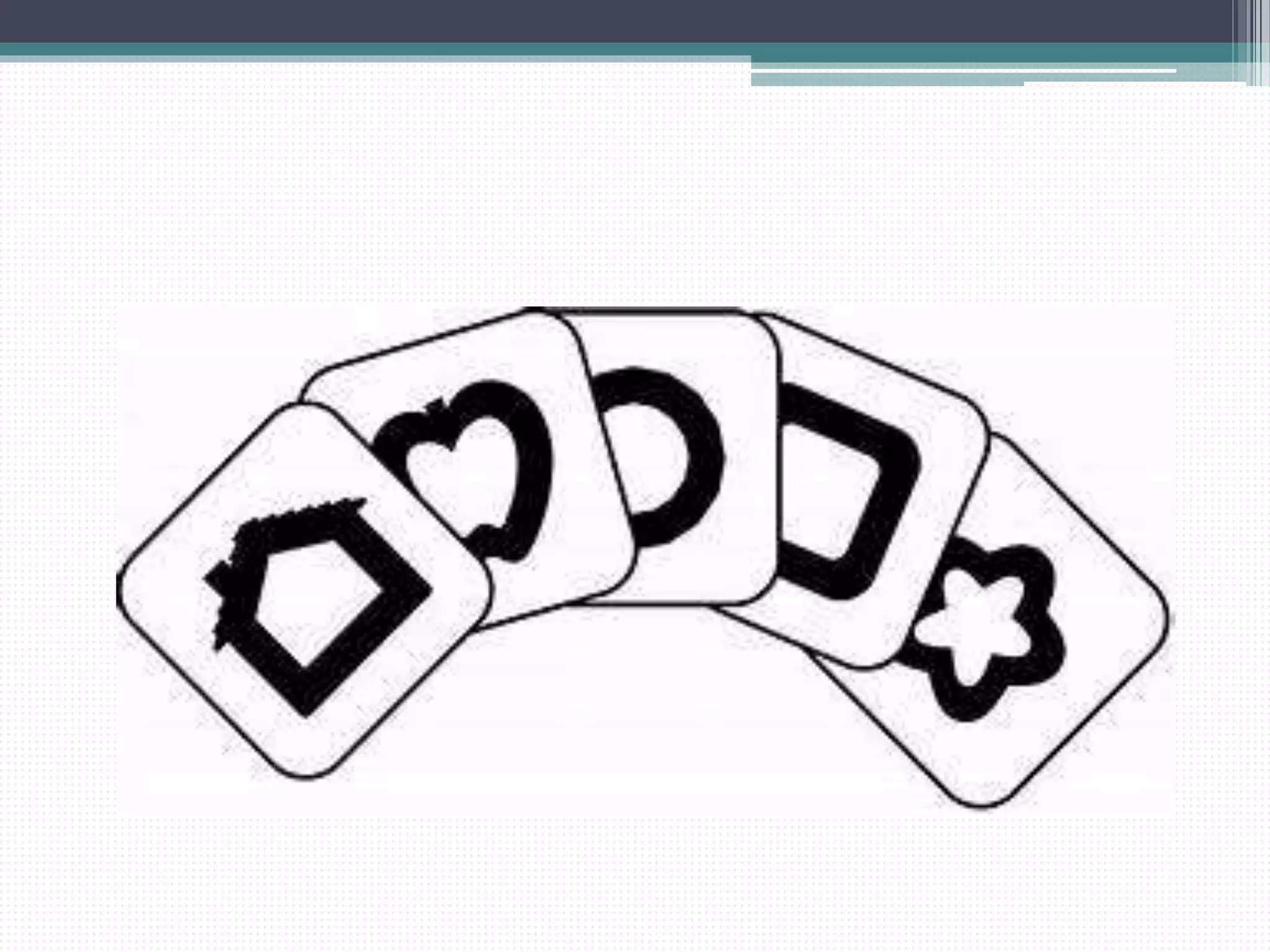
5.Kay picture Test
• Kay Picture visual acuity test is the Gold
Standard vision test for pre-literate
children, providing accurate, crowded visual
acuity measurements earlier than symbol and
letter tests.
Features of kay pictures
• It is used for children of 2-3 yrs .
• The test is done at distance of 6 meter .
• It is based on snellen principle .
• The chart is in the form of spiral booklets .
• Each page has a single picture .
• The size goes on decreasing from 6/60 to 6/6
• with each size having 3 cards.
• Again the patient is given a key card and is
• asked to match with the picture as shown in
• the main chart .
6.Patti pics
• Patti Pics™ were introduced in 2003 as an improved test for
vision screening and testing of pediatric and adult patients
where universal symbols and matching may serve the
process better than letters or other symbols. They were
developed following the Snellen principal of 1862, the
recommended standard for optotype design. They are also
the only symbol test of its type with the stated objective of
calibration targeted to equal Sloan letters used in the ETDRS
charts. This uniformity is especially important when taking
patients from symbols to letter tests. Other tests are either
much easier than ETDRS charts or they are outdated and no
longer relevant. Both are very significant factors when a child
has an eye disorder or amblyopia and they advance to clinical
letter charts.
Vision test in 3-5 years
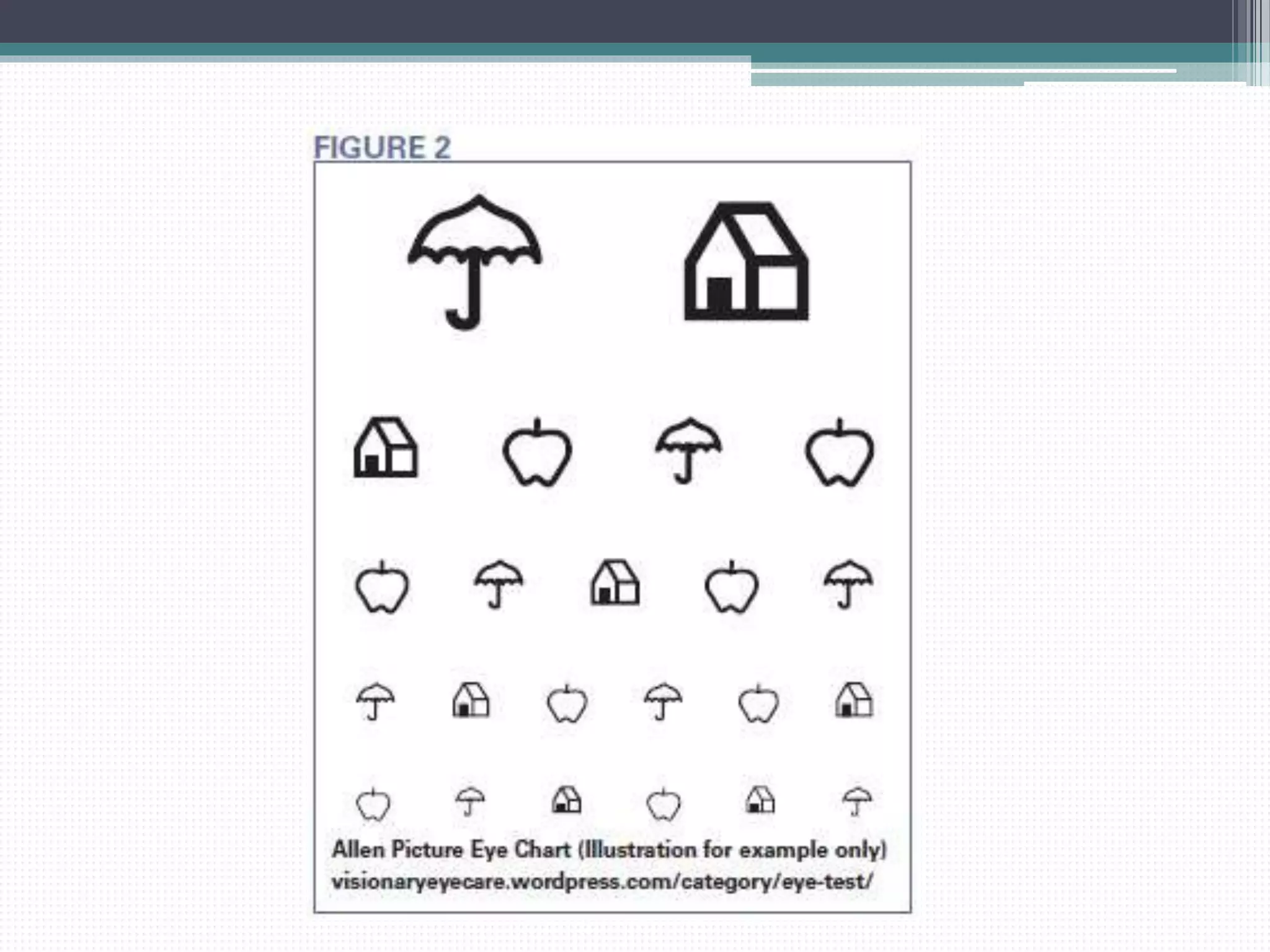
1.Allen’s Picture Cards
• It is recorded same as Snellens Acuity test
Instead of letters child identifies picture at a
Distance of 6m.
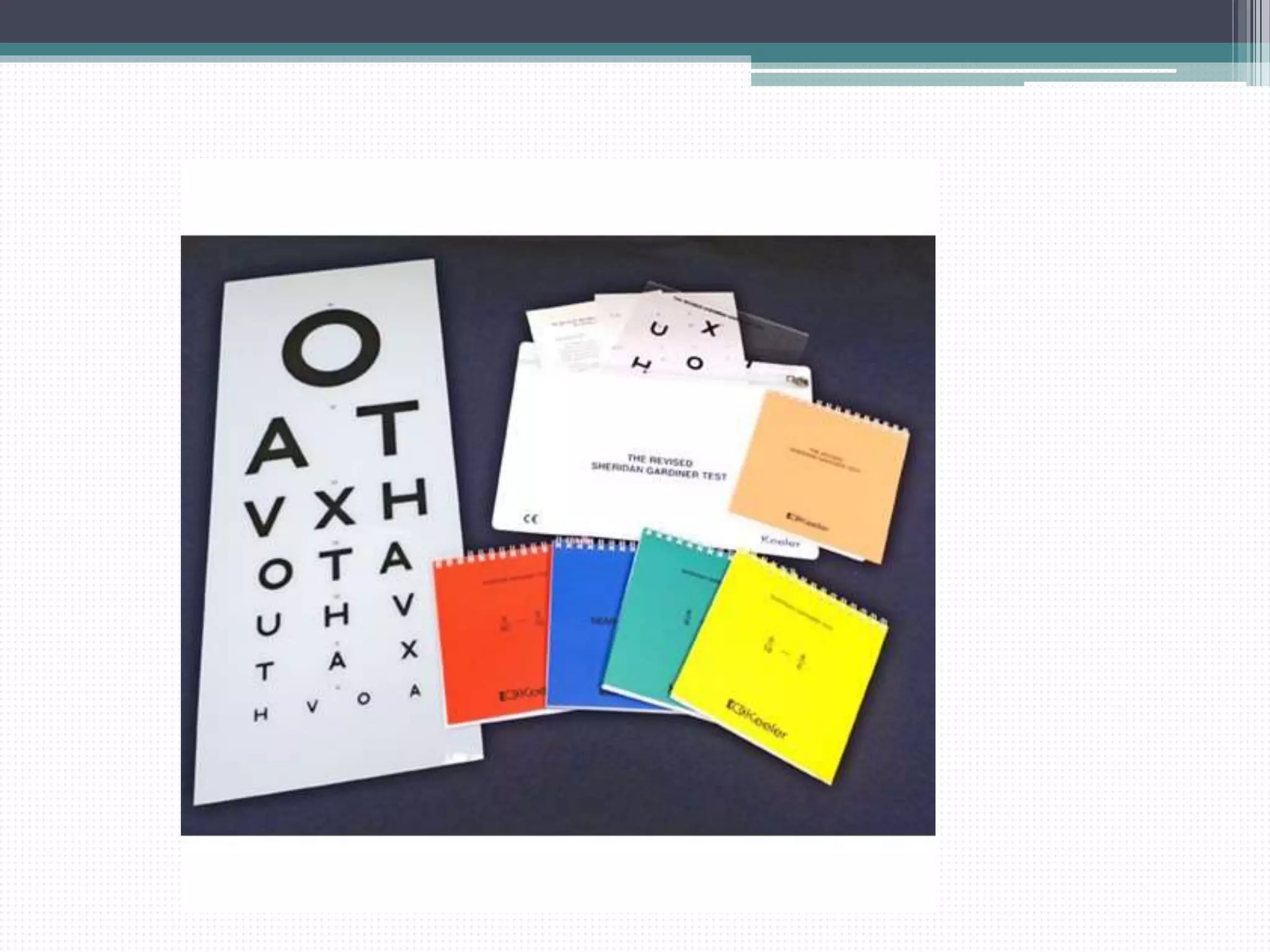
2.Sheridan letter test
• It uses 5 letters HOTV &X
A & U are added in 7 letter set Examiner shows
cards having small range of letters at 3m
Child points at one of the card identical to the
examiner card
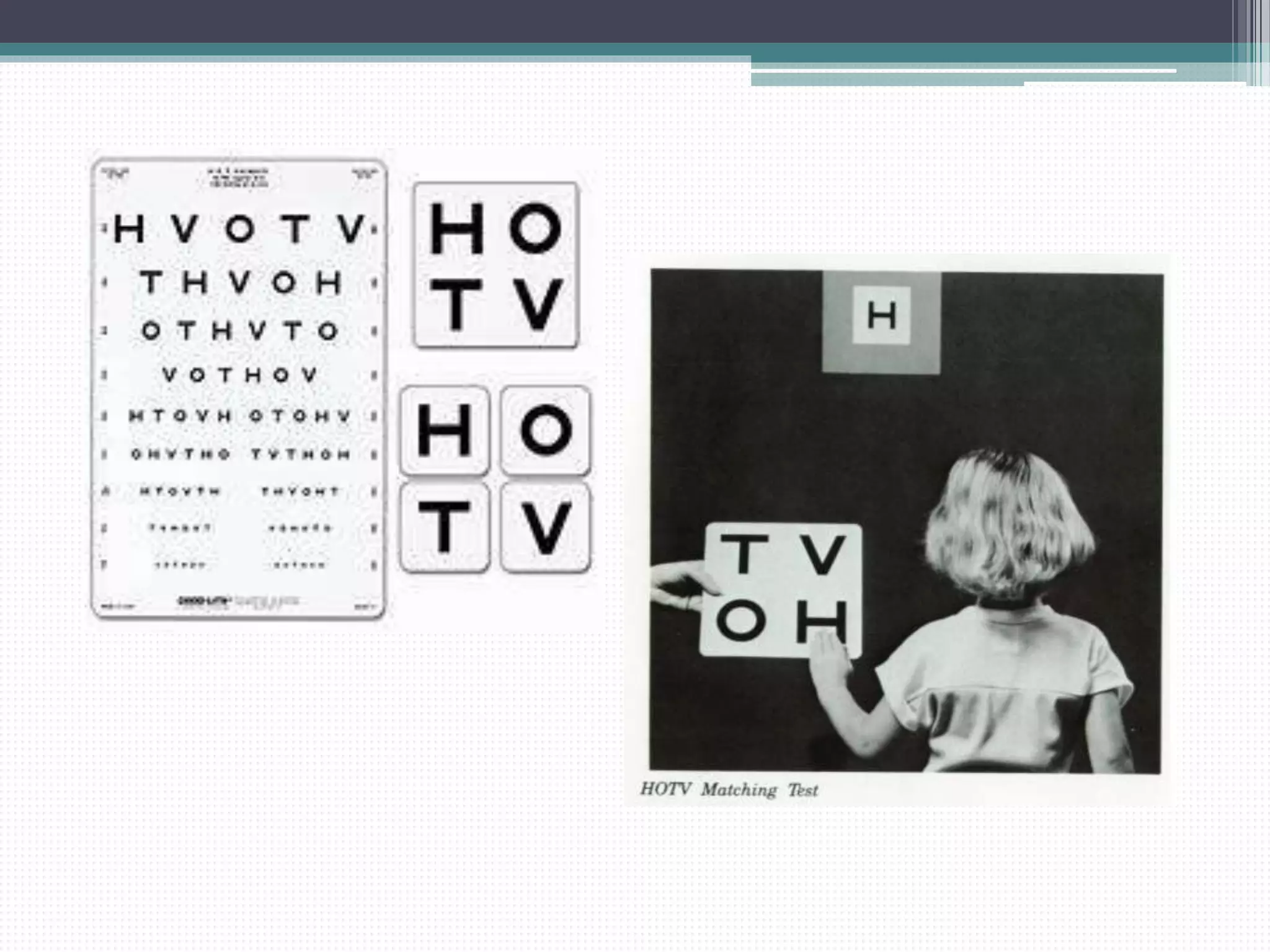
3.Lippmans HOTV test
• Simpler version of Sheridan's test using only 4
letters HOTV.
• Test distance 3meter
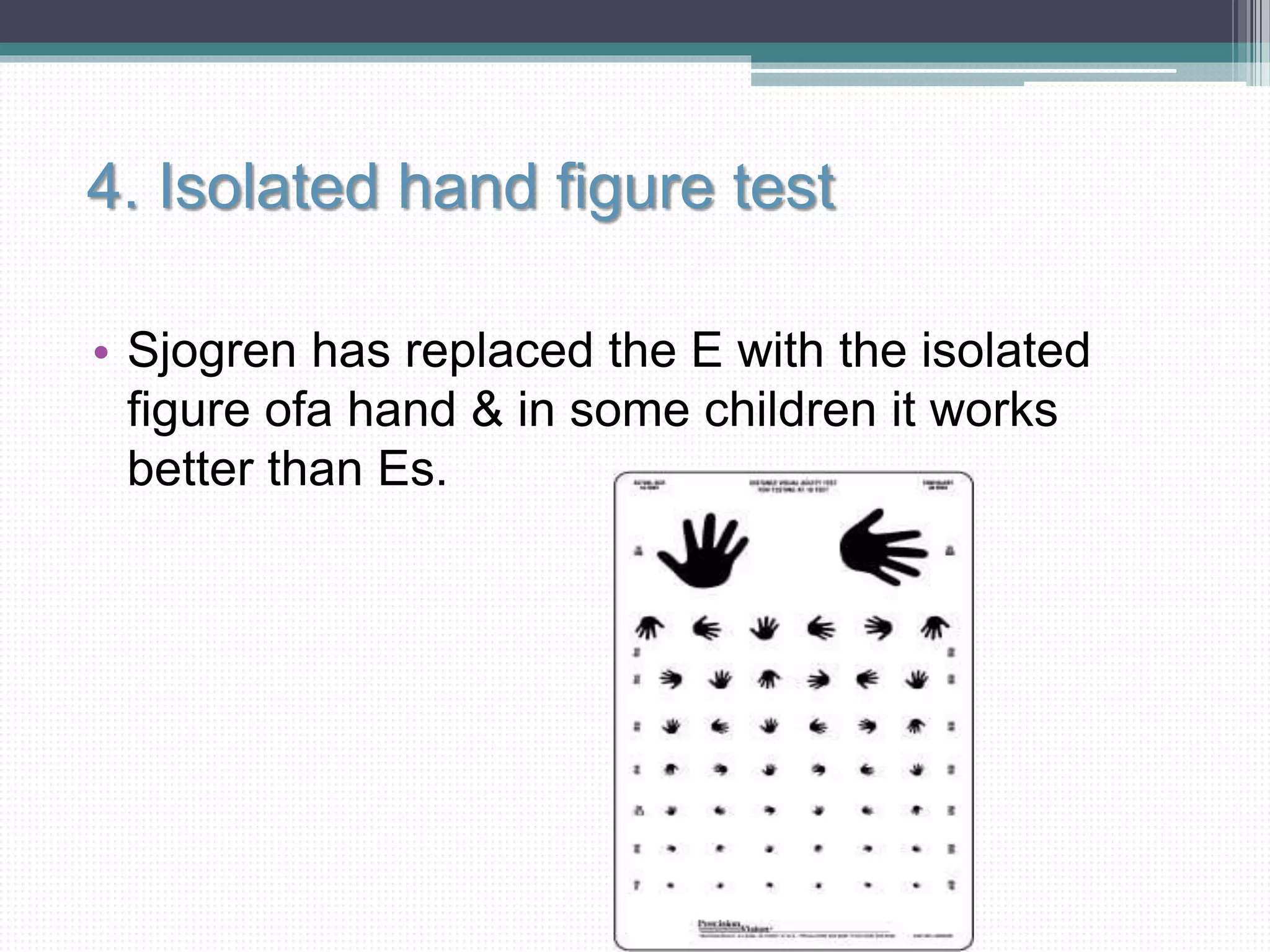
4. Isolated hand figure test
• Sjogren has replaced the E with the isolated
figure ofa hand & in some children it works
better than Es.
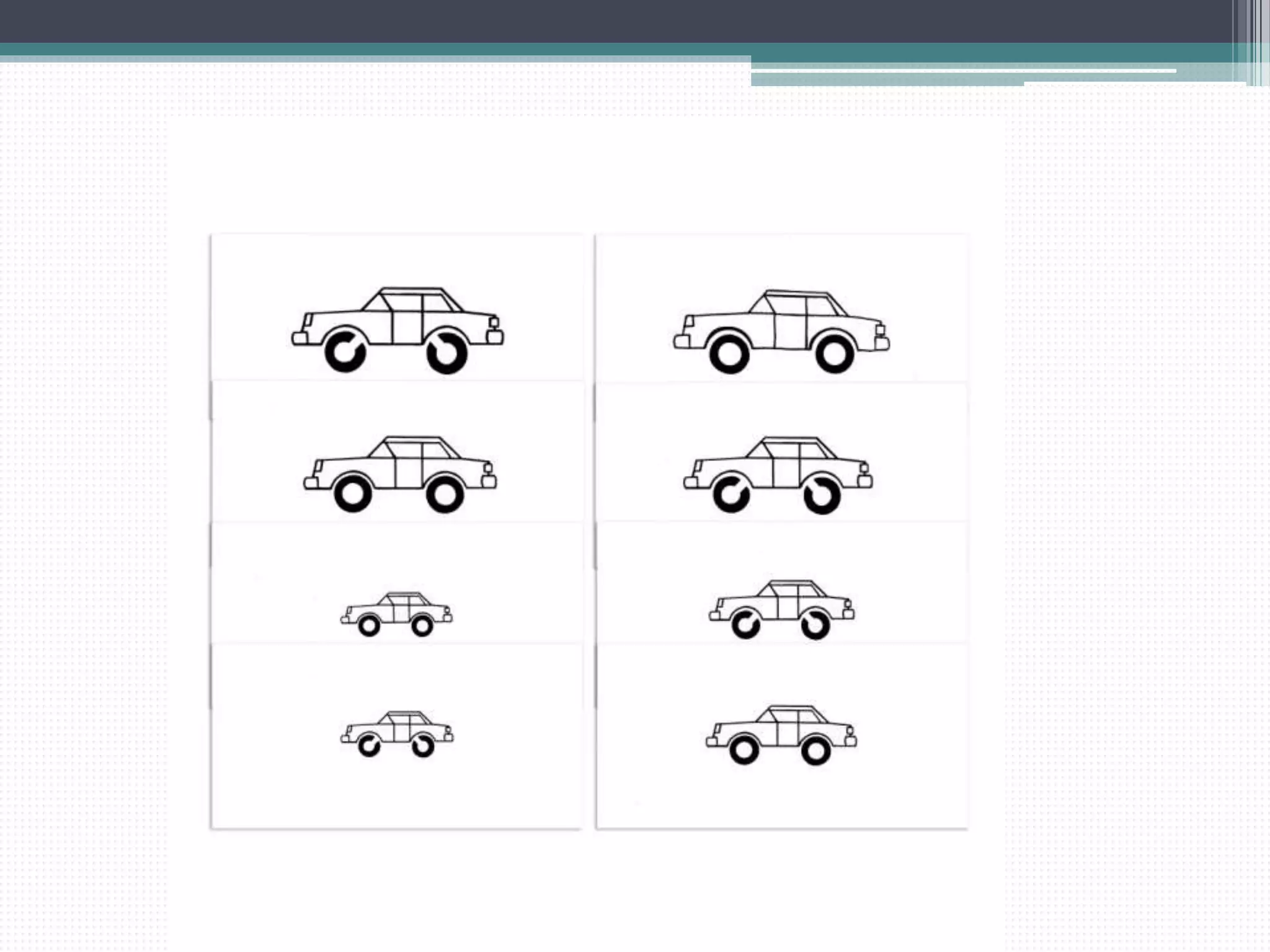
5.Broken wheel test
• Consist of 8 pair of test cards 20/20, 20/25,
20/30, 20/40, 20/60, 20/80, 20/100,20/120.
• Each card has a black line drawing of a car on a
white background.
• 1 with solid wheels , other with broken wheels.
• Done from 3m distance
Clinical Procedure
• 2 cards are held before the child
• He simply identifies which one is broken wheel
• If the child can distinguish which car has the broken
wheels, it indicates that he can resolve the gap size
of the landolt C for the particular card
• If acuity is less than 20/120,steps are repeated at
1.5m distance.
• Visual acuity is recorded as the last set of cards at
which the child correctly respond.
6. Light home picture card
• A chart containing an apple, a house and an
umbrella, arranged in Snellen’s equivalents of
20/200-20/10 is used, and
• The child is asked to identify the pictures along
the lines.
• The test is carried out at 3m
• 12 cards are available, size of each card is 4×5
inch
Vision Test in
5-6 Years and above
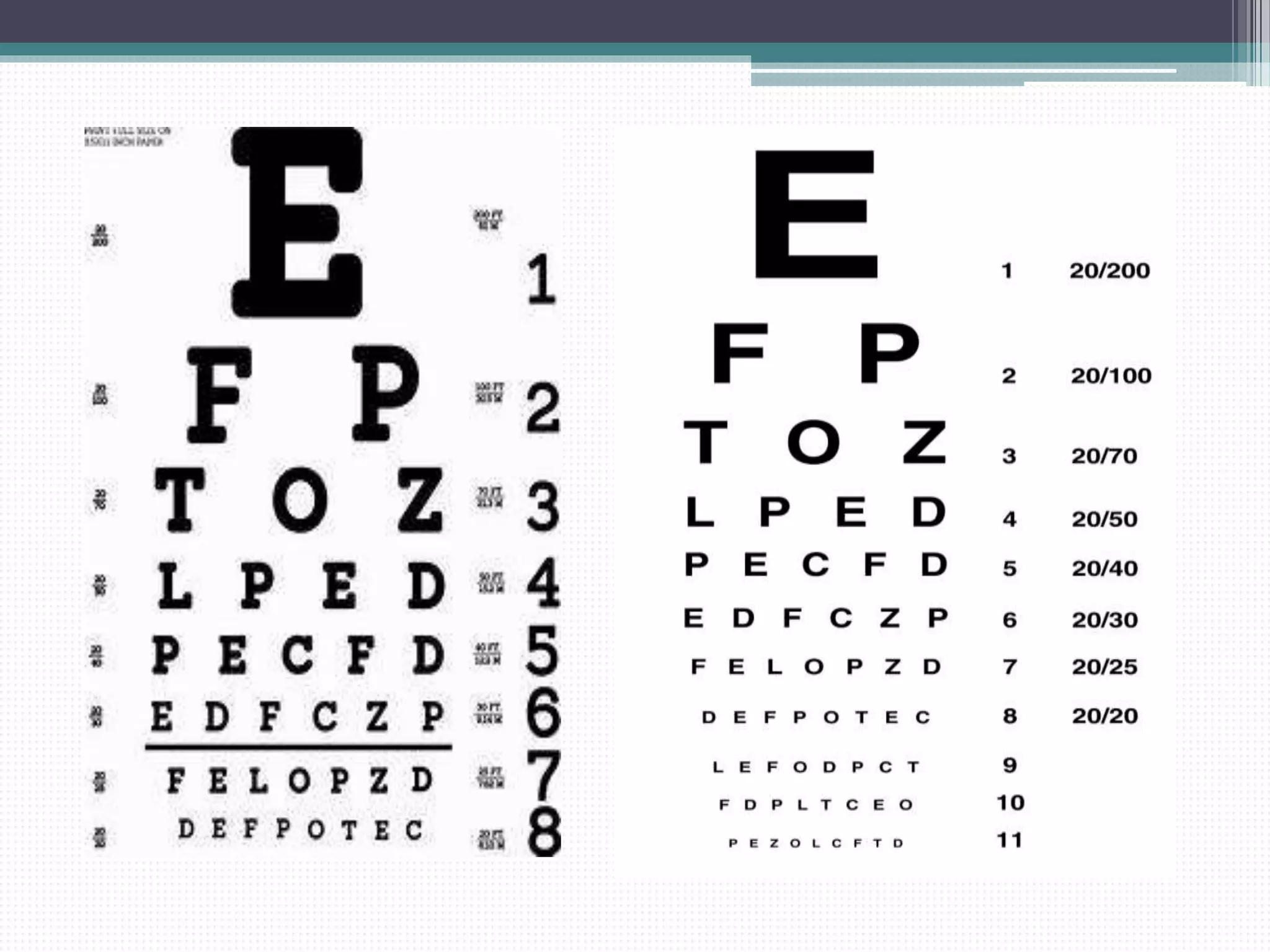
1.SnellensVisualAcuityTest
• Most commonly used
• Smallest Object which can be resolved by the eye
subtends the same visual angle at the nodal point of
the eye i.e 5min of arc
• The test employs a chart with rows of letters with
diminishing size
• Each row is accorded a number indicating the
distance in meters at which a person with normal
visual acuity should correctly identify the letters
• Testing distance is 6m
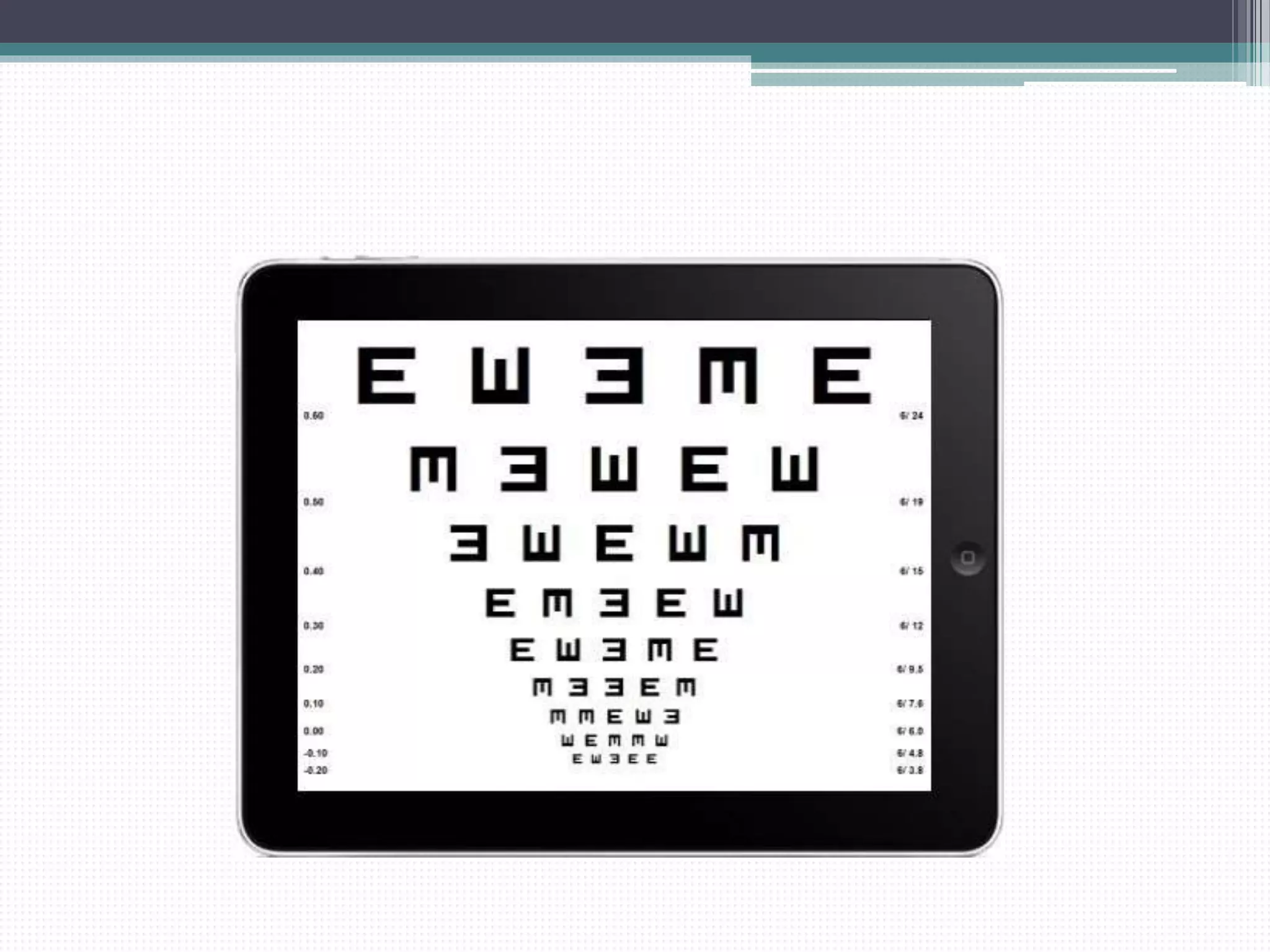
2.LogMAR Visual Acuity Charts
• Based on Minimum Angle of Resolution
• More Precise than Snellen Test
• Have regular progression in the Size and
spacing of the letters from one line to next
• Same number of letters on everyline
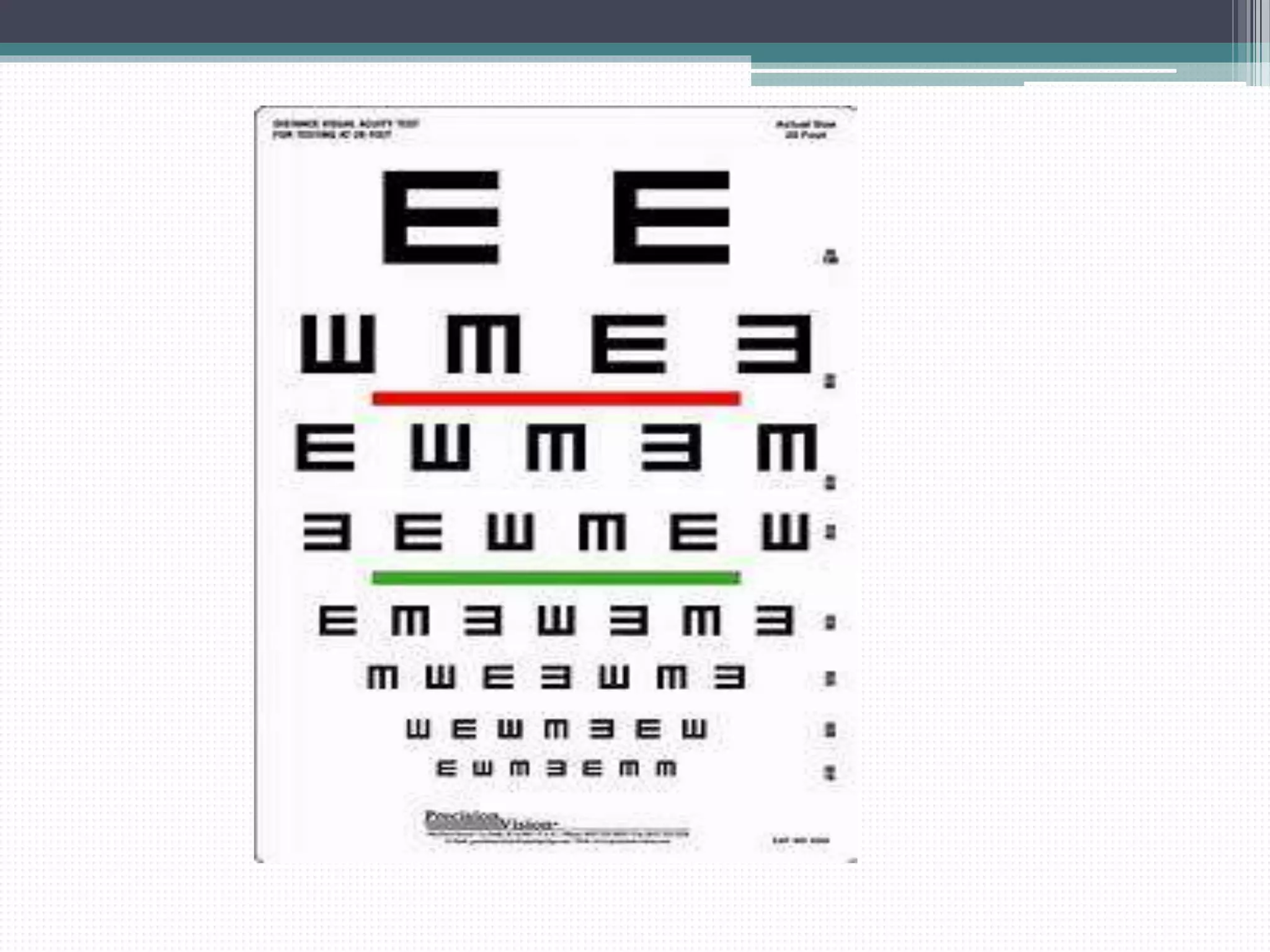
3.Tumbling E Test
• Based on Minimum Separable distance
• Task is to identify the direction in which the limb
of E points
• Identification of the last line gives visual acuity
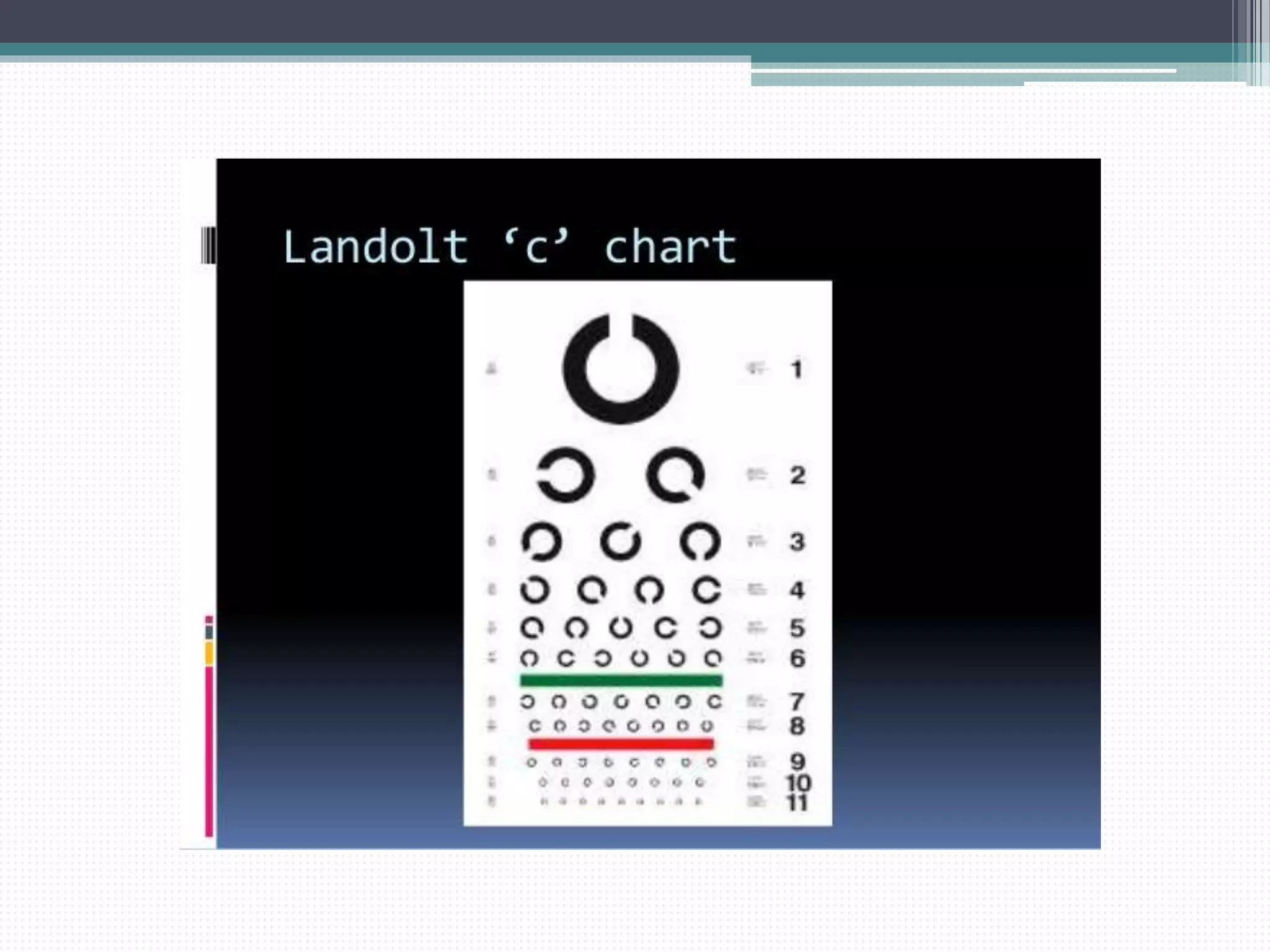
4.Landolt’s Broken Ring Chart
• Most Commonly used
• Based on Minimum Separable distance.
• The rings are constructed on the same basis as
that of Snellens
• Child is instructed to indicate by the motion of
the hand at which point each one is broken
• Interpretation of the last line identified by the
child determines visual acuity
5.ETDRS
• The ETDRS acuity test was developed to aid in
evaluating the changes in vision following
panretinal photocoagulation in patients with
diabetic retinopathy. Previous studies had
somewhat confusing results due to
inadequacies of the acuity tests used in those
early studies.
ETDRS design
• The ETDRS test incorporates specific design criteria
to make it more accurate than the Snellen or Sloan
acuity tests. These include:
• Same number of letters per row (five letters per row)
• Equal spacing of the rows on a log scale (the rows
are separated by 0.1. log unit)
• Equal spacing of the letters on a log scale
• Individual rows balanced for letter difficulty
• To prevent memorization, different versions of the
ETDRS test chart are available. The three standard
versions of the ETDRS chart are R, 1 and 2.
Scoring method
• Determine the last row where the patient can correctly
identify all 5 letters on that row.
• Determine the log score for that row (these scores are
shown in the margin of the ETDRS test, e.g. the 20/25
line has a log score of 0.1)
• subtract 0.02 log units for every letter that is correctly
identified beyond the last row where all of the letters are
correctly identified. For example, if the patient reads all
of the letters correctly on the 20/30 row and then 3
letters correctly on the 20/25 row, the Log Score would
be calculated as follows:
• 20/30 Row = 0.20
3 letters X 0.02 log/letter = – 0.06
ETDRS Acuity Log Score = 0.14
How Are Bailey-Lovie Charts and
ETDRS different?
• Bailey-Lovie charts incorporate the European
design of LogMAR, where letter sizes are
rectangular instead of square. For example, a
20/20 ETDRS letter is square, 5 minutes of arc
by 5 minutes of arc. For the Bailey-Lovie Chart
Design, a 20/20 letter is 4 minutes of arc by 5
minutes of arc.
Conclusion
• Measuring vision in children is a comprehensive
task. For diagnostic purposes, follow-up and
evaluation of visual impairments, all elements
should be considered and compared with the visual
function of daily life. Results need to be explained
and discussed with the parents or guardian to help
them understand the situation and strengthen
interaction with their children. This will reduce the
visual disability, especially if the vision cannot be
improved through medical treatment.
References
• Primary care optometry
• Theory and practice of optics and refraction-A.K
Khurana
• Clinical visual optics.
• Community eye health-measuring vision in children
• Wiley online library-The measurement of visual
acuity in children: an evidence‐based update
• MEAJ-Comparison of Visual Acuity Results in
Preschool Children with Lea Symbols and Bailey-
Lovie E Chart
• Pictures-internet
Visual acuity measurement in children

Visual acuity measurement in children

  • 1.
    Visual acuity measurementin children Rachana Kafle
  • 2.
    VISION • Vision orvisual perception is a complex integration of light sense,form sense, contrast sense and color sense. • VA is considered as a measure of form sense.
  • 3.
    Visual Acuity • Itis the measure of the spatial resolution of visual processing. • Also known as resolving power of eye. • Ability to differentiate two separate object as separate and appreciate the details of visible object.
  • 4.
    Components of VA •Minimum visibility-a judgement of whether a target is present or absent (detection acuity) • Resolution-evidence that the spatial detail contained within a target has been fully resolved (resolution acuity) • Recognition- the identification of a target • Minimum discriminable
  • 5.
    1.Minimum visibility -Ability todetect whether an object is present or not. -depends on specification of stimulus; size, shape and illumination.
  • 6.
    2. Resolution -The discriminationof two spatially separated object is resolution. -The normal angle threshold for discrimination of resolution is 30-60 second of arc.It is known as Minimum Angle of Resolution. - it is assessment function of fovea centralis.
  • 7.
    Recognition -The ability tonot only discriminate the spatial characteristics of test pattern but also identifies the pattern with which one has had an experience. - It is familiar with the test pattern, - The test targets are called as optotypes. Eg-identification of faces
  • 8.
    Minimun discriminable - Itrefers to the spatial detection by an observer when an threshold stimulus is much lower than the ordinary acuity. VERNIER ACUITY
  • 9.
    Normal Visual Developmentand Functions • In normal visual development, children start by observing their mother's face. Experiences of space, distances, and hand-eye coordination are important steps in stimulating the development of all visual functions during the critical period from birth to five years. Deprivation disturbs this development and may lead to ‘nystagmus’(pendular, mainly horizontal, involuntary eye movements). Amblyopia or ‘lazy eye’ is another condition that can result from visual deprivation in early childhood. • Major visual functions which can be tested from a very young age include: • pupil reaction • motility • fusion • fixation • visual acuity • colour vision
  • 10.
    • The mostimportant visual function is visual acuity. If a child has eye problems, visual acuity should be measured as soon as possible. This will indicate if vision is developing normally. It is not always possible to obtain a quantitative measurement of a child's visual acuity. However, a qualitative assessment by an experienced observer can be very useful. Although a qualitative assessment will show if a child is blind or not, it will not detect unilateral poor vision.
  • 11.
    NORMAL VISUAL DEVELOPMENT 1. Atbirth - 6/120 2. 4 months - 6/60 3. 6 months - 6/36 4. 1 year - 6/18 5. 2 years - 6/6
  • 12.
    MILESTONE OF VISUAL DEVELOPMENT •Very soon after birth- Can fix and follow a light source, face or large, colorful toy. • 1month- Fixation is central, steady and maintained , can follow as low target, and converge, preference of looking at face. • 3months- binocular vision and eye cordination, eyes follow a moving light or face, responsive smile.
  • 13.
    • 6months-Reaches outaccurately for toys. • 9months–look for hidden toys. • 2years-Picture matching • 3years-Letter matching of single letters(e.g.Sheridan Gardiner) • 5years-Snellen chart by matching or naming.
  • 14.
    Guidelines for theassessment of visual acuity in young children • cooperation • understanding the test • which eye should be tested first? 1st visit Vs subsequent visits • occlusion • the best time to test an infant(not hungry) • distance vision: 3m • easy symbols • missing or confusion • unexplained low vision retest with BE open • abnormal head posture • near vision: 33cm • Linear visual acuity should be tested as soon as possible(more accurate)
  • 15.
    Age Groups • Infants-(Birth–12months) •Toddlers-(12months–21/2years) • Preschoolers-(21/2years–5years) • School going children(5years–15years)
  • 16.
    10PD fixation test •It is suitable from birth to 3 yrs of age . 1. In strabismic child: • Based on observation that a constant unilateral strabismic child will prefer to fixate with either test . • If there is constant unilateral strabismus, the VA will be lower in the eye that is no used for fixation ,where as if the strabismus is alternating VA generally equal in in two eyes.
  • 17.
    • In nonstrabismiceyes vertical prism is used to dissociate the eye and to assess the fixation preference • It produces diplopia . • If both eyes have equal acuity , examiner observe back and forth from Rt to Lt eye .
  • 18.
    Following criteria areused to grade the fixation preference • 1. spontaneously alternates: Pt freely alternates without any intervention on the part of examiner. • 2.Holds well: the non preferred eye can hold the fixation for 5 sec through smooth pursuit movement or blink. • 3. holds momentarily • 4. will not hold
  • 19.
    • The 1&2category are considered as normal i.e. of equal acuity • where as 3&4 consider as difference in acuity or amblyopic. • Form 3&4 groups: - have at least 2 lines of difference in acuity is suspected.
  • 20.
    Alternate occlusion method •This test is suitable for the age from few wks . • By using this test some assessment of equality of vision between two eyes can be made. • Each eye is occluded by resting one hand on the child forehead and then drooping of thumb down in line of visual axis .
  • 21.
    • If eacheye has equal acuity there will be no difference in response as each eye has covered . • However when a dominant eye is occluded the child will usually show signs of disquiet . • The test can be further refined by assessing the child response to a small target .
  • 22.
  • 23.
    •C:Central • S:Steady •M:Maintenance Test isdone by providing target at 40cm distance. •C refers to the central corneal light reflex as the patient fixates eye on the examiner’s light and if fixation target is viewed eccentrically then it is termed as uncentral. •S refers to the steadiness as the examiner’s light is motionless and then it is slowly moved out. 1.CSM
  • 24.
    • M refersto the ability of patient to maintain alignment ,first with one eye then with another. EVALUATION • CSM- 66-69 • CSNM-636-660 • Unsteady central fixation-<660
  • 25.
    2.Preferential Looking Test •Most Commonly used Test • Based upon turning of the head or eyes towards the pattern rather than a uniform[homogenous]field. • Alternating Black and White Stripes are present Stripe width progressively narrows which is then Randomly shown next to plain test object • Children with better vision are able to see finer grating and turn towards it
  • 27.
    Drawbacks of PreferentialLooking Tests Test near vision not distance vision
  • 28.
    3.Teller Acuity Cards •Modified form of Preferential • Looking Test • Simpler & rapid testing • contains 17cards • 12.5x12.5cmpatchesofsquarewavegrating- • Gratingscontrast:82%-84% • Properillumination:10candelas/m²
  • 29.
    Drawbacks Measures near visualacuity and not distance
  • 32.
    4.Visual Evoked Potential •VEP is the measure of change of electrical activity of the visual cortex in response to patterned stimulus • Checkered board or square wave grating • Abnormal VEP may indicate a problem with the visual information reaching the cortex • VEP is very sensitive to optical blurring can thus be used as a method of refraction in very young patient
  • 33.
    VEP • VEP isuseful in the determination of problems such as amblyopia, cortical blindness, and visual impairment. A. Flash VEPs B. Pattern reversal VEPs C. Sweep VEPs
  • 35.
    5.Optokinetic nystagmus • Commonlyused Test in Neonates • Test object moves in one direction • Based on observation of Pendular Eye movements • Slow following phase& rapid recovery phase. • Good correlation with subjective acuity.
  • 37.
    Drawbacks of OptokineticNystagmus • Overestimates the visual acuity as the target is moving
  • 38.
    6.Catford Drum Test(CAT) •Based on observation of Pendular Eye movements Testing distance is 60cm • It comprises of white cylinder marked with black dots of increasing size corresponding to visual acuities • The drum is masked by a screen except for a rectangular aperture which exposes a single spot • Spot is made to oscillate horizontally and stimulates eye movement
  • 40.
    Drawbacks • Overestimate visionas target is moving and test is conducted at Short working distance • Unreliable for Amblyopia Screening
  • 41.
  • 42.
    1.Worth's ivory balltest: • Commonly Used • Based on Quality of Fixation • Ivory balls ranging from0.5"to1.5",rolled on floor at a distance of about 3metres. • Child is asked to retrieve each ball • Rough estimate of visual acuity is made from the size of smallest ball which the child can see
  • 44.
    2.Boeck Candy Test •Child picks up only those candy beads which he can see easily • Beads of different sizes are shown to child and is expected to pick them up • This gives approximate estimation of visual acuity
  • 46.
    3.Screening Test forYoung Children and Retards [STYCAR] 1.DYNAMIC • Based on Pursuit Eye movements • Ten Balls rolled across a well illuminating contrasting floor 3m away from child • Pursuit Eye movements indicate that they are seen. 2.STATIC The sphere is mounted on a wand and introduced into the periphery of the visual field and the child examiner determines whether the child fixates or not.
  • 47.
    4. Marble gametest • In children of 1-2 years of age reaching or placing games can be used to estimate visual function. • The game is the marble game. • This test is not intended to measure visual acuity of each eye.
  • 48.
    Procedure: • The childis asked to place marbles in the holes of a card or in a box. • Compare the functioning of the child’s eye when one or the other is closed. • The vision of an eye is then noted as being useful or less useful.
  • 49.
  • 50.
    Dot visual acuity test •Black dots on white background • Touch a black dot • Test dist--25 cm • VA--20/800 to 20/20 PROCEDURE……. • Child is shown an illuminated box with black dots of different sizes printed on it • The smallest dot identified denotes the visual acuity of the child
  • 51.
    1.Cardiff Acuity Test(CAT) • Principle: vanishing optotype • Target- pictures, of the same overall size, drawn in decreasing widths of white space • Acuity is determined by the narrowest white band for which the target is visible to the child • Child naturally prefers to look at a target figure rather than the blank end of the stimulus.
  • 53.
    2.Miniature Toy Test •Was previously used for handicapped children and low Intelligence patient Component of STYCAR Test • 2 sets of Miniature object are used Oneset is with Examiner standing at 10ft and child is askedto pick up similar objects from his own set
  • 55.
    3.Coin Test • Coinsof different sizes are shown to child and is Child picks up only those coins which he can see easily • Expected to pick them up
  • 57.
    4.LEA Symbol test •Good for amblyopic patient to avoid crowding phenomenon
  • 59.
    • Bailey-Lovie tumblingE chart is comparable to the Lea symbols chart in pre-school children. But preference should be given to Lea symbols for children aged 3-4 years as the symbols are more familiar than a directional test for this age group. (https://www.ncbi.nlm.nih.gov/pmc/articles/PMC 3841955/)
  • 60.
    5.Kay picture Test •Kay Picture visual acuity test is the Gold Standard vision test for pre-literate children, providing accurate, crowded visual acuity measurements earlier than symbol and letter tests.
  • 61.
    Features of kaypictures • It is used for children of 2-3 yrs . • The test is done at distance of 6 meter . • It is based on snellen principle . • The chart is in the form of spiral booklets . • Each page has a single picture . • The size goes on decreasing from 6/60 to 6/6 • with each size having 3 cards. • Again the patient is given a key card and is • asked to match with the picture as shown in • the main chart .
  • 63.
    6.Patti pics • PattiPics™ were introduced in 2003 as an improved test for vision screening and testing of pediatric and adult patients where universal symbols and matching may serve the process better than letters or other symbols. They were developed following the Snellen principal of 1862, the recommended standard for optotype design. They are also the only symbol test of its type with the stated objective of calibration targeted to equal Sloan letters used in the ETDRS charts. This uniformity is especially important when taking patients from symbols to letter tests. Other tests are either much easier than ETDRS charts or they are outdated and no longer relevant. Both are very significant factors when a child has an eye disorder or amblyopia and they advance to clinical letter charts.
  • 66.
    Vision test in3-5 years
  • 67.
    1.Allen’s Picture Cards •It is recorded same as Snellens Acuity test Instead of letters child identifies picture at a Distance of 6m.
  • 69.
    2.Sheridan letter test •It uses 5 letters HOTV &X A & U are added in 7 letter set Examiner shows cards having small range of letters at 3m Child points at one of the card identical to the examiner card
  • 71.
    3.Lippmans HOTV test •Simpler version of Sheridan's test using only 4 letters HOTV. • Test distance 3meter
  • 73.
    4. Isolated handfigure test • Sjogren has replaced the E with the isolated figure ofa hand & in some children it works better than Es.
  • 74.
    5.Broken wheel test •Consist of 8 pair of test cards 20/20, 20/25, 20/30, 20/40, 20/60, 20/80, 20/100,20/120. • Each card has a black line drawing of a car on a white background. • 1 with solid wheels , other with broken wheels. • Done from 3m distance
  • 76.
    Clinical Procedure • 2cards are held before the child • He simply identifies which one is broken wheel • If the child can distinguish which car has the broken wheels, it indicates that he can resolve the gap size of the landolt C for the particular card • If acuity is less than 20/120,steps are repeated at 1.5m distance. • Visual acuity is recorded as the last set of cards at which the child correctly respond.
  • 77.
    6. Light homepicture card • A chart containing an apple, a house and an umbrella, arranged in Snellen’s equivalents of 20/200-20/10 is used, and • The child is asked to identify the pictures along the lines. • The test is carried out at 3m • 12 cards are available, size of each card is 4×5 inch
  • 79.
    Vision Test in 5-6Years and above
  • 80.
    1.SnellensVisualAcuityTest • Most commonlyused • Smallest Object which can be resolved by the eye subtends the same visual angle at the nodal point of the eye i.e 5min of arc • The test employs a chart with rows of letters with diminishing size • Each row is accorded a number indicating the distance in meters at which a person with normal visual acuity should correctly identify the letters • Testing distance is 6m
  • 82.
    2.LogMAR Visual AcuityCharts • Based on Minimum Angle of Resolution • More Precise than Snellen Test • Have regular progression in the Size and spacing of the letters from one line to next • Same number of letters on everyline
  • 84.
    3.Tumbling E Test •Based on Minimum Separable distance • Task is to identify the direction in which the limb of E points • Identification of the last line gives visual acuity
  • 86.
    4.Landolt’s Broken RingChart • Most Commonly used • Based on Minimum Separable distance. • The rings are constructed on the same basis as that of Snellens • Child is instructed to indicate by the motion of the hand at which point each one is broken • Interpretation of the last line identified by the child determines visual acuity
  • 88.
    5.ETDRS • The ETDRSacuity test was developed to aid in evaluating the changes in vision following panretinal photocoagulation in patients with diabetic retinopathy. Previous studies had somewhat confusing results due to inadequacies of the acuity tests used in those early studies.
  • 89.
    ETDRS design • TheETDRS test incorporates specific design criteria to make it more accurate than the Snellen or Sloan acuity tests. These include: • Same number of letters per row (five letters per row) • Equal spacing of the rows on a log scale (the rows are separated by 0.1. log unit) • Equal spacing of the letters on a log scale • Individual rows balanced for letter difficulty • To prevent memorization, different versions of the ETDRS test chart are available. The three standard versions of the ETDRS chart are R, 1 and 2.
  • 90.
    Scoring method • Determinethe last row where the patient can correctly identify all 5 letters on that row. • Determine the log score for that row (these scores are shown in the margin of the ETDRS test, e.g. the 20/25 line has a log score of 0.1) • subtract 0.02 log units for every letter that is correctly identified beyond the last row where all of the letters are correctly identified. For example, if the patient reads all of the letters correctly on the 20/30 row and then 3 letters correctly on the 20/25 row, the Log Score would be calculated as follows: • 20/30 Row = 0.20 3 letters X 0.02 log/letter = – 0.06 ETDRS Acuity Log Score = 0.14
  • 91.
    How Are Bailey-LovieCharts and ETDRS different? • Bailey-Lovie charts incorporate the European design of LogMAR, where letter sizes are rectangular instead of square. For example, a 20/20 ETDRS letter is square, 5 minutes of arc by 5 minutes of arc. For the Bailey-Lovie Chart Design, a 20/20 letter is 4 minutes of arc by 5 minutes of arc.
  • 94.
    Conclusion • Measuring visionin children is a comprehensive task. For diagnostic purposes, follow-up and evaluation of visual impairments, all elements should be considered and compared with the visual function of daily life. Results need to be explained and discussed with the parents or guardian to help them understand the situation and strengthen interaction with their children. This will reduce the visual disability, especially if the vision cannot be improved through medical treatment.
  • 95.
    References • Primary careoptometry • Theory and practice of optics and refraction-A.K Khurana • Clinical visual optics. • Community eye health-measuring vision in children • Wiley online library-The measurement of visual acuity in children: an evidence‐based update • MEAJ-Comparison of Visual Acuity Results in Preschool Children with Lea Symbols and Bailey- Lovie E Chart • Pictures-internet