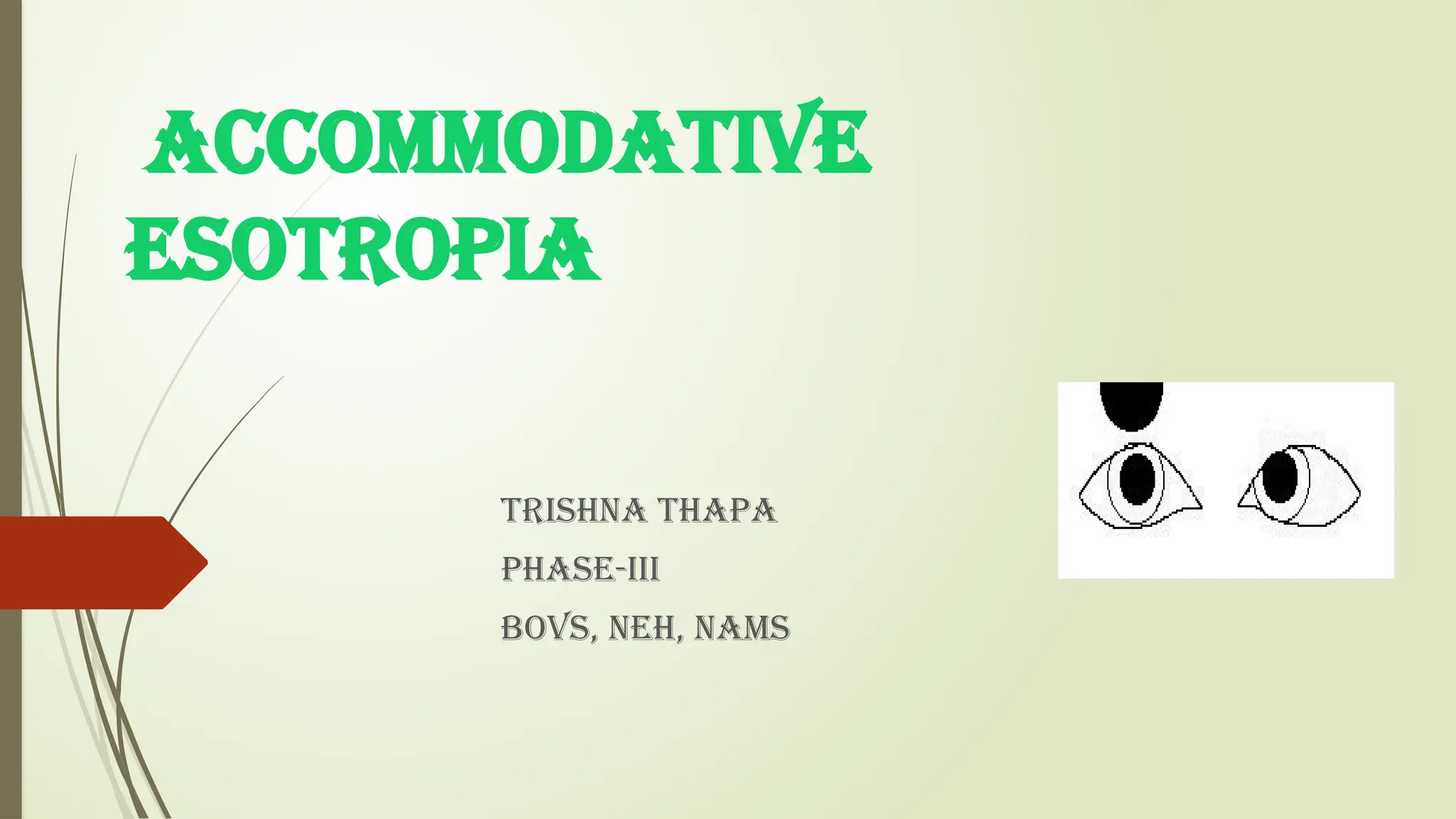
ACCOMMODATIVE
ESOTROPIA
TRISHNA THAPA
PHASE-III
BOVS, NEH, NAMS
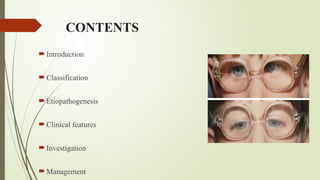
CONTENTS
Introduction
Classification
Etiopathogenesis
Clinical features
Investigation
Management
HISTORY
Was reported early as 1864 by Donders
Donders reasoned that these individual must accommodative more to
overcome hyperopia to clear retinal image
PREVALENCE
 The global prevalence of esotropia is 0.77%.
 The incidence is estimated at 1-2% of the population
 In Oman, a total of 51 patients that were identified, twenty-four patients were diagnosed
with fully accommodative ET (FAET) and 27 with partially accommodative ET (PAET)
 In a population based study of AE prevalence in amblyopia in Macedonia, the prevalence of
pure accommodative esotropia in Macedonian strabismic cohort was 11.6% (25/215), partial
accommodative esotropia 7.9% (17/215), and non-accommodative esotropia 59.5%
(128/215)
1. Hassan Hashemi , Reza Pakzad, Samira Heydarian, Abbasali Yekta, Global and regional prevalence of strabismus: a comprehensive systematic review and meta-
analysis ; strabismus 2019 Jun;27(2):54-65. doi: 10.1080/09273972.2019.1604773.
2. Lembo A, Serafino M, Strologo MD, Saunders RA, Trivedi RH, Villani E, Nucci P. Accommodative esotropia: the state of the art. Int Ophthalmol. 2019 Feb;39(2):497-
505. doi: 10.1007/s10792-018-0821-6. Epub 2018 Jan 13. PMID: 29332227.
3.. OK Sreelatha, Hajar Ali Al-Marshoudi, Maha Mameesh, Sana Al Zuhaibi, Anuradha Ganesh Accommodative esotropia: An outcome analysis from a tertiary center in
Oman , . 2022 Nov 2;15(3):274–278. doi: 10.4103/ojo.ojo_80_22
.
INTRODUCTION TO ACCOMMODATIVE
ESOTROPIA
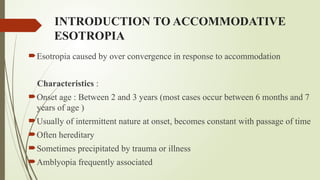
Esotropia caused by over convergence in response to accommodation
Characteristics :
Onset age : Between 2 and 3 years (most cases occur between 6 months and 7
years of age )
Usually of intermittent nature at onset, becomes constant with passage of time
Often hereditary
Sometimes precipitated by trauma or illness
Amblyopia frequently associated
CLASSIFICATION
1.
• REFRACTIVE ESOTROPIA
2.
• NON-REFRACTIVE ESOTROPIA
3.
• PARTIALLY ACCOMODATIVE ESOTROPIA
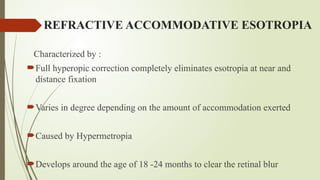
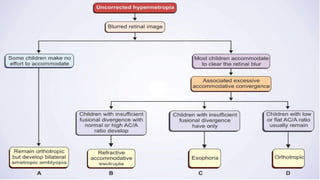
REFRACTIVE ACCOMMODATIVE ESOTROPIA
Characterized by :
Full hyperopic correction completely eliminates esotropia at near and
distance fixation
Varies in degree depending on the amount of accommodation exerted
Caused by Hypermetropia
Develops around the age of 18 -24 months to clear the retinal blur
ETIOPATHOGENESIS
Tendency to develop esotropia depends on :
Degree of Hyperopia
Amount of fusional amplitude in reserve
AC/A ratio
Child’s personality
CLINICAL FEATURES
1. Time of onset
 Manifests between the age of 2 and 3 years
2. Hypermetropia
 Hypemetropia ranging between 2 and 6 dioptres with
a mean of 4.75 dioptres
CLINICAL FEATURES
3. Ocular Deviation :
- Passes through following stages :
Stage of
Esophoria
Stage of
Intermittent
esotropia
Stage of constant
esotropia
CLINICAL FEATURES
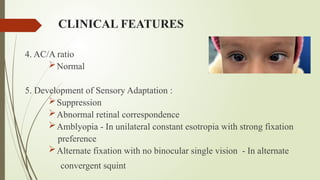
4. AC/A ratio
Normal
5. Development of Sensory Adaptation :
Suppression
Abnormal retinal correspondence
Amblyopia - In unilateral constant esotropia with strong fixation
preference
Alternate fixation with no binocular single vision - In alternate
convergent squint
CLINICAL FEATURES
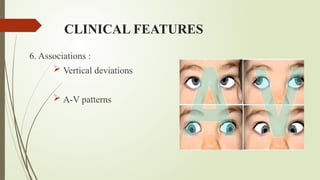
6. Associations :
 Vertical deviations
 A-V patterns
NON-REFRACTIVE ACCOMODATIVE
ESOTROPIA
Characterized by :
Significantly larger esotropia at near(10 PD or more) ,little or no esotropia
at distance fixation
Unrelated to refractive error
High AC/A ratio
About 5% of esotropia show non-refractive accommodative esotropia
ETIOPATHOGENESIS
 Causative factor attributed to :
Innervational and excessive amount of accommodative convergence
associated with abnormal amount of accommodation (i.e. high AC/A
ratio)
CLINICAL FEATURES
1. Time of onset :
 Between 2-3 years
2. Ocular deviation :
 Deviation initially small and intermittent(Rarely does it exceed 30
PD)
 The near esotropia is typically much greater than the distance
esodeviation
CLINICAL FEATURES
Near-distance disparity
Grade I : 10–19 PD more deviation for near
Grade II : 20–29 PD more deviation for near
Grade III : 30 PD more deviation for near
3. AC/A ratio :
 Characteristically high
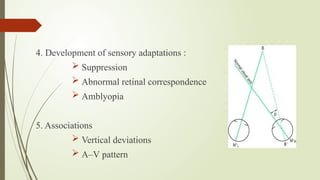
4. Development of sensory adaptations :
 Suppression
 Abnormal retinal correspondence
 Amblyopia
5. Associations
 Vertical deviations
 A–V pattern
HYPOACCOMODATIVE ESOTROPIA
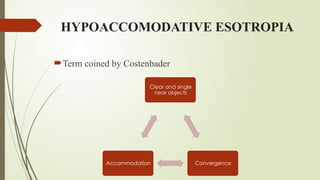
Term coined by Costenbader
Clear and single
near objects
Convergence
Accommodation
HYPOACCOMODATIVE ESOTROPIA
Weak accommodation , over convergence
Esotropia large for near fixation and small for distance fixation
Esotropia is not related to uncorrected hypermetropia
CA/C is low ?
Near point of accommodation (NPA) definitely remote, i.e. there
is weakness of accommodation
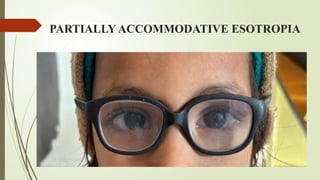
PARTIALLY ACCOMMODATIVE ESOTROPIA
Esotropia caused by combination of hypermetropia and high AC/A
ratio
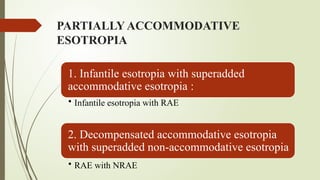
PARTIALLY ACCOMMODATIVE
ESOTROPIA
1. Infantile esotropia with superadded
accommodative esotropia :
• Infantile esotropia with RAE
2. Decompensated accommodative esotropia
with superadded non-accommodative esotropia
• RAE with NRAE
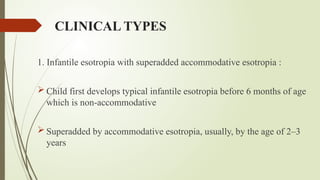
CLINICAL TYPES
1. Infantile esotropia with superadded accommodative esotropia :
 Child first develops typical infantile esotropia before 6 months of age
which is non-accommodative
 Superadded by accommodative esotropia, usually, by the age of 2–3
years
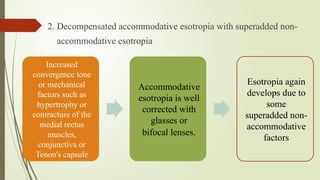
2. Decompensated accommodative esotropia with superadded non-
accommodative esotropia
Increased
convergence tone
or mechanical
factors such as
hypertrophy or
contracture of the
medial rectus
muscles,
conjunctiva or
Tenon's capsule
Accommodative
esotropia is well
corrected with
glasses or
bifocal lenses.
Esotropia again
develops due to
some
superadded non-
accommodative
factors
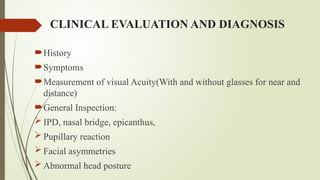
CLINICAL EVALUATION AND DIAGNOSIS
History
Symptoms
Measurement of visual Acuity(With and without glasses for near and
distance)
General Inspection:
 IPD, nasal bridge, epicanthus,
 Pupillary reaction
 Facial asymmetries
 Abnormal head posture
CLINICAL EVALUATION AND DIAGNOSIS
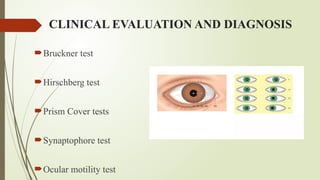
Bruckner test
Hirschberg test
Prism Cover tests
Synaptophore test
Ocular motility test
CLINICAL EVALUATION AND DIAGNOSIS
 Measurement of deviation(direction, frequency, laterality, magnitude of
deviation)
 Cycloplegic refraction
 Measurement of accommodation, AC/A ratio
 Measurement of fusional divergence amplitude
 Examination of fundus and ocular media
MANAGEMENT
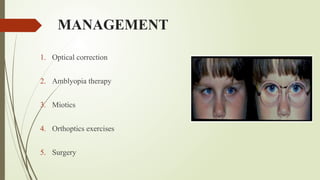
1. Optical correction
2. Amblyopia therapy
3. Miotics
4. Orthoptics exercises
5. Surgery
1. Optical correction
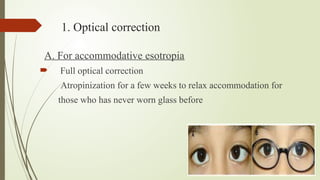
A. For accommodative esotropia
 Full optical correction
Atropinization for a few weeks to relax accommodation for
those who has never worn glass before
Method of prescribing optical correction and
follow-up
i. From birth to 6 months
 Full retinoscopic findings plus an additional +1.5D(for
hypermetropia of +2.0 diopters or more)
 These infants should be seen every 2–3 weeks
ii. From 6 months to 6 years
 Hypermetropia of more than +1.5 D should be prescribed full
retinoscopic finding without any additional plus lens
 Should be followed every month till their deviation is stabilized
iii. Above 6 years of age
 The optical prescription should include the minimum power lens
that should provide both binocular single vision with esophoria and
maximum visual acuity
 These patients should be followed up every 6 months for 2 years
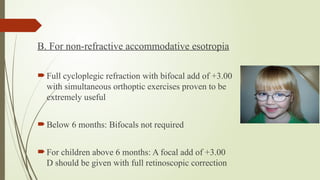
B. For non-refractive accommodative esotropia
 Full cycloplegic refraction with bifocal add of +3.00
with simultaneous orthoptic exercises proven to be
extremely useful
 Below 6 months: Bifocals not required
 For children above 6 months: A focal add of +3.00
D should be given with full retinoscopic correction
PRESCRIPTION OF BIFOCALS
Usually, +3.00 D add required in bifocal glasses
However, add determined by hit and trial method
Starting with +1D in increasing steps to +3 D till all near
esotropia corrected
Executive bifocal preferred
Follow up examination every 3 months up to 1 year, every
6 months up to 2 years ,thereafter every year
C. For hypo accommodative esotropia:
 NPA is definitely remote so, near add of plus lens are required to
compensate for weak accommodation
 Full cycloplegic correction is required for distance segment
D. For partially accommodative esotropia:
 Full hyperopic correction prescribed
 High AC/A ration can be treated with the help of bifocals
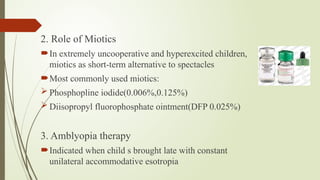
2. Role of Miotics
In extremely uncooperative and hyperexcited children,
miotics as short-term alternative to spectacles
Most commonly used miotics:
 Phosphopline iodide(0.006%,0.125%)
 Diisopropyl fluorophosphate ointment(DFP 0.025%)
3. Amblyopia therapy
Indicated when child s brought late with constant
unilateral accommodative esotropia
4. Orthoptic treatment
Aims at overcoming suppression and
negative fusional convergence
5.Role of surgery
Only indicated in patients who have
associated vertical deviations of A – V
patterns
REFERENCES
Theory and Practice of Squint and Orthoptics, AK khurana, 3rd
edition
Lyle and Jackson’s practical orthoptics in the treatment of
squint ,5th
edition
Pediatric Ophthalmology and strabismus : AAO
Binocular Vision and Ocular Motility, Gunter K. Von
Noorden, MD
Internet resources
THANK YOU !

Accommodative esotropia by Trishna Thapa

  • 1.
  • 2.
  • 3.
    HISTORY Was reported earlyas 1864 by Donders Donders reasoned that these individual must accommodative more to overcome hyperopia to clear retinal image
  • 4.
    PREVALENCE  The globalprevalence of esotropia is 0.77%.  The incidence is estimated at 1-2% of the population  In Oman, a total of 51 patients that were identified, twenty-four patients were diagnosed with fully accommodative ET (FAET) and 27 with partially accommodative ET (PAET)  In a population based study of AE prevalence in amblyopia in Macedonia, the prevalence of pure accommodative esotropia in Macedonian strabismic cohort was 11.6% (25/215), partial accommodative esotropia 7.9% (17/215), and non-accommodative esotropia 59.5% (128/215) 1. Hassan Hashemi , Reza Pakzad, Samira Heydarian, Abbasali Yekta, Global and regional prevalence of strabismus: a comprehensive systematic review and meta- analysis ; strabismus 2019 Jun;27(2):54-65. doi: 10.1080/09273972.2019.1604773. 2. Lembo A, Serafino M, Strologo MD, Saunders RA, Trivedi RH, Villani E, Nucci P. Accommodative esotropia: the state of the art. Int Ophthalmol. 2019 Feb;39(2):497- 505. doi: 10.1007/s10792-018-0821-6. Epub 2018 Jan 13. PMID: 29332227. 3.. OK Sreelatha, Hajar Ali Al-Marshoudi, Maha Mameesh, Sana Al Zuhaibi, Anuradha Ganesh Accommodative esotropia: An outcome analysis from a tertiary center in Oman , . 2022 Nov 2;15(3):274–278. doi: 10.4103/ojo.ojo_80_22 .
  • 5.
    INTRODUCTION TO ACCOMMODATIVE ESOTROPIA Esotropiacaused by over convergence in response to accommodation Characteristics : Onset age : Between 2 and 3 years (most cases occur between 6 months and 7 years of age ) Usually of intermittent nature at onset, becomes constant with passage of time Often hereditary Sometimes precipitated by trauma or illness Amblyopia frequently associated
  • 6.
    CLASSIFICATION 1. • REFRACTIVE ESOTROPIA 2. •NON-REFRACTIVE ESOTROPIA 3. • PARTIALLY ACCOMODATIVE ESOTROPIA
  • 7.
    REFRACTIVE ACCOMMODATIVE ESOTROPIA Characterizedby : Full hyperopic correction completely eliminates esotropia at near and distance fixation Varies in degree depending on the amount of accommodation exerted Caused by Hypermetropia Develops around the age of 18 -24 months to clear the retinal blur
  • 8.
    ETIOPATHOGENESIS Tendency to developesotropia depends on : Degree of Hyperopia Amount of fusional amplitude in reserve AC/A ratio Child’s personality
  • 10.
    CLINICAL FEATURES 1. Timeof onset  Manifests between the age of 2 and 3 years 2. Hypermetropia  Hypemetropia ranging between 2 and 6 dioptres with a mean of 4.75 dioptres
  • 11.
    CLINICAL FEATURES 3. OcularDeviation : - Passes through following stages : Stage of Esophoria Stage of Intermittent esotropia Stage of constant esotropia
  • 12.
    CLINICAL FEATURES 4. AC/Aratio Normal 5. Development of Sensory Adaptation : Suppression Abnormal retinal correspondence Amblyopia - In unilateral constant esotropia with strong fixation preference Alternate fixation with no binocular single vision - In alternate convergent squint
  • 13.
    CLINICAL FEATURES 6. Associations:  Vertical deviations  A-V patterns
  • 14.
    NON-REFRACTIVE ACCOMODATIVE ESOTROPIA Characterized by: Significantly larger esotropia at near(10 PD or more) ,little or no esotropia at distance fixation Unrelated to refractive error High AC/A ratio About 5% of esotropia show non-refractive accommodative esotropia
  • 15.
    ETIOPATHOGENESIS  Causative factorattributed to : Innervational and excessive amount of accommodative convergence associated with abnormal amount of accommodation (i.e. high AC/A ratio)
  • 16.
    CLINICAL FEATURES 1. Timeof onset :  Between 2-3 years 2. Ocular deviation :  Deviation initially small and intermittent(Rarely does it exceed 30 PD)  The near esotropia is typically much greater than the distance esodeviation
  • 17.
    CLINICAL FEATURES Near-distance disparity GradeI : 10–19 PD more deviation for near Grade II : 20–29 PD more deviation for near Grade III : 30 PD more deviation for near 3. AC/A ratio :  Characteristically high
  • 18.
    4. Development ofsensory adaptations :  Suppression  Abnormal retinal correspondence  Amblyopia 5. Associations  Vertical deviations  A–V pattern
  • 19.
    HYPOACCOMODATIVE ESOTROPIA Term coinedby Costenbader Clear and single near objects Convergence Accommodation
  • 20.
    HYPOACCOMODATIVE ESOTROPIA Weak accommodation, over convergence Esotropia large for near fixation and small for distance fixation
  • 21.
    Esotropia is notrelated to uncorrected hypermetropia CA/C is low ? Near point of accommodation (NPA) definitely remote, i.e. there is weakness of accommodation
  • 22.
    PARTIALLY ACCOMMODATIVE ESOTROPIA Esotropiacaused by combination of hypermetropia and high AC/A ratio
  • 23.
    PARTIALLY ACCOMMODATIVE ESOTROPIA 1. Infantileesotropia with superadded accommodative esotropia : • Infantile esotropia with RAE 2. Decompensated accommodative esotropia with superadded non-accommodative esotropia • RAE with NRAE
  • 24.
    CLINICAL TYPES 1. Infantileesotropia with superadded accommodative esotropia :  Child first develops typical infantile esotropia before 6 months of age which is non-accommodative  Superadded by accommodative esotropia, usually, by the age of 2–3 years
  • 25.
    2. Decompensated accommodativeesotropia with superadded non- accommodative esotropia Increased convergence tone or mechanical factors such as hypertrophy or contracture of the medial rectus muscles, conjunctiva or Tenon's capsule Accommodative esotropia is well corrected with glasses or bifocal lenses. Esotropia again develops due to some superadded non- accommodative factors
  • 26.
    CLINICAL EVALUATION ANDDIAGNOSIS History Symptoms Measurement of visual Acuity(With and without glasses for near and distance) General Inspection:  IPD, nasal bridge, epicanthus,  Pupillary reaction  Facial asymmetries  Abnormal head posture
  • 27.
    CLINICAL EVALUATION ANDDIAGNOSIS Bruckner test Hirschberg test Prism Cover tests Synaptophore test Ocular motility test
  • 28.
    CLINICAL EVALUATION ANDDIAGNOSIS  Measurement of deviation(direction, frequency, laterality, magnitude of deviation)  Cycloplegic refraction  Measurement of accommodation, AC/A ratio  Measurement of fusional divergence amplitude  Examination of fundus and ocular media
  • 29.
    MANAGEMENT 1. Optical correction 2.Amblyopia therapy 3. Miotics 4. Orthoptics exercises 5. Surgery
  • 30.
    1. Optical correction A.For accommodative esotropia  Full optical correction Atropinization for a few weeks to relax accommodation for those who has never worn glass before
  • 31.
    Method of prescribingoptical correction and follow-up i. From birth to 6 months  Full retinoscopic findings plus an additional +1.5D(for hypermetropia of +2.0 diopters or more)  These infants should be seen every 2–3 weeks ii. From 6 months to 6 years  Hypermetropia of more than +1.5 D should be prescribed full retinoscopic finding without any additional plus lens  Should be followed every month till their deviation is stabilized
  • 32.
    iii. Above 6years of age  The optical prescription should include the minimum power lens that should provide both binocular single vision with esophoria and maximum visual acuity  These patients should be followed up every 6 months for 2 years
  • 33.
    B. For non-refractiveaccommodative esotropia  Full cycloplegic refraction with bifocal add of +3.00 with simultaneous orthoptic exercises proven to be extremely useful  Below 6 months: Bifocals not required  For children above 6 months: A focal add of +3.00 D should be given with full retinoscopic correction
  • 34.
    PRESCRIPTION OF BIFOCALS Usually,+3.00 D add required in bifocal glasses However, add determined by hit and trial method Starting with +1D in increasing steps to +3 D till all near esotropia corrected Executive bifocal preferred Follow up examination every 3 months up to 1 year, every 6 months up to 2 years ,thereafter every year
  • 35.
    C. For hypoaccommodative esotropia:  NPA is definitely remote so, near add of plus lens are required to compensate for weak accommodation  Full cycloplegic correction is required for distance segment D. For partially accommodative esotropia:  Full hyperopic correction prescribed  High AC/A ration can be treated with the help of bifocals
  • 36.
    2. Role ofMiotics In extremely uncooperative and hyperexcited children, miotics as short-term alternative to spectacles Most commonly used miotics:  Phosphopline iodide(0.006%,0.125%)  Diisopropyl fluorophosphate ointment(DFP 0.025%) 3. Amblyopia therapy Indicated when child s brought late with constant unilateral accommodative esotropia
  • 37.
    4. Orthoptic treatment Aimsat overcoming suppression and negative fusional convergence 5.Role of surgery Only indicated in patients who have associated vertical deviations of A – V patterns
  • 38.
    REFERENCES Theory and Practiceof Squint and Orthoptics, AK khurana, 3rd edition Lyle and Jackson’s practical orthoptics in the treatment of squint ,5th edition Pediatric Ophthalmology and strabismus : AAO Binocular Vision and Ocular Motility, Gunter K. Von Noorden, MD Internet resources
  • 39.

Editor's Notes

  • #7 esotrop present mostly for near because there is greater need for accomodation for near
  • #8 Esotropia depends not only on degree of hyperopia but on fusional divergence amplitude in reserve and AC/A ratio
  • #10 higher refractive error are unliely ,with high error patient may prefer blur but single vision instead of constant effort to maintain focus
  • #16 onset occurs when ypunfg indivisuals become interested in viewing near objects
  • #26 IPD to rule out pseudoesotropia,pupil to rule out sensory deviation due to retinal and ON disese, facial –pseudeso, abnormal head –EOM paressis
  • #27 Each mm of deviation approx. equal to 7 degree, 1 degree =2 PD
  • #28 Normal fusional divergence amplitude at distance is 4–6 and at near it is 8–12
  • #31 The additional plus will provide clear vision up to 66 cm which is the usual limit of the young infant's world.
  • #36 Miotics facilitate accommodation and thus reduce the accommodative convergence