BRÜCKNER TEST
Md . Azizul Islam
Associate Optometrist
Oculoplasty Department ( IIEI&H )
IIEI&H
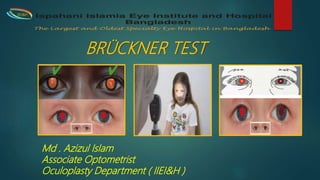
 Brückner, in 1962, published a paper in German describing a "trans-illumination" test
extremely useful in the diagnosis of small angle deviations and amblyopia in young
uncooperative children. A bright coaxial light source, such as a direct ophthalmoscope, is
used. Both eyes of the patient are simultaneously illuminated from approximately one meter
distance.
 First, the position of the corneal light reflex, (Hirschberg test), along with brightness
difference of the fundus reflex as seen in the pupil through the ophthalmoscope, is
evaluated. When strabismus is present. the fixing eye has a darker reflex than the deviated
eye.
 The second step evaluates pupil size, pupil reaction, and fixation movement of the eyes on
"successive" illumination of one eye at a time. This is useful in detecting amblyopia.
 The Brückner Test (often also referred to as red reflex test or transillumination test) and the
use of a direct ophthalmoscope.
Brückner Test
IIEI&H
How To Conduct The Brückner Test
With A Direct Ophthalmoscope
IIEI&H
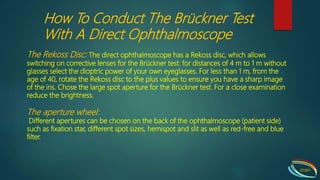
The Rekoss Disc: The direct ophthalmoscope has a Rekoss disc, which allows
switching on corrective lenses for the Brückner test: for distances of 4 m to 1 m without
glasses select the dioptric power of your own eyeglasses. For less than 1 m, from the
age of 40, rotate the Rekoss disc to the plus values to ensure you have a sharp image
of the iris. Chose the large spot aperture for the Brückner test. For a close examination
reduce the brightness.
The aperture wheel:
Different apertures can be chosen on the back of the ophthalmoscope (patient side)
such as fixation star, different spot sizes, hemispot and slit as well as red-free and blue
filter.
How To Conduct The Brückner Test
With A Direct Ophthalmoscope
IIEI&H
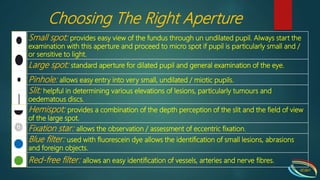
Small spot: provides easy view of the fundus through un undilated pupil. Always start the
examination with this aperture and proceed to micro spot if pupil is particularly small and /
or sensitive to light.
Large spot: standard aperture for dilated pupil and general examination of the eye.
Pinhole: allows easy entry into very small, undilated / miotic pupils.
Slit: helpful in determining various elevations of lesions, particularly tumours and
oedematous discs.
Hemispot: provides a combination of the depth perception of the slit and the field of view
of the large spot.
Fixation star: allows the observation / assessment of eccentric fixation.
Blue filter: used with fluorescein dye allows the identification of small lesions, abrasions
and foreign objects.
Red-free filter: allows an easy identification of vessels, arteries and nerve fibres.
Choosing The Right Aperture
IIEI&H
Background Information To
The Brückner Test
Childhood amblyopia is a frequent vision disorder with a prevalence of approx. 5 %. Delayed
recognition of an amblyopia in childhood may lead to permanent dysfunction of the eye or both
eyes and correspondingly affect the development of a child.
Possible causes are:
 Ametropia
 Anisometropia (unequal refractive power)
 Myopia (nearsightedness)
 Hypermetropia (farsightedness)
 Astigmatism
 Manifest strabismus
 Dysplasia (e.g. congenital cataract or retinoblastoma)
N,B: Brückner’s transillumination test cataract can be diagnosed in a simple, quick and highly
sensitive manner. In addition, myopia (nearsightedness) and anisometropia (unequal refractive
power) can be diagnosed with an examination at a distance.
IIEI&H
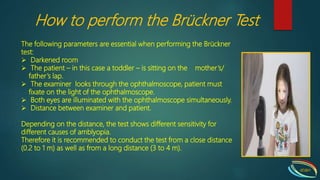
How to perform the Brückner Test
The following parameters are essential when performing the Brückner
test:
 Darkened room
 The patient – in this case a toddler – is sitting on the mother’s/
father’s lap.
 The examiner looks through the ophthalmoscope, patient must
fixate on the light of the ophthalmoscope.
 Both eyes are illuminated with the ophthalmoscope simultaneously.
 Distance between examiner and patient.
Depending on the distance, the test shows different sensitivity for
different causes of amblyopia.
Therefore it is recommended to conduct the test from a close distance
(0.2 to 1 m) as well as from a long distance (3 to 4 m).
IIEI&H
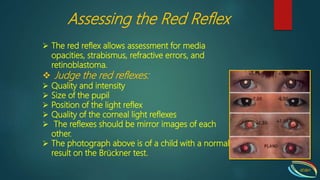
 The red reflex allows assessment for media
opacities, strabismus, refractive errors, and
retinoblastoma.
 Judge the red reflexes:
 Quality and intensity
 Size of the pupil
 Position of the light reflex
 Quality of the corneal light reflexes
 The reflexes should be mirror images of each
other.
 The photograph above is of a child with a normal
result on the Brückner test.
Assessing the Red Reflex
IIEI&H
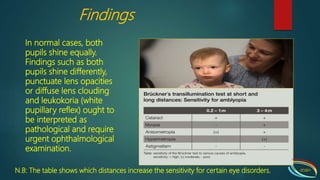
In normal cases, both
pupils shine equally.
Findings such as both
pupils shine differently,
punctuate lens opacities
or diffuse lens clouding
and leukokoria (white
pupillary reflex) ought to
be interpreted as
pathological and require
urgent ophthalmological
examination.
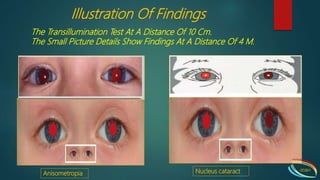
Findings
N.B: The table shows which distances increase the sensitivity for certain eye disorders. IIEI&H
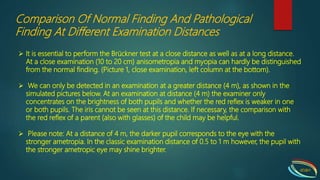
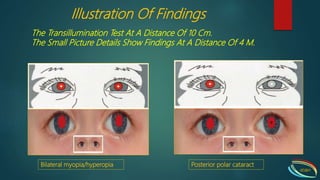
 It is essential to perform the Brückner test at a close distance as well as at a long distance.
At a close examination (10 to 20 cm) anisometropia and myopia can hardly be distinguished
from the normal finding. (Picture 1, close examination, left column at the bottom).
 We can only be detected in an examination at a greater distance (4 m), as shown in the
simulated pictures below. At an examination at distance (4 m) the examiner only
concentrates on the brightness of both pupils and whether the red reflex is weaker in one
or both pupils. The iris cannot be seen at this distance. If necessary, the comparison with
the red reflex of a parent (also with glasses) of the child may be helpful.
 Please note: At a distance of 4 m, the darker pupil corresponds to the eye with the
stronger ametropia. In the classic examination distance of 0.5 to 1 m however, the pupil with
the stronger ametropic eye may shine brighter.
Comparison Of Normal Finding And Pathological
Finding At Different Examination Distances
IIEI&H
The Transillumination Test At A Distance Of 10 Cm.
The Small Picture Details Show Findings At A Distance Of 4 M.
Normal Finding Diffuse Cataract
Illustration Of Findings
IIEI&H
Anisometropia Nucleus cataract
The Transillumination Test At A Distance Of 10 Cm.
The Small Picture Details Show Findings At A Distance Of 4 M.
Illustration Of Findings
IIEI&H
Bilateral myopia/hyperopia Posterior polar cataract
The Transillumination Test At A Distance Of 10 Cm.
The Small Picture Details Show Findings At A Distance Of 4 M.
Illustration Of Findings
IIEI&H
 Strabismus: A "positive" Brückner test
indicative of strabismus is characterized by:
 Asymmetry of the red reflex.
 Unequal pupil sizes.
 Displacement of the central light reflex. The
child in this photo has a right Esotropia/
Exotropia.
The Transillumination Test At A Distance Of 10 Cm.
The Small Picture Details Show Findings At A Distance Of 4 M.
Illustration Of Findings
IIEI&H
Brückner Test Examination
Of A Sleeping Child
Opening the eye lids:
The eye lids of a sleeping child can be opened by carefully spreading the lids with
thumb and forefinger of your free hand and carefully lifting the upper lid with the thumb
while e.g. the mother holds the lower lid with her finger. Avoid touching the conjunctiva
and the eye. Folding of the lid can be prevented by gently pushing it against the eye.
To trigger the eye opening reflex, the mother, holding the baby upright between her
hands and stabilizing its head, is moving the baby rhythmically up and down once a
second on a distance of 30 cm. The resulting acceleration evokes the opening of the
eyes, lifting of the eye brows and wrinkling of the baby’s forehead. For the examination,
the movement is interrupted.
IIEI&H
The Brückner test is usually performed at a distance of 1 m. Due to
optical reasons, the test should detect ametropia more sensitively at
an extended distance.
The sensitivity of the Brückner reflex for anisometropia improves by
extension of the examination distance, especially in the hands of less
experienced observers.
 To detect ametropia more sensitively, a test distance of 4 m is
recommended.
 A dim red reflex may reveal an unequal or high refractive error.
Home Massage
IIEI&H
References
 Kanski's Clinical Ophthalmology,7th Edition by Jack Kanski
 M Gräf in "The transillumination test according to Brücker“, Pediatric and Adolescent
Medicine 3/2014 Schattauer
 Red Reflex Examination in Neonates, Infants, and Children,December 2008, VOLUME
122 / ISSUE 6
 How to test for the red reflex in a child,Community Eye Health 2014; 27(86): 36.
 Picture+Vedio : Google + Me
IIEI&H
IIEI&H

Bruckner test

  • 1.
    BRÜCKNER TEST Md .Azizul Islam Associate Optometrist Oculoplasty Department ( IIEI&H ) IIEI&H
  • 2.
     Brückner, in1962, published a paper in German describing a "trans-illumination" test extremely useful in the diagnosis of small angle deviations and amblyopia in young uncooperative children. A bright coaxial light source, such as a direct ophthalmoscope, is used. Both eyes of the patient are simultaneously illuminated from approximately one meter distance.  First, the position of the corneal light reflex, (Hirschberg test), along with brightness difference of the fundus reflex as seen in the pupil through the ophthalmoscope, is evaluated. When strabismus is present. the fixing eye has a darker reflex than the deviated eye.  The second step evaluates pupil size, pupil reaction, and fixation movement of the eyes on "successive" illumination of one eye at a time. This is useful in detecting amblyopia.  The Brückner Test (often also referred to as red reflex test or transillumination test) and the use of a direct ophthalmoscope. Brückner Test IIEI&H
  • 3.
    How To ConductThe Brückner Test With A Direct Ophthalmoscope IIEI&H
  • 4.
    The Rekoss Disc:The direct ophthalmoscope has a Rekoss disc, which allows switching on corrective lenses for the Brückner test: for distances of 4 m to 1 m without glasses select the dioptric power of your own eyeglasses. For less than 1 m, from the age of 40, rotate the Rekoss disc to the plus values to ensure you have a sharp image of the iris. Chose the large spot aperture for the Brückner test. For a close examination reduce the brightness. The aperture wheel: Different apertures can be chosen on the back of the ophthalmoscope (patient side) such as fixation star, different spot sizes, hemispot and slit as well as red-free and blue filter. How To Conduct The Brückner Test With A Direct Ophthalmoscope IIEI&H
  • 5.
    Small spot: provideseasy view of the fundus through un undilated pupil. Always start the examination with this aperture and proceed to micro spot if pupil is particularly small and / or sensitive to light. Large spot: standard aperture for dilated pupil and general examination of the eye. Pinhole: allows easy entry into very small, undilated / miotic pupils. Slit: helpful in determining various elevations of lesions, particularly tumours and oedematous discs. Hemispot: provides a combination of the depth perception of the slit and the field of view of the large spot. Fixation star: allows the observation / assessment of eccentric fixation. Blue filter: used with fluorescein dye allows the identification of small lesions, abrasions and foreign objects. Red-free filter: allows an easy identification of vessels, arteries and nerve fibres. Choosing The Right Aperture IIEI&H
  • 6.
    Background Information To TheBrückner Test Childhood amblyopia is a frequent vision disorder with a prevalence of approx. 5 %. Delayed recognition of an amblyopia in childhood may lead to permanent dysfunction of the eye or both eyes and correspondingly affect the development of a child. Possible causes are:  Ametropia  Anisometropia (unequal refractive power)  Myopia (nearsightedness)  Hypermetropia (farsightedness)  Astigmatism  Manifest strabismus  Dysplasia (e.g. congenital cataract or retinoblastoma) N,B: Brückner’s transillumination test cataract can be diagnosed in a simple, quick and highly sensitive manner. In addition, myopia (nearsightedness) and anisometropia (unequal refractive power) can be diagnosed with an examination at a distance. IIEI&H
  • 7.
    How to performthe Brückner Test The following parameters are essential when performing the Brückner test:  Darkened room  The patient – in this case a toddler – is sitting on the mother’s/ father’s lap.  The examiner looks through the ophthalmoscope, patient must fixate on the light of the ophthalmoscope.  Both eyes are illuminated with the ophthalmoscope simultaneously.  Distance between examiner and patient. Depending on the distance, the test shows different sensitivity for different causes of amblyopia. Therefore it is recommended to conduct the test from a close distance (0.2 to 1 m) as well as from a long distance (3 to 4 m). IIEI&H
  • 8.
     The redreflex allows assessment for media opacities, strabismus, refractive errors, and retinoblastoma.  Judge the red reflexes:  Quality and intensity  Size of the pupil  Position of the light reflex  Quality of the corneal light reflexes  The reflexes should be mirror images of each other.  The photograph above is of a child with a normal result on the Brückner test. Assessing the Red Reflex IIEI&H
  • 9.
    In normal cases,both pupils shine equally. Findings such as both pupils shine differently, punctuate lens opacities or diffuse lens clouding and leukokoria (white pupillary reflex) ought to be interpreted as pathological and require urgent ophthalmological examination. Findings N.B: The table shows which distances increase the sensitivity for certain eye disorders. IIEI&H
  • 10.
     It isessential to perform the Brückner test at a close distance as well as at a long distance. At a close examination (10 to 20 cm) anisometropia and myopia can hardly be distinguished from the normal finding. (Picture 1, close examination, left column at the bottom).  We can only be detected in an examination at a greater distance (4 m), as shown in the simulated pictures below. At an examination at distance (4 m) the examiner only concentrates on the brightness of both pupils and whether the red reflex is weaker in one or both pupils. The iris cannot be seen at this distance. If necessary, the comparison with the red reflex of a parent (also with glasses) of the child may be helpful.  Please note: At a distance of 4 m, the darker pupil corresponds to the eye with the stronger ametropia. In the classic examination distance of 0.5 to 1 m however, the pupil with the stronger ametropic eye may shine brighter. Comparison Of Normal Finding And Pathological Finding At Different Examination Distances IIEI&H
  • 11.
    The Transillumination TestAt A Distance Of 10 Cm. The Small Picture Details Show Findings At A Distance Of 4 M. Normal Finding Diffuse Cataract Illustration Of Findings IIEI&H
  • 12.
    Anisometropia Nucleus cataract TheTransillumination Test At A Distance Of 10 Cm. The Small Picture Details Show Findings At A Distance Of 4 M. Illustration Of Findings IIEI&H
  • 13.
    Bilateral myopia/hyperopia Posteriorpolar cataract The Transillumination Test At A Distance Of 10 Cm. The Small Picture Details Show Findings At A Distance Of 4 M. Illustration Of Findings IIEI&H
  • 14.
     Strabismus: A"positive" Brückner test indicative of strabismus is characterized by:  Asymmetry of the red reflex.  Unequal pupil sizes.  Displacement of the central light reflex. The child in this photo has a right Esotropia/ Exotropia. The Transillumination Test At A Distance Of 10 Cm. The Small Picture Details Show Findings At A Distance Of 4 M. Illustration Of Findings IIEI&H
  • 15.
    Brückner Test Examination OfA Sleeping Child Opening the eye lids: The eye lids of a sleeping child can be opened by carefully spreading the lids with thumb and forefinger of your free hand and carefully lifting the upper lid with the thumb while e.g. the mother holds the lower lid with her finger. Avoid touching the conjunctiva and the eye. Folding of the lid can be prevented by gently pushing it against the eye. To trigger the eye opening reflex, the mother, holding the baby upright between her hands and stabilizing its head, is moving the baby rhythmically up and down once a second on a distance of 30 cm. The resulting acceleration evokes the opening of the eyes, lifting of the eye brows and wrinkling of the baby’s forehead. For the examination, the movement is interrupted. IIEI&H
  • 16.
    The Brückner testis usually performed at a distance of 1 m. Due to optical reasons, the test should detect ametropia more sensitively at an extended distance. The sensitivity of the Brückner reflex for anisometropia improves by extension of the examination distance, especially in the hands of less experienced observers.  To detect ametropia more sensitively, a test distance of 4 m is recommended.  A dim red reflex may reveal an unequal or high refractive error. Home Massage IIEI&H
  • 17.
    References  Kanski's ClinicalOphthalmology,7th Edition by Jack Kanski  M Gräf in "The transillumination test according to Brücker“, Pediatric and Adolescent Medicine 3/2014 Schattauer  Red Reflex Examination in Neonates, Infants, and Children,December 2008, VOLUME 122 / ISSUE 6  How to test for the red reflex in a child,Community Eye Health 2014; 27(86): 36.  Picture+Vedio : Google + Me IIEI&H
  • 18.