Low Vision in Childhood
                      - How to apply neuroscience in optics -


                              Vassilis Kokotas, Optometrist, Ophth.D.c
37th Annual Meeting, 2011
                                   Clinical Associate OEPF/COVD, U.S.A.
                                              www.optometria.gr
Neonate or young baby
•   Albinism
•   Cerebral blindness
•   Congenital cataract
•   Congenital glaucoma
•   Congenital idiopathic nystagmus
•   Leber’s congenital amaurosis
•   Macular coloboma
•   Optic atrophy or hypoplasia
•   Primary hyperplastic vitreous
•   Retinoblastoma
•   Retinopathy of prematurity
Childhood
•   Best’s disease or vitelliform dystrophy
•   Cone dystrophy
•   Optic atrophy
•   Retinitis pigmentosa
•   Stargardt’s disease
•   X-linked retinoschisis
Prognosis and rehabilitation
Pathology                    Visual Prognosis        Visual Field Defects           Visual Aids
                             (LogMAR)
Leber’s amaurosis            LP – 1.0                Complete loss                  Vision substitution
Optic atrophy                Variable. HM – 0.3      Paracentral scotomas           Good with LVA
Optic disc hypoplasia        Variable. Good or poor Variable                        Good with LVA
Cerebral blindness           Variable, poor          Difficult to test              Poor with LVA. Enviromental
                                                                                    modifications
Delayed visual development   Often normal            Normal                         Good with LVA and/ or training
Albinism                     1.0 – 0.5               Usually normal                 Good with LVA (distance)
Stargardt’s disease          50% > 0.1 / 50% < 0.1   Central scotoma                Good with LVA
Cone dystrophy               1.0 – 0.6               Central scotoma                Good with filters (red tint)
Best’s disease               1.0                     Normal – Central scotoma       Variable with LVA
Retinitis pigmentosa         1.3 - NLP               Peripheral constriction and/   Good with LVA and CCTV
                                                     or central defect
X-linked retinoschisis       1.3 – 0.8               Peripheral and central         Good with LVA
                                                     scotomas
                                                                                     A.J. Jackson, J.S. Wolffsohn (2007)
Low Vision Aids
Kids tend to reduce distance in order to gain magnification. But as they grow
older and accommodation lags they need to compensate with low vision aids.


Aphacic children need to be introduced to magnification as soon as possible.
Usually, they require higher amounts of magnification.


Children accept low vision aids and other visual modifications easier than
adults. They don’t experience emotions of loss and we meet less denial.


What looks a technological challenge for you, for kids is just a game.
Low Vision Aids
Eye – hand coordination is a very important factor that has to be developed
early with low to moderate magnification (table magnifiers, stand magnifiers,
magnifying rulers, etc).


Later, when head and ocular motor control is fine tuned magnifying glasses
can be used (monocular, prismatic binocular, special bifocals, etc).
Low Vision Aids
The use of hand held magnifiers can usually be incorporated for daily activities
when school starts. Combination with eyeglasses can provide patient with
higher magnificactions (with or without illumination, etc).


Telescopic systems can be used in a classroom environment too, although
hardly accepted due to aesthetic reasons (monocular, binocular, fixed,
removable, etc).
Low Vision Aids
CCTV and other electronic magnifiers can be used when good eye – hand
coordination has been established, although they are more necessary in
school years (colored, contrast enhancement, portable, etc).


New devices and software allow easy modification of size and spacing of
letters or even text to speech functions (e – readers, tablets, etc).
Definition of Vision
  Clinicians experience the visual
     process (apart from their own
      vision) through testing and
   therapy, thus each one creates
     his/ her own model of vision.

“Vision is the ability of the organism
     to derive meaning and direct
     action, as triggered by light.”
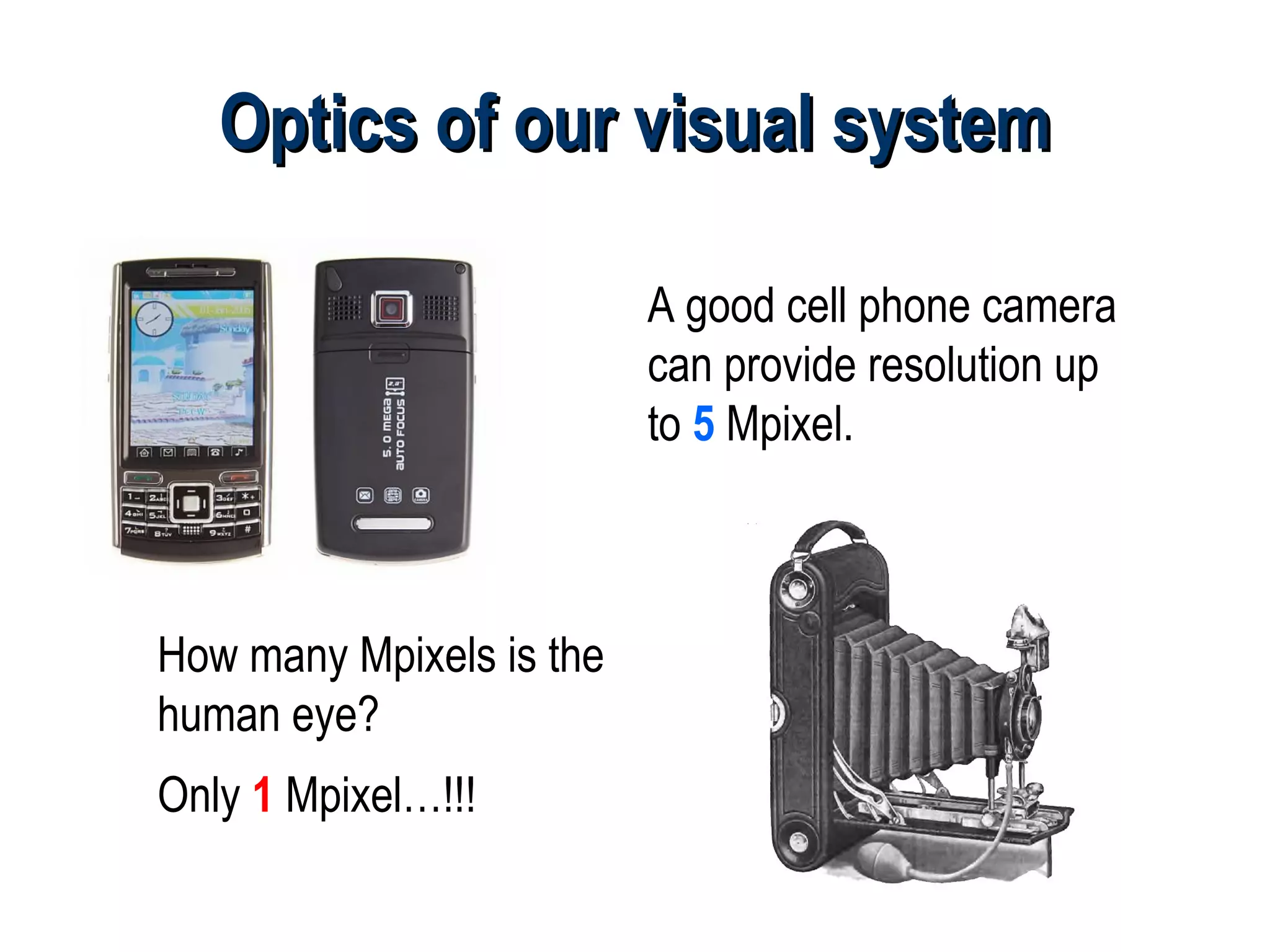
Optics of our visual system

                          A good cell phone camera
                          can provide resolution up
                          to 5 Mpixel.


How many Mpixels is the
human eye?
Only 1 Mpixel…!!!
Multi-tasking,
                                          simultaneous,
                                       exchanging, parallel
                                       processing systems.


Enriched by multi-sensory perception
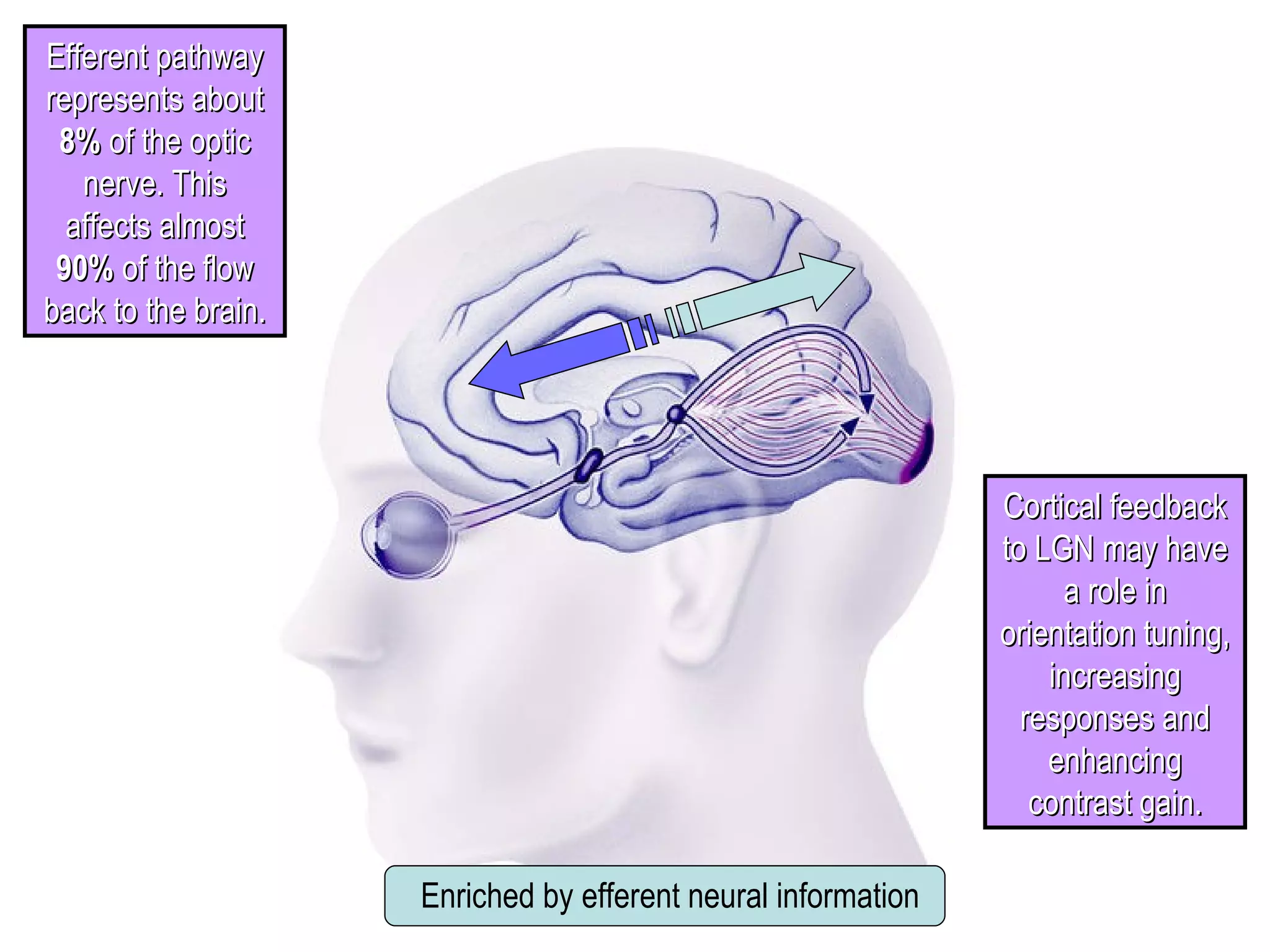
Efferent pathway
represents about
 8% of the optic
   nerve. This
  affects almost
 90% of the flow
back to the brain.


                                                               Cortical feedback
                                                               to LGN may have
                                                                     a role in
                                                               orientation tuning,
                                                                   increasing
                                                                 responses and
                                                                   enhancing
                                                                  contrast gain.

                     Enriched by efferent neural information
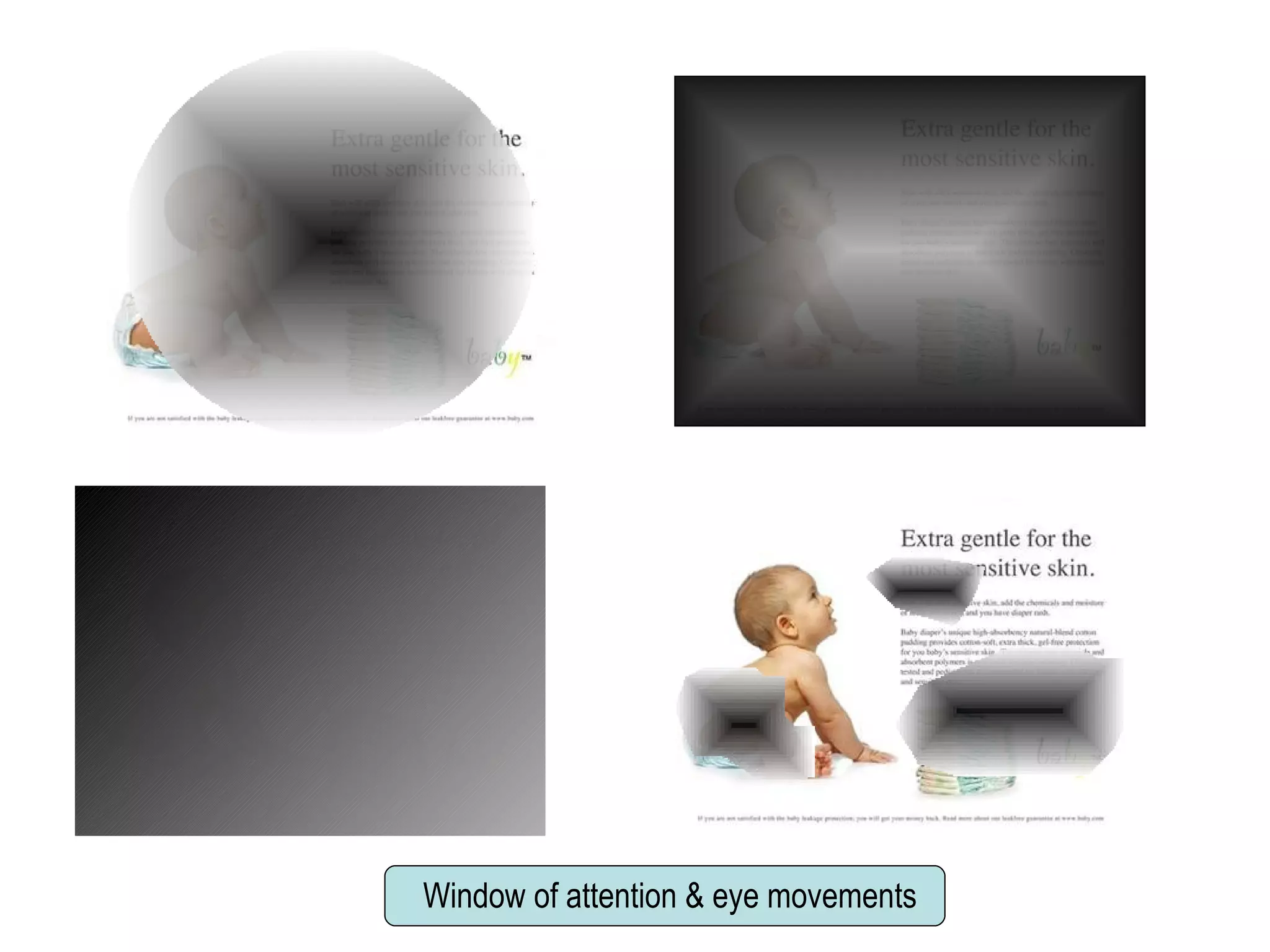
Window of attention & eye movements
The harder the task, the more central your window of
 attention is and the more periphery is suppressed.


                            Window of attention & eye movements
Window of attention & eye movements
Enhancement
Optometric Vision Training

           -Peripheral awareness
           -Ocular motor dysfunctions
           -Eye-hand coordination
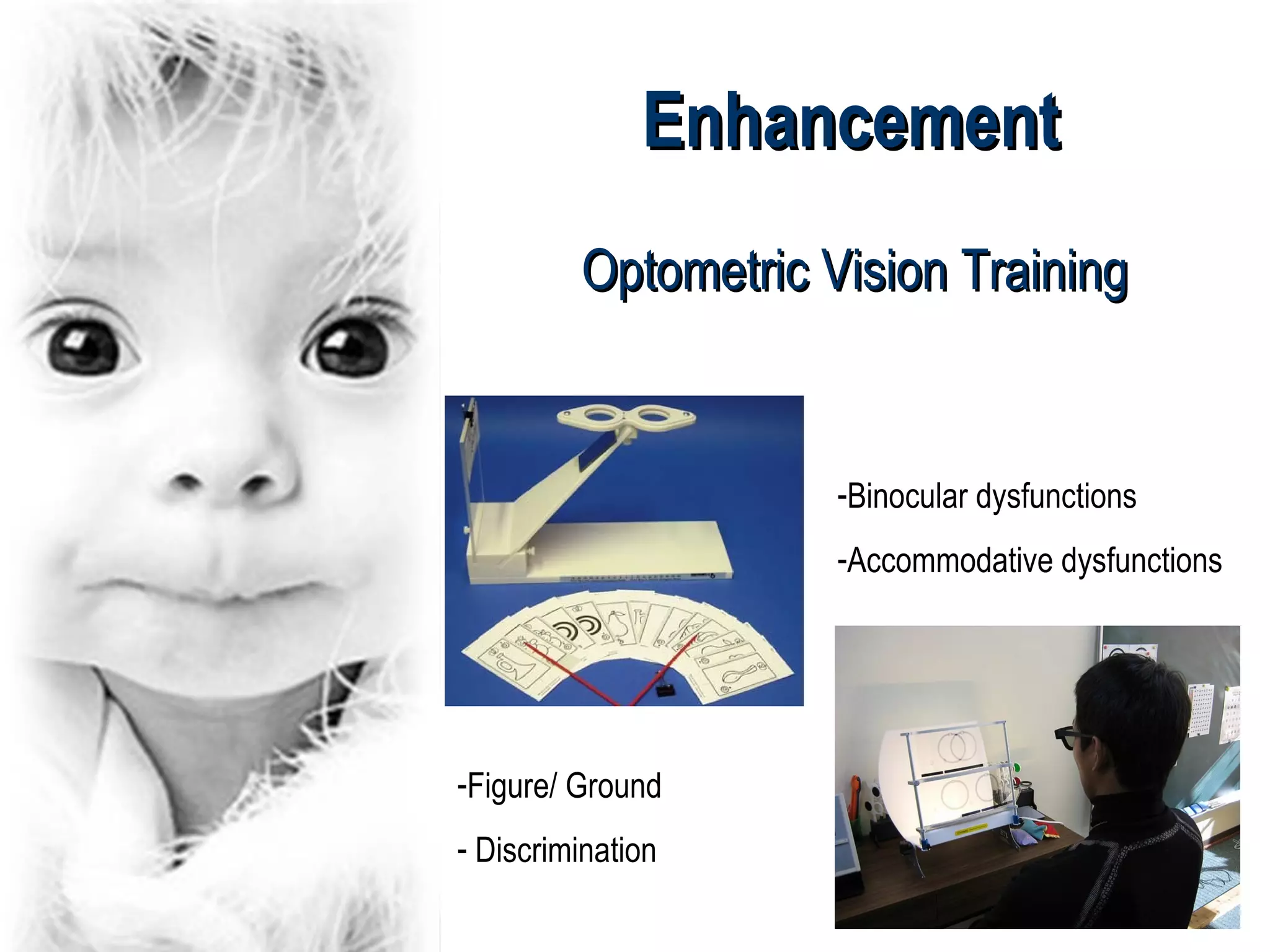
Enhancement
         Optometric Vision Training


                     -Binocular dysfunctions
                     -Accommodative dysfunctions


-Figure/ Ground
- Discrimination
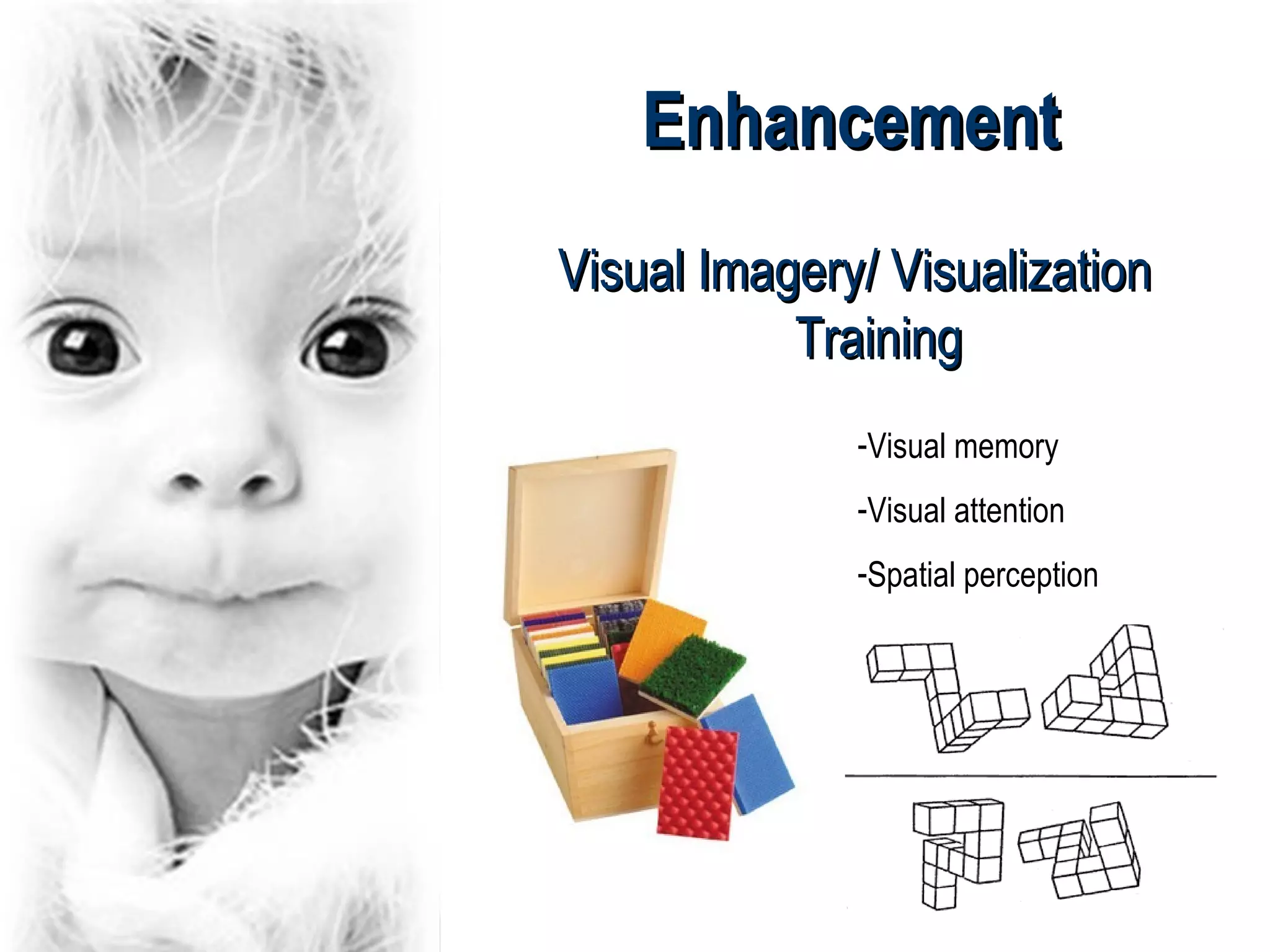
Enhancement
Visual Imagery/ Visualization
           Training
              -Visual memory
              -Visual attention
              -Spatial perception
References
• A.J. Jackson, J.S. Wolffsohn. Low vision manual. Butterworth – Heinemann, 2007.
• Worgotter F, Nelle E, Li B, Funke J. The influence of corticofugal feedback on the temporal structure of
    visual response of cat thalamic relay cell. J. Physiol. 1998;509:797-815.
• R.C. Peterson, J.S. Wolffsohn, M. Rubinstein, J. Lowe. Benefits of electronic vision enhancement
    systems (EVES) for the visually impaired. Br. J. Ophthalmol. 2003;136:1129-1135.
• B.P. Rosenthal, R.G. Cole. Functional assessment of low vision. Mosby, 1996.
• Przybyszewski AW, Gaska JP, Foote W, Pollen DA. Striate cortex increases contrast gain of macaque
    LGN neurons. Vis. Neurosci. 2000;17:485-494
• S.L. Macknik, S. Martinez-Conde. Sleights of mind. Henry Holt & Company, 2010.
• A. Robinson. Cunningham’s textbook of anatomy. Oxford University Press, 1931.
• D.N. Spinelli, K.H. Pribram, M. Weingarten. Centrifugal optic nerve responses evoked by auditory and
    somatic stimulation. Exp. Neurol. 1965;12:303-319.
• C. Dickinson. Low vision. Principles and practice. Butterworth – Heinemann, 1998.
• W.V. Padula. Neuro-optometric rehabilitation. Optometric Extension Program Foundation, 1996.
• B. Silverstone, M.A. Lang, B. Rosenthal, E.E. Faye. The lighthouse handbook on vision impairment and
    vision rahabilitation. Oxford University Press, 2000.
• E.B. Forrest. Visual imagery: An optometric approach. Optometric Extension Program Foundation, 1981.
Thank you!


                            E-mail: info@optometria.gr
                             Site: www.optometria.gr

37th Annual Meeting, 2011

Low vision in childhood

  • 1.
    Low Vision inChildhood - How to apply neuroscience in optics - Vassilis Kokotas, Optometrist, Ophth.D.c 37th Annual Meeting, 2011 Clinical Associate OEPF/COVD, U.S.A. www.optometria.gr
  • 2.
    Neonate or youngbaby • Albinism • Cerebral blindness • Congenital cataract • Congenital glaucoma • Congenital idiopathic nystagmus • Leber’s congenital amaurosis • Macular coloboma • Optic atrophy or hypoplasia • Primary hyperplastic vitreous • Retinoblastoma • Retinopathy of prematurity
  • 3.
    Childhood • Best’s disease or vitelliform dystrophy • Cone dystrophy • Optic atrophy • Retinitis pigmentosa • Stargardt’s disease • X-linked retinoschisis
  • 4.
    Prognosis and rehabilitation Pathology Visual Prognosis Visual Field Defects Visual Aids (LogMAR) Leber’s amaurosis LP – 1.0 Complete loss Vision substitution Optic atrophy Variable. HM – 0.3 Paracentral scotomas Good with LVA Optic disc hypoplasia Variable. Good or poor Variable Good with LVA Cerebral blindness Variable, poor Difficult to test Poor with LVA. Enviromental modifications Delayed visual development Often normal Normal Good with LVA and/ or training Albinism 1.0 – 0.5 Usually normal Good with LVA (distance) Stargardt’s disease 50% > 0.1 / 50% < 0.1 Central scotoma Good with LVA Cone dystrophy 1.0 – 0.6 Central scotoma Good with filters (red tint) Best’s disease 1.0 Normal – Central scotoma Variable with LVA Retinitis pigmentosa 1.3 - NLP Peripheral constriction and/ Good with LVA and CCTV or central defect X-linked retinoschisis 1.3 – 0.8 Peripheral and central Good with LVA scotomas A.J. Jackson, J.S. Wolffsohn (2007)
  • 5.
    Low Vision Aids Kidstend to reduce distance in order to gain magnification. But as they grow older and accommodation lags they need to compensate with low vision aids. Aphacic children need to be introduced to magnification as soon as possible. Usually, they require higher amounts of magnification. Children accept low vision aids and other visual modifications easier than adults. They don’t experience emotions of loss and we meet less denial. What looks a technological challenge for you, for kids is just a game.
  • 6.
    Low Vision Aids Eye– hand coordination is a very important factor that has to be developed early with low to moderate magnification (table magnifiers, stand magnifiers, magnifying rulers, etc). Later, when head and ocular motor control is fine tuned magnifying glasses can be used (monocular, prismatic binocular, special bifocals, etc).
  • 7.
    Low Vision Aids Theuse of hand held magnifiers can usually be incorporated for daily activities when school starts. Combination with eyeglasses can provide patient with higher magnificactions (with or without illumination, etc). Telescopic systems can be used in a classroom environment too, although hardly accepted due to aesthetic reasons (monocular, binocular, fixed, removable, etc).
  • 8.
    Low Vision Aids CCTVand other electronic magnifiers can be used when good eye – hand coordination has been established, although they are more necessary in school years (colored, contrast enhancement, portable, etc). New devices and software allow easy modification of size and spacing of letters or even text to speech functions (e – readers, tablets, etc).
  • 9.
    Definition of Vision Clinicians experience the visual process (apart from their own vision) through testing and therapy, thus each one creates his/ her own model of vision. “Vision is the ability of the organism to derive meaning and direct action, as triggered by light.”
  • 10.
    Optics of ourvisual system A good cell phone camera can provide resolution up to 5 Mpixel. How many Mpixels is the human eye? Only 1 Mpixel…!!!
  • 11.
    Multi-tasking, simultaneous, exchanging, parallel processing systems. Enriched by multi-sensory perception
  • 12.
    Efferent pathway represents about 8% of the optic nerve. This affects almost 90% of the flow back to the brain. Cortical feedback to LGN may have a role in orientation tuning, increasing responses and enhancing contrast gain. Enriched by efferent neural information
  • 13.
    Window of attention& eye movements
  • 14.
    The harder thetask, the more central your window of attention is and the more periphery is suppressed. Window of attention & eye movements
  • 15.
    Window of attention& eye movements
  • 16.
    Enhancement Optometric Vision Training -Peripheral awareness -Ocular motor dysfunctions -Eye-hand coordination
  • 17.
    Enhancement Optometric Vision Training -Binocular dysfunctions -Accommodative dysfunctions -Figure/ Ground - Discrimination
  • 18.
    Enhancement Visual Imagery/ Visualization Training -Visual memory -Visual attention -Spatial perception
  • 19.
    References • A.J. Jackson,J.S. Wolffsohn. Low vision manual. Butterworth – Heinemann, 2007. • Worgotter F, Nelle E, Li B, Funke J. The influence of corticofugal feedback on the temporal structure of visual response of cat thalamic relay cell. J. Physiol. 1998;509:797-815. • R.C. Peterson, J.S. Wolffsohn, M. Rubinstein, J. Lowe. Benefits of electronic vision enhancement systems (EVES) for the visually impaired. Br. J. Ophthalmol. 2003;136:1129-1135. • B.P. Rosenthal, R.G. Cole. Functional assessment of low vision. Mosby, 1996. • Przybyszewski AW, Gaska JP, Foote W, Pollen DA. Striate cortex increases contrast gain of macaque LGN neurons. Vis. Neurosci. 2000;17:485-494 • S.L. Macknik, S. Martinez-Conde. Sleights of mind. Henry Holt & Company, 2010. • A. Robinson. Cunningham’s textbook of anatomy. Oxford University Press, 1931. • D.N. Spinelli, K.H. Pribram, M. Weingarten. Centrifugal optic nerve responses evoked by auditory and somatic stimulation. Exp. Neurol. 1965;12:303-319. • C. Dickinson. Low vision. Principles and practice. Butterworth – Heinemann, 1998. • W.V. Padula. Neuro-optometric rehabilitation. Optometric Extension Program Foundation, 1996. • B. Silverstone, M.A. Lang, B. Rosenthal, E.E. Faye. The lighthouse handbook on vision impairment and vision rahabilitation. Oxford University Press, 2000. • E.B. Forrest. Visual imagery: An optometric approach. Optometric Extension Program Foundation, 1981.
  • 20.
    Thank you! E-mail: info@optometria.gr Site: www.optometria.gr 37th Annual Meeting, 2011