PRESENTEDBY:
CONTENT
S
 Introduction
 What is a VPN ?
 Types of VPNs
 VPN protocols
 VPNs - Advantages
 VPNs - Disadvantages
 Conclusion
Virtual. Virtual means not real or in a different state of being. In a VPN,
private communication between two or more devices is achieved through a
public network the Internet. Therefore, the communication is virtually but
not physically there.
Private. Private means to keep something a secret from the general public.
Although those two devices are communicating with each other in a public
environment, there is no third party who can interrupt this communication
or receive any data that is exchanged between them.
Network. A network consists of two or more devices that can freely and
electronically communicate with each other via cables and wire. A VPN is
a network. It can transmit information over long distances effectively and
efficiently.
Introduction
contin….
1. A VPN is a combination of software and hardware that allows
mobile employees, telecommuters, business partners, and
remote sites to use a public or "unsecured“ medium such as the
Internet to establish a secure, private connection with a host
network.
2. It uses "virtual" connections routed through the internet from
the business's private network to the remote site.
3. VPN extends a private network and the resources contained in
the network across public networks like the Internet.
Virtual Private Network, is defined as a network that uses public
network paths but maintains the security and protection of private
networks. For example, Delta Company has two locations, one in
Noida, New Delhi (A) and Pune, Mumbai (B). In order for both
locations to communicate efficiently, Delta Company has the choice
to set up private lines between the two locations. Although private
lines would restrict public access and extend the use of their
bandwidth, it will cost Delta Company a great deal of money since
they would have to purchase the communication lines per mile. The
more viable option is to implement a VPN. Delta Company can hook
their communication lines with a local ISP in both cities. The ISP
would act as a middleman, connecting the two locations. This would
create an affordable small area network for Delta Company.
What is a VPN ?
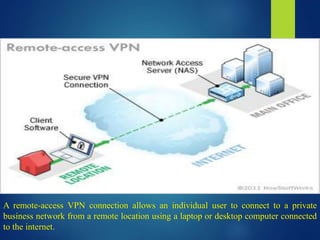
A remote-access VPN connection allows an individual user to connect to a private
business network from a remote location using a laptop or desktop computer connected
to the internet.
Types of VPNs
 Remote access VPN
 Intranet VPN
 Extranet VPN
Types of VPNs
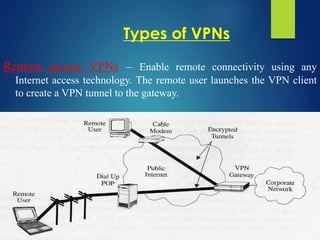
Remote access VPNs – Enable remote connectivity using any
Internet access technology. The remote user launches the VPN client
to create a VPN tunnel to the gateway.
Types of VPNs
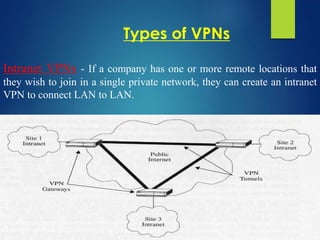
Intranet VPNs - If a company has one or more remote locations that
they wish to join in a single private network, they can create an intranet
VPN to connect LAN to LAN.
Types of VPNs
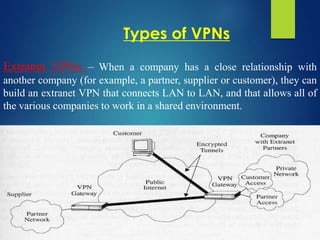
Extranet VPNs – When a company has a close relationship with
another company (for example, a partner, supplier or customer), they can
build an extranet VPN that connects LAN to LAN, and that allows all of
the various companies to work in a shared environment.
Types of VPN protocols
 PPTP--Point-to-Point Tunneling Protocol
 L2TP -- Layer 2 Tunneling Protocol
 IPsec-- Internet Protocol Security
 SSL -- Secure Socket Layer
1.Point-to-Point Tunneling Protocol(PPTP)
PPTP (Point-to-Point Tunneling Protocol) it’s the most widely
supported VPN method among Windows users and it was created by
Microsoft in association with other technology companies. The
disadvantage of PPTP is that it does not provide encryption and it relies
on the PPP (Point-to-Point Protocol) protocol to implement security
measures. But compared to other methods, PPTP is faster and it is also
available for Linux and Mac users.
L2TP (Layer 2 Tunneling Protocol) it’s another tunneling protocol that
supports VPNs. Like PPTP, L2TP does not provide encryption and it
relies on PPP protocol to do this. The difference between PPTP and
L2TP is that the second one provides not only data confidentiality but
also data integrity. L2TP was developed by Microsoft and Cisco as a
combination between PPTP and L2F(Layer 2 Forwarding).
2.Layer 2 Tunneling Protocol(L2TP)
IPsec protocol can be used for encryption in correlation with L2TP
tunneling protocol. It is used as a “protocol suite for securing Internet
Protocol (IP) communications by authenticating and encrypting each IP
packet of a data stream”. IPSec requires expensive, time consuming
client installations and this can be considered an important disadvantage.
3.Internet Protocol Security(IPsec)
SSL (Secure Socket Layer) is a VPN accessible via https over
web browser. The advantage of this SSL VPN is that it doesn’t
need any software installed because it uses the web browser as
the client application. Through SSL VPNs the user’s access
can be restrict to specific applications instead of allowing
access to the whole network.
4.Secure Socket Layer(SSL)
 Eliminate the need for expensive private or leased lines
 Reduce the long-distance telephone charges
 Reduced equipment costs (modem banks, CSU/DSUs)
 Reduced technical support
 Scalability – easy adding of new locations to the VPN
 Security
 Simple Management
 Lower Cost
VPNs - Advantages
VPNs - Disadvantages
 Require an in-depth understanding of public network security issues
and taking proper precautions in VPN deployment.
 The availability and performance of a corporate VPN (over the
Internet) depends on uncontrollable external factors.
 Shortage of standardization. The products from different vendors may
not work well together.
 VPNs need to accommodate complicated protocols other than IP.
Conclusion
VPN is an emerging technology that has come a long way. From an
insecure break off of Public Telephone networks to a powerful business
aid that uses the Internet as its gateway. VPN’s technology is still
developing, and this is a great advantage to businesses, which need to
have technology that is able to scale and grow along with them. With
VPN businesses now have alternative benefits to offer to their
employees, employees can work from home, take care of children while
still doing productive, and have access work related information at
anytime. VPN will also help to make the possibility of a business
expanding its services over long distances and globally, more of a reality.
Virtual Private Network

Virtual Private Network

  • 1.
  • 2.
    CONTENT S  Introduction  Whatis a VPN ?  Types of VPNs  VPN protocols  VPNs - Advantages  VPNs - Disadvantages  Conclusion
  • 3.
    Virtual. Virtual meansnot real or in a different state of being. In a VPN, private communication between two or more devices is achieved through a public network the Internet. Therefore, the communication is virtually but not physically there. Private. Private means to keep something a secret from the general public. Although those two devices are communicating with each other in a public environment, there is no third party who can interrupt this communication or receive any data that is exchanged between them. Network. A network consists of two or more devices that can freely and electronically communicate with each other via cables and wire. A VPN is a network. It can transmit information over long distances effectively and efficiently. Introduction
  • 4.
    contin…. 1. A VPNis a combination of software and hardware that allows mobile employees, telecommuters, business partners, and remote sites to use a public or "unsecured“ medium such as the Internet to establish a secure, private connection with a host network. 2. It uses "virtual" connections routed through the internet from the business's private network to the remote site. 3. VPN extends a private network and the resources contained in the network across public networks like the Internet.
  • 5.
    Virtual Private Network,is defined as a network that uses public network paths but maintains the security and protection of private networks. For example, Delta Company has two locations, one in Noida, New Delhi (A) and Pune, Mumbai (B). In order for both locations to communicate efficiently, Delta Company has the choice to set up private lines between the two locations. Although private lines would restrict public access and extend the use of their bandwidth, it will cost Delta Company a great deal of money since they would have to purchase the communication lines per mile. The more viable option is to implement a VPN. Delta Company can hook their communication lines with a local ISP in both cities. The ISP would act as a middleman, connecting the two locations. This would create an affordable small area network for Delta Company. What is a VPN ?
  • 6.
    A remote-access VPNconnection allows an individual user to connect to a private business network from a remote location using a laptop or desktop computer connected to the internet.
  • 7.
    Types of VPNs Remote access VPN  Intranet VPN  Extranet VPN
  • 8.
    Types of VPNs Remoteaccess VPNs – Enable remote connectivity using any Internet access technology. The remote user launches the VPN client to create a VPN tunnel to the gateway.
  • 9.
    Types of VPNs IntranetVPNs - If a company has one or more remote locations that they wish to join in a single private network, they can create an intranet VPN to connect LAN to LAN.
  • 10.
    Types of VPNs ExtranetVPNs – When a company has a close relationship with another company (for example, a partner, supplier or customer), they can build an extranet VPN that connects LAN to LAN, and that allows all of the various companies to work in a shared environment.
  • 11.
    Types of VPNprotocols  PPTP--Point-to-Point Tunneling Protocol  L2TP -- Layer 2 Tunneling Protocol  IPsec-- Internet Protocol Security  SSL -- Secure Socket Layer
  • 12.
    1.Point-to-Point Tunneling Protocol(PPTP) PPTP(Point-to-Point Tunneling Protocol) it’s the most widely supported VPN method among Windows users and it was created by Microsoft in association with other technology companies. The disadvantage of PPTP is that it does not provide encryption and it relies on the PPP (Point-to-Point Protocol) protocol to implement security measures. But compared to other methods, PPTP is faster and it is also available for Linux and Mac users.
  • 13.
    L2TP (Layer 2Tunneling Protocol) it’s another tunneling protocol that supports VPNs. Like PPTP, L2TP does not provide encryption and it relies on PPP protocol to do this. The difference between PPTP and L2TP is that the second one provides not only data confidentiality but also data integrity. L2TP was developed by Microsoft and Cisco as a combination between PPTP and L2F(Layer 2 Forwarding). 2.Layer 2 Tunneling Protocol(L2TP)
  • 14.
    IPsec protocol canbe used for encryption in correlation with L2TP tunneling protocol. It is used as a “protocol suite for securing Internet Protocol (IP) communications by authenticating and encrypting each IP packet of a data stream”. IPSec requires expensive, time consuming client installations and this can be considered an important disadvantage. 3.Internet Protocol Security(IPsec)
  • 15.
    SSL (Secure SocketLayer) is a VPN accessible via https over web browser. The advantage of this SSL VPN is that it doesn’t need any software installed because it uses the web browser as the client application. Through SSL VPNs the user’s access can be restrict to specific applications instead of allowing access to the whole network. 4.Secure Socket Layer(SSL)
  • 16.
     Eliminate theneed for expensive private or leased lines  Reduce the long-distance telephone charges  Reduced equipment costs (modem banks, CSU/DSUs)  Reduced technical support  Scalability – easy adding of new locations to the VPN  Security  Simple Management  Lower Cost VPNs - Advantages
  • 17.
    VPNs - Disadvantages Require an in-depth understanding of public network security issues and taking proper precautions in VPN deployment.  The availability and performance of a corporate VPN (over the Internet) depends on uncontrollable external factors.  Shortage of standardization. The products from different vendors may not work well together.  VPNs need to accommodate complicated protocols other than IP.
  • 18.
    Conclusion VPN is anemerging technology that has come a long way. From an insecure break off of Public Telephone networks to a powerful business aid that uses the Internet as its gateway. VPN’s technology is still developing, and this is a great advantage to businesses, which need to have technology that is able to scale and grow along with them. With VPN businesses now have alternative benefits to offer to their employees, employees can work from home, take care of children while still doing productive, and have access work related information at anytime. VPN will also help to make the possibility of a business expanding its services over long distances and globally, more of a reality.