VIRTUAL PRIVATE
   NETWORK


          Presented by:
          Shradha Maheshwari
          CS-08
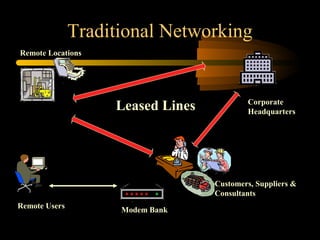
Traditional Networking
Remote Locations


                                           Corporate
                    Leased Lines           Headquarters


                                   Customers, Suppliers &
                                   Consultants
Remote Users         Modem Bank
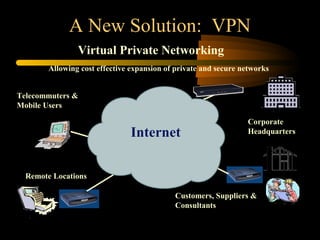
A New Solution: VPN
                Virtual Private Networking
        Allowing cost effective expansion of private and secure networks


Telecommuters &
Mobile Users

                                                                 Corporate
                               Internet                          Headquarters


  Remote Locations

                                            Customers, Suppliers &
                                            Consultants
VPN Introduction
• Virtual Private Network is a type of private
  network that uses public telecommunication,
  such as the Internet, instead of leased lines to
  communicate.

• Users only make a local call to the ISP instead
  of expensive long distance telephone calls to
  the remote access server.
Types of VPN
 TRUSTED VPN:
  Use dedicated circuitry.
  Path must be set and consistent.
  Rely on the security of a single provider’s network
   to protect the traffic.
                Technologies used
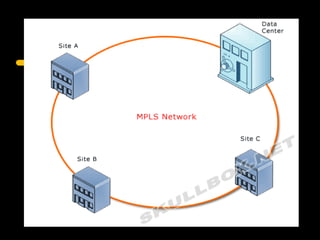
  MPLS and L2F
 SECURE VPN:
  All traffic is encrypted and authenticated
  The security properties of the VPN must be agreed
  to by all parties in the VPN.
  No one outside the VPN can affect the security
  properties of the VPN.
               Technologies used
 IPSec
 SSL/TLS
 PPTP
HYBRID VPN:

  The address boundaries of the secure VPN within the
  trusted VPN must be extremely clear.


                Technologies used
 Any supported secure VPN technologies running
  over any supported trusted VPN technology.
Brief Overview Of How VPN
               Works
1. Two connections – one is made to the Internet
   and the second is made to the VPN.
2. Datagrams – contains data, destination and
   source information.
3. Firewalls – VPNs allow authorized users to
   pass through the firewalls.
4. Protocols – protocols create the VPN tunnels.
Four Critical Functions
• Authentication – validates that the data was
  sent by the sender.
• Access control – limiting unauthorized users
  from accessing the network.
• Confidentiality – preventing the data to be read
  or copied as the data is being transported.
• Data Integrity – ensuring that the data has not
  been altered
VPN Security
 Encryption

 AAA servers

 IPSec

 Firewalls
Encryption
• It is a method of “scrambling” data before
  transmitting it onto the Internet.

• Two common techniques used for encryption
  are:
    a) Symmetric key encryption
    b) Public key encryption
AAA Servers
• Authentication in VPN is determining if the remote
  VPN user is who or what it is declared to be.
• The use of digital certificates is considered as the
  strong mechanism for authentication.
• Authorization in VPN is determining what the user is
  allowed to do.
• Accounting in VPN is determining what the user
  actually does.
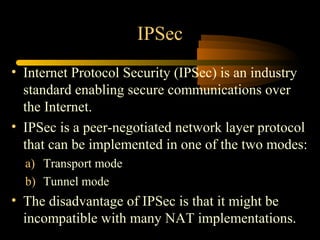
IPSec
• Internet Protocol Security (IPSec) is an industry
  standard enabling secure communications over
  the Internet.
• IPSec is a peer-negotiated network layer protocol
  that can be implemented in one of the two modes:
  a) Transport mode
  b) Tunnel mode
• The disadvantage of IPSec is that it might be
  incompatible with many NAT implementations.
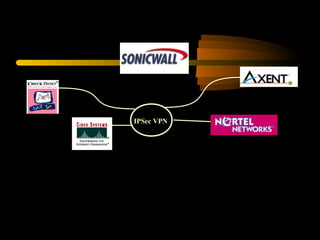
IPSec VPN
SSL/TLS
• TLS and it’s predecessor, SSL, are cryptographic
  protocols that provide communications security
  over the Internet.

• Operate at the session layer.

• It can force the browser to run applets.
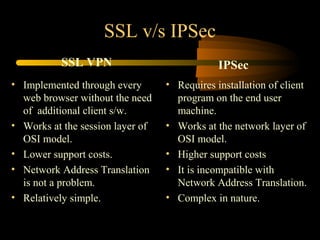
SSL v/s IPSec
           SSL VPN                            IPSec
• Implemented through every       • Requires installation of client
  web browser without the need      program on the end user
  of additional client s/w.         machine.
• Works at the session layer of   • Works at the network layer of
  OSI model.                        OSI model.
• Lower support costs.            • Higher support costs
• Network Address Translation     • It is incompatible with
  is not a problem.                 Network Address Translation.
• Relatively simple.              • Complex in nature.
Firewalls

• Monitors traffic crossing network
  parameters and protects enterprises from
  unauthorized access.
• Packet-level firewall checks source and
  destination.
• Application-level firewall acts as a host
  computer between the organization’s
  network and the Internet.
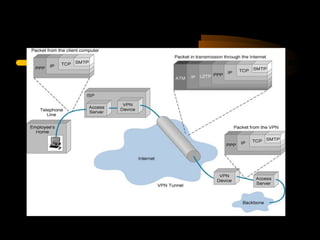
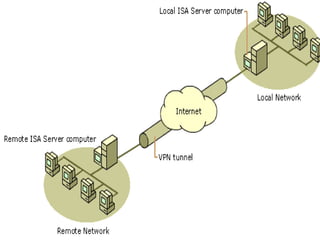
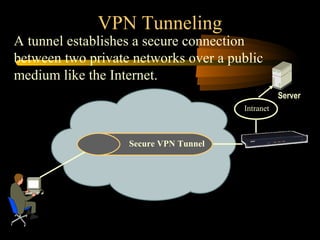
VPN Tunneling
A tunnel establishes a secure connection
between two private networks over a public
medium like the Internet.
                                                  Server
                                       Intranet


                   Secure VPN Tunnel
• A VPN tunnel software has a management
  protocol that creates, maintains and terminates
  a tunnel.

• Data is transferred through the VPN tunnel
  using a datagram based protocol.

• PPTP-Point to point tunneling protocol/L2TP-
  Layer 2 Tunneling protocol encapsulates
  private network traffic in packets to be
  transmitted over public networks (TCP/IP).
Original Datagram


              Encrypted inner datagram


Datagram Header   Outer Datagram Data Area


 Data encapsulation[from corner]
PPTP

• It is a proposed standard sponsored by
  Microsoft and other companies.
• PPTP creates another layer of security
  within TCP/IP.
• It encapsulates IP packets for transmission
  over an IP based network.
• Main benefit- You can create a link from
  any network with Internet access.
L2TP

• Represents the best features of PPTP nad
  L2F protocol.
• L2TP can be used over the internet as well
  as over private intranets.
• It sets up an IP security connection thereby
  making the VPN connection more secure.
• Provides data confidentiality which is not
  present in PPTP.
Two types of tunneling
• Voluntary Tunneling: In this the client starts the
  process of initiating a connection with the VPN server.
  In this case the user's computer is the end point and acts
  as a VPN client.
• Compulsory Tunneling: In this the connection is
  created between two VPN servers and two VPN access
  devices i.e. the routers. In this the user computer is not
  the end point.

  VPN tunnels can be created either at the data link layer
  or at the network layer of the OSI model.
Advantages
• Eliminating the need for expensive long-
  distance leased lines.
• Reducing the long-distance telephone
  charges for remote access.
• Greater scalability and easy to add/remove
  users.
• Centralization of shared data.
Disadvantages
• VPNs require an in-depth understanding of
  public network security issues and proper
  deployment of precautions
• Availability and performance depends on
  factors largely outside of their control
• VPNs need to accommodate protocols other
  than IP and existing internal network
  technology
• Unpredictable Internet traffic
Industries that may use VPN
•   Healthcare
•   Manufacturing
•   Retail
•   Banking/Financial
•   General business
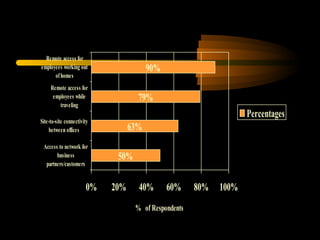
Remote access for
employees working out                   90%
      of homes
     Remote access for
      employees while               79%
         traveling
                                                                   Percentages
Site-to-site connectivity
    between offices               63%
 Access to network for
       business              50%
  partners/customers


                       0%   20%     40%       60%     80%   100%
                                   % of Respondents
Implementation

• Can be done in following ways:
  1. Site-to-site connection:
     Intranet :      within an organization
     Extranet :      outside an organization
  1. Remote access : employee to business
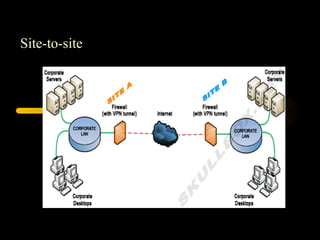
Site-to-site
Applications of site-to-site vpn
• Large-scale encryption between multiple fixed
  sites such as remote offices and central offices.

• Network traffic is sent over the branch office
  Internet connection.

• This saves the company hardware and
  management expenses
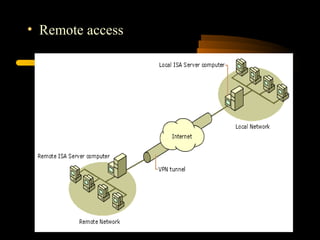
• Remote access
Applications of remote access
• Encrypted connections between mobile or
  remote users and their corporate networks
• Remote user can make a local call to an ISP, as
  opposed to a long distance call to the corporate
  remote access server.
• Ideal for a telecommuter or mobile sales people.
• VPN allows mobile workers & telecommuters to
  take advantage of broadband connectivity i.e.
  DSL, Cable.
REFERENCES

• Mitchell, Bradley. "VPN Tutorial." About.Com. 2007. 8 Mar. 2007
  <http://compnetworking.about.com/od/vpn/l/aa010701a.htm>.

• Tyson, Jeff. "How Virtual Private Networks Work." How Stuff
  Works. 6 Mar. 2007 <http://computer.howstuffworks.com/vpn.htm>.

• "Virtual Private Network." Wikipedia: the Free Encyclopedia. 6 Mar.
  2007. 9 Mar. 2007 <http://en.wikipedia.org/wiki/Vpn>.

• http://compnetworking.about.com/od/vpn/VPN_Virtual_Private_Netw
  orking.htm
• http://www.authorstream.com/Presentation/quangthanh-168465-vpn-
  abc-entertainment-ppt-powerpoint/
• www.vpntools.com
THANK YOU
ANY QUERIES??

Shradhamaheshwari vpn

  • 1.
    VIRTUAL PRIVATE NETWORK Presented by: Shradha Maheshwari CS-08
  • 2.
    Traditional Networking Remote Locations Corporate Leased Lines Headquarters Customers, Suppliers & Consultants Remote Users Modem Bank
  • 3.
    A New Solution:VPN Virtual Private Networking Allowing cost effective expansion of private and secure networks Telecommuters & Mobile Users Corporate Internet Headquarters Remote Locations Customers, Suppliers & Consultants
  • 4.
    VPN Introduction • VirtualPrivate Network is a type of private network that uses public telecommunication, such as the Internet, instead of leased lines to communicate. • Users only make a local call to the ISP instead of expensive long distance telephone calls to the remote access server.
  • 5.
    Types of VPN TRUSTED VPN:  Use dedicated circuitry.  Path must be set and consistent.  Rely on the security of a single provider’s network to protect the traffic. Technologies used  MPLS and L2F
  • 7.
     SECURE VPN:  All traffic is encrypted and authenticated  The security properties of the VPN must be agreed to by all parties in the VPN.  No one outside the VPN can affect the security properties of the VPN. Technologies used IPSec SSL/TLS PPTP
  • 8.
    HYBRID VPN: The address boundaries of the secure VPN within the trusted VPN must be extremely clear. Technologies used Any supported secure VPN technologies running over any supported trusted VPN technology.
  • 9.
    Brief Overview OfHow VPN Works 1. Two connections – one is made to the Internet and the second is made to the VPN. 2. Datagrams – contains data, destination and source information. 3. Firewalls – VPNs allow authorized users to pass through the firewalls. 4. Protocols – protocols create the VPN tunnels.
  • 11.
    Four Critical Functions •Authentication – validates that the data was sent by the sender. • Access control – limiting unauthorized users from accessing the network. • Confidentiality – preventing the data to be read or copied as the data is being transported. • Data Integrity – ensuring that the data has not been altered
  • 12.
    VPN Security  Encryption AAA servers  IPSec  Firewalls
  • 13.
    Encryption • It isa method of “scrambling” data before transmitting it onto the Internet. • Two common techniques used for encryption are: a) Symmetric key encryption b) Public key encryption
  • 14.
    AAA Servers • Authenticationin VPN is determining if the remote VPN user is who or what it is declared to be. • The use of digital certificates is considered as the strong mechanism for authentication. • Authorization in VPN is determining what the user is allowed to do. • Accounting in VPN is determining what the user actually does.
  • 15.
    IPSec • Internet ProtocolSecurity (IPSec) is an industry standard enabling secure communications over the Internet. • IPSec is a peer-negotiated network layer protocol that can be implemented in one of the two modes: a) Transport mode b) Tunnel mode • The disadvantage of IPSec is that it might be incompatible with many NAT implementations.
  • 16.
  • 17.
    SSL/TLS • TLS andit’s predecessor, SSL, are cryptographic protocols that provide communications security over the Internet. • Operate at the session layer. • It can force the browser to run applets.
  • 18.
    SSL v/s IPSec SSL VPN IPSec • Implemented through every • Requires installation of client web browser without the need program on the end user of additional client s/w. machine. • Works at the session layer of • Works at the network layer of OSI model. OSI model. • Lower support costs. • Higher support costs • Network Address Translation • It is incompatible with is not a problem. Network Address Translation. • Relatively simple. • Complex in nature.
  • 19.
    Firewalls • Monitors trafficcrossing network parameters and protects enterprises from unauthorized access. • Packet-level firewall checks source and destination. • Application-level firewall acts as a host computer between the organization’s network and the Internet.
  • 20.
    VPN Tunneling A tunnelestablishes a secure connection between two private networks over a public medium like the Internet. Server Intranet Secure VPN Tunnel
  • 21.
    • A VPNtunnel software has a management protocol that creates, maintains and terminates a tunnel. • Data is transferred through the VPN tunnel using a datagram based protocol. • PPTP-Point to point tunneling protocol/L2TP- Layer 2 Tunneling protocol encapsulates private network traffic in packets to be transmitted over public networks (TCP/IP).
  • 22.
    Original Datagram Encrypted inner datagram Datagram Header Outer Datagram Data Area Data encapsulation[from corner]
  • 23.
    PPTP • It isa proposed standard sponsored by Microsoft and other companies. • PPTP creates another layer of security within TCP/IP. • It encapsulates IP packets for transmission over an IP based network. • Main benefit- You can create a link from any network with Internet access.
  • 24.
    L2TP • Represents thebest features of PPTP nad L2F protocol. • L2TP can be used over the internet as well as over private intranets. • It sets up an IP security connection thereby making the VPN connection more secure. • Provides data confidentiality which is not present in PPTP.
  • 25.
    Two types oftunneling • Voluntary Tunneling: In this the client starts the process of initiating a connection with the VPN server. In this case the user's computer is the end point and acts as a VPN client. • Compulsory Tunneling: In this the connection is created between two VPN servers and two VPN access devices i.e. the routers. In this the user computer is not the end point. VPN tunnels can be created either at the data link layer or at the network layer of the OSI model.
  • 27.
    Advantages • Eliminating theneed for expensive long- distance leased lines. • Reducing the long-distance telephone charges for remote access. • Greater scalability and easy to add/remove users. • Centralization of shared data.
  • 28.
    Disadvantages • VPNs requirean in-depth understanding of public network security issues and proper deployment of precautions • Availability and performance depends on factors largely outside of their control • VPNs need to accommodate protocols other than IP and existing internal network technology • Unpredictable Internet traffic
  • 29.
    Industries that mayuse VPN • Healthcare • Manufacturing • Retail • Banking/Financial • General business
  • 30.
    Remote access for employeesworking out 90% of homes Remote access for employees while 79% traveling Percentages Site-to-site connectivity between offices 63% Access to network for business 50% partners/customers 0% 20% 40% 60% 80% 100% % of Respondents
  • 31.
    Implementation • Can bedone in following ways: 1. Site-to-site connection:  Intranet : within an organization  Extranet : outside an organization 1. Remote access : employee to business
  • 32.
  • 33.
    Applications of site-to-sitevpn • Large-scale encryption between multiple fixed sites such as remote offices and central offices. • Network traffic is sent over the branch office Internet connection. • This saves the company hardware and management expenses
  • 34.
  • 35.
    Applications of remoteaccess • Encrypted connections between mobile or remote users and their corporate networks • Remote user can make a local call to an ISP, as opposed to a long distance call to the corporate remote access server. • Ideal for a telecommuter or mobile sales people. • VPN allows mobile workers & telecommuters to take advantage of broadband connectivity i.e. DSL, Cable.
  • 36.
    REFERENCES • Mitchell, Bradley."VPN Tutorial." About.Com. 2007. 8 Mar. 2007 <http://compnetworking.about.com/od/vpn/l/aa010701a.htm>. • Tyson, Jeff. "How Virtual Private Networks Work." How Stuff Works. 6 Mar. 2007 <http://computer.howstuffworks.com/vpn.htm>. • "Virtual Private Network." Wikipedia: the Free Encyclopedia. 6 Mar. 2007. 9 Mar. 2007 <http://en.wikipedia.org/wiki/Vpn>. • http://compnetworking.about.com/od/vpn/VPN_Virtual_Private_Netw orking.htm • http://www.authorstream.com/Presentation/quangthanh-168465-vpn- abc-entertainment-ppt-powerpoint/ • www.vpntools.com
  • 37.
  • 38.

Editor's Notes

  • #3 33778 SonicWall.ppt #
  • #4 33778 SonicWall.ppt #