


Presented by

Or Sereiparinha
Phan Chhunlong
VPN
Introduction
What is VPN?
∞ Virtual Private Network is a type of private network that uses
public telecommunication, such as the Internet, instead of leased
lines to communicate.
VPN & Non-VPN
Virtual Private Network

Non - Private Network

∞ Advantages of private and
global internet
∞ Privatization is done by leased
line
∞ Cost inefficient

∞ Completely isolated network
from world
∞ Unsecured connection
∞ Costlier
How VPN Works ?
Tunneling
What is Tunnel?
∞
∞
∞

VPN technology
Maintaining a logical network connection
The process of placing an entire packet
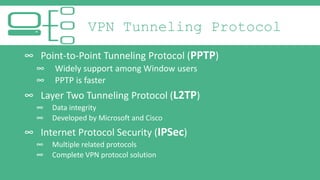
VPN Tunneling Protocol
∞ Point-to-Point Tunneling Protocol (PPTP)
∞
∞

Widely support among Window users
PPTP is faster

∞ Layer Two Tunneling Protocol (L2TP)
∞
∞

Data integrity
Developed by Microsoft and Cisco

∞ Internet Protocol Security (IPSec)
∞
∞

Multiple related protocols
Complete VPN protocol solution
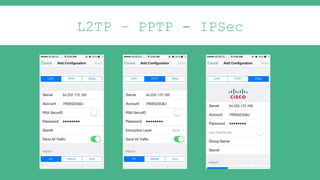
L2TP – PPTP - IPSec
Types of VPNs
∞ Remote access VPN
∞
∞

To establish secure connection
Client software

∞ Intranet VPN
∞
∞

Link corporate headquarters remote offices
Reduces WAN bandwidth & Connect new sites easily

∞ Extranet VPN
∞ Link customer, suppliers, partner of interest to corporate intranet
Over a shared using dedicated connection
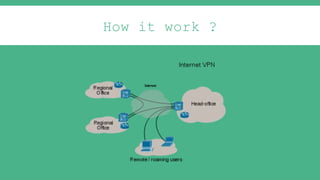
How it work ?
Firewall
∞ Firewall ?
∞
∞

Provides network security
Prevents attacks and secures your data

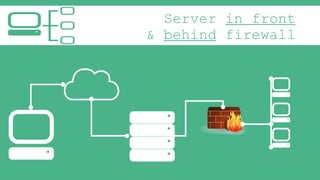
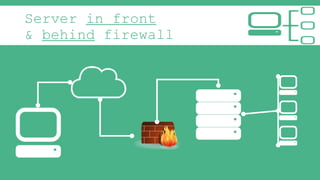
∞ Two approaches to using firewall with VPN server
∞
∞

VPN server in front of the firewall
VPN server behind the firewall
Server in front
& behind firewall
Server in front
& behind firewall
mVPN

∞

What is mVPN?
∞ Mobile device with access to network resources and software
application on their home network
Advantages & Disadvantages
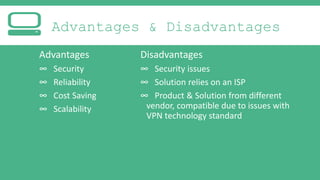
Advantages

Disadvantages

∞
∞
∞
∞

∞ Security issues
∞ Solution relies on an ISP
∞ Product & Solution from different
vendor, compatible due to issues with
VPN technology standard

Security
Reliability
Cost Saving
Scalability
5mn Before Demo ?

Virtual Private Network