Virtual Private Network
(VPN)
Presented By :Binod P Poudel
Topic covered
▪ Overview ofVPN
▪ Working ofVPN
▪ Types ofVPN
▪ Advantage and Disadvantage ofVPN
▪ Future ofVPN
Overview of VPN
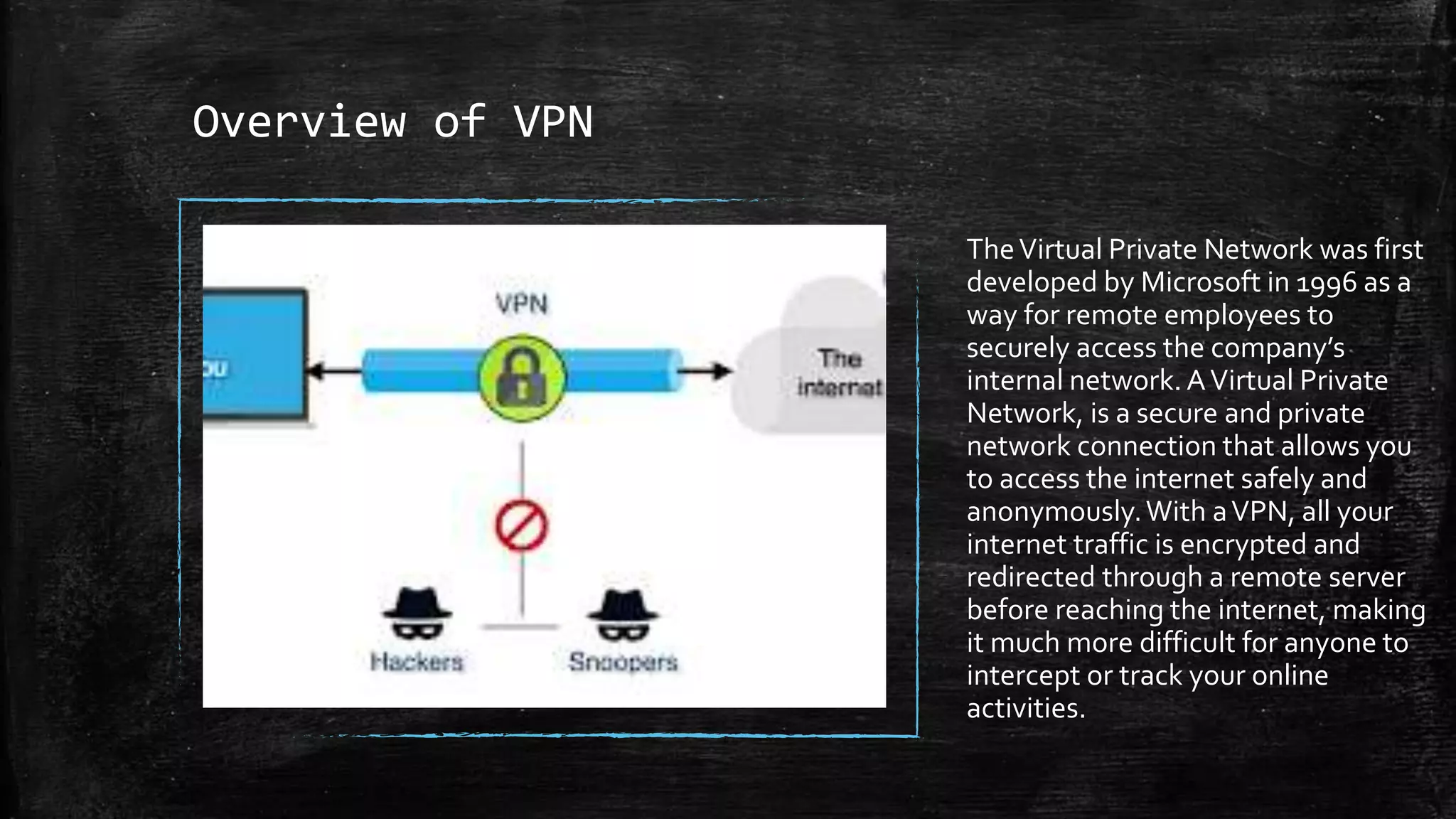
TheVirtual Private Network was first
developed by Microsoft in 1996 as a
way for remote employees to
securely access the company’s
internal network.AVirtual Private
Network, is a secure and private
network connection that allows you
to access the internet safely and
anonymously.With aVPN, all your
internet traffic is encrypted and
redirected through a remote server
before reaching the internet, making
it much more difficult for anyone to
intercept or track your online
activities.
Understanding working of VPN in
layman's terms
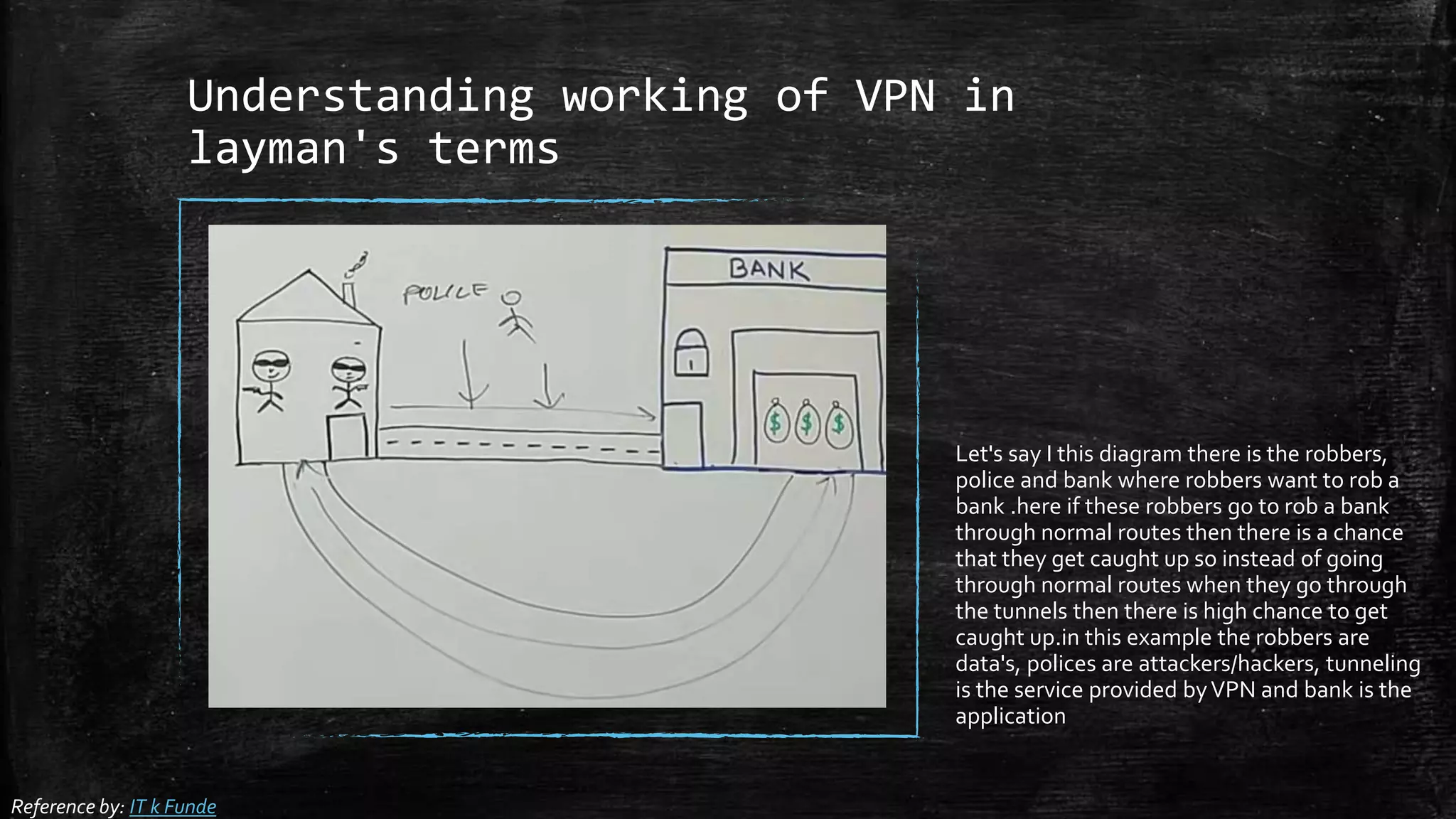
Let's say I this diagram there is the robbers,
police and bank where robbers want to rob a
bank .here if these robbers go to rob a bank
through normal routes then there is a chance
that they get caught up so instead of going
through normal routes when they go through
the tunnels then there is high chance to get
caught up.in this example the robbers are
data's, polices are attackers/hackers, tunneling
is the service provided byVPN and bank is the
application
Reference by: IT k Funde
Working Of VPN
• Connection:When you connect to aVPN, your
device sends a request to theVPN server to
establish a secure connection.
• Encryption: Once the connection is established,
all the data that you send and receive is
encrypted.This means that the data is
transformed into a code to prevent
unauthorized access.
• Tunneling:The encrypted data is then sent
through a virtual tunnel between your device
and theVPN server.This virtual tunnel provides
a secure and private connection.
• Decryption:When the encrypted data reaches
theVPN server, it is decrypted and sent to its
intended destination on the internet.The same
process happens in reverse for incoming data.
• Remote IP address:TheVPN server assigns
your device a new IP address that appears to be
from the location of theVPN server.This masks
your real IP address and location, providing
anonymity and bypassing geo-restrictions.
• Data transmission:With aVPN connection
established, all your internet traffic is
transmitted securely and privately through the
VPN server.
Types of VPN
▪ Site-To-SiteVPN
▪ Remote AccessVPN
▪ MobileVPN
▪ IntranetVPN
Site-To-Site VPN
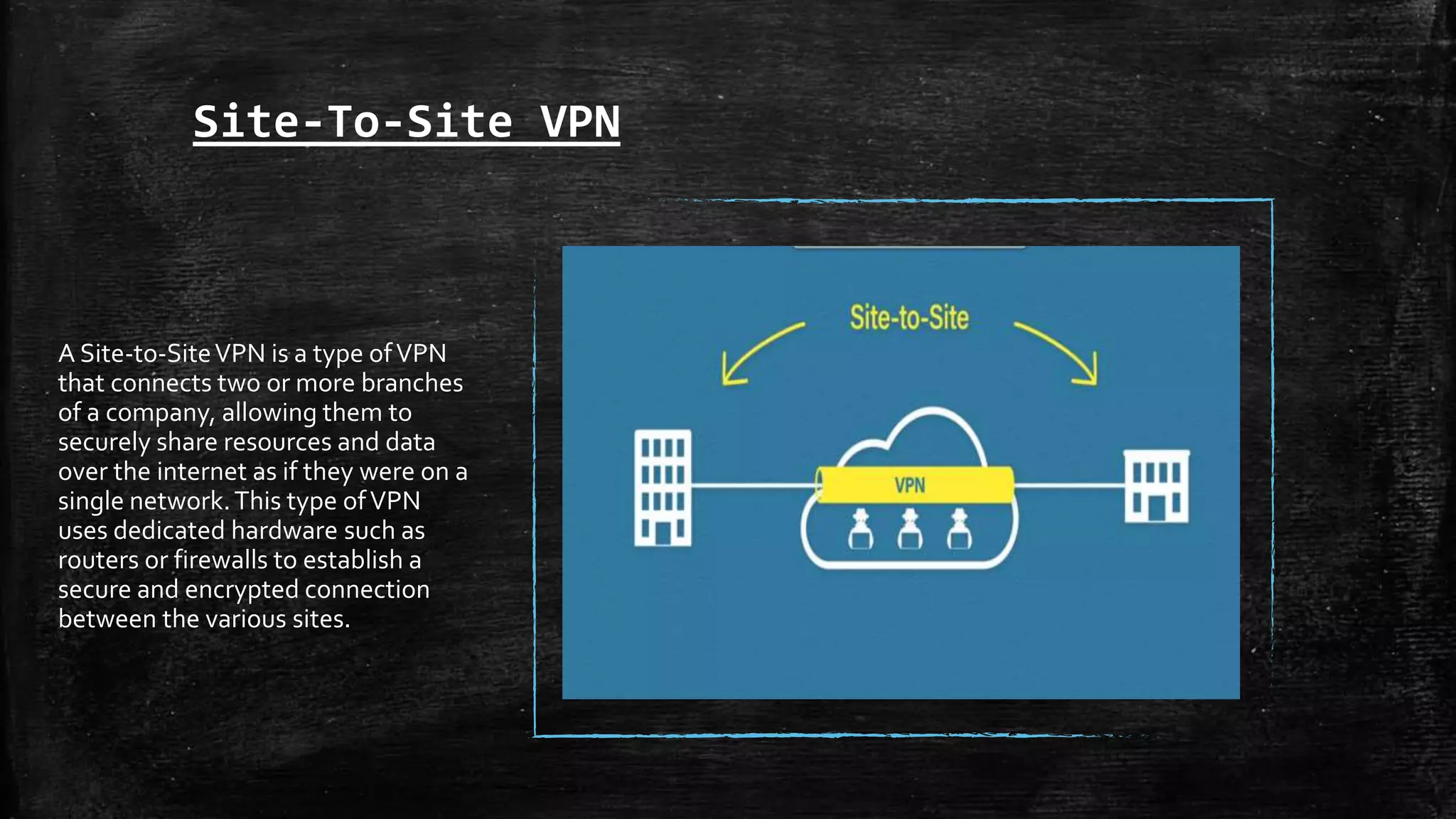
A Site-to-SiteVPN is a type ofVPN
that connects two or more branches
of a company, allowing them to
securely share resources and data
over the internet as if they were on a
single network.This type ofVPN
uses dedicated hardware such as
routers or firewalls to establish a
secure and encrypted connection
between the various sites.
Continue...
MobileVPN
A MobileVPN is a type ofVPN designed
for mobile devices such as smartphones
and tablets.This type ofVPN uses
software that can be easily installed on
mobile devices, allowing the user to
access the internet securely from
anywhere.
IntranetVPN
An IntranetVPN is a type ofVPN that
connects employees within a company
to a private network.This type ofVPN
allows employees to securely access
internal resources and sensitive data,
even when they are working remotely.
Advantage Of VPN
▪ Security: VPNs provide a high level of security by encrypting all internet traffic between
the user's device and theVPN server.This helps to protect sensitive information and
privacy, and prevents unauthorized access to data.
▪ Anonymity: VPNs allow users to browse the web anonymously by hiding their IP
address and location.This helps to protect against online tracking and monitoring, and
can also help users to access websites and services that are blocked in their country.
▪ Remote Access: VPNs provide remote workers, travelers, or users from different
locations with secure access to a company's network as if they were physically present
in the office.This makes it easier for employees to work remotely and access internal
resources securely.
▪ Cost Savings: VPNs can help companies to save money on communication costs by
allowing employees to securely share files and data over the internet, reducing the
need for physical meetings and travel.
Disadvantage Of VPN
▪ Speed: Encrypting and decrypting data over aVPN can slow down internet speeds,
especially if theVPN server is far from the user's location.
▪ Cost: VPNs can be expensive, especially for businesses that need to provideVPN
access to many users.
▪ Trust: VPN providers are responsible for maintaining the privacy and security of user
data, and users must trust that the provider will take the necessary steps to protect
their information.
▪ Logging: SomeVPN providers keep logs of user activity, which could potentially be
used to track users' online activity.This is a privacy concern for users who want to
maintain anonymity online.
Future of VPN
The future ofVPNs looks promising as more and more people become aware of the importance of
online privacy and security.With the increasing use of the internet for sensitive transactions, remote
work, and online activities, the demand forVPNs is likely to grow. Here are a few trends and
advancements that could shape the future ofVPNs:
▪ IncreasedAdoption:With the growing concern for privacy and security online, it is
likely that more individuals and businesses will adoptVPNs to protect their data
and online activities.
▪ 5G Support:The roll-out of 5G networks will bring faster internet speeds and
improved connectivity, which could makeVPNs even more important for privacy
and security.VPNs will be able to take advantage of these new networks to provide
faster and more reliable connections.
▪ Virtual Reality:The growing use of virtual reality (VR) technology could increase
the need forVPNs, asVR requires large amounts of data to be transmitted securely
and in real-time.
▪ Greater Regulation:With increasing concern about privacy and security online, it is
possible that governments will impose stricter regulations onVPN providers, which
could impact the wayVPNs are used and the services they offer.
Thank you!
Hope I left you with no queries

Presentation on VPN

  • 1.
  • 2.
    Topic covered ▪ OverviewofVPN ▪ Working ofVPN ▪ Types ofVPN ▪ Advantage and Disadvantage ofVPN ▪ Future ofVPN
  • 3.
    Overview of VPN TheVirtualPrivate Network was first developed by Microsoft in 1996 as a way for remote employees to securely access the company’s internal network.AVirtual Private Network, is a secure and private network connection that allows you to access the internet safely and anonymously.With aVPN, all your internet traffic is encrypted and redirected through a remote server before reaching the internet, making it much more difficult for anyone to intercept or track your online activities.
  • 4.
    Understanding working ofVPN in layman's terms Let's say I this diagram there is the robbers, police and bank where robbers want to rob a bank .here if these robbers go to rob a bank through normal routes then there is a chance that they get caught up so instead of going through normal routes when they go through the tunnels then there is high chance to get caught up.in this example the robbers are data's, polices are attackers/hackers, tunneling is the service provided byVPN and bank is the application Reference by: IT k Funde
  • 5.
    Working Of VPN •Connection:When you connect to aVPN, your device sends a request to theVPN server to establish a secure connection. • Encryption: Once the connection is established, all the data that you send and receive is encrypted.This means that the data is transformed into a code to prevent unauthorized access. • Tunneling:The encrypted data is then sent through a virtual tunnel between your device and theVPN server.This virtual tunnel provides a secure and private connection. • Decryption:When the encrypted data reaches theVPN server, it is decrypted and sent to its intended destination on the internet.The same process happens in reverse for incoming data. • Remote IP address:TheVPN server assigns your device a new IP address that appears to be from the location of theVPN server.This masks your real IP address and location, providing anonymity and bypassing geo-restrictions. • Data transmission:With aVPN connection established, all your internet traffic is transmitted securely and privately through the VPN server.
  • 6.
    Types of VPN ▪Site-To-SiteVPN ▪ Remote AccessVPN ▪ MobileVPN ▪ IntranetVPN
  • 7.
    Site-To-Site VPN A Site-to-SiteVPNis a type ofVPN that connects two or more branches of a company, allowing them to securely share resources and data over the internet as if they were on a single network.This type ofVPN uses dedicated hardware such as routers or firewalls to establish a secure and encrypted connection between the various sites.
  • 8.
    Continue... MobileVPN A MobileVPN isa type ofVPN designed for mobile devices such as smartphones and tablets.This type ofVPN uses software that can be easily installed on mobile devices, allowing the user to access the internet securely from anywhere. IntranetVPN An IntranetVPN is a type ofVPN that connects employees within a company to a private network.This type ofVPN allows employees to securely access internal resources and sensitive data, even when they are working remotely.
  • 9.
    Advantage Of VPN ▪Security: VPNs provide a high level of security by encrypting all internet traffic between the user's device and theVPN server.This helps to protect sensitive information and privacy, and prevents unauthorized access to data. ▪ Anonymity: VPNs allow users to browse the web anonymously by hiding their IP address and location.This helps to protect against online tracking and monitoring, and can also help users to access websites and services that are blocked in their country. ▪ Remote Access: VPNs provide remote workers, travelers, or users from different locations with secure access to a company's network as if they were physically present in the office.This makes it easier for employees to work remotely and access internal resources securely. ▪ Cost Savings: VPNs can help companies to save money on communication costs by allowing employees to securely share files and data over the internet, reducing the need for physical meetings and travel.
  • 10.
    Disadvantage Of VPN ▪Speed: Encrypting and decrypting data over aVPN can slow down internet speeds, especially if theVPN server is far from the user's location. ▪ Cost: VPNs can be expensive, especially for businesses that need to provideVPN access to many users. ▪ Trust: VPN providers are responsible for maintaining the privacy and security of user data, and users must trust that the provider will take the necessary steps to protect their information. ▪ Logging: SomeVPN providers keep logs of user activity, which could potentially be used to track users' online activity.This is a privacy concern for users who want to maintain anonymity online.
  • 11.
    Future of VPN Thefuture ofVPNs looks promising as more and more people become aware of the importance of online privacy and security.With the increasing use of the internet for sensitive transactions, remote work, and online activities, the demand forVPNs is likely to grow. Here are a few trends and advancements that could shape the future ofVPNs: ▪ IncreasedAdoption:With the growing concern for privacy and security online, it is likely that more individuals and businesses will adoptVPNs to protect their data and online activities. ▪ 5G Support:The roll-out of 5G networks will bring faster internet speeds and improved connectivity, which could makeVPNs even more important for privacy and security.VPNs will be able to take advantage of these new networks to provide faster and more reliable connections. ▪ Virtual Reality:The growing use of virtual reality (VR) technology could increase the need forVPNs, asVR requires large amounts of data to be transmitted securely and in real-time. ▪ Greater Regulation:With increasing concern about privacy and security online, it is possible that governments will impose stricter regulations onVPN providers, which could impact the wayVPNs are used and the services they offer.
  • 12.
    Thank you! Hope Ileft you with no queries