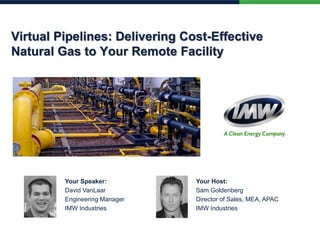
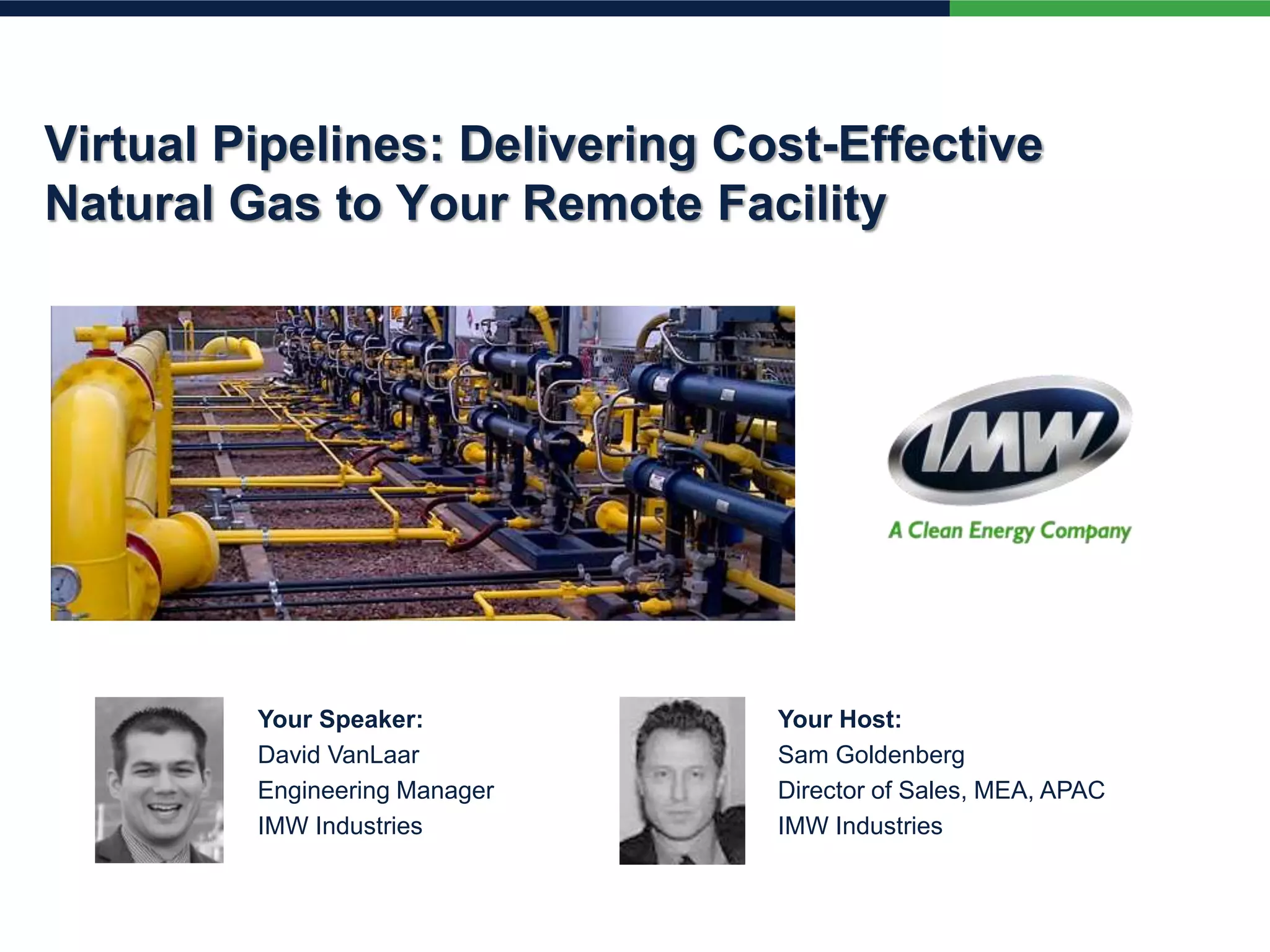

Virtual Pipelines: Delivering Cost-Effective
Natural Gas to Your Remote Facility
Your Speaker:
David VanLaar
Engineering Manager
IMW Industries
Your Host:
Sam Goldenberg
Director of Sales, MEA, APAC
IMW Industries
About IMW
IMW has been manufacturing industrial machinery since 1912, and has evolved to be a leading
manufacturer of natural gas compression systems, serving all major markets Globally. Equipment
is currently operating mid-east to North of the Arctic Circle.
• Quality Products & Leader in CNG Compression
• Non-Lubricated Compression for Clean CNG
A variety of configurations for all applications
A Clean Energy Company
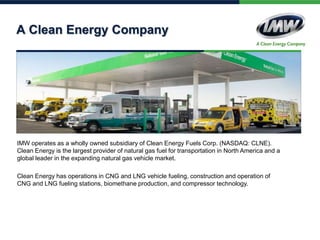
IMW operates as a wholly owned subsidiary of Clean Energy Fuels Corp. (NASDAQ: CLNE).
Clean Energy is the largest provider of natural gas fuel for transportation in North America and a
global leader in the expanding natural gas vehicle market.
Clean Energy has operations in CNG and LNG vehicle fueling, construction and operation of
CNG and LNG fueling stations, biomethane production, and compressor technology.
Your Speaker
David VanLaar, P. Eng
Manager, Product Solutions Group &
Engineering
IMW Industries
Compressed natural gas (CNG):
 composed of approximately 95 percent methane
 normally stored at 3,600 psi (250 bar) in specially
designed containers
 stays in a gaseous form
 typically compressed from a transmission or distribution
pipeline
 30% lower cost than other fuels
 30-40% fewer greenhouse gases during
combustion than other fuels
Overview of Natural Gas and CNG
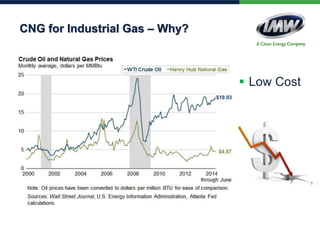
CNG for Industrial Gas – Why?
 Low Cost
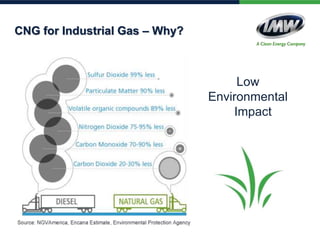
CNG for Industrial Gas – Why?
Low
Environmental
Impact
CNG for Industrial Gas – Why?
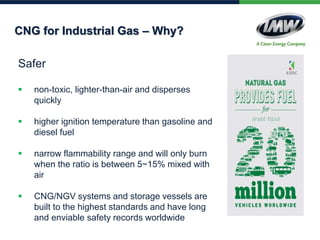
Safer
 non-toxic, lighter-than-air and disperses
quickly
 higher ignition temperature than gasoline and
diesel fuel
 narrow flammability range and will only burn
when the ratio is between 5~15% mixed with
air
 CNG/NGV systems and storage vessels are
built to the highest standards and have long
and enviable safety records worldwide
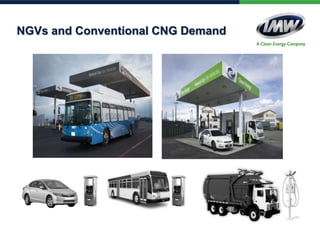
NGVs and Conventional CNG Demand
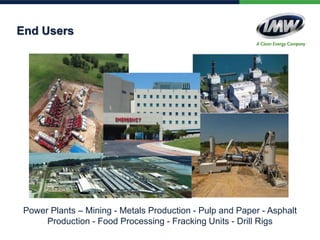
End Users
Power Plants – Mining - Metals Production - Pulp and Paper - Asphalt
Production - Food Processing - Fracking Units - Drill Rigs
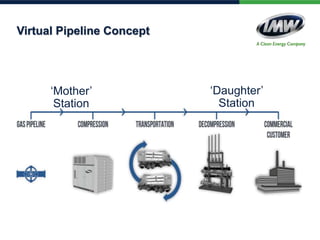
Virtual Pipeline Concept
‘Mother’
Station
‘Daughter’
Station
Main Components
 Typically transmission lines (300 psi / 20 bar – 1000
psi / 70 bar)
 Higher pressure means less compression is required
– less energy consumption
 Location of mother station is often flexible
 Require gas with low water content or use gas dryer
 Require natural gas with >90% methane
Pipeline – Gas Source
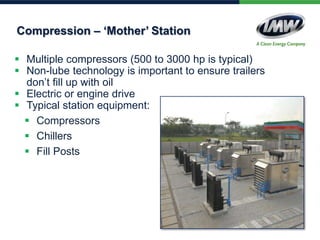
 Multiple compressors (500 to 3000 hp is typical)
 Non-lube technology is important to ensure trailers
don’t fill up with oil
 Electric or engine drive
 Typical station equipment:
 Compressors
 Chillers
 Fill Posts
Compression – ‘Mother’ Station
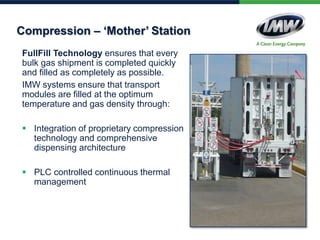
FullFill Technology ensures that every
bulk gas shipment is completed quickly
and filled as completely as possible.
IMW systems ensure that transport
modules are filled at the optimum
temperature and gas density through:
 Integration of proprietary compression
technology and comprehensive
dispensing architecture
 PLC controlled continuous thermal
management
Compression – ‘Mother’ Station
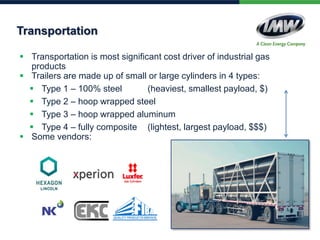
 Transportation is most significant cost driver of industrial gas
products
 Trailers are made up of small or large cylinders in 4 types:
 Type 1 – 100% steel (heaviest, smallest payload, $)
 Type 2 – hoop wrapped steel
 Type 3 – hoop wrapped aluminum
 Type 4 – fully composite (lightest, largest payload, $$$)
 Some vendors:
Transportation
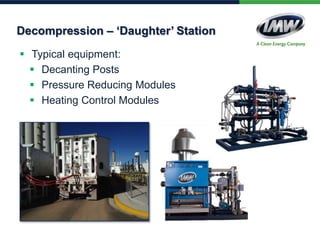
 Typical equipment:
 Decanting Posts
 Pressure Reducing Modules
 Heating Control Modules
Decompression – ‘Daughter’ Station
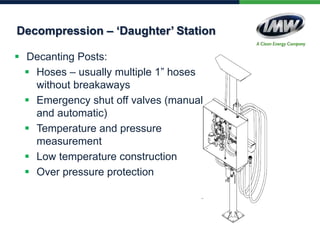
 Decanting Posts:
 Hoses – usually multiple 1” hoses
without breakaways
 Emergency shut off valves (manual
and automatic)
 Temperature and pressure
measurement
 Low temperature construction
 Over pressure protection
Decompression – ‘Daughter’ Station
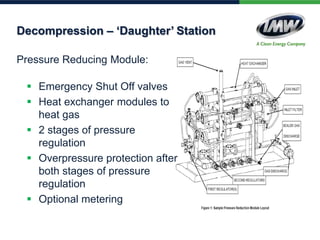
Pressure Reducing Module:
 Emergency Shut Off valves
 Heat exchanger modules to
heat gas
 2 stages of pressure
regulation
 Overpressure protection after
both stages of pressure
regulation
 Optional metering
Decompression – ‘Daughter’ Station
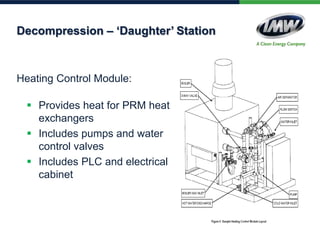
Heating Control Module:
 Provides heat for PRM heat
exchangers
 Includes pumps and water
control valves
 Includes PLC and electrical
cabinet
Decompression – ‘Daughter’ Station
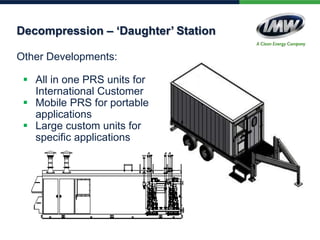
Other Developments:
 All in one PRS units for
International Customer
 Mobile PRS for portable
applications
 Large custom units for
specific applications
Decompression – ‘Daughter’ Station
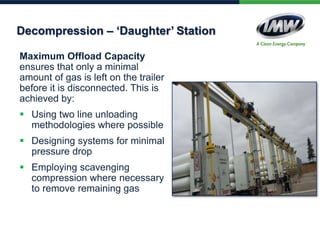
Maximum Offload Capacity
ensures that only a minimal
amount of gas is left on the trailer
before it is disconnected. This is
achieved by:
 Using two line unloading
methodologies where possible
 Designing systems for minimal
pressure drop
 Employing scavenging
compression where necessary
to remove remaining gas
Decompression – ‘Daughter’ Station
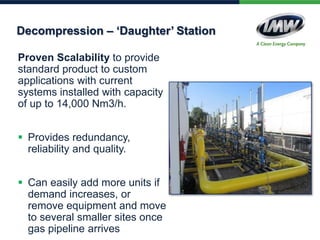
Proven Scalability to provide
standard product to custom
applications with current
systems installed with capacity
of up to 14,000 Nm3/h.
 Provides redundancy,
reliability and quality.
 Can easily add more units if
demand increases, or
remove equipment and move
to several smaller sites once
gas pipeline arrives
Decompression – ‘Daughter’ Station
Case Studies
Urumqi, China
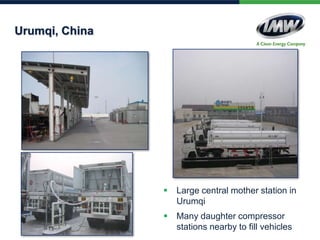
 Large central mother station in
Urumqi
 Many daughter compressor
stations nearby to fill vehicles
Cavendish Farms - Canada
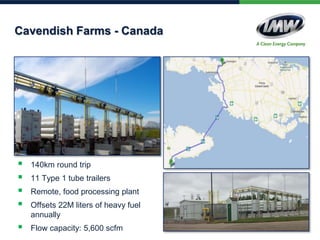
 140km round trip
 11 Type 1 tube trailers
 Remote, food processing plant
 Offsets 22M liters of heavy fuel
annually
 Flow capacity: 5,600 scfm
Mexico
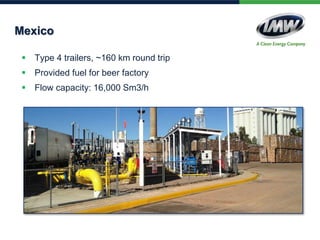
 Type 4 trailers, ~160 km round trip
 Provided fuel for beer factory
 Flow capacity: 16,000 Sm3/h
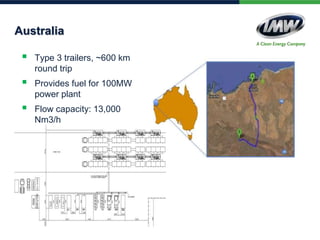
Australia
 Type 3 trailers, ~600 km
round trip
 Provides fuel for 100MW
power plant
 Flow capacity: 13,000
Nm3/h
43676 Progress Way • Chilliwack, BC • Canada V2R 0C3 p +1 604.795.9491 f +1 604.792.3806 e info@imw.ca
imw.ca
imw.ca/facebook
imw.ca/linkedin
imw.ca/youtube
David Orton
t: 604.795.9491
e: sales@imw.ca
Upcoming Webinars
www.imw.ca/cng-webinars/
• Free Monthly Webinars
• Documented CPD Credits
Feb 26 | Virtual Pipeline 201 – Applications, Cases & Illustrations
Overview of several field-proven projects in IPP Power & Heat for A
Variety of Remote Industrial and Mining Projects
• project cases from United States, Mexico, Australia and Singapore
• preliminary project feasibility calculations
David VanLaar
Engineering Manager
IMW Industries
Upcoming Topics for 2015 – Dates TBA
• Trailers & Cylinders
• Clean Energy’s Natural Gas Highway
• Transit
• & More
Questions?
Contact Us!
IMW Industries
43676 Progress Way
Chilliwack, BC,
Canada V2R 0C3
+1 604-795-9491
www.imw.ca
Questions?
sales@imw.ca
webinars@imw.ca

Virtual Pipelines 101: Delivering Cost-Effective Natural Beyond the Pipeline – New Innovations in Bulk Natural Gas Delivery

  • 1.
    Virtual Pipelines: DeliveringCost-Effective Natural Gas to Your Remote Facility Your Speaker: David VanLaar Engineering Manager IMW Industries Your Host: Sam Goldenberg Director of Sales, MEA, APAC IMW Industries
  • 2.
    About IMW IMW hasbeen manufacturing industrial machinery since 1912, and has evolved to be a leading manufacturer of natural gas compression systems, serving all major markets Globally. Equipment is currently operating mid-east to North of the Arctic Circle. • Quality Products & Leader in CNG Compression • Non-Lubricated Compression for Clean CNG A variety of configurations for all applications
  • 3.
    A Clean EnergyCompany IMW operates as a wholly owned subsidiary of Clean Energy Fuels Corp. (NASDAQ: CLNE). Clean Energy is the largest provider of natural gas fuel for transportation in North America and a global leader in the expanding natural gas vehicle market. Clean Energy has operations in CNG and LNG vehicle fueling, construction and operation of CNG and LNG fueling stations, biomethane production, and compressor technology.
  • 4.
    Your Speaker David VanLaar,P. Eng Manager, Product Solutions Group & Engineering IMW Industries
  • 5.
    Compressed natural gas(CNG):  composed of approximately 95 percent methane  normally stored at 3,600 psi (250 bar) in specially designed containers  stays in a gaseous form  typically compressed from a transmission or distribution pipeline  30% lower cost than other fuels  30-40% fewer greenhouse gases during combustion than other fuels Overview of Natural Gas and CNG
  • 6.
    CNG for IndustrialGas – Why?  Low Cost
  • 7.
    CNG for IndustrialGas – Why? Low Environmental Impact
  • 8.
    CNG for IndustrialGas – Why? Safer  non-toxic, lighter-than-air and disperses quickly  higher ignition temperature than gasoline and diesel fuel  narrow flammability range and will only burn when the ratio is between 5~15% mixed with air  CNG/NGV systems and storage vessels are built to the highest standards and have long and enviable safety records worldwide
  • 9.
  • 10.
    End Users Power Plants– Mining - Metals Production - Pulp and Paper - Asphalt Production - Food Processing - Fracking Units - Drill Rigs
  • 11.
  • 12.
  • 13.
     Typically transmissionlines (300 psi / 20 bar – 1000 psi / 70 bar)  Higher pressure means less compression is required – less energy consumption  Location of mother station is often flexible  Require gas with low water content or use gas dryer  Require natural gas with >90% methane Pipeline – Gas Source
  • 14.
     Multiple compressors(500 to 3000 hp is typical)  Non-lube technology is important to ensure trailers don’t fill up with oil  Electric or engine drive  Typical station equipment:  Compressors  Chillers  Fill Posts Compression – ‘Mother’ Station
  • 15.
    FullFill Technology ensuresthat every bulk gas shipment is completed quickly and filled as completely as possible. IMW systems ensure that transport modules are filled at the optimum temperature and gas density through:  Integration of proprietary compression technology and comprehensive dispensing architecture  PLC controlled continuous thermal management Compression – ‘Mother’ Station
  • 16.
     Transportation ismost significant cost driver of industrial gas products  Trailers are made up of small or large cylinders in 4 types:  Type 1 – 100% steel (heaviest, smallest payload, $)  Type 2 – hoop wrapped steel  Type 3 – hoop wrapped aluminum  Type 4 – fully composite (lightest, largest payload, $$$)  Some vendors: Transportation
  • 17.
     Typical equipment: Decanting Posts  Pressure Reducing Modules  Heating Control Modules Decompression – ‘Daughter’ Station
  • 18.
     Decanting Posts: Hoses – usually multiple 1” hoses without breakaways  Emergency shut off valves (manual and automatic)  Temperature and pressure measurement  Low temperature construction  Over pressure protection Decompression – ‘Daughter’ Station
  • 19.
    Pressure Reducing Module: Emergency Shut Off valves  Heat exchanger modules to heat gas  2 stages of pressure regulation  Overpressure protection after both stages of pressure regulation  Optional metering Decompression – ‘Daughter’ Station
  • 20.
    Heating Control Module: Provides heat for PRM heat exchangers  Includes pumps and water control valves  Includes PLC and electrical cabinet Decompression – ‘Daughter’ Station
  • 21.
    Other Developments:  Allin one PRS units for International Customer  Mobile PRS for portable applications  Large custom units for specific applications Decompression – ‘Daughter’ Station
  • 22.
    Maximum Offload Capacity ensuresthat only a minimal amount of gas is left on the trailer before it is disconnected. This is achieved by:  Using two line unloading methodologies where possible  Designing systems for minimal pressure drop  Employing scavenging compression where necessary to remove remaining gas Decompression – ‘Daughter’ Station
  • 23.
    Proven Scalability toprovide standard product to custom applications with current systems installed with capacity of up to 14,000 Nm3/h.  Provides redundancy, reliability and quality.  Can easily add more units if demand increases, or remove equipment and move to several smaller sites once gas pipeline arrives Decompression – ‘Daughter’ Station
  • 24.
  • 25.
    Urumqi, China  Largecentral mother station in Urumqi  Many daughter compressor stations nearby to fill vehicles
  • 26.
    Cavendish Farms -Canada  140km round trip  11 Type 1 tube trailers  Remote, food processing plant  Offsets 22M liters of heavy fuel annually  Flow capacity: 5,600 scfm
  • 27.
    Mexico  Type 4trailers, ~160 km round trip  Provided fuel for beer factory  Flow capacity: 16,000 Sm3/h
  • 28.
    Australia  Type 3trailers, ~600 km round trip  Provides fuel for 100MW power plant  Flow capacity: 13,000 Nm3/h
  • 29.
    43676 Progress Way• Chilliwack, BC • Canada V2R 0C3 p +1 604.795.9491 f +1 604.792.3806 e info@imw.ca imw.ca imw.ca/facebook imw.ca/linkedin imw.ca/youtube David Orton t: 604.795.9491 e: sales@imw.ca
  • 30.
    Upcoming Webinars www.imw.ca/cng-webinars/ • FreeMonthly Webinars • Documented CPD Credits Feb 26 | Virtual Pipeline 201 – Applications, Cases & Illustrations Overview of several field-proven projects in IPP Power & Heat for A Variety of Remote Industrial and Mining Projects • project cases from United States, Mexico, Australia and Singapore • preliminary project feasibility calculations David VanLaar Engineering Manager IMW Industries Upcoming Topics for 2015 – Dates TBA • Trailers & Cylinders • Clean Energy’s Natural Gas Highway • Transit • & More
  • 31.
  • 32.
    Contact Us! IMW Industries 43676Progress Way Chilliwack, BC, Canada V2R 0C3 +1 604-795-9491 www.imw.ca Questions? sales@imw.ca webinars@imw.ca