Natural Gas Fueling
    (CNG & LNG)
Infrastructure Design, Development & Fleet Deployment


                                                    S
What is Natural Gas?

S   Natural Gas is primarily methane gas which can be drilled for exclusively
    or produced as a by product of oil exploration

S   Natural gas used in transportation fuel has been treated to eliminate
    Carbon Dioxide (CO2), Hydrogen Sulfide (H2S) and moisture (H2O) as
    well as any other impurities found in the raw feedstock. This ensures the
    fuel delivery system in the vehicle operates properly and does not fail due
    to contamination

S   Liquefied Natural Gas (LNG) is methane gas that has been chilled to -260
    degrees F and stored at pressures under 100 psig

S   Compressed Natural Gas (CNG) is pipeline quality gas that has been
    compressed and stored at pressures of 3600 psig or greater
Why Natural Gas?

S   Domestic gas supplies are substantial and secure which decrease our
    dependence on foreign oil and stabilizes natural gas price

S   Current spread between oil futures and natural gas futures, along with
    long term supply estimates, indicate long term price stability

S   Natural Gas Vehicles (NGV’s) require less maintenance and run cleaner
    than conventional gasoline or diesel fueled vehicles

S   Allow fleets to meet strict emissions regulations in densely populated
    areas

S   FUEL COST SAVINGS!
The Math Works-CNG


S   1 gallon gasoline $3.61 = Gasoline Gallon Equivalent for CNG = $2.09*
    S   Gasoline in Naples, FL – CNG in Pompano Beach, FL – Retail Prices

S   1 gallon diesel $3.98 = Diesel Gallon Equivalent for CNG = $2.09*
    S   Diesel in Naples, FL – CNG in Pompano Beach, FL – Retail Prices

S   Example:
    S  ABC Trucking operates 20 heavy duty diesel delivery trucks
    S  Each truck drives 150 miles per day and averages 5 MPG; 5 days per week
    S  They currently use $620,880 of fuel per year @ $3.98 per gallon
    S  If they convert to CNG their fuel savings per year could be $294,840
    S  Cost to convert 20 trucks to CNG: 20 trucks x $25k per conversion = $500,000
    S  Payback on conversion cost with NO grant money $500K/295K = 1.7 Years
    S  Assumes all fueling is done at public stations
    S  7 year vehicle life cycle – Net fuel savings = $1,475,000
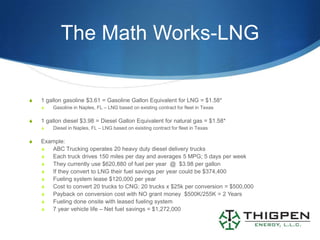
The Math Works-LNG


S   1 gallon gasoline $3.61 = Gasoline Gallon Equivalent for LNG = $1.58*
    S   Gasoline in Naples, FL – LNG based on existing contract for fleet in Texas

S   1 gallon diesel $3.98 = Diesel Gallon Equivalent for natural gas = $1.58*
    S   Diesel in Naples, FL – LNG based on existing contract for fleet in Texas

S   Example:
    S  ABC Trucking operates 20 heavy duty diesel delivery trucks
    S  Each truck drives 150 miles per day and averages 5 MPG; 5 days per week
    S  They currently use $620,880 of fuel per year @ $3.98 per gallon
    S  If they convert to LNG their fuel savings per year could be $374,400
    S  Fueling system lease $120,000 per year
    S  Cost to convert 20 trucks to CNG: 20 trucks x $25k per conversion = $500,000
    S  Payback on conversion cost with NO grant money $500K/255K = 2 Years
    S  Fueling done onsite with leased fueling system
    S  7 year vehicle life – Net fuel savings = $1,272,000
CNG Fueling Infrastructure


S Can be mobile or skid mounted units for ease of relocation,
   deployment and installation
S Can be permanent “Gas Station” style installations

S Can be “slow fill” or “fast fill” systems

S Systems consist of similar components regardless of design,
   only variance is size and fueling capacity
Fast Fill Design-CNG

S   System consists of meter, dryer, compressor, priority
    panel, storage, dispenser and credit card reader

S   Dispensing systems similar to traditional retail fueling stations for
    gasoline and diesel

S   Fast fill fueling accomplished through use of storage vessels and
    dispensers

S   Can have multiple islands for multiple vehicles

S   Addition of credit card reader can make transaction seem like
    traditional station
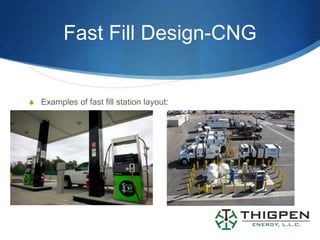
Fast Fill Design-CNG


S Examples of fast fill station layout:
Slow Fill Design-CNG


S Dispensing systems in slow fill applications consist of
  multiple individual fueling connections which allow the
  system to fill all vehicles at one time as a whole

S No storage is used in slow fill applications

S Costs can be lower depending on system design and size

S No cost effective individual vehicle fuel measurement is
  readily available at this time
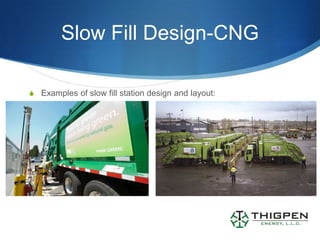
Slow Fill Design-CNG

S Examples of slow fill station design and layout:
LNG Fueling Infrastructure


S Can be mobile or skid mounted units for ease of relocation,
   deployment and installation
S Can be permanent “Gas Station” style installations

S Slow fill system configurations are not typical with LNG as
   pumps are sized to deliver the volume required for a fleet’s
   requirements
S Systems consist of similar components regardless of design;
   only variance is storage size and pump capacity
Fast Fill Design-LNG

S   System consists of storage vessel, cryogenic pump, control panel,
    dispenser and credit card reader

S   Dispensing systems can be similar to traditional retail fueling stations
    for gasoline and diesel

S   Fast fill fueling accomplished through use of high speed cryogenic
    pump, storage vessel and dispensers

S   Can have multiple islands for multiple vehicles

S   Addition of credit card reader can make transaction seem like
    traditional station
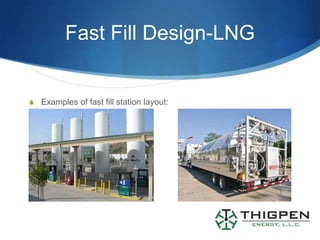
Fast Fill Design-LNG


S Examples of fast fill station layout:
L-CNG Fueling Infrastructure


S Integrates LNG and CNG systems into one hybrid design to
   utilize LNG as a fuel source while filling both LNG and CNG
   vehicles
S Solution for natural gas fueling needs where natural gas
   pipeline is not available for typical CNG station
S Uses in today’s market: Hydraulic fracturing, Oil and gas
   drilling, remote fleet conversions, industrial applications
Maintenance Shop
              Infrastructure

S NFPA 52 codes require NGV maintenance facilities incorporate
  safety measures to reduce the potential for accidental fire or
  explosion
  S Continuous ventilation or automated ventilation activated by gas
      detection system
  S   Air exchange rates of 1cu. ft./min
  S   Electrical circuits installed in accordance with NEC Class I Div II
      requirements; Typically 18” envelope below ceiling is classified
      area
  S   Audible and visual alarm installation required
  S   Heating system style may need retrofit to eliminate open flame
      style heaters; Recommend radiant heating systems
Natural Gas Engines


S   What is Bi-Fuel?
    S Commonly referred to as “switchable” systems; Engines that run on
      gasoline or natural gas, but not simultaneously; Engine will run on 100%
      gasoline or 100% natural gas

S   What is Dual Fuel?
    S Dual fuel systems are diesel engines that run on a mixture of natural gas
      and diesel; Natural gas is injected into the diesel engine to replace a
      certain amount of diesel; Can still run on 100% diesel; Cannot run on 100%
      natural gas

S   What is Dedicated Fuel?
    S Dedicated natural gas engines are only designed to burn natural gas as a
      fuel; These cannot burn diesel or gasoline
Natural Gas Engines (Cont’d)


S   Light Duty Solutions
    S Direct new OEM natural gas vehicles factory equipped for natural gas fuel
    S Conversion of older engines as per EPA guidelines

S   Medium Duty Solutions
    S International Navistar DT466 T444E repowered to Phoenix 7.6L and 7.3L
    S Landi Renzo/Baytech CNG conversion of GM and Isuzu engines
    S Various

S   Heavy Duty Solutions
    S Cummins Westport ISL G, ISX12, ISX
    S American Power Group conversions
    S Various
About Thigpen Energy, LLC


S   Provides high level consulting, management and implementation
    solutions to clients in the energy industry
S   Offers turnkey execution of projects in construction, service and
    equipment packaging
S   Member of the Greater Houston NGV Alliance and licensed by the
    Texas Railroad Commission in the installation and service of LNG and
    CNG facilities
S   Existing clients include Clean Energy, Calpine, Chesapeake, EOG
    Resources, Goodrich Petroleum, Waste Management & Dallas Area
    Rapid Transit
For More Information

Thigpen Energy, LLC
PO Box 7157
Cut and Shoot, TX 77306
855-NGV-4USA
www.thigpenenegy.com
www.twitter.com/thigpenenergy
www.facebook.com/thigpenenergy

Railroad Commission of Texas
P.O. Box 12967
Austin, TX 78711
(877) 228-5740
www.rrc.state.tx.us

National Fire Protection Association
134 Kirk Lane
Gallatin, TN 37066
www.nfpa.org
www.twitter.com/nfpa
www.facebook.com/thenfpa

NGV Infrastructure Introduction

  • 1.
    Natural Gas Fueling (CNG & LNG) Infrastructure Design, Development & Fleet Deployment S
  • 2.
    What is NaturalGas? S Natural Gas is primarily methane gas which can be drilled for exclusively or produced as a by product of oil exploration S Natural gas used in transportation fuel has been treated to eliminate Carbon Dioxide (CO2), Hydrogen Sulfide (H2S) and moisture (H2O) as well as any other impurities found in the raw feedstock. This ensures the fuel delivery system in the vehicle operates properly and does not fail due to contamination S Liquefied Natural Gas (LNG) is methane gas that has been chilled to -260 degrees F and stored at pressures under 100 psig S Compressed Natural Gas (CNG) is pipeline quality gas that has been compressed and stored at pressures of 3600 psig or greater
  • 3.
    Why Natural Gas? S Domestic gas supplies are substantial and secure which decrease our dependence on foreign oil and stabilizes natural gas price S Current spread between oil futures and natural gas futures, along with long term supply estimates, indicate long term price stability S Natural Gas Vehicles (NGV’s) require less maintenance and run cleaner than conventional gasoline or diesel fueled vehicles S Allow fleets to meet strict emissions regulations in densely populated areas S FUEL COST SAVINGS!
  • 4.
    The Math Works-CNG S 1 gallon gasoline $3.61 = Gasoline Gallon Equivalent for CNG = $2.09* S Gasoline in Naples, FL – CNG in Pompano Beach, FL – Retail Prices S 1 gallon diesel $3.98 = Diesel Gallon Equivalent for CNG = $2.09* S Diesel in Naples, FL – CNG in Pompano Beach, FL – Retail Prices S Example: S ABC Trucking operates 20 heavy duty diesel delivery trucks S Each truck drives 150 miles per day and averages 5 MPG; 5 days per week S They currently use $620,880 of fuel per year @ $3.98 per gallon S If they convert to CNG their fuel savings per year could be $294,840 S Cost to convert 20 trucks to CNG: 20 trucks x $25k per conversion = $500,000 S Payback on conversion cost with NO grant money $500K/295K = 1.7 Years S Assumes all fueling is done at public stations S 7 year vehicle life cycle – Net fuel savings = $1,475,000
  • 5.
    The Math Works-LNG S 1 gallon gasoline $3.61 = Gasoline Gallon Equivalent for LNG = $1.58* S Gasoline in Naples, FL – LNG based on existing contract for fleet in Texas S 1 gallon diesel $3.98 = Diesel Gallon Equivalent for natural gas = $1.58* S Diesel in Naples, FL – LNG based on existing contract for fleet in Texas S Example: S ABC Trucking operates 20 heavy duty diesel delivery trucks S Each truck drives 150 miles per day and averages 5 MPG; 5 days per week S They currently use $620,880 of fuel per year @ $3.98 per gallon S If they convert to LNG their fuel savings per year could be $374,400 S Fueling system lease $120,000 per year S Cost to convert 20 trucks to CNG: 20 trucks x $25k per conversion = $500,000 S Payback on conversion cost with NO grant money $500K/255K = 2 Years S Fueling done onsite with leased fueling system S 7 year vehicle life – Net fuel savings = $1,272,000
  • 6.
    CNG Fueling Infrastructure SCan be mobile or skid mounted units for ease of relocation, deployment and installation S Can be permanent “Gas Station” style installations S Can be “slow fill” or “fast fill” systems S Systems consist of similar components regardless of design, only variance is size and fueling capacity
  • 7.
    Fast Fill Design-CNG S System consists of meter, dryer, compressor, priority panel, storage, dispenser and credit card reader S Dispensing systems similar to traditional retail fueling stations for gasoline and diesel S Fast fill fueling accomplished through use of storage vessels and dispensers S Can have multiple islands for multiple vehicles S Addition of credit card reader can make transaction seem like traditional station
  • 8.
    Fast Fill Design-CNG SExamples of fast fill station layout:
  • 9.
    Slow Fill Design-CNG SDispensing systems in slow fill applications consist of multiple individual fueling connections which allow the system to fill all vehicles at one time as a whole S No storage is used in slow fill applications S Costs can be lower depending on system design and size S No cost effective individual vehicle fuel measurement is readily available at this time
  • 10.
    Slow Fill Design-CNG SExamples of slow fill station design and layout:
  • 11.
    LNG Fueling Infrastructure SCan be mobile or skid mounted units for ease of relocation, deployment and installation S Can be permanent “Gas Station” style installations S Slow fill system configurations are not typical with LNG as pumps are sized to deliver the volume required for a fleet’s requirements S Systems consist of similar components regardless of design; only variance is storage size and pump capacity
  • 12.
    Fast Fill Design-LNG S System consists of storage vessel, cryogenic pump, control panel, dispenser and credit card reader S Dispensing systems can be similar to traditional retail fueling stations for gasoline and diesel S Fast fill fueling accomplished through use of high speed cryogenic pump, storage vessel and dispensers S Can have multiple islands for multiple vehicles S Addition of credit card reader can make transaction seem like traditional station
  • 13.
    Fast Fill Design-LNG SExamples of fast fill station layout:
  • 14.
    L-CNG Fueling Infrastructure SIntegrates LNG and CNG systems into one hybrid design to utilize LNG as a fuel source while filling both LNG and CNG vehicles S Solution for natural gas fueling needs where natural gas pipeline is not available for typical CNG station S Uses in today’s market: Hydraulic fracturing, Oil and gas drilling, remote fleet conversions, industrial applications
  • 15.
    Maintenance Shop Infrastructure S NFPA 52 codes require NGV maintenance facilities incorporate safety measures to reduce the potential for accidental fire or explosion S Continuous ventilation or automated ventilation activated by gas detection system S Air exchange rates of 1cu. ft./min S Electrical circuits installed in accordance with NEC Class I Div II requirements; Typically 18” envelope below ceiling is classified area S Audible and visual alarm installation required S Heating system style may need retrofit to eliminate open flame style heaters; Recommend radiant heating systems
  • 16.
    Natural Gas Engines S What is Bi-Fuel? S Commonly referred to as “switchable” systems; Engines that run on gasoline or natural gas, but not simultaneously; Engine will run on 100% gasoline or 100% natural gas S What is Dual Fuel? S Dual fuel systems are diesel engines that run on a mixture of natural gas and diesel; Natural gas is injected into the diesel engine to replace a certain amount of diesel; Can still run on 100% diesel; Cannot run on 100% natural gas S What is Dedicated Fuel? S Dedicated natural gas engines are only designed to burn natural gas as a fuel; These cannot burn diesel or gasoline
  • 17.
    Natural Gas Engines(Cont’d) S Light Duty Solutions S Direct new OEM natural gas vehicles factory equipped for natural gas fuel S Conversion of older engines as per EPA guidelines S Medium Duty Solutions S International Navistar DT466 T444E repowered to Phoenix 7.6L and 7.3L S Landi Renzo/Baytech CNG conversion of GM and Isuzu engines S Various S Heavy Duty Solutions S Cummins Westport ISL G, ISX12, ISX S American Power Group conversions S Various
  • 18.
    About Thigpen Energy,LLC S Provides high level consulting, management and implementation solutions to clients in the energy industry S Offers turnkey execution of projects in construction, service and equipment packaging S Member of the Greater Houston NGV Alliance and licensed by the Texas Railroad Commission in the installation and service of LNG and CNG facilities S Existing clients include Clean Energy, Calpine, Chesapeake, EOG Resources, Goodrich Petroleum, Waste Management & Dallas Area Rapid Transit
  • 19.
    For More Information ThigpenEnergy, LLC PO Box 7157 Cut and Shoot, TX 77306 855-NGV-4USA www.thigpenenegy.com www.twitter.com/thigpenenergy www.facebook.com/thigpenenergy Railroad Commission of Texas P.O. Box 12967 Austin, TX 78711 (877) 228-5740 www.rrc.state.tx.us National Fire Protection Association 134 Kirk Lane Gallatin, TN 37066 www.nfpa.org www.twitter.com/nfpa www.facebook.com/thenfpa