
Natural Gas VehiclesIndustry DevelopmentSeptember 2011
Current Market ConditionsThe United States consumed 6.971 BILLION barrels of petroleum products in 2010 19.1 million barrels per dayImports accounted for 49% of our total consumption in 2010 which equates to 9.4 million barrels per day or 3.431 BILLION barrels per yearAt the current average market price of $85 per barrel, the US imported approximately $291,635,000,000 of petroleum products in 201018% of our imports came from the Persian Gulf; $524 Million*Data obtained from Energy information Administration website for calendar year 2010For the first time geo-politics, emerging market oil demand and the discovery of new domestic gas supplies has resulted in a massive BTU price spread between oil & gas
Why Natural Gas?Supply:  Domestic gas supplies are substantial and currently at an estimated 100 year supply level from known reservoirs with more exploration to comeDistribution: An established nationwide pipeline system currently in placeCost: Natural gas is currently the only economically feasible alternative fuelReliability: In 2010 approximately 12.6 MM natural gas vehicles in use around the world, however only an estimated 100,000 were in the U.S. Economy: Will reduce the amount of foreign petroleum imports and keep more money in our domestic economy
Why Natural Gas?Emissions: Natural gas vehicles reduce emissions of CO2 by 20-30%, CO by 70-90%, NOx by 75-95%, particulate matter by up to 90% and volatile organic compounds by up to 89% Safety: Natural gas vehicles are as safe as or safer than competing gasoline or diesel powered vehiclesEase of use: Natural gas vehicles are similar in operation to their gasoline and diesel counterparts.  The main difference is fueling procedure which most fleets find more efficient and cost effectiveStability: With the price of natural gas disconnected from the price of oil, the market is stable and allows for better budgeting of fuel costs
The Math WorksThe driving force behind the expansion of the natural gas fueling market is cost1 barrel of oil = 5.8 Mcf of natural gas$85 per barrel oil compared to $4.00 per Mcf natural gas equates to $23.20 barrel of oil equivalent; A 73% reduction in feedstock for fueling useFor every new BOE of natural gas consumed, we remove a nearly 4x more expensive barrel of imported oil off the market
The Math Works1 gallon of gasoline priced at $3.30 = 114,00 BTU1 gallon of diesel priced at $3.65 = 129,500 BTU1 Mcf of natural gas at $6.50 (delivered) = 912,024 BTU1 Mcf = 8 gallons of gasoline = $26.40 1 Mcf = 7 gallons of diesel = $27.01Diesel Gallon Equivalent for natural gas = $.93* ($6.50 Mcf/7)Gasoline Gallon Equivalent for natural gas = $.82* ($6.50 Mcf/8)* Does not include any cost associated with infrastructure development or operation
VehiclesNatural gas fueled light duty vehicles cost an average $5000 - $7500 more than conventional gasoline or diesel modelsNatural gas fueled heavy duty vehicles cost up to $30,000 more than conventional gasoline or diesel modelsFuel savings average 50-75% for natural gas reducing the ROI on the additional cost significantlyReduction of fuel costs are dependant on use of privately owned fueling facilities or public fueling stationsNatural gas vehicles require less maintenance which reduces operating costsTypical fleet configurations consist of CNG in light duty and return to base applications, while LNG is common in OTR applications
VehiclesNatural gas vehicles utilize high pressure storage tanks mounted in the vehicle to store compressed natural gas for fuelThe common tank size available on the market today is a 24 gasoline gallon equivalent tankVehicles can be configured as dual fuel to use gasoline/diesel and natural gas combined or dedicated natural gasThe range of vehicles with the ability to run on natural gas includes pick up trucks, cars, buses, heavy duty vehicles and industrial equipment
VehiclesLight Duty Example: 30,000 MPY @ 15 MPG = 2000 gal/gasoline @ $3.30 = $6600 per year; 50% reduction in fuel cost equates to ROI in approx 2.25 years = Life fuel savings of $90005 year replacement cycle using public fueling stationHeavy Duty Example: 12,000 MPY @ 7 MPG = 1714 gal/diesel @ $3.65 = $6256 per year; 50% reduction in fuel cost equates to ROI in approximately 9.5 years = Life fuel savings of $16,92015 year replacement cycle using public fueling stationLight Duty Example: 30,000 MPY @ 15 MPG = 2000 gal/gasoline @ $3.30 = $6600 per year; 75% reduction in fuel cost equates to ROI in approx 1.5 years = Life fuel savings of $17,2505 year replacement cycle using fleet owned fueling station (Fuel cost only)Heavy Duty Example: 12,000 MPY @ 7 MPG = 1714 gal/diesel @ $3.65 = $6256 per year; 75% reduction in fuel cost equates to ROI in approximately 6.4 years = Life fuel savings of $40,38015 year replacement cycle using fleet owned fueling station (Fuel cost only)
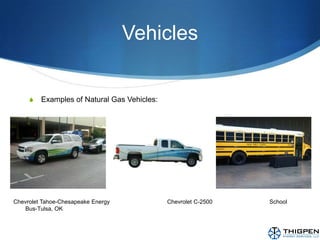
VehiclesExamples of Natural Gas Vehicles:Chevrolet Tahoe-Chesapeake Energy 	                Chevrolet C-2500		School Bus-Tulsa, OK
Infrastructure-CNG & LNGCan be fully integrated, mobile, skid mounted units for ease of relocation, deployment and installationCan be permanent “Gas Station” style installationsCNG systems can be fast fill or slow fill; LNG systems are fast fillCNG uses compression to deliver high pressure gas for use as fuel; LNG is delivered by tanker truck and stored in a cryogenic tankSystems consist of similar components regardless of design; Variances in size of equipment occur based on total fueling needsAll CNG/LNG infrastructure in Texas is regulated by the Railroad Commission of Texas and the NFPA
Fast Fill Design-CNGThe three main components in any fast fill application are compression, storage and dispensersTypical compression inlet pressure is 10-25 psigNecessary compression discharge pressure is 4000-4500 psigTypical compressor horsepower ratings range from 50-250+ HPTypical compressor flow rates are 75 Standard cubic feet per minute to 500+ Standard cubic feet per minute (SCFM)* 125 SCF = 1 Gasoline Gallon Equivalent
Fast Fill Design-CNGTypical storage cascade designs used for fast fill systems are three high pressure vessels with a usable storage capacity of approximately 100 Gasoline Gallon Equivalent (GGE)Storage pressures range from 4000 to 4500 psig depending on design and operation; Texas codes limit storage to 1.25x vehicle operating pressure (3600 psig * 1.25=4500 psig)All storage vessels must be ASME coded and be installed above ground
Fast Fill Design-CNGDispensing systems are similar to familiar gasoline and diesel fuel dispensers at local gas stations
Dispensers use a valve sequencing function to fill the vehicle's tank to the maximum pressure as quickly as possible
Additional components necessary in the total system design include inlet gas dryer system, gas cooler and high pressure gas filtration systemFast Fill Design-LNGComponents consist of LNG storage tank, control system and LNG cryogenic pump
Dispensing system consists of fuel hose and vent hose
Compact installation footprint make skid mounted systems desirable
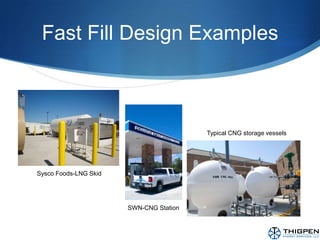
Since LNG is delivered similar to gasoline or diesel via tanker truck, no additional equipment besides storage tank and dispensing system is necessaryFast Fill Design ExamplesTypical CNG storage vesselsSysco Foods-LNG SkidSWN-CNG Station
Slow Fill Design-CNGThe two main components in any slow fill application are compression and dispensing pointsTypical compression inlet pressure is 10-25 psigNecessary compression discharge is 3800-4000 psigTypical compressor HP ratings range from 25-250+ hpTypical compressor flow rates are 25 SCFM to 500+ SCFM
Slow Fill Design-CNGDispensing systems in slow fill applications consist of multiple individual fueling connections; This allows the system to fill all vehicles at one time as a wholeNo storage used in slow fill applicationsEquipment costs can be lower depending on system design and sizeNo cost effective individual vehicle fuel measurement is readily available at this time
Slow Fill Design-CNGExample 1: 20 vehicles with 75 SCFM compressor; 3.75 SCFM per vehicle at 3600 psig; Refueling rate is 1.8 gallons per hourExample 2: 50 vehicles with 250 SCFM compressor; 5 SCFM per vehicle at 3600 psig; Refueling rate is 2.4 gallons per hourSlow fill applications for vehicles that return to base on a regular schedule can increase the efficiency of vehicle re-fueling in that the operator does not have to be present while vehicles are re-fueledAdditional components necessary in the total system design include inlet gas dryer system, gas cooler and high pressure gas filtration system
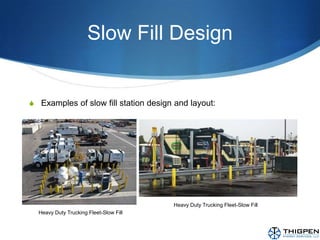
Slow Fill DesignExamples of slow fill station design and layout:Heavy Duty Trucking Fleet-Slow FillHeavy Duty Trucking Fleet-Slow Fill

NGV Industry Development

  • 1.
    Natural Gas VehiclesIndustryDevelopmentSeptember 2011
  • 2.
    Current Market ConditionsTheUnited States consumed 6.971 BILLION barrels of petroleum products in 2010 19.1 million barrels per dayImports accounted for 49% of our total consumption in 2010 which equates to 9.4 million barrels per day or 3.431 BILLION barrels per yearAt the current average market price of $85 per barrel, the US imported approximately $291,635,000,000 of petroleum products in 201018% of our imports came from the Persian Gulf; $524 Million*Data obtained from Energy information Administration website for calendar year 2010For the first time geo-politics, emerging market oil demand and the discovery of new domestic gas supplies has resulted in a massive BTU price spread between oil & gas
  • 3.
    Why Natural Gas?Supply: Domestic gas supplies are substantial and currently at an estimated 100 year supply level from known reservoirs with more exploration to comeDistribution: An established nationwide pipeline system currently in placeCost: Natural gas is currently the only economically feasible alternative fuelReliability: In 2010 approximately 12.6 MM natural gas vehicles in use around the world, however only an estimated 100,000 were in the U.S. Economy: Will reduce the amount of foreign petroleum imports and keep more money in our domestic economy
  • 4.
    Why Natural Gas?Emissions:Natural gas vehicles reduce emissions of CO2 by 20-30%, CO by 70-90%, NOx by 75-95%, particulate matter by up to 90% and volatile organic compounds by up to 89% Safety: Natural gas vehicles are as safe as or safer than competing gasoline or diesel powered vehiclesEase of use: Natural gas vehicles are similar in operation to their gasoline and diesel counterparts. The main difference is fueling procedure which most fleets find more efficient and cost effectiveStability: With the price of natural gas disconnected from the price of oil, the market is stable and allows for better budgeting of fuel costs
  • 5.
    The Math WorksThedriving force behind the expansion of the natural gas fueling market is cost1 barrel of oil = 5.8 Mcf of natural gas$85 per barrel oil compared to $4.00 per Mcf natural gas equates to $23.20 barrel of oil equivalent; A 73% reduction in feedstock for fueling useFor every new BOE of natural gas consumed, we remove a nearly 4x more expensive barrel of imported oil off the market
  • 6.
    The Math Works1gallon of gasoline priced at $3.30 = 114,00 BTU1 gallon of diesel priced at $3.65 = 129,500 BTU1 Mcf of natural gas at $6.50 (delivered) = 912,024 BTU1 Mcf = 8 gallons of gasoline = $26.40 1 Mcf = 7 gallons of diesel = $27.01Diesel Gallon Equivalent for natural gas = $.93* ($6.50 Mcf/7)Gasoline Gallon Equivalent for natural gas = $.82* ($6.50 Mcf/8)* Does not include any cost associated with infrastructure development or operation
  • 7.
    VehiclesNatural gas fueledlight duty vehicles cost an average $5000 - $7500 more than conventional gasoline or diesel modelsNatural gas fueled heavy duty vehicles cost up to $30,000 more than conventional gasoline or diesel modelsFuel savings average 50-75% for natural gas reducing the ROI on the additional cost significantlyReduction of fuel costs are dependant on use of privately owned fueling facilities or public fueling stationsNatural gas vehicles require less maintenance which reduces operating costsTypical fleet configurations consist of CNG in light duty and return to base applications, while LNG is common in OTR applications
  • 8.
    VehiclesNatural gas vehiclesutilize high pressure storage tanks mounted in the vehicle to store compressed natural gas for fuelThe common tank size available on the market today is a 24 gasoline gallon equivalent tankVehicles can be configured as dual fuel to use gasoline/diesel and natural gas combined or dedicated natural gasThe range of vehicles with the ability to run on natural gas includes pick up trucks, cars, buses, heavy duty vehicles and industrial equipment
  • 9.
    VehiclesLight Duty Example:30,000 MPY @ 15 MPG = 2000 gal/gasoline @ $3.30 = $6600 per year; 50% reduction in fuel cost equates to ROI in approx 2.25 years = Life fuel savings of $90005 year replacement cycle using public fueling stationHeavy Duty Example: 12,000 MPY @ 7 MPG = 1714 gal/diesel @ $3.65 = $6256 per year; 50% reduction in fuel cost equates to ROI in approximately 9.5 years = Life fuel savings of $16,92015 year replacement cycle using public fueling stationLight Duty Example: 30,000 MPY @ 15 MPG = 2000 gal/gasoline @ $3.30 = $6600 per year; 75% reduction in fuel cost equates to ROI in approx 1.5 years = Life fuel savings of $17,2505 year replacement cycle using fleet owned fueling station (Fuel cost only)Heavy Duty Example: 12,000 MPY @ 7 MPG = 1714 gal/diesel @ $3.65 = $6256 per year; 75% reduction in fuel cost equates to ROI in approximately 6.4 years = Life fuel savings of $40,38015 year replacement cycle using fleet owned fueling station (Fuel cost only)
  • 10.
    VehiclesExamples of NaturalGas Vehicles:Chevrolet Tahoe-Chesapeake Energy Chevrolet C-2500 School Bus-Tulsa, OK
  • 11.
    Infrastructure-CNG & LNGCanbe fully integrated, mobile, skid mounted units for ease of relocation, deployment and installationCan be permanent “Gas Station” style installationsCNG systems can be fast fill or slow fill; LNG systems are fast fillCNG uses compression to deliver high pressure gas for use as fuel; LNG is delivered by tanker truck and stored in a cryogenic tankSystems consist of similar components regardless of design; Variances in size of equipment occur based on total fueling needsAll CNG/LNG infrastructure in Texas is regulated by the Railroad Commission of Texas and the NFPA
  • 12.
    Fast Fill Design-CNGThethree main components in any fast fill application are compression, storage and dispensersTypical compression inlet pressure is 10-25 psigNecessary compression discharge pressure is 4000-4500 psigTypical compressor horsepower ratings range from 50-250+ HPTypical compressor flow rates are 75 Standard cubic feet per minute to 500+ Standard cubic feet per minute (SCFM)* 125 SCF = 1 Gasoline Gallon Equivalent
  • 13.
    Fast Fill Design-CNGTypicalstorage cascade designs used for fast fill systems are three high pressure vessels with a usable storage capacity of approximately 100 Gasoline Gallon Equivalent (GGE)Storage pressures range from 4000 to 4500 psig depending on design and operation; Texas codes limit storage to 1.25x vehicle operating pressure (3600 psig * 1.25=4500 psig)All storage vessels must be ASME coded and be installed above ground
  • 14.
    Fast Fill Design-CNGDispensingsystems are similar to familiar gasoline and diesel fuel dispensers at local gas stations
  • 15.
    Dispensers use avalve sequencing function to fill the vehicle's tank to the maximum pressure as quickly as possible
  • 16.
    Additional components necessaryin the total system design include inlet gas dryer system, gas cooler and high pressure gas filtration systemFast Fill Design-LNGComponents consist of LNG storage tank, control system and LNG cryogenic pump
  • 17.
    Dispensing system consistsof fuel hose and vent hose
  • 18.
    Compact installation footprintmake skid mounted systems desirable
  • 19.
    Since LNG isdelivered similar to gasoline or diesel via tanker truck, no additional equipment besides storage tank and dispensing system is necessaryFast Fill Design ExamplesTypical CNG storage vesselsSysco Foods-LNG SkidSWN-CNG Station
  • 20.
    Slow Fill Design-CNGThetwo main components in any slow fill application are compression and dispensing pointsTypical compression inlet pressure is 10-25 psigNecessary compression discharge is 3800-4000 psigTypical compressor HP ratings range from 25-250+ hpTypical compressor flow rates are 25 SCFM to 500+ SCFM
  • 21.
    Slow Fill Design-CNGDispensingsystems in slow fill applications consist of multiple individual fueling connections; This allows the system to fill all vehicles at one time as a wholeNo storage used in slow fill applicationsEquipment costs can be lower depending on system design and sizeNo cost effective individual vehicle fuel measurement is readily available at this time
  • 22.
    Slow Fill Design-CNGExample1: 20 vehicles with 75 SCFM compressor; 3.75 SCFM per vehicle at 3600 psig; Refueling rate is 1.8 gallons per hourExample 2: 50 vehicles with 250 SCFM compressor; 5 SCFM per vehicle at 3600 psig; Refueling rate is 2.4 gallons per hourSlow fill applications for vehicles that return to base on a regular schedule can increase the efficiency of vehicle re-fueling in that the operator does not have to be present while vehicles are re-fueledAdditional components necessary in the total system design include inlet gas dryer system, gas cooler and high pressure gas filtration system
  • 23.
    Slow Fill DesignExamplesof slow fill station design and layout:Heavy Duty Trucking Fleet-Slow FillHeavy Duty Trucking Fleet-Slow Fill