Marathon Technical Services 1 
Recommended Practices for CNG 
Fueling Station Design, Construction 
and Operation 
GRI/NGV NGV-IWG RFP 
Project No. 0000000908 
Presented at: 
NGV TECHNOLOGY FORUM 
TECHNICAL COMMITTEE MEETING 
January 28, 2003 
Dallas, Texas
Marathon Technical Services 2 
Prepared by: 
Marathon Technical 
Services 
P.O. Box 318, 6 Venus Crescent 
Heidelberg, Ontario,Canada N0B 1Y0 
Phone 519-699-9250 
Fax 519-699-9255 
e-mail: radams@marathontech.ca
Marathon Technical Services 3 
CNG Station Best Practices Practices- 
Purpose and scope of project 
QQ Review current industry Best Practices related 
to CNG station design, construction, operation 
and maintenance. Compile these for use by the 
industry. 
QQ Provide a CNG primer manual and a Code 
Official Official’’s handbook and video to assist Code 
Officials to better understand permitting 
requirements.
Marathon Technical Services 4 
CNG Station Best PracticesCNG Practices-- Revised deliverablesRevised deliverablesMarathon has discussed the deliverables with GTI as Marathon we proceeded and we have revised the format of the deliverables:
QQ All information will be CD and or Web based. 
QQ This format allows the information to be more 
interactive in nature. 
QQ Production and distribution costs and time are 
reduced. 
QQ Updates are easier, faster to produce and 
distribute. 
QQ It is likely that this format will be more useful 
and more used than paper reports and VHS 
tapes.
Marathon Technical Services 5 
CNG Station Best Practices Practices- 
Preview of deliverables 
QQPreview of CNG 101 --CNG PrimerCNG Primer QQPreview of CNG 201 --Code HandbookCode Handbook QQPreview of BusPreview Bus--toto--Bus Fueling Procedure (developed under separate contract)(contract) QQPreview of Station Equipment Selection & Budgeting.Content and format of the ProductsContent Products
Marathon Technical Services 6 
CNG Station Best Practices Practices- 
Suggested “Best Practices” 
QQ Fueling procedure/Temperature compensation 
QQ Oil carryover - PAG oils 
QQ Oil carryover - Proper filtration design, maintenance 
QQ Fail Safe Control Systems/Gas Detection 
QQ Station flow optimization, gas flow, pipe sizing, etc. 
QQ Station redundancy. 
QQ Station layout - dispenser location, noise reduction, etc. 
QQ Isolation and Blowdown Design and procedures 
QQ Industry Incidents - lessons learned 
QQ Other - Brainstorm 
Other Best Practice topics/Case Studies - What are 
““Best Practices Practices”” 
Examples:
CNG 101An Introduction to Compressed Natural GasVersion 0.5 
Best viewed at 1024 x 768 resolution
Marathon Technical Services 8 
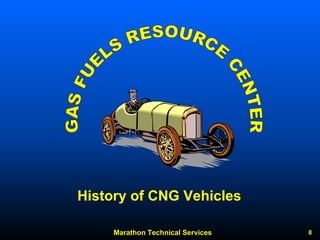
History of CNG Vehicles
Marathon Technical Services 9 
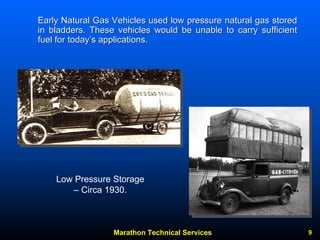
Early Natural Gas Vehicles used low pressure natural gas stored in bladders. These vehicles would be unable to carry sufficient fuel for today’s applications.Low Pressure Storage –Circa 1930.
Marathon Technical Services 10 
CNG Vehicle Emissions & Other Benefits
Marathon Technical Services 11 
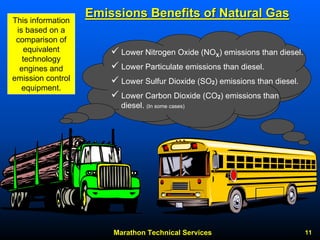
9Lower Nitrogen Oxide (NOXX) emissions than diesel. 9Lower Particulate emissions than diesel. 9Lower Sulfur Dioxide (SO2) emissions than diesel. 9Lower Carbon Dioxide (CO2) emissions than diesel. (In some cases) This information is based on a comparison of equivalent technology engines and emission control equipment. 
Emissions Benefits of Natural Gas
Marathon Technical Services 12 
Properties and Fundamentals of Natural Gas
Marathon Technical Services 13 
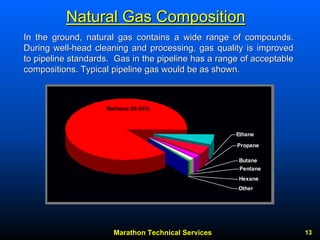
Natural Gas Composition 
In the ground, natural gas contains a wide range of compounds. 
During well well-head cleaning and processing, gas quality is improved 
to pipeline standards. Gas in the pipeline has a range of accep acceptable table 
compositions. Typical pipeline gas would be as shown. 
ButanePentaneHexaneEthanePropaneOtherMethane 85-95%
Marathon Technical Services 14 
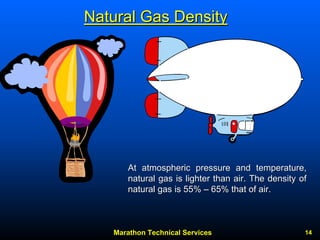
Natural Gas Density 
At atmospheric pressure and temperature, natural gas is lighter than air. The density of natural gas is 55% ––65% that of air.
Marathon Technical Services 15 
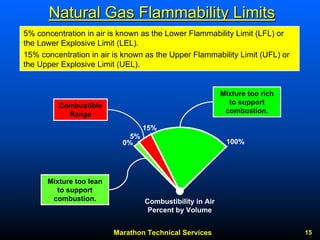
Natural Gas Flammability Limits 
5% concentration in air is known as the Lower Flammability Limit(LFL) or the Lower Explosive Limit (LEL). 
15% concentration in air is known as the Upper Flammability Limit (UFL) or the Upper Explosive Limit (UEL). 
0% 5% 15% 100% Combustibility in Air Percent by VolumeMixture too rich to support combustion. Mixture too lean to support combustion. Combustible Range
Marathon Technical Services 16 
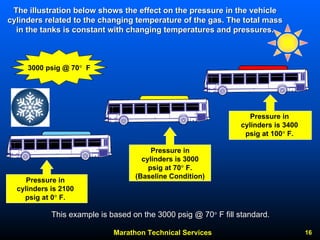
Pressure in cylinders is 3000 psig at 70°F. (Baseline Condition) Pressure in cylinders is 3400 psig at 100°F. Pressure in cylinders is 2100 psig at 0°F. The illustration below shows the effect on the pressure in the vThe vehicle ehicle cylinders related to the changing temperature of the gas. The tocylinders total mass tal in the tanks is constant with changing temperatures and pressurein pressures.s. 
3000 psig @ 70°F 
This example is based on the 3000 psig @ 70 70°° F fill standard.
Marathon Technical Services 17 
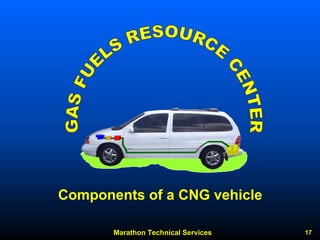
Components of a CNG vehicle
Marathon Technical Services 18 
Types of CNG Stations
Marathon Technical Services 19 
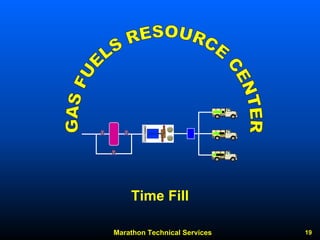
Time Fill
Marathon Technical Services 20 
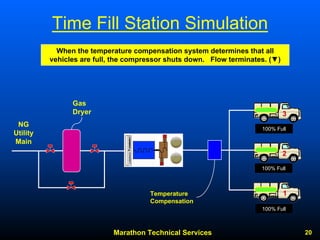
Time Fill Station Simulation 
When the temperature compensation system determines that all vehicles are full, the compressor shuts down. Flow terminates.(▼) 
Gas 
Dryer1100% Full100% Full100% Full32 
NG Utility Main 
TemperatureCompensation
Marathon Technical Services 21 
Time Fill Using Fueling Appliances 
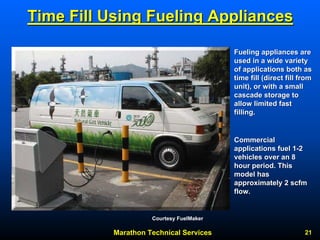
Fueling appliances are 
used in a wide variety 
of applications both as 
time fill (direct fill from 
unit), or with a small 
cascade storage to 
allow limited fast filling. 
Commercial 
applications fuel 1 1-2 
vehicles over an 8 
hour period. This 
model has 
approximately 2 scfm 
flow. 
Courtesy FuelMaker
Marathon Technical Services 22 
Cascade Installations 
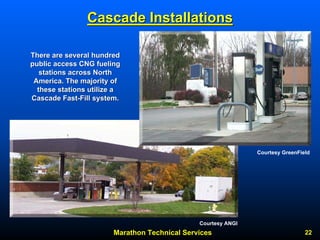
There are several hundred 
public access CNG fueling 
stations across North 
America. The majority of 
these stations utilize a 
Cascade Fast Fast-Fill system. 
Courtesy GreenField 
Courtesy ANGI
Marathon Technical Services 23 
Buffer Installations 
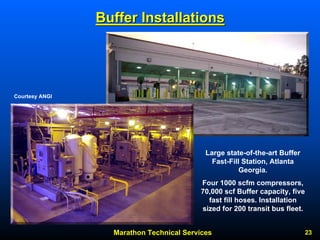
Courtesy ANGI 
Large state-of-the-art Buffer Fast-Fill Station, Atlanta Georgia. 
Four 1000 scfmcompressors, 70,000 scf Buffer capacity, five fast fill hoses. Installation sized for 200 transit bus fleet.
Marathon Technical Services 24 
L/CNG Installations 
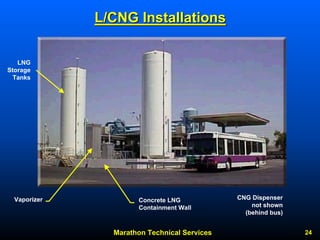
Courtesy NexgenFueling 
LNG Storage Tanks 
CNG Dispenser not shown (behind bus) 
Vaporizer 
Concrete LNG Containment Wall
Marathon Technical Services 25 
Station Components
Marathon Technical Services 26 
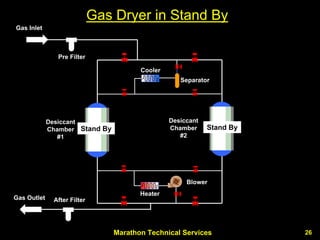
Gas Dryer in Stand By 
Gas InletStand By 
Pre Filter 
Cooler 
SeparatorStand By 
Desiccant Chamber #2 
Desiccant Chamber #1 
Blower 
Heater 
Gas Outlet 
After Filter
Marathon Technical Services 27 
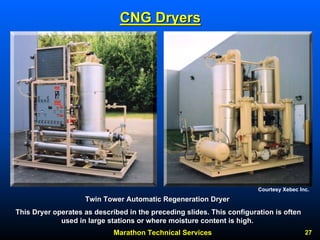
CNG Dryers 
Courtesy Xebec Inc. 
Twin Tower Automatic Regeneration Dryer 
This Dryer operates as described in the preceding slides. This configuration is often 
used in large stations or where moisture content is high.
Marathon Technical Services 28 
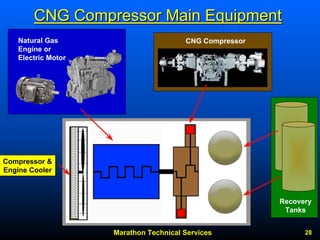
CNG Compressor Main Equipment 
Compressor & Engine CoolerCompressor CoolerRecovery TanksCNG Compressor Natural Gas Engine or Electric Motor
Marathon Technical Services 29 
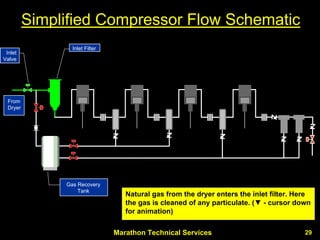
Simplified Compressor Flow SchematicInlet FilterInlet ValveFrom DryerGas Recovery Tank 
Natural gas from the dryer enters the inlet filter. Here the gas is cleaned of any particulate. (▼ -cursor down for animation)
Marathon Technical Services 30 
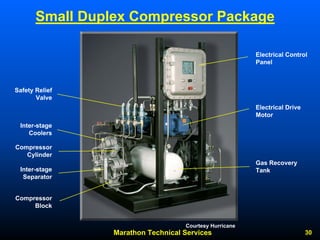
Small Duplex Compressor Package 
Electrical Control Panel 
Safety Relief Valve 
Electrical Drive Motor 
Inter-stage Coolers 
Compressor Cylinder 
Gas Recovery Tank 
Inter-stage Separator 
Compressor Block 
Courtesy Hurricane
Marathon Technical Services 31 
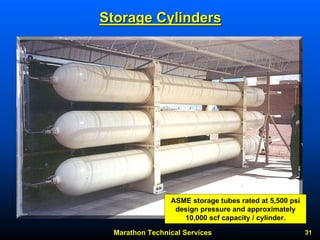
Storage Cylinders 
ASME storage tubes rated at 5,500 psidesign pressure and approximately 10,000 scf capacity / cylinder.
Marathon Technical Services 32 
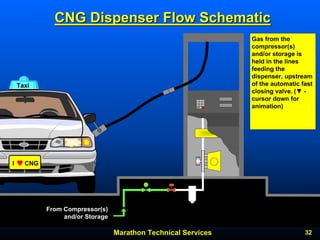
CNG Dispenser Flow Schematic 
From Compressor(s) and/or StorageTaxiI CNG 
Gas from the compressor(s) and/or storage is held in the lines feeding the dispenser, upstream of the automatic fast closing valve.(▼ - cursor down for animation)
Marathon Technical Services 33 
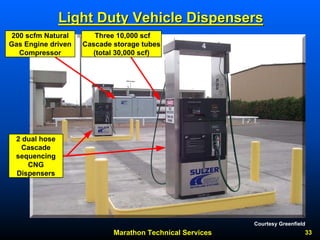
Light Duty Vehicle Dispensers 
200 scfmNatural Gas Engine driven CompressorThree 10,000 scf Cascade storage tubes (total 30,000 scf) 2 dual hose Cascade sequencing CNG Dispensers 
Courtesy Greenfield
Marathon Technical Services 34 
Vehicle and Engine Manufacturers
Marathon Technical Services 35 
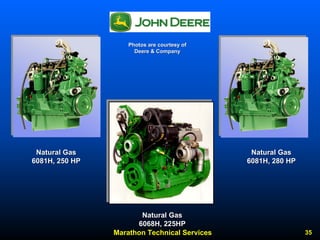
Photos are courtesy of 
Deere & Company 
Natural Gas 
6081H, 280 HP 
Natural Gas 
6081H, 250 HP 
Natural Gas 
6068H, 225HP
Marathon Technical Services 36 
Test Your KnowledgeNote: Macros must be running for this section to work properly
Marathon Technical Services 37 
Test Your Knowledge 
The Lower Flammability Limit of natural gas is 15% True FalseCCResetClick For Reference Slide
Marathon Technical Services 38 
CNG 201CNG Code Reference GuideVersion 0.1 
Best viewed with PowerPoint 2002 at 1024 x 768 resolution
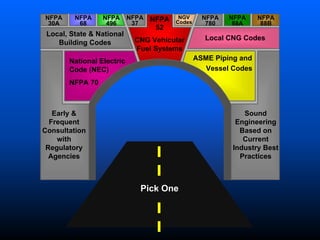
ASME Piping andVessel CodesSound Engineering Based on Current Industry Best PracticesLocal, State & National Building CodesLocal CNG CodesNFPA 30AEarly & Frequent Consultation with Regulatory AgenciesNFPA 68NFPA 780NFPA 88ANFPA 88BNational Electric Code (NEC) NFPA 70NFPA 52CNG Vehicular Fuel SystemsNFPA 496NFPA 37NGV CodesPick OnePick One
Marathon Technical Services 40 
NFPA 52 -1998CNG Vehicular Fuels SystemThis presentation includes only sections relevantto CNG station greater than 10 SCFM. Sections related to fueling appliances and vehicles have been omitted.
Marathon Technical Services 41 
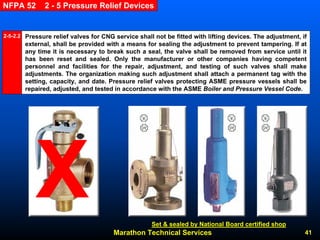
NFPA 52 2 -5 Pressure Relief DevicesPressure relief valves for CNG service shall not be fitted with lifting devices. The adjustment, if external, shall be provided with a means for sealing the adjustment to prevent tampering. If at any time it is necessary to break such a seal, the valve shall be removed from service until it has been reset and sealed. Only the manufacturer or other companies having competent personnel and facilities for the repair, adjustment, and testingof such valves shall make adjustments. The organization making such adjustment shall attach a permanent tag with the setting, capacity, and date. Pressure relief valves protecting ASME pressure vessels shall be repaired, adjusted, and tested in accordance with the ASME Boiler and Pressure Vessel Code. 2-5-2.2 
Set & sealed by National Board certified shop
Marathon Technical Services 42 
NFPA 52 2 -8 Fuel Lines 
Pipe, tubing, fittings, gaskets, and packing material shall be compatible with the fuel under the service conditions. 
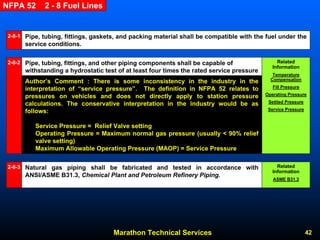
2-8-1Pipe, tubing, fittings, and other piping components shall be capable of withstanding a hydrostatic test of at least four times the ratedservice pressure without structural failure.Author’s Comment : There is some inconsistency in the industry in the interpretation of “service pressure”. The definition in NFPA 52 relates to pressures on vehicles and does not directly apply to station pressure calculations. The conservative interpretation in the industry would be as follows: Service Pressure = Relief Valve settingOperating Pressure = Maximum normal gas pressure (usually < 90% relief valve setting) Maximum Allowable Operating Pressure (MAOP) = Service Pressure 
Related Information 
Temperature Compensation 
Fill Pressure 
Operating Pressure 
Settled Pressure 
Service Pressure 
2-8-2 
Natural gas piping shall be fabricated and tested in accordance with ANSI/ASME B31.3, Chemical Plant and Petroleum Refinery Piping. 
Related Information 
ASME B31.3 
2-8-3
Marathon Technical Services 43 
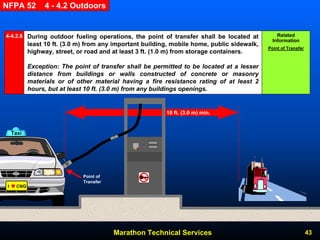
NFPA 52 4 -4.2 Outdoors10 ft. (3.0 m) min. TaxiI CNG 
During outdoor fueling operations, the point of transfer shall be located at least 10 ft. (3.0 m) from any important building, mobile home, public sidewalk, highway, street, or road and at least 3 ft. (1.0 m) from storagecontainers. 
Exception: The point of transfer shall be permitted to be located at a lesser distance from buildings or walls constructed of concrete or masonry materials or of other material having a fire resistance rating of at least 2 hours, but at least 10 ft. (3.0 m) from any buildings openings. 
Related Information 
Point of Transfer 
4-4.2.8 
Point of Transfer
Marathon Technical Services 44 
NFPA 52 4 -10 Testing 
Pressure relief valves shall be tested at least every 5 years. 
4-10.2 
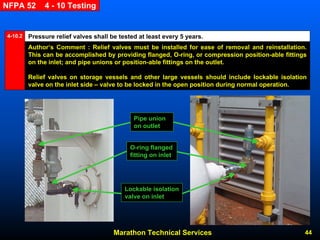
Author’s Comment : Relief valves must be installed for ease of removal and reinstallation. This can be accomplished by providing flanged, O-ring, or compression position-able fittings on the inlet; and pipe unions or position-able fittings on the outlet. 
Relief valves on storage vessels and other large vessels should include lockable isolation valve on the inlet side –valve to be locked in the open position during normal operation. Pipe union on outletLockable isolation valve on inletO-ring flanged fitting on inlet
Marathon Technical Services 45 
NFPA 70 -2002National Electric Code (NEC)
Marathon Technical Services 46 
ASME Piping and Vessel Codes
Marathon Technical Services 47 
NFPA 68 -1998Venting of Deflagrations
Marathon Technical Services 48 
NFPA 88A -1998Parking Structures
Marathon Technical Services 49 
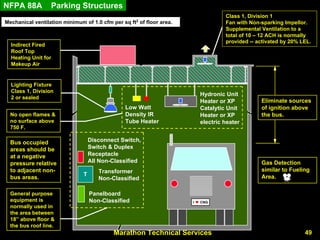
NFPA 88A Parking StructuresTransformerNon-ClassifiedPanelboardNon-ClassifiedDisconnect Switch, Switch & DuplexReceptacleAll Non-ClassifiedTHydronicUnit Heater or XP Catalytic Unit Heater or XP electric heaterLow Watt Density IR Tube HeaterI CNG 
Class 1, Division 1 
Fan with Non-sparking Impellor. 
Supplemental Ventilation to a 
total of 10 –12 ACH is normally 
provided --activated by 20% LEL. 
Mechanical ventilation minimum of 1.0 cfmper sq ft2of floor area. 
Indirect Fired 
Roof Top 
Heating Unit for 
Makeup Air 
Lighting Fixture 
Class 1, Division 
2 or sealed 
Eliminate sources of ignition above the bus. 
No open flames & no surface above 750 F. 
Bus occupied areas should be at a negative pressure relative to adjacent non- bus areas. Gas Detection similar to Fueling Area. 
General purpose equipment is normally used in the area between 18” above floor & the bus roof line.
Marathon Technical Services 50 
NFPA 88B -1997Repair Garages 
Portions of this document pertaining to Repair Garages are now included in NFPA 30A –2000.
Marathon Technical Services 51 
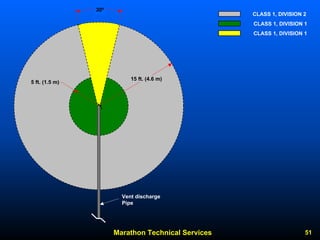
15 ft. (4.6 m)5 ft. (1.5 m) 30º CLASS 1, DIVISION 2CLASS 1, DIVISION 1CLASS 1, DIVISION 1 
Vent discharge Pipe
Marathon Technical Services 52 
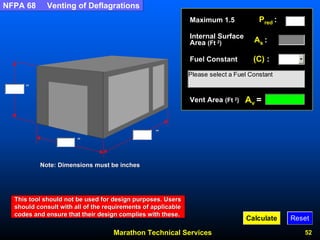
NFPA 68 Venting of DeflagrationsInternal Surface Area (Ft 2) Av = Pred: As : Fuel Constant (C) : Maximum 1.5Please select a Fuel ConstantVent Area (Ft 2) ”” ”” ”” 
Note: Dimensions must be inches 
This tool should not be used for design purposes. Users 
should consult with all of the requirements of applicable 
codes and ensure that their design complies with these. CalculateReset
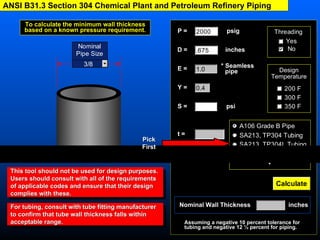
0.4Y = Calculate200 F300 F350 FDesignTemperaturet = 1.0E =* Seamless pipe Yes NoS =psiP =2000psig.675D =inchesThreadingc =0 A106 Grade B Pipe SA213, TP304 Tubing SA213, TP304L TubingAssuming a negative 10 percent tolerance for tubing and negative 12 ½ percent for piping. Nominal Wall Thicknessinches3/8Pick Pick FirstFirstNominal Pipe Size 
To calculate the minimum wall thickness 
based on a known pressure requirement. 
This tool should not be used for design purposes. Users should consult with all of the requirements of applicable codes and ensure that their design complies with these. 
This tool should not be used for design purposes. 
Users should consult with all of the requirements 
of applicable codes and ensure that their design 
complies with these. 
For tubing, consult with tube fitting manufacturer to confirm that tube wall thickness falls within acceptable range. 
For tubing, consult with tube fitting manufacturer 
to confirm that tube wall thickness falls within 
acceptable range. 
ANSI B31.3 Section 304 Chemical Plant and Petroleum Refinery Piping
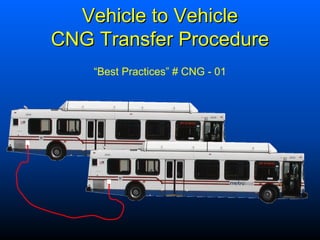
Vehicle to Vehicle 
CNG Transfer Procedure 
“Best Practices” # CNG -01
Marathon Technical Services 55 
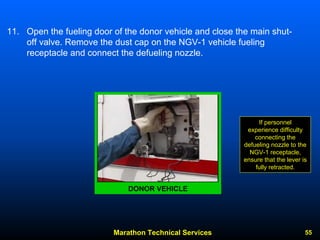
11.Open the fueling door of the donor vehicle and close the main shut- off valve. Remove the dust cap on the NGV-1 vehicle fueling receptacle and connect the defuelingnozzle. 
If personnel experience difficulty connecting the defuelingnozzle to the NGV-1 receptacle, ensure that the lever is fully retracted. 
DONOR VEHICLE
Marathon Technical Services 56 
CNG Station Best Practice 2.0CNG Station Sizing & SelectionBest viewed with PowerPoint 2002 at 1024 x 768 resolution
Marathon Technical Services 57 
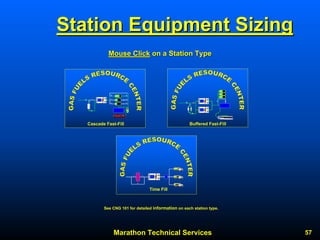
Station Equipment Sizing 
Mouse Click on a Station Type 
Buffered Fast-FillCascade Fast-FillTime FillTime Fill 
See CNG 101 for detailed informationon each station type.
Marathon Technical Services 58 
We wish to thank 
GTI / IWG / DOE 
and the 
NGV TECHNOLOGY FORUM

Recommend pract cng_

  • 1.
    Marathon Technical Services1 Recommended Practices for CNG Fueling Station Design, Construction and Operation GRI/NGV NGV-IWG RFP Project No. 0000000908 Presented at: NGV TECHNOLOGY FORUM TECHNICAL COMMITTEE MEETING January 28, 2003 Dallas, Texas
  • 2.
    Marathon Technical Services2 Prepared by: Marathon Technical Services P.O. Box 318, 6 Venus Crescent Heidelberg, Ontario,Canada N0B 1Y0 Phone 519-699-9250 Fax 519-699-9255 e-mail: radams@marathontech.ca
  • 3.
    Marathon Technical Services3 CNG Station Best Practices Practices- Purpose and scope of project QQ Review current industry Best Practices related to CNG station design, construction, operation and maintenance. Compile these for use by the industry. QQ Provide a CNG primer manual and a Code Official Official’’s handbook and video to assist Code Officials to better understand permitting requirements.
  • 4.
    Marathon Technical Services4 CNG Station Best PracticesCNG Practices-- Revised deliverablesRevised deliverablesMarathon has discussed the deliverables with GTI as Marathon we proceeded and we have revised the format of the deliverables: QQ All information will be CD and or Web based. QQ This format allows the information to be more interactive in nature. QQ Production and distribution costs and time are reduced. QQ Updates are easier, faster to produce and distribute. QQ It is likely that this format will be more useful and more used than paper reports and VHS tapes.
  • 5.
    Marathon Technical Services5 CNG Station Best Practices Practices- Preview of deliverables QQPreview of CNG 101 --CNG PrimerCNG Primer QQPreview of CNG 201 --Code HandbookCode Handbook QQPreview of BusPreview Bus--toto--Bus Fueling Procedure (developed under separate contract)(contract) QQPreview of Station Equipment Selection & Budgeting.Content and format of the ProductsContent Products
  • 6.
    Marathon Technical Services6 CNG Station Best Practices Practices- Suggested “Best Practices” QQ Fueling procedure/Temperature compensation QQ Oil carryover - PAG oils QQ Oil carryover - Proper filtration design, maintenance QQ Fail Safe Control Systems/Gas Detection QQ Station flow optimization, gas flow, pipe sizing, etc. QQ Station redundancy. QQ Station layout - dispenser location, noise reduction, etc. QQ Isolation and Blowdown Design and procedures QQ Industry Incidents - lessons learned QQ Other - Brainstorm Other Best Practice topics/Case Studies - What are ““Best Practices Practices”” Examples:
  • 7.
    CNG 101An Introductionto Compressed Natural GasVersion 0.5 Best viewed at 1024 x 768 resolution
  • 8.
    Marathon Technical Services8 History of CNG Vehicles
  • 9.
    Marathon Technical Services9 Early Natural Gas Vehicles used low pressure natural gas stored in bladders. These vehicles would be unable to carry sufficient fuel for today’s applications.Low Pressure Storage –Circa 1930.
  • 10.
    Marathon Technical Services10 CNG Vehicle Emissions & Other Benefits
  • 11.
    Marathon Technical Services11 9Lower Nitrogen Oxide (NOXX) emissions than diesel. 9Lower Particulate emissions than diesel. 9Lower Sulfur Dioxide (SO2) emissions than diesel. 9Lower Carbon Dioxide (CO2) emissions than diesel. (In some cases) This information is based on a comparison of equivalent technology engines and emission control equipment. Emissions Benefits of Natural Gas
  • 12.
    Marathon Technical Services12 Properties and Fundamentals of Natural Gas
  • 13.
    Marathon Technical Services13 Natural Gas Composition In the ground, natural gas contains a wide range of compounds. During well well-head cleaning and processing, gas quality is improved to pipeline standards. Gas in the pipeline has a range of accep acceptable table compositions. Typical pipeline gas would be as shown. ButanePentaneHexaneEthanePropaneOtherMethane 85-95%
  • 14.
    Marathon Technical Services14 Natural Gas Density At atmospheric pressure and temperature, natural gas is lighter than air. The density of natural gas is 55% ––65% that of air.
  • 15.
    Marathon Technical Services15 Natural Gas Flammability Limits 5% concentration in air is known as the Lower Flammability Limit(LFL) or the Lower Explosive Limit (LEL). 15% concentration in air is known as the Upper Flammability Limit (UFL) or the Upper Explosive Limit (UEL). 0% 5% 15% 100% Combustibility in Air Percent by VolumeMixture too rich to support combustion. Mixture too lean to support combustion. Combustible Range
  • 16.
    Marathon Technical Services16 Pressure in cylinders is 3000 psig at 70°F. (Baseline Condition) Pressure in cylinders is 3400 psig at 100°F. Pressure in cylinders is 2100 psig at 0°F. The illustration below shows the effect on the pressure in the vThe vehicle ehicle cylinders related to the changing temperature of the gas. The tocylinders total mass tal in the tanks is constant with changing temperatures and pressurein pressures.s. 3000 psig @ 70°F This example is based on the 3000 psig @ 70 70°° F fill standard.
  • 17.
    Marathon Technical Services17 Components of a CNG vehicle
  • 18.
    Marathon Technical Services18 Types of CNG Stations
  • 19.
  • 20.
    Marathon Technical Services20 Time Fill Station Simulation When the temperature compensation system determines that all vehicles are full, the compressor shuts down. Flow terminates.(▼) Gas Dryer1100% Full100% Full100% Full32 NG Utility Main TemperatureCompensation
  • 21.
    Marathon Technical Services21 Time Fill Using Fueling Appliances Fueling appliances are used in a wide variety of applications both as time fill (direct fill from unit), or with a small cascade storage to allow limited fast filling. Commercial applications fuel 1 1-2 vehicles over an 8 hour period. This model has approximately 2 scfm flow. Courtesy FuelMaker
  • 22.
    Marathon Technical Services22 Cascade Installations There are several hundred public access CNG fueling stations across North America. The majority of these stations utilize a Cascade Fast Fast-Fill system. Courtesy GreenField Courtesy ANGI
  • 23.
    Marathon Technical Services23 Buffer Installations Courtesy ANGI Large state-of-the-art Buffer Fast-Fill Station, Atlanta Georgia. Four 1000 scfmcompressors, 70,000 scf Buffer capacity, five fast fill hoses. Installation sized for 200 transit bus fleet.
  • 24.
    Marathon Technical Services24 L/CNG Installations Courtesy NexgenFueling LNG Storage Tanks CNG Dispenser not shown (behind bus) Vaporizer Concrete LNG Containment Wall
  • 25.
    Marathon Technical Services25 Station Components
  • 26.
    Marathon Technical Services26 Gas Dryer in Stand By Gas InletStand By Pre Filter Cooler SeparatorStand By Desiccant Chamber #2 Desiccant Chamber #1 Blower Heater Gas Outlet After Filter
  • 27.
    Marathon Technical Services27 CNG Dryers Courtesy Xebec Inc. Twin Tower Automatic Regeneration Dryer This Dryer operates as described in the preceding slides. This configuration is often used in large stations or where moisture content is high.
  • 28.
    Marathon Technical Services28 CNG Compressor Main Equipment Compressor & Engine CoolerCompressor CoolerRecovery TanksCNG Compressor Natural Gas Engine or Electric Motor
  • 29.
    Marathon Technical Services29 Simplified Compressor Flow SchematicInlet FilterInlet ValveFrom DryerGas Recovery Tank Natural gas from the dryer enters the inlet filter. Here the gas is cleaned of any particulate. (▼ -cursor down for animation)
  • 30.
    Marathon Technical Services30 Small Duplex Compressor Package Electrical Control Panel Safety Relief Valve Electrical Drive Motor Inter-stage Coolers Compressor Cylinder Gas Recovery Tank Inter-stage Separator Compressor Block Courtesy Hurricane
  • 31.
    Marathon Technical Services31 Storage Cylinders ASME storage tubes rated at 5,500 psidesign pressure and approximately 10,000 scf capacity / cylinder.
  • 32.
    Marathon Technical Services32 CNG Dispenser Flow Schematic From Compressor(s) and/or StorageTaxiI CNG Gas from the compressor(s) and/or storage is held in the lines feeding the dispenser, upstream of the automatic fast closing valve.(▼ - cursor down for animation)
  • 33.
    Marathon Technical Services33 Light Duty Vehicle Dispensers 200 scfmNatural Gas Engine driven CompressorThree 10,000 scf Cascade storage tubes (total 30,000 scf) 2 dual hose Cascade sequencing CNG Dispensers Courtesy Greenfield
  • 34.
    Marathon Technical Services34 Vehicle and Engine Manufacturers
  • 35.
    Marathon Technical Services35 Photos are courtesy of Deere & Company Natural Gas 6081H, 280 HP Natural Gas 6081H, 250 HP Natural Gas 6068H, 225HP
  • 36.
    Marathon Technical Services36 Test Your KnowledgeNote: Macros must be running for this section to work properly
  • 37.
    Marathon Technical Services37 Test Your Knowledge The Lower Flammability Limit of natural gas is 15% True FalseCCResetClick For Reference Slide
  • 38.
    Marathon Technical Services38 CNG 201CNG Code Reference GuideVersion 0.1 Best viewed with PowerPoint 2002 at 1024 x 768 resolution
  • 39.
    ASME Piping andVesselCodesSound Engineering Based on Current Industry Best PracticesLocal, State & National Building CodesLocal CNG CodesNFPA 30AEarly & Frequent Consultation with Regulatory AgenciesNFPA 68NFPA 780NFPA 88ANFPA 88BNational Electric Code (NEC) NFPA 70NFPA 52CNG Vehicular Fuel SystemsNFPA 496NFPA 37NGV CodesPick OnePick One
  • 40.
    Marathon Technical Services40 NFPA 52 -1998CNG Vehicular Fuels SystemThis presentation includes only sections relevantto CNG station greater than 10 SCFM. Sections related to fueling appliances and vehicles have been omitted.
  • 41.
    Marathon Technical Services41 NFPA 52 2 -5 Pressure Relief DevicesPressure relief valves for CNG service shall not be fitted with lifting devices. The adjustment, if external, shall be provided with a means for sealing the adjustment to prevent tampering. If at any time it is necessary to break such a seal, the valve shall be removed from service until it has been reset and sealed. Only the manufacturer or other companies having competent personnel and facilities for the repair, adjustment, and testingof such valves shall make adjustments. The organization making such adjustment shall attach a permanent tag with the setting, capacity, and date. Pressure relief valves protecting ASME pressure vessels shall be repaired, adjusted, and tested in accordance with the ASME Boiler and Pressure Vessel Code. 2-5-2.2 Set & sealed by National Board certified shop
  • 42.
    Marathon Technical Services42 NFPA 52 2 -8 Fuel Lines Pipe, tubing, fittings, gaskets, and packing material shall be compatible with the fuel under the service conditions. 2-8-1Pipe, tubing, fittings, and other piping components shall be capable of withstanding a hydrostatic test of at least four times the ratedservice pressure without structural failure.Author’s Comment : There is some inconsistency in the industry in the interpretation of “service pressure”. The definition in NFPA 52 relates to pressures on vehicles and does not directly apply to station pressure calculations. The conservative interpretation in the industry would be as follows: Service Pressure = Relief Valve settingOperating Pressure = Maximum normal gas pressure (usually < 90% relief valve setting) Maximum Allowable Operating Pressure (MAOP) = Service Pressure Related Information Temperature Compensation Fill Pressure Operating Pressure Settled Pressure Service Pressure 2-8-2 Natural gas piping shall be fabricated and tested in accordance with ANSI/ASME B31.3, Chemical Plant and Petroleum Refinery Piping. Related Information ASME B31.3 2-8-3
  • 43.
    Marathon Technical Services43 NFPA 52 4 -4.2 Outdoors10 ft. (3.0 m) min. TaxiI CNG During outdoor fueling operations, the point of transfer shall be located at least 10 ft. (3.0 m) from any important building, mobile home, public sidewalk, highway, street, or road and at least 3 ft. (1.0 m) from storagecontainers. Exception: The point of transfer shall be permitted to be located at a lesser distance from buildings or walls constructed of concrete or masonry materials or of other material having a fire resistance rating of at least 2 hours, but at least 10 ft. (3.0 m) from any buildings openings. Related Information Point of Transfer 4-4.2.8 Point of Transfer
  • 44.
    Marathon Technical Services44 NFPA 52 4 -10 Testing Pressure relief valves shall be tested at least every 5 years. 4-10.2 Author’s Comment : Relief valves must be installed for ease of removal and reinstallation. This can be accomplished by providing flanged, O-ring, or compression position-able fittings on the inlet; and pipe unions or position-able fittings on the outlet. Relief valves on storage vessels and other large vessels should include lockable isolation valve on the inlet side –valve to be locked in the open position during normal operation. Pipe union on outletLockable isolation valve on inletO-ring flanged fitting on inlet
  • 45.
    Marathon Technical Services45 NFPA 70 -2002National Electric Code (NEC)
  • 46.
    Marathon Technical Services46 ASME Piping and Vessel Codes
  • 47.
    Marathon Technical Services47 NFPA 68 -1998Venting of Deflagrations
  • 48.
    Marathon Technical Services48 NFPA 88A -1998Parking Structures
  • 49.
    Marathon Technical Services49 NFPA 88A Parking StructuresTransformerNon-ClassifiedPanelboardNon-ClassifiedDisconnect Switch, Switch & DuplexReceptacleAll Non-ClassifiedTHydronicUnit Heater or XP Catalytic Unit Heater or XP electric heaterLow Watt Density IR Tube HeaterI CNG Class 1, Division 1 Fan with Non-sparking Impellor. Supplemental Ventilation to a total of 10 –12 ACH is normally provided --activated by 20% LEL. Mechanical ventilation minimum of 1.0 cfmper sq ft2of floor area. Indirect Fired Roof Top Heating Unit for Makeup Air Lighting Fixture Class 1, Division 2 or sealed Eliminate sources of ignition above the bus. No open flames & no surface above 750 F. Bus occupied areas should be at a negative pressure relative to adjacent non- bus areas. Gas Detection similar to Fueling Area. General purpose equipment is normally used in the area between 18” above floor & the bus roof line.
  • 50.
    Marathon Technical Services50 NFPA 88B -1997Repair Garages Portions of this document pertaining to Repair Garages are now included in NFPA 30A –2000.
  • 51.
    Marathon Technical Services51 15 ft. (4.6 m)5 ft. (1.5 m) 30º CLASS 1, DIVISION 2CLASS 1, DIVISION 1CLASS 1, DIVISION 1 Vent discharge Pipe
  • 52.
    Marathon Technical Services52 NFPA 68 Venting of DeflagrationsInternal Surface Area (Ft 2) Av = Pred: As : Fuel Constant (C) : Maximum 1.5Please select a Fuel ConstantVent Area (Ft 2) ”” ”” ”” Note: Dimensions must be inches This tool should not be used for design purposes. Users should consult with all of the requirements of applicable codes and ensure that their design complies with these. CalculateReset
  • 53.
    0.4Y = Calculate200F300 F350 FDesignTemperaturet = 1.0E =* Seamless pipe Yes NoS =psiP =2000psig.675D =inchesThreadingc =0 A106 Grade B Pipe SA213, TP304 Tubing SA213, TP304L TubingAssuming a negative 10 percent tolerance for tubing and negative 12 ½ percent for piping. Nominal Wall Thicknessinches3/8Pick Pick FirstFirstNominal Pipe Size To calculate the minimum wall thickness based on a known pressure requirement. This tool should not be used for design purposes. Users should consult with all of the requirements of applicable codes and ensure that their design complies with these. This tool should not be used for design purposes. Users should consult with all of the requirements of applicable codes and ensure that their design complies with these. For tubing, consult with tube fitting manufacturer to confirm that tube wall thickness falls within acceptable range. For tubing, consult with tube fitting manufacturer to confirm that tube wall thickness falls within acceptable range. ANSI B31.3 Section 304 Chemical Plant and Petroleum Refinery Piping
  • 54.
    Vehicle to Vehicle CNG Transfer Procedure “Best Practices” # CNG -01
  • 55.
    Marathon Technical Services55 11.Open the fueling door of the donor vehicle and close the main shut- off valve. Remove the dust cap on the NGV-1 vehicle fueling receptacle and connect the defuelingnozzle. If personnel experience difficulty connecting the defuelingnozzle to the NGV-1 receptacle, ensure that the lever is fully retracted. DONOR VEHICLE
  • 56.
    Marathon Technical Services56 CNG Station Best Practice 2.0CNG Station Sizing & SelectionBest viewed with PowerPoint 2002 at 1024 x 768 resolution
  • 57.
    Marathon Technical Services57 Station Equipment Sizing Mouse Click on a Station Type Buffered Fast-FillCascade Fast-FillTime FillTime Fill See CNG 101 for detailed informationon each station type.
  • 58.
    Marathon Technical Services58 We wish to thank GTI / IWG / DOE and the NGV TECHNOLOGY FORUM