 
Zin Eddine Dadach
Higher Colleges of Technology, UAE
CO2 Capture & Storage
A Solution To Global Warming
I. Is the world getting warmer?
II. Are The Actions Of Mankind To Blame For Earth‟s Temperature Increases?
III. What Can/Should Be Done About These Issues?
IV. Carbon Capture & Storage ?
V. CO2-Capture Strategies
VI. Strategies For the Compression of CO2
VII. Strategies For The Transport Of CO2
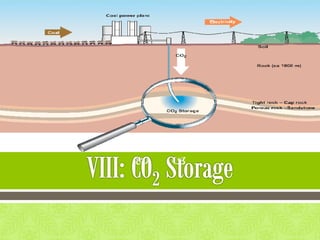
VIII. VIII: CO2 Storage In Suitable Geological Formations
VIII.1: Sequestration In Saline Aquifers
VIII.2: CO2 Injection For Enhanced Oil Recovery
IX. Getting Green is Expensive
X. Safety And Legal Issues
XI. Conclusion
Is the world getting warmer?
If so, are the actions of mankind to
blame for earth‟s temperature
increases?
What can/should be done about these
issues?


Carbon dioxide (26%) is not as strong a greenhouse gas as
water vapor (58%), but it absorbs energy in wavelengths
(12-15 micrometers) that water vapor does not, partially
closing the “water vapor window” through which heat
radiated by the surface would normally escape to space.
Carbon dioxide and the greenhouse effect are necessary for Earth to survive. In
fact, if we had no greenhouse effect, our planet would have an average
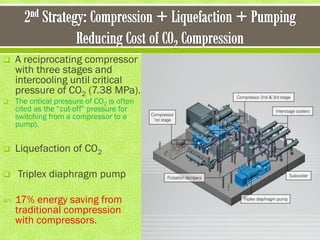
temperature of –300C [source: UNEP]. However, human inventions like power
plants and transportation vehicles, which burn fossil fuels, release extra CO2 into
the air.
 Power generation
industry plays a major
role in the economic
growth of any country.
 About 80% of total
electricity in the world
is produced from
fossil fuels fired
thermal power plants.
Combustion Reactions
CH4 + Air (O2 +N2) → CO2 + H2O +N2
C5H10+ Air(O2 +N2) → 5CO2 + H2O +N2
Oil
Coal
NG
Nuclear
Renewables
Quad(1015)BTU

16
as energy
consumption
continues to rise
Climate change is probably the biggest challenge the
world is facing, but it‟s not too late to fix it, however
Carbon Capture and Storage has the potential to provide a
critical near-term solution for reducing the concentration of
carbon dioxide in the atmosphere. 17
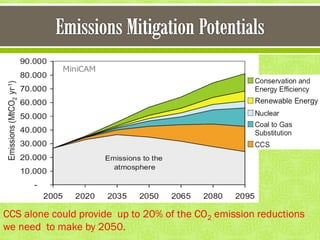
CCS alone could provide up to 20% of the CO2 emission reductions
we need to make by 2050.
Carbon capture and storage is mostly used to describe methods for
removing CO2 emissions from large stationary sources, such as electricity
generation and some industrial processes, and storing it away from the
atmosphere.
STEP I
Capturing and concentrating CO2 from industrial sources.
STEP II
Compression of CO2 until pressure of injection (20 MPa)
STEP III
Transport of CO2 from Compression units until injection sites.
STEP IV
CO2 will be stored underground or in Oil and Gas fields.

The high capital cost of CO2 capture technologies is
often cited as a key barrier by the potential CCS
developers and investors.
More Impurities with Heavier Fuels
Global Warming Effects of
Impurities
 Involves the removal of CO2 from
the flue gas produced by
combustion of fossil fuel.
 Nearly pure oxygen is used for
combustion instead of air. The flue
gas that is mainly CO2 and H2O.
 Involves reaction of a fuel with air
and/or steam to give mainly a gas
composed of carbon monoxide and
hydrogen. The carbon monoxide
reacts with steam to give CO2 and
more hydrogen
 Solvents – aqueous amines and salts
 Membranes – polymeric
 Solid sorbents – Lime, zeolite, activated carbon
 Cryogenic processes – Liquefaction/distillation
The advantage of Post-combustion is that it can be
fully integrated with existing plants.
The main issue is the low concentration of CO2 in the flue gases (3-
10%) that makes the process very costly (70-80% of CCS Cost)
CH4 + (2O2 + 7.52 N2) → CO2 + 2H2O +7.52 N2
 STEP I: Isolate CO2 from the
other gases (10%) (CO2 reacts
with amine in the absorber)
 STEP II: Concentrate CO2 from
10% until 90-95% (CO2 is
separated from amine in the
desorber)
 INCONVENIENT: With the
classical amine MEA, 70-80 %
of CCS cost is due to the heat
for its regeneration in the
reboiler.
 The Classical MEA Consumes a lot of heat during regeneration.
The principal question is how to select a competitive solvent which
is capable of rapid rate of absorption. At the same time, the
solvent should have low regeneration energy consumption
 ADVANCED AMINE SOLVENT (blend of low concentration of primary
amine MEA mixed with high concentration of tertiary amine MDEA
(slow reaction but needs less heat for regeneration).
 The Piperazine (PZ) activated MDEA process was patented by BASF
in the early 80‟s
 The hindered amine 2-Amino-2-Methyl-1-Propanol (AMP) is also
used by some companies (Mitsubishi) instead of MDEA.
 Some authors ranked the regeneration performance in the
following order AMP>MDEA>DETA>DEA>MEA
 Recently Ionic liquids are introduced as new
family of solvents to be tested for CO2 Capture
 Ionic liquids need less energy in the desorber than
classical amines (CO2 physically absorbed)
 Inconvenient: Very viscous and have lower rates
of absorption than amines
 Post Combustion by absorption: Adding Ionic Liquids To
amine mixture :An aqueous amine solution mixed with ionic
liquid was proposed and the results are the following:
 The energy consumption of the mixed (Ionic liquid + MEA
amine) solution in the desorber was 37.2% lower than that
of aqueous MEA amine solution alone.
 Publication Date: January 2014; American Chemical Society

VI : Compression of CO2
It requires significant power to boost the pressure of CO2 from the atmospheric pressure
(0.1MPa) of the capture plant up to a pressure suitable for injection of 15 MPa because
storage of CO2 is more efficient if it is in supercritical conditions (P > 7.4 MPa and T> 300 K.).
Compression of “captured CO2” performed by multi-
stage reciprocating or turbo compressors with
intercooling from atmospheric pressure (0.1 MPa) to
injection pressure of about 15 MPa.
 A reciprocating compressor
with three stages and
intercooling until critical
pressure of CO2 (7.38 MPa).
 The critical pressure of CO2 is often
cited as the “cut-off” pressure for
switching from a compressor to a
pump).
 Liquefaction of CO2
 Triplex diaphragm pump
 17% energy saving from
traditional compression
with compressors.

VII: Transport of CO2
Many point sources of captured CO2 would not be close to
geological or oceanic storage facilities. In these cases,
transportation would be required. The main forms of
transportation are pipeline & shipping

The effectiveness of geological
storage for safe and long storage of
CO2 depends on a combination of
physical and geochemical trapping
mechanisms (Depth of 800 m, Seal,
Porosity, Permeability, Brine water)
Storage Capacity Injectivity
Perfect sealing
Depth: 800 m
 Geological
sequestration of carbon
dioxide is a means of its
injection in a suitable
geological formation
 Saline aquifers,
 Oil and gas reservoirs
(EOR),
 Depleted oil and gas
reservoirs,
 Coal beds
 Ocean
Impacts
o pH change
o Mortality of ocean organisms
o Ecosystem consequences
o Chronic effects unknown
Change of bacteria, nanobenthos and
meiobenthos abundace after exposure to
20,000 and 5,000 ppm for 77-375 hrs
during experiments carried out at 2000
m depth in NW Pacific
100%
80%
60%
40%
20%
0%
-20%
-40%
-60%
-80%
-100%
<10 mm 10-30 mm
MeibenthosNanobenthosBacteria
Changepopulation
20,000 ppm
5000 ppm

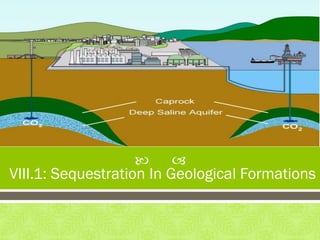
VIII.1: Sequestration In Geological Formations
 Deep saline formations are very
similar to oil and gas reservoirs in
that they are deep, porous rocks that
may contain a fluid trapped by cap-
rock for many millions of years
 Injecting CO2 in these formations
would see the CO2 at first added to
the salty brine, eventually dissolving
and finally mineralizing to become
part of the rock
 Another potential storage medium is
unminable coal. CO2 can be injected
into suitable coal seams where it will
be adsorbed onto the coal, locking it
up permanently.
This is the most dominant trapping mechanism. The injected supercritical CO2
(more buoyant than other liquids) will percolate up through the porous rocks until it
reaches the top of the formation where it meets (and is trapped by) an
impermeable layer of cap-rock.
Structural traps are formed as a result of changes in the structure (domes,
anticlines, and folds).
Stratigraphic traps lateral and vertical variations in the thickness, texture,
porosity or lithology of the reservoir rock.
Concern: it does not immobilize CO2 itself.
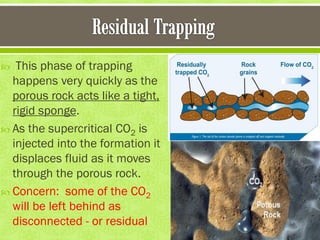
 This phase of trapping
happens very quickly as the
porous rock acts like a tight,
rigid sponge.
 As the supercritical CO2 is
injected into the formation it
displaces fluid as it moves
through the porous rock.
 Concern: some of the CO2
will be left behind as
disconnected - or residual
 CO2 dissolves in other
fluids in its gaseous and
supercritical state.
 This phase in the trapping
process involves the CO2
dissolving into the salt
water (or brine) already
present in the porous rock.
 Concern: Aqueous CO2 can
still migrate due to ground
water flow and any drop in
pressure can lead to the
liberation of CO2.
 Final phase of trapping,
CO2 dissolves in water to
form a weak carbonic
acid
 This process can be rapid
or very slow (depending
on the chemistry of the
rock and water in a
specific storage site) but
it effectively binds CO2 to
the rock.
 Over a long time, this weak acid
can react with the minerals in the
surrounding rock to form solid
carbonate minerals,
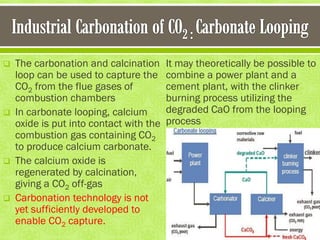
 The carbonation and calcination
loop can be used to capture the
CO2 from the flue gases of
combustion chambers
 In carbonate looping, calcium
oxide is put into contact with the
combustion gas containing CO2
to produce calcium carbonate.
 The calcium oxide is
regenerated by calcination,
giving a CO2 off-gas
 Carbonation technology is not
yet sufficiently developed to
enable CO2 capture.
It may theoretically be possible to
combine a power plant and a
cement plant, with the clinker
burning process utilizing the
degraded CaO from the looping
process

VIII. 2: CO2 Injection For Enhanced Oil Recovery
 By definition, oil reservoirs are
proven natural traps of liquids
and gas, and the injected CO2
would fill the pores in the rock
that were previously filled by
them..
 Oil displacement by CO2
injection relies on the phase
behavior and dependent on
reservoir temperature,
pressure and oil composition.
 Sandstone/Carbonate
formations suitable for CO2EOR
 MMP is the minimum pressure required to achieve multi-contact miscibility
between CO2 and the reservoir oil at a given temperature and composition.
 First, CO2-Oil MMP (Rising Bubble method) need to be determined for the
specific candidate oil field based on the reservoir pressure, temperature, and oil
composition.
 There are two main types of CO2-EOR processes called Miscible and Immiscible
CO2-EOR
Immiscible Flooding: At pressures below MMP, injected CO2 does not mix
with the oil within the reservoir, but causes the swelling of the oil, reducing
its density, improving mobility and increasing oil recovery.
Miscible Flooding : At pressures above the MMP, the injected CO2 does mix
completely with the oil into the reservoir to form a low viscosity fluid that
can be easily displaced and produced. Some concerns about asphaltene
precipitation and well plugging.
 Miscible enhanced oil recovery processes have estimated additional 10-15%
recovery of OOIP (Original oil in place), compared to immiscible displacement
processes that with 5-10%. 1)
Recommended Range of current projects
Crude Oil
Gravity (0API) >22 27-44
Viscosity (cp) < 10 0.3 to 6
Composition High percentage of C5 to C12
Reservoir
Oil saturation
( % PORE VOLUME)
> 20 15 to 70
Type of formation Sandstone or carbonate and relatively thin unless dipping.
Average permeability
,md
Not critical if sufficient injection rates can be maintained
Depth and
temperature
Depth should be enough to allow injection pressures greater than
MMP which increases with temperature and for heavier oils.
TypeofCO2 flooding OilGravity(0
API) Depthmustbegreaterthan(ft.)
Miscible >40 2500
32-39.9 2800
28-31.9 3300
22to27.9 4000
<22 Failsformiscibility
Immiscible 13to21.9 1800
<13 Allreservoirsfailatanydepth
At<1800ft.,allreservoirsfailscreeningforeithermiscibleorimmisciblefloodingwithsupercriticalCO2
Three CO2 injection strategies commonly used in commercial
miscible-flooding applications:
Slug injection involves continuous injection of approximately 0.2 to
0.4 hydrocarbon pore volumes (HCPV) of CO2 that, in turn, is
displaced by water or dry solvent
Water-alternating-gas (WAG) injection involves alternately injecting
small volumes (0.01–0.04 HCPV) of water and solvent. The total
amount of CO2 injected usually ranges from 0.2 to 0.6 HCPV. The final
drive fluid is usually water or dry solvent.
Gravity-stable injection is used for some pinnacle reefs and steeply
dipping reservoirs with high vertical communication, it is
advantageous to inject less-dense CO2 at the top of the reservoir in a
gravity-stable displacement process
 Traditionally, CO2-EOR projects have been designed only
to enhance crude oil production. Amount of CO2 injected
minimized (Cost).
 New CO2-EOR Strategies need to use a larger amount of
CO2 in order to optimize between CO2 storage and
increasing crude oil production.
 These increased CO2 volumes need to be “managed and
controlled” to assure that they contact, displace, and
recover additional residual oil, rather than merely
circulate through a high permeability zone of the
reservoir.
 “State of the Art” CO2-EOR : The injection of much larger volumes of CO2
at 1.0 HCPV (hydrocarbon pore volume) rather than the smaller (on the
order of 0.4 HCPV) volumes used in the past.
 “New Generation” CO2-EOR: After using the “State of the Art” CO2 EOR,
the “New Generation” miscible CO2-EOR technique will Increase Oil
Recovery Efficiency and expanding CO2 Storage Capacity by increasing
the volume of CO2 injected into the oil reservoir from 1.0 to 1.5 HCPV
 “Second Generation” CO2-EOR: After the “Next generation” technologies,
It will target both the main pay zone plus an the underlying residual oil
zones (ROZs), with continued CO2 injection into and storage in an
underlying saline aquifer, including injecting continuous CO2 after
completion of oil recovery operations.
NEXT GENERATION SECOND GENERATION
CO2-EOR CO2-EOR CO2-STORAGE TOTAL
CO2 STORAGE
(Million Metric
Tons)
32 76 33 109
Storage Capacity
Utilization
22% 53% 23% 76%
Oil Recovery
(million barrels)
92 180 180

It takes a large amount of energy to capture CO2 from stacks at
power plants, cement kilns, refineries, etc. It takes more energy to
compress it to the point of injection
► Cost of CCS makes electricity power stations more expensive to
build and electricity more expensive to buy.
Actual cost of CCS range from 50 to 100 USD/CO2
 Capture & Compression: 25-50 USD/ tonne CO2.:
 Transportation: 1-5 USD/ tonne CO2 &100 km.
 Storage :1-2 USD/ tonne CO2
 OBJECTIVE 2030:
Cutting the cost of CCS to 25-50 USD per tonne of CO2
 A cost for CO2 emissions (Carbon Tax) could provide the
economic rationale for CCS projects
 CCS economic viability could also be based on an
business agreement to sell its captured carbon to
another company for Enhanced Oil Recovery (EOR)
 (It is estimated that some 300–400 million tons of CO2 will be
required for every billion barrels of incremental oil to be
recovered).
EOR: A Vital Tool In A Low-Carbon Future
Revenues from the extra production of crude oil could be invested in CCS
projects

 To ensure public support, the
technology must be shown to be
safe, which involves predicting the
fate of the CO2 over thousands of
years. The risks due to storage of
CO2 in geological reservoirs fall into
two broad categories:
 Global risks involve the release of
stored CO2 to the atmosphere that
may contribute significantly to
climate change if some fraction
leaks from the storage formation.
 Local risks include hazards for
humans, ecosystems and
groundwater.
The engineered bio-
mineralization process
produces biofilm and mineral
deposits that
 1) Reduce the permeability
of geologic media
 2) Modify the geochemistry
of brines to enhance CO2
solubility and mineral
precipitation.
• Fraction retained in appropriately selected and
managed geological reservoirs is
– very likely to exceed 99% over 100 years, and
– is likely to exceed 99% over 1,000 years.
"Likely" is a probability between 66 and 90%, "very likely" of 90 to 99%
• Release of CO2 from ocean storage would be
gradual over hundreds of years
 A rigorous regulatory process that has
broad public and political support will be
required if CO2 is to be sequestered
underground on a large scale
 Some sort of international monitoring
system will be needed if countries or
companies are going to engage in
international trading of credits related to
sequestration of CO2
 Issues related to prohibition by
international conventions of dumping of
industrial waste in the ocean will need
to be resolved (would fossil fuel CO2
qualify as an „industrial waste‟?)
CAPTURE
The economic viability of CCS on a global
scale largely depends on the value and
price that governments and people put
on environmental and ecosystem
viability.
STORAGE
Unless it can be proven that CO2 can
be permanently and safely stored
over the long term, the option will be
untenable, whatever its additional
benefits.
Cost Effective Strategies to Reduce CO2 Emissions in the UAE: A Literature Review,
Faisal Al Wahedi & Zin Eddine Dadach (Higher Colleges of Technology);
Industrial Engineering and Management, 2-4, 1-9, 2013
.

Carbon Capture & Storage

  • 1.
      Zin EddineDadach Higher Colleges of Technology, UAE CO2 Capture & Storage A Solution To Global Warming
  • 2.
    I. Is theworld getting warmer? II. Are The Actions Of Mankind To Blame For Earth‟s Temperature Increases? III. What Can/Should Be Done About These Issues? IV. Carbon Capture & Storage ? V. CO2-Capture Strategies VI. Strategies For the Compression of CO2 VII. Strategies For The Transport Of CO2 VIII. VIII: CO2 Storage In Suitable Geological Formations VIII.1: Sequestration In Saline Aquifers VIII.2: CO2 Injection For Enhanced Oil Recovery IX. Getting Green is Expensive X. Safety And Legal Issues XI. Conclusion
  • 3.
    Is the worldgetting warmer? If so, are the actions of mankind to blame for earth‟s temperature increases? What can/should be done about these issues?
  • 4.
  • 7.
  • 9.
    Carbon dioxide (26%)is not as strong a greenhouse gas as water vapor (58%), but it absorbs energy in wavelengths (12-15 micrometers) that water vapor does not, partially closing the “water vapor window” through which heat radiated by the surface would normally escape to space.
  • 10.
    Carbon dioxide andthe greenhouse effect are necessary for Earth to survive. In fact, if we had no greenhouse effect, our planet would have an average temperature of –300C [source: UNEP]. However, human inventions like power plants and transportation vehicles, which burn fossil fuels, release extra CO2 into the air.
  • 11.
     Power generation industryplays a major role in the economic growth of any country.  About 80% of total electricity in the world is produced from fossil fuels fired thermal power plants. Combustion Reactions CH4 + Air (O2 +N2) → CO2 + H2O +N2 C5H10+ Air(O2 +N2) → 5CO2 + H2O +N2
  • 13.
  • 15.
  • 16.
    16 as energy consumption continues torise Climate change is probably the biggest challenge the world is facing, but it‟s not too late to fix it, however
  • 17.
    Carbon Capture andStorage has the potential to provide a critical near-term solution for reducing the concentration of carbon dioxide in the atmosphere. 17
  • 18.
    CCS alone couldprovide up to 20% of the CO2 emission reductions we need to make by 2050.
  • 19.
    Carbon capture andstorage is mostly used to describe methods for removing CO2 emissions from large stationary sources, such as electricity generation and some industrial processes, and storing it away from the atmosphere.
  • 20.
    STEP I Capturing andconcentrating CO2 from industrial sources. STEP II Compression of CO2 until pressure of injection (20 MPa) STEP III Transport of CO2 from Compression units until injection sites. STEP IV CO2 will be stored underground or in Oil and Gas fields.
  • 21.
     The high capitalcost of CO2 capture technologies is often cited as a key barrier by the potential CCS developers and investors.
  • 22.
    More Impurities withHeavier Fuels Global Warming Effects of Impurities
  • 24.
     Involves theremoval of CO2 from the flue gas produced by combustion of fossil fuel.  Nearly pure oxygen is used for combustion instead of air. The flue gas that is mainly CO2 and H2O.  Involves reaction of a fuel with air and/or steam to give mainly a gas composed of carbon monoxide and hydrogen. The carbon monoxide reacts with steam to give CO2 and more hydrogen
  • 25.
     Solvents –aqueous amines and salts  Membranes – polymeric  Solid sorbents – Lime, zeolite, activated carbon  Cryogenic processes – Liquefaction/distillation
  • 26.
    The advantage ofPost-combustion is that it can be fully integrated with existing plants. The main issue is the low concentration of CO2 in the flue gases (3- 10%) that makes the process very costly (70-80% of CCS Cost) CH4 + (2O2 + 7.52 N2) → CO2 + 2H2O +7.52 N2
  • 27.
     STEP I:Isolate CO2 from the other gases (10%) (CO2 reacts with amine in the absorber)  STEP II: Concentrate CO2 from 10% until 90-95% (CO2 is separated from amine in the desorber)  INCONVENIENT: With the classical amine MEA, 70-80 % of CCS cost is due to the heat for its regeneration in the reboiler.
  • 28.
     The ClassicalMEA Consumes a lot of heat during regeneration. The principal question is how to select a competitive solvent which is capable of rapid rate of absorption. At the same time, the solvent should have low regeneration energy consumption  ADVANCED AMINE SOLVENT (blend of low concentration of primary amine MEA mixed with high concentration of tertiary amine MDEA (slow reaction but needs less heat for regeneration).  The Piperazine (PZ) activated MDEA process was patented by BASF in the early 80‟s  The hindered amine 2-Amino-2-Methyl-1-Propanol (AMP) is also used by some companies (Mitsubishi) instead of MDEA.  Some authors ranked the regeneration performance in the following order AMP>MDEA>DETA>DEA>MEA
  • 29.
     Recently Ionicliquids are introduced as new family of solvents to be tested for CO2 Capture  Ionic liquids need less energy in the desorber than classical amines (CO2 physically absorbed)  Inconvenient: Very viscous and have lower rates of absorption than amines
  • 30.
     Post Combustionby absorption: Adding Ionic Liquids To amine mixture :An aqueous amine solution mixed with ionic liquid was proposed and the results are the following:  The energy consumption of the mixed (Ionic liquid + MEA amine) solution in the desorber was 37.2% lower than that of aqueous MEA amine solution alone.  Publication Date: January 2014; American Chemical Society
  • 31.
     VI : Compressionof CO2 It requires significant power to boost the pressure of CO2 from the atmospheric pressure (0.1MPa) of the capture plant up to a pressure suitable for injection of 15 MPa because storage of CO2 is more efficient if it is in supercritical conditions (P > 7.4 MPa and T> 300 K.).
  • 32.
    Compression of “capturedCO2” performed by multi- stage reciprocating or turbo compressors with intercooling from atmospheric pressure (0.1 MPa) to injection pressure of about 15 MPa.
  • 33.
     A reciprocatingcompressor with three stages and intercooling until critical pressure of CO2 (7.38 MPa).  The critical pressure of CO2 is often cited as the “cut-off” pressure for switching from a compressor to a pump).  Liquefaction of CO2  Triplex diaphragm pump  17% energy saving from traditional compression with compressors.
  • 34.
  • 35.
    Many point sourcesof captured CO2 would not be close to geological or oceanic storage facilities. In these cases, transportation would be required. The main forms of transportation are pipeline & shipping
  • 36.
  • 37.
    The effectiveness ofgeological storage for safe and long storage of CO2 depends on a combination of physical and geochemical trapping mechanisms (Depth of 800 m, Seal, Porosity, Permeability, Brine water) Storage Capacity Injectivity Perfect sealing Depth: 800 m
  • 38.
     Geological sequestration ofcarbon dioxide is a means of its injection in a suitable geological formation  Saline aquifers,  Oil and gas reservoirs (EOR),  Depleted oil and gas reservoirs,  Coal beds  Ocean
  • 39.
    Impacts o pH change oMortality of ocean organisms o Ecosystem consequences o Chronic effects unknown Change of bacteria, nanobenthos and meiobenthos abundace after exposure to 20,000 and 5,000 ppm for 77-375 hrs during experiments carried out at 2000 m depth in NW Pacific 100% 80% 60% 40% 20% 0% -20% -40% -60% -80% -100% <10 mm 10-30 mm MeibenthosNanobenthosBacteria Changepopulation 20,000 ppm 5000 ppm
  • 40.
     VIII.1: Sequestration InGeological Formations
  • 41.
     Deep salineformations are very similar to oil and gas reservoirs in that they are deep, porous rocks that may contain a fluid trapped by cap- rock for many millions of years  Injecting CO2 in these formations would see the CO2 at first added to the salty brine, eventually dissolving and finally mineralizing to become part of the rock  Another potential storage medium is unminable coal. CO2 can be injected into suitable coal seams where it will be adsorbed onto the coal, locking it up permanently.
  • 43.
    This is themost dominant trapping mechanism. The injected supercritical CO2 (more buoyant than other liquids) will percolate up through the porous rocks until it reaches the top of the formation where it meets (and is trapped by) an impermeable layer of cap-rock. Structural traps are formed as a result of changes in the structure (domes, anticlines, and folds). Stratigraphic traps lateral and vertical variations in the thickness, texture, porosity or lithology of the reservoir rock. Concern: it does not immobilize CO2 itself.
  • 44.
     This phaseof trapping happens very quickly as the porous rock acts like a tight, rigid sponge.  As the supercritical CO2 is injected into the formation it displaces fluid as it moves through the porous rock.  Concern: some of the CO2 will be left behind as disconnected - or residual
  • 45.
     CO2 dissolvesin other fluids in its gaseous and supercritical state.  This phase in the trapping process involves the CO2 dissolving into the salt water (or brine) already present in the porous rock.  Concern: Aqueous CO2 can still migrate due to ground water flow and any drop in pressure can lead to the liberation of CO2.
  • 46.
     Final phaseof trapping, CO2 dissolves in water to form a weak carbonic acid  This process can be rapid or very slow (depending on the chemistry of the rock and water in a specific storage site) but it effectively binds CO2 to the rock.  Over a long time, this weak acid can react with the minerals in the surrounding rock to form solid carbonate minerals,
  • 47.
     The carbonationand calcination loop can be used to capture the CO2 from the flue gases of combustion chambers  In carbonate looping, calcium oxide is put into contact with the combustion gas containing CO2 to produce calcium carbonate.  The calcium oxide is regenerated by calcination, giving a CO2 off-gas  Carbonation technology is not yet sufficiently developed to enable CO2 capture. It may theoretically be possible to combine a power plant and a cement plant, with the clinker burning process utilizing the degraded CaO from the looping process
  • 48.
     VIII. 2: CO2Injection For Enhanced Oil Recovery
  • 50.
     By definition,oil reservoirs are proven natural traps of liquids and gas, and the injected CO2 would fill the pores in the rock that were previously filled by them..  Oil displacement by CO2 injection relies on the phase behavior and dependent on reservoir temperature, pressure and oil composition.  Sandstone/Carbonate formations suitable for CO2EOR
  • 51.
     MMP isthe minimum pressure required to achieve multi-contact miscibility between CO2 and the reservoir oil at a given temperature and composition.  First, CO2-Oil MMP (Rising Bubble method) need to be determined for the specific candidate oil field based on the reservoir pressure, temperature, and oil composition.  There are two main types of CO2-EOR processes called Miscible and Immiscible CO2-EOR Immiscible Flooding: At pressures below MMP, injected CO2 does not mix with the oil within the reservoir, but causes the swelling of the oil, reducing its density, improving mobility and increasing oil recovery. Miscible Flooding : At pressures above the MMP, the injected CO2 does mix completely with the oil into the reservoir to form a low viscosity fluid that can be easily displaced and produced. Some concerns about asphaltene precipitation and well plugging.  Miscible enhanced oil recovery processes have estimated additional 10-15% recovery of OOIP (Original oil in place), compared to immiscible displacement processes that with 5-10%. 1)
  • 52.
    Recommended Range ofcurrent projects Crude Oil Gravity (0API) >22 27-44 Viscosity (cp) < 10 0.3 to 6 Composition High percentage of C5 to C12 Reservoir Oil saturation ( % PORE VOLUME) > 20 15 to 70 Type of formation Sandstone or carbonate and relatively thin unless dipping. Average permeability ,md Not critical if sufficient injection rates can be maintained Depth and temperature Depth should be enough to allow injection pressures greater than MMP which increases with temperature and for heavier oils. TypeofCO2 flooding OilGravity(0 API) Depthmustbegreaterthan(ft.) Miscible >40 2500 32-39.9 2800 28-31.9 3300 22to27.9 4000 <22 Failsformiscibility Immiscible 13to21.9 1800 <13 Allreservoirsfailatanydepth At<1800ft.,allreservoirsfailscreeningforeithermiscibleorimmisciblefloodingwithsupercriticalCO2
  • 53.
    Three CO2 injectionstrategies commonly used in commercial miscible-flooding applications: Slug injection involves continuous injection of approximately 0.2 to 0.4 hydrocarbon pore volumes (HCPV) of CO2 that, in turn, is displaced by water or dry solvent Water-alternating-gas (WAG) injection involves alternately injecting small volumes (0.01–0.04 HCPV) of water and solvent. The total amount of CO2 injected usually ranges from 0.2 to 0.6 HCPV. The final drive fluid is usually water or dry solvent. Gravity-stable injection is used for some pinnacle reefs and steeply dipping reservoirs with high vertical communication, it is advantageous to inject less-dense CO2 at the top of the reservoir in a gravity-stable displacement process
  • 56.
     Traditionally, CO2-EORprojects have been designed only to enhance crude oil production. Amount of CO2 injected minimized (Cost).  New CO2-EOR Strategies need to use a larger amount of CO2 in order to optimize between CO2 storage and increasing crude oil production.  These increased CO2 volumes need to be “managed and controlled” to assure that they contact, displace, and recover additional residual oil, rather than merely circulate through a high permeability zone of the reservoir.
  • 57.
     “State ofthe Art” CO2-EOR : The injection of much larger volumes of CO2 at 1.0 HCPV (hydrocarbon pore volume) rather than the smaller (on the order of 0.4 HCPV) volumes used in the past.  “New Generation” CO2-EOR: After using the “State of the Art” CO2 EOR, the “New Generation” miscible CO2-EOR technique will Increase Oil Recovery Efficiency and expanding CO2 Storage Capacity by increasing the volume of CO2 injected into the oil reservoir from 1.0 to 1.5 HCPV  “Second Generation” CO2-EOR: After the “Next generation” technologies, It will target both the main pay zone plus an the underlying residual oil zones (ROZs), with continued CO2 injection into and storage in an underlying saline aquifer, including injecting continuous CO2 after completion of oil recovery operations.
  • 59.
    NEXT GENERATION SECONDGENERATION CO2-EOR CO2-EOR CO2-STORAGE TOTAL CO2 STORAGE (Million Metric Tons) 32 76 33 109 Storage Capacity Utilization 22% 53% 23% 76% Oil Recovery (million barrels) 92 180 180
  • 61.
  • 62.
    It takes alarge amount of energy to capture CO2 from stacks at power plants, cement kilns, refineries, etc. It takes more energy to compress it to the point of injection ► Cost of CCS makes electricity power stations more expensive to build and electricity more expensive to buy. Actual cost of CCS range from 50 to 100 USD/CO2  Capture & Compression: 25-50 USD/ tonne CO2.:  Transportation: 1-5 USD/ tonne CO2 &100 km.  Storage :1-2 USD/ tonne CO2  OBJECTIVE 2030: Cutting the cost of CCS to 25-50 USD per tonne of CO2
  • 63.
     A costfor CO2 emissions (Carbon Tax) could provide the economic rationale for CCS projects  CCS economic viability could also be based on an business agreement to sell its captured carbon to another company for Enhanced Oil Recovery (EOR)  (It is estimated that some 300–400 million tons of CO2 will be required for every billion barrels of incremental oil to be recovered).
  • 64.
    EOR: A VitalTool In A Low-Carbon Future Revenues from the extra production of crude oil could be invested in CCS projects
  • 65.
  • 66.
     To ensurepublic support, the technology must be shown to be safe, which involves predicting the fate of the CO2 over thousands of years. The risks due to storage of CO2 in geological reservoirs fall into two broad categories:  Global risks involve the release of stored CO2 to the atmosphere that may contribute significantly to climate change if some fraction leaks from the storage formation.  Local risks include hazards for humans, ecosystems and groundwater.
  • 69.
    The engineered bio- mineralizationprocess produces biofilm and mineral deposits that  1) Reduce the permeability of geologic media  2) Modify the geochemistry of brines to enhance CO2 solubility and mineral precipitation.
  • 70.
    • Fraction retainedin appropriately selected and managed geological reservoirs is – very likely to exceed 99% over 100 years, and – is likely to exceed 99% over 1,000 years. "Likely" is a probability between 66 and 90%, "very likely" of 90 to 99% • Release of CO2 from ocean storage would be gradual over hundreds of years
  • 71.
     A rigorousregulatory process that has broad public and political support will be required if CO2 is to be sequestered underground on a large scale  Some sort of international monitoring system will be needed if countries or companies are going to engage in international trading of credits related to sequestration of CO2  Issues related to prohibition by international conventions of dumping of industrial waste in the ocean will need to be resolved (would fossil fuel CO2 qualify as an „industrial waste‟?)
  • 72.
    CAPTURE The economic viabilityof CCS on a global scale largely depends on the value and price that governments and people put on environmental and ecosystem viability. STORAGE Unless it can be proven that CO2 can be permanently and safely stored over the long term, the option will be untenable, whatever its additional benefits.
  • 73.
    Cost Effective Strategiesto Reduce CO2 Emissions in the UAE: A Literature Review, Faisal Al Wahedi & Zin Eddine Dadach (Higher Colleges of Technology); Industrial Engineering and Management, 2-4, 1-9, 2013
  • 74.