1
cleanenergyfuels.com
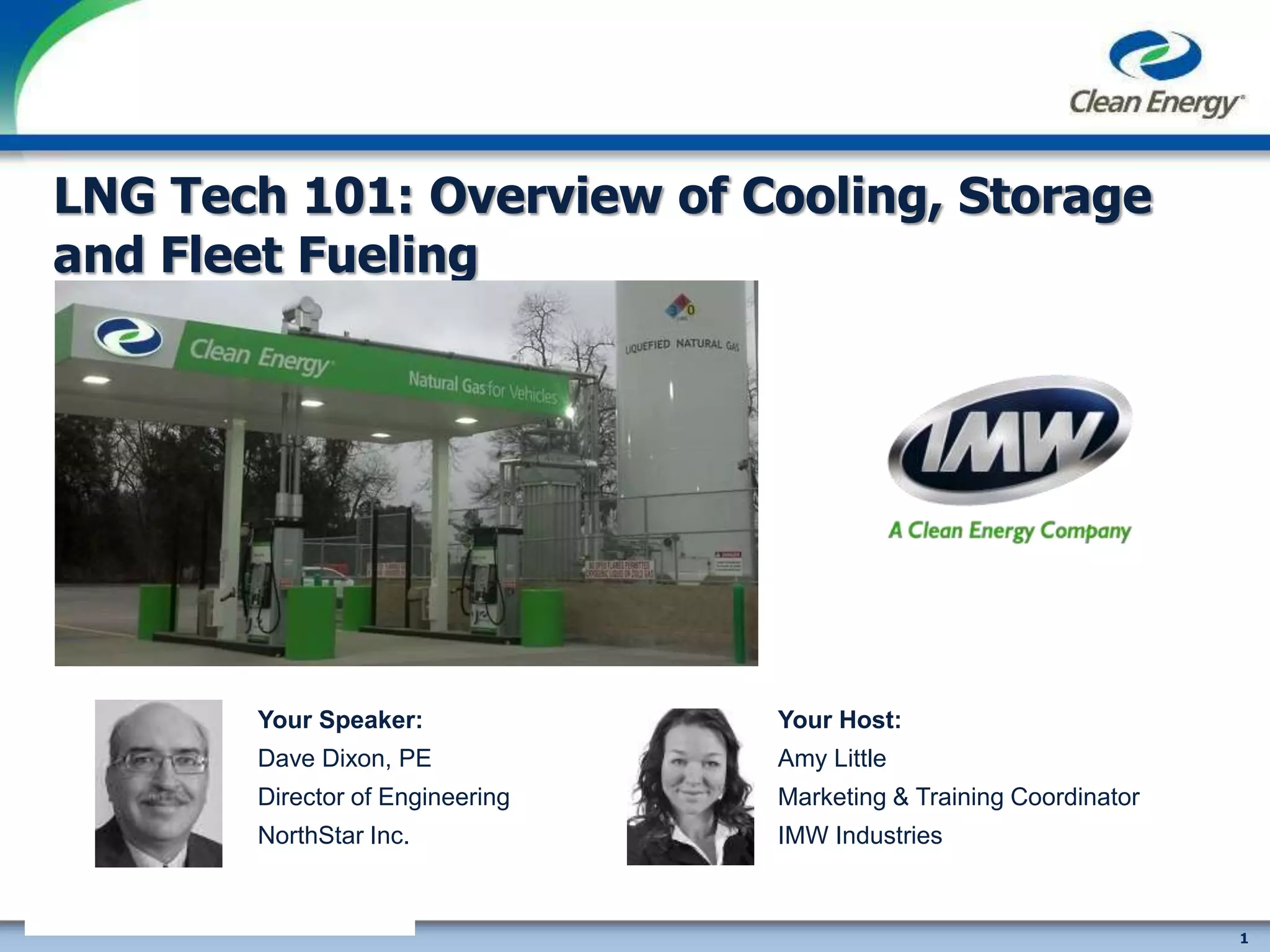
LNG Tech 101: Overview of Cooling, Storage
and Fleet Fueling
Your Host:
Amy Little
Marketing & Training Coordinator
IMW Industries
Your Speaker:
Dave Dixon, PE
Director of Engineering
NorthStar Inc.
2
cleanenergyfuels.com
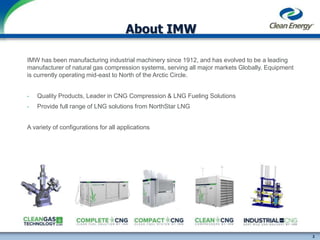
About IMW
IMW has been manufacturing industrial machinery since 1912, and has evolved to be a leading
manufacturer of natural gas compression systems, serving all major markets Globally. Equipment
is currently operating mid-east to North of the Arctic Circle.
• Quality Products, Leader in CNG Compression & LNG Fueling Solutions
• Provide full range of LNG solutions from NorthStar LNG
A variety of configurations for all applications
3
cleanenergyfuels.com
4
cleanenergyfuels.com
5
cleanenergyfuels.com
6
cleanenergyfuels.com
A Clean Energy Company
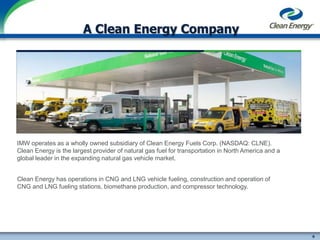
IMW operates as a wholly owned subsidiary of Clean Energy Fuels Corp. (NASDAQ: CLNE).
Clean Energy is the largest provider of natural gas fuel for transportation in North America and a
global leader in the expanding natural gas vehicle market.
Clean Energy has operations in CNG and LNG vehicle fueling, construction and operation of
CNG and LNG fueling stations, biomethane production, and compressor technology.
7
cleanenergyfuels.com
Continuing Education Credit
1 hr Technical Informal
More CPD Info or Board Room Attendance:
• Name
• Job title
• Company
• Email
Email to: webinars@imw.ca
8
cleanenergyfuels.com
Join the Discussion!
9
cleanenergyfuels.com
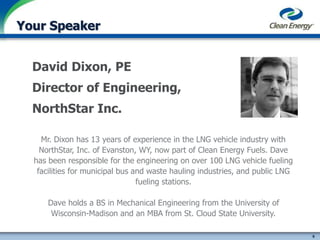
Your Speaker
David Dixon, PE
Director of Engineering,
NorthStar Inc.
Mr. Dixon has 13 years of experience in the LNG vehicle industry with
NorthStar, Inc. of Evanston, WY, now part of Clean Energy Fuels. Dave
has been responsible for the engineering on over 100 LNG vehicle fueling
facilities for municipal bus and waste hauling industries, and public LNG
fueling stations.
Dave holds a BS in Mechanical Engineering from the University of
Wisconsin-Madison and an MBA from St. Cloud State University.
10
cleanenergyfuels.com
LNG Tech 101
11
cleanenergyfuels.com
Introduction
 David Dixon, P.E., Director of Engineering, NorthStar, Inc.
 13 years with NorthStar, all focused on building LNG fueling
stations.
 Also designed and built many LCNG stations.
 Previous experience: 5 years at Minnesota Valley Engineering,
which later became Chart Industries, designing cryogenic
storage tanks and equipment.
 Career focus: Design of LNG fueling facilities, less experienced
with truck engines and vehicle fuel systems.
12
cleanenergyfuels.com
NorthStar History
 Delivering turnkey LNG solutions since 1994.
 Started as a family-owned business.
 Our 20 years of experience gives us a great advantage with
our knowledge of LNG fuel and LNG stations.
 Built over 30 turnkey LNG and LNCG fueling facilities.
 Acquired by Clean Energy Fuels Dec. 2010.
 Manufactured equipment for over 100 LNG and LCNG facilities
for Clean Energy Fuels since the acquisition.
13
cleanenergyfuels.com
Clean Energy Fuels History
 Started as Pickens Fuel Corporation by T. Boone Pickens and
Andrew J. Littlefair, Clean Energy President and CEO in 1997,
and now the largest natural gas fueling provider in the US.
 Clean Energy is committed to delivering the benefits of natural
gas fuel to fleet operators across America.
 Provides natural gas vehicle infrastructure and fuel:
 LNG and CNG fueling stations.
 LNG and CNG fuel sales.
 Assistance with grant funding, vehicle leasing, and
financial incentives.
 Vehicle Facility Modifications to allow vehicle maintenance.
14
cleanenergyfuels.com
Agenda:
 Basics of LNG
 LNG Fueling Station Technology
 LNG Vehicle Fueling
 CNG Vehicle Fueling
 Other LNG Applications
15
cleanenergyfuels.com
Basics of LNG - What is LNG 1
 LNG is natural gas that has been refrigerated to -260 Deg. F.
 Liquefaction reduces the volume by 600:1.
 Density of LNG is approximately 3.5 lb/gal at 0 psi, roughly
half the density of diesel fuel.
 LNG is stored at the liquefaction plant in multi-million gallon
storage tanks (typically). The liquefier might be a dedicated
facility for LNG vehicles (Clean Energy two, Boron, CA and
Willis, TX) or might be peak shavers which sell excess LNG
into the LNG vehicle market.
 LNG is predominately methane (typically >98%) with trace
amounts of ethane, propane, etc.
16
cleanenergyfuels.com
Basics of LNG - What is LNG 2
 LNG is colorless, odorless, and non-toxic.
 When vaporized and mixed with air LNG is flammable.
 Cold methane vapor is denser than air and can settle in
enclosed areas, while warm methane vapor is lighter than air
and disperses.
 LNG can also be made from landfill gas, therefore is a
renewable, more carbon-neutral fuel.
17
cleanenergyfuels.com
Basics of LNG - LNG Hazards
 Methane is flammable in air in concentrations of 5% to 15%.
– Below 5% the mixture is too lean to burn.
– Above 15% the mixture to rich to burn.
 Potential for frostbite and freezing due to low temperatures.
– Eyes especially vulnerable to sprayed or splashed LNG.
 Potential for asphyxiation due to displacement of oxygen,
especially in enclosed areas.
18
cleanenergyfuels.com
Basics of LNG - LNG Safety and Hazard
Prevention
 Recommended Personnel Protective Equipment:
– Cryogenic Gloves
– Face shield
– Closed shoes or boots
– Long sleeve shirt and long pants recommended.
 Hazard Prevention:
– Follow recommended operating and maintenance procedures.
– Use Personnel Protective Equipment
– If there is a leak, avoid direct contact.
– Don’t handle cold hoses and piping without proposer gloves.
– Keep ignition sources away for tank and piping. No smoking.
– Perform vehicle maintenance in proper area.
19
cleanenergyfuels.com
Basics of LNG - First Aid
 First Aid:
– Treat methane burns as other types of burns – cool affected area,
bandage if necessary, and seek medical assistance.
– Treat frostbite by warming slowly (do not run) and seek medical
assistance.
– Treat asphyxia by providing fresh air, rescue breathing if necessary, and
seek medical assistance.
– Seek medical assistance for eye injury caused by LNG.
20
cleanenergyfuels.com
LNG Station Technology
 Main Components of an LNG Station:
– LNG Storage Tank
– LNG Dispense Pump
– LNG Dispenser
– LNG Offload System
– Safety System
– PLC Control System
21
cleanenergyfuels.com
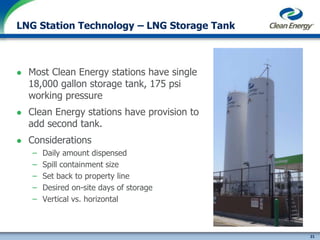
LNG Station Technology – LNG Storage Tank
 Most Clean Energy stations have single
18,000 gallon storage tank, 175 psi
working pressure
 Clean Energy stations have provision to
add second tank.
 Considerations
– Daily amount dispensed
– Spill containment size
– Set back to property line
– Desired on-site days of storage
– Vertical vs. horizontal
22
cleanenergyfuels.com
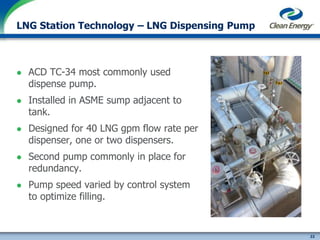
LNG Station Technology – LNG Dispensing Pump
 ACD TC-34 most commonly used
dispense pump.
 Installed in ASME sump adjacent to
tank.
 Designed for 40 LNG gpm flow rate per
dispenser, one or two dispensers.
 Second pump commonly in place for
redundancy.
 Pump speed varied by control system
to optimize filling.
23
cleanenergyfuels.com
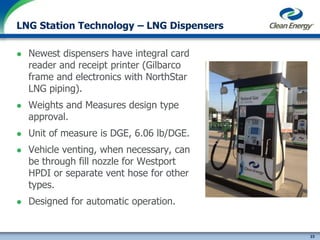
LNG Station Technology – LNG Dispensers
 Newest dispensers have integral card
reader and receipt printer (Gilbarco
frame and electronics with NorthStar
LNG piping).
 Weights and Measures design type
approval.
 Unit of measure is DGE, 6.06 lb/DGE.
 Vehicle venting, when necessary, can
be through fill nozzle for Westport
HPDI or separate vent hose for other
types.
 Designed for automatic operation.
24
cleanenergyfuels.com
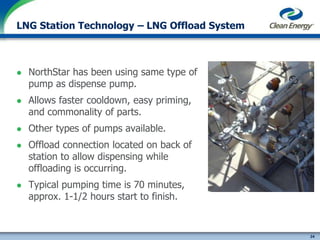
LNG Station Technology – LNG Offload System
 NorthStar has been using same type of
pump as dispense pump.
 Allows faster cooldown, easy priming,
and commonality of parts.
 Other types of pumps available.
 Offload connection located on back of
station to allow dispensing while
offloading is occurring.
 Typical pumping time is 70 minutes,
approx. 1-1/2 hours start to finish.
25
cleanenergyfuels.com
LNG Station Technology – Safety System
 Emergency Shut Down System, manual reset only
 Fire Detectors
 Methane Detectors
 Emergency Stop Buttons
 Emergency Shutdown Valves
 Remove electrical power from all LNG equipment
 Spill containment wall sized for entire tank contents
 Auto dialer or fire alarm control panel
 Dispenser flow limits
26
cleanenergyfuels.com
LNG Station Technology – PLC Control System
 Integrated PLC control system to minimize operator input.
 PLC monitors and operates LNG tanks, LNG pumps, and
dispensers.
 CE stations include web server for remote access through
VPN.
 PLC programmed to automatically recover from many faults.
 Some conditions may require technician assistance, such as
sensor failure. Auto dialer calls out to technician.
 PLC contains adjustable operating parameters, normally only
adjusted at commissioning, or to optimize operation.
 PLC also performs data collection that can be used for
optimization or alarm analysis.
27
cleanenergyfuels.com
LNG Station Technology – Considerations
 Fuel at existing public station, or build private station?
 Public stations:
– Maintenance and operations handled by station owner
– Are stations on common routes or near fleet yard?
 Private back lot stations:
– Maintenance and operation by fleet owner, or contracted out.
– Capital cost, or is grant funding available?
– Start with small mobile fueler?
– Sizing station for initial plus future expansion.
– Is space available at fleet yard?
28
cleanenergyfuels.com
LNG Station Technology – Sizing
 Select number of dispensers based on number of vehicles to
be fueled per day
– 2 LNG dispensers minimum recommended for redundancy
– Rule of thumb 50 vehicles per dispenser per day, but every situation is
different.
 Select number of dispense pumps based on number of
dispensers
– 1 pump can feed 2 dispensers.
– Consider second pump for redundancy
 Size storage tank for throughput
– One 10,000 gallon delivery every 3 or 4 days or so is comfortable;
consider larger tanks or multiple tanks if throughput is higher than a
delivery every 2 days.
 General recommendation: Do not over-size tanks or
dispensers; adds cost and adds heat load on station
29
cleanenergyfuels.com
LNG Vehicle Fueling
30
cleanenergyfuels.com
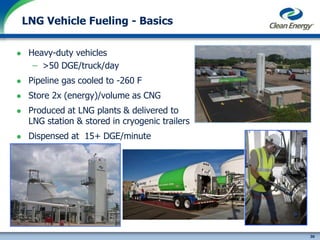
 Heavy-duty vehicles
– >50 DGE/truck/day
 Pipeline gas cooled to -260 F
 Store 2x (energy)/volume as CNG
 Produced at LNG plants & delivered to
LNG station & stored in cryogenic trailers
 Dispensed at 15+ DGE/minute
LNG Vehicle Fueling - Basics
31
cleanenergyfuels.com
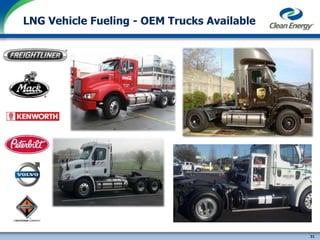
LNG Vehicle Fueling - OEM Trucks Available
32
cleanenergyfuels.com
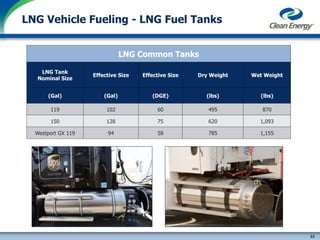
LNG Vehicle Fueling - LNG Fuel Tanks
LNG Common Tanks
LNG Tank
Nominal Size
Effective Size Effective Size Dry Weight Wet Weight
(Gal) (Gal) (DGE) (lbs) (lbs)
119 102 60 495 870
150 128 75 620 1,093
Westport GX 119 94 58 785 1,155
33
cleanenergyfuels.com
LNG Vehicle Fueling – High Pressure/Low
Pressure Engine Systems
 Westport HPDI
– HPDI now out of production, but included an onboard high pressure
pump.
• Uses colder, low pressure LNG than spark ignited system.
 For Saturated Systems for Spark Ignited Engines:
– Spark ignited engines traditionally need low pressure at engine 50 to 80
psi is typical.
– LNG warmed in station to provide suitable pressure
– Recently Chart Industries and Westport have introduced pumping and
pressure building systems (Chart Charger and IcePak).
34
cleanenergyfuels.com
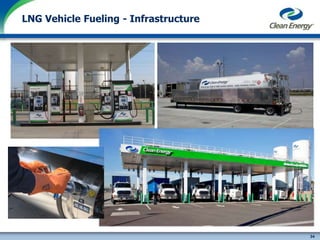
LNG Vehicle Fueling - Infrastructure
35
cleanenergyfuels.com
LNG – Advantages and Considerations
Advantages
 Fuel costs less than diesel
 Lower GHG emissions than
diesel
 LNG composition is 97% CH4
 No diesel fuel or exhaust after-
treatment to manage (SI
engines)
 Diesel-like fueling
 Greater fuel density/volume
– Greater range than CNG, per volume
– Substantially lower weight of
storage
 Less expensive tanks vs. CNG
equivalent
Considerations
 Cryogenic tanks
 Special handling when fueling
(PPE)
 Pressure and temperature
management of fuel to engine
 Potential boil off (use it or lose
it) if vehicles are parked for
extended period (typically 7 to
10 hold time, depending on
tank design and liquid level)
 Building modifications for
indoor maintenance
 Fueling station availability
36
cleanenergyfuels.com
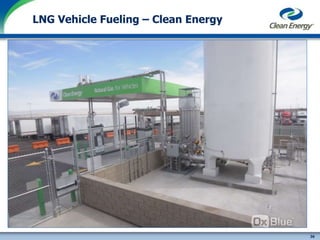
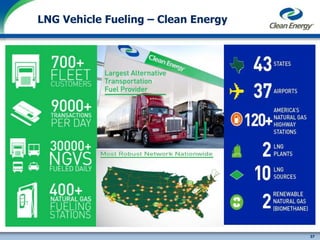
LNG Vehicle Fueling – Clean Energy
37
cleanenergyfuels.com
LNG Vehicle Fueling – Clean Energy
38
cleanenergyfuels.com
CNG Vehicle Fueling
39
cleanenergyfuels.com
CNG Vehicle Fueling - Common CNG Applications
 Taxis
 Light duty vehicles (pickup trucks, cars, vans)
 Buses
 Refuse trucks
 Over-the-road tractor trailers
40
cleanenergyfuels.com
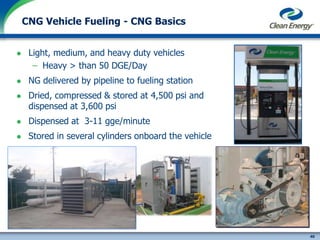
CNG Vehicle Fueling - CNG Basics
 Light, medium, and heavy duty vehicles
– Heavy > than 50 DGE/Day
 NG delivered by pipeline to fueling station
 Dried, compressed & stored at 4,500 psi and
dispensed at 3,600 psi
 Dispensed at 3-11 gge/minute
 Stored in several cylinders onboard the vehicle
41
cleanenergyfuels.com
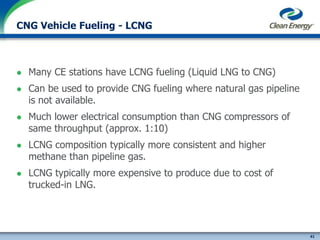
CNG Vehicle Fueling - LCNG
 Many CE stations have LCNG fueling (Liquid LNG to CNG)
 Can be used to provide CNG fueling where natural gas pipeline
is not available.
 Much lower electrical consumption than CNG compressors of
same throughput (approx. 1:10)
 LCNG composition typically more consistent and higher
methane than pipeline gas.
 LCNG typically more expensive to produce due to cost of
trucked-in LNG.
42
cleanenergyfuels.com
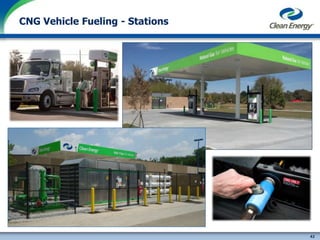
CNG Vehicle Fueling - Stations
43
cleanenergyfuels.com
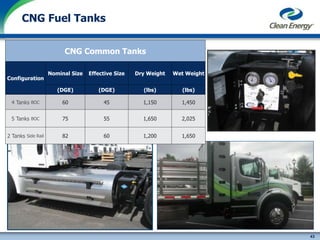
CNG Fuel Tanks
CNG Common Tanks
Configuration
Nominal Size Effective Size Dry Weight Wet Weight
(DGE) (DGE) (lbs) (lbs)
4 Tanks BOC 60 45 1,150 1,450
5 Tanks BOC 75 55 1,650 2,025
2 Tanks Side Rail 82 60 1,200 1,650
44
cleanenergyfuels.com
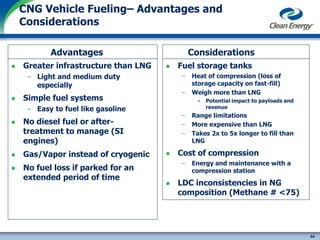
CNG Vehicle Fueling– Advantages and
Considerations
Advantages
 Greater infrastructure than LNG
– Light and medium duty
especially
 Simple fuel systems
– Easy to fuel like gasoline
 No diesel fuel or after-
treatment to manage (SI
engines)
 Gas/Vapor instead of cryogenic
 No fuel loss if parked for an
extended period of time
Considerations
 Fuel storage tanks
– Heat of compression (loss of
storage capacity on fast-fill)
– Weigh more than LNG
• Potential impact to payloads and
revenue
– Range limitations
– More expensive than LNG
– Takes 2x to 5x longer to fill than
LNG
 Cost of compression
– Energy and maintenance with a
compression station
 LDC inconsistencies in NG
composition (Methane # <75)
45
cleanenergyfuels.com
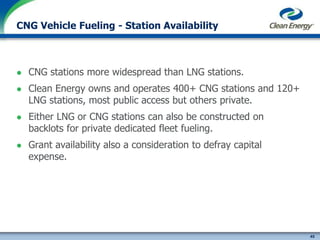
CNG Vehicle Fueling - Station Availability
 CNG stations more widespread than LNG stations.
 Clean Energy owns and operates 400+ CNG stations and 120+
LNG stations, most public access but others private.
 Either LNG or CNG stations can also be constructed on
backlots for private dedicated fleet fueling.
 Grant availability also a consideration to defray capital
expense.
46
cleanenergyfuels.com
Other LNG Applications
47
cleanenergyfuels.com
Other LNG Applications
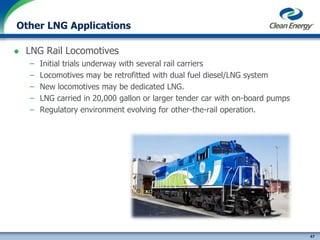
 LNG Rail Locomotives
– Initial trials underway with several rail carriers
– Locomotives may be retrofitted with dual fuel diesel/LNG system
– New locomotives may be dedicated LNG.
– LNG carried in 20,000 gallon or larger tender car with on-board pumps
– Regulatory environment evolving for other-the-rail operation.
48
cleanenergyfuels.com
Other LNG Applications
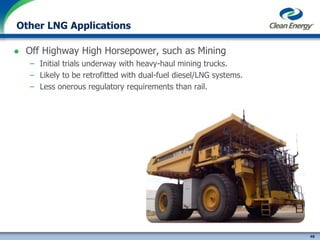
 Off Highway High Horsepower, such as Mining
– Initial trials underway with heavy-haul mining trucks.
– Likely to be retrofitted with dual-fuel diesel/LNG systems.
– Less onerous regulatory requirements than rail.
49
cleanenergyfuels.com
Other LNG Applications
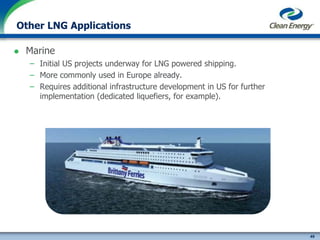
 Marine
– Initial US projects underway for LNG powered shipping.
– More commonly used in Europe already.
– Requires additional infrastructure development in US for further
implementation (dedicated liquefiers, for example).
50
cleanenergyfuels.com
Other LNG Applications
 Power Generation
– LNG can be used as replacement for propane or oil in many applications
– Goal is reduced fuel costs, balanced against infrastructure cost to switch
to LNG.
– Stranded islands with no local energy source investigating LNG.
 Storage and Vaporization
– Can be used as temporary replacement for pipeline natural gas.
– Replacement for propane for heat (eg asphalt plants).
51
cleanenergyfuels.com
Conclusion
- Tremendous Opportunities in LNG
- Let’s work together to take advantage
- Questions?
52
cleanenergyfuels.com
43676 Progress Way • Chilliwack, BC • Canada V2R 0C3 p +1 604.795.9491 f +1 604.792.3806 e info@imw.ca
john smith imw.ca
imw.ca/facebook
imw.ca/linkedin
imw.ca/youtube
e: johnsmith@imw.ca
d: +1 604.233.4567
m:+1 604.233.6789
53
cleanenergyfuels.com
Upcoming Webinars
www.imw.ca/cng-webinars/
• Free Monthly Webinars
• Documented CPD Credits
June 23
CNG Facility Modifications
Stephe Yborra, NGV America
Rick Mendoza, Clean Energy
July 24
Renewable Natural Gas Production, Distribution
and Sale 101: Important Primer for Project
Feasibility & Buyer Considerations
Nicholas Lumpkin
Director, Business Development
Clean Energy Renewable Fuels
Sept 19
Why Go Natural Gas? CNGVA President, Alicia
Milner Discusses the Case for Natural Gas Vehicles
in Canada
54
cleanenergyfuels.com
Questions?
55
cleanenergyfuels.com
Contact Us!
IMW Industries
43676 Progress Way
Chilliwack, BC,
Canada V2R 0C3
+1 604-795-9491
www.imw.ca
Questions?
sales@imw.ca
webinars@imw.ca

May 22 Webinar: LNG Tech 101

  • 1.
    1 cleanenergyfuels.com LNG Tech 101:Overview of Cooling, Storage and Fleet Fueling Your Host: Amy Little Marketing & Training Coordinator IMW Industries Your Speaker: Dave Dixon, PE Director of Engineering NorthStar Inc.
  • 2.
    2 cleanenergyfuels.com About IMW IMW hasbeen manufacturing industrial machinery since 1912, and has evolved to be a leading manufacturer of natural gas compression systems, serving all major markets Globally. Equipment is currently operating mid-east to North of the Arctic Circle. • Quality Products, Leader in CNG Compression & LNG Fueling Solutions • Provide full range of LNG solutions from NorthStar LNG A variety of configurations for all applications
  • 3.
  • 4.
  • 5.
  • 6.
    6 cleanenergyfuels.com A Clean EnergyCompany IMW operates as a wholly owned subsidiary of Clean Energy Fuels Corp. (NASDAQ: CLNE). Clean Energy is the largest provider of natural gas fuel for transportation in North America and a global leader in the expanding natural gas vehicle market. Clean Energy has operations in CNG and LNG vehicle fueling, construction and operation of CNG and LNG fueling stations, biomethane production, and compressor technology.
  • 7.
    7 cleanenergyfuels.com Continuing Education Credit 1hr Technical Informal More CPD Info or Board Room Attendance: • Name • Job title • Company • Email Email to: webinars@imw.ca
  • 8.
  • 9.
    9 cleanenergyfuels.com Your Speaker David Dixon,PE Director of Engineering, NorthStar Inc. Mr. Dixon has 13 years of experience in the LNG vehicle industry with NorthStar, Inc. of Evanston, WY, now part of Clean Energy Fuels. Dave has been responsible for the engineering on over 100 LNG vehicle fueling facilities for municipal bus and waste hauling industries, and public LNG fueling stations. Dave holds a BS in Mechanical Engineering from the University of Wisconsin-Madison and an MBA from St. Cloud State University.
  • 10.
  • 11.
    11 cleanenergyfuels.com Introduction  David Dixon,P.E., Director of Engineering, NorthStar, Inc.  13 years with NorthStar, all focused on building LNG fueling stations.  Also designed and built many LCNG stations.  Previous experience: 5 years at Minnesota Valley Engineering, which later became Chart Industries, designing cryogenic storage tanks and equipment.  Career focus: Design of LNG fueling facilities, less experienced with truck engines and vehicle fuel systems.
  • 12.
    12 cleanenergyfuels.com NorthStar History  Deliveringturnkey LNG solutions since 1994.  Started as a family-owned business.  Our 20 years of experience gives us a great advantage with our knowledge of LNG fuel and LNG stations.  Built over 30 turnkey LNG and LNCG fueling facilities.  Acquired by Clean Energy Fuels Dec. 2010.  Manufactured equipment for over 100 LNG and LCNG facilities for Clean Energy Fuels since the acquisition.
  • 13.
    13 cleanenergyfuels.com Clean Energy FuelsHistory  Started as Pickens Fuel Corporation by T. Boone Pickens and Andrew J. Littlefair, Clean Energy President and CEO in 1997, and now the largest natural gas fueling provider in the US.  Clean Energy is committed to delivering the benefits of natural gas fuel to fleet operators across America.  Provides natural gas vehicle infrastructure and fuel:  LNG and CNG fueling stations.  LNG and CNG fuel sales.  Assistance with grant funding, vehicle leasing, and financial incentives.  Vehicle Facility Modifications to allow vehicle maintenance.
  • 14.
    14 cleanenergyfuels.com Agenda:  Basics ofLNG  LNG Fueling Station Technology  LNG Vehicle Fueling  CNG Vehicle Fueling  Other LNG Applications
  • 15.
    15 cleanenergyfuels.com Basics of LNG- What is LNG 1  LNG is natural gas that has been refrigerated to -260 Deg. F.  Liquefaction reduces the volume by 600:1.  Density of LNG is approximately 3.5 lb/gal at 0 psi, roughly half the density of diesel fuel.  LNG is stored at the liquefaction plant in multi-million gallon storage tanks (typically). The liquefier might be a dedicated facility for LNG vehicles (Clean Energy two, Boron, CA and Willis, TX) or might be peak shavers which sell excess LNG into the LNG vehicle market.  LNG is predominately methane (typically >98%) with trace amounts of ethane, propane, etc.
  • 16.
    16 cleanenergyfuels.com Basics of LNG- What is LNG 2  LNG is colorless, odorless, and non-toxic.  When vaporized and mixed with air LNG is flammable.  Cold methane vapor is denser than air and can settle in enclosed areas, while warm methane vapor is lighter than air and disperses.  LNG can also be made from landfill gas, therefore is a renewable, more carbon-neutral fuel.
  • 17.
    17 cleanenergyfuels.com Basics of LNG- LNG Hazards  Methane is flammable in air in concentrations of 5% to 15%. – Below 5% the mixture is too lean to burn. – Above 15% the mixture to rich to burn.  Potential for frostbite and freezing due to low temperatures. – Eyes especially vulnerable to sprayed or splashed LNG.  Potential for asphyxiation due to displacement of oxygen, especially in enclosed areas.
  • 18.
    18 cleanenergyfuels.com Basics of LNG- LNG Safety and Hazard Prevention  Recommended Personnel Protective Equipment: – Cryogenic Gloves – Face shield – Closed shoes or boots – Long sleeve shirt and long pants recommended.  Hazard Prevention: – Follow recommended operating and maintenance procedures. – Use Personnel Protective Equipment – If there is a leak, avoid direct contact. – Don’t handle cold hoses and piping without proposer gloves. – Keep ignition sources away for tank and piping. No smoking. – Perform vehicle maintenance in proper area.
  • 19.
    19 cleanenergyfuels.com Basics of LNG- First Aid  First Aid: – Treat methane burns as other types of burns – cool affected area, bandage if necessary, and seek medical assistance. – Treat frostbite by warming slowly (do not run) and seek medical assistance. – Treat asphyxia by providing fresh air, rescue breathing if necessary, and seek medical assistance. – Seek medical assistance for eye injury caused by LNG.
  • 20.
    20 cleanenergyfuels.com LNG Station Technology Main Components of an LNG Station: – LNG Storage Tank – LNG Dispense Pump – LNG Dispenser – LNG Offload System – Safety System – PLC Control System
  • 21.
    21 cleanenergyfuels.com LNG Station Technology– LNG Storage Tank  Most Clean Energy stations have single 18,000 gallon storage tank, 175 psi working pressure  Clean Energy stations have provision to add second tank.  Considerations – Daily amount dispensed – Spill containment size – Set back to property line – Desired on-site days of storage – Vertical vs. horizontal
  • 22.
    22 cleanenergyfuels.com LNG Station Technology– LNG Dispensing Pump  ACD TC-34 most commonly used dispense pump.  Installed in ASME sump adjacent to tank.  Designed for 40 LNG gpm flow rate per dispenser, one or two dispensers.  Second pump commonly in place for redundancy.  Pump speed varied by control system to optimize filling.
  • 23.
    23 cleanenergyfuels.com LNG Station Technology– LNG Dispensers  Newest dispensers have integral card reader and receipt printer (Gilbarco frame and electronics with NorthStar LNG piping).  Weights and Measures design type approval.  Unit of measure is DGE, 6.06 lb/DGE.  Vehicle venting, when necessary, can be through fill nozzle for Westport HPDI or separate vent hose for other types.  Designed for automatic operation.
  • 24.
    24 cleanenergyfuels.com LNG Station Technology– LNG Offload System  NorthStar has been using same type of pump as dispense pump.  Allows faster cooldown, easy priming, and commonality of parts.  Other types of pumps available.  Offload connection located on back of station to allow dispensing while offloading is occurring.  Typical pumping time is 70 minutes, approx. 1-1/2 hours start to finish.
  • 25.
    25 cleanenergyfuels.com LNG Station Technology– Safety System  Emergency Shut Down System, manual reset only  Fire Detectors  Methane Detectors  Emergency Stop Buttons  Emergency Shutdown Valves  Remove electrical power from all LNG equipment  Spill containment wall sized for entire tank contents  Auto dialer or fire alarm control panel  Dispenser flow limits
  • 26.
    26 cleanenergyfuels.com LNG Station Technology– PLC Control System  Integrated PLC control system to minimize operator input.  PLC monitors and operates LNG tanks, LNG pumps, and dispensers.  CE stations include web server for remote access through VPN.  PLC programmed to automatically recover from many faults.  Some conditions may require technician assistance, such as sensor failure. Auto dialer calls out to technician.  PLC contains adjustable operating parameters, normally only adjusted at commissioning, or to optimize operation.  PLC also performs data collection that can be used for optimization or alarm analysis.
  • 27.
    27 cleanenergyfuels.com LNG Station Technology– Considerations  Fuel at existing public station, or build private station?  Public stations: – Maintenance and operations handled by station owner – Are stations on common routes or near fleet yard?  Private back lot stations: – Maintenance and operation by fleet owner, or contracted out. – Capital cost, or is grant funding available? – Start with small mobile fueler? – Sizing station for initial plus future expansion. – Is space available at fleet yard?
  • 28.
    28 cleanenergyfuels.com LNG Station Technology– Sizing  Select number of dispensers based on number of vehicles to be fueled per day – 2 LNG dispensers minimum recommended for redundancy – Rule of thumb 50 vehicles per dispenser per day, but every situation is different.  Select number of dispense pumps based on number of dispensers – 1 pump can feed 2 dispensers. – Consider second pump for redundancy  Size storage tank for throughput – One 10,000 gallon delivery every 3 or 4 days or so is comfortable; consider larger tanks or multiple tanks if throughput is higher than a delivery every 2 days.  General recommendation: Do not over-size tanks or dispensers; adds cost and adds heat load on station
  • 29.
  • 30.
    30 cleanenergyfuels.com  Heavy-duty vehicles –>50 DGE/truck/day  Pipeline gas cooled to -260 F  Store 2x (energy)/volume as CNG  Produced at LNG plants & delivered to LNG station & stored in cryogenic trailers  Dispensed at 15+ DGE/minute LNG Vehicle Fueling - Basics
  • 31.
  • 32.
    32 cleanenergyfuels.com LNG Vehicle Fueling- LNG Fuel Tanks LNG Common Tanks LNG Tank Nominal Size Effective Size Effective Size Dry Weight Wet Weight (Gal) (Gal) (DGE) (lbs) (lbs) 119 102 60 495 870 150 128 75 620 1,093 Westport GX 119 94 58 785 1,155
  • 33.
    33 cleanenergyfuels.com LNG Vehicle Fueling– High Pressure/Low Pressure Engine Systems  Westport HPDI – HPDI now out of production, but included an onboard high pressure pump. • Uses colder, low pressure LNG than spark ignited system.  For Saturated Systems for Spark Ignited Engines: – Spark ignited engines traditionally need low pressure at engine 50 to 80 psi is typical. – LNG warmed in station to provide suitable pressure – Recently Chart Industries and Westport have introduced pumping and pressure building systems (Chart Charger and IcePak).
  • 34.
  • 35.
    35 cleanenergyfuels.com LNG – Advantagesand Considerations Advantages  Fuel costs less than diesel  Lower GHG emissions than diesel  LNG composition is 97% CH4  No diesel fuel or exhaust after- treatment to manage (SI engines)  Diesel-like fueling  Greater fuel density/volume – Greater range than CNG, per volume – Substantially lower weight of storage  Less expensive tanks vs. CNG equivalent Considerations  Cryogenic tanks  Special handling when fueling (PPE)  Pressure and temperature management of fuel to engine  Potential boil off (use it or lose it) if vehicles are parked for extended period (typically 7 to 10 hold time, depending on tank design and liquid level)  Building modifications for indoor maintenance  Fueling station availability
  • 36.
  • 37.
  • 38.
  • 39.
    39 cleanenergyfuels.com CNG Vehicle Fueling- Common CNG Applications  Taxis  Light duty vehicles (pickup trucks, cars, vans)  Buses  Refuse trucks  Over-the-road tractor trailers
  • 40.
    40 cleanenergyfuels.com CNG Vehicle Fueling- CNG Basics  Light, medium, and heavy duty vehicles – Heavy > than 50 DGE/Day  NG delivered by pipeline to fueling station  Dried, compressed & stored at 4,500 psi and dispensed at 3,600 psi  Dispensed at 3-11 gge/minute  Stored in several cylinders onboard the vehicle
  • 41.
    41 cleanenergyfuels.com CNG Vehicle Fueling- LCNG  Many CE stations have LCNG fueling (Liquid LNG to CNG)  Can be used to provide CNG fueling where natural gas pipeline is not available.  Much lower electrical consumption than CNG compressors of same throughput (approx. 1:10)  LCNG composition typically more consistent and higher methane than pipeline gas.  LCNG typically more expensive to produce due to cost of trucked-in LNG.
  • 42.
  • 43.
    43 cleanenergyfuels.com CNG Fuel Tanks CNGCommon Tanks Configuration Nominal Size Effective Size Dry Weight Wet Weight (DGE) (DGE) (lbs) (lbs) 4 Tanks BOC 60 45 1,150 1,450 5 Tanks BOC 75 55 1,650 2,025 2 Tanks Side Rail 82 60 1,200 1,650
  • 44.
    44 cleanenergyfuels.com CNG Vehicle Fueling–Advantages and Considerations Advantages  Greater infrastructure than LNG – Light and medium duty especially  Simple fuel systems – Easy to fuel like gasoline  No diesel fuel or after- treatment to manage (SI engines)  Gas/Vapor instead of cryogenic  No fuel loss if parked for an extended period of time Considerations  Fuel storage tanks – Heat of compression (loss of storage capacity on fast-fill) – Weigh more than LNG • Potential impact to payloads and revenue – Range limitations – More expensive than LNG – Takes 2x to 5x longer to fill than LNG  Cost of compression – Energy and maintenance with a compression station  LDC inconsistencies in NG composition (Methane # <75)
  • 45.
    45 cleanenergyfuels.com CNG Vehicle Fueling- Station Availability  CNG stations more widespread than LNG stations.  Clean Energy owns and operates 400+ CNG stations and 120+ LNG stations, most public access but others private.  Either LNG or CNG stations can also be constructed on backlots for private dedicated fleet fueling.  Grant availability also a consideration to defray capital expense.
  • 46.
  • 47.
    47 cleanenergyfuels.com Other LNG Applications LNG Rail Locomotives – Initial trials underway with several rail carriers – Locomotives may be retrofitted with dual fuel diesel/LNG system – New locomotives may be dedicated LNG. – LNG carried in 20,000 gallon or larger tender car with on-board pumps – Regulatory environment evolving for other-the-rail operation.
  • 48.
    48 cleanenergyfuels.com Other LNG Applications Off Highway High Horsepower, such as Mining – Initial trials underway with heavy-haul mining trucks. – Likely to be retrofitted with dual-fuel diesel/LNG systems. – Less onerous regulatory requirements than rail.
  • 49.
    49 cleanenergyfuels.com Other LNG Applications Marine – Initial US projects underway for LNG powered shipping. – More commonly used in Europe already. – Requires additional infrastructure development in US for further implementation (dedicated liquefiers, for example).
  • 50.
    50 cleanenergyfuels.com Other LNG Applications Power Generation – LNG can be used as replacement for propane or oil in many applications – Goal is reduced fuel costs, balanced against infrastructure cost to switch to LNG. – Stranded islands with no local energy source investigating LNG.  Storage and Vaporization – Can be used as temporary replacement for pipeline natural gas. – Replacement for propane for heat (eg asphalt plants).
  • 51.
    51 cleanenergyfuels.com Conclusion - Tremendous Opportunitiesin LNG - Let’s work together to take advantage - Questions?
  • 52.
    52 cleanenergyfuels.com 43676 Progress Way• Chilliwack, BC • Canada V2R 0C3 p +1 604.795.9491 f +1 604.792.3806 e info@imw.ca john smith imw.ca imw.ca/facebook imw.ca/linkedin imw.ca/youtube e: johnsmith@imw.ca d: +1 604.233.4567 m:+1 604.233.6789
  • 53.
    53 cleanenergyfuels.com Upcoming Webinars www.imw.ca/cng-webinars/ • FreeMonthly Webinars • Documented CPD Credits June 23 CNG Facility Modifications Stephe Yborra, NGV America Rick Mendoza, Clean Energy July 24 Renewable Natural Gas Production, Distribution and Sale 101: Important Primer for Project Feasibility & Buyer Considerations Nicholas Lumpkin Director, Business Development Clean Energy Renewable Fuels Sept 19 Why Go Natural Gas? CNGVA President, Alicia Milner Discusses the Case for Natural Gas Vehicles in Canada
  • 54.
  • 55.
    55 cleanenergyfuels.com Contact Us! IMW Industries 43676Progress Way Chilliwack, BC, Canada V2R 0C3 +1 604-795-9491 www.imw.ca Questions? sales@imw.ca webinars@imw.ca