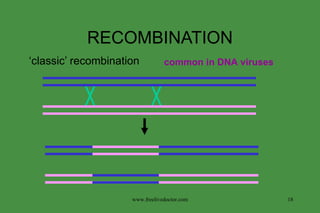
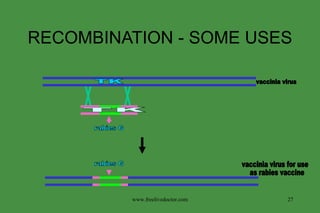
RNA viruses are able to evolve much more rapidly than the DNA of their eukaryotic hosts due to their lack of proofreading during replication. They undergo genetic changes through mutations, which can occur spontaneously due to errors during replication or due to environmental factors like UV light, as well as through recombination and reassortment. These genetic changes allow RNA viruses to alter their phenotypes and adapt in ways such as drug resistance, host range, temperature sensitivity, or attenuation for vaccine development.