Normal Labourwww.freelivedoctor.com
Normal LabourDefinitionsLabour is the process by which a viable foetus i.e. at the end of 28 weeks or more is expelled or is going to be expelled from the uterus.Delivery means actual birth of the foetus.www.freelivedoctor.com
The following criteria should be present to call it normal labour:    Spontaneous expulsion, of a single, mature foetus, presented by vertex,    through the birth canal,   within a reasonable time (not less than 3 hours or more than 18 hours),  without complications to the mother, or the foetus.www.freelivedoctor.com
Cause of Onset of LabourIt is unknown but the following theories were postulated:Hormonal factorsMechanical factorswww.freelivedoctor.com
Hormonal factorsOestrogen theory: During pregnancy, most of the oestrogens are present in a binding form. During the last trimester, more free oestrogen appears increasing the excitability of the myometrium and prostaglandins synthesis.www.freelivedoctor.com
Hormonal factorsProgesterone withdrawal theory: Before labour, there is a drop in progesterone synthesis leading to predominance of the excitatory action of oestrogens.www.freelivedoctor.com
Hormonal factorsProstaglandins theory: Prostaglandins E2 and F2α are powerful stimulators of uterine muscle activity. PGF2α was found to be increased in maternal and foetal blood as well as the amniotic fluid late in pregnancy and during labour.www.freelivedoctor.com
Hormonal factorsOxytocin theory: Although oxytocin is a powerful stimulator of uterine contraction, its natural role in onset of labour is doubtful. The secretion of oxytocinase enzyme from the placenta is decreased near term due to placental ischaemia leading to predominance of oxytocin’s action.www.freelivedoctor.com
Hormonal factorsFoetalcortisol theory: Increased cortisol production from the foetal adrenal gland before labour may influence its onset by increasing oestrogen production from the placenta.www.freelivedoctor.com
Mechanical factorsUterine distension theory: Like any hollow organ in the body, when the uterus in distended to a certain limit, it starts to contract to evacuate its contents. This explains the preterm labour in case of multiple pregnancy and polyhydramnios. Stretch of the lower uterine segment: by the presenting part near term.www.freelivedoctor.com
CLINICAL PICTURE OF LABOURProdromal (pre-labour) stageThe following clinical manifestations may occur in the last weeks of pregnancy.a. Shelfing: It is falling forwards of the uterine fundus making the upper abdomen looks like a shelf during standing position. This is due to engagement of the head which brings the foetus perpendicular to the pelvic inlet in the direction of pelvic axis.www.freelivedoctor.com
CLINICAL PICTURE OF LABOURb. Lightening: It is the relief of upper abdominal pressure symptoms as dyspnoea, dyspepsia and palpitation due to: > descent in the fundal level after engagement of the head and > shelfing of the uterus.www.freelivedoctor.com
CLINICAL PICTURE OF LABOURc. Pelvic pressure symptoms:     With engagement of the presenting part the   following symptoms may occur:    > Frequency of micturition,    > rectal tenesmus and  difficulty in walking.d. Increased vaginal discharge.e. False labour pain:www.freelivedoctor.com
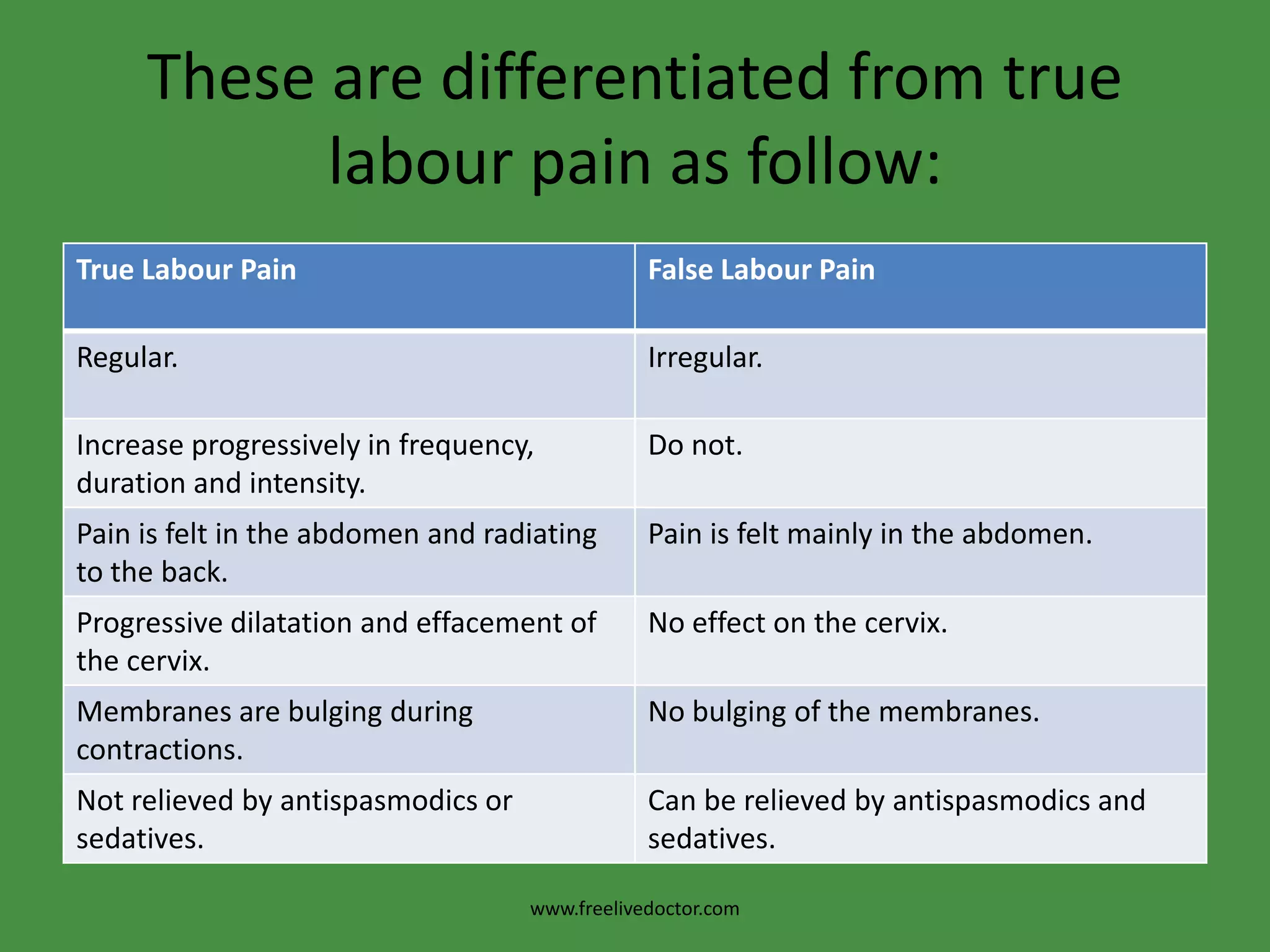
These are differentiated from true labour pain as follow:www.freelivedoctor.com
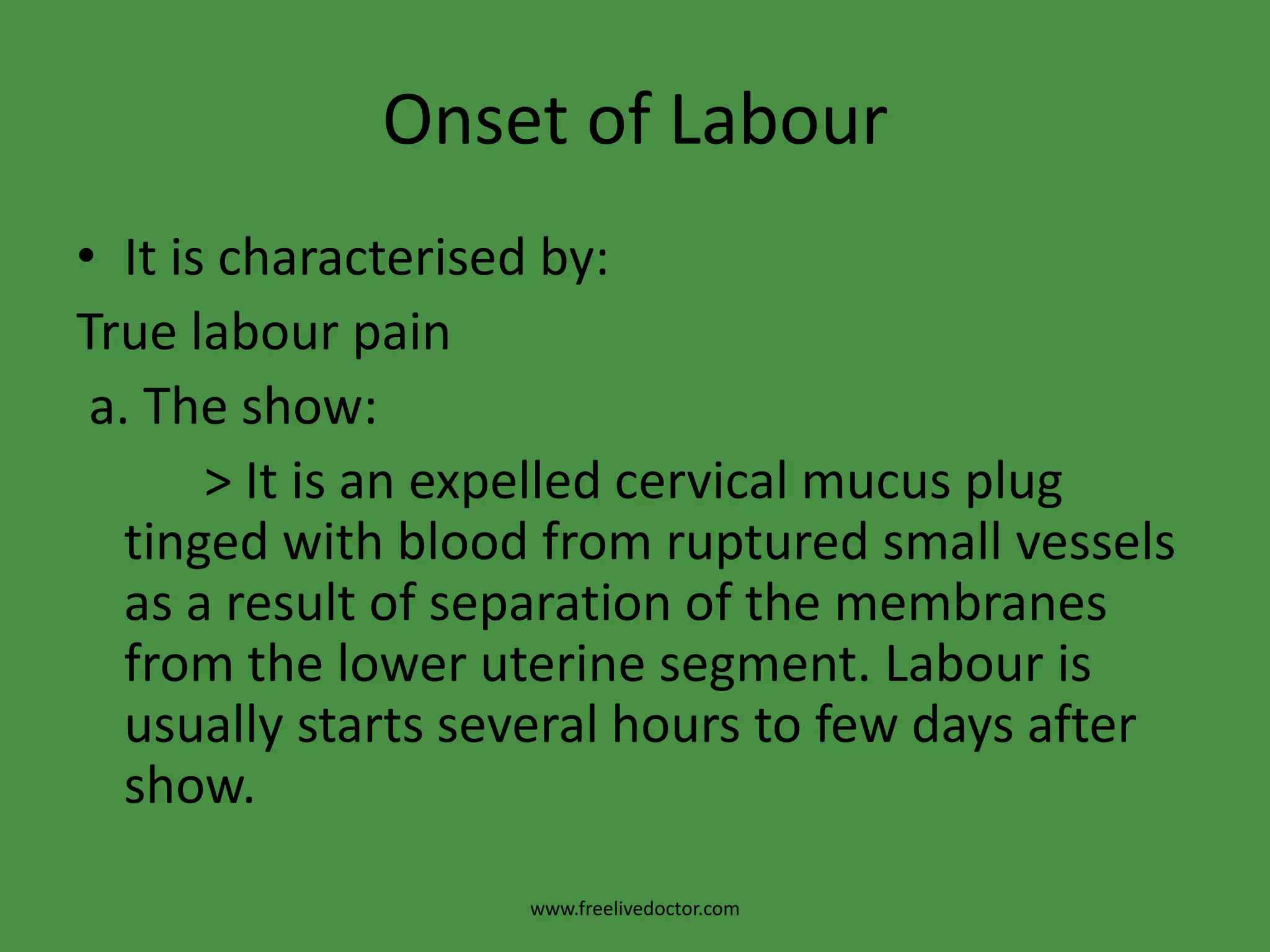
Onset of LabourIt is characterised by:True labour pain a. The show:          > It is an expelled cervical mucus plug tinged with blood from ruptured small vessels as a result of separation of the membranes from the lower uterine segment. Labour is usually starts several hours to few days after show.www.freelivedoctor.com
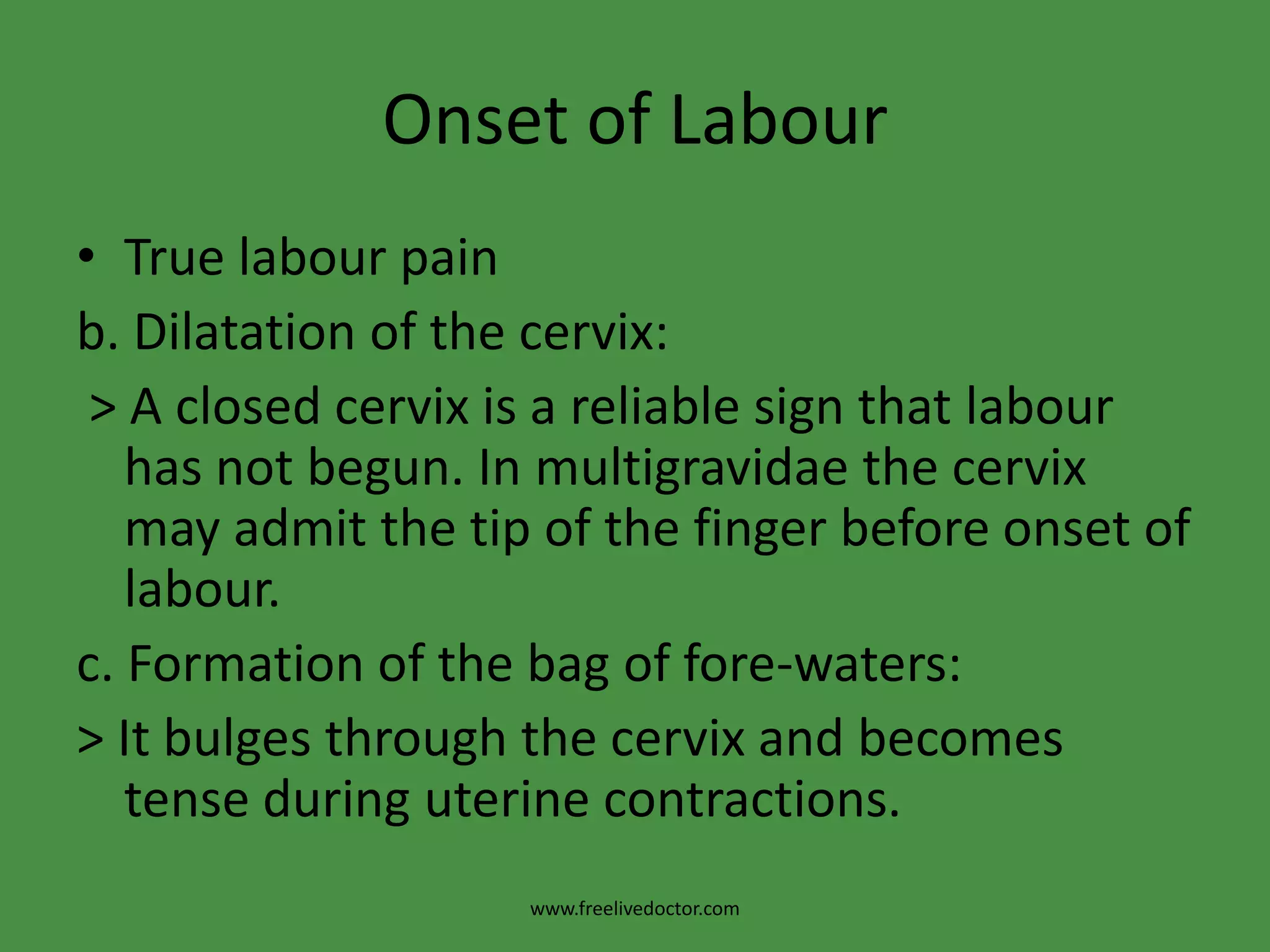
Onset of LabourTrue labour painb. Dilatation of the cervix: > A closed cervix is a reliable sign that labour has not begun. In multigravidae the cervix may admit the tip of the finger before onset of labour.c. Formation of the bag of fore-waters:> It bulges through the cervix and becomes tense during uterine contractions.www.freelivedoctor.com
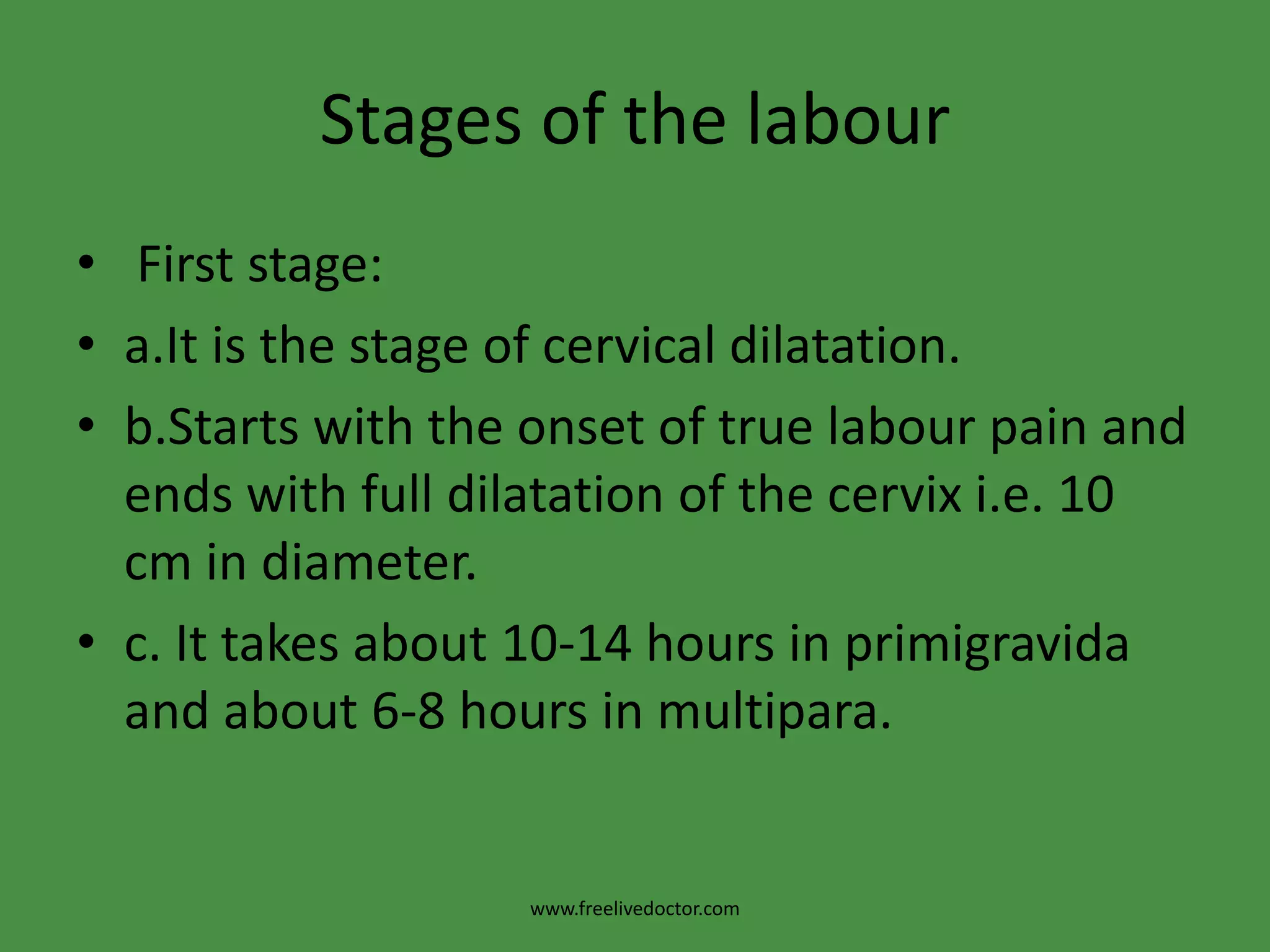
Stages of the labour First stage:a.It is the stage of cervical dilatation.b.Starts with the onset of true labour pain and ends with full dilatation of the cervix i.e. 10 cm in diameter.c. It takes about 10-14 hours in primigravida and about 6-8 hours in multipara.www.freelivedoctor.com
Stages of the labourSecond stagea.It is the stage of expulsion of the foetus.b.Begins with full cervical dilatation and ends with the delivery of the foetus.c.Its duration is about 1 hour in primigravida and ½ hour in multipara.www.freelivedoctor.com
Stages of the labourThird stagea.It is the stage of expulsion of the placenta and membranes.b.Begins after delivery of the foetus and ends with expulsion of the placenta and membranes.c.Its duration is about 10-20 minutes in both primi and multipara.www.freelivedoctor.com
Stages of the labourFourth stagea.It is the stage of early recovery.b.Begins immediately after expulsion of the placenta and membranes and lasts for one hour.c.During which careful observation for the patient, particularly for signs of postpartum haemorrhage is essential. Routine uterine massage is usually done every 15 minutes during this period.www.freelivedoctor.com
First StageCauses of cervical dilatation:a. Contraction and retraction of uterine musculature.b. Mechanical pressure by the forebag of waters, if membranes still intact, or the presenting part, if they had ruptured. This in turn will release more prostaglandins which stimulate uterine contractions and cervical effacement.c. Softness of the cervix which has occurred during pregnancy facilitates dilatation and effacement of the cervix.www.freelivedoctor.com
First StageMechanism of cervical dilatation In primigravidas, the cervical canal dilates from above downwards i.e. from the internal os downwards to the external os. So its length shorts gradually from more than 2 cm to a thin rim of few millimetres continuous with the lower uterine segment. This process is called effacement and expressed in percentage so when we say effacement is 70% it means that 70% of the cervical canal has been taken up.www.freelivedoctor.com
First StageMechanism of cervical dilatationDilatation of the cervix (external os) starts after complete effacement of the cervix. In multigravidas, effacement and dilatation occur simultaneously.www.freelivedoctor.com
First StageMechanism of cervical dilatation In normal presentation and position, the head is applied well to the lower uterine segment dividing the amniotic sac by the girdle of contact into a hindwaters above it containing the foetus and a forewaters below it. This reduces the pressure in the forewaters preventing early rupture of membranes. After full dilatation of the cervix the hind and forewaters become one sac with increased pressure in the bag of forewaters leading to its rupture.www.freelivedoctor.com
First StageMechanism of cervical dilatationIn primigravidas, the cervical canal dilates from above downwards i.e. from the internal os downwards to the external os. So its length shorts gradually from more than 2 cm to a thin rim of few millimetres continuous with the lower uterine segment. This process is called effacement and expressed in percentage so when we say effacement is 70% it means that 70% of the cervical canal has been taken up.www.freelivedoctor.com
First StageMechanism of cervical dilatationDilatation of the cervix (external os) starts after complete effacement of the cervix. In multigravidas, effacement and dilatation occur simultaneously.www.freelivedoctor.com
First StageMechanism of cervical dilatationIn normal presentation and position, the head is applied well to the lower uterine segment dividing the amniotic sac by the girdle of contact into a hindwaters above it containing the foetus and a forewaters below it. This reduces the pressure in the forewaters preventing early rupture of membranes. After full dilatation of the cervix the hind and forewaters become one sac with increased pressure in the bag of forewaters leading to its rupture.www.freelivedoctor.com
First StagePhases of cervical dilatation Latent phase:This is the first 3 cm of cervical dilatation which is slow takes about 8 hours in nulliparae and 4 hours in multiparaewww.freelivedoctor.com
First StagePhases of cervical dilatationActive phase:   It has 3 components:acceleration phase,
maximum slope, and
 deceleration phase.www.freelivedoctor.com
First StagePhases of cervical dilatationThe phase of maximum slope is the most detectable and the two other phases are of shorter duration and can be detected only by frequent vaginal examination.The normal rate of cervical dilatation in active phase is 1.2 cm/ hour in primigravidae and 1.5 cm/hour in multiparae. If the rate is < 1cm / hour it is considered prolonged.www.freelivedoctor.com
Second StageDelivery of the head1.Descent: It is continuous throughout labour particularly during the second stage and caused by: > Uterine contractions and retractions. > The auxiliary forces which is bearing down brought by contraction of the diaphragm and abdominal muscles.> The unfolding of the foetus i.e. straightening of its body due to contractions of the circular muscles of the uterus.www.freelivedoctor.com
Second Stage2. Engagement:The head normally engages in the oblique or transverse diameter of the inlet.www.freelivedoctor.com
Second Stage3. Increased flexion:a.As the atlanto-occipital joint is nearer to the occiput than the sinciput, increased flexion of the head occurs when it meets the pelvic floor according to the lever theory.b.Increased flexion results in:                > The suboccipito-bregmatic diameter (9.5 cm) passes through the birth canal instead of the suboccipito-frontal diameter (10 cm). >The part of the foetal head applied to the maternal passages is like a ball with equal longitudinal and transverse diameters as the suboccipito-bregmatic = biparietal = 9.5 cm. The circumference of this ball is 30 cm.  >The occiput will meet the pelvic floor.www.freelivedoctor.com
Second Stage4. Internal rotation: a. The rule is that the part of foetus meets the pelvic floor first will rotate anteriorly. So that itsmovement is in the direction of levatorani muscles (the main muscle of the pelvic floor) i.e. downwards, forwards and inwards.b. In normal labour, the occiput which meets the pelvic floor first rotates anteriorly 1/8 circle.www.freelivedoctor.com
Second Stage 5. Extension:a. The suboccipital region lies under the symphysis then by head extension the vertex, forehead and face come out successively.b. The head is acted upon by 2 forces:  > the uterine contractions acting downwards and forwards.  > the pelvic floor resistance acting upwards and forwards so the net result is forward direction i.e. extension of the head.www.freelivedoctor.com
Second Stage6. Restitution:After delivery, the head rotates 1/8 of a circle in the opposite direction of internal rotation to undo the twist produced by it.www.freelivedoctor.com
Second Stage7. External rotation: The shoulders enter the pelvis in the opposite oblique diameter to that previously passed  by the head. When the anterior shoulder meets the pelvic floor it rotates anteriorly 1/8 of a circle. This movement is transmitted to the head so it rotates 1/8 of a circle in the same direction of restitution.www.freelivedoctor.com
Second StageDelivery of the shoulder and bodyThe anterior shoulder hinges below the symphysis pubis and with continuous descent the posterior shoulder is delivered first by lateral flexion of the spines followed by anterior shoulder then the body.www.freelivedoctor.com
Third StageAfter delivery of the foetus, the uterus continues to contract and retract. As the placenta is inelastic, it starts to separate through the spongiosa layer by one of the following mechanisms:www.freelivedoctor.com
Third StageSchultze’s mechanism (80%) a. The central area of the placenta separates first and placenta is delivered like an inverted umbrella so the foetal surface appears first followed by the membranes containing small retroplacental clot. b. There is less blood loss and less liability for retention of fragments.www.freelivedoctor.com
Third StageDuncan’s mechanism (20%)a. The lower edge of the placenta separates first and placenta is delivered side ways.b. There is more liability of bleeding and retained fragments.www.freelivedoctor.com
Third StageThe 3rd stage is composed of 3 phases: Placental separation. Placental descent. Placental expulsion.www.freelivedoctor.com
PHYSIOLOGICAL EFFECTS OF LABOUROn the Mothera. First stage: minimal effectswww.freelivedoctor.com
PHYSIOLOGICAL EFFECTS OF LABOUROn the Motherb. Second stage:> Temperature: slight rise to 37.5oC.> Pulse: increases up to 100/min.> Blood pressure: systolic blood pressure may rise slightly due to pain, anxiety and stress.> Oedema and congestion of the conjuctiva.> Minor injuries: to the birth canal and perineum may occur particularly in primigravidas.www.freelivedoctor.com
PHYSIOLOGICAL EFFECTS OF LABOUROn the Motherc. Third stage:    Blood loss from the placental site is100-200 ml and from laceration or episiotomy is 100 ml so the total average blood loss in normal labour is 250 ml.www.freelivedoctor.com
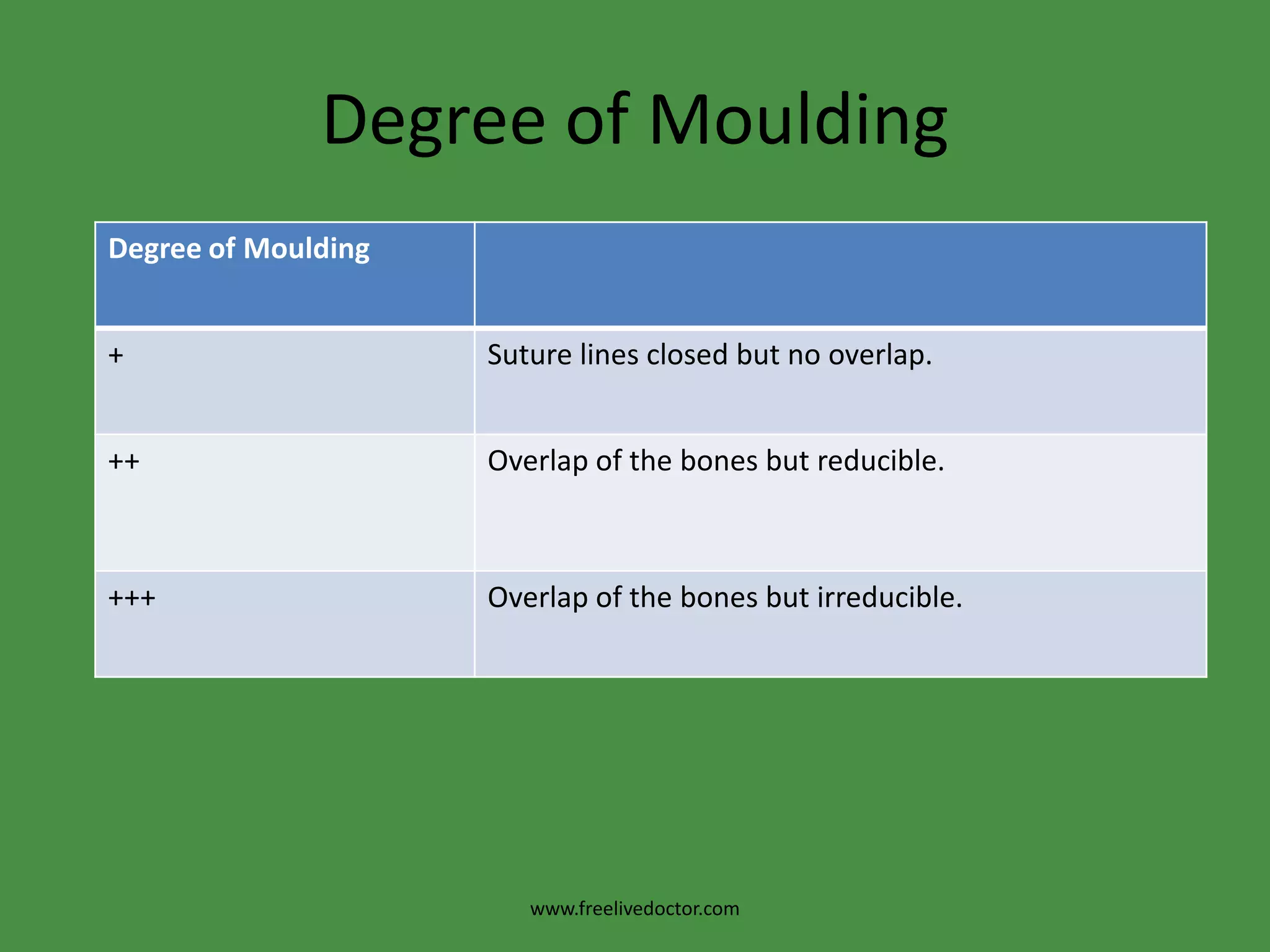
PHYSIOLOGICAL EFFECTS OF LABOUROn the FoetusMoulding:>The physiological gradual overlapping of the vault bones as the skull is compressed during its passage in the birth canal.>One parietal bone overlaps the other and both overlap the occipital and frontal bones so fontanelles are no more detectable. It is of a good value in reducing the skull diameters but severe and / or rapid moulding is dangerous as it may cause intracranial haemorrhage.www.freelivedoctor.com
Degree of Mouldingwww.freelivedoctor.com
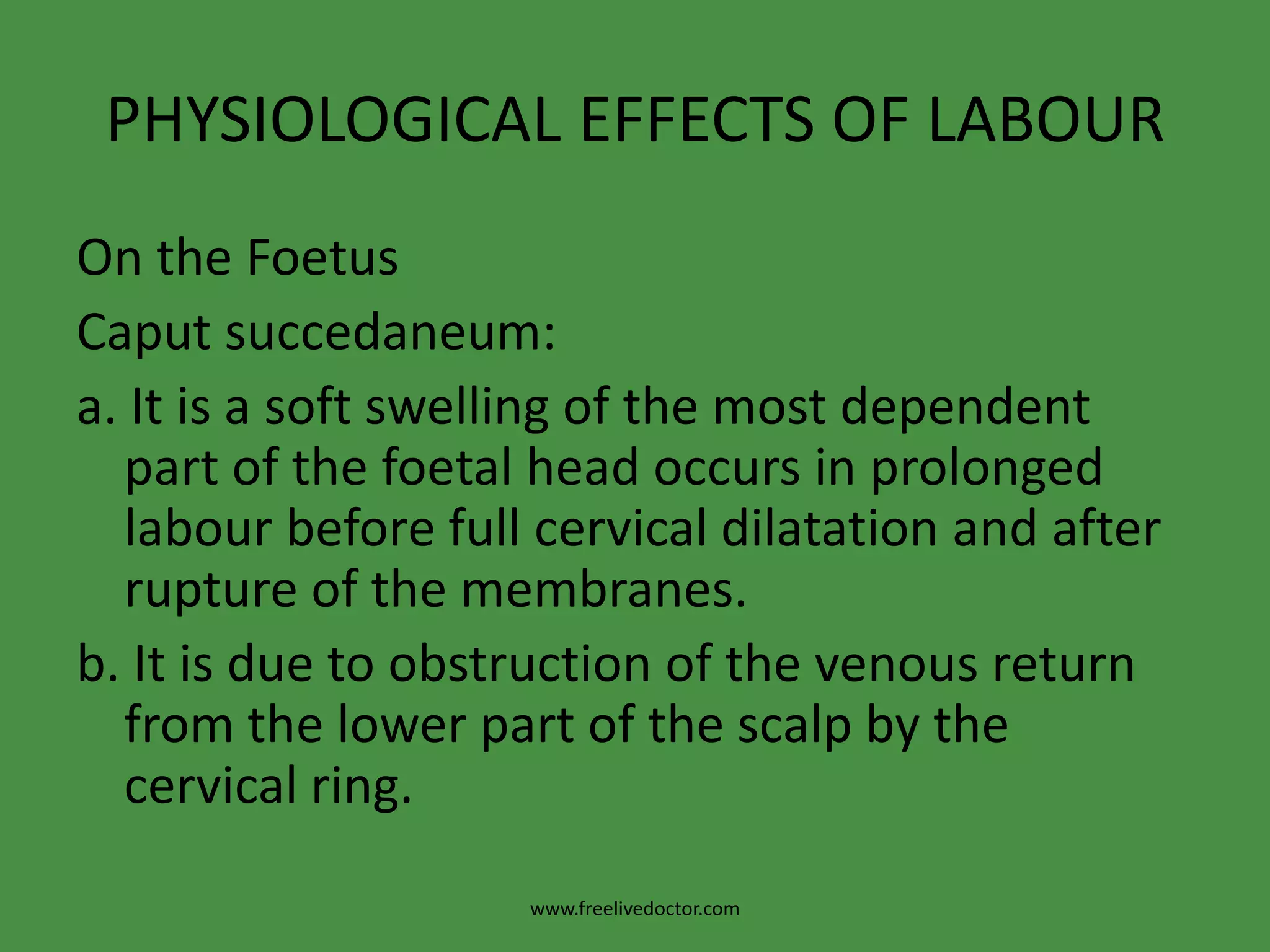
PHYSIOLOGICAL EFFECTS OF LABOUROn the FoetusCaput succedaneum:a. It is a soft swelling of the most dependent part of the foetal head occurs in prolonged labour before full cervical dilatation and after rupture of the membranes.b. It is due to obstruction of the venous return from the lower part of the scalp by the cervical ring.www.freelivedoctor.com
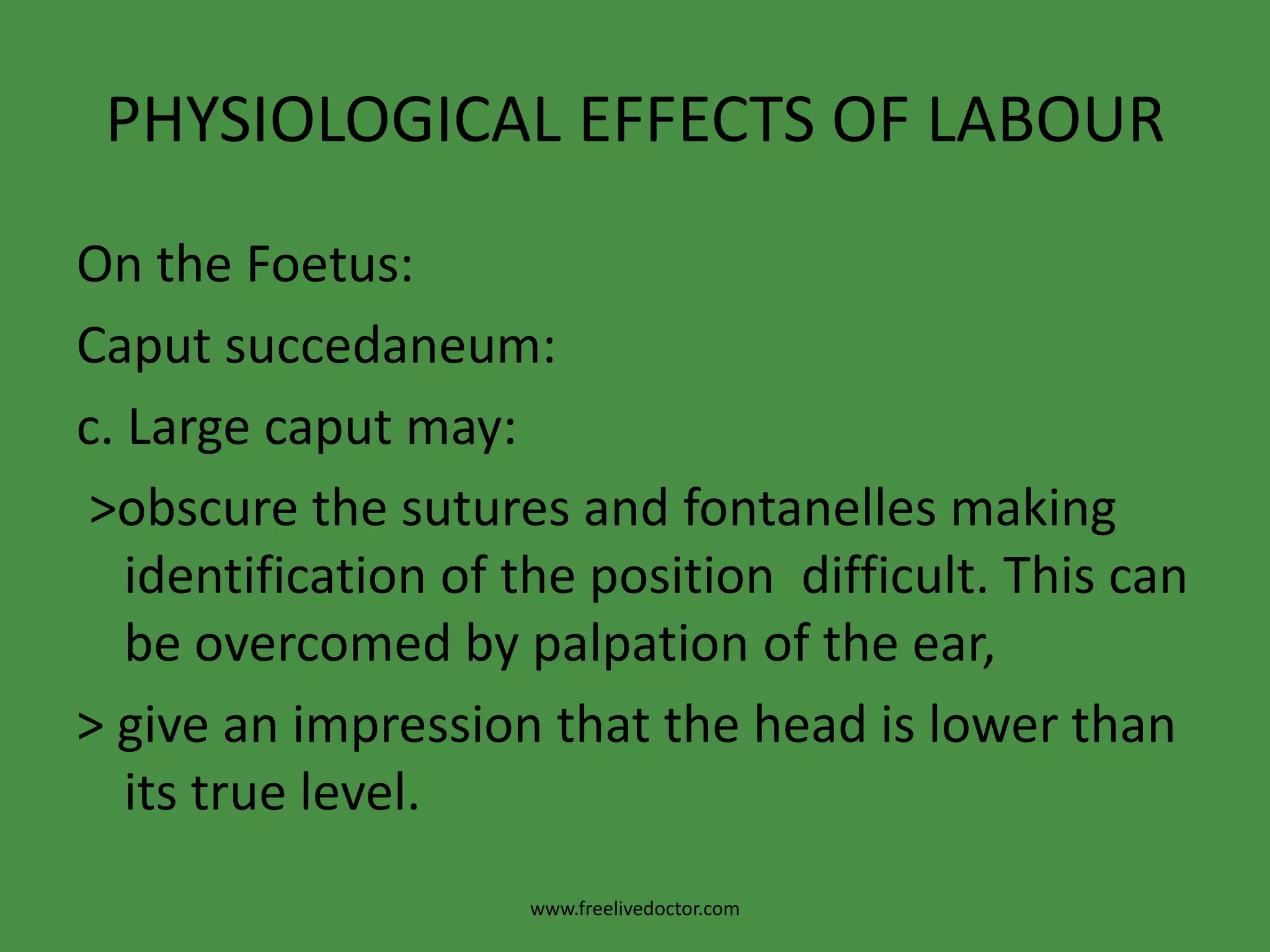
PHYSIOLOGICAL EFFECTS OF LABOUROn the Foetus:Caput succedaneum:c. Large caput may: >obscure the sutures and fontanelles making identification of the position  difficult. This can be overcomed by palpation of the ear,          > give an impression that the head is lower than its true level.www.freelivedoctor.com

Normal labour

  • 1.
  • 2.
    Normal LabourDefinitionsLabour isthe process by which a viable foetus i.e. at the end of 28 weeks or more is expelled or is going to be expelled from the uterus.Delivery means actual birth of the foetus.www.freelivedoctor.com
  • 3.
    The following criteriashould be present to call it normal labour: Spontaneous expulsion, of a single, mature foetus, presented by vertex, through the birth canal, within a reasonable time (not less than 3 hours or more than 18 hours), without complications to the mother, or the foetus.www.freelivedoctor.com
  • 4.
    Cause of Onsetof LabourIt is unknown but the following theories were postulated:Hormonal factorsMechanical factorswww.freelivedoctor.com
  • 5.
    Hormonal factorsOestrogen theory:During pregnancy, most of the oestrogens are present in a binding form. During the last trimester, more free oestrogen appears increasing the excitability of the myometrium and prostaglandins synthesis.www.freelivedoctor.com
  • 6.
    Hormonal factorsProgesterone withdrawaltheory: Before labour, there is a drop in progesterone synthesis leading to predominance of the excitatory action of oestrogens.www.freelivedoctor.com
  • 7.
    Hormonal factorsProstaglandins theory:Prostaglandins E2 and F2α are powerful stimulators of uterine muscle activity. PGF2α was found to be increased in maternal and foetal blood as well as the amniotic fluid late in pregnancy and during labour.www.freelivedoctor.com
  • 8.
    Hormonal factorsOxytocin theory:Although oxytocin is a powerful stimulator of uterine contraction, its natural role in onset of labour is doubtful. The secretion of oxytocinase enzyme from the placenta is decreased near term due to placental ischaemia leading to predominance of oxytocin’s action.www.freelivedoctor.com
  • 9.
    Hormonal factorsFoetalcortisol theory:Increased cortisol production from the foetal adrenal gland before labour may influence its onset by increasing oestrogen production from the placenta.www.freelivedoctor.com
  • 10.
    Mechanical factorsUterine distensiontheory: Like any hollow organ in the body, when the uterus in distended to a certain limit, it starts to contract to evacuate its contents. This explains the preterm labour in case of multiple pregnancy and polyhydramnios. Stretch of the lower uterine segment: by the presenting part near term.www.freelivedoctor.com
  • 11.
    CLINICAL PICTURE OFLABOURProdromal (pre-labour) stageThe following clinical manifestations may occur in the last weeks of pregnancy.a. Shelfing: It is falling forwards of the uterine fundus making the upper abdomen looks like a shelf during standing position. This is due to engagement of the head which brings the foetus perpendicular to the pelvic inlet in the direction of pelvic axis.www.freelivedoctor.com
  • 12.
    CLINICAL PICTURE OFLABOURb. Lightening: It is the relief of upper abdominal pressure symptoms as dyspnoea, dyspepsia and palpitation due to: > descent in the fundal level after engagement of the head and > shelfing of the uterus.www.freelivedoctor.com
  • 13.
    CLINICAL PICTURE OFLABOURc. Pelvic pressure symptoms: With engagement of the presenting part the following symptoms may occur: > Frequency of micturition, > rectal tenesmus and difficulty in walking.d. Increased vaginal discharge.e. False labour pain:www.freelivedoctor.com
  • 14.
    These are differentiatedfrom true labour pain as follow:www.freelivedoctor.com
  • 15.
    Onset of LabourItis characterised by:True labour pain a. The show: > It is an expelled cervical mucus plug tinged with blood from ruptured small vessels as a result of separation of the membranes from the lower uterine segment. Labour is usually starts several hours to few days after show.www.freelivedoctor.com
  • 16.
    Onset of LabourTruelabour painb. Dilatation of the cervix: > A closed cervix is a reliable sign that labour has not begun. In multigravidae the cervix may admit the tip of the finger before onset of labour.c. Formation of the bag of fore-waters:> It bulges through the cervix and becomes tense during uterine contractions.www.freelivedoctor.com
  • 17.
    Stages of thelabour First stage:a.It is the stage of cervical dilatation.b.Starts with the onset of true labour pain and ends with full dilatation of the cervix i.e. 10 cm in diameter.c. It takes about 10-14 hours in primigravida and about 6-8 hours in multipara.www.freelivedoctor.com
  • 18.
    Stages of thelabourSecond stagea.It is the stage of expulsion of the foetus.b.Begins with full cervical dilatation and ends with the delivery of the foetus.c.Its duration is about 1 hour in primigravida and ½ hour in multipara.www.freelivedoctor.com
  • 19.
    Stages of thelabourThird stagea.It is the stage of expulsion of the placenta and membranes.b.Begins after delivery of the foetus and ends with expulsion of the placenta and membranes.c.Its duration is about 10-20 minutes in both primi and multipara.www.freelivedoctor.com
  • 20.
    Stages of thelabourFourth stagea.It is the stage of early recovery.b.Begins immediately after expulsion of the placenta and membranes and lasts for one hour.c.During which careful observation for the patient, particularly for signs of postpartum haemorrhage is essential. Routine uterine massage is usually done every 15 minutes during this period.www.freelivedoctor.com
  • 21.
    First StageCauses ofcervical dilatation:a. Contraction and retraction of uterine musculature.b. Mechanical pressure by the forebag of waters, if membranes still intact, or the presenting part, if they had ruptured. This in turn will release more prostaglandins which stimulate uterine contractions and cervical effacement.c. Softness of the cervix which has occurred during pregnancy facilitates dilatation and effacement of the cervix.www.freelivedoctor.com
  • 22.
    First StageMechanism ofcervical dilatation In primigravidas, the cervical canal dilates from above downwards i.e. from the internal os downwards to the external os. So its length shorts gradually from more than 2 cm to a thin rim of few millimetres continuous with the lower uterine segment. This process is called effacement and expressed in percentage so when we say effacement is 70% it means that 70% of the cervical canal has been taken up.www.freelivedoctor.com
  • 23.
    First StageMechanism ofcervical dilatationDilatation of the cervix (external os) starts after complete effacement of the cervix. In multigravidas, effacement and dilatation occur simultaneously.www.freelivedoctor.com
  • 24.
    First StageMechanism ofcervical dilatation In normal presentation and position, the head is applied well to the lower uterine segment dividing the amniotic sac by the girdle of contact into a hindwaters above it containing the foetus and a forewaters below it. This reduces the pressure in the forewaters preventing early rupture of membranes. After full dilatation of the cervix the hind and forewaters become one sac with increased pressure in the bag of forewaters leading to its rupture.www.freelivedoctor.com
  • 25.
    First StageMechanism ofcervical dilatationIn primigravidas, the cervical canal dilates from above downwards i.e. from the internal os downwards to the external os. So its length shorts gradually from more than 2 cm to a thin rim of few millimetres continuous with the lower uterine segment. This process is called effacement and expressed in percentage so when we say effacement is 70% it means that 70% of the cervical canal has been taken up.www.freelivedoctor.com
  • 26.
    First StageMechanism ofcervical dilatationDilatation of the cervix (external os) starts after complete effacement of the cervix. In multigravidas, effacement and dilatation occur simultaneously.www.freelivedoctor.com
  • 27.
    First StageMechanism ofcervical dilatationIn normal presentation and position, the head is applied well to the lower uterine segment dividing the amniotic sac by the girdle of contact into a hindwaters above it containing the foetus and a forewaters below it. This reduces the pressure in the forewaters preventing early rupture of membranes. After full dilatation of the cervix the hind and forewaters become one sac with increased pressure in the bag of forewaters leading to its rupture.www.freelivedoctor.com
  • 28.
    First StagePhases ofcervical dilatation Latent phase:This is the first 3 cm of cervical dilatation which is slow takes about 8 hours in nulliparae and 4 hours in multiparaewww.freelivedoctor.com
  • 29.
    First StagePhases ofcervical dilatationActive phase: It has 3 components:acceleration phase,
  • 30.
  • 31.
  • 32.
    First StagePhases ofcervical dilatationThe phase of maximum slope is the most detectable and the two other phases are of shorter duration and can be detected only by frequent vaginal examination.The normal rate of cervical dilatation in active phase is 1.2 cm/ hour in primigravidae and 1.5 cm/hour in multiparae. If the rate is < 1cm / hour it is considered prolonged.www.freelivedoctor.com
  • 33.
    Second StageDelivery ofthe head1.Descent: It is continuous throughout labour particularly during the second stage and caused by: > Uterine contractions and retractions. > The auxiliary forces which is bearing down brought by contraction of the diaphragm and abdominal muscles.> The unfolding of the foetus i.e. straightening of its body due to contractions of the circular muscles of the uterus.www.freelivedoctor.com
  • 34.
    Second Stage2. Engagement:Thehead normally engages in the oblique or transverse diameter of the inlet.www.freelivedoctor.com
  • 35.
    Second Stage3. Increasedflexion:a.As the atlanto-occipital joint is nearer to the occiput than the sinciput, increased flexion of the head occurs when it meets the pelvic floor according to the lever theory.b.Increased flexion results in: > The suboccipito-bregmatic diameter (9.5 cm) passes through the birth canal instead of the suboccipito-frontal diameter (10 cm). >The part of the foetal head applied to the maternal passages is like a ball with equal longitudinal and transverse diameters as the suboccipito-bregmatic = biparietal = 9.5 cm. The circumference of this ball is 30 cm. >The occiput will meet the pelvic floor.www.freelivedoctor.com
  • 36.
    Second Stage4. Internalrotation: a. The rule is that the part of foetus meets the pelvic floor first will rotate anteriorly. So that itsmovement is in the direction of levatorani muscles (the main muscle of the pelvic floor) i.e. downwards, forwards and inwards.b. In normal labour, the occiput which meets the pelvic floor first rotates anteriorly 1/8 circle.www.freelivedoctor.com
  • 37.
    Second Stage 5.Extension:a. The suboccipital region lies under the symphysis then by head extension the vertex, forehead and face come out successively.b. The head is acted upon by 2 forces: > the uterine contractions acting downwards and forwards. > the pelvic floor resistance acting upwards and forwards so the net result is forward direction i.e. extension of the head.www.freelivedoctor.com
  • 38.
    Second Stage6. Restitution:Afterdelivery, the head rotates 1/8 of a circle in the opposite direction of internal rotation to undo the twist produced by it.www.freelivedoctor.com
  • 39.
    Second Stage7. Externalrotation: The shoulders enter the pelvis in the opposite oblique diameter to that previously passed by the head. When the anterior shoulder meets the pelvic floor it rotates anteriorly 1/8 of a circle. This movement is transmitted to the head so it rotates 1/8 of a circle in the same direction of restitution.www.freelivedoctor.com
  • 40.
    Second StageDelivery ofthe shoulder and bodyThe anterior shoulder hinges below the symphysis pubis and with continuous descent the posterior shoulder is delivered first by lateral flexion of the spines followed by anterior shoulder then the body.www.freelivedoctor.com
  • 41.
    Third StageAfter deliveryof the foetus, the uterus continues to contract and retract. As the placenta is inelastic, it starts to separate through the spongiosa layer by one of the following mechanisms:www.freelivedoctor.com
  • 42.
    Third StageSchultze’s mechanism(80%) a. The central area of the placenta separates first and placenta is delivered like an inverted umbrella so the foetal surface appears first followed by the membranes containing small retroplacental clot. b. There is less blood loss and less liability for retention of fragments.www.freelivedoctor.com
  • 43.
    Third StageDuncan’s mechanism(20%)a. The lower edge of the placenta separates first and placenta is delivered side ways.b. There is more liability of bleeding and retained fragments.www.freelivedoctor.com
  • 44.
    Third StageThe 3rdstage is composed of 3 phases: Placental separation. Placental descent. Placental expulsion.www.freelivedoctor.com
  • 45.
    PHYSIOLOGICAL EFFECTS OFLABOUROn the Mothera. First stage: minimal effectswww.freelivedoctor.com
  • 46.
    PHYSIOLOGICAL EFFECTS OFLABOUROn the Motherb. Second stage:> Temperature: slight rise to 37.5oC.> Pulse: increases up to 100/min.> Blood pressure: systolic blood pressure may rise slightly due to pain, anxiety and stress.> Oedema and congestion of the conjuctiva.> Minor injuries: to the birth canal and perineum may occur particularly in primigravidas.www.freelivedoctor.com
  • 47.
    PHYSIOLOGICAL EFFECTS OFLABOUROn the Motherc. Third stage: Blood loss from the placental site is100-200 ml and from laceration or episiotomy is 100 ml so the total average blood loss in normal labour is 250 ml.www.freelivedoctor.com
  • 48.
    PHYSIOLOGICAL EFFECTS OFLABOUROn the FoetusMoulding:>The physiological gradual overlapping of the vault bones as the skull is compressed during its passage in the birth canal.>One parietal bone overlaps the other and both overlap the occipital and frontal bones so fontanelles are no more detectable. It is of a good value in reducing the skull diameters but severe and / or rapid moulding is dangerous as it may cause intracranial haemorrhage.www.freelivedoctor.com
  • 49.
  • 50.
    PHYSIOLOGICAL EFFECTS OFLABOUROn the FoetusCaput succedaneum:a. It is a soft swelling of the most dependent part of the foetal head occurs in prolonged labour before full cervical dilatation and after rupture of the membranes.b. It is due to obstruction of the venous return from the lower part of the scalp by the cervical ring.www.freelivedoctor.com
  • 51.
    PHYSIOLOGICAL EFFECTS OFLABOUROn the Foetus:Caput succedaneum:c. Large caput may: >obscure the sutures and fontanelles making identification of the position difficult. This can be overcomed by palpation of the ear, > give an impression that the head is lower than its true level.www.freelivedoctor.com
  • 52.
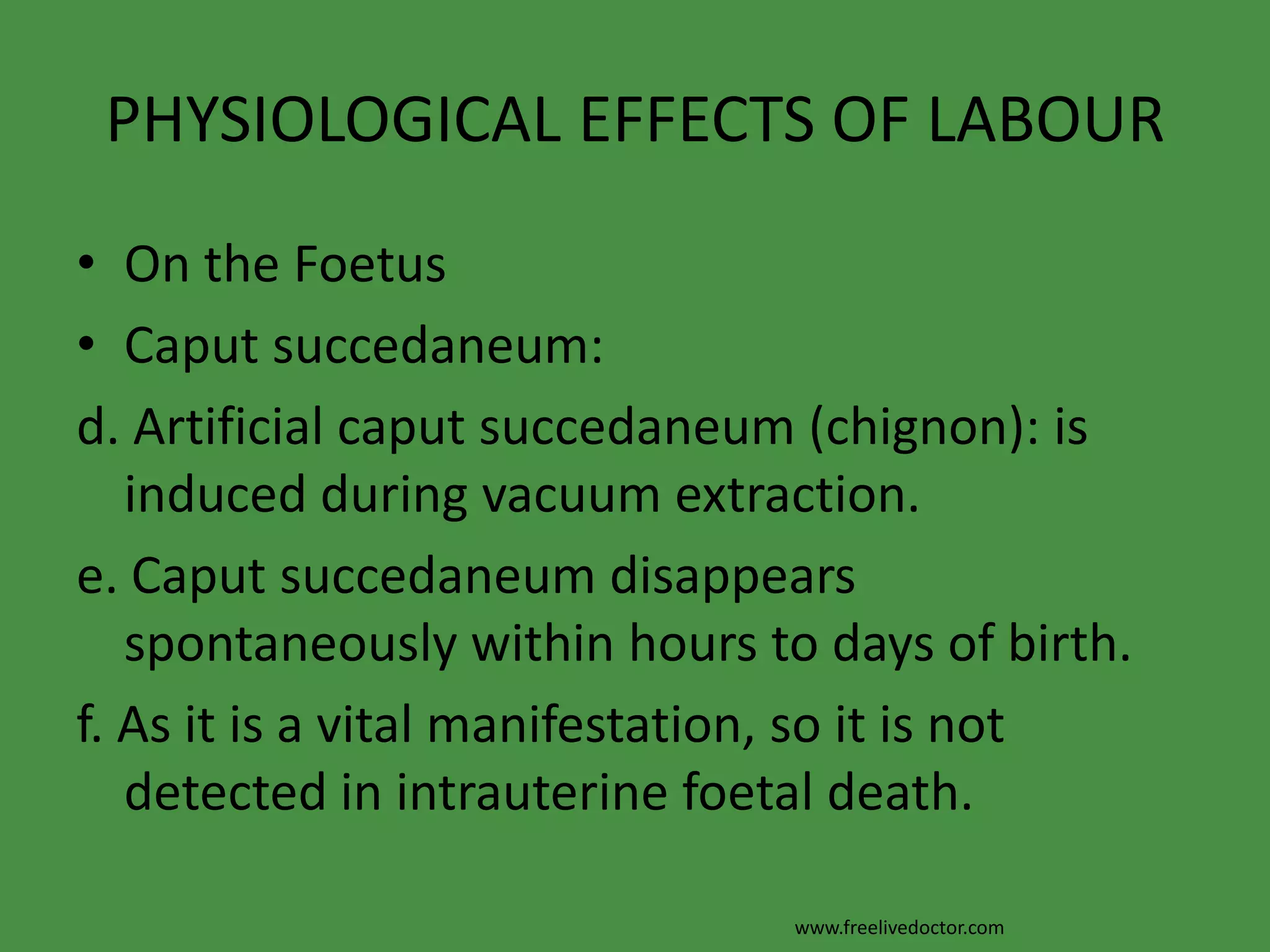
    PHYSIOLOGICAL EFFECTS OFLABOUROn the FoetusCaput succedaneum:d. Artificial caput succedaneum (chignon): is induced during vacuum extraction.e. Caput succedaneum disappears spontaneously within hours to days of birth.f. As it is a vital manifestation, so it is not detected in intrauterine foetal death.www.freelivedoctor.com
  • 53.
    PHYSIOLOGICAL EFFECTS OFLABOUROn the FoetusThe presence of caput indicates that:> the foetus was living during labour,>labour was prolonged and difficult,>the attitude of foetal head during labour can be expected as caput is present in the most dependant part of it.www.freelivedoctor.com