
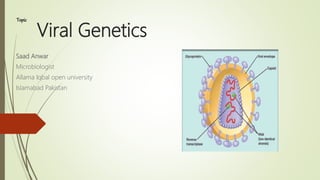
Viral Genetics
Saad Anwar
Microbiologist
Allama Iqbal open university
Islamabad Pakistan
Topic
Introduction
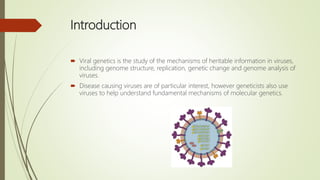
 Viral genetics is the study of the mechanisms of heritable information in viruses,
including genome structure, replication, genetic change and genome analysis of
viruses.
 Disease causing viruses are of particular interest, however geneticists also use
viruses to help understand fundamental mechanisms of molecular genetics.
Nature of Viruses
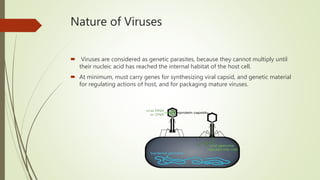
 Viruses are considered as genetic parasites, because they cannot multiply until
their nucleic acid has reached the internal habitat of the host cell.
 At minimum, must carry genes for synthesizing viral capsid, and genetic material
for regulating actions of host, and for packaging mature viruses.
DNA and RNA Viruses
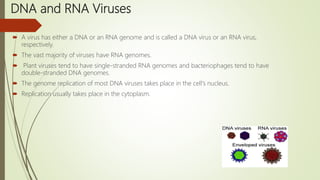
 A virus has either a DNA or an RNA genome and is called a DNA virus or an RNA virus,
respectively.
 The vast majority of viruses have RNA genomes.
 Plant viruses tend to have single-stranded RNA genomes and bacteriophages tend to have
double-stranded DNA genomes.
 The genome replication of most DNA viruses takes place in the cell's nucleus.
 Replication usually takes place in the cytoplasm.
Cont.…….
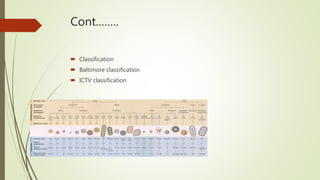
 Classification
 Baltimore classification
 ICTV classification
Genetic Change in Viruses
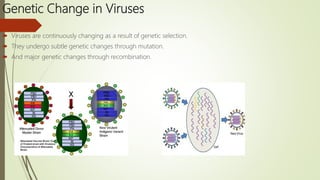
 Viruses are continuously changing as a result of genetic selection.
 They undergo subtle genetic changes through mutation.
 And major genetic changes through recombination.
Viral Replication
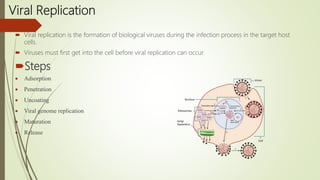
 Viral replication is the formation of biological viruses during the infection process in the target host
cells.
 Viruses must first get into the cell before viral replication can occur.
Steps
 Adsorption
 Penetration
 Uncoating
 Viral genome replication
 Maturation
 Release
Genome Analysis
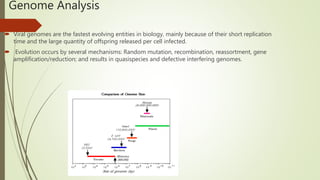
 Viral genomes are the fastest evolving entities in biology, mainly because of their short replication
time and the large quantity of offspring released per cell infected.
 Evolution occurs by several mechanisms: Random mutation, recombination, reassortment, gene
amplification/reduction; and results in quasispecies and defective interfering genomes.

Viral genetics

  • 2.
    Viral Genetics Saad Anwar Microbiologist AllamaIqbal open university Islamabad Pakistan Topic
  • 3.
    Introduction  Viral geneticsis the study of the mechanisms of heritable information in viruses, including genome structure, replication, genetic change and genome analysis of viruses.  Disease causing viruses are of particular interest, however geneticists also use viruses to help understand fundamental mechanisms of molecular genetics.
  • 4.
    Nature of Viruses Viruses are considered as genetic parasites, because they cannot multiply until their nucleic acid has reached the internal habitat of the host cell.  At minimum, must carry genes for synthesizing viral capsid, and genetic material for regulating actions of host, and for packaging mature viruses.
  • 5.
    DNA and RNAViruses  A virus has either a DNA or an RNA genome and is called a DNA virus or an RNA virus, respectively.  The vast majority of viruses have RNA genomes.  Plant viruses tend to have single-stranded RNA genomes and bacteriophages tend to have double-stranded DNA genomes.  The genome replication of most DNA viruses takes place in the cell's nucleus.  Replication usually takes place in the cytoplasm.
  • 6.
    Cont.…….  Classification  Baltimoreclassification  ICTV classification
  • 7.
    Genetic Change inViruses  Viruses are continuously changing as a result of genetic selection.  They undergo subtle genetic changes through mutation.  And major genetic changes through recombination.
  • 8.
    Viral Replication  Viralreplication is the formation of biological viruses during the infection process in the target host cells.  Viruses must first get into the cell before viral replication can occur. Steps  Adsorption  Penetration  Uncoating  Viral genome replication  Maturation  Release
  • 9.
    Genome Analysis  Viralgenomes are the fastest evolving entities in biology, mainly because of their short replication time and the large quantity of offspring released per cell infected.  Evolution occurs by several mechanisms: Random mutation, recombination, reassortment, gene amplification/reduction; and results in quasispecies and defective interfering genomes.