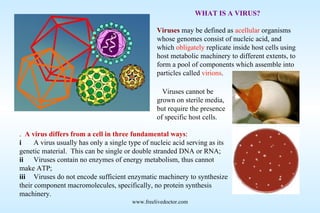
Viruses are acellular organisms that can only replicate inside host cells. They contain either DNA or RNA as their genetic material but lack enzymes to synthesize proteins or metabolic machinery. A virus infects a host cell and uses the cell's machinery to produce copies of its genome and proteins which self-assemble into new virus particles. Viruses are distinguished from other parasites by their inability to grow outside of host cells and lack of cellular structure. They have played a major role in human diseases throughout history such as smallpox, measles, and influenza.




![1. introduction to_virology[1]](https://cdn.slidesharecdn.com/ss_thumbnails/1-210814125616-thumbnail.jpg?width=640&height=640&fit=bounds)


