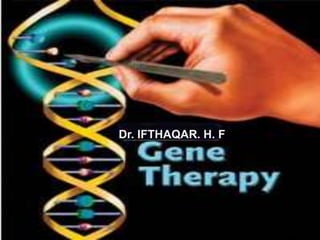
Dr. IFTHAQAR. H. F
 Definiton: An experimental technique for 
correcting defective genes that are 
responsible for diseases by replacing 
them. 
 Several approaches to gene therapy: 
1. Inserting a normal gene to replace an 
abnormal gene. 
2. Inactivating, or “knocking out,” a mutated 
gene that is functioning improperly. 
3. Introducing a new gene into the body to help 
fight a disease.
STEPS IN GENE THERAPY: 
 Identification of the defective gene. 
 Cloning of normal healthy gene. 
 Identification of target cell / tissue / organ. 
 Insertion of the normal functional gene into 
the host DNA.
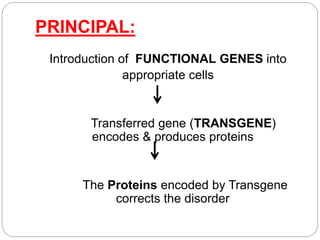
PRINCIPAL: 
Introduction of FUNCTIONAL GENES into 
appropriate cells 
Transferred gene (TRANSGENE) 
encodes & produces proteins 
The Proteins encoded by Transgene 
corrects the disorder
TYPES OF GENE THERAPY: 
1. SOMATIC CELL THERAPY 
2. GERM LINE THERAPY
1.SOMATIC CELL THERAPY: 
 Insertion of therapeutic gene into somatic 
cells. 
 like fibroblasts, myoblasts, epithelial cells, 
nervous cells, glial cells etc. 
 This can correct the genetic defect in the 
patient. 
 Transgene cannot be passed on to the 
siblings.
2. GERMLINE THERAPY: 
 Introduction of the foreign gene into germ 
cells like sperm / ovum / fertilized egg. 
 Results in expression of modified features in 
both somatic as well as germ cells of the 
offspring. 
 Considered unethical, and is not advocated 
in humans.
TECHNIQUE OF GENE 
THERAPY 
1. Ex vivo 
2. In vivo 
Two distinct strategies are used to achieve long-term 
gene expression: 
one is to transduce stem cells with an integrating 
vector, so that all progeny cells will carry the 
donated gene; 
the other is to transduce long-lived cells such as 
skeletal muscle or neural cells
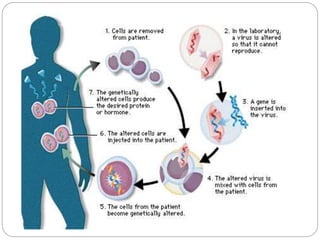
1. Ex vivo approach: 
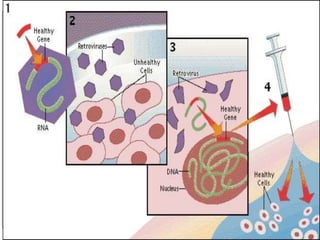
-Target cells are removed from the 
body and grown in vitro. 
-The gene is then introduced into the 
cultured cells. 
-These cells are then re-introduced 
into the same individual. 
-Examples: Fibroblast cells, 
Hematopoietic cells.
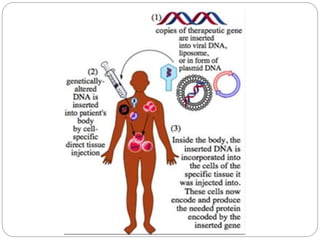
2. In vivo approach: (Direct Gene 
Transfer) 
-Cloned therapeutic gene is introduced 
directly into the affected tissue. 
-Specially designed vehicles are 
needed. 
-Examples are: Lungs, Brain
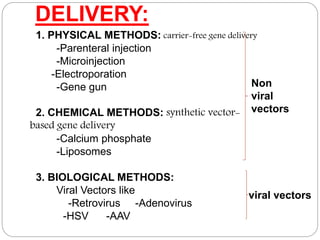
DELIVERY: 
1. PHYSICAL METHODS: carrier-free gene delivery 
-Parenteral injection 
-Microinjection 
-Electroporation 
-Gene gun 
2. CHEMICAL METHODS: synthetic vector-based 
gene delivery 
-Calcium phosphate 
-Liposomes 
3. BIOLOGICAL METHODS: 
Viral Vectors like 
-Retrovirus -Adenovirus 
-HSV -AAV 
Non 
viral 
vectors 
viral vectors
To be successful, a vector 
must: 
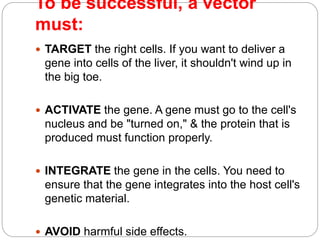
 TARGET the right cells. If you want to deliver a 
gene into cells of the liver, it shouldn't wind up in 
the big toe. 
 ACTIVATE the gene. A gene must go to the cell's 
nucleus and be "turned on," & the protein that is 
produced must function properly. 
 INTEGRATE the gene in the cells. You need to 
ensure that the gene integrates into the host cell's 
genetic material. 
 AVOID harmful side effects.
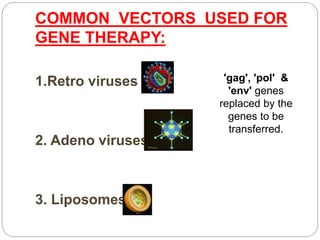
COMMON VECTORS USED FOR 
GENE THERAPY: 
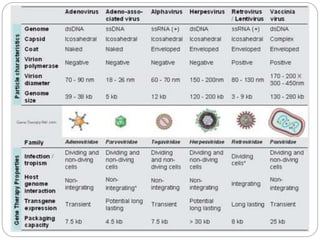
1.Retro viruses 
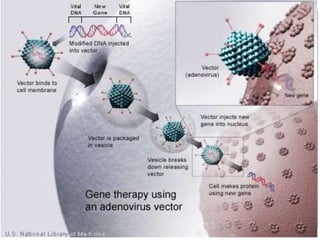
2. Adeno viruses 
3. Liposomes 
'gag', 'pol' & 
'env' genes 
replaced by the 
genes to be 
transferred.
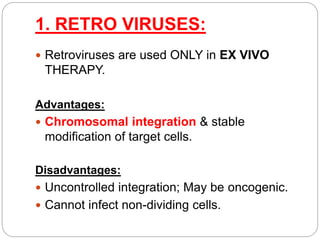
1. RETRO VIRUSES: 
 Retroviruses are used ONLY in EX VIVO 
THERAPY. 
Advantages: 
 Chromosomal integration & stable 
modification of target cells. 
Disadvantages: 
 Uncontrolled integration; May be oncogenic. 
 Cannot infect non-dividing cells.
2. ADENO VIRUSES: 
 Second most commonly used. 
Advantages: 
 Can infect non-dividing cells, thus suitable for gene 
therapy of Cystic fibrosis, DMD. 
 Can be produced at high titres in cultures. 
 Non-integration to chromosome. Avoids the risks 
of uncontrolled integration. 
Disadvantages: 
 Transient expression of gene due to episomal 
integration. 
 Provokes immune response. 
Alternative & better – AAV for 3 reasons
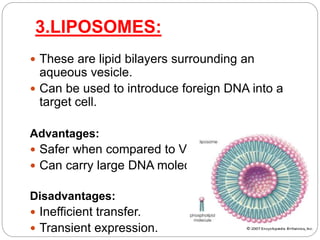
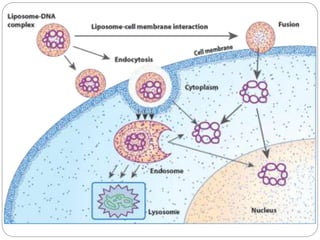
3.LIPOSOMES: 
 These are lipid bilayers surrounding an 
aqueous vesicle. 
 Can be used to introduce foreign DNA into a 
target cell. 
Advantages: 
 Safer when compared to Viral vectors. 
 Can carry large DNA molecules. 
Disadvantages: 
 Inefficient transfer. 
 Transient expression.
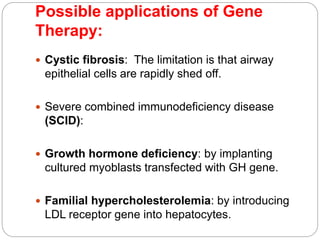
Possible applications of Gene 
Therapy: 
 Cystic fibrosis: The limitation is that airway 
epithelial cells are rapidly shed off. 
 Severe combined immunodeficiency disease 
(SCID): 
 Growth hormone deficiency: by implanting 
cultured myoblasts transfected with GH gene. 
 Familial hypercholesterolemia: by introducing 
LDL receptor gene into hepatocytes.
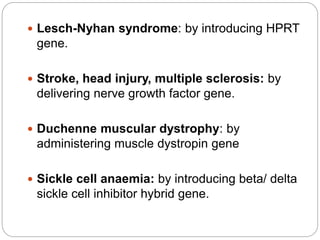
 Lesch-Nyhan syndrome: by introducing HPRT 
gene. 
 Stroke, head injury, multiple sclerosis: by 
delivering nerve growth factor gene. 
 Duchenne muscular dystrophy: by 
administering muscle dystropin gene 
 Sickle cell anaemia: by introducing beta/ delta 
sickle cell inhibitor hybrid gene.
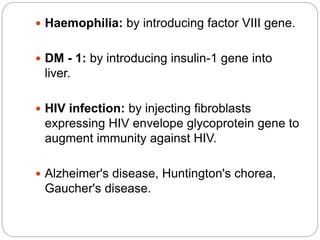
 Haemophilia: by introducing factor VIII gene. 
 DM - 1: by introducing insulin-1 gene into 
liver. 
 HIV infection: by injecting fibroblasts 
expressing HIV envelope glycoprotein gene to 
augment immunity against HIV. 
 Alzheimer's disease, Huntington's chorea, 
Gaucher's disease.
Cancer: 
(i) By genetic introduction of an enzyme (viral 
thymidine kinase) into tumour cells followed by a 
prodrug that is converted to the toxic metabolite, 
tumour cells are selectively killed. 
(ii) By inserting TNFa, IL-2 and other cytokine genes 
into tumour cells to increase their immune 
recognition and destruction by tumour infiltrating 
lymphocytes.
(iii) By introducing promoter 'antisense' gene or 
'suppressor' gene which negatively regulate 
tumour growth. 
(iv) By introducing multidrug resistance MDR-1 
gene into bone marrow cells and render them 
less susceptible to destruction by 
myelosuppressant drugs, toxicity of many 
anticancer drugs can be overcome.
Potential Complications of Gene 
Therapy: 
 Gene silencing 
 Genotoxicity: complications arising from 
insertional mutagenesis. 
 Phenotoxicity: complications arising from 
overexpression or ectopic expression of the 
transgene. 
 Immunotoxicity: harmful immune response to 
either the vector or transgene. 
 Risks of horizontal transmission: shedding of 
infectious vector into environment. 
 Risks of vertical transmission: germline 
transmission of donated DNA.
References 
 Essentials of Medical Pharmacology, 6th Edition 
by KD TRIPATHI. 
 Harrisons Text book of medicine – 18th edition. 
 Centre for Genetics Education. 
www.genetics.edu.au 
 Genetics Home Reference 
(http://ghr.nlm.nih.gov/) 
 Google images.
TAKE HOME MESSAGE: 
 Very promising prospect to cure many diseases. 
 Two things to remember 
2 types 
2 vectors 
2 methods 
 Should be restricted to treat diseases not change 
nature. 
 Still lot of research needs to be done.
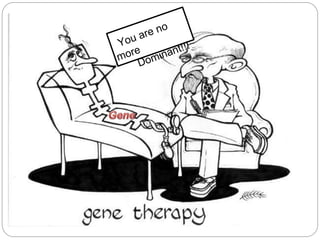
Gene therapy
Gene therapy

Gene therapy

  • 1.
  • 2.
     Definiton: Anexperimental technique for correcting defective genes that are responsible for diseases by replacing them.  Several approaches to gene therapy: 1. Inserting a normal gene to replace an abnormal gene. 2. Inactivating, or “knocking out,” a mutated gene that is functioning improperly. 3. Introducing a new gene into the body to help fight a disease.
  • 3.
    STEPS IN GENETHERAPY:  Identification of the defective gene.  Cloning of normal healthy gene.  Identification of target cell / tissue / organ.  Insertion of the normal functional gene into the host DNA.
  • 4.
    PRINCIPAL: Introduction ofFUNCTIONAL GENES into appropriate cells Transferred gene (TRANSGENE) encodes & produces proteins The Proteins encoded by Transgene corrects the disorder
  • 5.
    TYPES OF GENETHERAPY: 1. SOMATIC CELL THERAPY 2. GERM LINE THERAPY
  • 6.
    1.SOMATIC CELL THERAPY:  Insertion of therapeutic gene into somatic cells.  like fibroblasts, myoblasts, epithelial cells, nervous cells, glial cells etc.  This can correct the genetic defect in the patient.  Transgene cannot be passed on to the siblings.
  • 7.
    2. GERMLINE THERAPY:  Introduction of the foreign gene into germ cells like sperm / ovum / fertilized egg.  Results in expression of modified features in both somatic as well as germ cells of the offspring.  Considered unethical, and is not advocated in humans.
  • 8.
    TECHNIQUE OF GENE THERAPY 1. Ex vivo 2. In vivo Two distinct strategies are used to achieve long-term gene expression: one is to transduce stem cells with an integrating vector, so that all progeny cells will carry the donated gene; the other is to transduce long-lived cells such as skeletal muscle or neural cells
  • 9.
    1. Ex vivoapproach: -Target cells are removed from the body and grown in vitro. -The gene is then introduced into the cultured cells. -These cells are then re-introduced into the same individual. -Examples: Fibroblast cells, Hematopoietic cells.
  • 11.
    2. In vivoapproach: (Direct Gene Transfer) -Cloned therapeutic gene is introduced directly into the affected tissue. -Specially designed vehicles are needed. -Examples are: Lungs, Brain
  • 13.
    DELIVERY: 1. PHYSICALMETHODS: carrier-free gene delivery -Parenteral injection -Microinjection -Electroporation -Gene gun 2. CHEMICAL METHODS: synthetic vector-based gene delivery -Calcium phosphate -Liposomes 3. BIOLOGICAL METHODS: Viral Vectors like -Retrovirus -Adenovirus -HSV -AAV Non viral vectors viral vectors
  • 14.
    To be successful,a vector must:  TARGET the right cells. If you want to deliver a gene into cells of the liver, it shouldn't wind up in the big toe.  ACTIVATE the gene. A gene must go to the cell's nucleus and be "turned on," & the protein that is produced must function properly.  INTEGRATE the gene in the cells. You need to ensure that the gene integrates into the host cell's genetic material.  AVOID harmful side effects.
  • 15.
    COMMON VECTORS USEDFOR GENE THERAPY: 1.Retro viruses 2. Adeno viruses 3. Liposomes 'gag', 'pol' & 'env' genes replaced by the genes to be transferred.
  • 16.
    1. RETRO VIRUSES:  Retroviruses are used ONLY in EX VIVO THERAPY. Advantages:  Chromosomal integration & stable modification of target cells. Disadvantages:  Uncontrolled integration; May be oncogenic.  Cannot infect non-dividing cells.
  • 18.
    2. ADENO VIRUSES:  Second most commonly used. Advantages:  Can infect non-dividing cells, thus suitable for gene therapy of Cystic fibrosis, DMD.  Can be produced at high titres in cultures.  Non-integration to chromosome. Avoids the risks of uncontrolled integration. Disadvantages:  Transient expression of gene due to episomal integration.  Provokes immune response. Alternative & better – AAV for 3 reasons
  • 21.
    3.LIPOSOMES:  Theseare lipid bilayers surrounding an aqueous vesicle.  Can be used to introduce foreign DNA into a target cell. Advantages:  Safer when compared to Viral vectors.  Can carry large DNA molecules. Disadvantages:  Inefficient transfer.  Transient expression.
  • 23.
    Possible applications ofGene Therapy:  Cystic fibrosis: The limitation is that airway epithelial cells are rapidly shed off.  Severe combined immunodeficiency disease (SCID):  Growth hormone deficiency: by implanting cultured myoblasts transfected with GH gene.  Familial hypercholesterolemia: by introducing LDL receptor gene into hepatocytes.
  • 24.
     Lesch-Nyhan syndrome:by introducing HPRT gene.  Stroke, head injury, multiple sclerosis: by delivering nerve growth factor gene.  Duchenne muscular dystrophy: by administering muscle dystropin gene  Sickle cell anaemia: by introducing beta/ delta sickle cell inhibitor hybrid gene.
  • 25.
     Haemophilia: byintroducing factor VIII gene.  DM - 1: by introducing insulin-1 gene into liver.  HIV infection: by injecting fibroblasts expressing HIV envelope glycoprotein gene to augment immunity against HIV.  Alzheimer's disease, Huntington's chorea, Gaucher's disease.
  • 26.
    Cancer: (i) Bygenetic introduction of an enzyme (viral thymidine kinase) into tumour cells followed by a prodrug that is converted to the toxic metabolite, tumour cells are selectively killed. (ii) By inserting TNFa, IL-2 and other cytokine genes into tumour cells to increase their immune recognition and destruction by tumour infiltrating lymphocytes.
  • 27.
    (iii) By introducingpromoter 'antisense' gene or 'suppressor' gene which negatively regulate tumour growth. (iv) By introducing multidrug resistance MDR-1 gene into bone marrow cells and render them less susceptible to destruction by myelosuppressant drugs, toxicity of many anticancer drugs can be overcome.
  • 29.
    Potential Complications ofGene Therapy:  Gene silencing  Genotoxicity: complications arising from insertional mutagenesis.  Phenotoxicity: complications arising from overexpression or ectopic expression of the transgene.  Immunotoxicity: harmful immune response to either the vector or transgene.  Risks of horizontal transmission: shedding of infectious vector into environment.  Risks of vertical transmission: germline transmission of donated DNA.
  • 30.
    References  Essentialsof Medical Pharmacology, 6th Edition by KD TRIPATHI.  Harrisons Text book of medicine – 18th edition.  Centre for Genetics Education. www.genetics.edu.au  Genetics Home Reference (http://ghr.nlm.nih.gov/)  Google images.
  • 31.
    TAKE HOME MESSAGE:  Very promising prospect to cure many diseases.  Two things to remember 2 types 2 vectors 2 methods  Should be restricted to treat diseases not change nature.  Still lot of research needs to be done.

Editor's Notes

  • #19 AAV are devoid of viral coding sequences and trigger very little immune response. It has tropism for certain long-lived cell types, such as skeletal muscle, the central nervous system, and hepatocytes, long-term expression can be achieved even in the absence of integration.