• Veterinary Gastrointestinal surgery


                             • Presented by
                               • Dr. Rekha Pathak
                                •   Senior scientist , IVRI


The photographs have been collected from
 different sources i.e. Internet, text books
                     etc
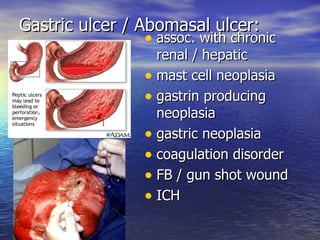
Gastric ulcer / Abomasal ulcer:
                 • assoc. with chronic
                    renal / hepatic
                  • mast cell neoplasia
                  • gastrin producing
                    neoplasia
                  • gastric neoplasia
                  • coagulation disorder
                  • FB / gun shot wound
                  • ICH
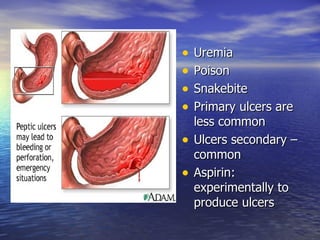
•   Uremia
•   Poison
•   Snakebite
•   Primary ulcers are
    less common
•   Ulcers secondary –
    common
•   Aspirin:
    experimentally to
    produce ulcers
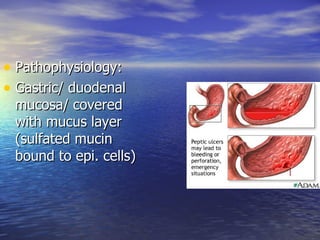
• Pathophysiology:
• Gastric/ duodenal
 mucosa/ covered
 with mucus layer
 (sulfated mucin
 bound to epi. cells)
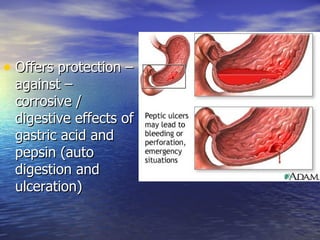
• Offers protection –
 against –
 corrosive /
 digestive effects of
 gastric acid and
 pepsin (auto
 digestion and
 ulceration)
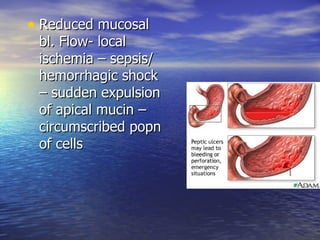
• Reduced mucosal
 bl. Flow- local
 ischemia – sepsis/
 hemorrhagic shock
 – sudden expulsion
 of apical mucin –
 circumscribed popn
 of cells
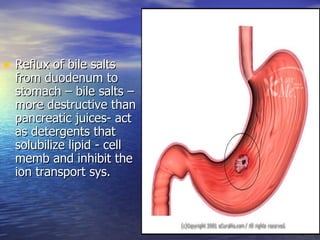
• Reflux of bile salts
  from duodenum to
  stomach – bile salts –
  more destructive than
  pancreatic juices- act
  as detergents that
  solubilize lipid - cell
  memb and inhibit the
  ion transport sys.
• bile content – greatest – pyloric antrum –
  ulcer region of stomach
• hyper secretion of HCL
  – gastrinoma ie non beta islets cell tumour of
    pancreas and hypergastinemia
  – in renal failure (gastrin is removed by
    kidneys)
– increased histamine: mastocytoma and Endotoxemia
      and hemorrhagic shock
    – NSAIDS- reduced secretion of mucus
        • alters the biochemical composition of mucin
• ingestion of chemicals(arsenic ,cresote)
• Signs: vomiting (not immediately after
    ingestion)
•   eating – gastric pain- relieved by vomiting
•   Hemet emesis and melena
•   slow bleeding: coffee colored blood
•   sudden - massive and semi clotted blood
• generalized peritonitis: gastric perforation
    (mostly doesn’t occur due to effective sealing
    with omentum)
•   wt. loss – hepatic/ neoplastic
•   additionally in calves : due to bleeding ulcers –
    recumbent suddenly – cold extremity- subnormal
    temp. tachycardia and dehydration- hypovolemic
    shock and death 24 hrs
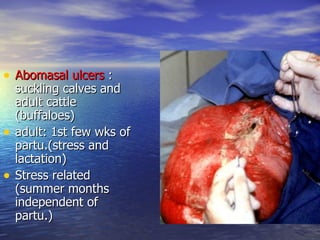
• Abomasal ulcers :
    suckling calves and
    adult cattle
    (buffaloes)
•   adult: 1st few wks of
    partu.(stress and
    lactation)
•   Stress related
    (summer months
    independent of
    partu.)
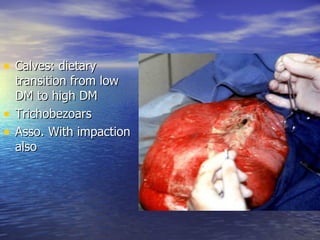
• Calves: dietary
    transition from low
    DM to high DM
•   Trichobezoars
•   Asso. With impaction
    also
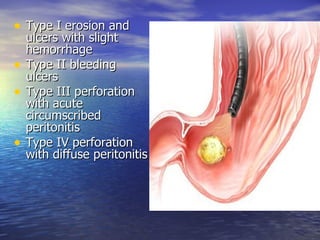
• Type I erosion and
    ulcers with slight
    hemorrhage
•   Type II bleeding
    ulcers
•   Type III perforation
    with acute
    circumscribed
    peritonitis
•   Type IV perforation
    with diffuse peritonitis
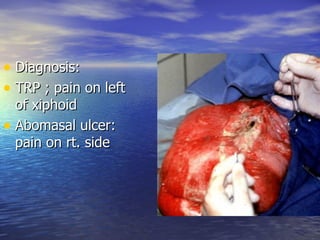
• Diagnosis:
• TRP ; pain on left
  of xiphoid
• Abomasal ulcer:
  pain on rt. side
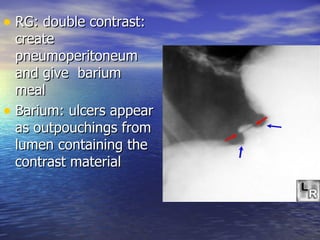
• RG: double contrast:
  create
  pneumoperitoneum
  and give barium
  meal
• Barium: ulcers appear
  as outpouchings from
  lumen containing the
  contrast material
• Fluoroscopy: helps in variable
 positioning and pin point the site
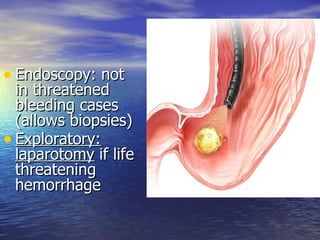
• Endoscopy: not
  in threatened
  bleeding cases
  (allows biopsies)
• Exploratory:
  laparotomy if life
  threatening
  hemorrhage
Treatment

• Surgical excision
• Cranial midline incision
• Carefully palpate from fundus to pylorus
• If ulcers then – adhesion, serosal scarring
 and irregular thickened areas on gastric
 wall
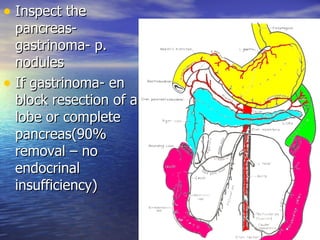
• Inspect the
  pancreas-
  gastrinoma- p.
  nodules
• If gastrinoma- en
  block resection of a
  lobe or complete
  pancreas(90%
  removal – no
  endocrinal
  insufficiency)
• If no ulcers found
• Open stomach- find the bleeding site- also
  on pyloric antrum(equidistant from lesser /
  greater curvature)
• Extend to duodenum if necessary
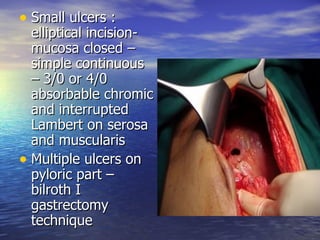
• Small ulcers :
  elliptical incision-
  mucosa closed –
  simple continuous
  – 3/0 or 4/0
  absorbable chromic
  and interrupted
  Lambert on serosa
  and muscularis
• Multiple ulcers on
  pyloric part –
  bilroth I
  gastrectomy
  technique
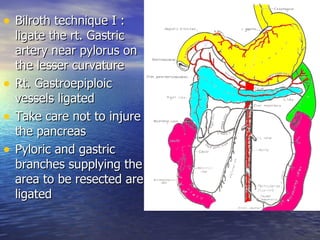
• Bilroth technique I :
    ligate the rt. Gastric
    artery near pylorus on
    the lesser curvature
•   Rt. Gastroepiploic
    vessels ligated
•   Take care not to injure
    the pancreas
•   Pyloric and gastric
    branches supplying the
    area to be resected are
    ligated
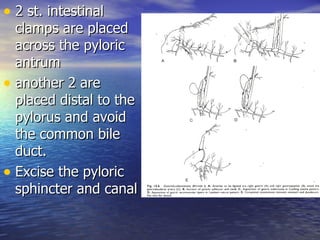
• 2 st. intestinal
  clamps are placed
  across the pyloric
  antrum
• another 2 are
  placed distal to the
  pylorus and avoid
  the common bile
  duct.
• Excise the pyloric
  sphincter and canal
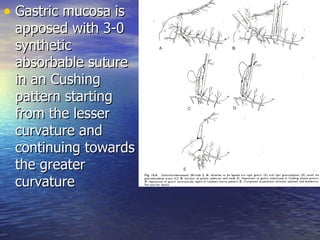
• Gastric mucosa is
 apposed with 3-0
 synthetic
 absorbable suture
 in an Cushing
 pattern starting
 from the lesser
 curvature and
 continuing towards
 the greater
 curvature
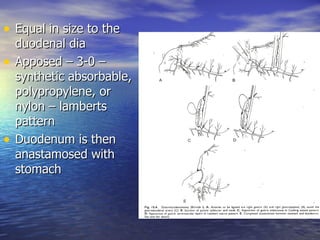
• Equal in size to the
    duodenal dia
•   Apposed – 3-0 –
    synthetic absorbable,
    polypropylene, or
    nylon – lamberts
    pattern
•   Duodenum is then
    anastamosed with
    stomach
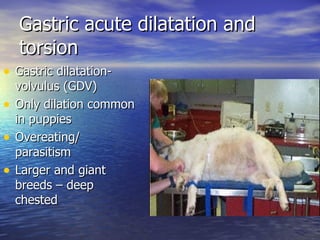
Gastric acute dilatation and
    torsion
• Gastric dilatation-
    volvulus (GDV)
•   Only dilation common
    in puppies
•   Overeating/
    parasitism
•   Larger and giant
    breeds – deep
    chested
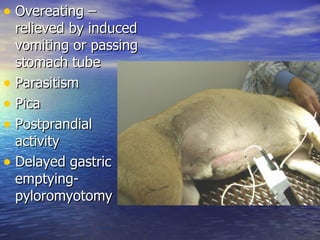
• Overeating –
  relieved by induced
  vomiting or passing
  stomach tube
• Parasitism
• Pica
• Postprandial
  activity
• Delayed gastric
  emptying-
  pyloromyotomy
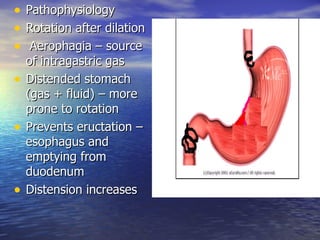
•   Pathophysiology
•   Rotation after dilation
•    Aerophagia – source
    of intragastric gas
•   Distended stomach
    (gas + fluid) – more
    prone to rotation
•   Prevents eructation –
    esophagus and
    emptying from
    duodenum
•   Distension increases
• Presses the caudal vena/ portal vein –
  reduced venous return – red. CO. –
  red. Tissue perfusion and shock
• Ischemic bowel – release toxins-
  endotoxemia-shock and hypotension
• Red. Ventilation- pressure on
  diaphragm
• Acid base and electrolyte disturbance
• Myocardial ischemia
• Rotation of stomach – strangulation
 of gastric vessels- edema and anoxia
 –gastric wall ulceration and necrosis
•   Clinical signs
•   Acute onset of cranial abd. Distention
•   Vomiting
•   Profuse salivation-pain
•   Prolonged CRT, Pallor, weak pulse
•   Shock (pooling of blood in spleen due to rotation
    of splenic vessels, hypovolemia and
    hypotension)
•   Dyspnea
• RG signs: differentiate simple gastric
  distension from GDV
• Gas filled stomach- 50-75% - splenic
  position is normal if no volvulus
• In GDV –pylorus is located cranial/dorsal –
  fundus
• Position of spleen may not be normal
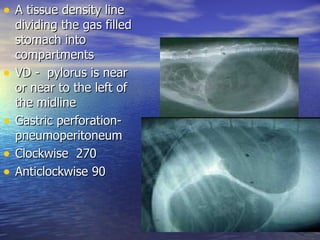
• A tissue density line
    dividing the gas filled
    stomach into
    compartments
•   VD - pylorus is near
    or near to the left of
    the midline
•   Gastric perforation-
    pneumoperitoneum
•   Clockwise 270
•   Anticlockwise 90
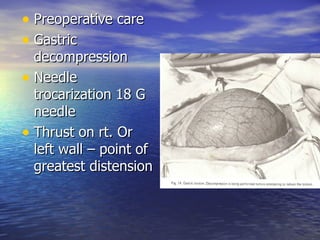
• Preoperative care
• Gastric
  decompression
• Needle
  trocarization 18 G
  needle
• Thrust on rt. Or
  left wall – point of
  greatest distension
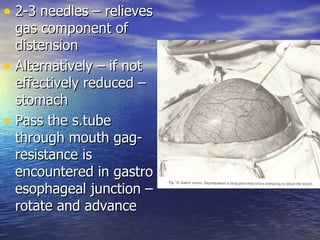
• 2-3 needles – relieves
  gas component of
  distension
• Alternatively – if not
  effectively reduced –
  stomach
• Pass the s.tube
  through mouth gag-
  resistance is
  encountered in gastro
  esophageal junction –
  rotate and advance
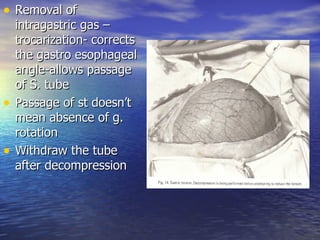
• Removal of
    intragastric gas –
    trocarization- corrects
    the gastro esophageal
    angle-allows passage
    of S. tube
•   Passage of st doesn’t
    mean absence of g.
    rotation
•   Withdraw the tube
    after decompression
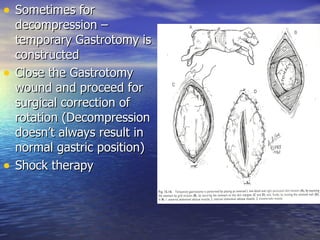
• Sometimes for
    decompression –
    temporary Gastrotomy is
    constructed
•   Close the Gastrotomy
    wound and proceed for
    surgical correction of
    rotation (Decompression
    doesn’t always result in
    normal gastric position)
•   Shock therapy
• Surgical correction of volvulus
• If surgery is delayed – gastric necrosis worsens
• Reposition the stomach by derotating it
• Avoid injury to splenic v. (digital palpation of
  esophagus reveals the direction of rotation
• Pylorus is a good / useful landmark – firm
  consistency)
• See the viability of gastric tissue – necrosed
  and non-viable – esp. the greater curvature is
  damaged
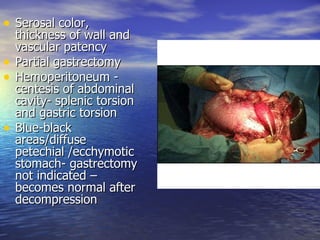
• Serosal color,
    thickness of wall and
    vascular patency
•   Partial gastrectomy
•   Hemoperitoneum -
    centesis of abdominal
    cavity- splenic torsion
    and gastric torsion
•   Blue-black
    areas/diffuse
    petechial /ecchymotic
    stomach- gastrectomy
    not indicated –
    becomes normal after
    decompression
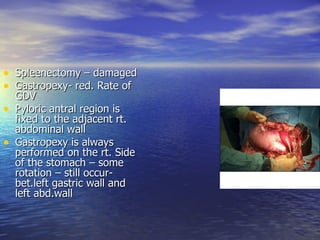
• Spleenectomy – damaged
• Gastropexy- red. Rate of
    GDV
•   Pyloric antral region is
    fixed to the adjacent rt.
    abdominal wall
•   Gastropexy is always
    performed on the rt. Side
    of the stomach – some
    rotation – still occur-
    bet.left gastric wall and
    left abd.wall
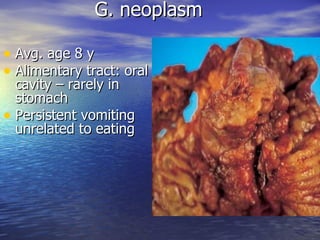
G. neoplasm

• Avg. age 8 y
• Alimentary tract: oral
  cavity – rarely in
  stomach
• Persistent vomiting
  unrelated to eating
• Within the antrum on the lesser
  curvature
• Metastasis: liver, lungs, spleen
• Leiomyoma/ rhabdomyosarcoma/
  polyps (solitary or multiple)
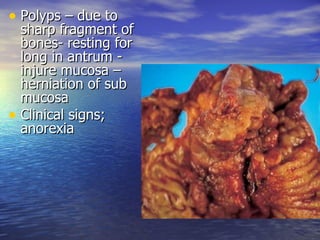
• Polyps – due to
  sharp fragment of
  bones- resting for
  long in antrum -
  injure mucosa –
  herniation of sub
  mucosa
• Clinical signs;
  anorexia
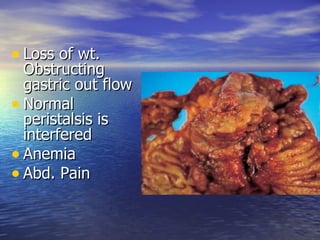
• Loss of wt.
  Obstructing
  gastric out flow
• Normal
  peristalsis is
  interfered
• Anemia
• Abd. Pain
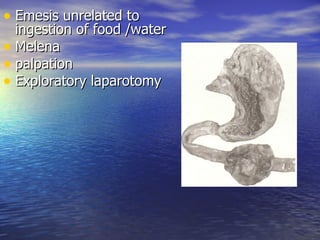
• Emesis unrelated to
  ingestion of food /water
• Melena
• palpation
• Exploratory laparotomy
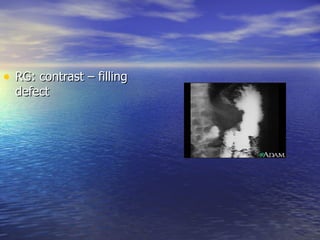
• RG: contrast – filling
  defect
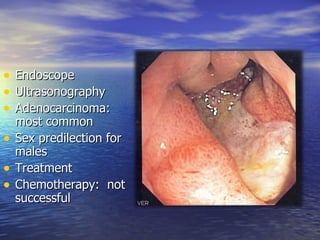
•   Endoscope
•   Ultrasonography
•   Adenocarcinoma:
    most common
•   Sex predilection for
    males
•   Treatment
•   Chemotherapy: not
    successful
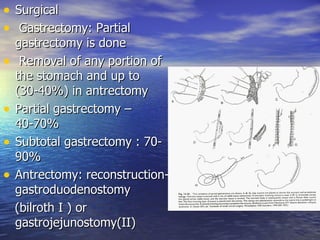
• Surgical
• Gastrectomy: Partial
    gastrectomy is done
•    Removal of any portion of
    the stomach and up to
    (30-40%) in antrectomy
•   Partial gastrectomy –
    40-70%
•   Subtotal gastrectomy : 70-
    90%
•   Antrectomy: reconstruction-
    gastroduodenostomy
    (bilroth I ) or
    gastrojejunostomy(II)
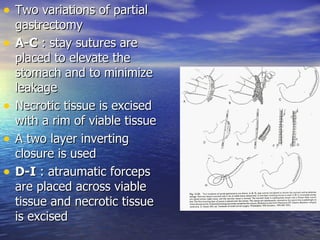
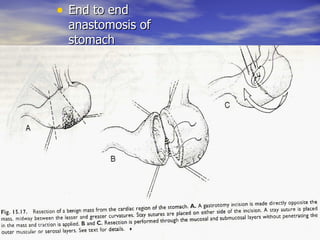
• Two variations of partial
    gastrectomy
•   A-C : stay sutures are
    placed to elevate the
    stomach and to minimize
    leakage
•   Necrotic tissue is excised
    with a rim of viable tissue
•   A two layer inverting
    closure is used
•   D-I : atraumatic forceps
    are placed across viable
    tissue and necrotic tissue
    is excised
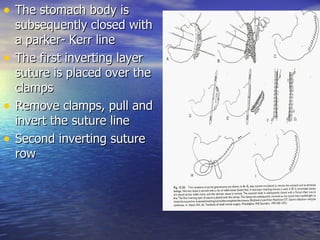
• The stomach body is
    subsequently closed with
    a parker- Kerr line
•   The first inverting layer
    suture is placed over the
    clamps
•   Remove clamps, pull and
    invert the suture line
•   Second inverting suture
    row
• End to end
 anastomosis of
 stomach
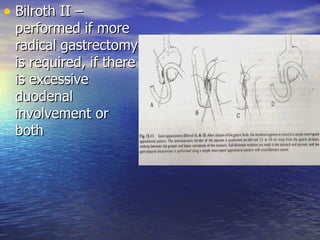
• Bilroth II –
  performed if more
  radical gastrectomy
  is required, if there
  is excessive
  duodenal
  involvement or
  both
Bloat

• Bloat : Major problems- GIT – cattle and
  buffaloes
• Higher in buffaloes
• Acute/chronic
• Gaseous bloat – free gas - dorsal part of
  rumen
• Frothy bloat – gas trapped with ingesta-
  dispersed throughout the rumen content
• Acute: rapid feeding and sudden diet
  change – large ruminants
• s. ruminants – large quantities of grain
  ingestion/cereals
• More pressure on diaphragm –
  hypoventilation and red. Venous return to
  the heart
• signs: bulge on Para lumbar fossa
• Abdominal distension
• Cyanotic mm
• v. serious – lying down – asphyxiated –
 open mouth- protruded tongue and
 tachycardia
• Treatment: puncture wall – left side with
  trocar and canula
• if frothy – antifoaming agents – turpentine
  oil (80ml) + mustard oil (500-1000 ml)
• antifroth prepn. – bloatosil
• gives immediate relief to ailing animal
• avoid conc. – 2-3 days and leguminous
  fodder
•   Resort to rumenotomy / rumenostomy
•   S. animal: IV- RL or oral soda bicarb
•   Chronic bloat: TRP (FBS) – reticuloperitonitis/
    fibrinous pneumonia – pleuritis involving the
    vagus nerve
•   Liver abscess, splenic cyst and abscess, enlarged
    mediastinal lymph nodes, pyloric stenosis
•   Rumen fistulation / rumenotomy can be done
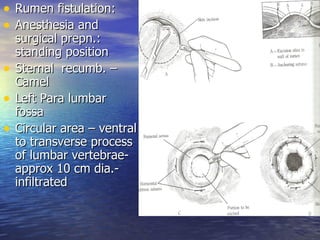
• Rumen fistulation:
• Anesthesia and
    surgical prepn.:
    standing position
•   Sternal recumb. –
    Camel
•   Left Para lumbar
    fossa
•   Circular area – ventral
    to transverse process
    of lumbar vertebrae-
    approx 10 cm dia.-
    infiltrated
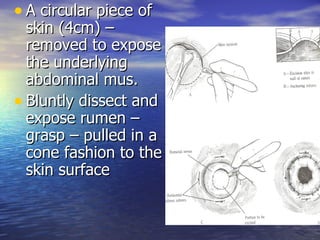
• A circular piece of
  skin (4cm) –
  removed to expose
  the underlying
  abdominal mus.
• Bluntly dissect and
  expose rumen –
  grasp – pulled in a
  cone fashion to the
  skin surface
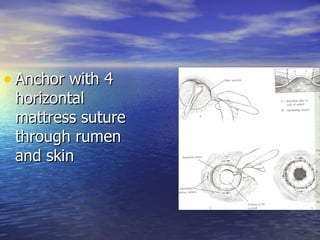
• Anchor with 4
 horizontal
 mattress suture
 through rumen
 and skin
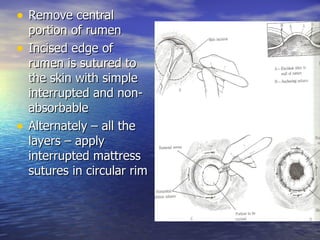
• Remove central
    portion of rumen
•   Incised edge of
    rumen is sutured to
    the skin with simple
    interrupted and non-
    absorbable
•   Alternately – all the
    layers – apply
    interrupted mattress
    sutures in circular rim
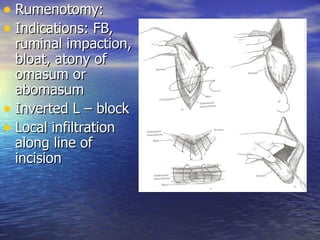
• Rumenotomy:
• Indications: FB,
  ruminal impaction,
  bloat, atony of
  omasum or
  abomasum
• Inverted L – block
• Local infiltration
  along line of
  incision
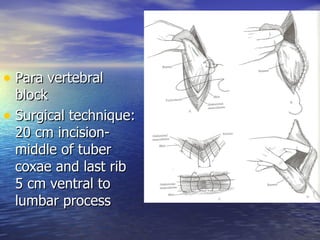
• Para vertebral
  block
• Surgical technique:
  20 cm incision-
  middle of tuber
  coxae and last rib
  5 cm ventral to
  lumbar process
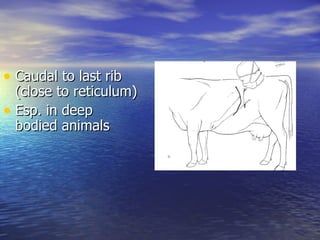
• Caudal to last rib
  (close to reticulum)
• Esp. in deep
  bodied animals
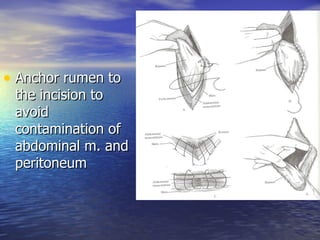
• Anchor rumen to
 the incision to
 avoid
 contamination of
 abdominal m. and
 peritoneum
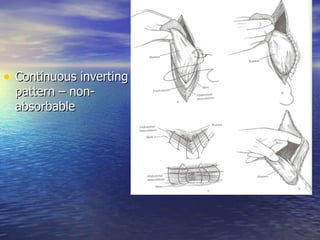
• Continuous inverting
  pattern – non-
  absorbable
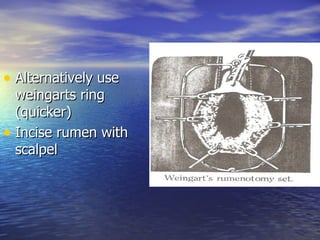
• Alternatively use
  weingarts ring
  (quicker)
• Incise rumen with
  scalpel
• Evacuate and
  explore for FB in
  reticulum and
  remove
• Try to feel for
  abscess in reticular
  area
• Reticulum is swept
  with a magnet to
  retrieve the iron FB

• Rumen cud + soda
 bicarb= mineral oil
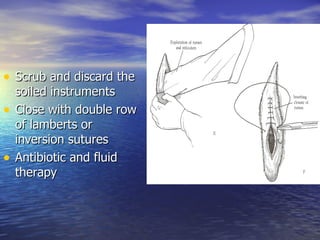
• Scrub and discard the
    soiled instruments
•   Close with double row
    of lamberts or
    inversion sutures
•   Antibiotic and fluid
    therapy

Veterinary gastrointestinal surgery

  • 1.
    • Veterinary Gastrointestinalsurgery • Presented by • Dr. Rekha Pathak • Senior scientist , IVRI The photographs have been collected from different sources i.e. Internet, text books etc
  • 2.
    Gastric ulcer /Abomasal ulcer: • assoc. with chronic renal / hepatic • mast cell neoplasia • gastrin producing neoplasia • gastric neoplasia • coagulation disorder • FB / gun shot wound • ICH
  • 3.
    Uremia • Poison • Snakebite • Primary ulcers are less common • Ulcers secondary – common • Aspirin: experimentally to produce ulcers
  • 4.
    • Pathophysiology: • Gastric/duodenal mucosa/ covered with mucus layer (sulfated mucin bound to epi. cells)
  • 5.
    • Offers protection– against – corrosive / digestive effects of gastric acid and pepsin (auto digestion and ulceration)
  • 6.
    • Reduced mucosal bl. Flow- local ischemia – sepsis/ hemorrhagic shock – sudden expulsion of apical mucin – circumscribed popn of cells
  • 7.
    • Reflux ofbile salts from duodenum to stomach – bile salts – more destructive than pancreatic juices- act as detergents that solubilize lipid - cell memb and inhibit the ion transport sys.
  • 8.
    • bile content– greatest – pyloric antrum – ulcer region of stomach • hyper secretion of HCL – gastrinoma ie non beta islets cell tumour of pancreas and hypergastinemia – in renal failure (gastrin is removed by kidneys)
  • 9.
    – increased histamine:mastocytoma and Endotoxemia and hemorrhagic shock – NSAIDS- reduced secretion of mucus • alters the biochemical composition of mucin • ingestion of chemicals(arsenic ,cresote) • Signs: vomiting (not immediately after ingestion) • eating – gastric pain- relieved by vomiting • Hemet emesis and melena • slow bleeding: coffee colored blood • sudden - massive and semi clotted blood
  • 10.
    • generalized peritonitis:gastric perforation (mostly doesn’t occur due to effective sealing with omentum) • wt. loss – hepatic/ neoplastic • additionally in calves : due to bleeding ulcers – recumbent suddenly – cold extremity- subnormal temp. tachycardia and dehydration- hypovolemic shock and death 24 hrs
  • 11.
    • Abomasal ulcers: suckling calves and adult cattle (buffaloes) • adult: 1st few wks of partu.(stress and lactation) • Stress related (summer months independent of partu.)
  • 12.
    • Calves: dietary transition from low DM to high DM • Trichobezoars • Asso. With impaction also
  • 13.
    • Type Ierosion and ulcers with slight hemorrhage • Type II bleeding ulcers • Type III perforation with acute circumscribed peritonitis • Type IV perforation with diffuse peritonitis
  • 14.
    • Diagnosis: • TRP; pain on left of xiphoid • Abomasal ulcer: pain on rt. side
  • 15.
    • RG: doublecontrast: create pneumoperitoneum and give barium meal • Barium: ulcers appear as outpouchings from lumen containing the contrast material
  • 16.
    • Fluoroscopy: helpsin variable positioning and pin point the site
  • 17.
    • Endoscopy: not in threatened bleeding cases (allows biopsies) • Exploratory: laparotomy if life threatening hemorrhage
  • 18.
    Treatment • Surgical excision •Cranial midline incision • Carefully palpate from fundus to pylorus • If ulcers then – adhesion, serosal scarring and irregular thickened areas on gastric wall
  • 19.
    • Inspect the pancreas- gastrinoma- p. nodules • If gastrinoma- en block resection of a lobe or complete pancreas(90% removal – no endocrinal insufficiency)
  • 20.
    • If noulcers found • Open stomach- find the bleeding site- also on pyloric antrum(equidistant from lesser / greater curvature) • Extend to duodenum if necessary
  • 21.
    • Small ulcers: elliptical incision- mucosa closed – simple continuous – 3/0 or 4/0 absorbable chromic and interrupted Lambert on serosa and muscularis • Multiple ulcers on pyloric part – bilroth I gastrectomy technique
  • 22.
    • Bilroth techniqueI : ligate the rt. Gastric artery near pylorus on the lesser curvature • Rt. Gastroepiploic vessels ligated • Take care not to injure the pancreas • Pyloric and gastric branches supplying the area to be resected are ligated
  • 23.
    • 2 st.intestinal clamps are placed across the pyloric antrum • another 2 are placed distal to the pylorus and avoid the common bile duct. • Excise the pyloric sphincter and canal
  • 24.
    • Gastric mucosais apposed with 3-0 synthetic absorbable suture in an Cushing pattern starting from the lesser curvature and continuing towards the greater curvature
  • 25.
    • Equal insize to the duodenal dia • Apposed – 3-0 – synthetic absorbable, polypropylene, or nylon – lamberts pattern • Duodenum is then anastamosed with stomach
  • 26.
    Gastric acute dilatationand torsion • Gastric dilatation- volvulus (GDV) • Only dilation common in puppies • Overeating/ parasitism • Larger and giant breeds – deep chested
  • 27.
    • Overeating – relieved by induced vomiting or passing stomach tube • Parasitism • Pica • Postprandial activity • Delayed gastric emptying- pyloromyotomy
  • 28.
    Pathophysiology • Rotation after dilation • Aerophagia – source of intragastric gas • Distended stomach (gas + fluid) – more prone to rotation • Prevents eructation – esophagus and emptying from duodenum • Distension increases
  • 29.
    • Presses thecaudal vena/ portal vein – reduced venous return – red. CO. – red. Tissue perfusion and shock • Ischemic bowel – release toxins- endotoxemia-shock and hypotension • Red. Ventilation- pressure on diaphragm
  • 30.
    • Acid baseand electrolyte disturbance • Myocardial ischemia • Rotation of stomach – strangulation of gastric vessels- edema and anoxia –gastric wall ulceration and necrosis
  • 31.
    Clinical signs • Acute onset of cranial abd. Distention • Vomiting • Profuse salivation-pain • Prolonged CRT, Pallor, weak pulse • Shock (pooling of blood in spleen due to rotation of splenic vessels, hypovolemia and hypotension) • Dyspnea
  • 32.
    • RG signs:differentiate simple gastric distension from GDV • Gas filled stomach- 50-75% - splenic position is normal if no volvulus • In GDV –pylorus is located cranial/dorsal – fundus • Position of spleen may not be normal
  • 33.
    • A tissuedensity line dividing the gas filled stomach into compartments • VD - pylorus is near or near to the left of the midline • Gastric perforation- pneumoperitoneum • Clockwise 270 • Anticlockwise 90
  • 34.
    • Preoperative care •Gastric decompression • Needle trocarization 18 G needle • Thrust on rt. Or left wall – point of greatest distension
  • 35.
    • 2-3 needles– relieves gas component of distension • Alternatively – if not effectively reduced – stomach • Pass the s.tube through mouth gag- resistance is encountered in gastro esophageal junction – rotate and advance
  • 36.
    • Removal of intragastric gas – trocarization- corrects the gastro esophageal angle-allows passage of S. tube • Passage of st doesn’t mean absence of g. rotation • Withdraw the tube after decompression
  • 37.
    • Sometimes for decompression – temporary Gastrotomy is constructed • Close the Gastrotomy wound and proceed for surgical correction of rotation (Decompression doesn’t always result in normal gastric position) • Shock therapy
  • 38.
    • Surgical correctionof volvulus • If surgery is delayed – gastric necrosis worsens • Reposition the stomach by derotating it • Avoid injury to splenic v. (digital palpation of esophagus reveals the direction of rotation • Pylorus is a good / useful landmark – firm consistency) • See the viability of gastric tissue – necrosed and non-viable – esp. the greater curvature is damaged
  • 39.
    • Serosal color, thickness of wall and vascular patency • Partial gastrectomy • Hemoperitoneum - centesis of abdominal cavity- splenic torsion and gastric torsion • Blue-black areas/diffuse petechial /ecchymotic stomach- gastrectomy not indicated – becomes normal after decompression
  • 40.
    • Spleenectomy –damaged • Gastropexy- red. Rate of GDV • Pyloric antral region is fixed to the adjacent rt. abdominal wall • Gastropexy is always performed on the rt. Side of the stomach – some rotation – still occur- bet.left gastric wall and left abd.wall
  • 41.
    G. neoplasm • Avg.age 8 y • Alimentary tract: oral cavity – rarely in stomach • Persistent vomiting unrelated to eating
  • 42.
    • Within theantrum on the lesser curvature • Metastasis: liver, lungs, spleen • Leiomyoma/ rhabdomyosarcoma/ polyps (solitary or multiple)
  • 43.
    • Polyps –due to sharp fragment of bones- resting for long in antrum - injure mucosa – herniation of sub mucosa • Clinical signs; anorexia
  • 44.
    • Loss ofwt. Obstructing gastric out flow • Normal peristalsis is interfered • Anemia • Abd. Pain
  • 45.
    • Emesis unrelatedto ingestion of food /water • Melena • palpation • Exploratory laparotomy
  • 46.
    • RG: contrast– filling defect
  • 47.
    Endoscope • Ultrasonography • Adenocarcinoma: most common • Sex predilection for males • Treatment • Chemotherapy: not successful
  • 48.
    • Surgical • Gastrectomy:Partial gastrectomy is done • Removal of any portion of the stomach and up to (30-40%) in antrectomy • Partial gastrectomy – 40-70% • Subtotal gastrectomy : 70- 90% • Antrectomy: reconstruction- gastroduodenostomy (bilroth I ) or gastrojejunostomy(II)
  • 49.
    • Two variationsof partial gastrectomy • A-C : stay sutures are placed to elevate the stomach and to minimize leakage • Necrotic tissue is excised with a rim of viable tissue • A two layer inverting closure is used • D-I : atraumatic forceps are placed across viable tissue and necrotic tissue is excised
  • 50.
    • The stomachbody is subsequently closed with a parker- Kerr line • The first inverting layer suture is placed over the clamps • Remove clamps, pull and invert the suture line • Second inverting suture row
  • 51.
    • End toend anastomosis of stomach
  • 52.
    • Bilroth II– performed if more radical gastrectomy is required, if there is excessive duodenal involvement or both
  • 53.
    Bloat • Bloat :Major problems- GIT – cattle and buffaloes • Higher in buffaloes • Acute/chronic • Gaseous bloat – free gas - dorsal part of rumen • Frothy bloat – gas trapped with ingesta- dispersed throughout the rumen content
  • 54.
    • Acute: rapidfeeding and sudden diet change – large ruminants • s. ruminants – large quantities of grain ingestion/cereals • More pressure on diaphragm – hypoventilation and red. Venous return to the heart
  • 55.
    • signs: bulgeon Para lumbar fossa • Abdominal distension • Cyanotic mm • v. serious – lying down – asphyxiated – open mouth- protruded tongue and tachycardia
  • 56.
    • Treatment: puncturewall – left side with trocar and canula • if frothy – antifoaming agents – turpentine oil (80ml) + mustard oil (500-1000 ml) • antifroth prepn. – bloatosil • gives immediate relief to ailing animal • avoid conc. – 2-3 days and leguminous fodder
  • 57.
    Resort to rumenotomy / rumenostomy • S. animal: IV- RL or oral soda bicarb • Chronic bloat: TRP (FBS) – reticuloperitonitis/ fibrinous pneumonia – pleuritis involving the vagus nerve • Liver abscess, splenic cyst and abscess, enlarged mediastinal lymph nodes, pyloric stenosis • Rumen fistulation / rumenotomy can be done
  • 58.
    • Rumen fistulation: •Anesthesia and surgical prepn.: standing position • Sternal recumb. – Camel • Left Para lumbar fossa • Circular area – ventral to transverse process of lumbar vertebrae- approx 10 cm dia.- infiltrated
  • 59.
    • A circularpiece of skin (4cm) – removed to expose the underlying abdominal mus. • Bluntly dissect and expose rumen – grasp – pulled in a cone fashion to the skin surface
  • 60.
    • Anchor with4 horizontal mattress suture through rumen and skin
  • 61.
    • Remove central portion of rumen • Incised edge of rumen is sutured to the skin with simple interrupted and non- absorbable • Alternately – all the layers – apply interrupted mattress sutures in circular rim
  • 62.
    • Rumenotomy: • Indications:FB, ruminal impaction, bloat, atony of omasum or abomasum • Inverted L – block • Local infiltration along line of incision
  • 63.
    • Para vertebral block • Surgical technique: 20 cm incision- middle of tuber coxae and last rib 5 cm ventral to lumbar process
  • 64.
    • Caudal tolast rib (close to reticulum) • Esp. in deep bodied animals
  • 65.
    • Anchor rumento the incision to avoid contamination of abdominal m. and peritoneum
  • 66.
    • Continuous inverting pattern – non- absorbable
  • 67.
    • Alternatively use weingarts ring (quicker) • Incise rumen with scalpel
  • 68.
    • Evacuate and explore for FB in reticulum and remove • Try to feel for abscess in reticular area • Reticulum is swept with a magnet to retrieve the iron FB • Rumen cud + soda bicarb= mineral oil
  • 69.
    • Scrub anddiscard the soiled instruments • Close with double row of lamberts or inversion sutures • Antibiotic and fluid therapy