Castration 
(castrating) Male neutering, otherwise known as sterilisation, "fixing", desexing or by its correct 
veterinary name: orchiectomy (also termed gonadectomy), is the surgical removal of testicles for 
the purposes of population control, medical health benefit, genetic-disease control and 
behavioural modification. 
Neutering pros and cons in dogs:- 
The benefits of neutering 
 The prevention of unwanted litters. 
 The reduction of stray and feral animal populations. 
 To reduce the spread of inferior genetic traits, genetic diseases and congenital deformities. 
 The prevention or reduction of testicular (and epididymal) diseases. 
 The prevention or reduction of testosterone-induced diseases. 
 The prevention or reduction of testosterone-mediated behavioural problems. 
The disadvantages of desexing 
 The dog may become overweight or obese 
 Desexing equates to a loss of breeding potential and valuable genetics 
 Loss of testosterone as a result of desexing may result in immature development of 
masculine characteristics and a reduced body musculature 
 Loss of testosterone as a result of desexing may result in delayed growth plate closure 
 Neutering reduces the male animal's drive to herd, hunt, guard and work 
 As an elective procedure, desexing costs too much 
Information about neutering age of dog 
for elective procedure it can be done any time between 5 to 16 months. In America some 
are being done at 8 weeks and they routinely neuter at between four and six months. for 
any pathological problem it can be at any time when dog is anesthetically safe. 
Cat:- 
The benefits of neutering in cat 
Roaming: More than 90% will reduce this behavior with neutering. Approximately 60% reduce this 
behavior right away 
Fighting: More than 90% will reduce this behavior with neutering Approximately 60% reduce this 
behavior right away 
Urine marking: More than 90% will reduce this behavior with neutering. Approximately 80% 
reduce this behavior right away. 
Another reason to neuter a male cat has to do with the physical appearance. Cats neutered prior to 
puberty (most cats are neutered at approximately age 6 months) do not develop secondary sex 
characteristics. These include a more muscular body, thickenings around the face called shields, 
and spines on the penis.
Male cat neutered prior to puberty 
Male cat neutered after reaching 
puberty
Neutering procedure (desexing surgery) - a step by step 
pictorial guide to canine neutering. 
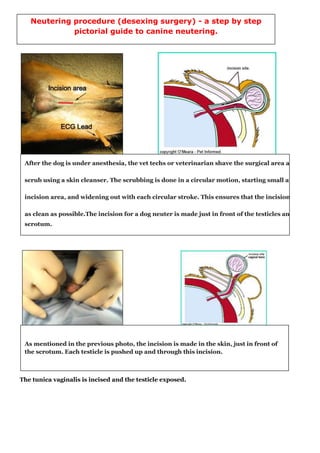
After the dog is under anesthesia, the vet techs or veterinarian shave the surgical area and 
scrub using a skin cleanser. The scrubbing is done in a circular motion, starting small at the 
incision area, and widening out with each circular stroke. This ensures that the incision area is 
as clean as possible.The incision for a dog neuter is made just in front of the testicles and 
scrotum. 
This is because the scrotal tissue is thin, very sensitive, and bleeds more than the skin incision. 
As mentioned in the previous photo, the incision is made in the skin, just in front of 
the scrotum. Each testicle is pushed up and through this incision. 
The tunica vaginalis is incised and the testicle exposed.
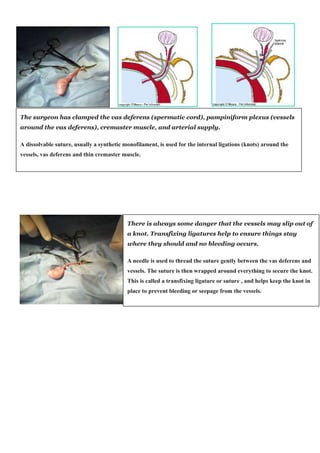
The surgeon has clamped the vas deferens (spermatic cord), pampiniform plexus (vessels 
around the vas deferens), cremaster muscle, and arterial supply. 
A dissolvable suture, usually a synthetic monofilament, is used for the internal ligations (knots) around the 
vessels, vas deferens and thin cremaster muscle. 
There is always some danger that the vessels may slip out of 
a knot. Transfixing ligatures help to ensure things stay 
where they should and no bleeding occurs. 
A needle is used to thread the suture gently between the vas deferens and 
vessels. The suture is then wrapped around everything to secure the knot. 
This is called a transfixing ligature or suture , and helps keep the knot in 
place to prevent bleeding or seepage from the vessels.
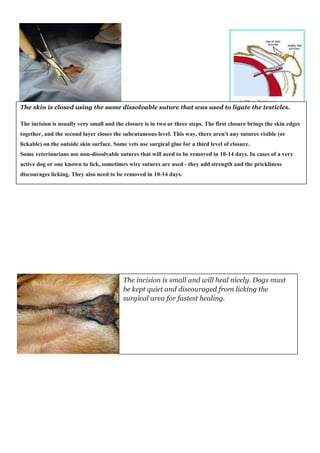
The skin is closed using the same dissolvable suture that was used to ligate the testicles. 
The incision is usually very small and the closure is in two or three steps. The first closure brings the skin edges 
together, and the second layer closes the subcutaneous level. This way, there aren't any sutures visible (or 
lickable) on the outside skin surface. Some vets use surgical glue for a third level of closure. 
Some veterinarians use non-dissolvable sutures that will need to be removed in 10-14 days. In cases of a very 
active dog or one known to lick, sometimes wire sutures are used - they add strength and the prickliness 
discourages licking. They also need to be removed in 10-14 days. 
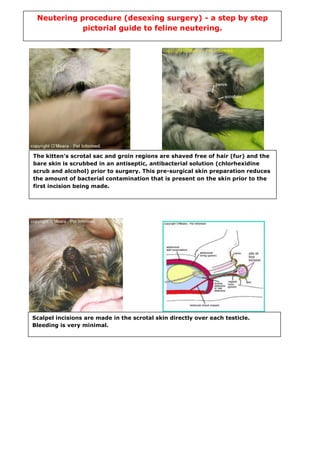
The incision is small and will heal nicely. Dogs must 
be kept quiet and discouraged from licking the 
surgical area for fastest healing.
Neutering procedure (desexing surgery) - a step by step 
pictorial guide to feline neutering. 
The kitten's scrotal sac and groin regions are shaved free of hair (fur) and the 
bare skin is scrubbed in an antiseptic, antibacterial solution (chlorhexidine 
scrub and alcohol) prior to surgery. This pre-surgical skin preparation reduces 
the amount of bacterial contamination that is present on the skin prior to the 
first incision being made. 
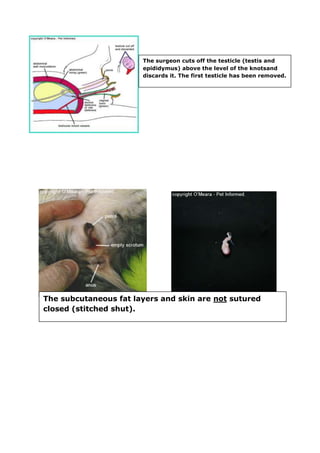
Scalpel incisions are made in the scrotal skin directly over each testicle. 
Bleeding is very minimal.
After the skin has been incised with the scalpel, each side of the scrotal sac is squeezed so 
that the testicle (the pink ball seen in the images above) contained inside pops out, ready 
for removal. 
The vas deferens (also called the spermatic duct or 
deferent duct) and epididymal structuresare 
separated away from the testis and testicular blood 
supply. This creates two separate "strings"which 
can be tied around each other: as indicated in the 
next step. 
The testicular blood vessels and spermatic cords 
are knotted tightly around each other repeatedly 
in order to occlude (block) the blood vessels 
supplying the feline testicles. This prevents the 
animal's testicular blood vessels from bleeding 
once the testicle is cut off. It also prevents the 
veterinarian from having to place any sutures.
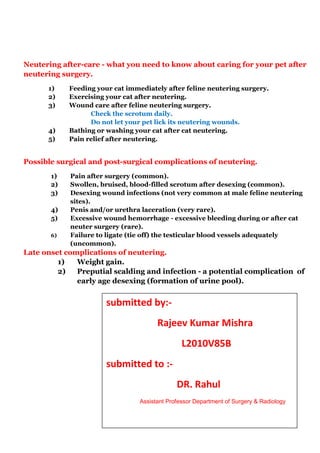
The surgeon cuts off the testicle (testis and 
epididymus) above the level of the knotsand 
discards it. The first testicle has been removed. 
The subcutaneous fat layers and skin are not sutured 
closed (stitched shut).
Neutering after-care - what you need to know about caring for your pet after 
neutering surgery. 
1) Feeding your cat immediately after feline neutering surgery. 
2) Exercising your cat after neutering. 
3) Wound care after feline neutering surgery. 
Check the scrotum daily. 
Do not let your pet lick its neutering wounds. 
4) Bathing or washing your cat after cat neutering. 
5) Pain relief after neutering. 
Possible surgical and post-surgical complications of neutering. 
1) Pain after surgery (common). 
2) Swollen, bruised, blood-filled scrotum after desexing (common). 
3) Desexing wound infections (not very common at male feline neutering 
sites). 
4) Penis and/or urethra laceration (very rare). 
5) Excessive wound hemorrhage - excessive bleeding during or after cat 
neuter surgery (rare). 
6) Failure to ligate (tie off) the testicular blood vessels adequately 
(uncommon). 
Late onset complications of neutering. 
1) Weight gain. 
2) Preputial scalding and infection - a potential complication of 
early age desexing (formation of urine pool). 
submitted by:- 
Rajeev Kumar Mishra 
L2010V85B 
submitted to :- 
DR. Rahul 
Assistant Professor Department of Surgery & Radiology
Rajeev mishra ,castration of small animal(dog and cat).

Rajeev mishra ,castration of small animal(dog and cat).

  • 1.
    Castration (castrating) Maleneutering, otherwise known as sterilisation, "fixing", desexing or by its correct veterinary name: orchiectomy (also termed gonadectomy), is the surgical removal of testicles for the purposes of population control, medical health benefit, genetic-disease control and behavioural modification. Neutering pros and cons in dogs:- The benefits of neutering  The prevention of unwanted litters.  The reduction of stray and feral animal populations.  To reduce the spread of inferior genetic traits, genetic diseases and congenital deformities.  The prevention or reduction of testicular (and epididymal) diseases.  The prevention or reduction of testosterone-induced diseases.  The prevention or reduction of testosterone-mediated behavioural problems. The disadvantages of desexing  The dog may become overweight or obese  Desexing equates to a loss of breeding potential and valuable genetics  Loss of testosterone as a result of desexing may result in immature development of masculine characteristics and a reduced body musculature  Loss of testosterone as a result of desexing may result in delayed growth plate closure  Neutering reduces the male animal's drive to herd, hunt, guard and work  As an elective procedure, desexing costs too much Information about neutering age of dog for elective procedure it can be done any time between 5 to 16 months. In America some are being done at 8 weeks and they routinely neuter at between four and six months. for any pathological problem it can be at any time when dog is anesthetically safe. Cat:- The benefits of neutering in cat Roaming: More than 90% will reduce this behavior with neutering. Approximately 60% reduce this behavior right away Fighting: More than 90% will reduce this behavior with neutering Approximately 60% reduce this behavior right away Urine marking: More than 90% will reduce this behavior with neutering. Approximately 80% reduce this behavior right away. Another reason to neuter a male cat has to do with the physical appearance. Cats neutered prior to puberty (most cats are neutered at approximately age 6 months) do not develop secondary sex characteristics. These include a more muscular body, thickenings around the face called shields, and spines on the penis.
  • 2.
    Male cat neuteredprior to puberty Male cat neutered after reaching puberty
  • 3.
    Neutering procedure (desexingsurgery) - a step by step pictorial guide to canine neutering. After the dog is under anesthesia, the vet techs or veterinarian shave the surgical area and scrub using a skin cleanser. The scrubbing is done in a circular motion, starting small at the incision area, and widening out with each circular stroke. This ensures that the incision area is as clean as possible.The incision for a dog neuter is made just in front of the testicles and scrotum. This is because the scrotal tissue is thin, very sensitive, and bleeds more than the skin incision. As mentioned in the previous photo, the incision is made in the skin, just in front of the scrotum. Each testicle is pushed up and through this incision. The tunica vaginalis is incised and the testicle exposed.
  • 4.
    The surgeon hasclamped the vas deferens (spermatic cord), pampiniform plexus (vessels around the vas deferens), cremaster muscle, and arterial supply. A dissolvable suture, usually a synthetic monofilament, is used for the internal ligations (knots) around the vessels, vas deferens and thin cremaster muscle. There is always some danger that the vessels may slip out of a knot. Transfixing ligatures help to ensure things stay where they should and no bleeding occurs. A needle is used to thread the suture gently between the vas deferens and vessels. The suture is then wrapped around everything to secure the knot. This is called a transfixing ligature or suture , and helps keep the knot in place to prevent bleeding or seepage from the vessels.
  • 5.
    The skin isclosed using the same dissolvable suture that was used to ligate the testicles. The incision is usually very small and the closure is in two or three steps. The first closure brings the skin edges together, and the second layer closes the subcutaneous level. This way, there aren't any sutures visible (or lickable) on the outside skin surface. Some vets use surgical glue for a third level of closure. Some veterinarians use non-dissolvable sutures that will need to be removed in 10-14 days. In cases of a very active dog or one known to lick, sometimes wire sutures are used - they add strength and the prickliness discourages licking. They also need to be removed in 10-14 days. The incision is small and will heal nicely. Dogs must be kept quiet and discouraged from licking the surgical area for fastest healing.
  • 6.
    Neutering procedure (desexingsurgery) - a step by step pictorial guide to feline neutering. The kitten's scrotal sac and groin regions are shaved free of hair (fur) and the bare skin is scrubbed in an antiseptic, antibacterial solution (chlorhexidine scrub and alcohol) prior to surgery. This pre-surgical skin preparation reduces the amount of bacterial contamination that is present on the skin prior to the first incision being made. Scalpel incisions are made in the scrotal skin directly over each testicle. Bleeding is very minimal.
  • 7.
    After the skinhas been incised with the scalpel, each side of the scrotal sac is squeezed so that the testicle (the pink ball seen in the images above) contained inside pops out, ready for removal. The vas deferens (also called the spermatic duct or deferent duct) and epididymal structuresare separated away from the testis and testicular blood supply. This creates two separate "strings"which can be tied around each other: as indicated in the next step. The testicular blood vessels and spermatic cords are knotted tightly around each other repeatedly in order to occlude (block) the blood vessels supplying the feline testicles. This prevents the animal's testicular blood vessels from bleeding once the testicle is cut off. It also prevents the veterinarian from having to place any sutures.
  • 8.
    The surgeon cutsoff the testicle (testis and epididymus) above the level of the knotsand discards it. The first testicle has been removed. The subcutaneous fat layers and skin are not sutured closed (stitched shut).
  • 9.
    Neutering after-care -what you need to know about caring for your pet after neutering surgery. 1) Feeding your cat immediately after feline neutering surgery. 2) Exercising your cat after neutering. 3) Wound care after feline neutering surgery. Check the scrotum daily. Do not let your pet lick its neutering wounds. 4) Bathing or washing your cat after cat neutering. 5) Pain relief after neutering. Possible surgical and post-surgical complications of neutering. 1) Pain after surgery (common). 2) Swollen, bruised, blood-filled scrotum after desexing (common). 3) Desexing wound infections (not very common at male feline neutering sites). 4) Penis and/or urethra laceration (very rare). 5) Excessive wound hemorrhage - excessive bleeding during or after cat neuter surgery (rare). 6) Failure to ligate (tie off) the testicular blood vessels adequately (uncommon). Late onset complications of neutering. 1) Weight gain. 2) Preputial scalding and infection - a potential complication of early age desexing (formation of urine pool). submitted by:- Rajeev Kumar Mishra L2010V85B submitted to :- DR. Rahul Assistant Professor Department of Surgery & Radiology