Abomasal Displacments and Volvulus
Dr. Satyajeet Singh
Greater Omentum
 Consists of 2 leaves
 Superficial leaf (1)
 Left longitudinal groove of rumen
 Greater curvature of abomasum and
duodenum (2)
 Deep leaf (3)
 Right longitudinal groove of rumen
 Decending duodenum
 Both leaves form sling for intestine
1
3
2
2
2
Lessor Omentum (1)
 Connects peritoneum between
 Liver (2)
 Lesser curvature of abomasum (3)
 Cranial duodenum (4)
 Covers right side of omasum
 Key to other structures
 Mesoduodenum (5)
 Greater omentum (6)
2
3
4
1
5
6
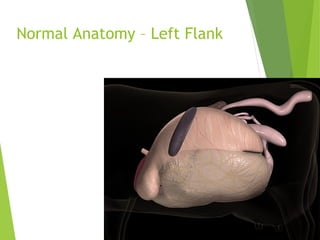
Normal Anatomy – Left Flank
Normal Anatomy – Right Flank
Normal Anatomy - Ventral
Incidence of Abomasal Displacement
 10% RDA
 90% LDA
 91% occur within first 6 weeks of calving
 Most likely to occur
 Adult diary cattle in early postpartum period
 Prevalence in well managed herd varies
 0.2 – 2.5%
Predisposing Factors
 Abomasal atony
 High grain/low roughage diets
  [VFA]  Gas accumulation Distention
 Roughage (large particles)
 Stimulates rumination via touch receptors
 Increases salivary buffer action
 Hypocalcemia
 Milk fever
  smooth muscle tone and motility
 4.8 x risk of developing LDA than normocalcemic
Predisposing Factors
 Abomasal atony
 Metritis, retained placenta, severe mastitis
 Endotoxins and endogenous pyrogens (IL-1) depress motility
 Result in hypocalcemia
 Electrolyte disturbances
 Lack of exercise/confinement
 High producing diary cows
 Large abdominal cavities  more room for displacement
 Genetic selection
LDA Clinical Signs
 Anorexia
  fecal output
  rumen motility
  milk production
 2o
ketosis
 Sunken left paralumbar fossa
LDA Clinical Signs
 Percussion left paralumber fossa
 Above/below line from point of
elbow to tuber coxae
 Ping over gas filled portion of
abomasum
LDA Differential Diagnosis
 Rumen tympany
 Peritonitis
 Pneumoperitoneum
 Physometra
LDA Diagnosis
 Clinical signs
 Percussion
 Liptak test
 Centesis area below gas ping in “abomasum”
 Fluid pH < 4.5 Abomasum
 Burnt almond odor of gas Abomasum
Normal Transit
 Simple LDA cases
 normal serum electrolyte
levels
 Normal acid/base balance
Anion Gap
H2CO3
-
Cl-
K+
Na+
Normal Transit
 Not a complete obstruction
 Chloride secreted in abomasum
 Absorbed in small intestine
 + Mild hypochloremia
 + Mild metabolic alkalosis
LDA – Right Flank
LDA – Left Flank
LDA - Ventral
LDA Treatment
 Medical techniques
 Cast in right lateral recumbency 
 Roll into dorsal recumbency/shake legs 
 Roll over to left lateralrecumbency  Stand
 Surgical techniques
 Right paralumbar fossa omentopexy
 Left paralumbar fossa abomasopexy
 Right paramedian abomasopexy
 Percutaneous abomasopexy
LDA Prevention
 Diet
 Prepartum introduction of ensiled/concentrate feeds
 Slowly introduce concentrates post-calving
 Increase particle size of forage
 Prevent hypocalcemia
 Manage periparturient inflammatory diseases
RDA Clinical Signs and DDx
 Clinical signs similar to LDA
 Differential diagnosis
 Cecal dilitation or volvulus
 Gas in spiral colon
 Small intestinal obstruction or volvulus
 Torsion about root of mesentery
 Pneumorectum
 Pneumoperitoneum
 Physometra
 Abomasal volvulus
RDA Diagnosis
 Clinical signs
 Precussion
 Ping under last 5 ribs in dorsal abdomen
 Rectal palpation
Slow Transit
 Potential for sequestration of HCl in
abomasum
 Hyochloremia (loss of anions)
 Obstruction
 Reabsorption of Cl-
by small intestine
Slow Transit
 Metabolic alkalosis
 Compensate for loss of Cl-
kidney produces H2CO3
-
 Hypokalemia
 Stabilize blood pH
 K+
(extracellular)  H+
(intracellular)
 Paradoxic aciduria
 Perfusion in peripheral tissue
 Aldosterone Reabsorb Na+
 Secrete K+
 Deplete K+
Reabsorb Na+
 Secrete H+
RDA – Right Flank
RDA Treatment
 Medical techniques
 Rolling contraindicated
 Progression to Abomasal volvulus
 Surgical techniques
 Difficult to distinguish RDA vs. AV
 Right paralumbar fossa omentopexy or
abomasopexy
 Right paramedian abomasopexy
AV Clinical Signs
 Colic
 Tachycardia (> 100 bpm)
 Dehydration
 Bilateral abdominal distention
 Feces abscent or watery but scant
 AV Compete obstruction of flow of ingestia through duodenum
AV Differential Diagnosis
 Cecal dilitation or volvulus
 Gas in spiral colon
 Small intestinal obstruction or volvulus
 Torsion about root of mesentery
 Right abomasal displacement
AV Diagnosis
 Clinical signs
 Precussion
 Ping
 Extends from 8th
rib to middle of right paralumbar fossa
 Ventral border is horizontal
 Fluid in abomasum
 Ballottement
 Rectal palpation
AV Clinical Pathology
 Similar to RDA but more severe
 Hypochloremia
 Hypohalemia
 Metabolic alkalosis  Metabolic acidosis
 More chronic cases
 Dehydration
 Poor peripheral perfusion
 Shock
AV – Right Flank
 Typical orientation
 Counterclockwise viewed from right flank
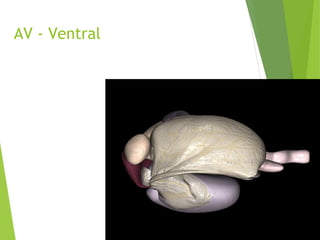
AV - Ventral
AV - Cranial
 Typical orientation
 Clockwise viewed from cranial
RDA Treatment
 Surgical Emergency
 Preoperative
 IV fluids with KCl
 Hypertonic saline
 Normasol
 0.9% NaCl
 NSAIDs
 Broad spectrum antibiotics
RDA Treatment
 Surgical techniques
 Right paralumbar fossa omentopexy
Best choice
Integrity of abomasum often compromised
Abomasopexy procedures do not work well
 Progniosis
 Depends on degree of damage to abomasal mucosa
 Vagal indigestion syndrome common
Proximal Paravertebral Nerve Block
 T13, L1, and L2
 Sensory and motor to
 Skin
 Fascia
 Muscle
 Peritoneum
Proximal Paravertebral Nerve Block
 Nerve most localized
 Intervertebral foramen
 Walk needle of caudle edge of transverse process
 Single site rather than dorsal and ventral branches individually
 Transverse process slopes forward
 Technique
 Injection site 3 – 4 cm from midline
 Local bled of 2% lidocaine hydrochloride
 Use 1 in 16-ga needle as trocar for 10 cm 20-ga needle
Proximal Paravertebral Nerve Block
 Technique
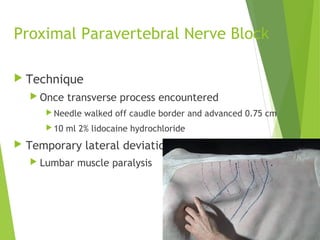
 Once transverse process encountered
 Needle walked off caudle border and advanced 0.75 cm
 10 ml 2% lidocaine hydrochloride
 Temporary lateral deviation of spine
 Lumbar muscle paralysis
Distal Paravertebral Nerve Block
 Branches of T13, L1, and L2 blocked at ends of
transverse processes of L1, L2, and L4 (not L3)
 Technique
 25 ml 2% lidocaine hydrochloride per site
 18-ga needle inserted under each transverse process
 10 ml 2% lidocaine hydrochloride
Distal Paravertebral Nerve Block
 Technique
 Withdrawn short distance and redirected craniad and
caudad
 2% lidocaine hydrochloride
 Infiltration of ventral branches
Distal Paravertebral Nerve Block
 Technique
 Needle redirected dorsal and caudal to transverse
process
 2% lidocaine hydrochloride
 Infiltration of dorsolateral branches
 No deviation of spine
 No lumbar muscle paralysis
Inverted L Nerve Block
 Vertical line passes caudal to last rib
 Horizontal line passes ventral to transverse
processes
 100 ml 2% lidocaine hydrochloride
Right Paralumbar Fossa Omentopexy
 Vertical incision in middle of paralumbar fossa
 3 – 5 cm ventral to transverse processes
 20 – 25 cm long
 Skin
 SQ
Right Paralumbar Fossa Omentopexy
 External abdominal oblique muscle
 Internal abdominal oblique muscle
 Aponeurosis of transverse abdominal muscle
 Peritoneum
LDA Decompression
 14 gauge needle attached to sterile suction hose
LDA Decompression
 14 gauge needle attached to sterile suction hose
LDA Manipulation
 Abomasum returned to normal position
 Follow peritoneal surfaces ventrally
 Hand between rumen and body wall
 Elevate caudal ventral blind sac of rumen
LDA Manipulation
 Abomasum returned to normal position
 Follow peritoneal surfaces ventrally
 Hand between rumen and body wall
 Elevate caudal ventral blind sac of rumen
Right Paralumbar Fossa Omentopexy
 Gently pull omentum out through incision
 Retract dorsad and caudad until pylorus is visualized
 Omentum on both sides of pylorus
 Palpable firmness of torus pyloricus muscle
 Omentopexy
 Close to pyloroduodenal
junction
 3 – 4 cm caudal
 Appendage “sows ear”
 6 – 8 cm vertical section of
greater omentum
 Distribute pexy of wide area
Right Paralumbar Fossa Omentopexy
 #2 or #3 chromic gut
 Incorporate omentum in peritoneum and
transversus abdominal muscle closure
Right Paralumbar Fossa Omentopexy
 External/internal abdominal oblique muscles
closure
 Single layer, simple continuous pattern, #2 - #3 chromic
gut
 Skin closure
 Ford interlocking pattern, #3 polymerized caprolactam
(Vetafil)
AV Decompression
 14 gauge needle attached to sterile suction hose
AV Manipulation
 Typical orientation
 Counterclockwise
 Viewed from right flank
 Viewed from rear
Advantages and Disadvantages:
Right Paralumbar Fossa Omentopexy
 Prognosis
 LDA 86% - 90%
 Complications
 Redisplacement 3.6% - 4.2%
 Incisional infection
 Peritonitis
 Advantages
 Animal in standing position
 Surgeon can perform procedure alone
 Allows abdomial exploration
 Used to correct LDA, RDA, and AV
 Disadvantages
 More skill
 Proper position of abomasum
 Proper area for fixation
 Abomasum position less anatomically correct than abomasopexy
 Not good if suspect adhesions beteen abomasum and left body wall
Left Paralumbar Fossa Abomasopexy
 Identify abomasum
Left Paralumbar Fossa Abomasopexy
 Well distented abomasum
 Along greater curvature
 2 – 3 cm from attachment of greater
omentum
 Ford interlocking pattern 5 – 7 cm
 Bites through submucosa
 #2 - #3 monofilament, non-absorbable
 2 m long
 2 long tags with straight needles
 Decompress abomasum
Left Paralumbar Fossa Abomasopexy
 Anchor suture tags
 Cranial site 10 cm caudal/right of xiphoid
process
 Pass cranial suture through ventral
abdomin
 Assistant applies pressure of site with
hemostats
 Assistant pulls needle
through skin
 Repeat with caudal suture
Left Paralumbar Fossa Abomasopexy
 Reduction of abomasum
 Each suture is placed through a sponge before
being tied
Advantages and Disadvantages:
Left Paralumbar Fossa Abomasopexy
 Prognosis
 83.5% - 94%
 Complications
 Entrapment of small intestine between abomasum and body wall
 Abomasal fistula formation if
 Suture penetrates abomasal mucosa
 Suture not removed in 2 – 3 weeks
 Advantages
 Animal in standing position
 Best choice for cows in advanced pregnancy (> 7 months)
 Best choice for rumenotomy with concurrent TRP
 Disadvantages
 Only for LDA not for RDA or AV
 Requires assistant to guide needle placement
Percutaneous Abomasopexy
 Toggle
 5 cm long plastic rod
 30 cm long nylon suture
 Trocar with stylet
 Used to place toggle in the abomasum
Percutaneous Abomasopexy
 Abomasum repositioned
 Position of abomasum identified
Percutaneous Abomasopexy
 Trocar with stylet inserted into abomasum
 Stylet removed
 Abomasal odor confirmed
 First toggle passed through cannula to abomasum
Percutaneous Abomasopexy
 Trocar with stylet inserted into abomasum
 Stylet removed
 Abomasal odor confirmed
 Second toggle passed through cannula to
abomasum
Percutaneous Abomasopexy
 Ends of suture tied around a sponge
Advantages and Disadvantages:
Percutaneous Abomasopexy
 Prognosis
 80% - 88%
 Complications
 Pexy viscera or omentum
 Abomasal rupture at suture site
 Peritonitis
 Abomasal obstruction
 Advantages
 Quick, inexpensive, easy to perform
 May be good choice for cows that are poor surgical candidates
 Disadvantages
 Requires dorsal recumbency
 Only for LDA not for RDA or AV
 Requires assistants
 Abomasum must be distended with gas
Laparascopic Assisted Abomasopexy
 Minimally invasive technique for surgical correction of LDA
 Developed to reduce incidence of complications
 Traditional laparotomy
 Percutaneous toggle placement
Laparascopic Assisted Abomasopexy
 Advantages
 Reduced surgical time and cost
 Reduced healing time
 Can immediately go back into production
 Reduced milk discarding
 Antibiotics not required
 Allows abdominal exploratory
 Any degree of gas distention
 Even minimally dilated
Laparascopic Assisted Abomasopexy
 Two-step technique
 Toggle placement – standing
 Suture retrieval – dorsal recumbency
 One-step technique
 Dorsal resumbency
 One-step technique
 Standing
Laparascopic Assisted Abomasopexy
 Single toggle
 Toggle bar
 Stainless steel with central recess
 Epoxy filling recess securing suture to toggle
 Suture
 Twin 80cm strands
 Marker 4.5 cm from toggle bar
Marker
Two-Step Technique: Step 1 - Standing
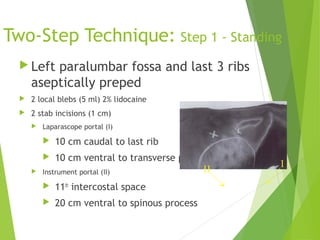
 Left paralumbar fossa and last 3 ribs
aseptically preped
 2 local blebs (5 ml) 2% lidocaine
 2 stab incisions (1 cm)
 Laparascope portal (I)
 10 cm caudal to last rib
 10 cm ventral to transverse process
 Instrument portal (II)
 11th
intercostal space
 20 cm ventral to spinous process
II
I
Two-Step Technique: Step 1 - Standing
 Pneumoperitoneum
 Left paralumbar fossa
 Position I
 Veress needle with silicon tubing
 Insufflation pump
Two-Step Technique: Step 1 - Standing
 Trocar-cannula assembly inserted in left paralumbar fossa (I) through stab
incision
 Laparascope inserted into cannula
 Abdominal exploratory
Two-Step Technique: Step 1 - Standing
 Endoscopic picture of LDA
Two-Step Technique: Step 1 - Standing
 Trocar-cannula assembly inserted in 11th
ICS (II) through stab incision
 Instrument portal
Two-Step Technique: Step 1 - Standing
 Toggle trocar passed through instrument portal
and inserted into abomasum
 Toggle bar passed through trocar into abomasal
lumen
Two-Step Technique: Step 1 - Standing
 Abomasum decompressed
 Excess toggle suture fully
inserted into abdomen
 Toggle trocar & laparascope
removed
 Skin incisions closed
 Single interrupted suture
Two-Step Technique: Step 2 – Dorsal Recumbency
 Right parameadian area aseptically preped
 2 local blebs (5 ml) 2% lidocaine
 2 stab incisions (1 cm)
 Laparascope portal (III)
 5 cm lateral from midline
 20 cm distal to xyphoid
 Instrument portal (IV)
 5 cm lateral from midline
 10 cm distal to xyphoid
Two-Step Technique: Step 2 – Dorsal Recumbency
 Laparascope and grasping forceps inserted
through portals
Two-Step Technique: Step 2 – Dorsal Recumbency
 Abomasum and suture material identified
 Suture retrieved using grasping forceps
Two-Step Technique: Step 2 – Dorsal Recumbency
 Excess suture withdrawn through instrument portal up to preset marker on
suture
 Abomasum in proper anatomical position
 Remove laparasope and cannulas
 Skin incisions closed
 Single interrupted suture
Two-Step Technique: Step 2 – Dorsal Recumbency
 Suture ends each passed through separate 14
ga needles inserted through gauze stent
 Needles removed
 Suture tied over gauze stent
 Leave 3 cm of play in suture
 Suture removed after 3 – 4 weeks
One-Step Technique - Dorsal Recumbency
 Animal is sedated and placed in dorsal
recumbency
 Area aseptically prepared from
 Xyphoid process to 10 cm caudal to umbilicus
 Width of 20 cm each side of ventral midline
One-Step Technique - Dorsal Recumbency
 3 local blebs (5 ml) 2% lidocaine
 3 stab incisions (1 cm)
 Portal site I (laparoscope)
 2 cm left of umbilicus
 Portal site II (grasping forceps)
 3 cm caudal and 7 cm right of xyphoid process
 Portal site III (needle holder)
 5 cm right and 3 cm cranial to umbilicus
One-Step Technique - Dorsal Recumbency
 Fixation site IV
 10 cm long line block using 2% lidocaine
 3 - 5 cm right of linea alba
 Centered between umbilicus and xyphoid process
 Four 1-cm long skin incisions
 Perpendicular to ventral midline
 Spaced 2.5 cm apart
One-Step Technique - Dorsal Recumbency
I
II III
IV
One-Step Technique - Dorsal Recumbency
 Grasping forceps used to locate abomasum
 Grasp abomasum in middle of greater
curvature
 2 – 3 cm from greater omentum attachment
 Fixation site
One-Step Technique - Dorsal Recumbency
 2 PDS suture with curved needle (1/2, 40mm)
is used
 Needle straightened to facilitate manipulation of needle
 Needle introduced into abdomen through one
of cutaneous incisions
 Needle grasped intra-abdominally using needle
holder
One-Step Technique - Dorsal Recumbency
 Needle and suture passed through serous and
muscular layers of abomasum
 Stitch measuring 2 cm
 Running perpendicular to greater curvature
 Site inspected for gas or fluid leakage
One-Step Technique - Dorsal Recumbency
 18 G needle inserted through abdominal wall
 Used as guide to exteriorize needle and suture
 Suture pulled out of abdominal cavity
One-Step Technique - Dorsal Recumbency
 3 other sutures are placed in similar fashion
 Correct positioning of abomasum verified by
pulling gently on sutures to approximate
abomasum to body wall
One-Step Technique - Dorsal Recumbency
 Sutures are knotted
 Cutaneous incisions closed
One-Step Technique - Dorsal Recumbency
 Adhesions 3 months post-operatively
One-Step Technique - Dorsal Recumbency
 Follows two-step technique
 Except once toggle bar inserted into abomasum,
suture ends not passed into abdominal cavity
 Specially designed instrument is used to drive
toggle suture from left flank to ventral
abdomen
 Suture is tied as in two-step technique
Right Paramedian Abomasopexy
 Incision
 15 – 20 cm long, parallel and 3 – 4 cm right of midline
 Extending caudal from a point 4 – 8 cm caudal to xiphoid
 Six distinct layers
 Skin
 SQ fascia
 Deep pectoral muscle in cranial 1/3
 External rectus sheath
 Rectus abdominus muscle
 Internal rectus sheath
 Peritoneum
Right Paramedian Abomasopexy
 Exploratory
 Decompress abomasum and exteriorize
 Identify pylorus
 Omentum on both sides of pylorus
 Palpable firmness of torus pyloricus muscle
 Identify greater omentum
 Greater curvature (arrow)
 Sweeps to left side of rumen
 Covering ventral surface of rumen
Right Paramedian Abomasopexy
 Abomasopexy
 3 horizontal mattress sutures
 Lateral aspect of greater curvature of abomasum free of omentum
 Seromuscular layer
 Peritoneum and internal rectus sheath
 #2 chromic gut
 Simple continuous pattern
 Peritoneum and internal rectus sheath
 At least 6 bites incorporating abomasum
 Seromuscular layer
Right Paramedian Abomasopexy
 Closure
 External rectus sheath
 Horizontal mattress pattern
 #3 chromic gut
 Skin
 Ford interlocking pattern
 #3 polymerized caprolactam (Vetafil)
Advantages and Disadvantages:
Right Paramedian Abomasopexy
 Prognosis
 83.5% - 95%
 Complications
 Incisional hemorrhage, dehiscence, herniation or fistulation
 Advantages
 Strong adhesions develop between abomasum and body wall
 Abomasum returns near normal position during placing in dorsal recumbency
 Correct LDA, RDA or AV
 Disadvantages
 Dorsal recumbency
 Bloat, regurgitation, aspiration
 Requires assistants

Abomasal displacements and volvulus

  • 1.
    Abomasal Displacments andVolvulus Dr. Satyajeet Singh
  • 2.
    Greater Omentum  Consistsof 2 leaves  Superficial leaf (1)  Left longitudinal groove of rumen  Greater curvature of abomasum and duodenum (2)  Deep leaf (3)  Right longitudinal groove of rumen  Decending duodenum  Both leaves form sling for intestine 1 3 2 2 2
  • 3.
    Lessor Omentum (1) Connects peritoneum between  Liver (2)  Lesser curvature of abomasum (3)  Cranial duodenum (4)  Covers right side of omasum  Key to other structures  Mesoduodenum (5)  Greater omentum (6) 2 3 4 1 5 6
  • 4.
  • 5.
    Normal Anatomy –Right Flank
  • 6.
  • 7.
    Incidence of AbomasalDisplacement  10% RDA  90% LDA  91% occur within first 6 weeks of calving  Most likely to occur  Adult diary cattle in early postpartum period  Prevalence in well managed herd varies  0.2 – 2.5%
  • 8.
    Predisposing Factors  Abomasalatony  High grain/low roughage diets   [VFA]  Gas accumulation Distention  Roughage (large particles)  Stimulates rumination via touch receptors  Increases salivary buffer action  Hypocalcemia  Milk fever   smooth muscle tone and motility  4.8 x risk of developing LDA than normocalcemic
  • 9.
    Predisposing Factors  Abomasalatony  Metritis, retained placenta, severe mastitis  Endotoxins and endogenous pyrogens (IL-1) depress motility  Result in hypocalcemia  Electrolyte disturbances  Lack of exercise/confinement  High producing diary cows  Large abdominal cavities  more room for displacement  Genetic selection
  • 10.
    LDA Clinical Signs Anorexia   fecal output   rumen motility   milk production  2o ketosis  Sunken left paralumbar fossa
  • 11.
    LDA Clinical Signs Percussion left paralumber fossa  Above/below line from point of elbow to tuber coxae  Ping over gas filled portion of abomasum
  • 12.
    LDA Differential Diagnosis Rumen tympany  Peritonitis  Pneumoperitoneum  Physometra
  • 13.
    LDA Diagnosis  Clinicalsigns  Percussion  Liptak test  Centesis area below gas ping in “abomasum”  Fluid pH < 4.5 Abomasum  Burnt almond odor of gas Abomasum
  • 14.
    Normal Transit  SimpleLDA cases  normal serum electrolyte levels  Normal acid/base balance Anion Gap H2CO3 - Cl- K+ Na+
  • 15.
    Normal Transit  Nota complete obstruction  Chloride secreted in abomasum  Absorbed in small intestine  + Mild hypochloremia  + Mild metabolic alkalosis
  • 16.
  • 17.
  • 18.
  • 19.
    LDA Treatment  Medicaltechniques  Cast in right lateral recumbency   Roll into dorsal recumbency/shake legs   Roll over to left lateralrecumbency  Stand  Surgical techniques  Right paralumbar fossa omentopexy  Left paralumbar fossa abomasopexy  Right paramedian abomasopexy  Percutaneous abomasopexy
  • 20.
    LDA Prevention  Diet Prepartum introduction of ensiled/concentrate feeds  Slowly introduce concentrates post-calving  Increase particle size of forage  Prevent hypocalcemia  Manage periparturient inflammatory diseases
  • 21.
    RDA Clinical Signsand DDx  Clinical signs similar to LDA  Differential diagnosis  Cecal dilitation or volvulus  Gas in spiral colon  Small intestinal obstruction or volvulus  Torsion about root of mesentery  Pneumorectum  Pneumoperitoneum  Physometra  Abomasal volvulus
  • 22.
    RDA Diagnosis  Clinicalsigns  Precussion  Ping under last 5 ribs in dorsal abdomen  Rectal palpation
  • 23.
    Slow Transit  Potentialfor sequestration of HCl in abomasum  Hyochloremia (loss of anions)  Obstruction  Reabsorption of Cl- by small intestine
  • 24.
    Slow Transit  Metabolicalkalosis  Compensate for loss of Cl- kidney produces H2CO3 -  Hypokalemia  Stabilize blood pH  K+ (extracellular)  H+ (intracellular)  Paradoxic aciduria  Perfusion in peripheral tissue  Aldosterone Reabsorb Na+  Secrete K+  Deplete K+ Reabsorb Na+  Secrete H+
  • 25.
  • 26.
    RDA Treatment  Medicaltechniques  Rolling contraindicated  Progression to Abomasal volvulus  Surgical techniques  Difficult to distinguish RDA vs. AV  Right paralumbar fossa omentopexy or abomasopexy  Right paramedian abomasopexy
  • 27.
    AV Clinical Signs Colic  Tachycardia (> 100 bpm)  Dehydration  Bilateral abdominal distention  Feces abscent or watery but scant  AV Compete obstruction of flow of ingestia through duodenum
  • 28.
    AV Differential Diagnosis Cecal dilitation or volvulus  Gas in spiral colon  Small intestinal obstruction or volvulus  Torsion about root of mesentery  Right abomasal displacement
  • 29.
    AV Diagnosis  Clinicalsigns  Precussion  Ping  Extends from 8th rib to middle of right paralumbar fossa  Ventral border is horizontal  Fluid in abomasum  Ballottement  Rectal palpation
  • 30.
    AV Clinical Pathology Similar to RDA but more severe  Hypochloremia  Hypohalemia  Metabolic alkalosis  Metabolic acidosis  More chronic cases  Dehydration  Poor peripheral perfusion  Shock
  • 31.
    AV – RightFlank  Typical orientation  Counterclockwise viewed from right flank
  • 32.
  • 33.
    AV - Cranial Typical orientation  Clockwise viewed from cranial
  • 34.
    RDA Treatment  SurgicalEmergency  Preoperative  IV fluids with KCl  Hypertonic saline  Normasol  0.9% NaCl  NSAIDs  Broad spectrum antibiotics
  • 35.
    RDA Treatment  Surgicaltechniques  Right paralumbar fossa omentopexy Best choice Integrity of abomasum often compromised Abomasopexy procedures do not work well  Progniosis  Depends on degree of damage to abomasal mucosa  Vagal indigestion syndrome common
  • 36.
    Proximal Paravertebral NerveBlock  T13, L1, and L2  Sensory and motor to  Skin  Fascia  Muscle  Peritoneum
  • 37.
    Proximal Paravertebral NerveBlock  Nerve most localized  Intervertebral foramen  Walk needle of caudle edge of transverse process  Single site rather than dorsal and ventral branches individually  Transverse process slopes forward  Technique  Injection site 3 – 4 cm from midline  Local bled of 2% lidocaine hydrochloride  Use 1 in 16-ga needle as trocar for 10 cm 20-ga needle
  • 38.
    Proximal Paravertebral NerveBlock  Technique  Once transverse process encountered  Needle walked off caudle border and advanced 0.75 cm  10 ml 2% lidocaine hydrochloride  Temporary lateral deviation of spine  Lumbar muscle paralysis
  • 39.
    Distal Paravertebral NerveBlock  Branches of T13, L1, and L2 blocked at ends of transverse processes of L1, L2, and L4 (not L3)  Technique  25 ml 2% lidocaine hydrochloride per site  18-ga needle inserted under each transverse process  10 ml 2% lidocaine hydrochloride
  • 40.
    Distal Paravertebral NerveBlock  Technique  Withdrawn short distance and redirected craniad and caudad  2% lidocaine hydrochloride  Infiltration of ventral branches
  • 41.
    Distal Paravertebral NerveBlock  Technique  Needle redirected dorsal and caudal to transverse process  2% lidocaine hydrochloride  Infiltration of dorsolateral branches  No deviation of spine  No lumbar muscle paralysis
  • 42.
    Inverted L NerveBlock  Vertical line passes caudal to last rib  Horizontal line passes ventral to transverse processes  100 ml 2% lidocaine hydrochloride
  • 43.
    Right Paralumbar FossaOmentopexy  Vertical incision in middle of paralumbar fossa  3 – 5 cm ventral to transverse processes  20 – 25 cm long  Skin  SQ
  • 44.
    Right Paralumbar FossaOmentopexy  External abdominal oblique muscle  Internal abdominal oblique muscle  Aponeurosis of transverse abdominal muscle  Peritoneum
  • 45.
    LDA Decompression  14gauge needle attached to sterile suction hose
  • 46.
    LDA Decompression  14gauge needle attached to sterile suction hose
  • 47.
    LDA Manipulation  Abomasumreturned to normal position  Follow peritoneal surfaces ventrally  Hand between rumen and body wall  Elevate caudal ventral blind sac of rumen
  • 48.
    LDA Manipulation  Abomasumreturned to normal position  Follow peritoneal surfaces ventrally  Hand between rumen and body wall  Elevate caudal ventral blind sac of rumen
  • 49.
    Right Paralumbar FossaOmentopexy  Gently pull omentum out through incision  Retract dorsad and caudad until pylorus is visualized  Omentum on both sides of pylorus  Palpable firmness of torus pyloricus muscle  Omentopexy  Close to pyloroduodenal junction  3 – 4 cm caudal  Appendage “sows ear”  6 – 8 cm vertical section of greater omentum  Distribute pexy of wide area
  • 50.
    Right Paralumbar FossaOmentopexy  #2 or #3 chromic gut  Incorporate omentum in peritoneum and transversus abdominal muscle closure
  • 51.
    Right Paralumbar FossaOmentopexy  External/internal abdominal oblique muscles closure  Single layer, simple continuous pattern, #2 - #3 chromic gut  Skin closure  Ford interlocking pattern, #3 polymerized caprolactam (Vetafil)
  • 52.
    AV Decompression  14gauge needle attached to sterile suction hose
  • 53.
    AV Manipulation  Typicalorientation  Counterclockwise  Viewed from right flank  Viewed from rear
  • 54.
    Advantages and Disadvantages: RightParalumbar Fossa Omentopexy  Prognosis  LDA 86% - 90%  Complications  Redisplacement 3.6% - 4.2%  Incisional infection  Peritonitis  Advantages  Animal in standing position  Surgeon can perform procedure alone  Allows abdomial exploration  Used to correct LDA, RDA, and AV  Disadvantages  More skill  Proper position of abomasum  Proper area for fixation  Abomasum position less anatomically correct than abomasopexy  Not good if suspect adhesions beteen abomasum and left body wall
  • 55.
    Left Paralumbar FossaAbomasopexy  Identify abomasum
  • 56.
    Left Paralumbar FossaAbomasopexy  Well distented abomasum  Along greater curvature  2 – 3 cm from attachment of greater omentum  Ford interlocking pattern 5 – 7 cm  Bites through submucosa  #2 - #3 monofilament, non-absorbable  2 m long  2 long tags with straight needles  Decompress abomasum
  • 57.
    Left Paralumbar FossaAbomasopexy  Anchor suture tags  Cranial site 10 cm caudal/right of xiphoid process  Pass cranial suture through ventral abdomin  Assistant applies pressure of site with hemostats  Assistant pulls needle through skin  Repeat with caudal suture
  • 58.
    Left Paralumbar FossaAbomasopexy  Reduction of abomasum  Each suture is placed through a sponge before being tied
  • 59.
    Advantages and Disadvantages: LeftParalumbar Fossa Abomasopexy  Prognosis  83.5% - 94%  Complications  Entrapment of small intestine between abomasum and body wall  Abomasal fistula formation if  Suture penetrates abomasal mucosa  Suture not removed in 2 – 3 weeks  Advantages  Animal in standing position  Best choice for cows in advanced pregnancy (> 7 months)  Best choice for rumenotomy with concurrent TRP  Disadvantages  Only for LDA not for RDA or AV  Requires assistant to guide needle placement
  • 60.
    Percutaneous Abomasopexy  Toggle 5 cm long plastic rod  30 cm long nylon suture  Trocar with stylet  Used to place toggle in the abomasum
  • 61.
    Percutaneous Abomasopexy  Abomasumrepositioned  Position of abomasum identified
  • 62.
    Percutaneous Abomasopexy  Trocarwith stylet inserted into abomasum  Stylet removed  Abomasal odor confirmed  First toggle passed through cannula to abomasum
  • 63.
    Percutaneous Abomasopexy  Trocarwith stylet inserted into abomasum  Stylet removed  Abomasal odor confirmed  Second toggle passed through cannula to abomasum
  • 64.
    Percutaneous Abomasopexy  Endsof suture tied around a sponge
  • 65.
    Advantages and Disadvantages: PercutaneousAbomasopexy  Prognosis  80% - 88%  Complications  Pexy viscera or omentum  Abomasal rupture at suture site  Peritonitis  Abomasal obstruction  Advantages  Quick, inexpensive, easy to perform  May be good choice for cows that are poor surgical candidates  Disadvantages  Requires dorsal recumbency  Only for LDA not for RDA or AV  Requires assistants  Abomasum must be distended with gas
  • 66.
    Laparascopic Assisted Abomasopexy Minimally invasive technique for surgical correction of LDA  Developed to reduce incidence of complications  Traditional laparotomy  Percutaneous toggle placement
  • 67.
    Laparascopic Assisted Abomasopexy Advantages  Reduced surgical time and cost  Reduced healing time  Can immediately go back into production  Reduced milk discarding  Antibiotics not required  Allows abdominal exploratory  Any degree of gas distention  Even minimally dilated
  • 68.
    Laparascopic Assisted Abomasopexy Two-step technique  Toggle placement – standing  Suture retrieval – dorsal recumbency  One-step technique  Dorsal resumbency  One-step technique  Standing
  • 69.
    Laparascopic Assisted Abomasopexy Single toggle  Toggle bar  Stainless steel with central recess  Epoxy filling recess securing suture to toggle  Suture  Twin 80cm strands  Marker 4.5 cm from toggle bar Marker
  • 70.
    Two-Step Technique: Step1 - Standing  Left paralumbar fossa and last 3 ribs aseptically preped  2 local blebs (5 ml) 2% lidocaine  2 stab incisions (1 cm)  Laparascope portal (I)  10 cm caudal to last rib  10 cm ventral to transverse process  Instrument portal (II)  11th intercostal space  20 cm ventral to spinous process II I
  • 71.
    Two-Step Technique: Step1 - Standing  Pneumoperitoneum  Left paralumbar fossa  Position I  Veress needle with silicon tubing  Insufflation pump
  • 72.
    Two-Step Technique: Step1 - Standing  Trocar-cannula assembly inserted in left paralumbar fossa (I) through stab incision  Laparascope inserted into cannula  Abdominal exploratory
  • 73.
    Two-Step Technique: Step1 - Standing  Endoscopic picture of LDA
  • 74.
    Two-Step Technique: Step1 - Standing  Trocar-cannula assembly inserted in 11th ICS (II) through stab incision  Instrument portal
  • 75.
    Two-Step Technique: Step1 - Standing  Toggle trocar passed through instrument portal and inserted into abomasum  Toggle bar passed through trocar into abomasal lumen
  • 76.
    Two-Step Technique: Step1 - Standing  Abomasum decompressed  Excess toggle suture fully inserted into abdomen  Toggle trocar & laparascope removed  Skin incisions closed  Single interrupted suture
  • 77.
    Two-Step Technique: Step2 – Dorsal Recumbency  Right parameadian area aseptically preped  2 local blebs (5 ml) 2% lidocaine  2 stab incisions (1 cm)  Laparascope portal (III)  5 cm lateral from midline  20 cm distal to xyphoid  Instrument portal (IV)  5 cm lateral from midline  10 cm distal to xyphoid
  • 78.
    Two-Step Technique: Step2 – Dorsal Recumbency  Laparascope and grasping forceps inserted through portals
  • 79.
    Two-Step Technique: Step2 – Dorsal Recumbency  Abomasum and suture material identified  Suture retrieved using grasping forceps
  • 80.
    Two-Step Technique: Step2 – Dorsal Recumbency  Excess suture withdrawn through instrument portal up to preset marker on suture  Abomasum in proper anatomical position  Remove laparasope and cannulas  Skin incisions closed  Single interrupted suture
  • 81.
    Two-Step Technique: Step2 – Dorsal Recumbency  Suture ends each passed through separate 14 ga needles inserted through gauze stent  Needles removed  Suture tied over gauze stent  Leave 3 cm of play in suture  Suture removed after 3 – 4 weeks
  • 82.
    One-Step Technique -Dorsal Recumbency  Animal is sedated and placed in dorsal recumbency  Area aseptically prepared from  Xyphoid process to 10 cm caudal to umbilicus  Width of 20 cm each side of ventral midline
  • 83.
    One-Step Technique -Dorsal Recumbency  3 local blebs (5 ml) 2% lidocaine  3 stab incisions (1 cm)  Portal site I (laparoscope)  2 cm left of umbilicus  Portal site II (grasping forceps)  3 cm caudal and 7 cm right of xyphoid process  Portal site III (needle holder)  5 cm right and 3 cm cranial to umbilicus
  • 84.
    One-Step Technique -Dorsal Recumbency  Fixation site IV  10 cm long line block using 2% lidocaine  3 - 5 cm right of linea alba  Centered between umbilicus and xyphoid process  Four 1-cm long skin incisions  Perpendicular to ventral midline  Spaced 2.5 cm apart
  • 85.
    One-Step Technique -Dorsal Recumbency I II III IV
  • 86.
    One-Step Technique -Dorsal Recumbency  Grasping forceps used to locate abomasum  Grasp abomasum in middle of greater curvature  2 – 3 cm from greater omentum attachment  Fixation site
  • 87.
    One-Step Technique -Dorsal Recumbency  2 PDS suture with curved needle (1/2, 40mm) is used  Needle straightened to facilitate manipulation of needle  Needle introduced into abdomen through one of cutaneous incisions  Needle grasped intra-abdominally using needle holder
  • 88.
    One-Step Technique -Dorsal Recumbency  Needle and suture passed through serous and muscular layers of abomasum  Stitch measuring 2 cm  Running perpendicular to greater curvature  Site inspected for gas or fluid leakage
  • 89.
    One-Step Technique -Dorsal Recumbency  18 G needle inserted through abdominal wall  Used as guide to exteriorize needle and suture  Suture pulled out of abdominal cavity
  • 90.
    One-Step Technique -Dorsal Recumbency  3 other sutures are placed in similar fashion  Correct positioning of abomasum verified by pulling gently on sutures to approximate abomasum to body wall
  • 91.
    One-Step Technique -Dorsal Recumbency  Sutures are knotted  Cutaneous incisions closed
  • 92.
    One-Step Technique -Dorsal Recumbency  Adhesions 3 months post-operatively
  • 93.
    One-Step Technique -Dorsal Recumbency  Follows two-step technique  Except once toggle bar inserted into abomasum, suture ends not passed into abdominal cavity  Specially designed instrument is used to drive toggle suture from left flank to ventral abdomen  Suture is tied as in two-step technique
  • 94.
    Right Paramedian Abomasopexy Incision  15 – 20 cm long, parallel and 3 – 4 cm right of midline  Extending caudal from a point 4 – 8 cm caudal to xiphoid  Six distinct layers  Skin  SQ fascia  Deep pectoral muscle in cranial 1/3  External rectus sheath  Rectus abdominus muscle  Internal rectus sheath  Peritoneum
  • 95.
    Right Paramedian Abomasopexy Exploratory  Decompress abomasum and exteriorize  Identify pylorus  Omentum on both sides of pylorus  Palpable firmness of torus pyloricus muscle  Identify greater omentum  Greater curvature (arrow)  Sweeps to left side of rumen  Covering ventral surface of rumen
  • 96.
    Right Paramedian Abomasopexy Abomasopexy  3 horizontal mattress sutures  Lateral aspect of greater curvature of abomasum free of omentum  Seromuscular layer  Peritoneum and internal rectus sheath  #2 chromic gut  Simple continuous pattern  Peritoneum and internal rectus sheath  At least 6 bites incorporating abomasum  Seromuscular layer
  • 97.
    Right Paramedian Abomasopexy Closure  External rectus sheath  Horizontal mattress pattern  #3 chromic gut  Skin  Ford interlocking pattern  #3 polymerized caprolactam (Vetafil)
  • 98.
    Advantages and Disadvantages: RightParamedian Abomasopexy  Prognosis  83.5% - 95%  Complications  Incisional hemorrhage, dehiscence, herniation or fistulation  Advantages  Strong adhesions develop between abomasum and body wall  Abomasum returns near normal position during placing in dorsal recumbency  Correct LDA, RDA or AV  Disadvantages  Dorsal recumbency  Bloat, regurgitation, aspiration  Requires assistants