METABOLIC DISORDERS OF LIVESTOCK
Inborn errors of metabolism occur from a group of rare genetic disorders
Disorders caused by defects in the enzymes
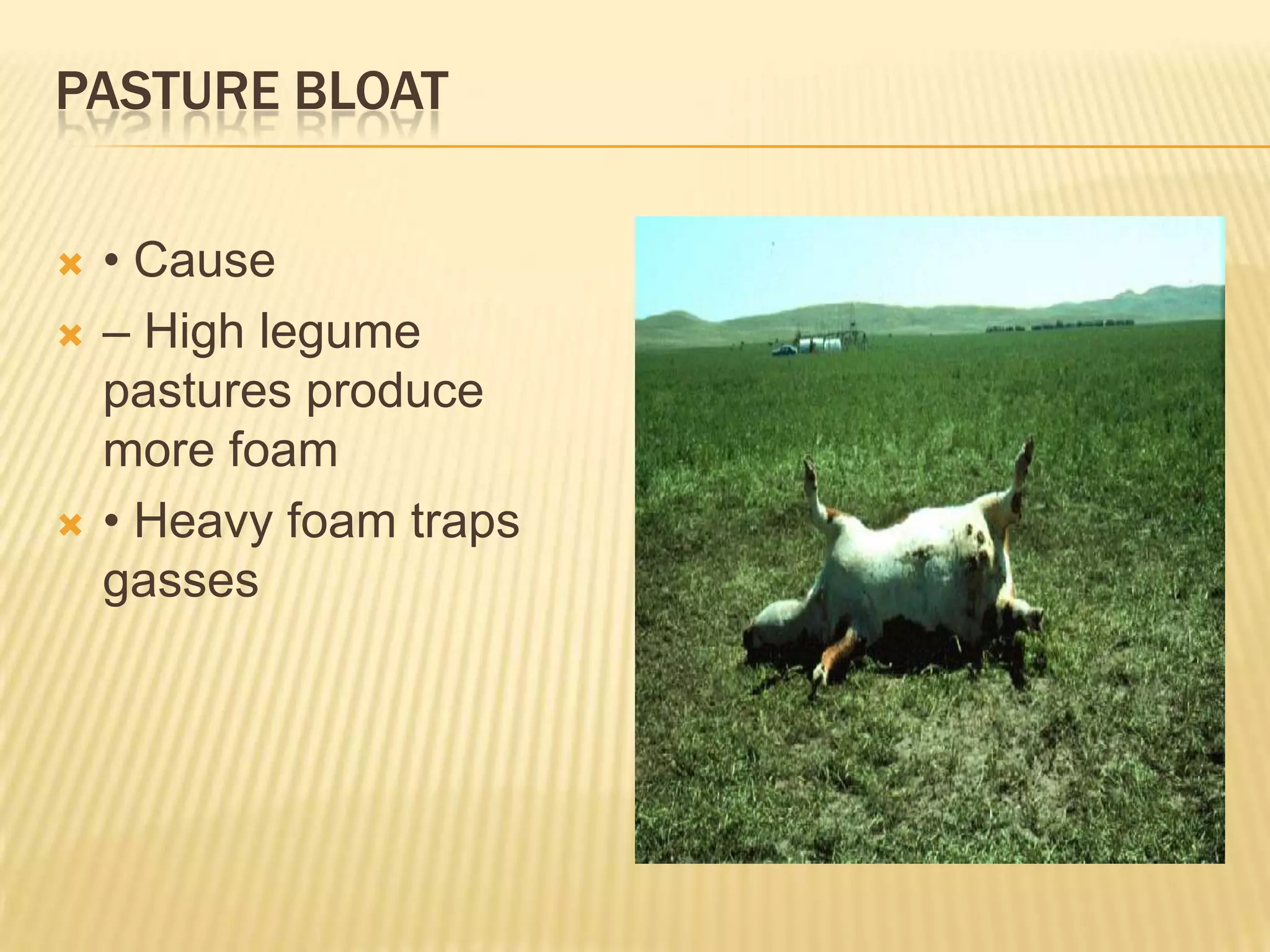
PASTURE BLOAT
 • Cause
 – High legume
pastures produce
more foam
 • Heavy foam traps
gasses
ENTEROTOXEMIA
(OVER-EATING DISEASE)
• Cause
– Toxin produced by clostridium
perfringens
bacteria that grow when fed high energy
feeds
or lush pastures
• Symptoms
– Sudden death
– Can be prevented by vaccination
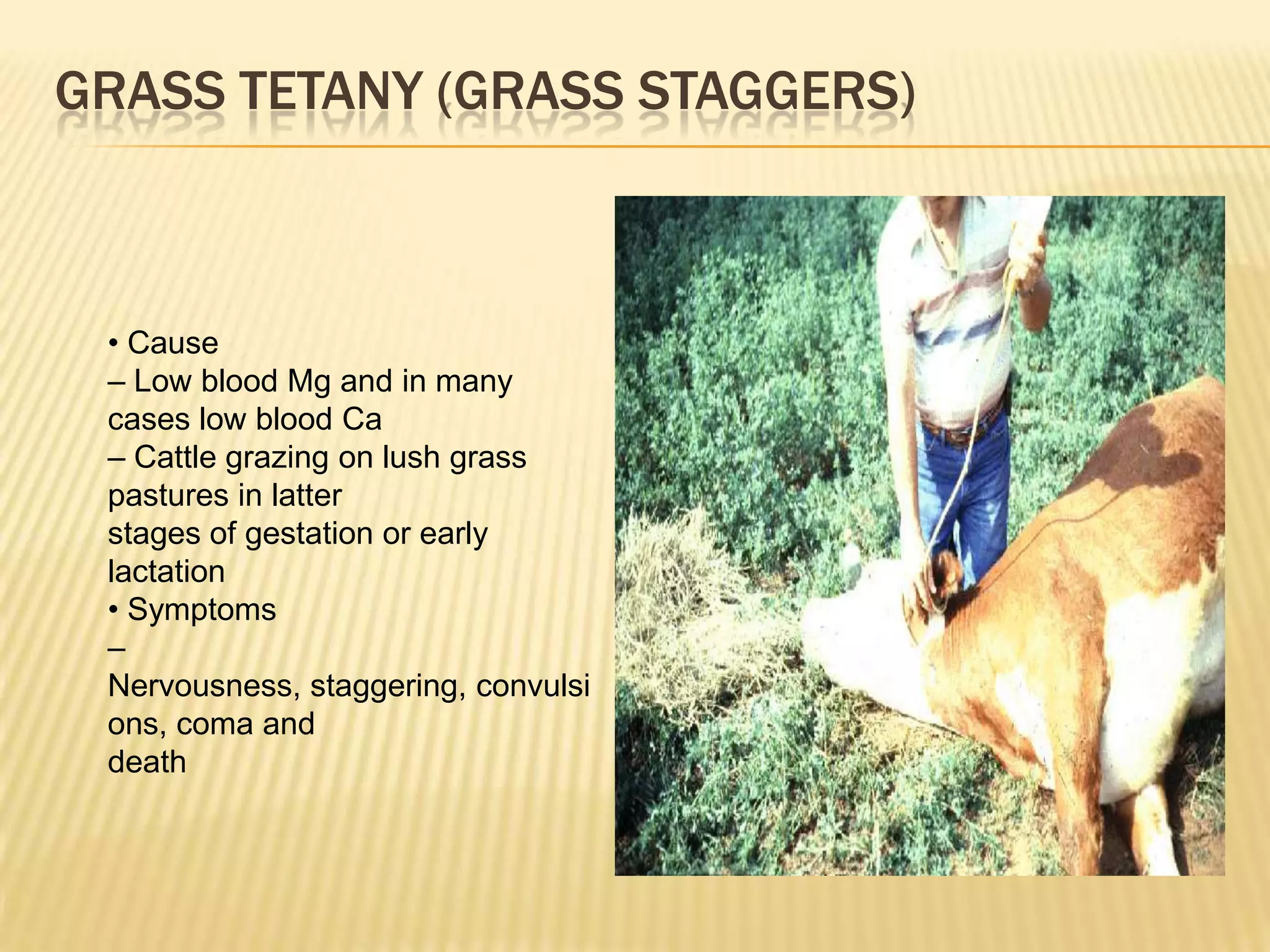
GRASS TETANY (GRASS STAGGERS)
• Cause
– Low blood Mg and in many
cases low blood Ca
– Cattle grazing on lush grass
pastures in latter
stages of gestation or early
lactation
• Symptoms
–
Nervousness, staggering, convulsi
ons, coma and
death
KETOSIS
• Cause
– CHO- low blood sugar
– High energy demand pulls down fat
reserves
rapidly
• Symptoms
– Loss of appetite, acetone (sweetish
chloroformlike
smell) odor from milk, urine and breath
 Night Blindness
 • Cause
 – Vitamin A deficiency
 • Symptoms
 • Roughened hair and
scaly skin with mild
deficiency
 • Prolonged deficiency
leads to poor vision in
dim
 light and eye ulceration
 Nitrate poisoning
 • Cause
 – Excessive levels of
nitrate plant material
 • Symptoms
 – Bluish coloration of
membranes, staggering,
 shortness of breath and
death
LIVER ABSCESSES
 • Cause
 – High concentrate
rations
 • Symptoms
 – Symptoms include
reduced feed intake
and gain
 – Can be prevented
with antibiotics
 Pregnancy disease of
ewes
 • Cause
 – Ewes carrying twins
or triplets in the last 6
 weeks of gestation
 – Insufficient CHO - low
blood sugar
 • Symptoms
 – Ketosis in sheep
PARTURIENT PARESIS
MILK FEVER, HYPOCALEMIA
• Cause
– Low blood Calcium
– Usually occurs within 72 hours following
parturition
– Ewes in the latter stages of gestation
• Symptoms
– Loss of
appetite, nervousness, collapse, head
turned back toward flank
NUTRITIONAL SECONDARY HYPER-
PARATHYROIDISM
It is nutritional/ metabolic disorder caused by
elevation of parathyroid hormone (PTH), usually
secondary to poor nutrition.
All meat or all grain diet is rich in P which is
responsible for this disorder.
Low calcium and Vitamin D and malabsorption
also cause hypocalcaemia.
Increased PTH causes bone resorption, & Ca,
thus, mobilized is transferred to extra-cellular
fluid.
Depletion of bone osteoid leads to deformities,
fractures and loss of structural support.
DISPLACED ABOMASUM
 .. Refers to repositioning of
abomasal
 compartment from the right ventral
 abdominal wall
 .. Twisting from this repositioning
slows or stops
 flow of digesta
 .. Gas buildup leads to bloat
appearance
 .. “Pinging” detected with
stethoscope by thumping the
 cow near the last rib and listening
on the left flank
 .. 85-90% left-sided
 .. Right-sided more complete
torsion
 .. 75% occur within 1st 14 days
postcalving
 .. Rare in heifers
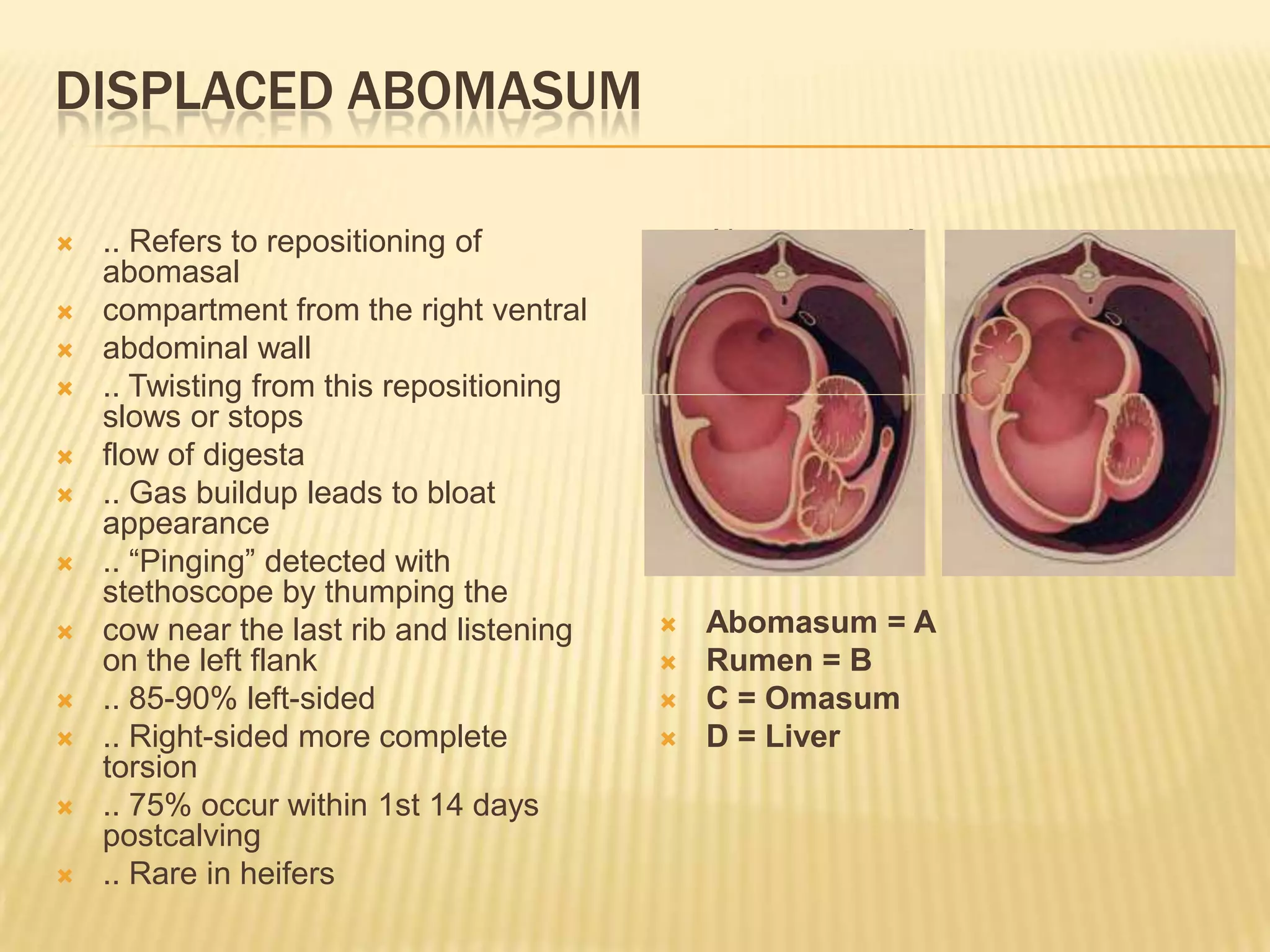
 Abomasum = A
 Rumen = B
 C = Omasum
 Abomasum = A
 Rumen = B
 C = Omasum
 D = Liver
 Symptoms of DA
 􀂄 Dramatically decreased feed
intake
 􀂄 Drastic drop in milk production
 􀂄 Pain (stand with back arched)
 􀂄 Can diagnose by “thumping”
near last
 rib and listening along left flank
 Causes and Risk Factors
 􀂄 Space in abdominal cavity
 􀂄 Decreased feed intake
 􀂄 Sudden ration changes
 􀂄 􀂄 Hypocalcemia allows
stagnant gut and gas
 buildup in abomasum
 􀂄 High grain feeding (high VFA
production)
 prior to proper rumen papillae
development
 􀂄 Over 2/3 of cases are preceded
by a different
 metabolic disorder
 􀂄 Cows with high condition scores
at parturition
 are more prone to displacements
DISPLACED ABOMASUM
 􀂄 When abomasal attachments
stretch during
 pregnancy, this may increase risk
for
 developing a DA
 􀂄 Genetics of the animal may also
affect the
 predisposition to this disorder
 􀂄 Resting positions may affect
risk for DA
 􀂄 Resting on left side reduces risk
of LDA relative to
 resting on right side
 Non-surgical treatment
 􀂄 Removal of gas from
abomasum
 􀂄 Rolling cow over, taking on
rough trailer ride
 􀂄 Tethering of right hind leg
 􀂄 87% recovery rate
 Prevention
 􀂄 Prevent other metabolic diseases
 􀂄 Cows should be in proper body
condition at
 parturition
 􀂄 Cows fed to encourage maximal
intake
 􀂄 Prevent hypocalcemia
 􀂄 Encourage cows to lie on left side
 􀂄 Cows lie with hooves downhill
 􀂄 Stall/Barn design may affect
incidence
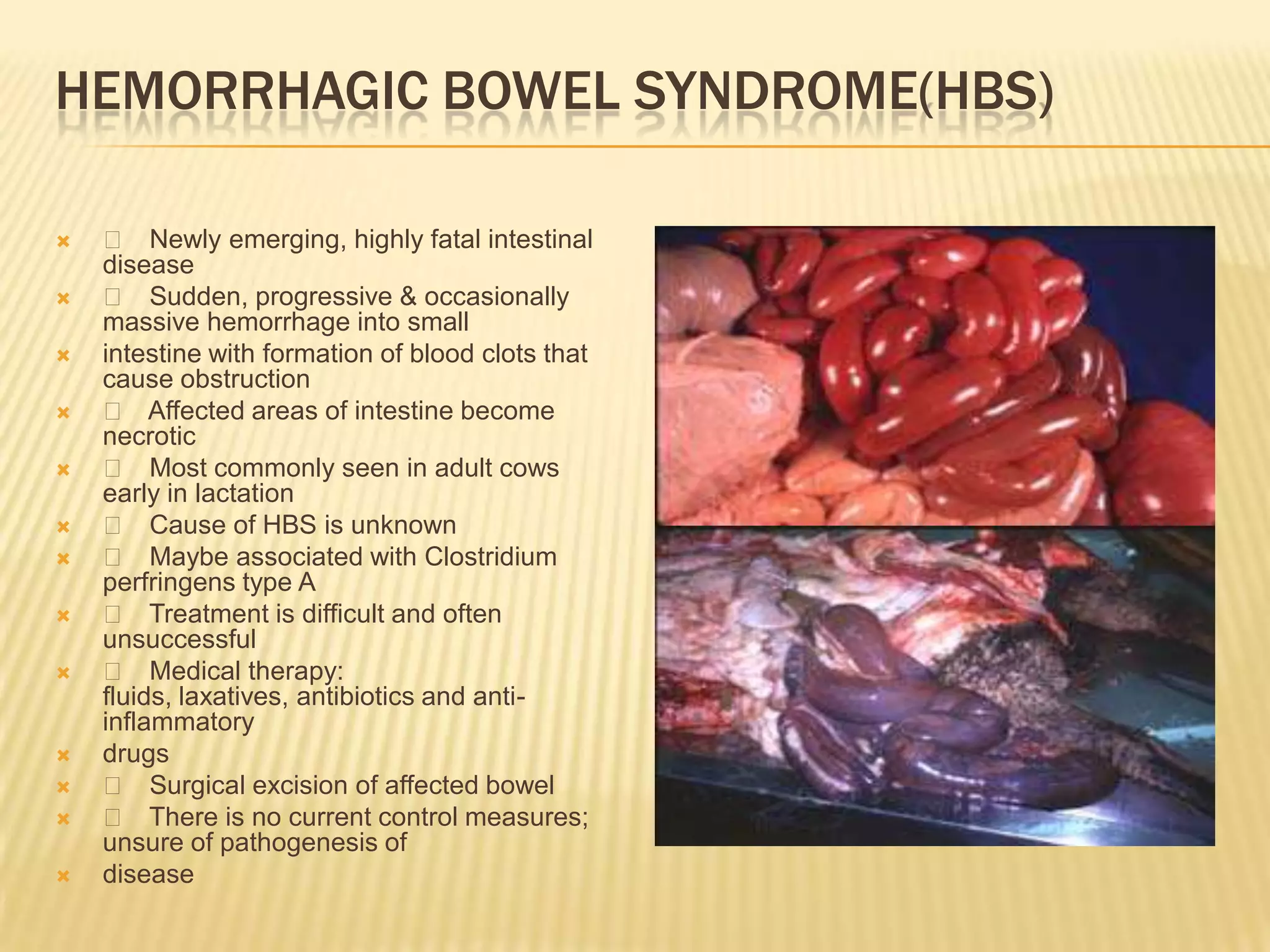
HEMORRHAGIC BOWEL SYNDROME(HBS)
 􀂄 Newly emerging, highly fatal intestinal
disease
 􀂄 Sudden, progressive & occasionally
massive hemorrhage into small
 intestine with formation of blood clots that
cause obstruction
 􀂄 Affected areas of intestine become
necrotic
 􀂄 Most commonly seen in adult cows
early in lactation
 􀂄 Cause of HBS is unknown
 􀂄 Maybe associated with Clostridium
perfringens type A
 􀂄 Treatment is difficult and often
unsuccessful
 􀂄 Medical therapy:
fluids, laxatives, antibiotics and anti-
inflammatory
 drugs
 􀂄 Surgical excision of affected bowel
 􀂄 There is no current control measures;
unsure of pathogenesis of
 disease
MILK FEVER
 􀂄 Hypocalcemia
 􀂄 Ca mobilization unable to keep
up with demand
 􀂄 Calcium moves from blood to
mammary gland
 􀂄 􀂄 Requires increased
absorption of calcium from feed
 􀂄 Requires increased resorption
of calcium from bone
 􀂄 Associated with blood changes
 􀂄 Hypophosphatemia
 􀂄 Hypermagnesemia
 􀂄 Hyperglycemia
 􀂄 Most cases in first 24 hours
post-calving
 􀂄 Higher frequency in older cows
 􀂄 Higher frequency in Jerseys
 Symptoms
 .. No fever, ears and teats actually
become
 hypothermic
 .... Loss of appetite
 .. Feed remains in rumen, calcium is
essential for gut
 motility
 .. Pulse and respiration rate increase
 .. Milk fever is 100% fatal if untreated
 .. After treatment, secondary
problems may occur
 .. Degeneration of muscle, nerve
paralysis from laying too
 long
 .. Injuries from staggering and falling
MASTITIS
 Pathogens colonize mammary
gland
 􀂄 Spread by milking
machines, milkers & cow to
 cow
 􀂄 Streptococcus agalactiae
 􀂄 Streptococcus dysgalactiae
 􀂄 Staphylococcus aureus
 􀂄 Mycoplasma bovis
 Important to maintain sanitary
conditions
 Mastitis Signs and Symptoms
 􀂄 Acute mastitis
 􀂄 Udder is hot, very hard, and
tender
 􀂄 Increase in temperature,
refusal to eat, dull eyes,
 􀂄 Increase in blood proteins
and leukocytes in
 mammary tissue and milk
 􀂄 Blood vessels greatly dilated
 􀂄 Milk ducts compressed
 􀂄 Treatments more likely to be
unsuccessful under these
 conditions
 Mastitis
 􀂄 Sphincter open in high-
pathogen environment
 􀂄 Neutrophil function
compromised by low Ca
 􀂄 Increases risk of ketosis
 􀂄 Depression of feed intake is
long-term
 􀂄 Dystocia
 􀂄 Pre-calving hypocalcemia
 􀂄 No uterine contractions
 􀂄 Uterine prolapse
 Incomplete first milking
 .. Increased incidence of mastitis
 .. Preventative feeding strategies
 .. Limit calcium intake during dry
period
 .. Not practical
 .. Limit potassium intake in forages
fed to dry cows
 .. More important
 .. By increasing concentration of
anions in diet, it
 becomes acidogenic
 .. Decreases blood pH, much less
susceptible to milk fever
 .. Increases calcium resorption from
bone
 .. Reduces severity of hypocalcemia
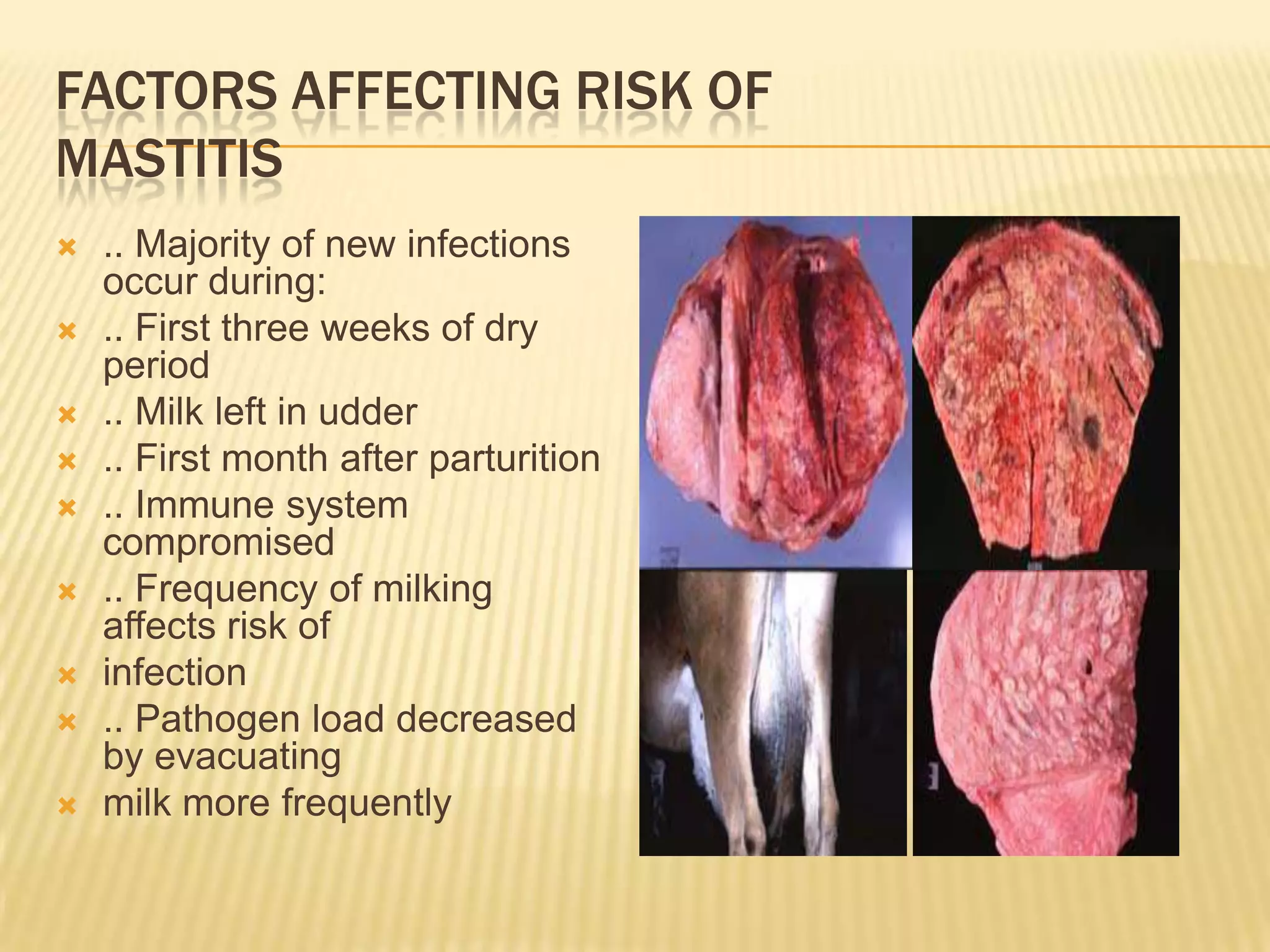
FACTORS AFFECTING RISK OF
MASTITIS
 .. Majority of new infections
occur during:
 .. First three weeks of dry
period
 .. Milk left in udder
 .. First month after parturition
 .. Immune system
compromised
 .. Frequency of milking
affects risk of
 infection
 .. Pathogen load decreased
by evacuating
 milk more frequently
TREATMENT
 􀂄 Slow infusion of calcium
intravenously
 􀂄 Rapid delivery will cause heart
to stop
 􀂄 Some animals need second
treatment 8 hours after the
 first treatment
 􀂄 Some herds regularly use oral
calcium gels at
 calving to improve calcium status
 􀂄 Calcium chloride problematic
 􀂄 Calcium propionate preferred
 􀂄 Can be used as stand-alone
treatment, in conjunction with
 IV calcium, or as prevention
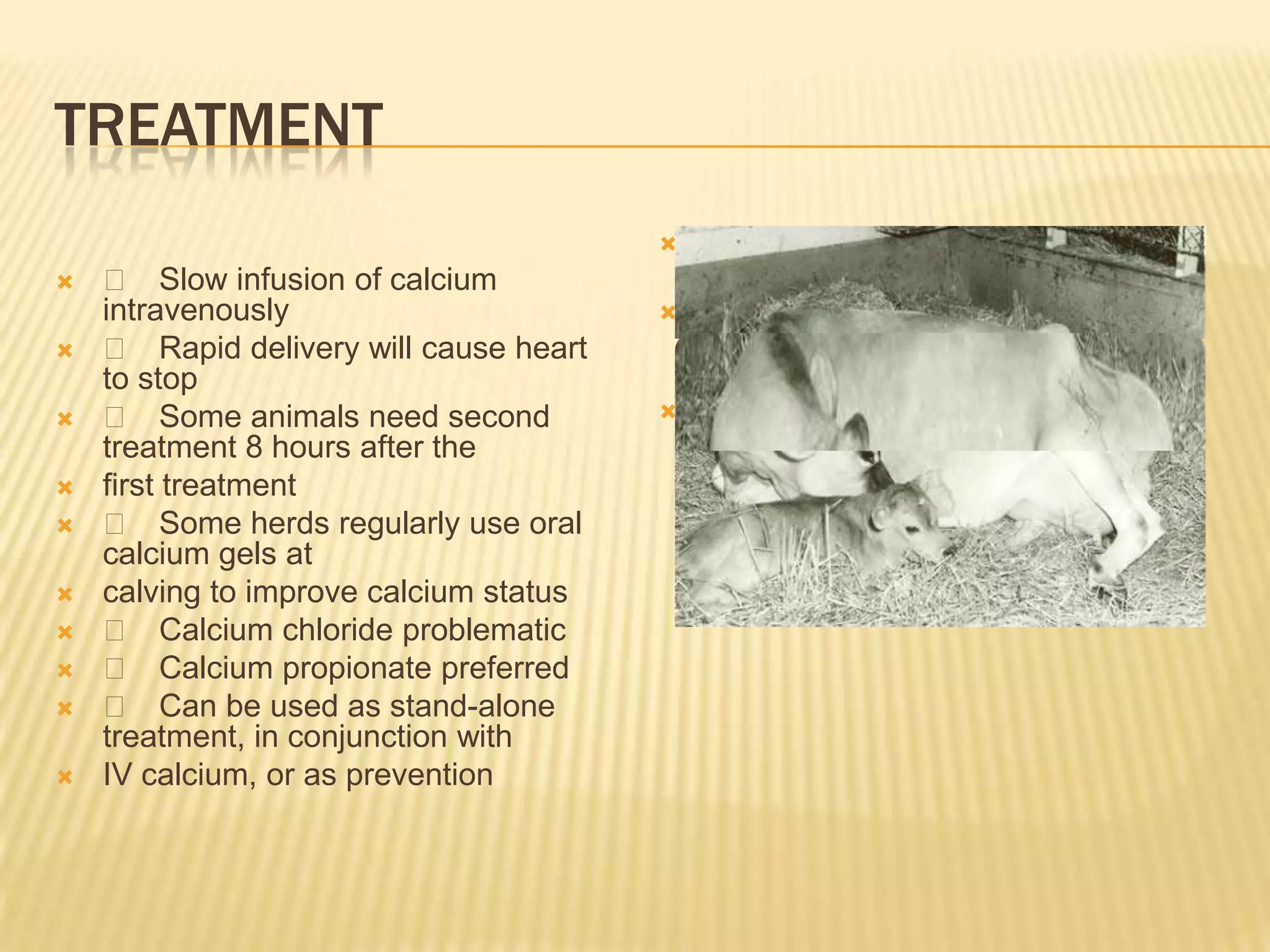
 Cows with milk fever will typically
tuck their head back
 against their flank (Courtesy of
University of IllCows with milk fever
will typically tuck their head back
 against their flank (Courtesy of
University of llinois)inois)
PREVENTION
 􀂄 Clean and dry
environment
 􀂄 Clean and dry teats at
milking
 􀂄 Teat dips (pre- and post-
milking)
 􀂄 Properly maintained
equipment
 􀂄 Early identification
 􀂄 Prompt treatment
 Teat dips are only
effective if adequate
coverage of all teats is
 accomplished (Courtesy
of Mark Kirkpa
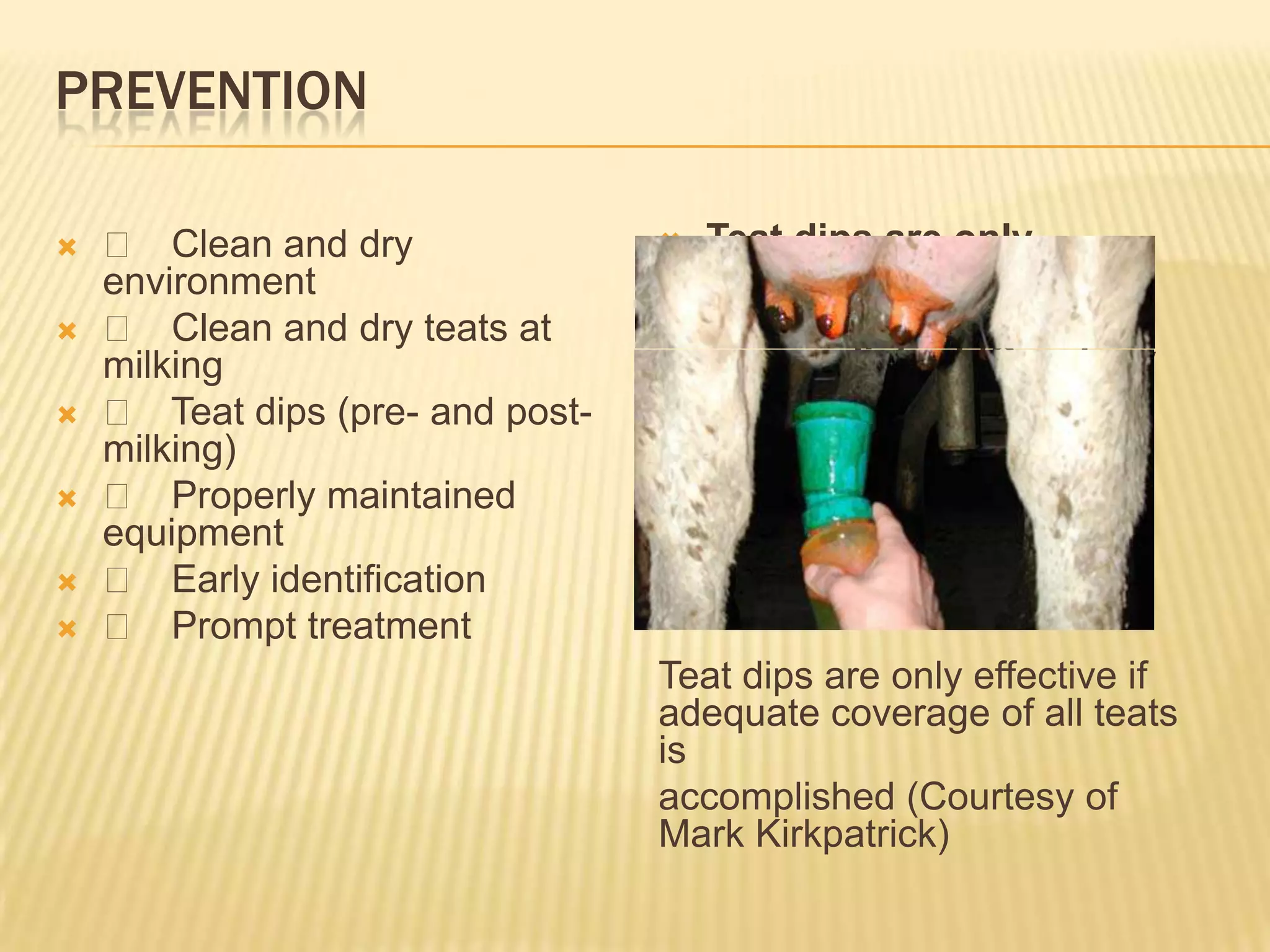
Teat dips are only effective if
adequate coverage of all teats
is
accomplished (Courtesy of
Mark Kirkpatrick)
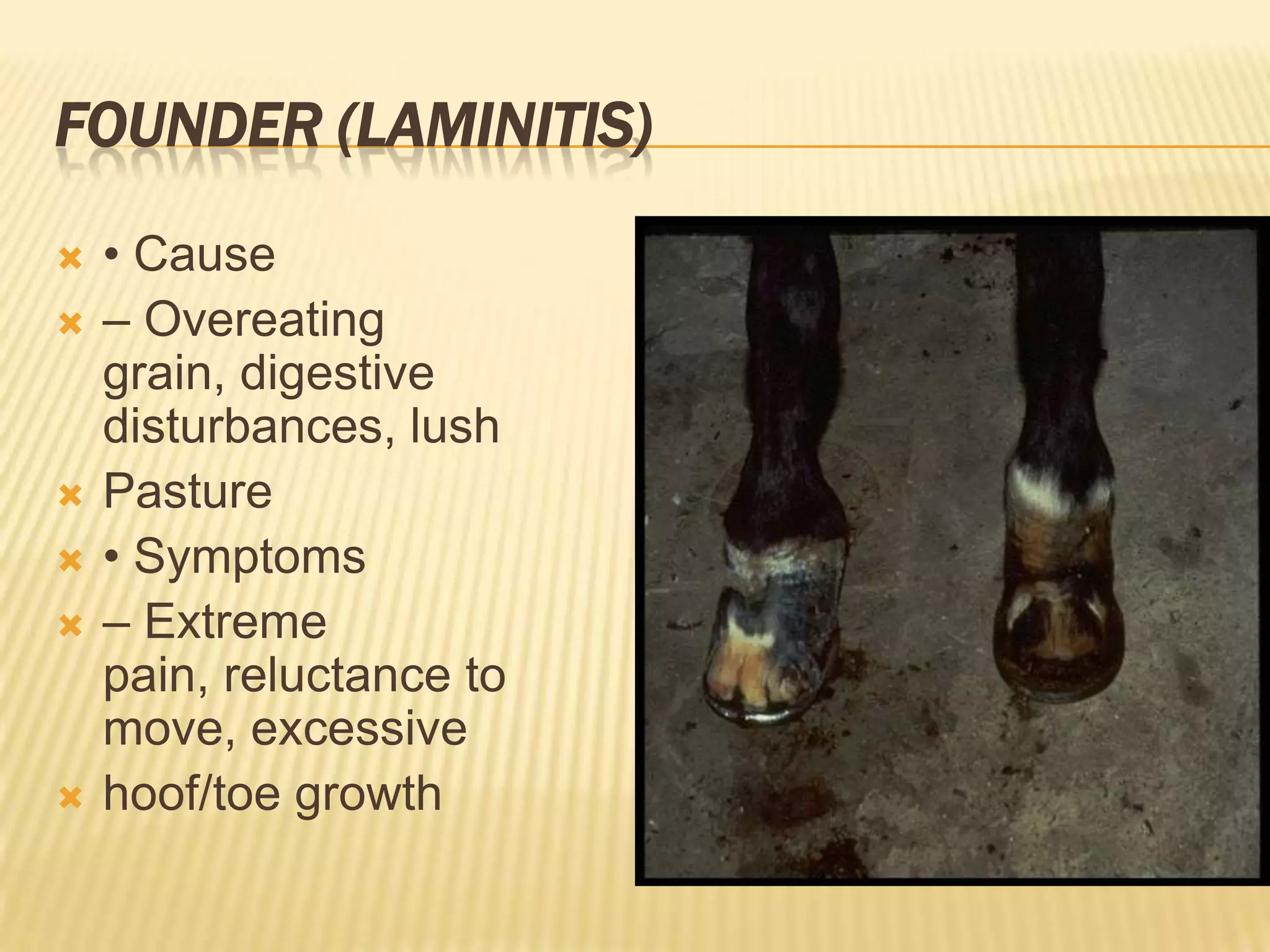
LAMINITIS
 .. Separation of epidermal laminae from
dermal laminae of hoof
 .. Causes in cattle include:
 .. Carbohydrate
overload, metritis, ketosis, mastitis and a
heritable form in
 Jerseys.
 .. Foot rot or hoof damage and secondary
infection can result in laminitis in cattle
 (Bacteroides nodosus, Fusobacterium
necrophorum )
 .. Typical Clinical Findings:
 .. Pain, lameness, abnormal
stance, reluctance to move
 .. Pounding digital pulses, increased
temperature of hoof wall
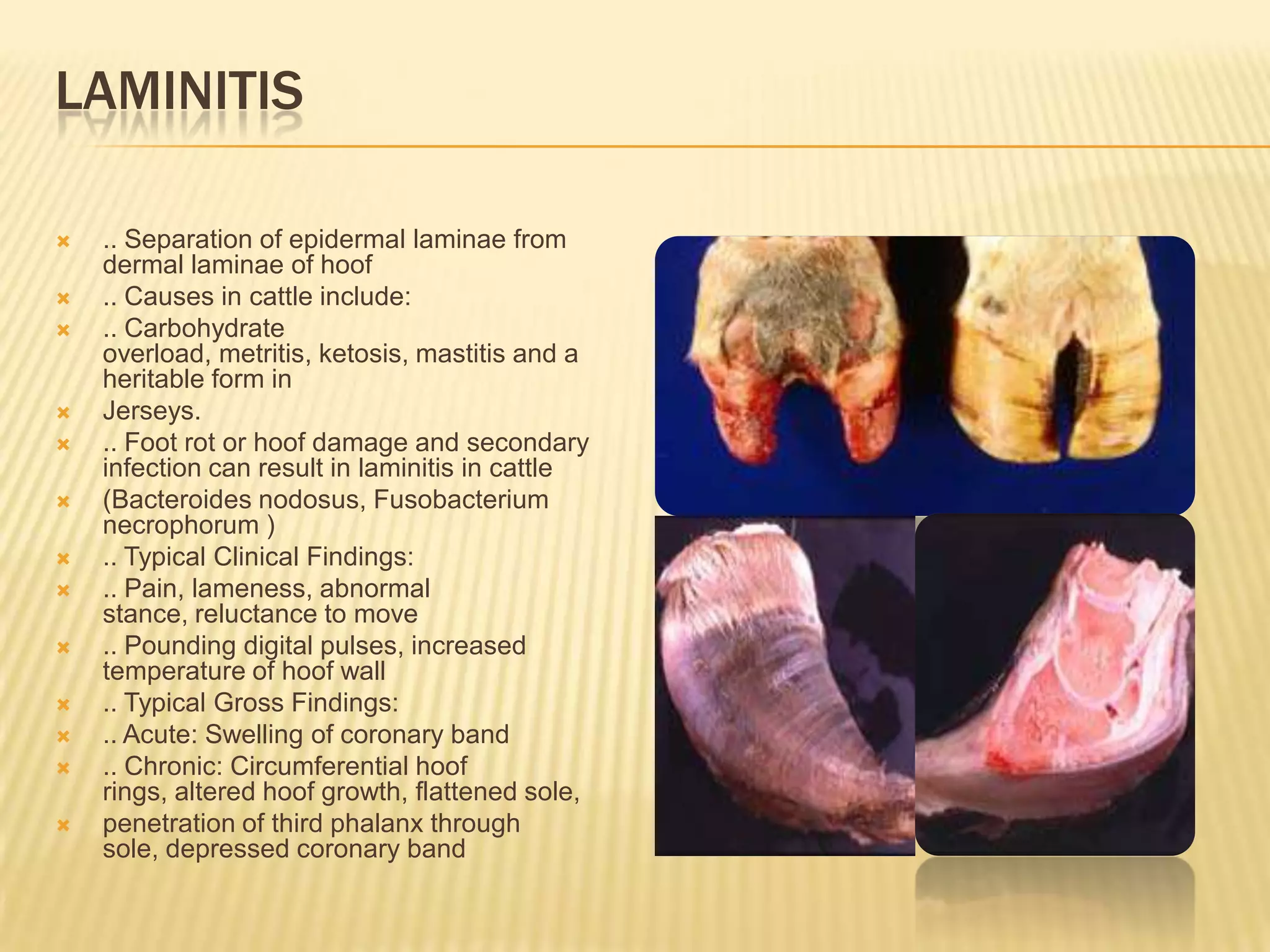
 .. Typical Gross Findings:
 .. Acute: Swelling of coronary band
 .. Chronic: Circumferential hoof
rings, altered hoof growth, flattened sole,
 penetration of third phalanx through
sole, depressed coronary band
FOUNDER (LAMINITIS)
 • Cause
 – Overeating
grain, digestive
disturbances, lush
 Pasture
 • Symptoms
 – Extreme
pain, reluctance to
move, excessive
 hoof/toe growth
THANKYOU FOR ATTENTION
PRESENTED BY:DR.IRFAN BHATTI
PRESENTED TO:DR.JAMIL AHMAD
CLASS :DVM(IST SEMMESTER)
DEPT.BZU,COLLEGE OF VERINARY
SCIENCES LAYYAH.
E.MAIL:BZUVETSCARECLUBLAYYAH@YAHO
O.COM

Metabolic disorders of livestock ppt.

  • 1.
    METABOLIC DISORDERS OFLIVESTOCK Inborn errors of metabolism occur from a group of rare genetic disorders Disorders caused by defects in the enzymes
  • 2.
    PASTURE BLOAT  •Cause  – High legume pastures produce more foam  • Heavy foam traps gasses
  • 3.
    ENTEROTOXEMIA (OVER-EATING DISEASE) • Cause –Toxin produced by clostridium perfringens bacteria that grow when fed high energy feeds or lush pastures • Symptoms – Sudden death – Can be prevented by vaccination
  • 4.
    GRASS TETANY (GRASSSTAGGERS) • Cause – Low blood Mg and in many cases low blood Ca – Cattle grazing on lush grass pastures in latter stages of gestation or early lactation • Symptoms – Nervousness, staggering, convulsi ons, coma and death
  • 5.
    KETOSIS • Cause – CHO-low blood sugar – High energy demand pulls down fat reserves rapidly • Symptoms – Loss of appetite, acetone (sweetish chloroformlike smell) odor from milk, urine and breath
  • 6.
     Night Blindness • Cause  – Vitamin A deficiency  • Symptoms  • Roughened hair and scaly skin with mild deficiency  • Prolonged deficiency leads to poor vision in dim  light and eye ulceration  Nitrate poisoning  • Cause  – Excessive levels of nitrate plant material  • Symptoms  – Bluish coloration of membranes, staggering,  shortness of breath and death
  • 7.
    LIVER ABSCESSES  •Cause  – High concentrate rations  • Symptoms  – Symptoms include reduced feed intake and gain  – Can be prevented with antibiotics  Pregnancy disease of ewes  • Cause  – Ewes carrying twins or triplets in the last 6  weeks of gestation  – Insufficient CHO - low blood sugar  • Symptoms  – Ketosis in sheep
  • 8.
    PARTURIENT PARESIS MILK FEVER,HYPOCALEMIA • Cause – Low blood Calcium – Usually occurs within 72 hours following parturition – Ewes in the latter stages of gestation • Symptoms – Loss of appetite, nervousness, collapse, head turned back toward flank
  • 9.
    NUTRITIONAL SECONDARY HYPER- PARATHYROIDISM Itis nutritional/ metabolic disorder caused by elevation of parathyroid hormone (PTH), usually secondary to poor nutrition. All meat or all grain diet is rich in P which is responsible for this disorder. Low calcium and Vitamin D and malabsorption also cause hypocalcaemia. Increased PTH causes bone resorption, & Ca, thus, mobilized is transferred to extra-cellular fluid. Depletion of bone osteoid leads to deformities, fractures and loss of structural support.
  • 10.
    DISPLACED ABOMASUM  ..Refers to repositioning of abomasal  compartment from the right ventral  abdominal wall  .. Twisting from this repositioning slows or stops  flow of digesta  .. Gas buildup leads to bloat appearance  .. “Pinging” detected with stethoscope by thumping the  cow near the last rib and listening on the left flank  .. 85-90% left-sided  .. Right-sided more complete torsion  .. 75% occur within 1st 14 days postcalving  .. Rare in heifers  Abomasum = A  Rumen = B  C = Omasum  Abomasum = A  Rumen = B  C = Omasum  D = Liver
  • 11.
     Symptoms ofDA  􀂄 Dramatically decreased feed intake  􀂄 Drastic drop in milk production  􀂄 Pain (stand with back arched)  􀂄 Can diagnose by “thumping” near last  rib and listening along left flank  Causes and Risk Factors  􀂄 Space in abdominal cavity  􀂄 Decreased feed intake  􀂄 Sudden ration changes  􀂄 􀂄 Hypocalcemia allows stagnant gut and gas  buildup in abomasum  􀂄 High grain feeding (high VFA production)  prior to proper rumen papillae development  􀂄 Over 2/3 of cases are preceded by a different  metabolic disorder  􀂄 Cows with high condition scores at parturition  are more prone to displacements
  • 12.
    DISPLACED ABOMASUM  􀂄When abomasal attachments stretch during  pregnancy, this may increase risk for  developing a DA  􀂄 Genetics of the animal may also affect the  predisposition to this disorder  􀂄 Resting positions may affect risk for DA  􀂄 Resting on left side reduces risk of LDA relative to  resting on right side  Non-surgical treatment  􀂄 Removal of gas from abomasum  􀂄 Rolling cow over, taking on rough trailer ride  􀂄 Tethering of right hind leg  􀂄 87% recovery rate  Prevention  􀂄 Prevent other metabolic diseases  􀂄 Cows should be in proper body condition at  parturition  􀂄 Cows fed to encourage maximal intake  􀂄 Prevent hypocalcemia  􀂄 Encourage cows to lie on left side  􀂄 Cows lie with hooves downhill  􀂄 Stall/Barn design may affect incidence
  • 13.
    HEMORRHAGIC BOWEL SYNDROME(HBS) 􀂄 Newly emerging, highly fatal intestinal disease  􀂄 Sudden, progressive & occasionally massive hemorrhage into small  intestine with formation of blood clots that cause obstruction  􀂄 Affected areas of intestine become necrotic  􀂄 Most commonly seen in adult cows early in lactation  􀂄 Cause of HBS is unknown  􀂄 Maybe associated with Clostridium perfringens type A  􀂄 Treatment is difficult and often unsuccessful  􀂄 Medical therapy: fluids, laxatives, antibiotics and anti- inflammatory  drugs  􀂄 Surgical excision of affected bowel  􀂄 There is no current control measures; unsure of pathogenesis of  disease
  • 14.
    MILK FEVER  􀂄Hypocalcemia  􀂄 Ca mobilization unable to keep up with demand  􀂄 Calcium moves from blood to mammary gland  􀂄 􀂄 Requires increased absorption of calcium from feed  􀂄 Requires increased resorption of calcium from bone  􀂄 Associated with blood changes  􀂄 Hypophosphatemia  􀂄 Hypermagnesemia  􀂄 Hyperglycemia  􀂄 Most cases in first 24 hours post-calving  􀂄 Higher frequency in older cows  􀂄 Higher frequency in Jerseys  Symptoms  .. No fever, ears and teats actually become  hypothermic  .... Loss of appetite  .. Feed remains in rumen, calcium is essential for gut  motility  .. Pulse and respiration rate increase  .. Milk fever is 100% fatal if untreated  .. After treatment, secondary problems may occur  .. Degeneration of muscle, nerve paralysis from laying too  long  .. Injuries from staggering and falling
  • 15.
    MASTITIS  Pathogens colonizemammary gland  􀂄 Spread by milking machines, milkers & cow to  cow  􀂄 Streptococcus agalactiae  􀂄 Streptococcus dysgalactiae  􀂄 Staphylococcus aureus  􀂄 Mycoplasma bovis  Important to maintain sanitary conditions  Mastitis Signs and Symptoms  􀂄 Acute mastitis  􀂄 Udder is hot, very hard, and tender  􀂄 Increase in temperature, refusal to eat, dull eyes,  􀂄 Increase in blood proteins and leukocytes in  mammary tissue and milk  􀂄 Blood vessels greatly dilated  􀂄 Milk ducts compressed  􀂄 Treatments more likely to be unsuccessful under these  conditions
  • 16.
     Mastitis  􀂄Sphincter open in high- pathogen environment  􀂄 Neutrophil function compromised by low Ca  􀂄 Increases risk of ketosis  􀂄 Depression of feed intake is long-term  􀂄 Dystocia  􀂄 Pre-calving hypocalcemia  􀂄 No uterine contractions  􀂄 Uterine prolapse  Incomplete first milking  .. Increased incidence of mastitis  .. Preventative feeding strategies  .. Limit calcium intake during dry period  .. Not practical  .. Limit potassium intake in forages fed to dry cows  .. More important  .. By increasing concentration of anions in diet, it  becomes acidogenic  .. Decreases blood pH, much less susceptible to milk fever  .. Increases calcium resorption from bone  .. Reduces severity of hypocalcemia
  • 17.
    FACTORS AFFECTING RISKOF MASTITIS  .. Majority of new infections occur during:  .. First three weeks of dry period  .. Milk left in udder  .. First month after parturition  .. Immune system compromised  .. Frequency of milking affects risk of  infection  .. Pathogen load decreased by evacuating  milk more frequently
  • 18.
    TREATMENT  􀂄 Slowinfusion of calcium intravenously  􀂄 Rapid delivery will cause heart to stop  􀂄 Some animals need second treatment 8 hours after the  first treatment  􀂄 Some herds regularly use oral calcium gels at  calving to improve calcium status  􀂄 Calcium chloride problematic  􀂄 Calcium propionate preferred  􀂄 Can be used as stand-alone treatment, in conjunction with  IV calcium, or as prevention  Cows with milk fever will typically tuck their head back  against their flank (Courtesy of University of IllCows with milk fever will typically tuck their head back  against their flank (Courtesy of University of llinois)inois)
  • 19.
    PREVENTION  􀂄 Cleanand dry environment  􀂄 Clean and dry teats at milking  􀂄 Teat dips (pre- and post- milking)  􀂄 Properly maintained equipment  􀂄 Early identification  􀂄 Prompt treatment  Teat dips are only effective if adequate coverage of all teats is  accomplished (Courtesy of Mark Kirkpa Teat dips are only effective if adequate coverage of all teats is accomplished (Courtesy of Mark Kirkpatrick)
  • 20.
    LAMINITIS  .. Separationof epidermal laminae from dermal laminae of hoof  .. Causes in cattle include:  .. Carbohydrate overload, metritis, ketosis, mastitis and a heritable form in  Jerseys.  .. Foot rot or hoof damage and secondary infection can result in laminitis in cattle  (Bacteroides nodosus, Fusobacterium necrophorum )  .. Typical Clinical Findings:  .. Pain, lameness, abnormal stance, reluctance to move  .. Pounding digital pulses, increased temperature of hoof wall  .. Typical Gross Findings:  .. Acute: Swelling of coronary band  .. Chronic: Circumferential hoof rings, altered hoof growth, flattened sole,  penetration of third phalanx through sole, depressed coronary band
  • 21.
    FOUNDER (LAMINITIS)  •Cause  – Overeating grain, digestive disturbances, lush  Pasture  • Symptoms  – Extreme pain, reluctance to move, excessive  hoof/toe growth
  • 22.
  • 23.
    PRESENTED BY:DR.IRFAN BHATTI PRESENTEDTO:DR.JAMIL AHMAD CLASS :DVM(IST SEMMESTER) DEPT.BZU,COLLEGE OF VERINARY SCIENCES LAYYAH. E.MAIL:BZUVETSCARECLUBLAYYAH@YAHO O.COM