TRANSMISSIBLE VENEREAL
TUMOR IN A BITCH
- A CASE STUDY

M.THAMIZHANNAL
BVM 06126
MADRAS VETERINARY COLLEGE
SIGNALME
NT
•
•
•
•
•
•
•

Case No: 122532
Owner's Name: Mr. Karthik
Address: Royapuram
Species: Canine
Breed: Boxer X
Age: 1.5yrs
Sex: Female
ANAMNESIS
• Animal was noticed of having a growth
in the vagina for the past 5 days
• Blood spotting wherever dog sits and
stands up
• Previously bred twice
• Last mating one month ago
GENERAL

INSPECTION
• General appearance: Normal
• Behaviour: Active & Alert
• Feeding habit: taking the routine
food given
• Urine and motion: Voided normally
• Abdominal palpation:
No abnormality detected
Vaginal
examination
• “ CHERRY RED
COLOURED
GROWTH ’’
DIGITAL EXAMINATION :
CAULIFLOWER LIKE GROWTH PALPATED
On 3.12.10(1 st day )
IMPRESSION
SMEAR
TUMOR CYTOLOGY
CONFIRMATORY DIAGNOSIS


TRANSMISSIBLE
VENEREAL
TUMOR
On 3.12.2010
• Inj. VINCRISTINE 0.025 mg/Kg
intravenously - Once a week
for 3 weeks
After one week on 10.12.10
COMPLETE BLOOD COUNT
3.12.10
Hb: 16.7g/dl
PCV: 45.6%
RBC:6.30Millions/Cumm
WBC count: 11,600 /Cumm
• DC: Neutrophils:72%
• Lymphocytes:22%
• Monocytes:3%
• Eosinophil:3%
• Basophil:

10.12.10
Hb: 16.4g/dl
PCV: 45.8%
RBC:6.40millions/Cumm
WBC count: 11,300 /Cumm
• DC: Neutrophils:76%
• Lymphocytes:20%
• Monocytes:2%
• Eosinophil:2%
• Basophil:
After two weeks on 17.12.10
CASE
DISCUSSION
TRANSMISSIBLE VENEREAL
TUMOR(TVT)
Novinsky in 1876
 Common neoplastic disease in
dog typically transmitted by
coitus
 No heritable breed
predisposition
 Histiocytic origin. Recent study
suggest an immature leucocytic
origin
•
•
•
•
•
•
•

Transmissible lymphosarcoma
Venereal granuloma
Canine condyloma
Venereal lymphosarcoma
Infectious sarcoma
Infectious lymphosarcoma
Sticker sarcoma
LETS..DISCUSS.…
• Common in free roaming dogs with poor control of
reproduction
• Young, sexually mature animals
• TVT - abnormal number of chromosomes range from
57 to 64 with an average of 59 in contrast to the
normal of 78
• Sub-tropical to tropical urban areas
• Females
TRANSMISSION
L
I
C
K
I
N
G

COITUS

SNIFFING
REPRODUCTIVE SITES
NON REPRODUCTIVE SITES
CLINICAL SIGNS
• Solitary Mass on the vaginal wall
with multiple nodules that are friable
in nature
• Deformation of external genitalia
• Cauliflower in shape, 4-7.5 cm in
diameter
• Reddish in colour, pedunculated,
papillary
• Abnormal oral odour
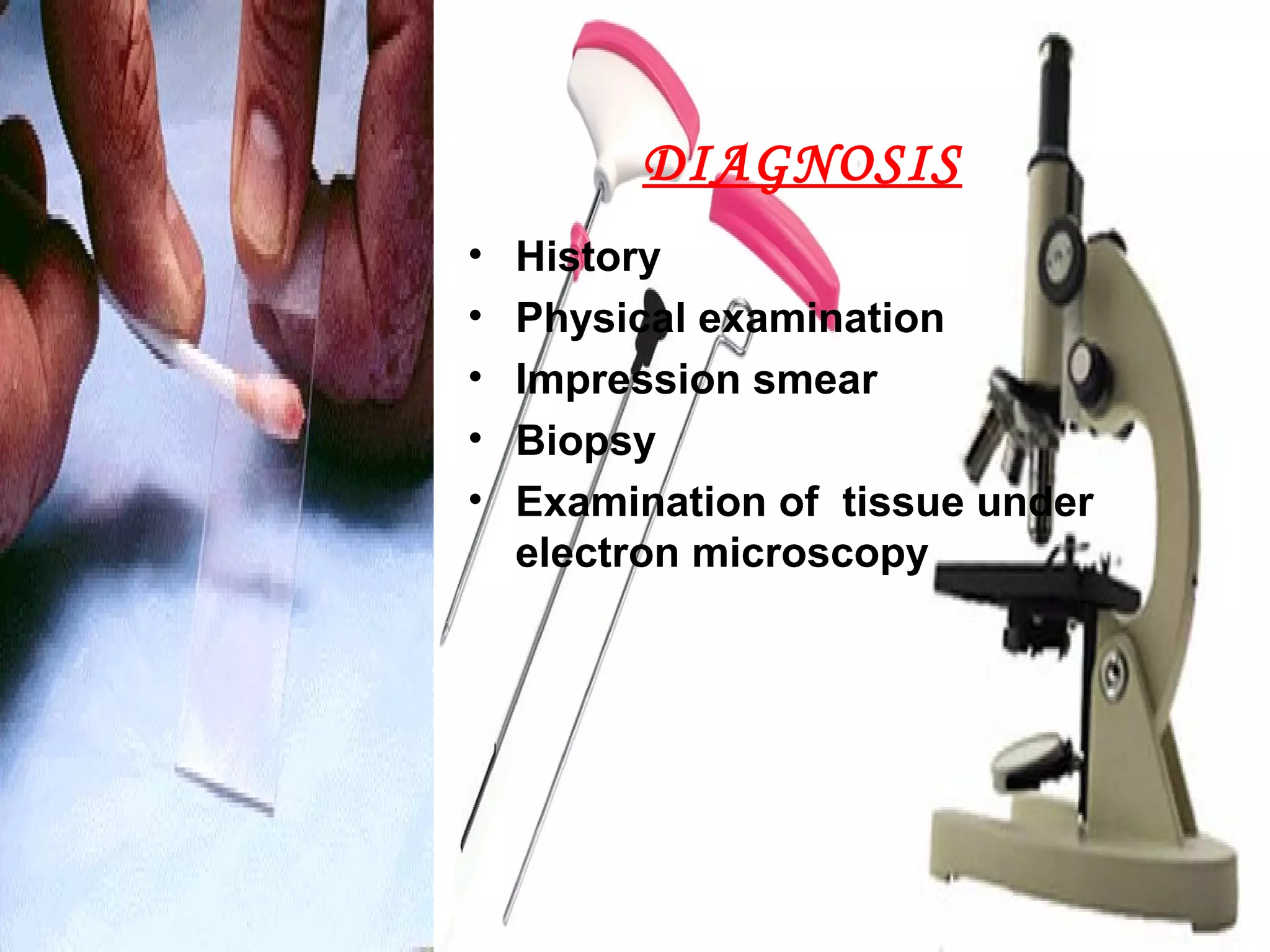
DIAGNOSIS
•
•
•
•
•

History
Physical examination
Impression smear
Biopsy
Examination of tissue under
electron microscopy
STAINS THAT CAN BE USED
•
•
•
•
•
•

Harris Haematoxylin and Eosin
Wright-Giemsa (WG)
May-Grunwald-Giemsa
Leishman-Giemsa
PAP stain
New methylene blue
TVT CELLS
Round
nucleus,
single
nucleolus,
and thin
rim of
basophilic,
vacuolated
cytoplasm
CELL CYTOLOGY DIFFERENTIAL DIAGNOSIS

multinucleated giant cell histiosarcoma

Canine_histiocytoma_ bean shaped

cytoplasmic granules – mast cell tumor

With cytoplasmic vacuoles – TVT
Vaginal hyperplasia
METASTASIS….?
 Uncommon (5-17%)
 Local lymph nodes, skin, eyes, liver, musculature,
subcutaneous tissue, spleen, oral mucosa,
peritoneum and bone marrow
• POSSIBILITY OF
SPONTANEOUS
REGRESSION..?
CHEMOTHE
RAPY
CYCLOPHOSPHAMIDE

VINCRISTINE

DOXORUBICIN
VINCRISTINE

Vinca rosea

Mechanism of action = mitosis block:
bind to tubulin and induce microtubule
depolymerization (Disassembly)

Dose-0.025mg/kg IV-once
a week(3-4 doses)
Strictly INTRAVENOUS

Tissue
sloughing

Necrotic skin lesion
caused by perivascular
leakage of vincristine
sulfate. Seven days after
application.

Fifteen days after
application
Effects of Vincristine
on Spermatogenesis..?
 Male dog fertility…?
 Testicular degeneration
 Increase in sperm mid piece
and tail abnormalities
 RECENT STUDIES-NOT
SUCH EFFECTS…!!!
 Total sperm count decreased
to low values (<200 x106)
DOXORUBICIN

Produced by fungus
Streptomyces percetus var
caesius.

Mechanisms of action:

DOXORUBICIN (Adriamycin)
30mg/m 2 IV-for every
21 days.2 doses

1) intercalation between DNA
base pairs
and inhibition of DNA
topoisomerases I & II
2) Altering membrane fluidity and
ion transport
METHOTREXATE & CYCLOPHOSPHAMIDE

DOSE 2.5mg/m 2 PO or
0.3-0.8mg/m2 IV

DOSE 50 mg/m 2 PO or IV 4 days/week
or
200 mg/m2 IV weekly
Chemotherapeutic side
effects
• Vincristine-Bone marrow
suppression,leukopenia,vomiting,
recumbency
• Doxorubicin,MethotrexateCARDIO TOXIC, RENAL FAILURE
alopecia, gastroenteritis,stomatitis.
• Immediate hypersensitivity reaction,
urticaria, facial swelling,
• Cyclophosphamide myelosuppression
RADIATION
THERAPY
COBALT – 60 at dose of
15Gy(10 to 18 Gy).
Three fractions
(Mon-Wed-Fri) 3 days
treatment

Available facility….?
CRYOTHERAPHY
 Localized freezing
 LIQUID NITROGEN -180 0 C
 LIQUID NITROUS OXIDE -800
 3-5 Weeks
 No pain
 Intratumoral application of Calmette-Guérin's bacillus
(BCG) was used for three weeks with sporadic
success.
 Biotherapy has unfortunately resulted in a high rate of
recurrence
I
• Staphylococcus
protein A, BCG or a
vaccine made fr om
tumor al cells.
• Recur rences
described after using
immunother apy.
SURGICAL
MANAGEMENT
• Recurrence rate :
•
20% to 60%.
HEALTH MANAGEMENT
REFERENCES

Canine and Feline Endocrinology and
Reproduction by Feldman and Nelson, W.B
Saunders,Third edition.924-927
Recent Advances in Small Animal
Reproduction, Concannon P.W., England G.,
Verstegen III J.and Linde-Forsberg C. (Eds.).
International Veterinary Information Service,
(www.ivis.org)
MY SINCERE THANKS to….
• Dr.RAJASUNDHARAM, Ph.D
• Dr.S.A.SRIDEVI, Ph.D
• Dr.CECILIA JOSEPH, Ph.D

Dept of ARGO
TRANSMISSIBLE VENEREAL TUMOR N DOGS

TRANSMISSIBLE VENEREAL TUMOR N DOGS