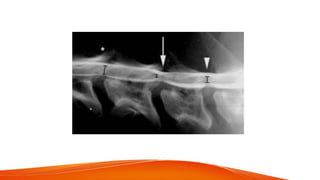
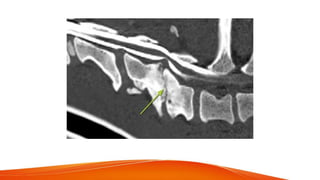
FRACTURES & LUXATION OF SPINE
Submitted to
Dr REKHA PATHAK and MERLIN MAMACHAN
Dept OF VETERINARY SURGERY AND RADIOLOGY
ICAR-IVRI
• Spine / vertebral column : Affected by intrinsic & extrinsic forces
• Intrinsic forces - musculature of abdomen & paraspinal
• Unit of spinal column - vertebrae , interposed soft tissue , ligaments , disc,
joint capsule , cartilage
• Ligamentous failure lead to spinal luxation
• Main site of fracture at vertebral body
• Dorsal component of canine spine - neural arch & assosciated ligaments
withstand tensile forces
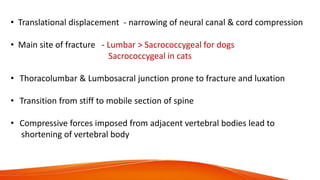
• Ventral component - body of vertebrae , intervertebral disc
withstand compressive forces
• Translational displacement - narrowing of neural canal & cord compression
• Main site of fracture - Lumbar > Sacrococcygeal for dogs
Sacrococcygeal in cats
• Thoracolumbar & Lumbosacral junction prone to fracture and luxation
• Transition from stiff to mobile section of spine
• Compressive forces imposed from adjacent vertebral bodies lead to
shortening of vertebral body
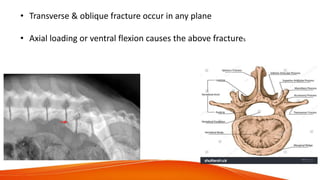
• Transverse & oblique fracture occur in any plane
• Axial loading or ventral flexion causes the above fractures
General treatment regimen in spinal injury
• Check CVS , pulmonary status , neurologic deficit
• Glucocorticoids given by i/v or epidural ( depomedrol ) - stabilize cellular &
lysosomal membrane , ↓ post traumatic catecholamine metabolism
• Mannitol & hypertonic saline i/v - control edema in brain & spinal cord
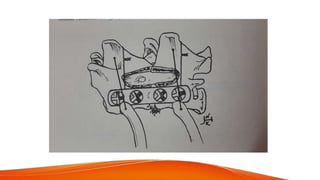
• Aminocaproic acid - antifibrinolytic agent to stabilize blood clot & haemorrhage
• Dimethyl sulfoxide - antiinflammatory , antiedema , vasodilation
• VD , Lateral view of spine , CT , Myelography , Fluroscopy
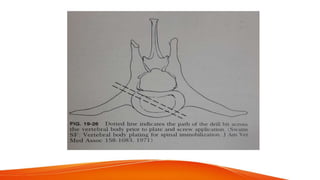
• Strict cage rest
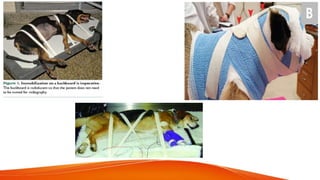
• Casting & splinting : Back splint anchored to head or pelvis
• Thermoplastic like orthoplast contoured to the shape of dorsum of body
• Aluminium sheet resembling sloped roof of house is applied to dorsum
with well cotton padding , then use elastikon to apply it to the body
SURGICAL TREATMENT
• Decompression of spinal cord - hemilaminectomy / dorsal laminectomy
• Fracture or luxation reduction
• Stabilization via internal fixation
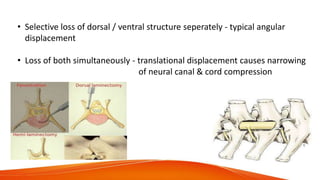
• Selective loss of dorsal / ventral structure seperately - typical angular
displacement
• Loss of both simultaneously - translational displacement causes narrowing
of neural canal & cord compression
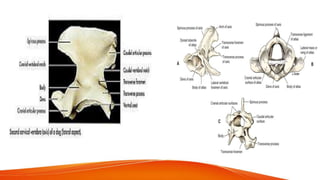
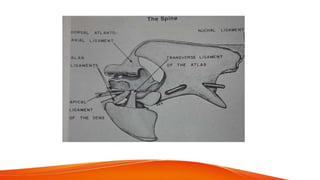
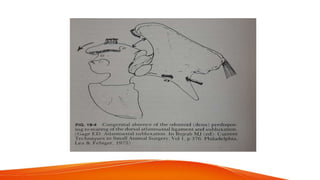
• Atlanto axial instability - subluxation of joint in small toy breeds
Hyperpathia , quadriplegia , respiratory arrest
• Congenital form - improper embryologic development of odontoid process
• Traumatic form - Bending force & displacement to cervical region
Translational & articular displacement of joint
• Hemilaminectomy : Craniolateral lamina of C2 & caudolateral of C1
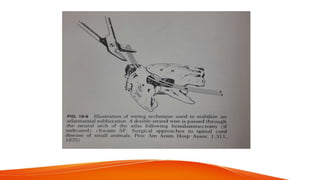
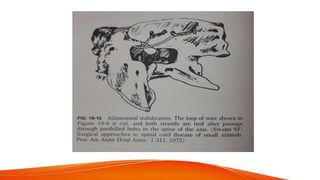
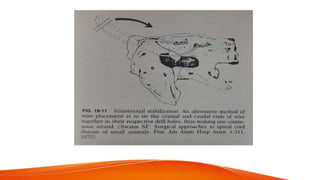
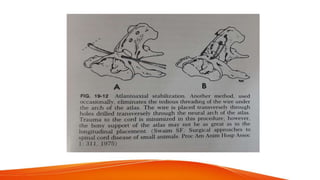
• Dorsal technique : Single or double stranded wiring of C1 & C2
2 holes on dorsal spinous process of axis
24 G orthopaedic wire passed under arch of atlas
wire loop cut and passed through predrilled holes
finally twisted
• Neck splint is done & bulky cotton padding from head to thoracic inlet
• Ventral technique : Ventral arch of atlas removed with rongeurs 0.5 cm
on each side of midline
Odontoid process removed & curette articular cartilage
Cancellous bone harvested from proximal humerus
harvested into the site
K pins directed bilaterally from body of axis across
the joint into the atlas
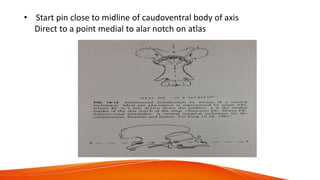
• Start pin close to midline of caudoventral body of axis
Direct to a point medial to alar notch on atlas
• Bilateral screws & wires through articular process of C4 & C5
• Ventral vertebral plating
• Dorsal vertebral fixation with screw provide better stabilization
THORACIC & LUMBAR FRACTURE FIXATION
• Application of plate & screws to the dorsal spinous process is most satisfactory
• Exceptions : lumbosacral junction ( small spinous process)
thoracic spine ( presence of rib head )
• Spinous process fixation : using stainless steel plate / polymer
metal plate are fastened via bolt through predrilled
hole in spinous process
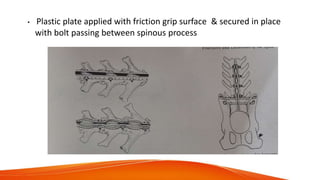
• Plastic plate applied with friction grip surface & secured in place
with bolt passing between spinous process
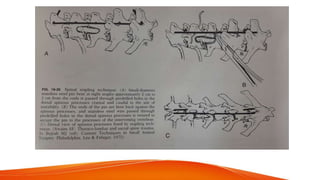
• Spinal stapling : Small diameter stainless steel pin bent at right angles
passed through predrilled holes in dorsal spinal process
cranial & caudal to instability
The end of pins are bent back against process
Stainless steel wire passed through the predrilled holes
in the spinous process is twisted to secure the pins
Vertebral body fixation
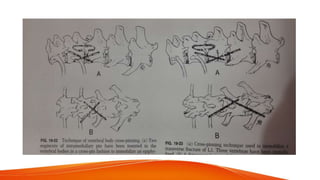
Vertebral cross pinning :
• For dogs less than 15 kg ; 0.045 cm to 0.062 cm diameter pins
• For dogs greater than 15 kg ; 0.1 to 0.2 cm diameter pins
• Dorsolateral approach on one side of spine
• Instability at or near vertebral space 2 pins are crossed diagonally in cranial
and caudal vertebral bodies
• Instability at or near vertebral space ; 2 pins are crossed
diagonally in cranial and caudal vertebral bodies
• Fracture at diaphysis of vertebral body , pin placement spans 3
vertebral bodies
• One pin inserted through middle of cranial vertebral body &
directed caudally
• It pass through middle of fractured vertebrae crossing fracture line
• 2 nd pin directed caudal to cranial
• For lumbar vertebrae , insert pin through dorsal aspect of lateral process
• For thoracic vertebrae , dorsal aspect of ribs is the site
• Always insert pin diagonally & ventrally
• Excellent resistance to shear & translational displacement
• Not recommended for comminuted vertebral body
fracture capable of collapse
VERTEBRAL BODY PLATES
• Incision length should take 3 complete intervertebral space
• Incision is carried ventrally to the level of transverse process of
lumbar spine / costovertebral junction of thoracic area
• Retract rib ventrally by cutting with bone cutting foreceps
• Wire is inserted into predrilled hole in rib head & fastened to
dorsal spinous process
• Screw holes predrilled on dorsolateral surface of vertebral body
• Drill is directed perpendicular to axis of spine & exit opposite
ventrolateral cortex
• Adequate angular , rotational, translational stability
• Withstand compressive force transmitted along vertebral bodies
• Preferred in area of vertebral body collapse & shortening
• Not preferred in lumbosacral area - lumbosacral plexus
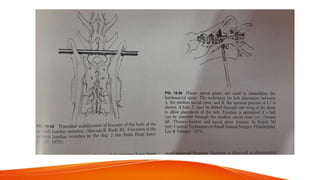
LUMBOSACRAL FRACTURES
• Reduction by traction on head & tail by assistants
• Elevate sacrum into normal position , if it is displaced cranioventrally
• Transilial pin inserted through gluteal muscle laterally over
caudal lamina of L7 & embedded in contralateral ilial wing
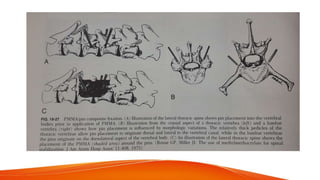
PMMA / PIN COMPOSITE FIXATION
• Site of incision - dorsal aspect of spine
• 2 bilateral pin secured cranially & caudally to fracture
• Pins are inserted through dorsolateral aspect of mid vertebral body
• Pins are cut at the level of articular process
• Apply saline soaked gelfoam on spinal cord before applying PMMA
• Make long cylinder of 2 cm diameter around laminectomy defect incorporat
• Iced RL applied to protect from thermal damage & necrosis of surrounding
tissues
• Suitable for any site of thoracolumbar spine
• Make long cylinder of 2 cm diameter around laminectomy defect
incorporating pins
• For mixing 4 minutes , 11 minutes for hardening
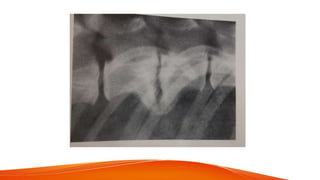
OSTEOMYELITIS OF VERTEBRAL BODY & INTERVERTEBRAL DISC -
DISCOSPONDYLITIS
• Concurrent intervertebral disc infection & vertebral osteomyelitis of
contiguous vertebrae
• S. aureus (most common) , B. canis , Nocardia ....
• Pathogenicity of offending organism or degree of inflammatory response to
penetrating foreign body
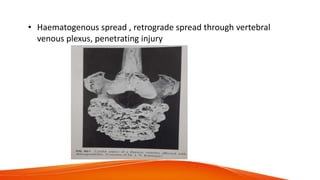
• Haematogenous spread , retrograde spread through vertebral
venous plexus, penetrating injury
• Local destructive process ; lysosomal activity subsequent to leukocyte
infiltration
• Destruction of bony trabeculae result into penetration of subchondral
end plate and extension into intervertebral disc
• Cord compression - infiltration of inflammatory cells, meningeal edema
• Septic diskitis - cord involvement , paraplegia
• Mostly seen in animals of age 8 months to 10 years
• Spinal pain , neurologic deficit , paresis / paraplegia - nerve root &
spinal cord compression
• Radiographic signs : narrowing of disc space , sclerosis ,
spondylosis, vertebral lysis
• Antibiotic therapy & confinement
• Cephalosporin , dicloxacillin, lincomycin
• B. canis - tetracycline ( 20 mg/kg TID P.O ) , streptomycin
• Debridement of vertebral disc
• Hemilaminectomy & dorsal laminectomy
SPONDYLOSIS DEFORMANS
• Non inflammatory degeneration of intervertebral disc & affect
vertebral bodies
• Bony spur formation , bony bridges around the disc & reestablish
stability to weak amphiarthrodial joint
• Periarticular in nature
• Osteophyte cause pressure on exiting spinal nerve root , neurologic deficit
• Large dog breeds
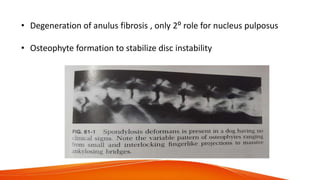
• Degeneration of anulus fibrosis , only 2⁰ role for nucleus pulposus
• Osteophyte formation to stabilize disc instability
• Changes in anulus fibrosis - major role in osteophyte formation
• Focal change in anulus lead to intra disc fissures ( ventral aspect mainly)
• Disc tissue almost disappears & adjacent vertebrae is ground , polished
• Site of osteophyte formation - intersection of vertebral body cortex with bony
end plate
• Multiple foci of fibrocartilage ; dystrophic calcification & unite vertebrae
• Ingrowth of blood vessels followed by destruction of calcified
cartilage & form mature trabecular bone
• They blend to vertebral cortex & shift to new bone growth
• Cats - thoracic spine main site
• Osteophyte seen around the circumference of end plate
• Seen as small size to massive ankylosing bridges
• Interlocking finger like projections ; more commonly seen
• Dorsolateral spur near intervertebral foramina seems like they project
into spinal canal
• Spondylosis deformans - generalized pattern & involves numerous disc space
• Hyervitaminosis A - bridging osteophyte in cats
• Solitary osteophyte - multiple osteochondromatosis in dog ( inside spinal cana
• End plate show sclerotic appearance , narrow intervertebral space
• Seperate ossification centre frequently seen in ventral aspect of anulus
- seems like fracture fragments
INTERVERTEBRAL DISC DISEASE
• Protrusion of IVD material into the spinal canal
• Mostly in chondrodystrophic breeds
• Manifested as pain, ataxia , sensorimotor paralysis
• Dynamic force at which IVD material compress spinal cord , degree of
hypoxia produced at spinal cord, mechanical displacement of cord
ANATOMY
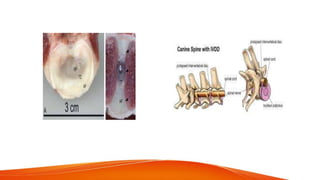
• Outer fibrocartilageneous material in concentric layers : anulus fibrosus
• Inner gelatinous material : nucleus pulposus , eccentrically located to
dorsal side
• Anulus fibrosus 2 times thicker ventrally
• 26 IVD ; largest at L7-S1
• Intercapital ligament courses dorsally from T2-T10 ; low incidence of IVDD
• Anulus fibrosus - stability , flexibility & shock absorption to spine
• Nucleus pulposus - shock absorption , equalizes force on IVD, fluid
exchange between vertebrae & IVD
• Cranial & caudal border - hyaline cartilagenous end plates &
cover epiphysis of vertebral bodies
PATHOPHYSIOLOGY OF IVDD
• Immature dogs - nucleus pulposus contain higher proteoglycans ,
glycoproteins
anulus fibrosus contain higher collagen content
• Degenerative changes as age ↑; collagen ↑ & pg ↓ in nucleus pulposus
• Loss of interstitial fluid alter gel consistency & reduces shock
absorbing power of nucleus pulposus
• Chondroid degeneration of IVD in chondrodystrophic breeds
• Mostly begins between 2 months & 2 years of age
• Finally results in mineralization of IVD
• Fibroid degeneration in non chondrodystrophic breeds
• Slow process , between 8 & 10 years of age
• Dorsal anulus degenerates and nucleus pulposus follows least
resistance pathway
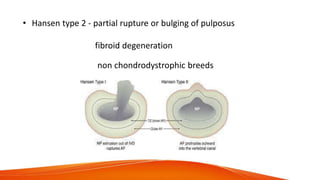
• Hansen type 1 - total rupture of anulus & massive extrusion of pulposus
Chondrodystrophic breeds
severe inflammatory response & neurologic signs
• Hansen type 2 - partial rupture or bulging of pulposus
fibroid degeneration
non chondrodystrophic breeds
• Effect of spinal cord compression more in thoracolumbar area - small ratio of
spinal canal to cord
• Cervical area , more diameter for spinal canal , more room for displacement
• Cervical IVDD - pain Thoracolumbar - paresis / paralysis
• Hypoxic changes occur due to mechanical & chemical damage to
spinal vasculature
• Slight demyelinization to total necrosis to gray & white matter
• Pain caused by pressure on nerve roots & on spinal cord
• Progressive venous stasis due to pressure on cord lead to spinal cord edema
• Haemorrhagic necrosis of neural tissue - progressive haeorrhagic
myelomalacia
• Animal in anxious appearance , sensorimotor loss , depressed hindlimb
reflex
CERVICAL IVD SYNDROME
• Neck guarding , muscle fasciculations about head & neck
• Most common in chondrodystrophic breeds
• Hyperesthesia of the neck & forelimbs , painful spasm , paresis , ataxia
• Pain is the hall mark of cervical IVD protrusion ; constant / intermittent
• Reflex alteration , proprioceptive deficits
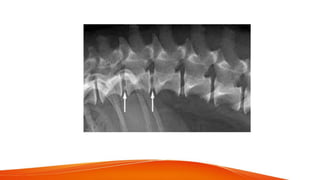
• Narrowing of IVD space , intervertebral foramen
• Cloudiness in the intervertebral foramen , presence of mineralized mass
above IVD space
• C2- C3 & C3 -C4 - more incidence of cervical IVD protrusion
• Medical management - Corticosteroid & cage confinement
Dexamethasone - 2 mg/kg initial dose , 0.2 to 0.3 mg/k
for 2 to 3 days
Muscle relaxants - Methocarbamol @ 10 mg/kg po
Chlorphenesin carbamate 50 mg/kg
• Curved haemostatic forceps positioned over center of ventral anulus & push it
downwards
• Haemostat are opened then to seperate longus colli musculature
• White ventral anulus is exposed ; cut a window using No. 11/15 scalpel
• Scoop out nucleus pulposus using bone curette / tartar scraper
• Same procedure done upto C5-C6
• Post operative - Cage rest , corticosteroids , muscle relaxants
SURGICAL MANAGEMENT
• Fenestration of cervical disc - prevent additional nucleus pulposus extruding
into canal
• Decompression - to remove IVD material from spinal canal
• Ventral approach better than dorsal ; less traumatic & less surgery time
VENTRAL FENESTRATION TECHNIQUE
• Incision site - ventral midline from base of larynx to the sternum
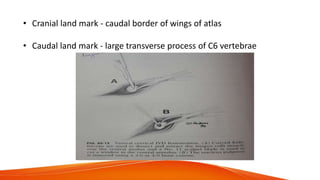
• Cranial land mark - caudal border of wings of atlas
• Caudal land mark - large transverse process of C6 vertebrae
DECOMPRESSSION OF CERVICAL SPINAL CORD
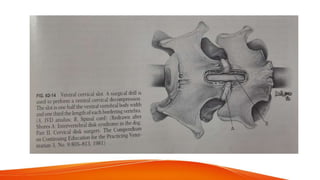
• Ventral slot technique - positioning same as of fenestration technique
• Cranial & caudal vertebrae of affected IVD identified
• Caudal ventral cervical vertebral process is removed using rongeurs
• Slot is made using surgical drill paralell to long axis of vertebrae
• Free fat graft / absorbable gelatin sponge is placed over the slot to control
haemorrhage
• Length caudal one third of cranial vertebrae & cranial one third
of caudal vertebrae
• Width should not exceed one half of vertebral body width
• Thin shelf of cortical bone , endosteum , dorsal anulus are
removed with tartar
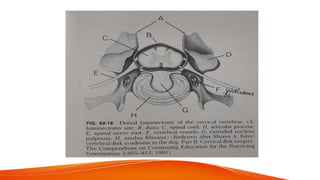
DORSAL LAMINECTOMY & HEMILAMINECTOMY
• Patient positioned in sternal recumbency with dorsiflexion of neck
• Skin incision from external occipital protuberance to dorsal spinous
process of T1
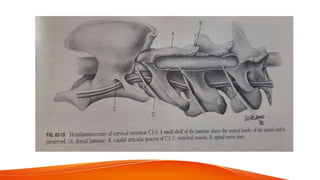
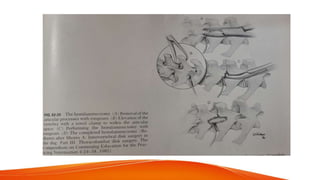
• Hemilaminectomy - create an opening in lateral laminae above the lesion
Enlarge it cranially & caudally with drill / rongeur , usually
1 to 2 vertebral length
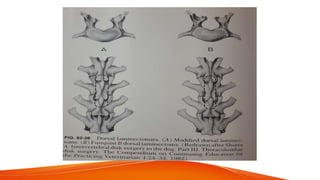
• Dorsal laminectomy - Removal of dorsal spinous process over the lesion with
rongeurs
Dorsal laminae removed with surgical drill
Laminectomy defect should be extended to medial aspect
of dorsal articular process & length of 2 to 3 vertebrae
• Dorsal limit is near the dorsal midline & ventral limit near floor
of spinal canal
THORACO LUMBAR IVD SYNDROME
• Paresis , paralysis , analgesia distal to spinal cord lesion
• UMN lesion - tensed bladder LMN lesion - flaccid bladder & anus , overflow
incontinence
• Loss of function
→
Proprioception , paresis , motor control , bladder control,
sensation
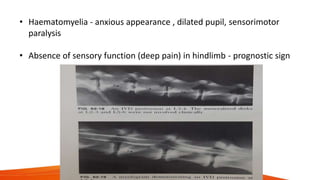
• Haematomyelia - anxious appearance , dilated pupil, sensorimotor
paralysis
• Absence of sensory function (deep pain) in hindlimb - prognostic sign
• Common site - T11 - 12
• Radiographic signs - narrowing of IVD space
narrowing & cloudiness of intervertebral foramen
abnormal spacing of articular process
presence of mineralized mass above IVD space
• Surgical management - Ventral fenestration
Lateral fenestration
Dorsolateral fenestration
Hemilaminectomy & Dorsal laminectomy
• Ventral fenestration - Prophylactic technique
Done only in animal with mild paresis
Hansen type II IVD protrusion
• IVD T11-12 through L3-4 are routinely fenestrated
• T10-11 IVD not common site ; intercapital ligament
• Patient in right lateral recumbency & paracostal incision is made
• Ventral anulus incised with No. 11/15 blade & nucleus removed using
small tartar scraper
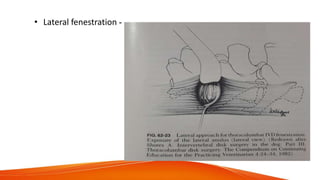
• Lateral fenestration -
• Hemilaminectomy - dorsolateral approach is best
• Identify the site of IVD protrusion ; remove articular process over it by
rongeurs
• Dorsal spinous process cranial to lesion clamped with towel calmp
• Perform hemilaminectomy using rongeur , length should be 1 vertebral
bodylength cranial and caudal to lesion
• Extruded material removed with curved blunt probe
• Dorsal laminectomy - Funquist B method & modified dorsal
laminectomy method
• Dorsal spinous process cranial & caudal to the lesion are removed
• Modified method - remove dorsal laminae to the junction of articular
process leave cranial articular process
• Funquist B method - done in similiar fashion , its width stops short of
articular process
CANINE WOBBLER SYNDROME
• Progressive cervical spinal cord compression ; caudal cervical vertebrae & its
articulations malformation
• Large breed dogs , great dane & doberman pinscher
• Vertebral malformation & malarticulations
• Stenosis of vertebral canal
• Overnutrition & overgrowth
• Osteoarthrosis of synovial joint due to stress ; uneven pressure on cartilage
• cartilage seperation & increased blood supply to subchondral bone
• Marginal osteophyte & osteocartilagenous joint mice
• DJD lead to ankylosis and direct / indirect compression on spinal cord
• Stenotic cranial orifice of vertebral foramen - hypercalcitonin
induced retardation of osteocytic osteolysis
• Hyperplasia of interarcuate ligament , joint capsule
• Stress on pedicle lead to direct pressure on articular process
ventrally & ↓ DV diameter
• Lateral spinal cord compression due to medial overgrowth of cranial
articular process
• Concomitant loss of cranioventral part of vertebral body & prominent
craniodorsal aspect
• Clinically presented as paraparesis - tetraparesis - ataxia
• Spinal cord compression , contusion lead to bilateral spastic paresis of
pelvic limb
• Base wide pelvic limb stance & crouched posture
• Dragging of limb on dorsal surface of digits , hypertonia ,
hyperreflexia
• Great deficit on hopping & proprioception
• Corticosteroid therapy - prednisolone 1 to 2 mg/kg loading dose
• Surgical treatment - dorsal decompressive laminectomy
ventral decompression
synovial joint arthrodesis
THANK YOU

spinal instability...pptx

  • 1.
    FRACTURES & LUXATIONOF SPINE Submitted to Dr REKHA PATHAK and MERLIN MAMACHAN Dept OF VETERINARY SURGERY AND RADIOLOGY ICAR-IVRI
  • 2.
    • Spine /vertebral column : Affected by intrinsic & extrinsic forces • Intrinsic forces - musculature of abdomen & paraspinal • Unit of spinal column - vertebrae , interposed soft tissue , ligaments , disc, joint capsule , cartilage • Ligamentous failure lead to spinal luxation • Main site of fracture at vertebral body • Dorsal component of canine spine - neural arch & assosciated ligaments withstand tensile forces
  • 3.
    • Ventral component- body of vertebrae , intervertebral disc withstand compressive forces
  • 4.
    • Translational displacement- narrowing of neural canal & cord compression • Main site of fracture - Lumbar > Sacrococcygeal for dogs Sacrococcygeal in cats • Thoracolumbar & Lumbosacral junction prone to fracture and luxation • Transition from stiff to mobile section of spine • Compressive forces imposed from adjacent vertebral bodies lead to shortening of vertebral body
  • 5.
    • Transverse &oblique fracture occur in any plane • Axial loading or ventral flexion causes the above fractures
  • 6.
    General treatment regimenin spinal injury • Check CVS , pulmonary status , neurologic deficit • Glucocorticoids given by i/v or epidural ( depomedrol ) - stabilize cellular & lysosomal membrane , ↓ post traumatic catecholamine metabolism • Mannitol & hypertonic saline i/v - control edema in brain & spinal cord • Aminocaproic acid - antifibrinolytic agent to stabilize blood clot & haemorrhage • Dimethyl sulfoxide - antiinflammatory , antiedema , vasodilation
  • 8.
    • VD ,Lateral view of spine , CT , Myelography , Fluroscopy • Strict cage rest • Casting & splinting : Back splint anchored to head or pelvis • Thermoplastic like orthoplast contoured to the shape of dorsum of body • Aluminium sheet resembling sloped roof of house is applied to dorsum with well cotton padding , then use elastikon to apply it to the body
  • 9.
    SURGICAL TREATMENT • Decompressionof spinal cord - hemilaminectomy / dorsal laminectomy • Fracture or luxation reduction • Stabilization via internal fixation
  • 10.
    • Selective lossof dorsal / ventral structure seperately - typical angular displacement • Loss of both simultaneously - translational displacement causes narrowing of neural canal & cord compression
  • 12.
    • Atlanto axialinstability - subluxation of joint in small toy breeds Hyperpathia , quadriplegia , respiratory arrest • Congenital form - improper embryologic development of odontoid process • Traumatic form - Bending force & displacement to cervical region Translational & articular displacement of joint • Hemilaminectomy : Craniolateral lamina of C2 & caudolateral of C1
  • 14.
    • Dorsal technique: Single or double stranded wiring of C1 & C2 2 holes on dorsal spinous process of axis 24 G orthopaedic wire passed under arch of atlas wire loop cut and passed through predrilled holes finally twisted
  • 21.
    • Neck splintis done & bulky cotton padding from head to thoracic inlet • Ventral technique : Ventral arch of atlas removed with rongeurs 0.5 cm on each side of midline Odontoid process removed & curette articular cartilage Cancellous bone harvested from proximal humerus harvested into the site K pins directed bilaterally from body of axis across the joint into the atlas
  • 22.
    • Start pinclose to midline of caudoventral body of axis Direct to a point medial to alar notch on atlas
  • 23.
    • Bilateral screws& wires through articular process of C4 & C5 • Ventral vertebral plating • Dorsal vertebral fixation with screw provide better stabilization
  • 24.
    THORACIC & LUMBARFRACTURE FIXATION • Application of plate & screws to the dorsal spinous process is most satisfactory • Exceptions : lumbosacral junction ( small spinous process) thoracic spine ( presence of rib head ) • Spinous process fixation : using stainless steel plate / polymer metal plate are fastened via bolt through predrilled hole in spinous process
  • 25.
    • Plastic plateapplied with friction grip surface & secured in place with bolt passing between spinous process
  • 26.
    • Spinal stapling: Small diameter stainless steel pin bent at right angles passed through predrilled holes in dorsal spinal process cranial & caudal to instability The end of pins are bent back against process Stainless steel wire passed through the predrilled holes in the spinous process is twisted to secure the pins
  • 28.
    Vertebral body fixation Vertebralcross pinning : • For dogs less than 15 kg ; 0.045 cm to 0.062 cm diameter pins • For dogs greater than 15 kg ; 0.1 to 0.2 cm diameter pins • Dorsolateral approach on one side of spine • Instability at or near vertebral space 2 pins are crossed diagonally in cranial and caudal vertebral bodies
  • 29.
    • Instability ator near vertebral space ; 2 pins are crossed diagonally in cranial and caudal vertebral bodies • Fracture at diaphysis of vertebral body , pin placement spans 3 vertebral bodies • One pin inserted through middle of cranial vertebral body & directed caudally
  • 30.
    • It passthrough middle of fractured vertebrae crossing fracture line • 2 nd pin directed caudal to cranial • For lumbar vertebrae , insert pin through dorsal aspect of lateral process • For thoracic vertebrae , dorsal aspect of ribs is the site • Always insert pin diagonally & ventrally
  • 31.
    • Excellent resistanceto shear & translational displacement • Not recommended for comminuted vertebral body fracture capable of collapse
  • 33.
    VERTEBRAL BODY PLATES •Incision length should take 3 complete intervertebral space • Incision is carried ventrally to the level of transverse process of lumbar spine / costovertebral junction of thoracic area • Retract rib ventrally by cutting with bone cutting foreceps
  • 34.
    • Wire isinserted into predrilled hole in rib head & fastened to dorsal spinous process • Screw holes predrilled on dorsolateral surface of vertebral body • Drill is directed perpendicular to axis of spine & exit opposite ventrolateral cortex
  • 35.
    • Adequate angular, rotational, translational stability • Withstand compressive force transmitted along vertebral bodies • Preferred in area of vertebral body collapse & shortening • Not preferred in lumbosacral area - lumbosacral plexus
  • 38.
    LUMBOSACRAL FRACTURES • Reductionby traction on head & tail by assistants • Elevate sacrum into normal position , if it is displaced cranioventrally • Transilial pin inserted through gluteal muscle laterally over caudal lamina of L7 & embedded in contralateral ilial wing
  • 40.
    PMMA / PINCOMPOSITE FIXATION • Site of incision - dorsal aspect of spine • 2 bilateral pin secured cranially & caudally to fracture • Pins are inserted through dorsolateral aspect of mid vertebral body • Pins are cut at the level of articular process • Apply saline soaked gelfoam on spinal cord before applying PMMA • Make long cylinder of 2 cm diameter around laminectomy defect incorporat
  • 41.
    • Iced RLapplied to protect from thermal damage & necrosis of surrounding tissues • Suitable for any site of thoracolumbar spine • Make long cylinder of 2 cm diameter around laminectomy defect incorporating pins • For mixing 4 minutes , 11 minutes for hardening
  • 43.
    OSTEOMYELITIS OF VERTEBRALBODY & INTERVERTEBRAL DISC - DISCOSPONDYLITIS • Concurrent intervertebral disc infection & vertebral osteomyelitis of contiguous vertebrae • S. aureus (most common) , B. canis , Nocardia .... • Pathogenicity of offending organism or degree of inflammatory response to penetrating foreign body
  • 44.
    • Haematogenous spread, retrograde spread through vertebral venous plexus, penetrating injury
  • 46.
    • Local destructiveprocess ; lysosomal activity subsequent to leukocyte infiltration • Destruction of bony trabeculae result into penetration of subchondral end plate and extension into intervertebral disc • Cord compression - infiltration of inflammatory cells, meningeal edema • Septic diskitis - cord involvement , paraplegia • Mostly seen in animals of age 8 months to 10 years
  • 47.
    • Spinal pain, neurologic deficit , paresis / paraplegia - nerve root & spinal cord compression • Radiographic signs : narrowing of disc space , sclerosis , spondylosis, vertebral lysis
  • 48.
    • Antibiotic therapy& confinement • Cephalosporin , dicloxacillin, lincomycin • B. canis - tetracycline ( 20 mg/kg TID P.O ) , streptomycin • Debridement of vertebral disc • Hemilaminectomy & dorsal laminectomy
  • 49.
    SPONDYLOSIS DEFORMANS • Noninflammatory degeneration of intervertebral disc & affect vertebral bodies • Bony spur formation , bony bridges around the disc & reestablish stability to weak amphiarthrodial joint • Periarticular in nature • Osteophyte cause pressure on exiting spinal nerve root , neurologic deficit • Large dog breeds
  • 50.
    • Degeneration ofanulus fibrosis , only 2⁰ role for nucleus pulposus • Osteophyte formation to stabilize disc instability
  • 51.
    • Changes inanulus fibrosis - major role in osteophyte formation • Focal change in anulus lead to intra disc fissures ( ventral aspect mainly) • Disc tissue almost disappears & adjacent vertebrae is ground , polished • Site of osteophyte formation - intersection of vertebral body cortex with bony end plate • Multiple foci of fibrocartilage ; dystrophic calcification & unite vertebrae
  • 52.
    • Ingrowth ofblood vessels followed by destruction of calcified cartilage & form mature trabecular bone • They blend to vertebral cortex & shift to new bone growth
  • 53.
    • Cats -thoracic spine main site • Osteophyte seen around the circumference of end plate • Seen as small size to massive ankylosing bridges • Interlocking finger like projections ; more commonly seen • Dorsolateral spur near intervertebral foramina seems like they project into spinal canal
  • 54.
    • Spondylosis deformans- generalized pattern & involves numerous disc space • Hyervitaminosis A - bridging osteophyte in cats • Solitary osteophyte - multiple osteochondromatosis in dog ( inside spinal cana • End plate show sclerotic appearance , narrow intervertebral space • Seperate ossification centre frequently seen in ventral aspect of anulus - seems like fracture fragments
  • 55.
    INTERVERTEBRAL DISC DISEASE •Protrusion of IVD material into the spinal canal • Mostly in chondrodystrophic breeds • Manifested as pain, ataxia , sensorimotor paralysis • Dynamic force at which IVD material compress spinal cord , degree of hypoxia produced at spinal cord, mechanical displacement of cord
  • 56.
    ANATOMY • Outer fibrocartilageneousmaterial in concentric layers : anulus fibrosus • Inner gelatinous material : nucleus pulposus , eccentrically located to dorsal side • Anulus fibrosus 2 times thicker ventrally • 26 IVD ; largest at L7-S1 • Intercapital ligament courses dorsally from T2-T10 ; low incidence of IVDD
  • 57.
    • Anulus fibrosus- stability , flexibility & shock absorption to spine • Nucleus pulposus - shock absorption , equalizes force on IVD, fluid exchange between vertebrae & IVD • Cranial & caudal border - hyaline cartilagenous end plates & cover epiphysis of vertebral bodies
  • 59.
    PATHOPHYSIOLOGY OF IVDD •Immature dogs - nucleus pulposus contain higher proteoglycans , glycoproteins anulus fibrosus contain higher collagen content • Degenerative changes as age ↑; collagen ↑ & pg ↓ in nucleus pulposus • Loss of interstitial fluid alter gel consistency & reduces shock absorbing power of nucleus pulposus
  • 60.
    • Chondroid degenerationof IVD in chondrodystrophic breeds • Mostly begins between 2 months & 2 years of age • Finally results in mineralization of IVD
  • 61.
    • Fibroid degenerationin non chondrodystrophic breeds • Slow process , between 8 & 10 years of age • Dorsal anulus degenerates and nucleus pulposus follows least resistance pathway • Hansen type 1 - total rupture of anulus & massive extrusion of pulposus Chondrodystrophic breeds severe inflammatory response & neurologic signs
  • 62.
    • Hansen type2 - partial rupture or bulging of pulposus fibroid degeneration non chondrodystrophic breeds
  • 63.
    • Effect ofspinal cord compression more in thoracolumbar area - small ratio of spinal canal to cord • Cervical area , more diameter for spinal canal , more room for displacement • Cervical IVDD - pain Thoracolumbar - paresis / paralysis • Hypoxic changes occur due to mechanical & chemical damage to spinal vasculature • Slight demyelinization to total necrosis to gray & white matter
  • 64.
    • Pain causedby pressure on nerve roots & on spinal cord • Progressive venous stasis due to pressure on cord lead to spinal cord edema • Haemorrhagic necrosis of neural tissue - progressive haeorrhagic myelomalacia • Animal in anxious appearance , sensorimotor loss , depressed hindlimb reflex
  • 65.
    CERVICAL IVD SYNDROME •Neck guarding , muscle fasciculations about head & neck • Most common in chondrodystrophic breeds • Hyperesthesia of the neck & forelimbs , painful spasm , paresis , ataxia • Pain is the hall mark of cervical IVD protrusion ; constant / intermittent • Reflex alteration , proprioceptive deficits
  • 67.
    • Narrowing ofIVD space , intervertebral foramen • Cloudiness in the intervertebral foramen , presence of mineralized mass above IVD space • C2- C3 & C3 -C4 - more incidence of cervical IVD protrusion • Medical management - Corticosteroid & cage confinement Dexamethasone - 2 mg/kg initial dose , 0.2 to 0.3 mg/k for 2 to 3 days Muscle relaxants - Methocarbamol @ 10 mg/kg po Chlorphenesin carbamate 50 mg/kg
  • 68.
    • Curved haemostaticforceps positioned over center of ventral anulus & push it downwards • Haemostat are opened then to seperate longus colli musculature • White ventral anulus is exposed ; cut a window using No. 11/15 scalpel • Scoop out nucleus pulposus using bone curette / tartar scraper • Same procedure done upto C5-C6 • Post operative - Cage rest , corticosteroids , muscle relaxants
  • 69.
    SURGICAL MANAGEMENT • Fenestrationof cervical disc - prevent additional nucleus pulposus extruding into canal • Decompression - to remove IVD material from spinal canal • Ventral approach better than dorsal ; less traumatic & less surgery time VENTRAL FENESTRATION TECHNIQUE • Incision site - ventral midline from base of larynx to the sternum
  • 70.
    • Cranial landmark - caudal border of wings of atlas • Caudal land mark - large transverse process of C6 vertebrae
  • 71.
    DECOMPRESSSION OF CERVICALSPINAL CORD • Ventral slot technique - positioning same as of fenestration technique • Cranial & caudal vertebrae of affected IVD identified • Caudal ventral cervical vertebral process is removed using rongeurs • Slot is made using surgical drill paralell to long axis of vertebrae
  • 72.
    • Free fatgraft / absorbable gelatin sponge is placed over the slot to control haemorrhage • Length caudal one third of cranial vertebrae & cranial one third of caudal vertebrae • Width should not exceed one half of vertebral body width • Thin shelf of cortical bone , endosteum , dorsal anulus are removed with tartar
  • 74.
    DORSAL LAMINECTOMY &HEMILAMINECTOMY • Patient positioned in sternal recumbency with dorsiflexion of neck • Skin incision from external occipital protuberance to dorsal spinous process of T1 • Hemilaminectomy - create an opening in lateral laminae above the lesion Enlarge it cranially & caudally with drill / rongeur , usually 1 to 2 vertebral length
  • 76.
    • Dorsal laminectomy- Removal of dorsal spinous process over the lesion with rongeurs Dorsal laminae removed with surgical drill Laminectomy defect should be extended to medial aspect of dorsal articular process & length of 2 to 3 vertebrae • Dorsal limit is near the dorsal midline & ventral limit near floor of spinal canal
  • 78.
    THORACO LUMBAR IVDSYNDROME • Paresis , paralysis , analgesia distal to spinal cord lesion • UMN lesion - tensed bladder LMN lesion - flaccid bladder & anus , overflow incontinence • Loss of function → Proprioception , paresis , motor control , bladder control, sensation
  • 79.
    • Haematomyelia -anxious appearance , dilated pupil, sensorimotor paralysis • Absence of sensory function (deep pain) in hindlimb - prognostic sign
  • 80.
    • Common site- T11 - 12 • Radiographic signs - narrowing of IVD space narrowing & cloudiness of intervertebral foramen abnormal spacing of articular process presence of mineralized mass above IVD space • Surgical management - Ventral fenestration Lateral fenestration Dorsolateral fenestration Hemilaminectomy & Dorsal laminectomy
  • 81.
    • Ventral fenestration- Prophylactic technique Done only in animal with mild paresis Hansen type II IVD protrusion • IVD T11-12 through L3-4 are routinely fenestrated • T10-11 IVD not common site ; intercapital ligament • Patient in right lateral recumbency & paracostal incision is made • Ventral anulus incised with No. 11/15 blade & nucleus removed using small tartar scraper
  • 82.
  • 83.
    • Hemilaminectomy -dorsolateral approach is best • Identify the site of IVD protrusion ; remove articular process over it by rongeurs • Dorsal spinous process cranial to lesion clamped with towel calmp • Perform hemilaminectomy using rongeur , length should be 1 vertebral bodylength cranial and caudal to lesion • Extruded material removed with curved blunt probe
  • 84.
    • Dorsal laminectomy- Funquist B method & modified dorsal laminectomy method • Dorsal spinous process cranial & caudal to the lesion are removed • Modified method - remove dorsal laminae to the junction of articular process leave cranial articular process • Funquist B method - done in similiar fashion , its width stops short of articular process
  • 87.
    CANINE WOBBLER SYNDROME •Progressive cervical spinal cord compression ; caudal cervical vertebrae & its articulations malformation • Large breed dogs , great dane & doberman pinscher • Vertebral malformation & malarticulations • Stenosis of vertebral canal • Overnutrition & overgrowth
  • 88.
    • Osteoarthrosis ofsynovial joint due to stress ; uneven pressure on cartilage • cartilage seperation & increased blood supply to subchondral bone • Marginal osteophyte & osteocartilagenous joint mice • DJD lead to ankylosis and direct / indirect compression on spinal cord
  • 89.
    • Stenotic cranialorifice of vertebral foramen - hypercalcitonin induced retardation of osteocytic osteolysis • Hyperplasia of interarcuate ligament , joint capsule • Stress on pedicle lead to direct pressure on articular process ventrally & ↓ DV diameter
  • 90.
    • Lateral spinalcord compression due to medial overgrowth of cranial articular process • Concomitant loss of cranioventral part of vertebral body & prominent craniodorsal aspect • Clinically presented as paraparesis - tetraparesis - ataxia • Spinal cord compression , contusion lead to bilateral spastic paresis of pelvic limb
  • 91.
    • Base widepelvic limb stance & crouched posture • Dragging of limb on dorsal surface of digits , hypertonia , hyperreflexia • Great deficit on hopping & proprioception
  • 92.
    • Corticosteroid therapy- prednisolone 1 to 2 mg/kg loading dose • Surgical treatment - dorsal decompressive laminectomy ventral decompression synovial joint arthrodesis
  • 95.