Warm-up ( Own Paper ) Which physical quantities have size and direction:  distance or displacement? speed or velocity? Displacement and velocity have both size and direction. Only size matters for distance and speed. The direction plays no part.
2-1: Intro to Vectors Distinguish  between a scalar and a vector. Add  and  subtract  vectors using the graphical method. Multiply  and  divide  vectors by scalar.
Scalar and vector Scalar  A quantity that is specified by magnitude with appropriate units. Has magnitude but no direction. Ex. – Speed, volume, time, temperature, mass Vector A quantity that is specified by both magnitude and  direction .  Ex. – Velocity, force, acceleration
Vectors The textbook notes vectors using  boldface . On homework, note the vector using an arrow. Vectors are easily tracked using graphical representations. The length of the vector is related to the magnitude.
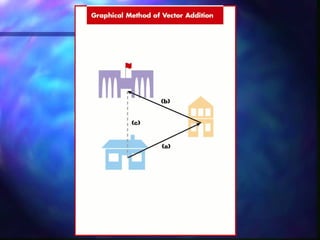
Graphical  vector addition Vectors always are a line with an arrowhead at tip. The length show’s magnitude. The direction of arrow shows vector’s direction. Displacement is always a straight-line pathway. Two vectors having the same direction are parallel. Vectors are always placed head-to-tail.
 
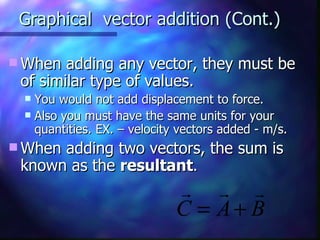
Graphical  vector addition (Cont.) When adding any vector, they must be of similar type of values.  You would not add displacement to force. Also you must have the same units for your quantities. EX. – velocity vectors added - m/s. When adding two vectors, the sum is known as the  resultant .
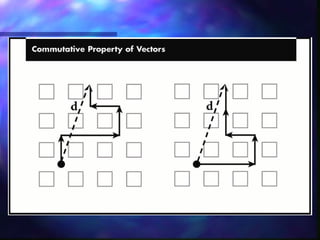
Properties of vectors In diagrams, vectors may be moved parallel.  See fig. 3-4 Triangle method of addition The must use a ruler and protractor, but math saves the day, and shortens the time needed for calculating. Vectors can be added in any order. See fig. 3-4 Multiplying or dividing vectors by scalars results in a vector.
 
2-1: Summary A scalar is a quantity specified only by numbers and appropriate units. A vector is a quantity that has magnitude and direction. Vectors can be added graphically using the triangle method of addition. Tail of one vector is placed at the head of another. The resultant is the vector drawn from the tail of the first vector to the head of the last.

2-1 Intro To Vectors

  • 1.
    Warm-up ( OwnPaper ) Which physical quantities have size and direction: distance or displacement? speed or velocity? Displacement and velocity have both size and direction. Only size matters for distance and speed. The direction plays no part.
  • 2.
    2-1: Intro toVectors Distinguish between a scalar and a vector. Add and subtract vectors using the graphical method. Multiply and divide vectors by scalar.
  • 3.
    Scalar and vectorScalar A quantity that is specified by magnitude with appropriate units. Has magnitude but no direction. Ex. – Speed, volume, time, temperature, mass Vector A quantity that is specified by both magnitude and direction . Ex. – Velocity, force, acceleration
  • 4.
    Vectors The textbooknotes vectors using boldface . On homework, note the vector using an arrow. Vectors are easily tracked using graphical representations. The length of the vector is related to the magnitude.
  • 5.
    Graphical vectoraddition Vectors always are a line with an arrowhead at tip. The length show’s magnitude. The direction of arrow shows vector’s direction. Displacement is always a straight-line pathway. Two vectors having the same direction are parallel. Vectors are always placed head-to-tail.
  • 6.
  • 7.
    Graphical vectoraddition (Cont.) When adding any vector, they must be of similar type of values. You would not add displacement to force. Also you must have the same units for your quantities. EX. – velocity vectors added - m/s. When adding two vectors, the sum is known as the resultant .
  • 8.
    Properties of vectorsIn diagrams, vectors may be moved parallel. See fig. 3-4 Triangle method of addition The must use a ruler and protractor, but math saves the day, and shortens the time needed for calculating. Vectors can be added in any order. See fig. 3-4 Multiplying or dividing vectors by scalars results in a vector.
  • 9.
  • 10.
    2-1: Summary Ascalar is a quantity specified only by numbers and appropriate units. A vector is a quantity that has magnitude and direction. Vectors can be added graphically using the triangle method of addition. Tail of one vector is placed at the head of another. The resultant is the vector drawn from the tail of the first vector to the head of the last.