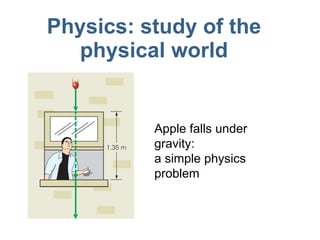
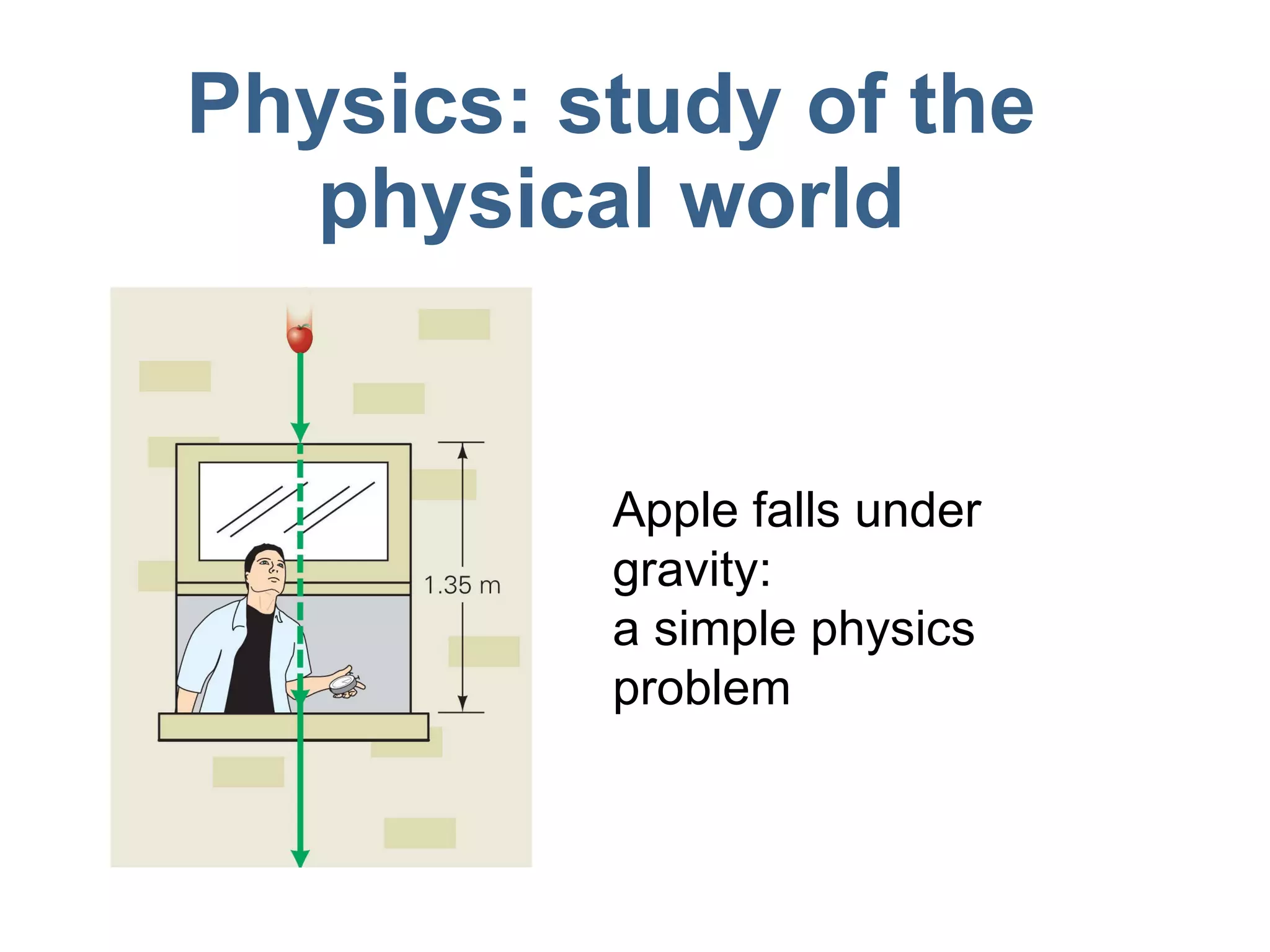
Physics: study of the physical world Apple falls under gravity:  a simple physics problem
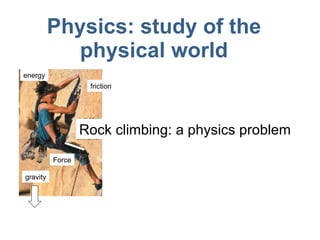
Physics: study of the physical world Rock climbing: a physics problem gravity friction energy Force
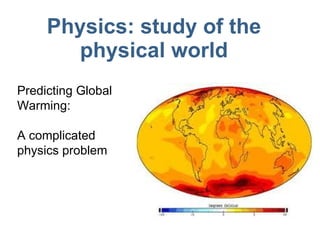
Physics: study of the physical world Predicting Global Warming: A complicated physics problem
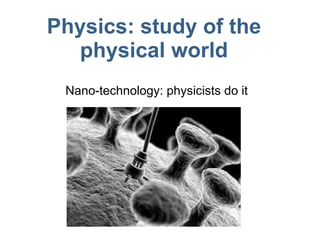
Physics: study of the physical world Nano-technology: physicists do it
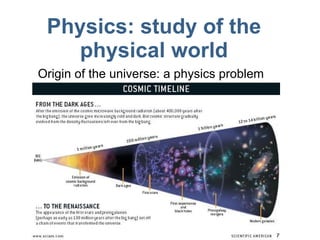
Physics: study of the physical world Origin of the universe: a physics problem
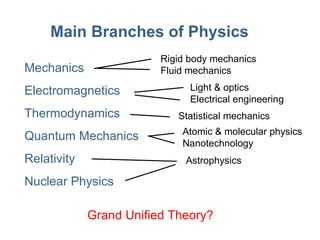
Main Branches of Physics Mechanics Electromagnetics Thermodynamics Quantum Mechanics Relativity Nuclear Physics Grand Unified Theory? Rigid body mechanics Fluid mechanics Light & optics Electrical engineering Atomic & molecular physics Nanotechnology Astrophysics Statistical mechanics
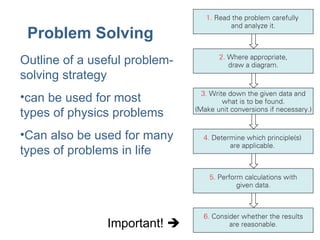
Problem Solving Outline of a useful problem-solving strategy  can be used for most types of physics problems Can also be used for many types of problems in life Important!  
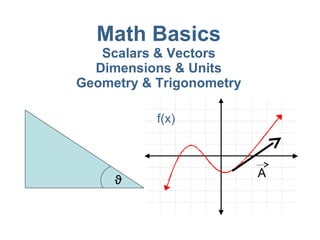
Math Basics Scalars & Vectors Dimensions & Units Geometry & Trigonometry f(x) A ϑ
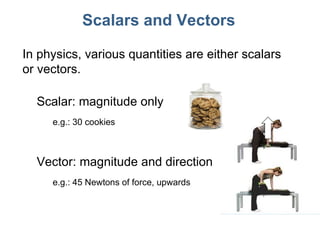
Scalars and Vectors Scalar: magnitude only e.g.: 30 cookies Vector: magnitude and direction e.g.: 45 Newtons of force, upwards In physics, various quantities are either scalars or vectors.
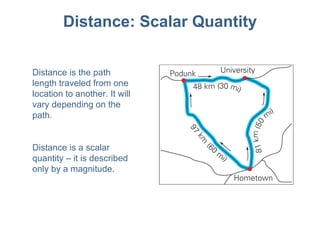
Distance: Scalar Quantity Distance is the path length traveled from one location to another. It will vary depending on the path. Distance is a scalar quantity – it is described only by a magnitude.
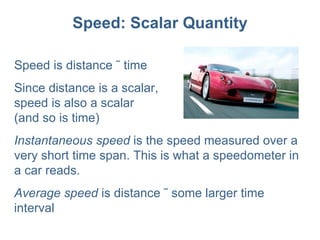
Speed: Scalar Quantity Speed is distance ÷ time Since distance is a scalar,  speed is also a scalar  (and so is time) Instantaneous speed  is the speed measured over a very short time span. This is what a speedometer in a car reads. Average speed  is distance ÷ some larger time interval
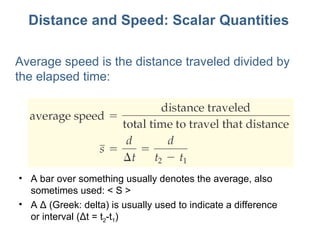
Distance and Speed: Scalar Quantities Average speed is the distance traveled divided by the elapsed time: A bar over something usually denotes the average, also sometimes used: < S > A Δ (Greek: delta) is usually used to indicate a difference or interval (Δt = t 2 -t 1 )
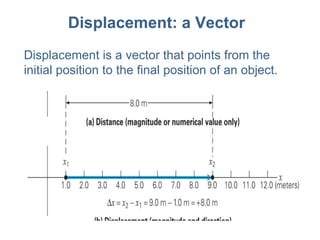
Displacement: a Vector  Displacement is a vector that points from the initial position to the final position of an object.
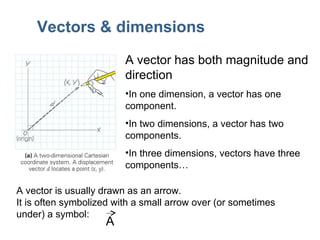
Vectors & dimensions A vector has both magnitude and direction In one dimension, a vector has one component.  In two dimensions, a vector has two components.  In three dimensions, vectors have three components… A vector is usually drawn as an arrow. It is often symbolized with a small arrow over (or sometimes under) a symbol: A
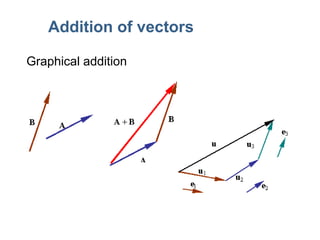
Addition of vectors Graphical addition
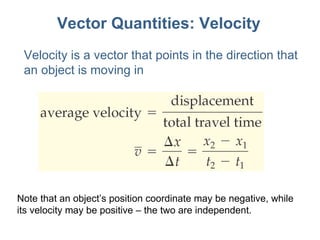
Vector Quantities: Velocity Note that an object ’s position coordinate may be negative, while its velocity may be positive – the two are independent. Velocity is a vector that points in the direction that an object is moving in
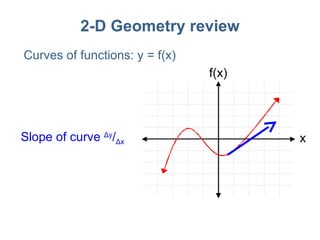
2-D Geometry review Curves of functions: y = f(x) f(x) x Slope of curve  Δy / Δx
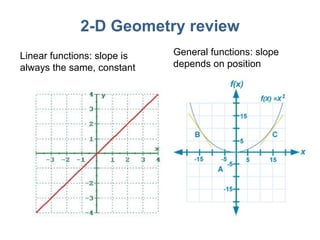
2-D Geometry review Linear functions: slope is always the same, constant General functions: slope depends on position
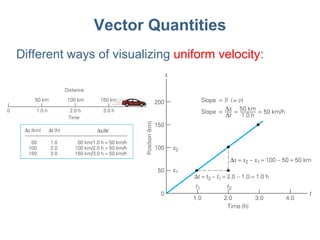
Vector Quantities Different ways of visualizing  uniform velocity :
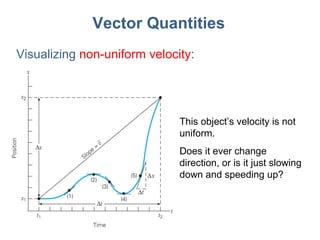
Vector Quantities This object ’s velocity is not uniform.  Does it ever change direction, or is it just slowing down and speeding up? Visualizing  non-uniform velocity :
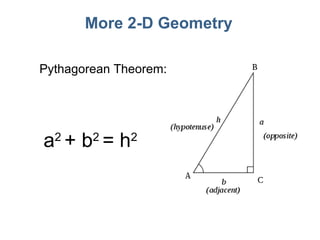
More 2-D Geometry Pythagorean Theorem: a 2  + b 2  = h 2
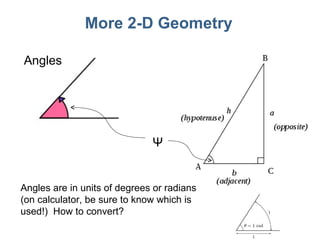
More 2-D Geometry Angles are in units of degrees or radians (on calculator, be sure to know which is used!)  How to convert? Ψ Angles
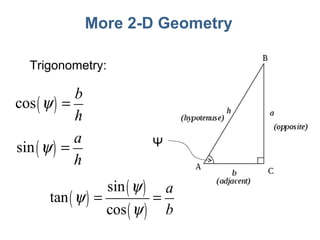
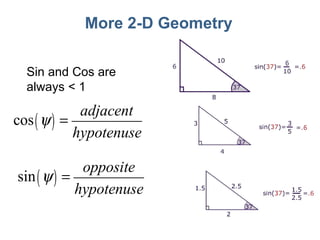
More 2-D Geometry Ψ Trigonometry:
More 2-D Geometry Sin and Cos are always < 1
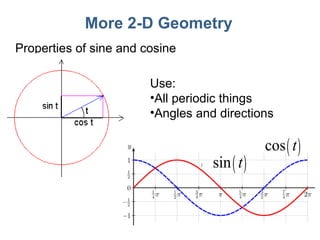
More 2-D Geometry Properties of sine and cosine Use: All periodic things Angles and directions
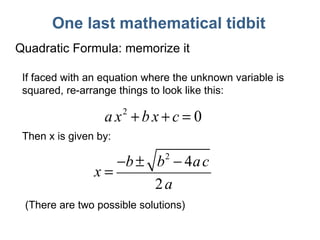
One last mathematical tidbit Quadratic Formula: memorize it If faced with an equation where the unknown variable is squared, re-arrange things to look like this: Then x is given by: (There are two possible solutions)
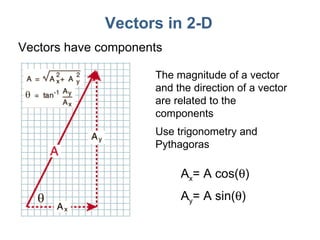
Vectors in 2-D Vectors have components The magnitude of a vector and the direction of a vector are related to the components  Use trigonometry and Pythagoras  A x = A cos(  ) A y = A sin(  )
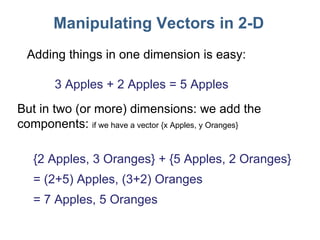
Manipulating Vectors in 2-D Adding things in one dimension is easy: 3 Apples + 2 Apples = 5 Apples But in two (or more) dimensions: we add the components:  if we have a vector {x Apples, y Oranges} {2 Apples, 3 Oranges} + {5 Apples, 2 Oranges} = (2+5) Apples, (3+2) Oranges  = 7 Apples, 5 Oranges
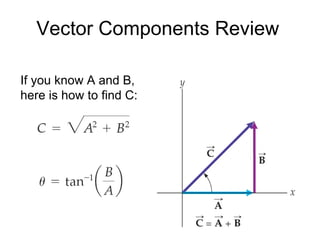
Vector Components Review If you know A and B, here is how to find C:
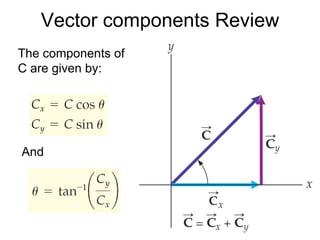
Vector components Review The components of C are given by: And
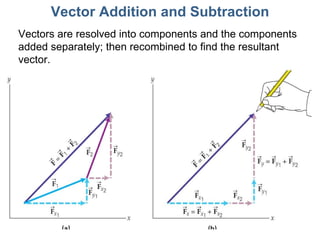
Vector Addition and Subtraction Vectors are resolved into components and the components added separately; then recombined to find the resultant vector.
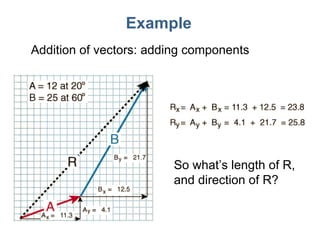
Example Addition of vectors: adding components So what’s length of R, and direction of R?
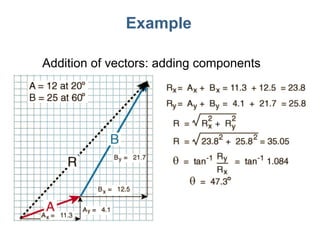
Example Addition of vectors: adding components

Lecture12 physicsintro

  • 1.
    Physics: study ofthe physical world Apple falls under gravity: a simple physics problem
  • 2.
    Physics: study ofthe physical world Rock climbing: a physics problem gravity friction energy Force
  • 3.
    Physics: study ofthe physical world Predicting Global Warming: A complicated physics problem
  • 4.
    Physics: study ofthe physical world Nano-technology: physicists do it
  • 5.
    Physics: study ofthe physical world Origin of the universe: a physics problem
  • 6.
    Main Branches ofPhysics Mechanics Electromagnetics Thermodynamics Quantum Mechanics Relativity Nuclear Physics Grand Unified Theory? Rigid body mechanics Fluid mechanics Light & optics Electrical engineering Atomic & molecular physics Nanotechnology Astrophysics Statistical mechanics
  • 7.
    Problem Solving Outlineof a useful problem-solving strategy can be used for most types of physics problems Can also be used for many types of problems in life Important! 
  • 8.
    Math Basics Scalars& Vectors Dimensions & Units Geometry & Trigonometry f(x) A ϑ
  • 9.
    Scalars and VectorsScalar: magnitude only e.g.: 30 cookies Vector: magnitude and direction e.g.: 45 Newtons of force, upwards In physics, various quantities are either scalars or vectors.
  • 10.
    Distance: Scalar QuantityDistance is the path length traveled from one location to another. It will vary depending on the path. Distance is a scalar quantity – it is described only by a magnitude.
  • 11.
    Speed: Scalar QuantitySpeed is distance ÷ time Since distance is a scalar, speed is also a scalar (and so is time) Instantaneous speed is the speed measured over a very short time span. This is what a speedometer in a car reads. Average speed is distance ÷ some larger time interval
  • 12.
    Distance and Speed:Scalar Quantities Average speed is the distance traveled divided by the elapsed time: A bar over something usually denotes the average, also sometimes used: < S > A Δ (Greek: delta) is usually used to indicate a difference or interval (Δt = t 2 -t 1 )
  • 13.
    Displacement: a Vector Displacement is a vector that points from the initial position to the final position of an object.
  • 14.
    Vectors & dimensionsA vector has both magnitude and direction In one dimension, a vector has one component. In two dimensions, a vector has two components. In three dimensions, vectors have three components… A vector is usually drawn as an arrow. It is often symbolized with a small arrow over (or sometimes under) a symbol: A
  • 15.
    Addition of vectorsGraphical addition
  • 16.
    Vector Quantities: VelocityNote that an object ’s position coordinate may be negative, while its velocity may be positive – the two are independent. Velocity is a vector that points in the direction that an object is moving in
  • 17.
    2-D Geometry reviewCurves of functions: y = f(x) f(x) x Slope of curve Δy / Δx
  • 18.
    2-D Geometry reviewLinear functions: slope is always the same, constant General functions: slope depends on position
  • 19.
    Vector Quantities Differentways of visualizing uniform velocity :
  • 20.
    Vector Quantities Thisobject ’s velocity is not uniform. Does it ever change direction, or is it just slowing down and speeding up? Visualizing non-uniform velocity :
  • 21.
    More 2-D GeometryPythagorean Theorem: a 2 + b 2 = h 2
  • 22.
    More 2-D GeometryAngles are in units of degrees or radians (on calculator, be sure to know which is used!) How to convert? Ψ Angles
  • 23.
    More 2-D GeometryΨ Trigonometry:
  • 24.
    More 2-D GeometrySin and Cos are always < 1
  • 25.
    More 2-D GeometryProperties of sine and cosine Use: All periodic things Angles and directions
  • 26.
    One last mathematicaltidbit Quadratic Formula: memorize it If faced with an equation where the unknown variable is squared, re-arrange things to look like this: Then x is given by: (There are two possible solutions)
  • 27.
    Vectors in 2-DVectors have components The magnitude of a vector and the direction of a vector are related to the components Use trigonometry and Pythagoras A x = A cos(  ) A y = A sin(  )
  • 28.
    Manipulating Vectors in2-D Adding things in one dimension is easy: 3 Apples + 2 Apples = 5 Apples But in two (or more) dimensions: we add the components: if we have a vector {x Apples, y Oranges} {2 Apples, 3 Oranges} + {5 Apples, 2 Oranges} = (2+5) Apples, (3+2) Oranges = 7 Apples, 5 Oranges
  • 29.
    Vector Components ReviewIf you know A and B, here is how to find C:
  • 30.
    Vector components ReviewThe components of C are given by: And
  • 31.
    Vector Addition andSubtraction Vectors are resolved into components and the components added separately; then recombined to find the resultant vector.
  • 32.
    Example Addition ofvectors: adding components So what’s length of R, and direction of R?
  • 33.
    Example Addition ofvectors: adding components