
1. Physical unit
2.Direction
3.Graphical representation
4.Representation
5.Representation of vector
A scalar is a quantity that has only
magnitude (size).
Scalar only tells how much
Examples
mass(60 kg)
speed (20 𝑚𝑠−1
)
power (1200W)
 A vector is a quantity that has both magnitude and
direction.
 A vector should tell you how much and which way.
Examples
force(60N, upwards)
displacement (40 m, west)
weight (340N, downwards)
 For example, if you travel 1 km down Main
Road to school, the quantity 1 km down Main
Road is a vector. The 1 km is the quantity (or
scalar) and the down Main Road gives a
direction.
 Everything measured is represented by an
appropriate symbol
We make use of the SI system
K H D M D M
 There are many acceptable methods of writing
vectors.
 a vector has to have a magnitude and a
direction.
 These different methods come from the
different methods of expressing a direction for a
vector.
Such as :
Compass Directions
Bearing
Relative Directions
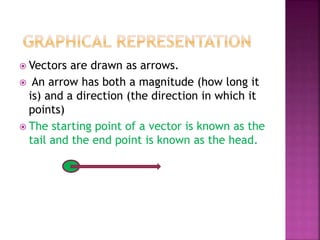
 Vectors are drawn as arrows.
 An arrow has both a magnitude (how long it
is) and a direction (the direction in which it
points)
 The starting point of a vector is known as the
tail and the end point is known as the head.
 Drawing vectors
 In order to draw a vector accurately we must
specify a scale and include a reference
direction in the diagram
Method: Drawing Vectors
1. Decide upon a scale and write it down.
2. Determine the length of the arrow representing
the vector, by using the scale.
3. Draw the vector as an arrow. Make sure that
you fill in the arrow head.
4. Fill in the magnitude of the vector.
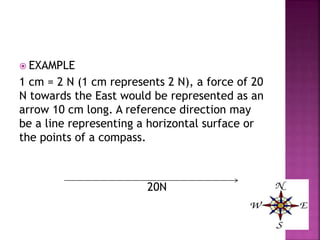
 EXAMPLE
1 cm = 2 N (1 cm represents 2 N), a force of 20
N towards the East would be represented as an
arrow 10 cm long. A reference direction may
be a line representing a horizontal surface or
the points of a compass.
20N
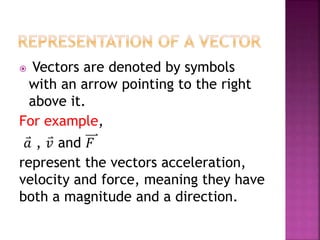
 Vectors are denoted by symbols
with an arrow pointing to the right
above it.
For example,
𝑎 , 𝑣 and 𝐹
represent the vectors acceleration,
velocity and force, meaning they have
both a magnitude and a direction.
Is a single vector that has the
same effect as a combination of
vectors
Or
The resultant of a number of
vectors is the single vector whose
effect is the same as the
individual vectors acting together.
 When vectors are added, we need to add
both a magnitude and a direction
EXAMPLE, take 2 steps in the forward
direction, stop and then take another 3 steps
in the forward direction.
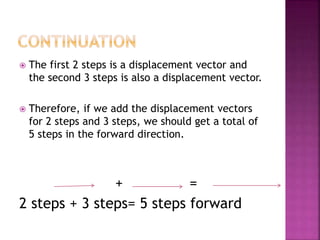
 The first 2 steps is a displacement vector and
the second 3 steps is also a displacement vector.
 Therefore, if we add the displacement vectors
for 2 steps and 3 steps, we should get a total of
5 steps in the forward direction.
+ =
2 steps + 3 steps= 5 steps forward
Scalars and vectors

Scalars and vectors

  • 1.
    1. Physical unit 2.Direction 3.Graphicalrepresentation 4.Representation 5.Representation of vector
  • 2.
    A scalar isa quantity that has only magnitude (size). Scalar only tells how much Examples mass(60 kg) speed (20 𝑚𝑠−1 ) power (1200W)
  • 3.
     A vectoris a quantity that has both magnitude and direction.  A vector should tell you how much and which way. Examples force(60N, upwards) displacement (40 m, west) weight (340N, downwards)
  • 4.
     For example,if you travel 1 km down Main Road to school, the quantity 1 km down Main Road is a vector. The 1 km is the quantity (or scalar) and the down Main Road gives a direction.
  • 5.
     Everything measuredis represented by an appropriate symbol We make use of the SI system K H D M D M
  • 6.
     There aremany acceptable methods of writing vectors.  a vector has to have a magnitude and a direction.  These different methods come from the different methods of expressing a direction for a vector. Such as : Compass Directions Bearing Relative Directions
  • 7.
     Vectors aredrawn as arrows.  An arrow has both a magnitude (how long it is) and a direction (the direction in which it points)  The starting point of a vector is known as the tail and the end point is known as the head.
  • 8.
     Drawing vectors In order to draw a vector accurately we must specify a scale and include a reference direction in the diagram Method: Drawing Vectors 1. Decide upon a scale and write it down. 2. Determine the length of the arrow representing the vector, by using the scale. 3. Draw the vector as an arrow. Make sure that you fill in the arrow head. 4. Fill in the magnitude of the vector.
  • 9.
     EXAMPLE 1 cm= 2 N (1 cm represents 2 N), a force of 20 N towards the East would be represented as an arrow 10 cm long. A reference direction may be a line representing a horizontal surface or the points of a compass. 20N
  • 10.
     Vectors aredenoted by symbols with an arrow pointing to the right above it. For example, 𝑎 , 𝑣 and 𝐹 represent the vectors acceleration, velocity and force, meaning they have both a magnitude and a direction.
  • 11.
    Is a singlevector that has the same effect as a combination of vectors Or The resultant of a number of vectors is the single vector whose effect is the same as the individual vectors acting together.
  • 12.
     When vectorsare added, we need to add both a magnitude and a direction EXAMPLE, take 2 steps in the forward direction, stop and then take another 3 steps in the forward direction.
  • 13.
     The first2 steps is a displacement vector and the second 3 steps is also a displacement vector.  Therefore, if we add the displacement vectors for 2 steps and 3 steps, we should get a total of 5 steps in the forward direction. + = 2 steps + 3 steps= 5 steps forward